Lead Qualification Criteria: 7 Signals That Predict a Real Buyer
Most teams qualify leads on job title and company size, then wonder why their pipeline stalls. These 7 lead qualification criteria, plus a points model, help you separate buyers from browsers before your reps waste a call.
TL;DR
- Lead qualification criteria are the specific, checkable conditions a lead has to meet before it earns time from a sales rep. They should be written down, measurable, and agreed on by both marketing and sales.
- Frameworks like BANT and MEDDIC are good starting points, but none of them works out of the box. Use one as a skeleton and add your own ICP and intent signals.
- The seven criteria that best predict a closed deal are ICP fit, a real pain, a reachable decision-maker, timing, budget reality, buying-process clarity, and engagement depth.
- Turn those criteria into a points model with a clear handoff threshold, and adjust it every quarter against deals you actually won and lost.
- Bad contact data quietly breaks qualification. If you can't reach the decision-maker on a verified channel, the lead isn't qualified yet.
What are lead qualification criteria?#
Lead qualification criteria are the rules your team uses to decide whether a lead is worth pursuing, and how hard. They turn "this feels like a good lead" into something you can check: the company has 50 to 500 employees, runs Salesforce, and the contact is a VP of Sales who asked for a demo.
You need criteria because your reps have limited time and your inbound and outbound volume doesn't. Without written rules, qualification turns into instinct, and instinct varies between reps, moods, and the last quarter's numbers. One SDR books a meeting with an intern at a 10-person agency. Another turns down a director at a target account because she "didn't sound urgent." Neither choice can be defended, because nobody wrote down what "qualified" means.
Good criteria do three jobs:
- Prioritize. They tell reps which leads to call first.
- Disqualify. They give reps permission to drop leads that will never close.
- Align. They give marketing and sales a shared definition, so handoffs stop turning into arguments about lead quality.
If your team still argues about what counts as a marketing qualified lead, your criteria aren't written down clearly enough yet.
Why do most lead qualification criteria fail?#
Most criteria fail because they measure who the lead is and ignore whether the lead is trying to buy. Job title, company size, and industry are easy to capture, so they end up as the whole model. But a perfectly matched VP who has no problem you solve is just a well-dressed dead end.
Three failure patterns come up again and again:
- Firmographics only. The lead fits your ICP on paper but shows no pain, no project, and no timeline. These leads fill your pipeline and then sit at "follow up next quarter" for a year.
- Activity mistaken for intent. Opening three newsletters is not buying behavior. Scoring every click the same way inflates scores for people who simply like your content.
- Criteria nobody revisits. The model gets built once, during a RevOps project, and stays frozen while your market, pricing, and ICP move on.
There's also a data problem underneath all three. If half the emails in your CRM bounce and a third of the job titles are two years old, even perfect criteria will score the wrong people. More on that below.
Which qualification framework should your criteria start from?#
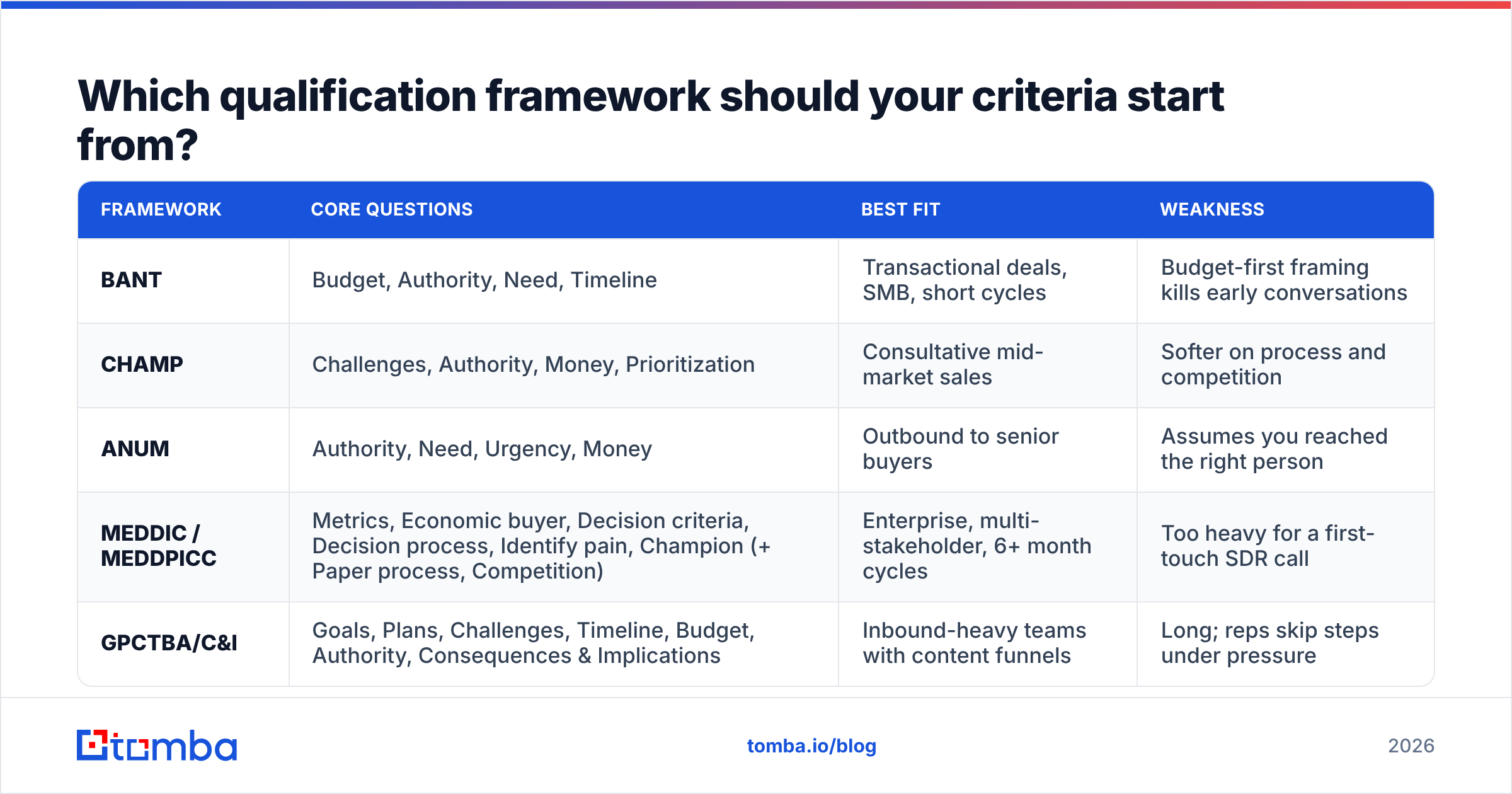
Choose one framework as your skeleton, based on deal size and sales-cycle complexity, and then customize it. Here's how the common ones compare.
| Framework | Core questions | Best fit | Weakness |
|---|---|---|---|
| BANT | Budget, Authority, Need, Timeline | Transactional deals, SMB, short cycles | Budget-first framing kills early conversations |
| CHAMP | Challenges, Authority, Money, Prioritization | Consultative mid-market sales | Softer on process and competition |
| ANUM | Authority, Need, Urgency, Money | Outbound to senior buyers | Assumes you reached the right person |
| MEDDIC / MEDDPICC | Metrics, Economic buyer, Decision criteria, Decision process, Identify pain, Champion (+ Paper process, Competition) | Enterprise, multi-stakeholder, 6+ month cycles | Too heavy for a first-touch SDR call |
| GPCTBA/C&I | Goals, Plans, Challenges, Timeline, Budget, Authority, Consequences & Implications | Inbound-heavy teams with content funnels | Long; reps skip steps under pressure |
HubSpot's sales team popularized GPCTBA/C&I, and its sales resources are worth reading if you run a mostly inbound motion. MEDDIC came out of enterprise software sales and remains the standard for complex deals.
The honest verdict: BANT is fine for triage and weak for real qualification. Asking about budget in the first call makes you sound like a vendor filling out a form. Most modern teams lead with need and pain (the CHAMP order) and confirm budget later.

What are the 7 lead qualification criteria that actually predict deals?#
These seven criteria cover fit, intent, and access. Score each one on its own, because a lead that's strong on one and missing another needs a different next step than a lead that's weak everywhere.
ICP fit. Does the company match your ideal customer profile on industry, headcount, revenue band, geography, and tech stack? This is the easiest criterion to automate and the weakest on its own. Treat it as a gate, not a score driver. A company outside your ICP should rarely reach a rep, however engaged the contact is.
A real, named pain. Can the lead describe a specific problem your product solves, in their own words? "We're growing" is not a pain. "Our SDRs spend two hours a day hunting for emails and our bounce rate is 9%" is one. If there's no pain, there's no deal. Everything else is noise.
A reachable decision-maker. Have you identified the economic buyer, and can you actually reach them? A champion who can't sign is useful. A champion who can't even name who signs is a warning sign. Access matters as much as authority: a VP with no verified email or direct phone is an idea, not a contact.
Timing and trigger events. Is something happening that forces a decision? New funding, a new VP of Sales, a hiring spree for SDRs, a contract renewal with a competitor, or a failed tool migration all compress the timeline. Leads with a dated trigger close faster than leads who "want to explore options."
Budget reality. Not "do you have budget?" but "does money move for problems like this in your company, and who moves it?" A lead can have no allocated budget today and still be highly qualified if the pain is expensive and the economic buyer is engaged.
Buying-process clarity. Do you know the steps between "yes" and a signed contract: security review, procurement, legal, pilot? The more of the process the lead can describe, the more serious they are. Leads who can't describe any process usually haven't started one.
Engagement depth. What has the lead actually done? Weight high-intent actions (pricing page visits, demo requests, replying to outbound with questions, bringing a colleague to a call) far above low-intent ones (newsletter opens, a single blog visit). Depth beats volume.
A quick test for your current model: pull your last 20 closed-won deals and check how many scored well on criteria 2, 3, and 4 at first touch. If your model gave them points mostly for title and headcount, it's measuring the wrong things.
How do you turn lead qualification criteria into a lead score?#
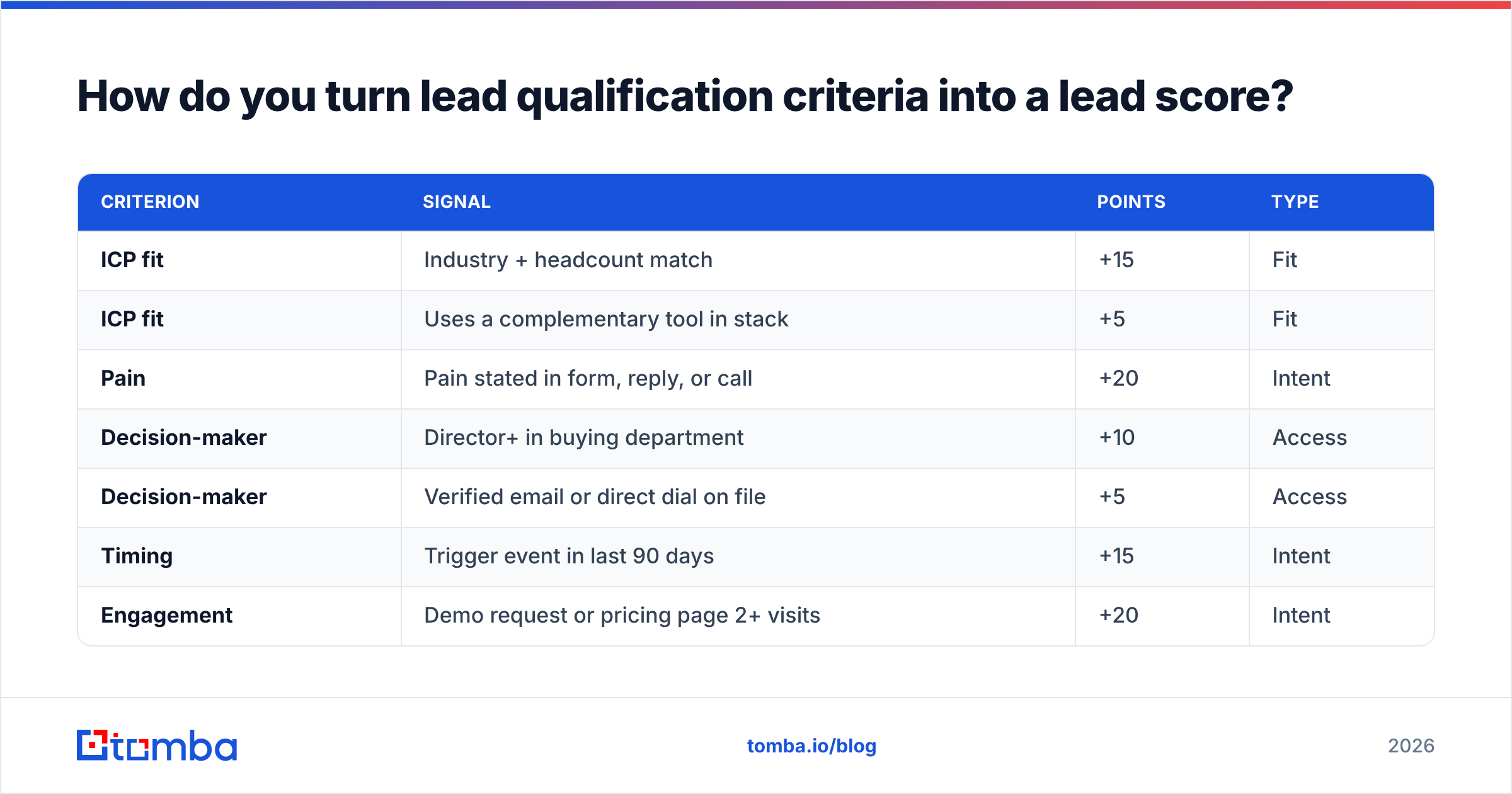
Give each criterion points, set a threshold for handoff to sales, and add negative scores for disqualifiers. Below is a starting model you can copy into your CRM and then calibrate.
| Criterion | Signal | Points | Type |
|---|---|---|---|
| ICP fit | Industry + headcount match | +15 | Fit |
| ICP fit | Uses a complementary tool in stack | +5 | Fit |
| Pain | Pain stated in form, reply, or call | +20 | Intent |
| Decision-maker | Director+ in buying department | +10 | Access |
| Decision-maker | Verified email or direct dial on file | +5 | Access |
| Timing | Trigger event in last 90 days | +15 | Intent |
| Engagement | Demo request or pricing page 2+ visits | +20 | Intent |
| Engagement | Newsletter open | +1 | Intent |
| Disqualifier | Student, competitor, or personal email domain | -50 | Negative |
| Disqualifier | Email bounced / invalid | -25 | Negative |
| Decay | No activity in 30 days | -10 | Negative |
A few calibration rules:
- Set the sales-ready threshold where your historical win rate jumps. If leads scoring 60+ historically close at three times the rate of leads scoring 40 to 59, 60 is your line.
- Make fit a gate, not a bonus. A lead with zero fit points shouldn't reach a rep, even with a 40-point engagement score.
- Decay scores. Intent from six months ago isn't intent today.
- Keep it under 15 rules. Complex models become impossible to debug, and reps stop trusting scores they can't explain.
Most CRMs support this natively. Salesforce and HubSpot both offer rule-based and predictive scoring. Start with rules. Predictive models need a few hundred closed deals before they beat a well-built rule set.
What data do you need before you can qualify a lead?#
You need accurate firmographics, a current role and title, and a contact channel that actually reaches the person. Qualification criteria are only as good as the fields they read. If the data is wrong, the score is wrong, however smart the logic is.
The minimum data layer for the seven criteria above:
- Company attributes (industry, headcount, location, tech stack) for ICP fit. Fill these automatically with data enrichment instead of asking prospects to type them into a long form. Every extra form field lowers conversion.
- Current title and department for decision-maker scoring. Job-change rates in B2B are high enough that a title captured last year is a guess.
- A verified email so the "reachable" criterion means something. Run new and aging records through an email verifier before scoring, and treat invalid addresses as a disqualifier until fixed.
- A direct phone number for high-score leads your reps will call. A phone finder closes the gap when the form only captured email.
- Engagement and intent events from your website, email platform, and product (for PLG motions).
The practical order: enrich first, verify second, score third. Scoring raw, unverified records is how a team ends up with 400 "hot" leads and a 12% connect rate.
How are MQL, SAL, and SQL criteria different?#
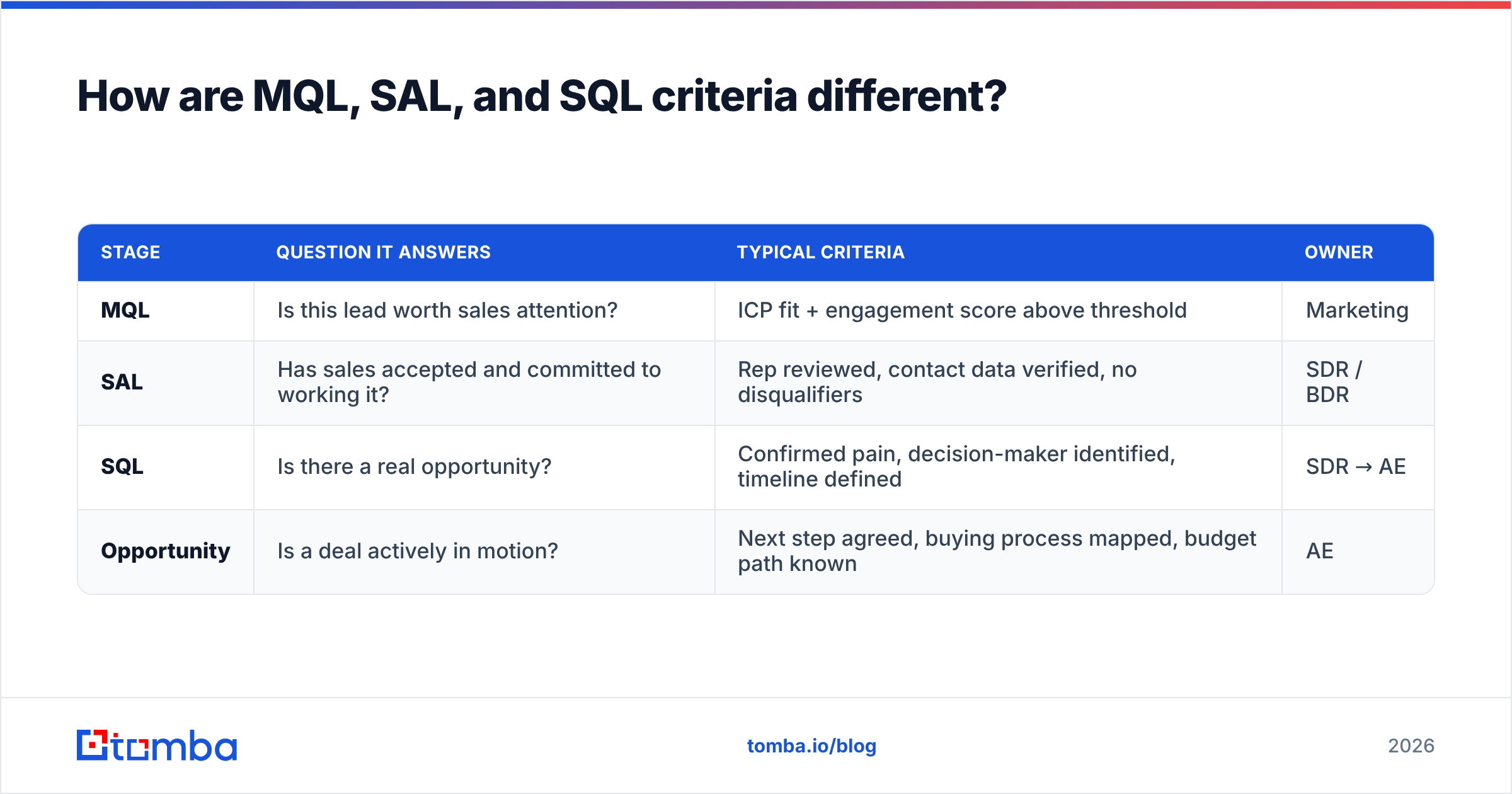
Each stage answers a different question, so each needs its own criteria. Mixing them up causes most sales-and-marketing friction.
| Stage | Question it answers | Typical criteria | Owner |
|---|---|---|---|
| MQL | Is this lead worth sales attention? | ICP fit + engagement score above threshold | Marketing |
| SAL | Has sales accepted and committed to working it? | Rep reviewed, contact data verified, no disqualifiers | SDR / BDR |
| SQL | Is there a real opportunity? | Confirmed pain, decision-maker identified, timeline defined | SDR → AE |
| Opportunity | Is a deal actively in motion? | Next step agreed, buying process mapped, budget path known | AE |
The SAL stage is the one teams most often skip, and skipping it is expensive. Without it, MQLs go into a rep's queue with no acknowledgment step, and nobody can tell whether a lead went cold because it was bad or because nobody called. Add an SLA: SALs get a first touch within a set number of hours, or they return to marketing with a reason code.
Write the criteria for each stage into a single shared doc and link it from your CRM. If an AE can reject an SQL, the rejection reason should map to one of the written criteria, not to "felt off."
What mistakes break a lead qualification process?#
Most breakdowns come from process drift, not bad framework choices. Watch for these:
- Qualifying too early. Running a full MEDDIC checklist on a cold first reply turns discovery into an interrogation. Use light criteria at the top of the funnel and add depth as the lead moves forward.
- Letting quota pressure lower the bar. At the end of a quarter, "qualified" quietly expands. Track SQL-to-opportunity conversion by week. A sudden drop in the last two weeks of a quarter means the criteria bent.
- No disqualification path. If reps can't formally mark a lead "not a fit, reason X," bad leads stay in nurture forever and skew your reporting.
- Ignoring rejection reasons. Your closed-lost and rejected-lead reasons are the best data you have for refining criteria. If nobody reads them, the model never improves.
- Scoring people you can't reach. A lead with bounced email and no phone number shouldn't score as sales-ready, however strong its intent signals are. Fix the contact data or hold the lead back.
- One model for every segment. An SMB self-serve lead and a Fortune 500 enterprise lead need different thresholds and different weightings. Split your models by segment once you have enough volume.
How often should you update your lead qualification criteria?#
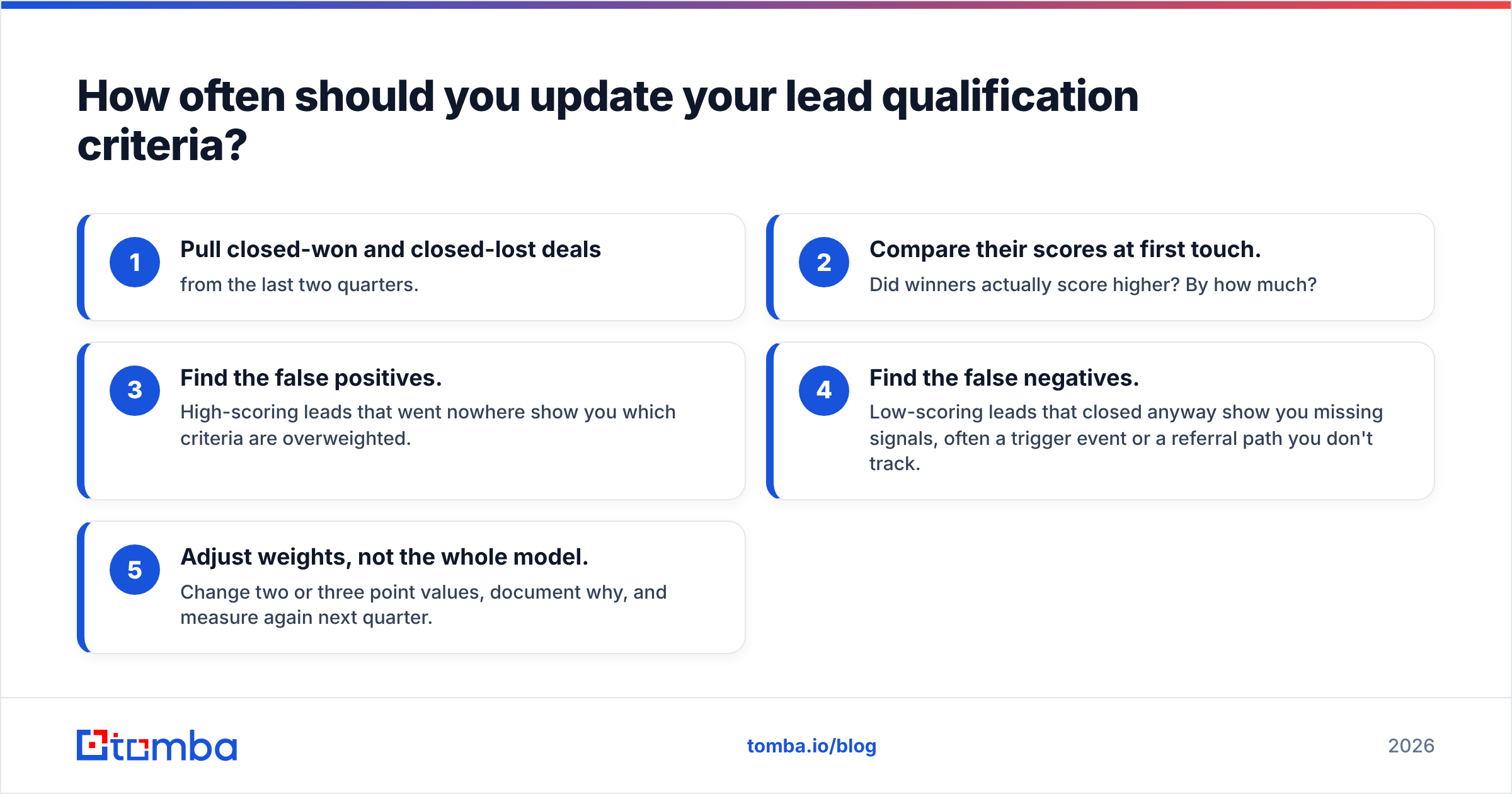
Review your criteria every quarter, and rebuild them whenever your ICP, pricing, or product changes significantly. The quarterly review should take about an hour if your CRM data is clean:
- Pull closed-won and closed-lost deals from the last two quarters.
- Compare their scores at first touch. Did winners actually score higher? By how much?
- Find the false positives. High-scoring leads that went nowhere show you which criteria are overweighted.
- Find the false negatives. Low-scoring leads that closed anyway show you missing signals, often a trigger event or a referral path you don't track.
- Adjust weights, not the whole model. Change two or three point values, document why, and measure again next quarter.
Analyst firms like Gartner have been making the same point for years: B2B buying groups keep getting larger and buyers do more of their research before they ever talk to sales. For your criteria, that means signals like multiple contacts from the same account engaging, or anonymous research activity, carry more weight than they used to. Consider adding an account-level score next to the lead-level score once you sell into buying committees.
FAQ#
What is the difference between lead qualification and lead scoring?#
Lead qualification is the decision about whether a lead is worth pursuing, based on criteria like fit, pain, and authority. Lead scoring is one way to automate that decision by giving points to those criteria. Scoring handles volume; human qualification on a discovery call confirms what the score suggests.
How many lead qualification criteria should you use?#
Between five and eight core criteria is the practical range. Fewer than five usually means you only check fit. More than eight makes the model hard to explain and hard for reps to apply consistently.
Is BANT still relevant in 2026?#
BANT is still useful as a quick triage checklist, especially for short-cycle SMB sales. As a full qualification method it's dated, mainly because asking about budget early hurts discovery. Most teams now lead with need and timing, and confirm budget and authority later.
Should marketing or sales own qualification criteria?#
Both should own them together, usually with RevOps holding the pen. Marketing owns MQL criteria, sales owns SQL criteria, and both agree on the handoff threshold and the rejection reasons.
Start qualifying leads you can actually reach#
The strongest qualification model fails if the decision-maker it flags has no working email. Before you score your next batch, make sure every high-fit lead has a real, verified way to reach the person who signs. Tomba Email Finder finds professional email addresses by name, company, or domain. You can fill the "reachable decision-maker" criterion in seconds instead of hunting for addresses by hand. Start on the free tier with 25 searches a month, or check Tomba pricing to see which plan matches your lead volume.
Related guides#
// get started
Find, verify and enrich your first contacts today
Start on the free plan with 25 searches a month, then scale when your team is ready.
Free plan · No credit card required · GDPR & CCPA
// about the author