Lead Qualification Matrix: How to Build One That Sales Trusts
Most lead scoring fails quietly: vague criteria, arbitrary weights, and bad contact data. Here's how to build a lead qualification matrix your reps will actually use, with a template you can copy.

TL;DR
- A lead qualification matrix scores every lead on two axes, fit (how closely they match your ICP) and intent (how ready they are to buy), and sends each one to a clear next action.
- The simplest version that works is a 2x2 grid: high fit/high intent goes to sales now, high fit/low intent goes to nurture or outbound, low fit/high intent gets a quick check, and low fit/low intent gets dropped.
- Keep it to 5–8 weighted criteria. Once you pass 15 or so, reps stop trusting the score and go back to gut feel.
- Your matrix is only as good as the data behind it. A missing job title or a bounced email can push a good lead into the wrong box.
- Look at conversion by quadrant every quarter and adjust the weights based on closed-won data, not opinions.
What is a lead qualification matrix?#
A lead qualification matrix is a grid that scores leads against set criteria and places each one in a category that tells your team what to do next. Think of it like triage in a hospital. Not every patient needs the surgeon right away, and sending everyone to the same queue wastes the most expensive people in the building.
Most matrices use two dimensions:
- Fit: Does this company and person match your ideal customer profile? Examples include industry, headcount, revenue, tech stack, geography, and the buyer's seniority and department.
- Intent: Are they showing buying behavior right now? Examples include pricing page visits, demo requests, content downloads, email replies, and third-party intent signals.
Combine the two and you get four quadrants, each with a defined owner and next step. The matrix isn't the score itself. It's the decision rule that turns scores into routing.
This is different from a plain lead score, which collapses everything into one number. According to the general lead scoring model, a single number works well for ranking. It works badly for explaining why a lead ranks where it does. A matrix keeps fit and intent separate, so a VP at a perfect-fit account who hasn't engaged yet doesn't look the same as a student who downloaded six ebooks.
How is a qualification matrix different from BANT, MEDDIC, or CHAMP?#
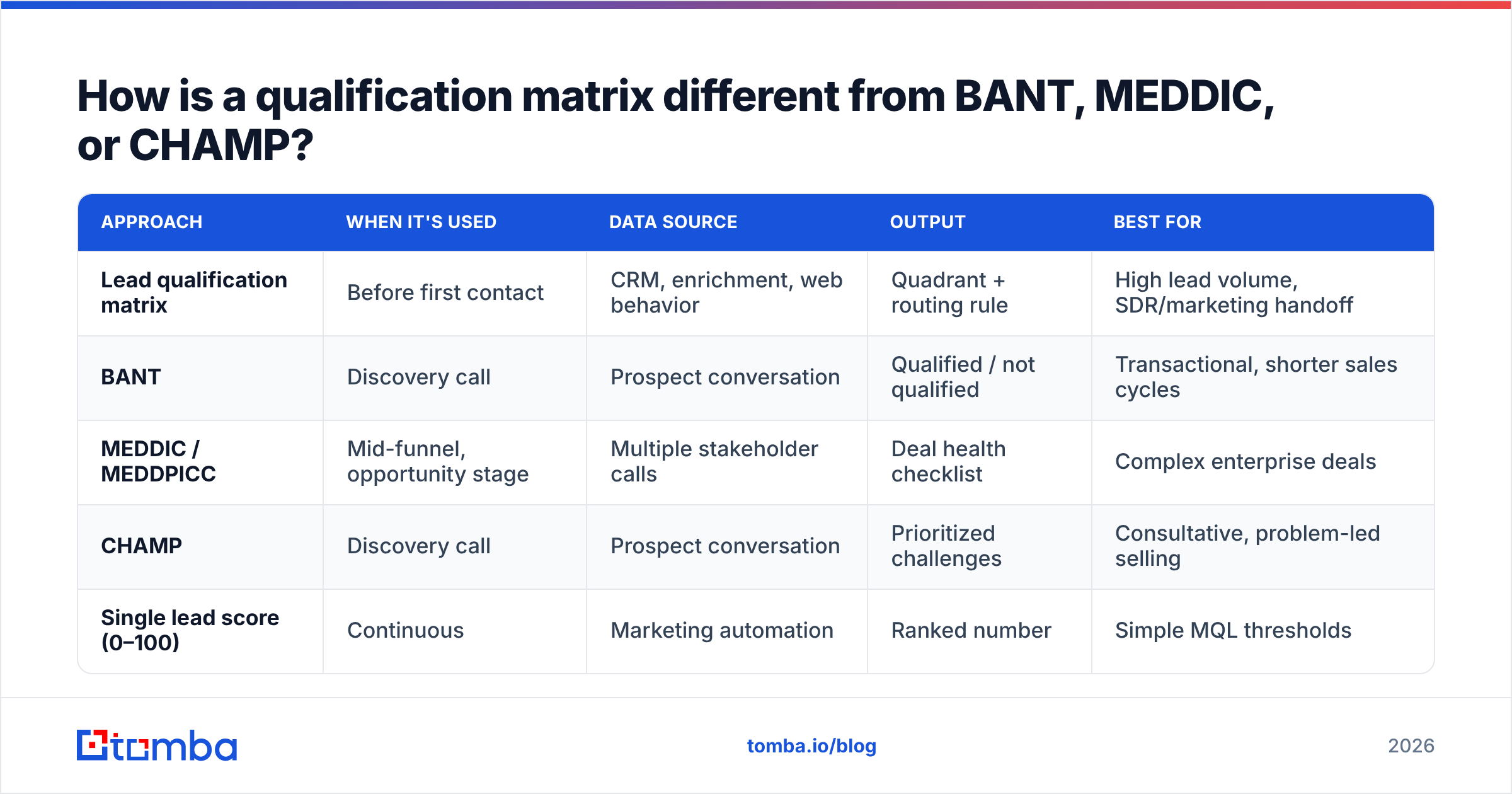
BANT, MEDDIC, and CHAMP are conversation frameworks. They tell a rep what to find out during a discovery call. A qualification matrix is a pre-conversation filter. It decides who gets the call in the first place.
You need both. The matrix works at the top of the funnel with mostly automated data. The frameworks take over once a human is talking to the prospect.
| Approach | When it's used | Data source | Output | Best for |
|---|---|---|---|---|
| Lead qualification matrix | Before first contact | CRM, enrichment, web behavior | Quadrant + routing rule | High lead volume, SDR/marketing handoff |
| BANT | Discovery call | Prospect conversation | Qualified / not qualified | Transactional, shorter sales cycles |
| MEDDIC / MEDDPICC | Mid-funnel, opportunity stage | Multiple stakeholder calls | Deal health checklist | Complex enterprise deals |
| CHAMP | Discovery call | Prospect conversation | Prioritized challenges | Consultative, problem-led selling |
| Single lead score (0–100) | Continuous | Marketing automation | Ranked number | Simple MQL thresholds |

The hot take has some truth in it. BANT still works fine on a call. It's a bad pre-contact filter because nobody fills in "budget" on a web form honestly. Leave budget and timeline to the conversation, and let the matrix handle what you can observe.
What should go into a lead qualification matrix?#
Only include criteria that past deals prove actually predict revenue. Here's a starting set for a typical B2B SaaS company. Adjust it to your own closed-won history.
Fit criteria (who they are):
- Company size: Headcount band that matches your best-retained customers. Too small often means churn. Too large can mean a sales cycle you aren't staffed for.
- Industry / vertical: Verticals where you have case studies, integrations, or compliance coverage.
- Buyer role and seniority: The department and level that actually signs or champions your product.
- Tech stack: Tools that signal compatibility, such as a specific CRM, or a competitor you displace well.
- Geography: Regions you can legally sell to, support, and bill.
Intent criteria (what they're doing):
- High-intent page views: Pricing, integrations, security, comparison pages.
- Direct engagement: Demo request, trial signup, reply to outbound.
- Content depth: Multiple visits over several days beat a single download.
- Third-party signals: Hiring for relevant roles, funding rounds, tech changes.
- Recency: A signal from last week is worth far more than one from last quarter.
Notice that half of the fit criteria depend on data the lead never gave you. Almost nobody types their company's headcount or tech stack into a form. That's where data enrichment comes in. Without it, your fit axis mostly runs on guesses.
How do you build a lead qualification matrix step by step?#
Here's the process that holds up in practice, from blank spreadsheet to routing rules in your CRM.
- Pull 12–24 months of closed-won and closed-lost deals. Export them with firmographics and the first-touch source. This dataset tells you which criteria actually matter. Without it you're guessing.
- Find the separating attributes. Compare win rate by segment: headcount band, industry, role, source. Keep the criteria where win rates differ sharply, and drop the ones where they don't.
- Assign weights, then cap the total. Give each criterion points that roughly match its predictive power. Keep fit and intent on separate 0–100 scales so the quadrants stay meaningful.
- Set quadrant thresholds. A common starting point is 60+ counting as "high" on each axis. Tune it until the high-fit/high-intent quadrant holds roughly the volume your sales team can handle within 24 hours.
- Define an action and owner for every quadrant. A quadrant with no owner is just a label. Write down who acts, how fast, and through which channel.
- Automate scoring in your CRM. Most platforms, including HubSpot and Salesforce, support separate fit and engagement scores natively or with a few custom properties.
- Review every quarter. Compare conversion rate by quadrant. If "low fit/high intent" leads are closing at the same rate as your top quadrant, your fit criteria are wrong.
What does a lead qualification matrix template look like?#
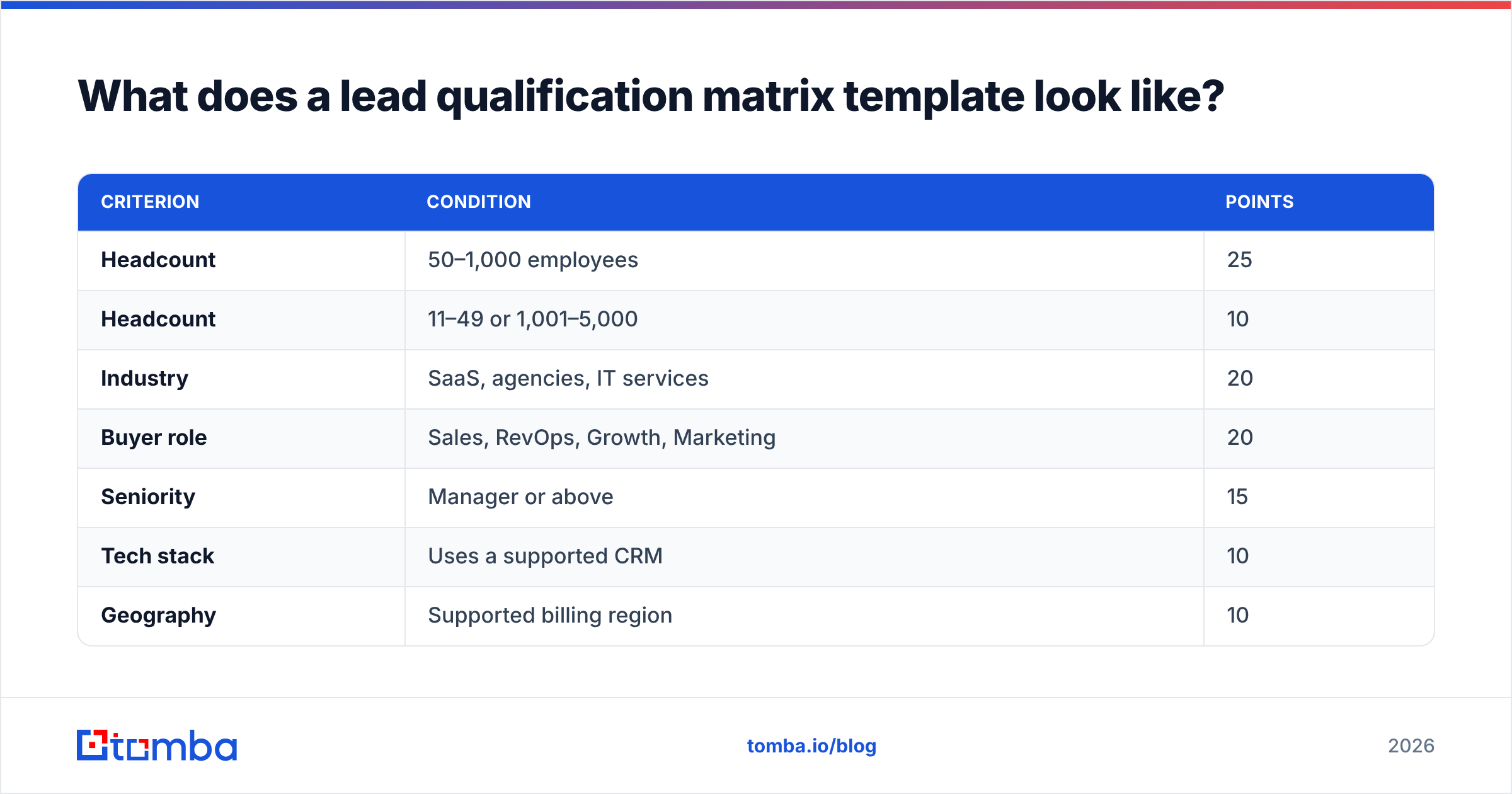
Copy this template and change the weights to match your own data. It's built for a mid-market B2B product selling to revenue teams.
Fit score (0–100)
| Criterion | Condition | Points |
|---|---|---|
| Headcount | 50–1,000 employees | 25 |
| Headcount | 11–49 or 1,001–5,000 | 10 |
| Industry | SaaS, agencies, IT services | 20 |
| Buyer role | Sales, RevOps, Growth, Marketing | 20 |
| Seniority | Manager or above | 15 |
| Tech stack | Uses a supported CRM | 10 |
| Geography | Supported billing region | 10 |
Intent score (0–100)
| Signal | Condition | Points |
|---|---|---|
| Demo request / trial | Last 14 days | 40 |
| Pricing page visit | 2+ visits, last 14 days | 20 |
| Outbound reply | Positive or neutral reply | 25 |
| Content engagement | 3+ sessions in 30 days | 10 |
| Third-party signal | Relevant hiring or funding | 10 |
| Decay | No activity in 30+ days | −20 |
Routing matrix
| Quadrant | Fit | Intent | Action | Owner | SLA |
|---|---|---|---|---|---|
| Hot | 60+ | 60+ | Direct sales outreach, book meeting | AE or senior SDR | 1 hour |
| Target | 60+ | Under 60 | Personalized outbound sequence | SDR | 48 hours |
| Check | Under 60 | 60+ | Quick manual review, self-serve path | SDR or support | 24 hours |
| Park | Under 60 | Under 60 | Low-touch nurture or suppress | Marketing automation | None |
Two design choices matter here. First, the decay rule in the intent table. Without it, a lead that binged your blog in January stays "hot" forever. Second, the Target quadrant. Many teams treat high-fit, low-intent leads as marketing's job and never call them. In practice this is where outbound earns its keep, because these accounts look like your best customers and just haven't noticed you yet.
Why do lead qualification matrices fail?#

Most matrices don't fail because of the framework. They fail for four boring reasons.
1. Garbage data on the fit axis. If 30% of your leads are missing a job title or company size, those criteria score zero. Perfectly good prospects then land in "Park." The usual culprits are free-email signups (gmail.com gives you no company to enrich) and outdated contact records. Fixing the inputs usually moves conversion more than tweaking the weights does.
2. Unverified contact details. A lead that scores 85/85 is worthless if the email bounces. Worse, a high bounce rate on your hottest segment hurts email deliverability for every other sequence you run. Run an email verifier before a lead enters any automated sequence, not after the first bounce.
3. Too many criteria. Every stakeholder wants their pet signal included. A 25-line scoring model is impossible to explain, so reps can't tell why a lead is hot, and they stop trusting it. Keep it under eight criteria per axis.
4. No feedback loop. Weights set in a workshop are hypotheses. If nobody checks quadrant conversion against closed-won revenue each quarter, the matrix slowly drifts away from reality. Gartner's sales research has long pointed out that B2B buying groups keep changing, so your model has to change with them.
How do enrichment and email data improve lead qualification?#
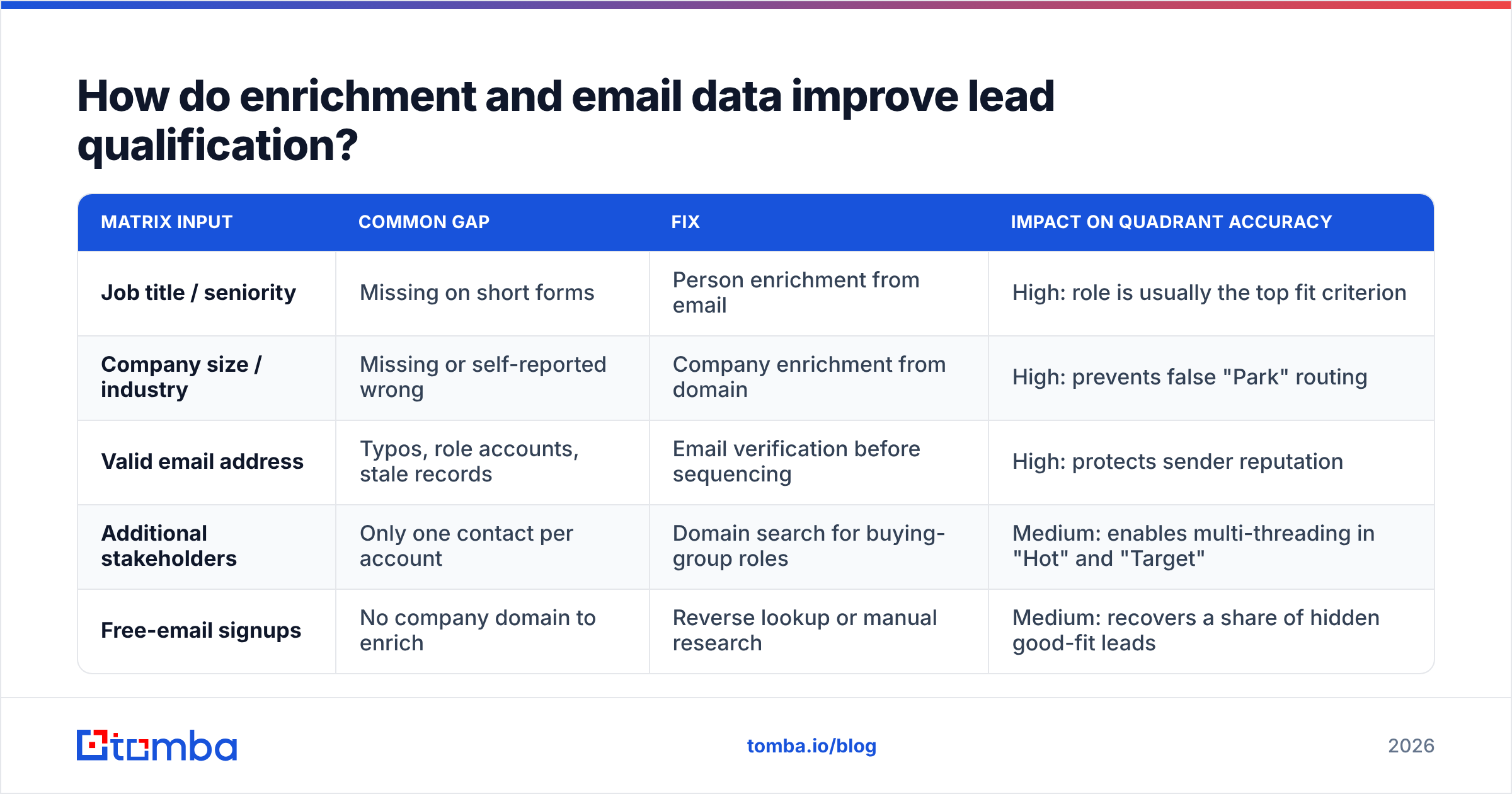
Enrichment turns a thin record (name + email) into a scoreable one (role, seniority, company, headcount, industry, tech). Here's how the data layer connects to each part of the matrix:
| Matrix input | Common gap | Fix | Impact on quadrant accuracy |
|---|---|---|---|
| Job title / seniority | Missing on short forms | Person enrichment from email | High: role is usually the top fit criterion |
| Company size / industry | Missing or self-reported wrong | Company enrichment from domain | High: prevents false "Park" routing |
| Valid email address | Typos, role accounts, stale records | Email verification before sequencing | High: protects sender reputation |
| Additional stakeholders | Only one contact per account | Domain search for buying-group roles | Medium: enables multi-threading in "Hot" and "Target" |
| Free-email signups | No company domain to enrich | Reverse lookup or manual research | Medium: recovers a share of hidden good-fit leads |
The Target quadrant is where this matters most. These leads haven't raised their hand, so you're contacting them cold. You need the right person at the account and an address that won't bounce. Tools like Tomba, Apollo, and BookYourData each approach this a bit differently. Tomba focuses on domain-based email finding and verification, Apollo bundles data with sequencing, and BookYourData offers a large pre-built contact database with list-building filters. Pick based on your workflow, not on headline database size.
How often should you update your lead qualification matrix?#
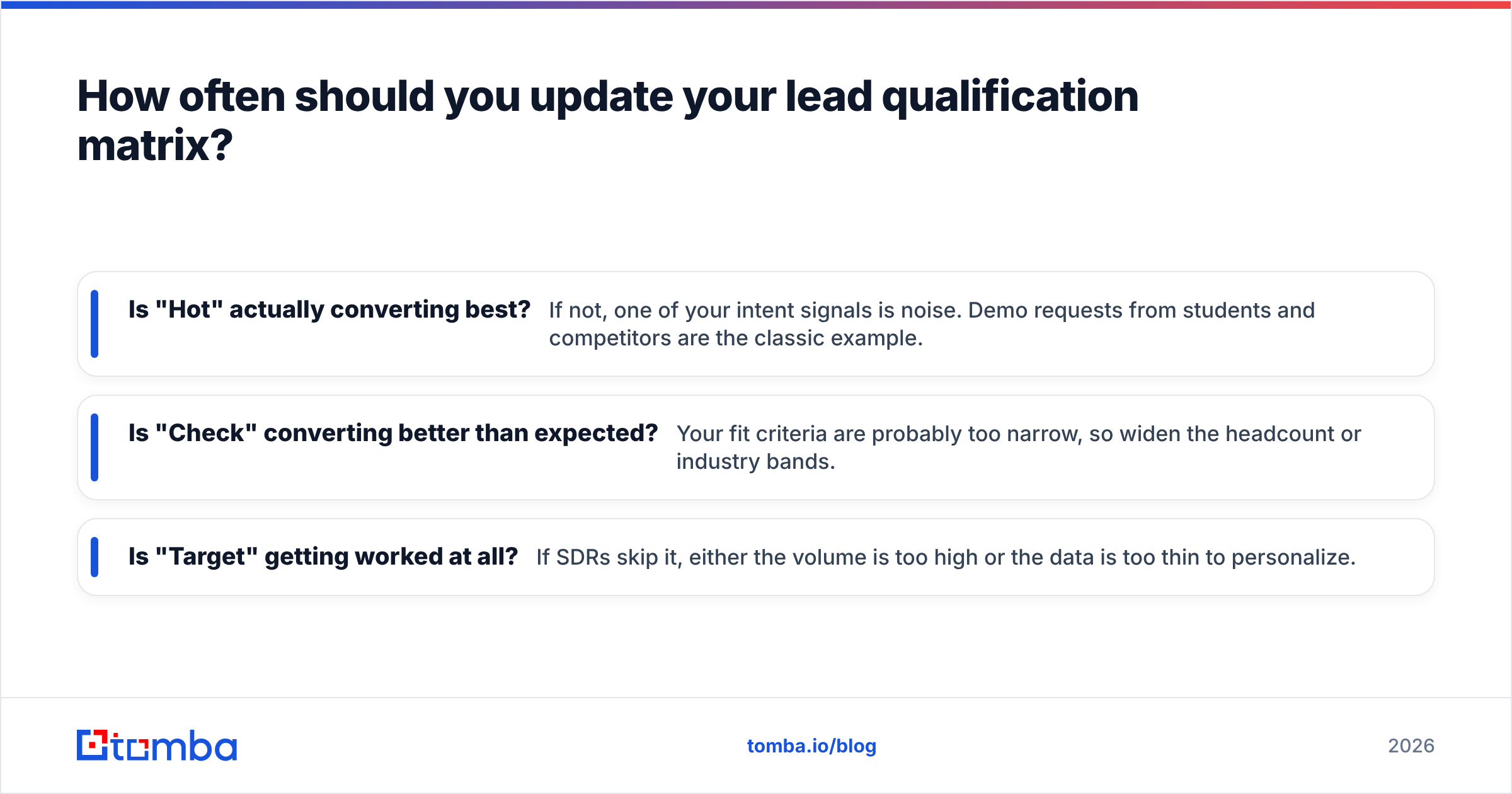
Check it every quarter and rebuild it every year. The quarterly check is quick. Pull conversion rates by quadrant and ask three questions:
- Is "Hot" actually converting best? If not, one of your intent signals is noise. Demo requests from students and competitors are the classic example.
- Is "Check" converting better than expected? Your fit criteria are probably too narrow, so widen the headcount or industry bands.
- Is "Target" getting worked at all? If SDRs skip it, either the volume is too high or the data is too thin to personalize.
Rebuild the whole matrix whenever you launch a new product tier, move upmarket or downmarket, or open a new region. Your ideal customer changes, and the matrix has to change too.
Also align the matrix with your MQL definition. In most teams, "Hot" plus "Check" after review is what counts as an MQL handed to sales. Write that down explicitly so marketing and sales stop arguing about lead quality in pipeline meetings.
Is a lead qualification matrix worth it for small teams?#
Yes, and small teams probably need it most, because they have the fewest hours to waste. A two-person sales team doesn't need a 50-point model in a marketing automation platform. A spreadsheet with five fit criteria, three intent signals, and the four-quadrant routing table above will do the job. Revisit it once a quarter.
The part small teams tend to skip is data quality. That's also the cheapest part to fix. Enriching and verifying a few hundred leads a month costs less than a single lost deal from a bounced email or a misrouted VP.
Put the right contacts into your matrix#
A lead qualification matrix routes leads well only when each record has a real person, a real role, and a working email. If your "Target" quadrant is full of good-fit accounts with no usable contact, Tomba Email Finder finds professional email addresses from a name and company domain and verifies them before they reach your sequences. It lets you move high-fit accounts from "we should talk to them" to an actual first touch. Start on the free tier (25 searches a month) to test it against your own high-fit accounts. Paid plans start at $49/month when you're ready to scale. See Tomba pricing.
Related guides#
// get started
Find, verify and enrich your first contacts today
Start on the free plan with 25 searches a month, then scale when your team is ready.
Free plan · No credit card required · GDPR & CCPA
// about the author