Lead Qualification Process: A 6-Step Framework for B2B Teams
Most pipelines are clogged with leads that were never going to buy. This 6-step lead qualification process, with framework comparisons and a copyable scoring model, helps your reps stop chasing ghosts.
TL;DR
- A lead qualification process is a repeatable set of checks that decides which leads get sales time, which go back to nurture, and which you drop.
- Put it in this order: define your ICP, clean and enrich the data, score for fit and intent, qualify in a conversation, route, then review.
- BANT still works for fast, transactional deals. MEDDIC or MEDDPICC fits complex deals with several stakeholders. CHAMP and ANUM sit between the two.
- Most failed processes break at step two. If the email bounces or the job title is three years old, no framework will save the lead.
- Review your disqualification reasons every month. They tell you more about your targeting than your wins do.
What is a lead qualification process?#
A lead qualification process is how your team decides whether a lead deserves a salesperson's time. Every contact that comes in, whether from a form fill, a list, a webinar, or outbound research, goes through the same set of questions. Is this company a fit? Does this person have a problem we solve? Can they buy, and will they buy soon?
The output is always a routing decision. The lead moves to sales, goes back to marketing for nurture, or is disqualified with a recorded reason.
It helps to separate two ideas that people often mix up:
- Lead scoring is automated and mostly passive. Points come from firmographics and behavior, such as company size, industry, or visiting the pricing page.
- Lead qualification is the wider process. It includes scoring, but it also includes a human conversation that confirms need, authority, and timing.
Scoring tells you who to call first. Qualification tells you who to keep calling. For background on how leads enter the funnel in the first place, the lead generation overview on Wikipedia is a reasonable neutral primer.
Why does a lead qualification process matter so much in 2026?#
Buying committees have grown, inboxes are more crowded, and inbox providers are stricter about bulk senders. Chasing a bad lead now costs more than rep time. A bounced email or an ignored sequence hurts your sender reputation, and that makes it harder to reach the good leads.
Without a defined process, three things tend to happen:
- Reps pick leads by gut. They chase the familiar logo or the loudest inbound request, not the best-fit account.
- Marketing and sales stop trusting each other. Marketing counts MQLs, sales calls them junk, and nobody agrees on the definition. (If your team's definitions are fuzzy, start with a shared marketing qualified lead definition.)
- Forecasts become fiction. Unqualified opportunities inflate the pipeline, stall at stage two, and get closed-lost at quarter end.
Gartner's sales research has pointed out for years that B2B buyers spend only a small share of their buying journey talking to suppliers. When you get that time, it should go to accounts that can actually close.
What are the 6 steps of a lead qualification process?#
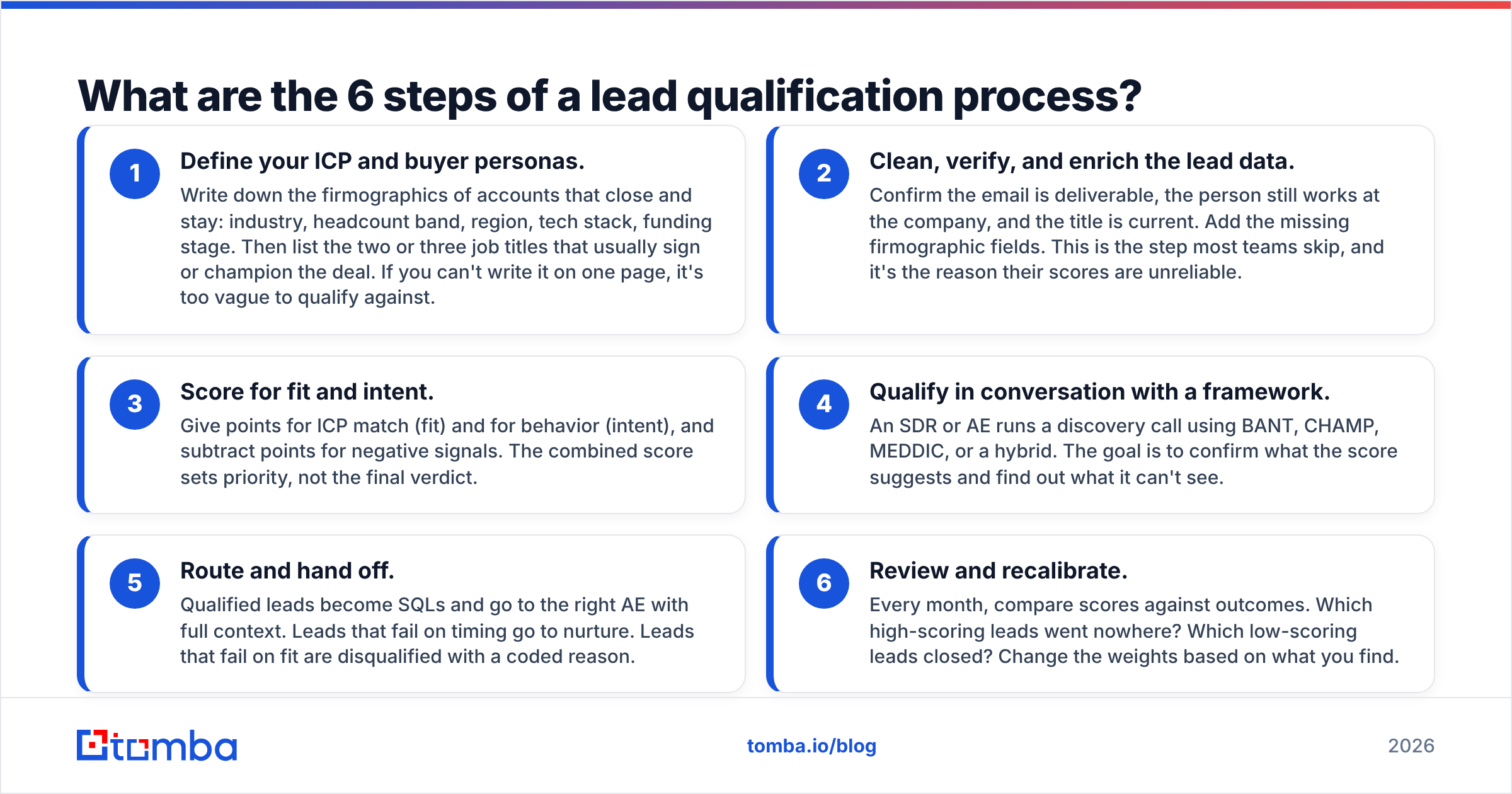
This is the sequence we recommend. Each step feeds the next, so skipping one creates problems further down.
- Define your ICP and buyer personas. Write down the firmographics of accounts that close and stay: industry, headcount band, region, tech stack, funding stage. Then list the two or three job titles that usually sign or champion the deal. If you can't write it on one page, it's too vague to qualify against.
- Clean, verify, and enrich the lead data. Confirm the email is deliverable, the person still works at the company, and the title is current. Add the missing firmographic fields. This is the step most teams skip, and it's the reason their scores are unreliable.
- Score for fit and intent. Give points for ICP match (fit) and for behavior (intent), and subtract points for negative signals. The combined score sets priority, not the final verdict.
- Qualify in conversation with a framework. An SDR or AE runs a discovery call using BANT, CHAMP, MEDDIC, or a hybrid. The goal is to confirm what the score suggests and find out what it can't see.
- Route and hand off. Qualified leads become SQLs and go to the right AE with full context. Leads that fail on timing go to nurture. Leads that fail on fit are disqualified with a coded reason.
- Review and recalibrate. Every month, compare scores against outcomes. Which high-scoring leads went nowhere? Which low-scoring leads closed? Change the weights based on what you find.
Step two gets its own section below, because that's where most processes quietly break.
Which lead qualification framework should you use?#
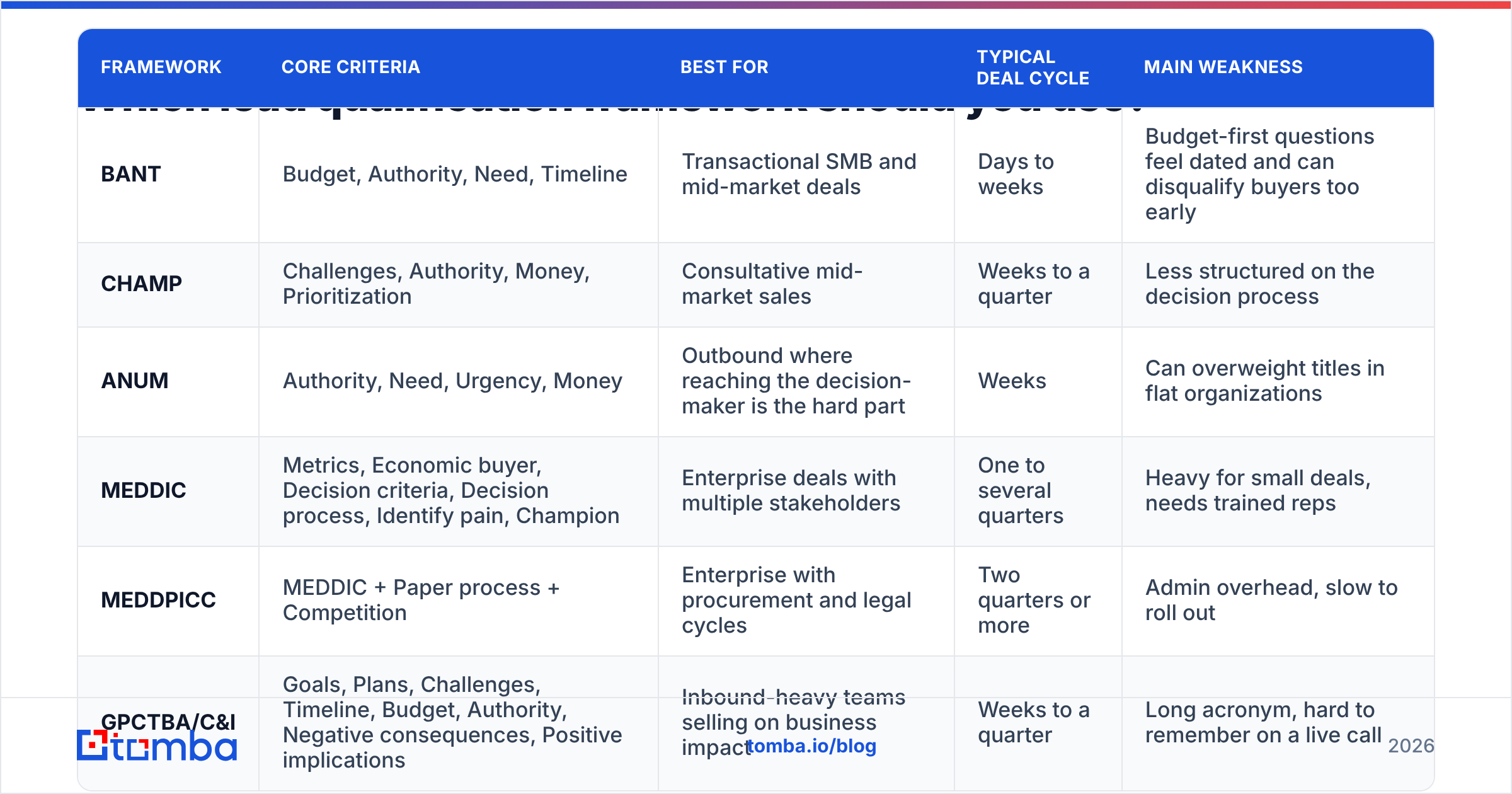
No single framework is the best. The right choice depends on deal size, cycle length, and how many people sign off. Here's how the main options compare:
| Framework | Core criteria | Best for | Typical deal cycle | Main weakness |
|---|---|---|---|---|
| BANT | Budget, Authority, Need, Timeline | Transactional SMB and mid-market deals | Days to weeks | Budget-first questions feel dated and can disqualify buyers too early |
| CHAMP | Challenges, Authority, Money, Prioritization | Consultative mid-market sales | Weeks to a quarter | Less structured on the decision process |
| ANUM | Authority, Need, Urgency, Money | Outbound where reaching the decision-maker is the hard part | Weeks | Can overweight titles in flat organizations |
| MEDDIC | Metrics, Economic buyer, Decision criteria, Decision process, Identify pain, Champion | Enterprise deals with multiple stakeholders | One to several quarters | Heavy for small deals, needs trained reps |
| MEDDPICC | MEDDIC + Paper process + Competition | Enterprise with procurement and legal cycles | Two quarters or more | Admin overhead, slow to roll out |
| GPCTBA/C&I | Goals, Plans, Challenges, Timeline, Budget, Authority, Negative consequences, Positive implications | Inbound-heavy teams selling on business impact | Weeks to a quarter | Long acronym, hard to remember on a live call |
A practical rule: if your average contract value fits on a credit card, use BANT or ANUM and move quickly. If procurement is involved, use MEDDIC or MEDDPICC. If you're somewhere in between, CHAMP is a good default because it starts with the buyer's problem instead of their budget.
Many teams use a hybrid. SDRs qualify on a light BANT or CHAMP pass, and AEs build out the full MEDDIC picture once the opportunity is open. That split keeps first calls short and still gives enterprise deals the rigor they need.
How do you build a lead scoring model that actually predicts deals?#
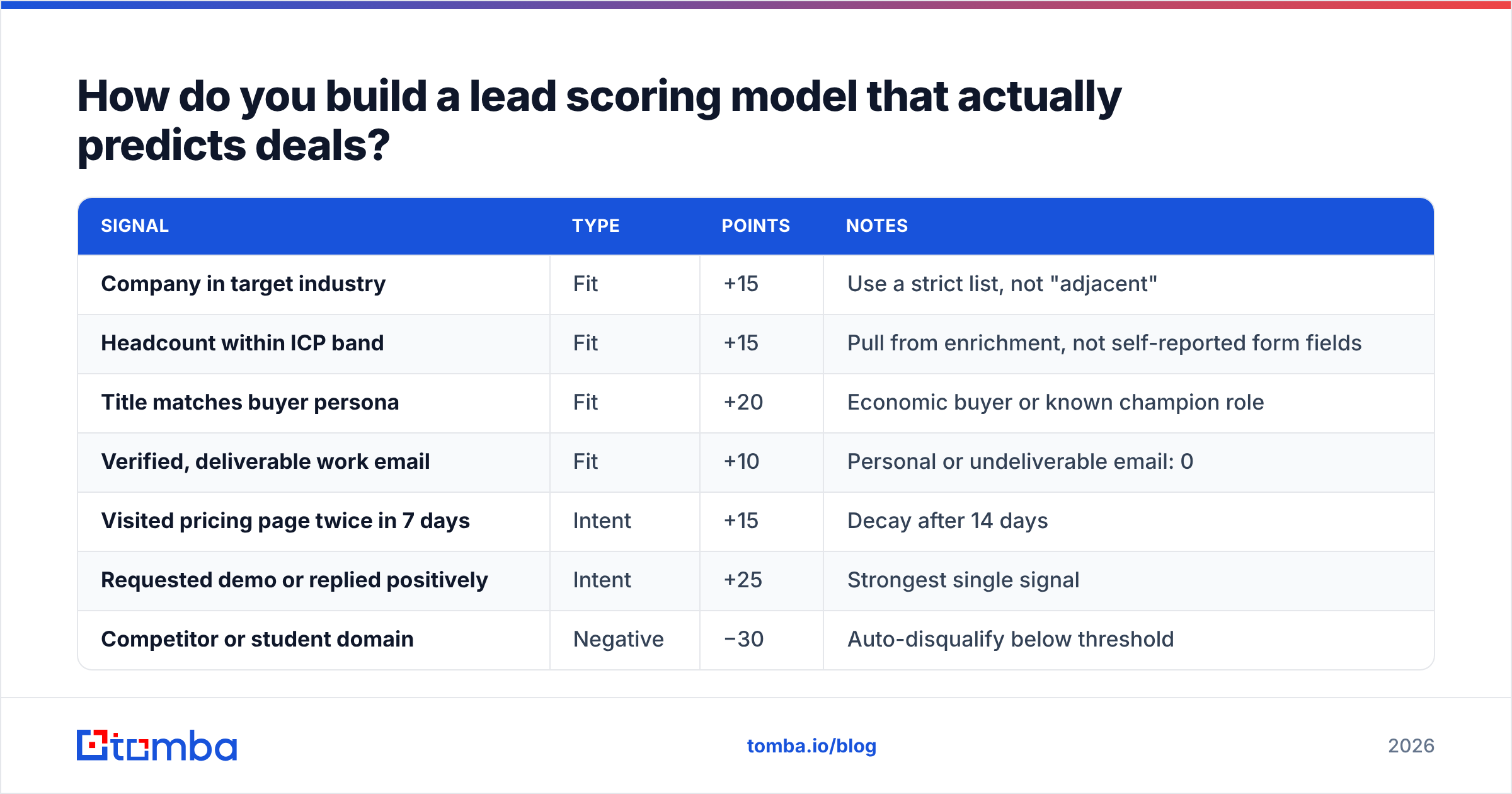
A scoring model is only as good as the fields it reads. Start simple. Five to eight signals, weighted by how well they have predicted closed-won deals in the past, will beat a 40-attribute model nobody trusts.
Here's a starter model you can adapt:
| Signal | Type | Points | Notes |
|---|---|---|---|
| Company in target industry | Fit | +15 | Use a strict list, not "adjacent" |
| Headcount within ICP band | Fit | +15 | Pull from enrichment, not self-reported form fields |
| Title matches buyer persona | Fit | +20 | Economic buyer or known champion role |
| Verified, deliverable work email | Fit | +10 | Personal or undeliverable email: 0 |
| Visited pricing page twice in 7 days | Intent | +15 | Decay after 14 days |
| Requested demo or replied positively | Intent | +25 | Strongest single signal |
| Competitor or student domain | Negative | −30 | Auto-disqualify below threshold |
| No activity in 60 days | Negative | −10 | Moves lead back to nurture |
Set your SQL threshold at a score where historical conversion clearly goes up. For many teams that lands around 60 to 70 on this scale, but calibrate it against your own data and don't copy the number.
Two rules make any model more accurate:
- Separate fit from intent. A perfect-fit account with no intent needs outbound, not a demo call. A high-intent lead with poor fit needs a polite, quick no. A 2x2 grid of fit against intent is easier for reps to act on than one blended number.
- Decay intent scores. A pricing-page visit from last quarter is not a buying signal today.
Most major CRMs support this natively. HubSpot and Salesforce both let you build fit and engagement scores and trigger routing when a lead crosses a threshold.
Why does data quality make or break lead qualification?#
Every framework and scoring model above assumes one thing: the data about the lead is correct. In practice, B2B contact data goes stale quickly. People change jobs, companies rebrand, and email patterns change after acquisitions. A model that awards +20 for "VP of Operations" is wrong if that VP left eight months ago.
Bad data damages qualification in three ways:
- False positives. A lead scores high on fit because of an outdated title or headcount, so a rep spends a discovery call on someone who can't buy.
- False negatives. A strong lead scores low because firmographic fields are empty. Your model can't give points for data it doesn't have.
- Deliverability damage. Sending sequences to unverified addresses increases bounces, which hurts sender reputation for the whole domain.
The fix is to put verification and enrichment before scoring, not after. Before a lead reaches your model:
- Run the address through an email verifier and suppress anything invalid or high-risk.
- Handle catch-all domains separately. They accept every address at the server level, so a "valid" result proves little on its own.
- Fill in missing firmographic and role fields with data enrichment so the fit score has real inputs.
- Re-verify older records on a schedule. Quarterly is a sensible minimum for active outbound lists.
Many teams use more than one provider here. Some pair a contact database such as BookYourData or Tomba with CRM-native enrichment and compare coverage by segment. Whatever stack you pick, the principle stays the same: score clean data, or the scores don't mean much.
How do you qualify a lead on a discovery call?#
Once a lead passes the score threshold, a person confirms it. Keep the call about the buyer, not a checklist. These questions cover most frameworks without sounding like an interrogation:
- Pain: "What made you look at this now rather than six months ago?"
- Impact: "If nothing changes, what does that cost the team this year?"
- Authority and process: "Apart from you, who needs to be comfortable with this before it moves forward?"
- Timeline: "Is there a date or event this needs to be solved by?"
- Budget: "Is this something you'd fund from an existing budget, or does it need a new line item?"
- Competition: "What else are you looking at, including doing nothing?"
Log the answers in structured CRM fields, not free-text notes. Structured fields are what make step six, the review, possible.
Disqualifying early is a skill. If a lead fails on fit, say so kindly and quickly, and offer something useful such as a resource, a referral, or a check-in date. A fast, clear "not right now" protects your win rate and the prospect's time.
What mistakes break a lead qualification process?#
These patterns show up again and again in teams whose pipelines look full but don't convert:
- Qualifying on budget first. Many buyers don't have budget until they see the value. Starting with money ends good conversations early. Start with the problem.
- One threshold for every source. An inbound demo request and a cold list import shouldn't need the same score to reach sales. Set thresholds by source.
- No disqualification codes. "Closed – unqualified" with no reason teaches you nothing. Use 5 to 8 coded reasons, such as no budget, wrong persona, bad data, or timing.
- Scoring on self-reported form data. Prospects round up headcount and inflate titles. Enrich instead of trusting the form.
- Never recalibrating. A model built for last year's ICP will steadily drift away from reality. Put a monthly review on the calendar.
- Letting SLAs slip. A hot lead that waits two days for follow-up isn't hot anymore. Agree on response-time SLAs between marketing and sales and track them.
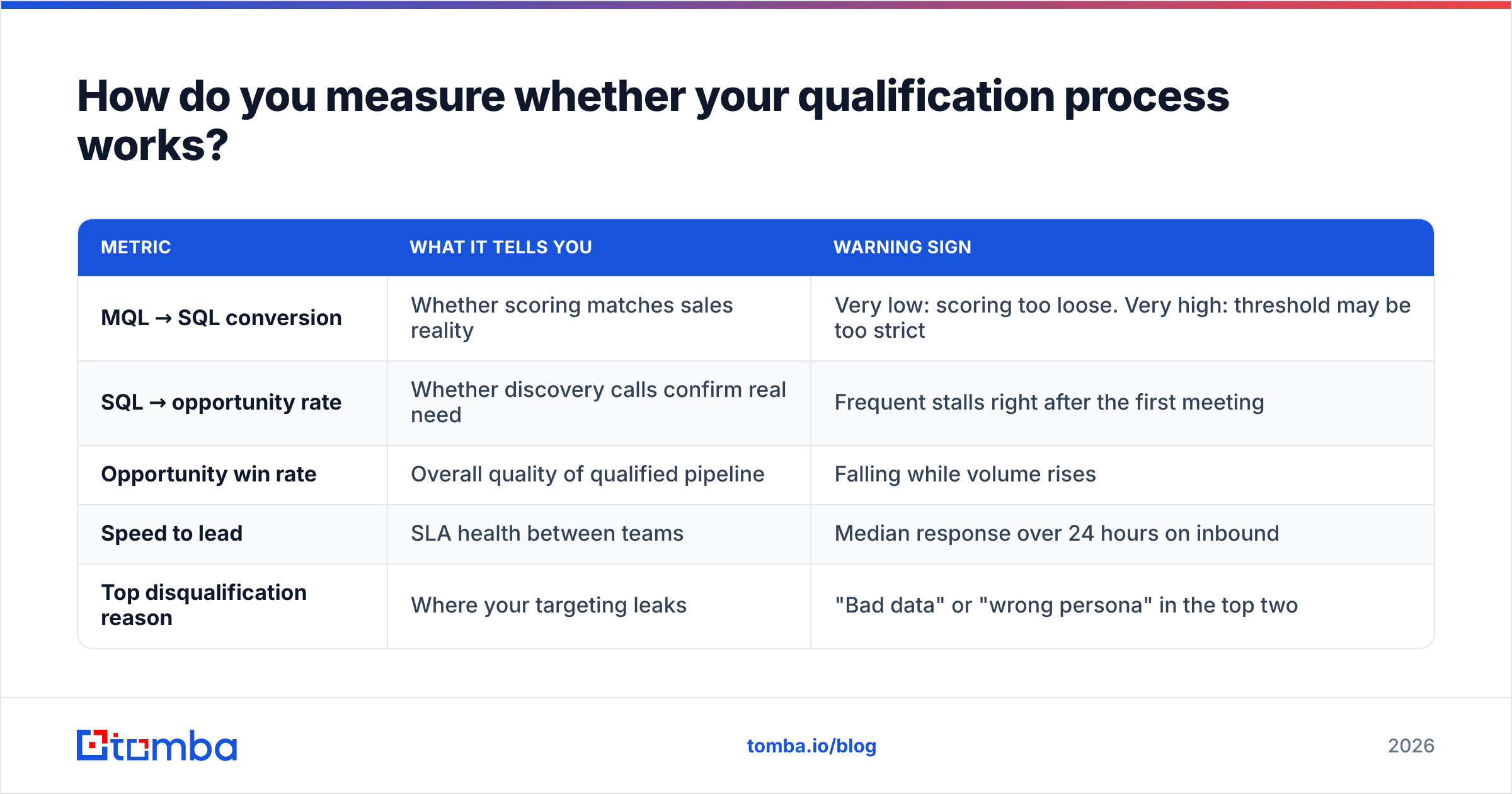
How do you measure whether your qualification process works?#
Track a few metrics monthly, split by lead source:
| Metric | What it tells you | Warning sign |
|---|---|---|
| MQL → SQL conversion | Whether scoring matches sales reality | Very low: scoring too loose. Very high: threshold may be too strict |
| SQL → opportunity rate | Whether discovery calls confirm real need | Frequent stalls right after the first meeting |
| Opportunity win rate | Overall quality of qualified pipeline | Falling while volume rises |
| Speed to lead | SLA health between teams | Median response over 24 hours on inbound |
| Top disqualification reason | Where your targeting leaks | "Bad data" or "wrong persona" in the top two |
If "bad data" is one of your top disqualification reasons, the problem isn't the framework. It's the upstream data, and fixing step two will do more than any retraining.
Frequently asked questions#
What's the difference between an MQL and an SQL? An MQL has met marketing's fit and engagement criteria. An SQL has been accepted by sales, usually after a qualifying conversation that confirms need and timing.
How long should lead qualification take? Automated scoring should be instant. For inbound, the first human qualification touch should ideally happen within the same business day. Full MEDDIC qualification on enterprise deals can take several meetings.
Should SDRs or AEs qualify leads? In most B2B teams, SDRs handle first-pass qualification and AEs handle deeper opportunity qualification. Small teams often combine both roles, and that's fine as long as the criteria are written down.
Can AI qualify leads on its own? AI works well for scoring, research, and drafting discovery questions. It can't yet reliably confirm authority or a buyer's internal politics. Keep a person in the loop for the SQL decision.
Where should you start?#
Clean the data first. Then pick a framework that matches your deal size, build a simple fit-plus-intent score, and review the results every month. The teams with the most reliable pipelines usually aren't using clever frameworks. They qualify from accurate contact data and are strict about disqualifying.
If your process breaks at the data step, Tomba Email Finder is a good place to start. It finds professional email addresses by name, domain, or company, and verification and enrichment are included so every lead reaching your scoring model has a deliverable address and current role data. The free tier includes 25 searches a month, and paid plans start at $49/mo when you're ready to run it across your whole pipeline.
Related guides#
// get started
Find, verify and enrich your first contacts today
Start on the free plan with 25 searches a month, then scale when your team is ready.
Free plan · No credit card required · GDPR & CCPA
Get the Tomba newsletter
Product and data updates
// about the author