Lead Qualification Sales Funnel: Stages, Frameworks & Scoring
Most pipelines don't have a lead-volume problem. They qualify leads too late. Here's how to set up a lead qualification sales funnel with clear stages, the right framework, and scoring that sends reps to actual buyers.
TL;DR
- A lead qualification sales funnel is a series of checkpoints. Each one removes leads that can't or won't buy before a rep spends time on them.
- Most funnels leak for three reasons: qualification happens too late, MQL criteria reward clicks instead of fit, and contact data is bad enough to break routing.
- Qualify in layers. Score fit before the first touch, measure intent during nurture, and confirm need and authority on the first call.
- Frameworks such as BANT, MEDDIC, and CHAMP aren't competing. Each one suits a different deal size and cycle length.
- Track conversion rate between stages, not just total lead count. The biggest drop-off points to the stage that needs fixing.
What is a lead qualification sales funnel?#
A lead qualification sales funnel is the set of stages a prospect moves through between first contact and a sales-accepted opportunity. Each stage has explicit criteria for moving forward. The funnel shape comes from filtering: many leads enter at the top, and far fewer reach a rep's calendar.
It's different from a generic marketing funnel (awareness, consideration, decision). That model describes how a buyer feels. A qualification funnel describes what your team knows about the buyer and what it has decided about them. At each stage someone, or some scoring rule, answers one question: should we keep investing in this lead?
If you've read about the sales process in general terms, the qualification funnel is the front half of it made operational. It turns "is this a good lead?" into rules your CRM can enforce.
What are the stages of a lead qualification funnel?#
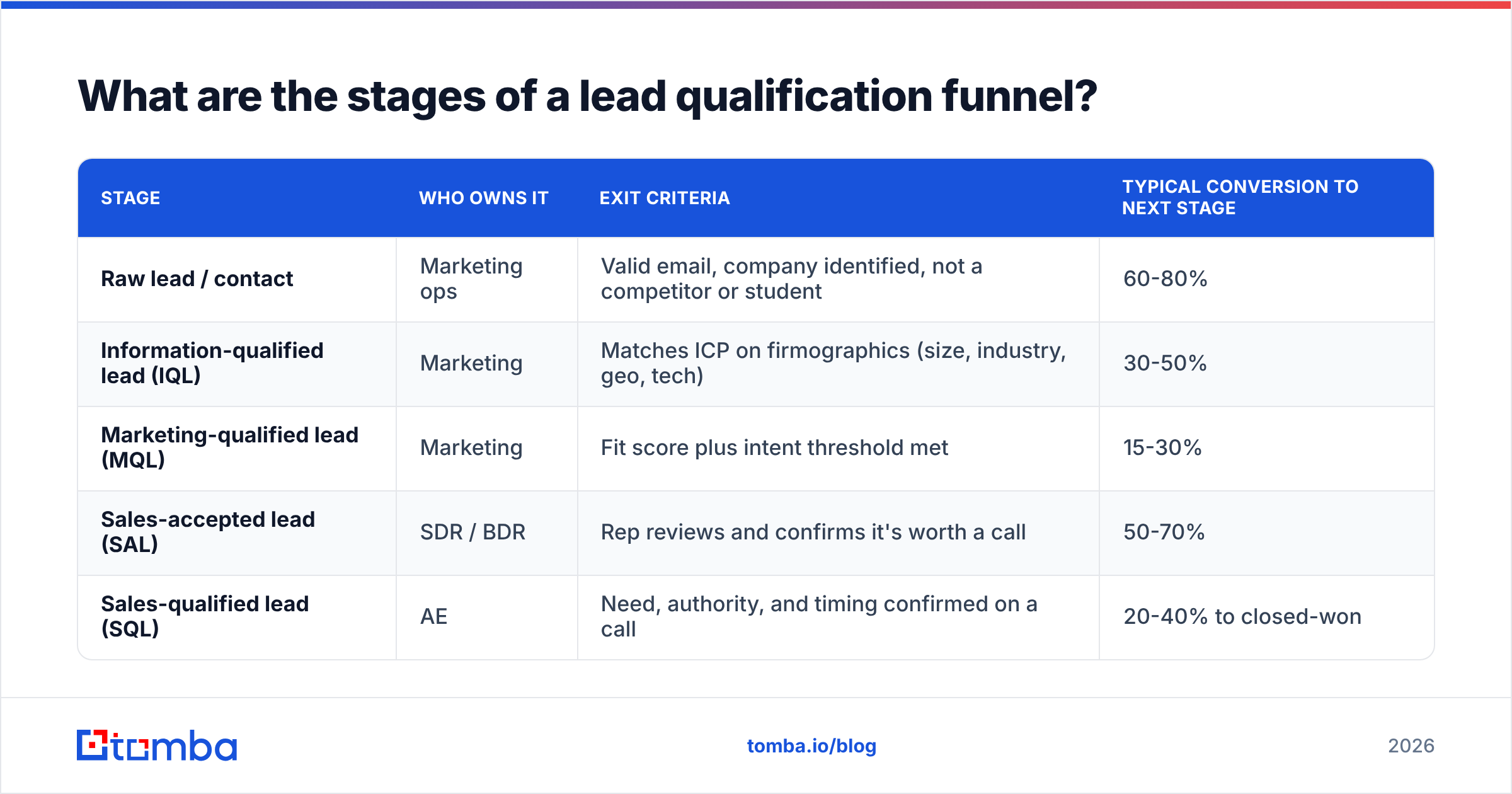
Stage names differ between companies. The underlying logic is fairly consistent, and most B2B teams run some version of these five stages:
| Stage | Who owns it | Exit criteria | Typical conversion to next stage |
|---|---|---|---|
| Raw lead / contact | Marketing ops | Valid email, company identified, not a competitor or student | 60-80% |
| Information-qualified lead (IQL) | Marketing | Matches ICP on firmographics (size, industry, geo, tech) | 30-50% |
| Marketing-qualified lead (MQL) | Marketing | Fit score plus intent threshold met | 15-30% |
| Sales-accepted lead (SAL) | SDR / BDR | Rep reviews and confirms it's worth a call | 50-70% |
| Sales-qualified lead (SQL) | AE | Need, authority, and timing confirmed on a call | 20-40% to closed-won |
These conversion ranges are directional. They vary a lot by ACV, inbound vs. outbound mix, and how strict each gate is. The value of the table is that it makes each handoff visible. If your IQL-to-MQL rate is 70%, your MQL definition is almost certainly too loose. If your SAL-to-SQL rate is 10%, marketing is passing leads that reps can't use.
If the acronyms are unfamiliar, the Tomba glossary entry on the marketing qualified lead explains how MQL is usually defined and where teams disagree.
Why do most lead qualification funnels leak?#
Funnels seldom fail at a single point. They leak in several places at once, and the leaks compound. These are the patterns that show up most often in B2B pipelines:
- Qualification starts too late. Many teams don't check fit until an SDR looks at the lead, which means reps spend hours researching accounts a firmographic filter would have removed in seconds.
- MQL is defined by activity, not fit. A student who downloads three ebooks can outscore a VP at your ideal account who visited the pricing page once. Activity only means something when it's weighted by who is doing it.
- Contact data is broken. Bounced emails, missing job titles, and personal Gmail addresses break routing rules. A lead with no company domain can't be scored on firmographics, so it either gets dropped or gets routed at random.
- There's no feedback loop from sales. When reps reject leads without recording a reason code, marketing can't tune the scoring model and makes the same mistakes next quarter.
- Every lead gets the same SLA. A high-fit, high-intent lead waits in the same queue as a cold newsletter signup, and it goes cold while it waits.
The data problem (#3) is the least visible and often the most expensive. If a quarter of your inbound leads arrive without a verifiable work email or company, every rule further down the funnel is working from partial information. That's why enrichment and verification belong at the very top of the funnel, before any scoring runs.
How do you qualify leads at the top of the funnel?#
Top-of-funnel qualification should be automated, fast, and mostly about fit. You're asking whether this person and company could ever buy from you, regardless of whether they want to right now.
Clean and enrich before you score#
Every new lead should pass through three checks in order:
- Verify the email. Deliverability is the first test. An email verifier flags invalid, disposable, and risky addresses before they reach your CRM, which keeps bounce rates low and scoring honest.
- Resolve the company. Map the email domain to a company record so you have headcount, industry, and location.
- Fill in the missing fields. Job title, seniority, department, and tech stack are what most fit models rely on. Data enrichment fills these gaps without adding form fields that reduce conversion.
Once those steps run automatically, your IQL stage is simply a filter on enriched fields: company size between X and Y, industry in your target list, and a seniority of manager or above in the buying department.
Build a simple fit score#
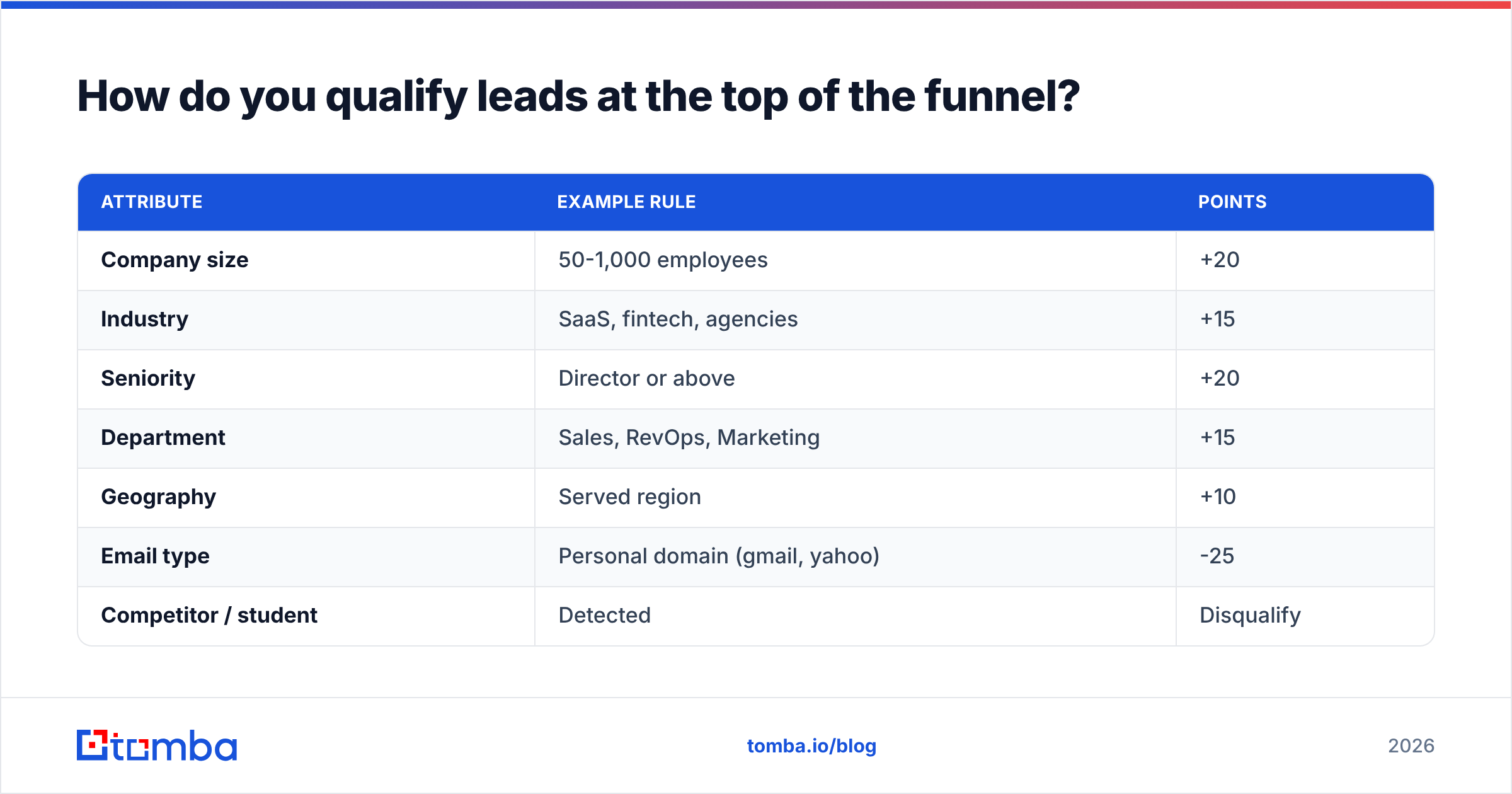
Keep the first version small. Five to seven attributes, each with a point value, will get you most of the benefit:
| Attribute | Example rule | Points |
|---|---|---|
| Company size | 50-1,000 employees | +20 |
| Industry | SaaS, fintech, agencies | +15 |
| Seniority | Director or above | +20 |
| Department | Sales, RevOps, Marketing | +15 |
| Geography | Served region | +10 |
| Email type | Personal domain (gmail, yahoo) | -25 |
| Competitor / student | Detected | Disqualify |
The Wikipedia article on lead scoring covers the general split between explicit (fit) and implicit (behavioral) scoring. The fit table above is the explicit half.
How do you qualify leads in the middle of the funnel?#
The middle of the funnel is about intent. The lead fits, but you need to know whether they are actively looking.
Behavioral signals worth scoring, from strongest to weakest:
- Pricing page visits, especially repeat visits within 7 days
- Demo or trial requests (these usually skip straight to SAL)
- Comparison or alternatives page views
- Product documentation or API reference visits
- Replies to outbound emails, including objections
- Webinar attendance, compared with registration alone
- Content downloads, which are the weakest signal on their own
Two design rules make intent scoring work:
- Decay scores over time. A pricing page visit from 90 days ago shouldn't count the same as one from yesterday. A common approach is to halve behavioral points every 30 days.
- Require fit plus intent for MQL. A combined threshold (for example fit ≥ 50 and intent ≥ 30) stops high-activity, low-fit leads from flooding SDR queues. It also stops a perfect-fit account that has shown no interest from being routed as though it were hot.
Most marketing automation platforms, including HubSpot, support separate fit and engagement scores. If yours allows only one score, create two properties and compute the MQL flag from both.
Which lead qualification framework should you use?#
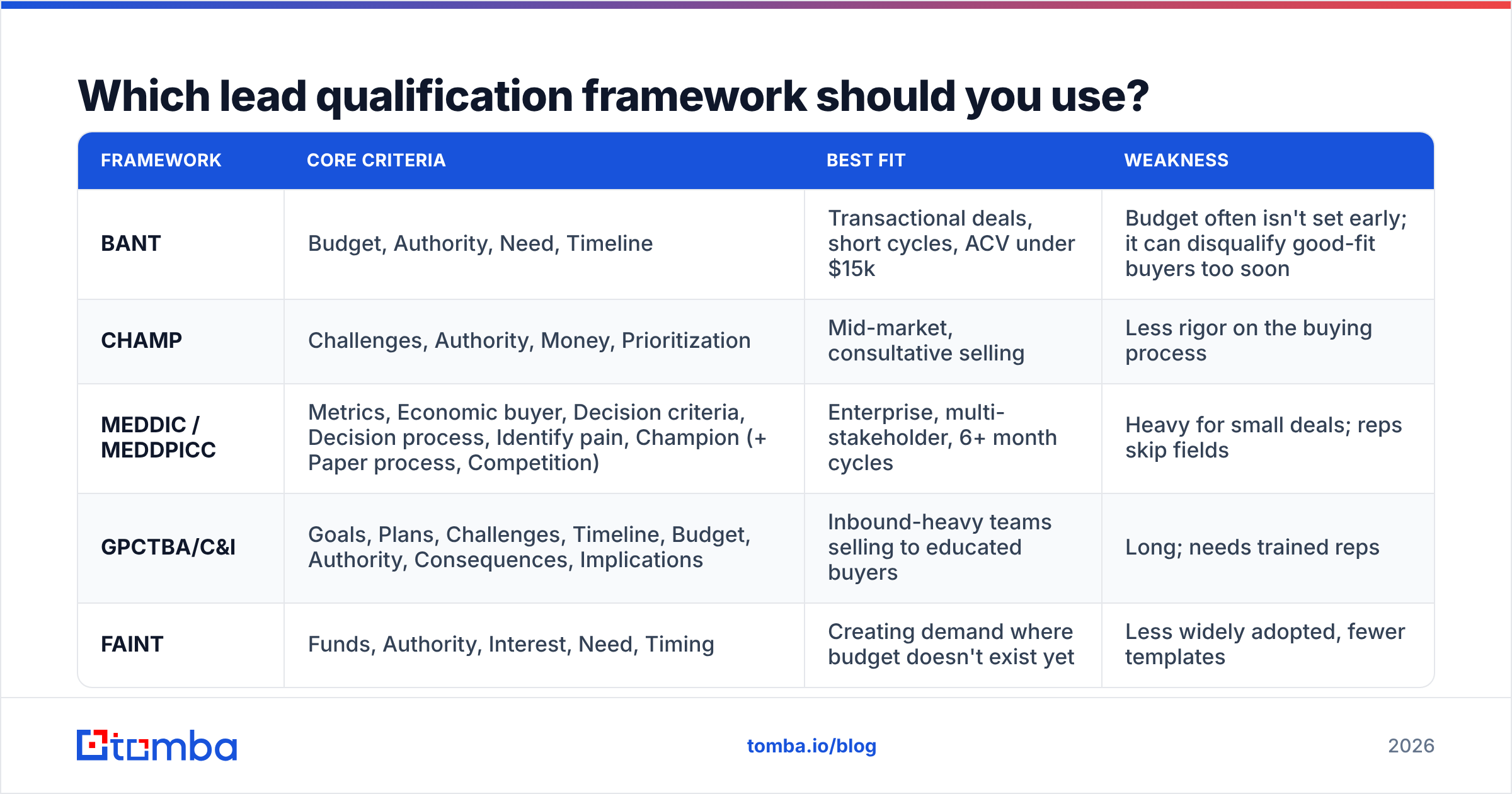
Once a lead reaches a rep, the qualification becomes a conversation. Frameworks give reps a shared structure for that conversation and a shared vocabulary for recording what they learned. Each framework answers a slightly different question, so the right one depends on your deal profile.
| Framework | Core criteria | Best fit | Weakness |
|---|---|---|---|
| BANT | Budget, Authority, Need, Timeline | Transactional deals, short cycles, ACV under $15k | Budget often isn't set early; it can disqualify good-fit buyers too soon |
| CHAMP | Challenges, Authority, Money, Prioritization | Mid-market, consultative selling | Less rigor on the buying process |
| MEDDIC / MEDDPICC | Metrics, Economic buyer, Decision criteria, Decision process, Identify pain, Champion (+ Paper process, Competition) | Enterprise, multi-stakeholder, 6+ month cycles | Heavy for small deals; reps skip fields |
| GPCTBA/C&I | Goals, Plans, Challenges, Timeline, Budget, Authority, Consequences, Implications | Inbound-heavy teams selling to educated buyers | Long; needs trained reps |
| FAINT | Funds, Authority, Interest, Need, Timing | Creating demand where budget doesn't exist yet | Less widely adopted, fewer templates |

The deliberately provocative point here is that BANT used alone is outdated for most B2B deals. It isn't useless. Buyers now do most of their research before talking to sales, and budget is often created once the pain is understood rather than set aside in advance. If a rep disqualifies because "no budget," they may be walking away from next quarter's best deal. A common hybrid is to use CHAMP on the first call and apply MEDDIC fields once the opportunity goes above a certain ACV.
How should sales and marketing split qualification ownership?#
Blurry ownership causes more funnel leaks than any scoring model. Write down who owns each gate, what they check, and how quickly they must act.
- Marketing owns fit and intent up to MQL. That includes enrichment, scoring, and nurture. Marketing is measured on MQL-to-SAL acceptance rate, not raw MQL volume.
- SDRs own the SAL gate. They must accept or reject every MQL within an SLA (commonly 24 business hours for high-score leads) and record a reason code on every rejection.
- AEs own SQL. They confirm need, authority, and timing on a discovery call and create the opportunity in the CRM.
- RevOps owns the model. Once a quarter they review rejection reasons, compare closed-won attributes against scoring weights, and adjust.
That last point is where most teams fall short. Salesforce's State of Sales research has repeatedly found that reps spend less than a third of their time actually selling. Poor lead routing is one of the main reasons. Keeping the scoring model tuned is how you get that time back.
How do you qualify outbound leads differently?#
With outbound, the qualification sequence runs in reverse. You choose accounts on fit before any intent exists, so qualification is front-loaded:
- Build the account list on ICP fit. Firmographics, technographics, and trigger events such as funding, hiring, or leadership changes.
- Find the right contacts inside those accounts. Map two or three people per account across the buying committee, not only the most senior title.
- Verify every address before the first send. Outbound bounce rates above 2-3% damage sender reputation fast, and once deliverability suffers, every later stage of the funnel shrinks.
- Let replies generate intent. A reply, even "not now," turns a fit-qualified contact into an intent signal. Route positive replies straight to SAL.
In outbound, step 2 is usually the bottleneck. You can have a well-targeted account list and still stall because you can't reach the VP of Sales at a 200-person company. An email finder that returns verified addresses by name and domain closes that gap without reps guessing email patterns by hand.
What metrics prove your qualification funnel is working?#
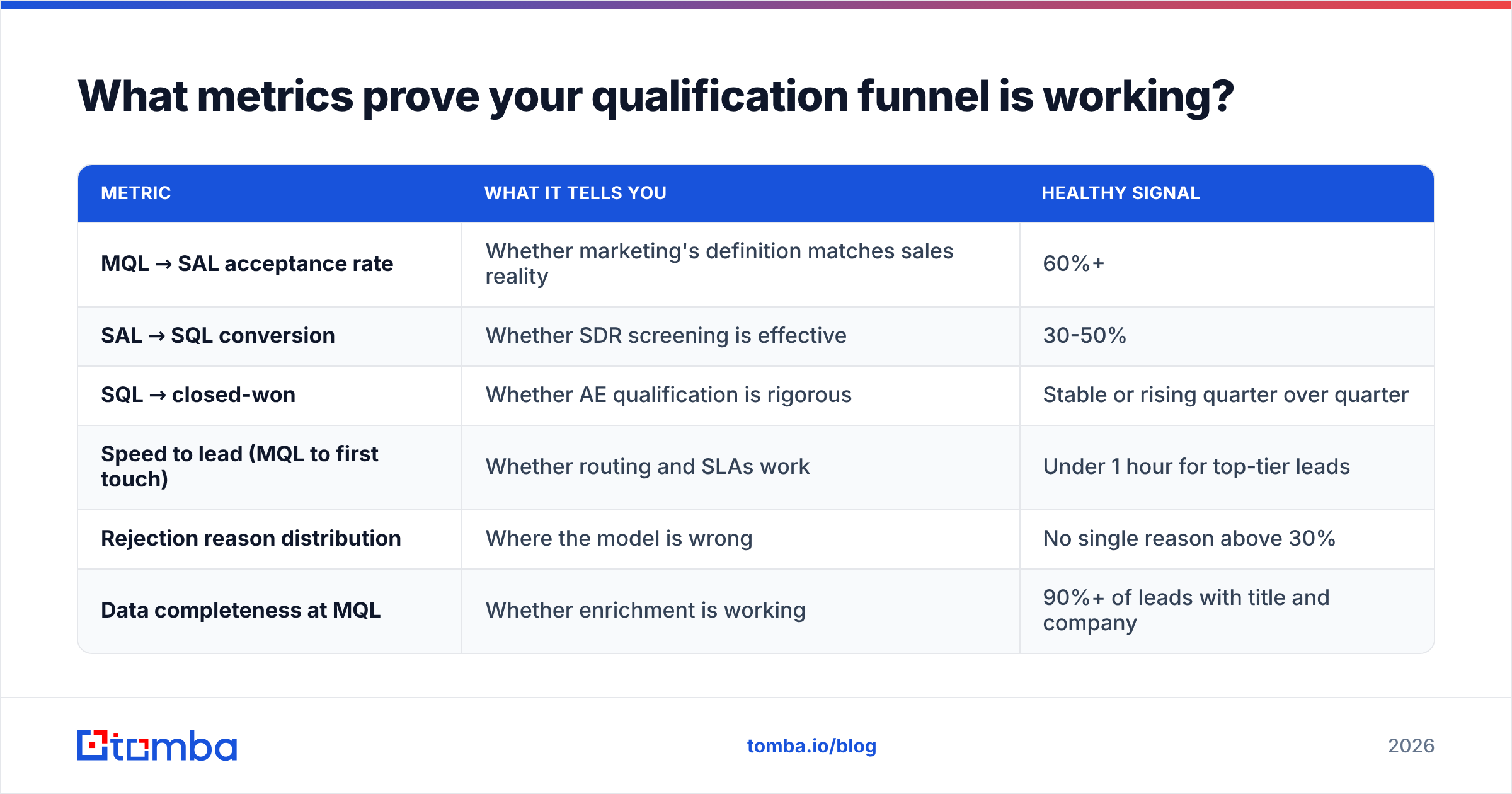
Stop reporting total lead volume as the headline number. Track these instead:
| Metric | What it tells you | Healthy signal |
|---|---|---|
| MQL → SAL acceptance rate | Whether marketing's definition matches sales reality | 60%+ |
| SAL → SQL conversion | Whether SDR screening is effective | 30-50% |
| SQL → closed-won | Whether AE qualification is rigorous | Stable or rising quarter over quarter |
| Speed to lead (MQL to first touch) | Whether routing and SLAs work | Under 1 hour for top-tier leads |
| Rejection reason distribution | Where the model is wrong | No single reason above 30% |
| Data completeness at MQL | Whether enrichment is working | 90%+ of leads with title and company |
Review stage conversion monthly and scoring weights quarterly. When one conversion rate drops, look at the stage above it first, because most problems come from upstream.
What does a good lead qualification sales funnel look like in practice?#
Here's a compact example for a mid-market SaaS company with an ACV of about $20k:
- Entry: Every inbound form fill and every outbound contact is verified and enriched automatically on creation.
- IQL: Companies with 50-1,000 employees in target industries and a manager-plus title in sales, marketing, or RevOps. Everyone else goes to a low-touch newsletter track.
- MQL: Fit ≥ 50 and intent ≥ 30, with intent decaying 50% every 30 days. Demo requests from IQLs skip directly to SAL.
- SAL: The SDR accepts or rejects within 24 business hours using a required reason picklist.
- SQL: The AE runs a CHAMP-based discovery call. Deals projected above $50k add the MEDDPICC fields.
- Review: RevOps compares the last 90 days of closed-won and closed-lost deals against scoring weights every quarter.
None of this depends on expensive tooling. You need clean data at the top, two scores in the middle, a framework your reps actually use, and a feedback loop. Most teams already have 80% of this in their CRM but haven't configured it.
Where should you start?#
If you change only one thing this quarter, fix the data entering the funnel. Scoring models, routing rules, and frameworks all depend on knowing who the lead is and being able to reach them. When a third of your records have unverified emails or missing company details, the rest of the funnel is guessing.
Tomba's Email Finder helps you find and verify professional email addresses by name, domain, or company. It's useful for building fit-qualified outbound lists and for filling in inbound leads that arrive with missing details. Plans start with a free tier of 25 searches per month, and Starter costs $49/mo. Put it at the top of your funnel so every stage after it works from contacts you can actually reach.
Related guides#
// get started
Find, verify and enrich your first contacts today
Start on the free plan with 25 searches a month, then scale when your team is ready.
Free plan · No credit card required · GDPR & CCPA
Get the Tomba newsletter
Product and data updates
// about the author