Lead Quality vs Quantity: Which Actually Drives B2B Pipeline?
10,000 cheap leads or 800 well-researched ones? We compare cost per meeting, deliverability risk and rep time to show when volume helps, when it hurts your pipeline, and which hybrid model B2B teams should run in 2026.
TL;DR
- The choice between lead quality and quantity is a false binary. The number that matters is cost per qualified meeting, and fit usually has more effect on it than raw volume.
- Quantity-first outbound breaks faster in 2026 because mailbox providers enforce bounce and spam-complaint limits. A dirty list can hurt the domain your whole team sends from.
- Quality-first is expensive per lead and doesn't scale by itself. You run out of hand-researched accounts before you hit your number.
- The model that works for most B2B teams: define a tight ICP, then scale volume only inside it, with every address verified before it gets sent to.
- If your reply rate is under 1% or your bounce rate is over 3%, fix quality first. If your reply rate is healthy but your pipeline is thin, you've earned the right to add volume.
What does "lead quality vs quantity" actually mean?#
Think of it like fishing. Quantity is casting a huge net across the whole ocean. Quality is taking a spear to the reef where you already know the fish are. The net brings up more, and most of what it brings up is stuff you have to throw back. The spear misses less, but you only catch one at a time.
In B2B sales terms:
- Lead quantity is the raw number of contacts entering your funnel: rows in a CSV, form fills, trade show badge scans, scraped profiles.
- Lead quality is how likely each contact is to become revenue. That depends on firmographic fit, the buyer's role and authority, timing signals, and whether the contact data is even reachable.
The debate exists because the two metrics get reported to different people. Marketing gets rewarded for volume (leads generated, MQLs delivered). Sales gets rewarded for closed revenue. When the incentives don't line up, SDRs end up with a pile of contacts that look good on a dashboard and never pick up the phone.
What makes a lead "high quality" in 2026?#
Before you can compare the two approaches, you need a working definition of quality. Most teams use some version of these five filters:
- Firmographic fit. Industry, headcount, revenue band, geography and tech stack match your best existing customers, not the customers you wish you had.
- Persona fit. The contact holds a role that owns the problem or signs the budget. A "Marketing Intern" at a perfect-fit account is still a low-quality lead for a $40K contract.
- Reachability. The email is valid and deliverable, and ideally there's a direct phone number too. A perfect-fit contact with a bouncing address is worth exactly zero.
- Intent or timing signal. Hiring for a relevant role, a recent funding round, a new executive, a tech-stack change, or content consumption that suggests an active project.
- Engagement history. Previous opens, replies, demo requests or website visits. This is what lead scoring models weight most heavily, because it's behavioral, not inferred.
Teams often skip the third filter. People treat data accuracy as an ops problem, but it's really the base the other four depend on. A 10,000-row list where 20% of addresses bounce isn't 10,000 leads. It's 8,000 leads plus a deliverability incident.
How do quality-first and quantity-first strategies compare?#
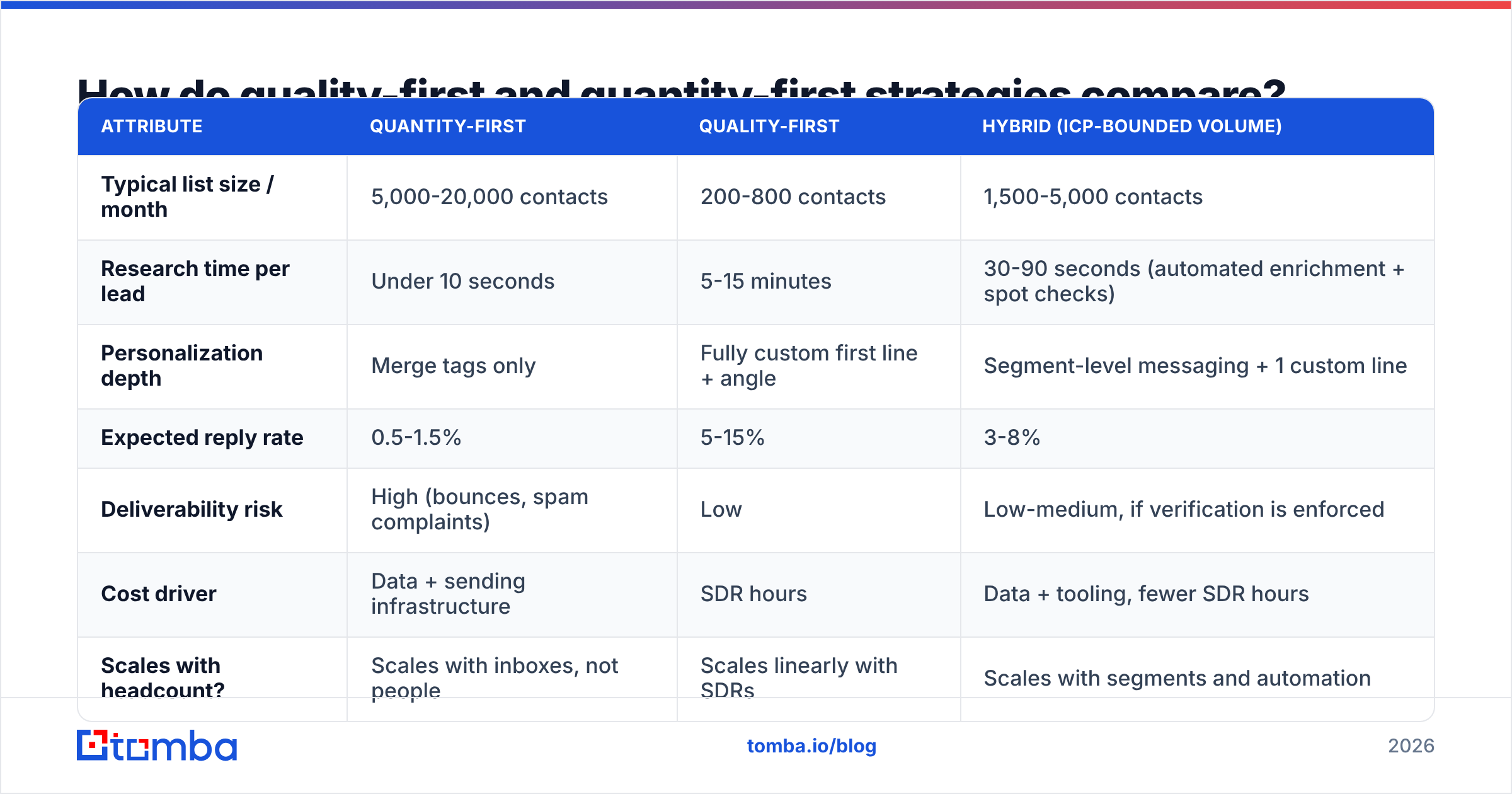
This is how the two pure strategies, plus the hybrid most mature teams end up running, compare on the attributes that affect pipeline.
| Attribute | Quantity-first | Quality-first | Hybrid (ICP-bounded volume) |
|---|---|---|---|
| Typical list size / month | 5,000-20,000 contacts | 200-800 contacts | 1,500-5,000 contacts |
| Research time per lead | Under 10 seconds | 5-15 minutes | 30-90 seconds (automated enrichment + spot checks) |
| Personalization depth | Merge tags only | Fully custom first line + angle | Segment-level messaging + 1 custom line |
| Expected reply rate | 0.5-1.5% | 5-15% | 3-8% |
| Deliverability risk | High (bounces, spam complaints) | Low | Low-medium, if verification is enforced |
| Cost driver | Data + sending infrastructure | SDR hours | Data + tooling, fewer SDR hours |
| Scales with headcount? | Scales with inboxes, not people | Scales linearly with SDRs | Scales with segments and automation |
| Best for | Very broad, low-ACV products | Enterprise, ABM, ACV > $50K | Mid-market SaaS and services, most B2B teams |
| Biggest failure mode | Burned domains, ignored sequences | Too few at-bats to hit quota | ICP drift as volume grows |
The reply-rate ranges are directional, taken from typical outbound benchmarks rather than a controlled study. Your numbers will vary by market and offer. Still, the pattern holds almost everywhere: going from mass to targeted multiplies reply rates several times over, and you give up far less volume than it seems.
Is quantity ever the right call?#
Yes, and dismissing volume completely is its own mistake. Quantity makes sense when:
- Your ICP is genuinely broad. If any company with a website and 10+ employees can buy your product (payroll, basic SEO tooling, office supplies), a narrow list leaves money on the table.
- You're still discovering your ICP. Early-stage teams often don't know which segment converts best. Sending moderate volume across four or five hypotheses, then doubling down on the winner, is a legitimate research method.
- Your ACV is low and your sales cycle is short. When a deal is worth $50/month, you can't afford 10 minutes of research per lead. The unit economics force you toward automation and volume.
- You're filling the top of an inbound nurture program, not a cold outbound sequence. Content syndication and webinar lists are expected to be broad, and the nurture track does the qualifying later.
Even in these cases, "quantity" should mean many relevant contacts, not many contacts. Volume inside a defined segment is a strategy. Volume across the whole internet is just spam.
Why does quantity-first outbound break faster in 2026?#
Two changes in the last couple of years moved the math sharply toward quality.
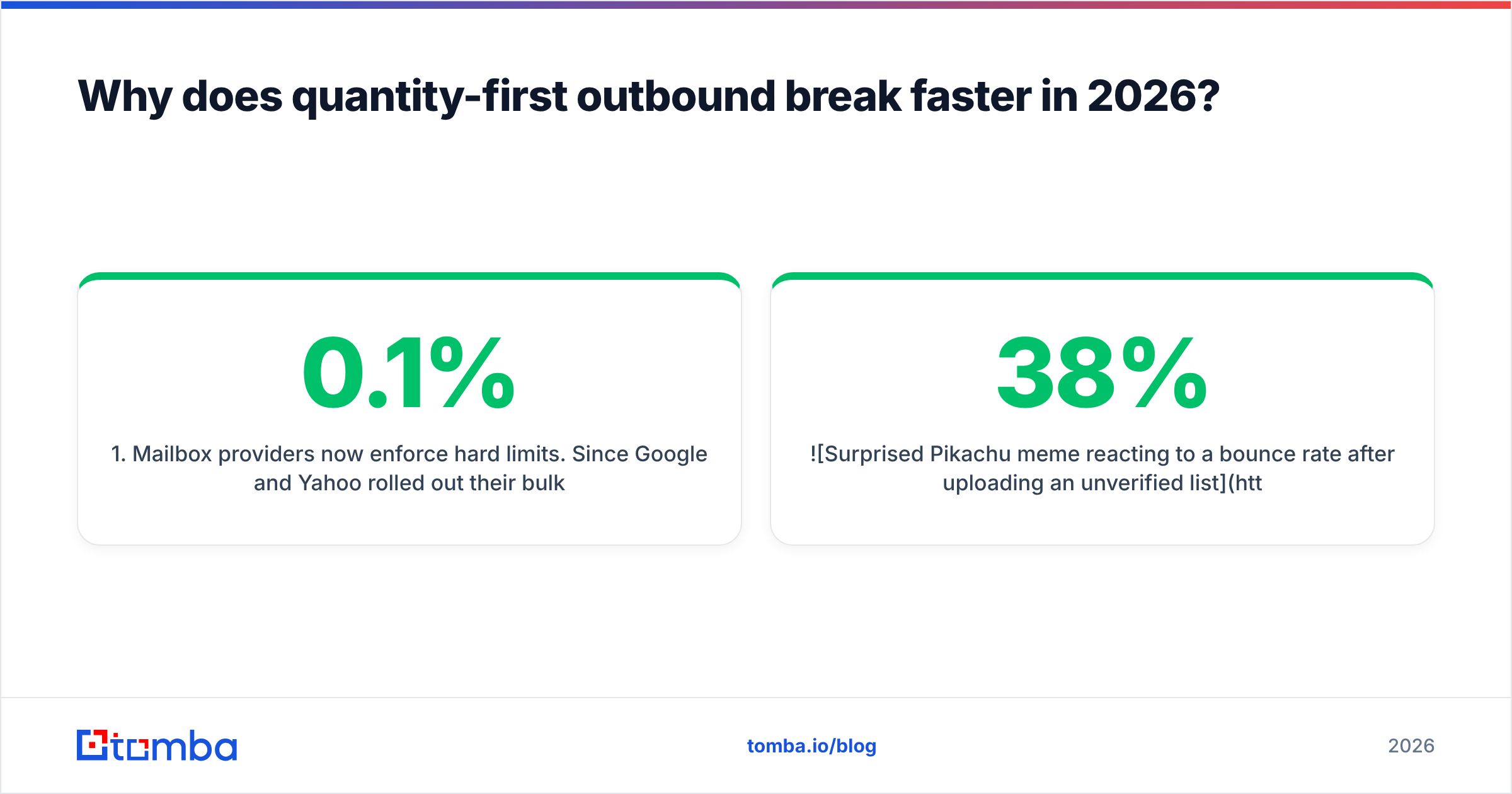
1. Mailbox providers now enforce hard limits. Since Google and Yahoo rolled out their bulk sender requirements, anyone sending at volume has to authenticate properly, offer one-click unsubscribe, and keep spam complaint rates low. Google's sender guidelines say to keep reported spam below 0.1% and never reach 0.3%. A spray-and-pray campaign to unverified, loosely targeted contacts can hit those thresholds within days.
2. Bounces cost you reputation, not just a wasted row. Every hard bounce tells the receiving server that you don't know who you're emailing. Too many and your email deliverability drops across the whole domain, which means your emails to your best prospects start landing in spam too. One sloppy list can undo months of good sending.
The end result: quantity no longer costs you a few extra seconds of SDR time. It puts the channel itself at risk.

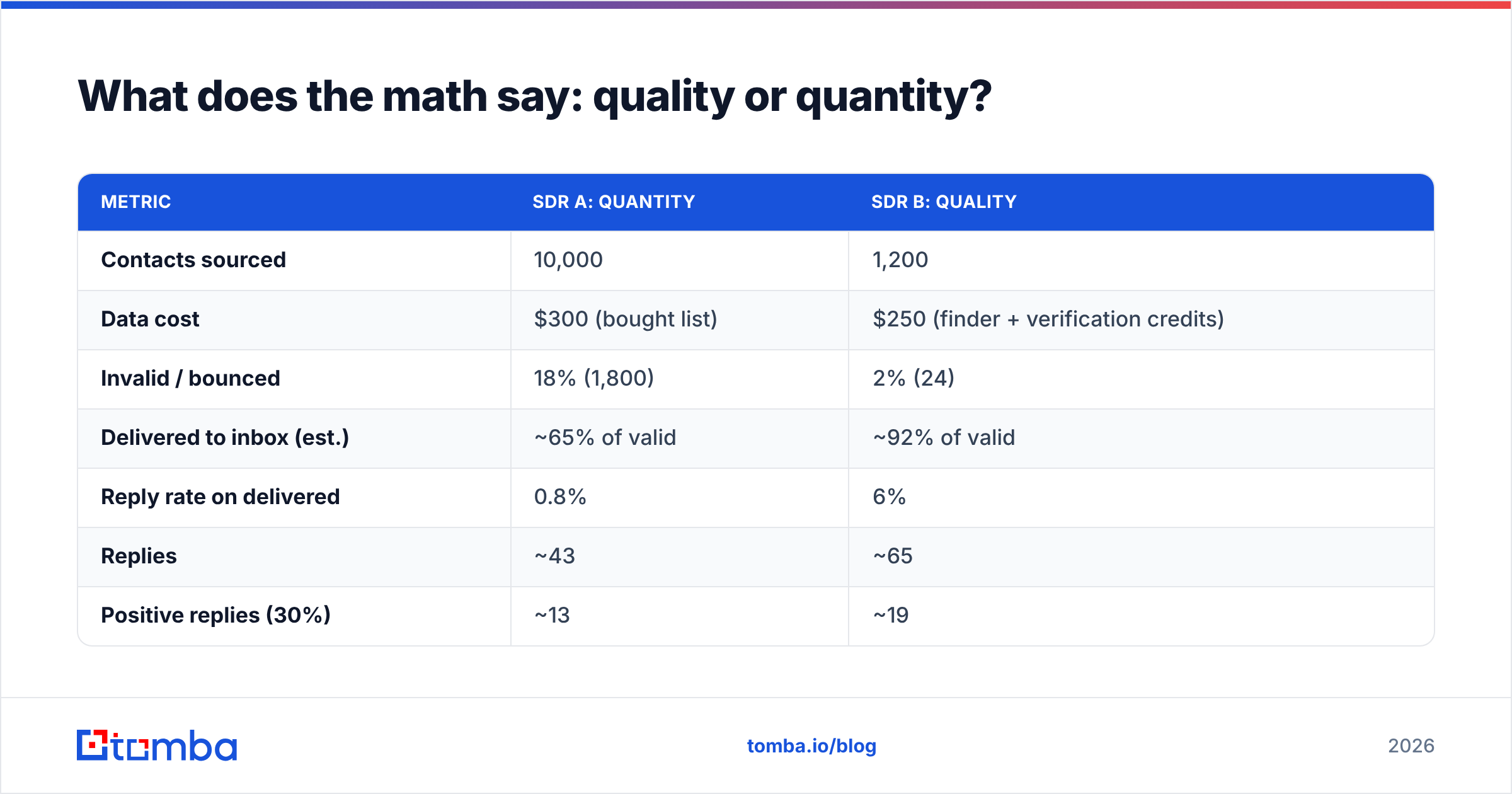
What does the math say: quality or quantity?#
Let's compare two SDRs, each with one month to book meetings. The figures are illustrative, but the structure is how you should model your own funnel.
| Metric | SDR A: Quantity | SDR B: Quality |
|---|---|---|
| Contacts sourced | 10,000 | 1,200 |
| Data cost | $300 (bought list) | $250 (finder + verification credits) |
| Invalid / bounced | 18% (1,800) | 2% (24) |
| Delivered to inbox (est.) | ~65% of valid | ~92% of valid |
| Reply rate on delivered | 0.8% | 6% |
| Replies | ~43 | ~65 |
| Positive replies (30%) | ~13 | ~19 |
| Meetings booked (70% of positive) | ~9 | ~13 |
| Domain health after month | Warning signs | Stable |
SDR B contacted 88% fewer people and booked more meetings. The damage is also asymmetric: SDR A ends the month with a domain that needs recovery time, so next month's numbers start lower.
The takeaway isn't "always pick quality". It's that reply rate multiplies everything else. A 3x increase in reply rate is worth more than a 3x increase in list size, and it doesn't cost you deliverability. Track your response rate by segment, and let it tell you where volume is safe to add.
How do you build a hybrid model that scales quality?#
Hybrid means: be strict about who goes on the list, then be generous about how many of them you reach. This is the operating sequence most high-performing outbound teams run:
- Write down your ICP from closed-won data, not opinion. Pull your last 30-50 won deals from your CRM (a tool like HubSpot or Salesforce makes this a single report). Look for shared headcount bands, industries, tech stacks and buyer titles. That becomes your filter.
- Build segments of 300-1,000 accounts each. Segment by something that changes the message: industry, trigger event, or tech stack. Each segment gets its own angle.
- Source contacts with a finder, not a bought list. Search by domain and role so every contact starts with a fit check. Tools like Tomba, Apollo, BookYourData, RocketReach and others all support domain-plus-title searches. Pick based on coverage in your region and your budget.
- Verify every address before it goes into a sequence. Run the list through an email verifier and handle catch-all domains separately, sending to them at lower volume or backing them up with phone or LinkedIn. This step alone usually decides whether a campaign stays under the 2-3% bounce ceiling.
- Score and tier. Tier 1 (best fit plus a trigger signal) gets manual research and a custom first line. Tier 2 gets segment-level personalization. Tier 3 goes to a lighter nurture track or waits.
- Scale the segments that reply. After 200-300 sends per segment, compare reply rates. Double the volume on segments above your benchmark and cut the ones below it. That's how you grow quantity without giving up quality.
Here the quantity comes after the quality: you only add volume where the data proves fit.
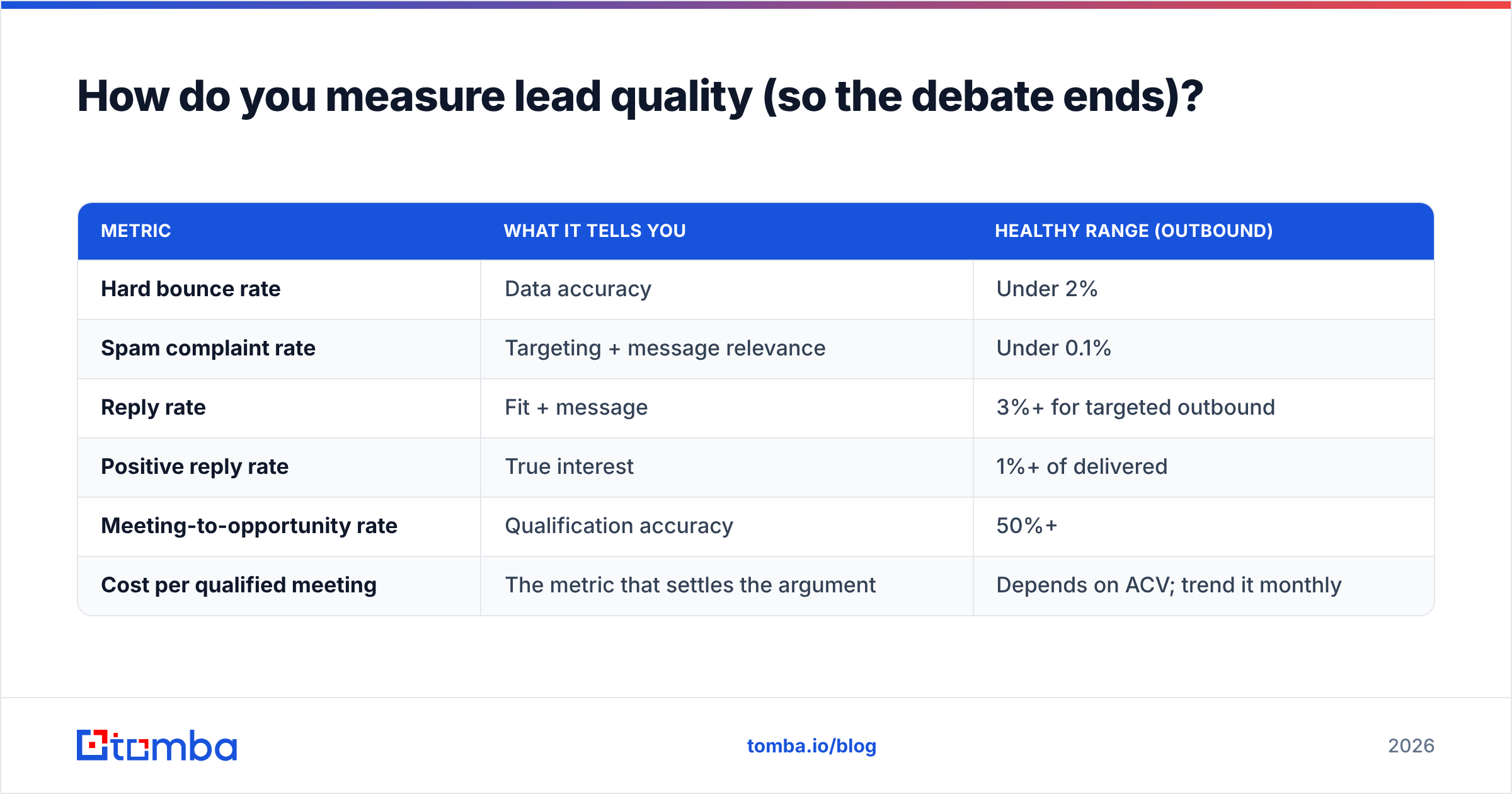
How do you measure lead quality (so the debate ends)?#
Most arguments about quality versus quantity drag on because nobody agreed on a metric up front. Put these on the same dashboard for marketing and sales:
| Metric | What it tells you | Healthy range (outbound) |
|---|---|---|
| Hard bounce rate | Data accuracy | Under 2% |
| Spam complaint rate | Targeting + message relevance | Under 0.1% |
| Reply rate | Fit + message | 3%+ for targeted outbound |
| Positive reply rate | True interest | 1%+ of delivered |
| Meeting-to-opportunity rate | Qualification accuracy | 50%+ |
| Cost per qualified meeting | The metric that settles the argument | Depends on ACV; trend it monthly |
Research firms like Gartner have long pointed out that B2B buying groups are getting bigger and harder to reach. That makes each contact within a real buying committee more valuable, and a random contact outside one worth even less.
If marketing reports lead count and sales reports pipeline, you'll argue forever. Once both teams report cost per qualified meeting, the right mix of quality and quantity for your business usually becomes obvious within a quarter.
Which should you prioritize right now?#
Use your current numbers to decide, not gut feel:
- Bounce rate above 3%? Stop adding volume. Fix your data source and verification first. Nothing else matters until this is solved.
- Reply rate under 1% with clean data? Your targeting or message is off. Tighten the ICP, rewrite for one segment, and test again before scaling.
- Reply rate 3%+ but pipeline still short of target? Now add quantity. Open new segments that look like your best-converting one and scale sending infrastructure gradually.
- Enterprise deals with ACV above $50K? Stay quality-first. Account-based plays with deep research beat volume at this price point almost every time.
- Early stage with an unproven ICP? Run moderate volume across several segments on purpose, measure, then narrow.
So, is lead quality better than quantity?#
For most B2B teams in 2026, yes: quality comes first, and quantity comes second, as a way to scale what already works. The teams that win aren't choosing between the two. They define quality strictly enough that adding volume stays safe. Data accuracy is the cheapest quality gain you can make, because it takes no creative work and no extra SDR hours, just better sourcing and verification.
If you want to build ICP-bounded lists without buying stale databases, start with the Tomba Email Finder. You can search by company domain, name, or role to pull contacts that match your ICP, verify each address before it reaches a sequence, and scale only the segments that reply. The free tier gives you 25 searches a month to test it on your best-fit accounts, and paid plans start at $49/month when you're ready to add volume.
Related guides#
// get started
Find, verify and enrich your first contacts today
Start on the free plan with 25 searches a month, then scale when your team is ready.
Free plan · No credit card required · GDPR & CCPA
// about the author