Lead Ranking: How to Decide Which Leads Your Reps Work First
Lead ranking puts your pipeline in order so reps call the right account first. Here's how the main models compare, which signals matter, and the data problems that quietly break a ranked list.
TL;DR
- Lead ranking puts your leads in order against each other, so reps know who to contact first today. Lead scoring gives each lead a number. Ranking decides the order.
- The strongest setups rank on two separate axes: fit (does this account match your ICP?) and engagement/intent (are they showing buying behavior right now?).
- The model matters less than the data behind it. If emails bounce, job titles are out of date, or firmographics are missing, the ranking just sorts bad records.
- Start with a simple rules-based model, check it against closed-won deals every quarter, and move to predictive scoring only after you have a few hundred outcomes to train on.
- Clean and enrich records before you rank them. That's where most teams lose accuracy without noticing.
What is lead ranking?#
Lead ranking means ordering your open leads by how likely they are to turn into revenue and how soon, so sales time goes to the best opportunities first.
It's easy to confuse with lead scoring. The two are related, but they aren't the same thing:
- Lead scoring gives each lead a value, such as 72 out of 100, based on attributes and behavior. Wikipedia's lead scoring entry describes it as ranking prospects against a scale of perceived value.
- Lead ranking takes those values, plus other factors like recency, ownership, and capacity, and produces an ordered list: call this person first, this one second, and nurture this one for 60 days.
Think of scoring as a thermometer and ranking as the triage nurse. A score of 72 tells you very little alone. It only becomes useful when you know that 72 puts this lead ahead of the 300 others in the queue.
Most teams already have some version of ranking even without calling it that. It might be a "hot leads" view in the CRM, an SDR's sorted spreadsheet, or a gut feeling about which inbound demo requests look serious. The aim is to make that ordering explicit, repeatable, and checked against real outcomes.
Why does lead ranking matter more in 2026?#
Three changes have made prioritization more urgent:
- Volume went up and quality didn't. AI-assisted forms, content syndication, and intent data vendors can fill a pipeline quickly. More leads means more noise, and reps can't work every one.
- Sending limits got stricter. Mailbox providers now penalize high bounce and complaint rates much harder. Sending to your whole list and hoping is no longer a safe strategy. You need to pick who gets contacted.
- Buying committees got bigger. One opportunity can involve five to ten people. Ranking contacts inside an account is now as important as ranking accounts against each other.
The practical result is that a rep who works the top 50 ranked leads with focus will usually beat a rep who works 300 unranked leads with generic sequences, and will do less damage to your domain reputation along the way.
How does lead ranking work? The core building blocks#
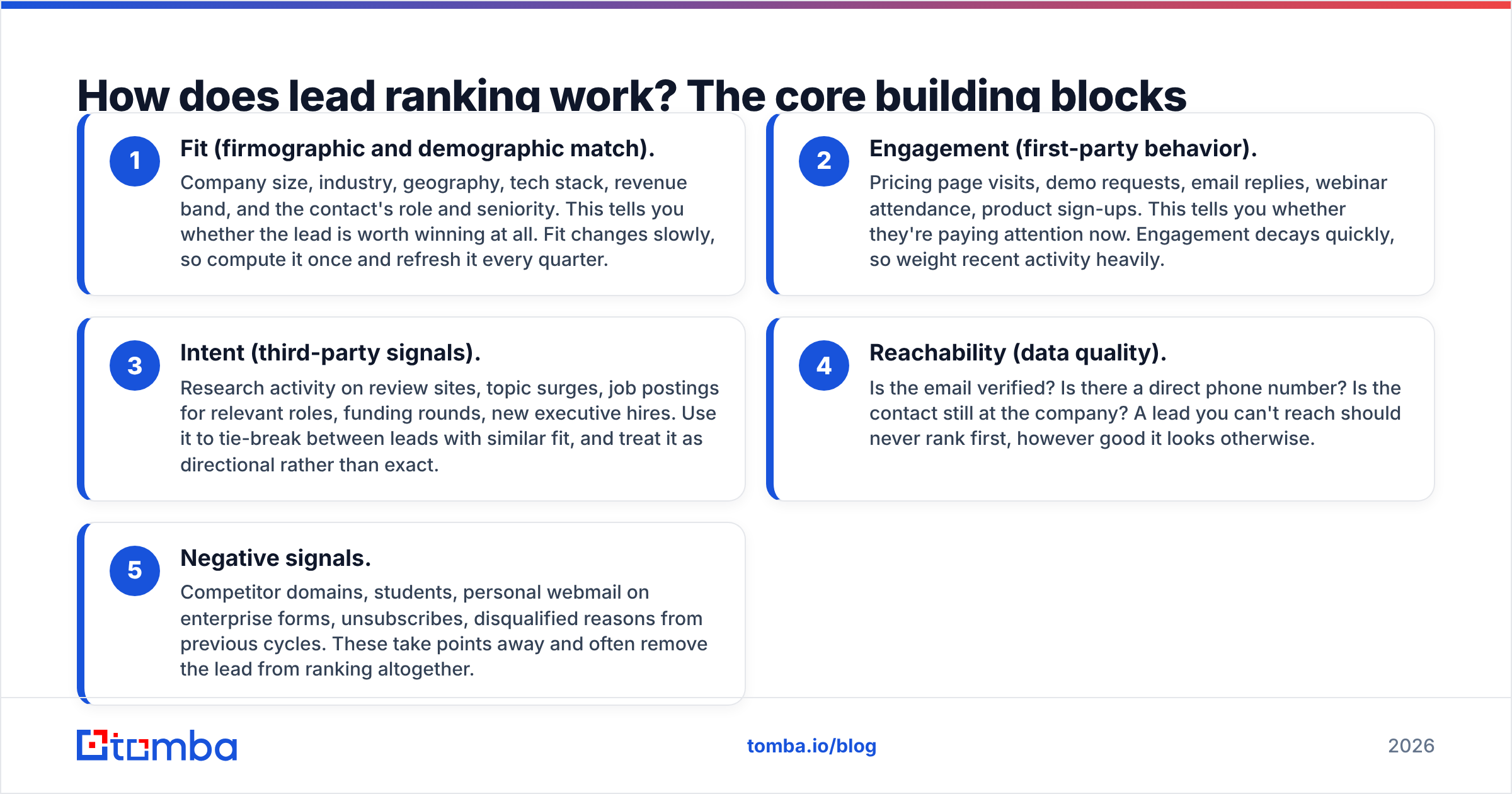
Every workable ranking system uses some mix of these five inputs. Get them right and the choice of model becomes much less important.
- Fit (firmographic and demographic match). Company size, industry, geography, tech stack, revenue band, and the contact's role and seniority. This tells you whether the lead is worth winning at all. Fit changes slowly, so compute it once and refresh it every quarter.
- Engagement (first-party behavior). Pricing page visits, demo requests, email replies, webinar attendance, product sign-ups. This tells you whether they're paying attention now. Engagement decays quickly, so weight recent activity heavily.
- Intent (third-party signals). Research activity on review sites, topic surges, job postings for relevant roles, funding rounds, new executive hires. Use it to tie-break between leads with similar fit, and treat it as directional rather than exact.
- Reachability (data quality). Is the email verified? Is there a direct phone number? Is the contact still at the company? A lead you can't reach should never rank first, however good it looks otherwise.
- Negative signals. Competitor domains, students, personal webmail on enterprise forms, unsubscribes, disqualified reasons from previous cycles. These take points away and often remove the lead from ranking altogether.
Most ranking frameworks skip the fourth input. A strong fit score attached to an email that bounces is worse than useless, because it sends a rep's first touch into a wall and sends a negative signal to Gmail or Outlook.

Which lead ranking model should you use?#
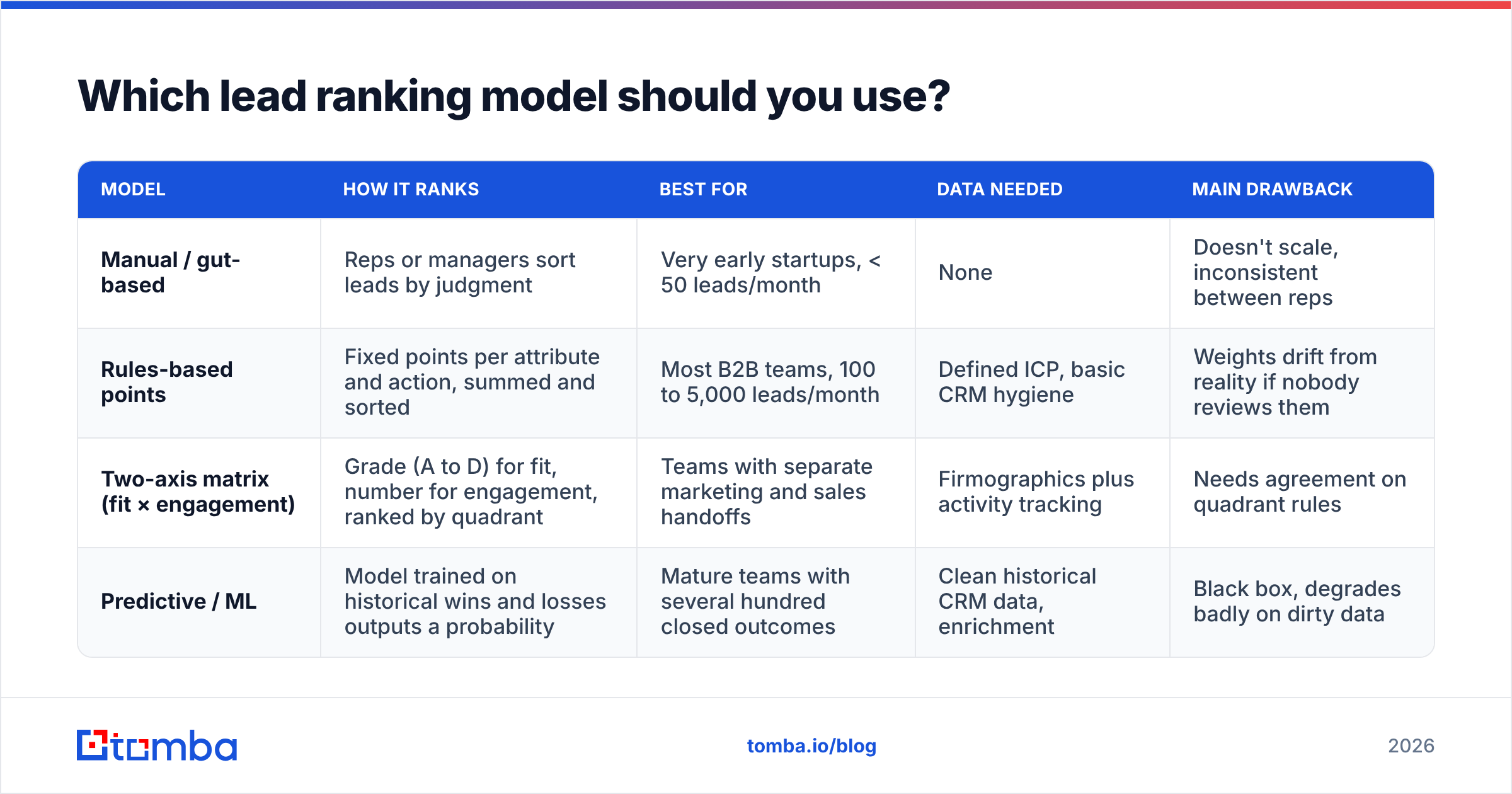
There are four common approaches. They trade off setup effort, transparency, and accuracy.
| Model | How it ranks | Best for | Data needed | Main drawback |
|---|---|---|---|---|
| Manual / gut-based | Reps or managers sort leads by judgment | Very early startups, < 50 leads/month | None | Doesn't scale, inconsistent between reps |
| Rules-based points | Fixed points per attribute and action, summed and sorted | Most B2B teams, 100 to 5,000 leads/month | Defined ICP, basic CRM hygiene | Weights drift from reality if nobody reviews them |
| Two-axis matrix (fit × engagement) | Grade (A to D) for fit, number for engagement, ranked by quadrant | Teams with separate marketing and sales handoffs | Firmographics plus activity tracking | Needs agreement on quadrant rules |
| Predictive / ML | Model trained on historical wins and losses outputs a probability | Mature teams with several hundred closed outcomes | Clean historical CRM data, enrichment | Black box, degrades badly on dirty data |
Rules-based points: the default starting point#
You assign points by hand, for example +20 for a VP title, +15 for 200 to 1,000 employees, +25 for a pricing page visit, and −50 for a competitor domain. Then you sort by the total.
It's transparent, and reps can see why a lead ranks where it does. That matters for adoption. If an SDR can't explain a ranking, they'll ignore it and go back to their own spreadsheet.
The weakness is that the weights are guesses. Revisit them every quarter by comparing the attributes of closed-won deals against the rest of your pipeline.
The two-axis matrix: the most practical upgrade#
Rather than combining fit and engagement into one number, you keep them separate:
- A1 (great fit, high engagement): route to sales within the hour.
- A3 (great fit, low engagement): targeted outbound, since they're the right account but haven't raised a hand yet.
- D1 (poor fit, high engagement): self-serve or nurture. They're interested but unlikely to buy at your price point.
- D3: suppress.
This approach keeps a student who downloads six ebooks from outranking a VP at a perfect-fit account who has visited your site once. It's also the easiest way to line up the marketing qualified lead definition between marketing and sales.
Predictive ranking: powerful once you have the data#
Predictive tools train a model on your historical outcomes and output a conversion probability for each lead. CRMs like Salesforce and HubSpot include versions of this, and G2's lead scoring category lists dozens of standalone options.
It works well when you have enough closed outcomes, usually a few hundred wins and losses at minimum, and when the input fields are consistently filled in. If half your records have no industry or employee count, the model learns to rank on whichever fields happen to be complete. That usually means it's ranking on data quality, not buying likelihood.
How do you build a lead ranking model step by step?#
Here's a practical sequence for a team moving from "whoever emailed last" to a real ranked queue.
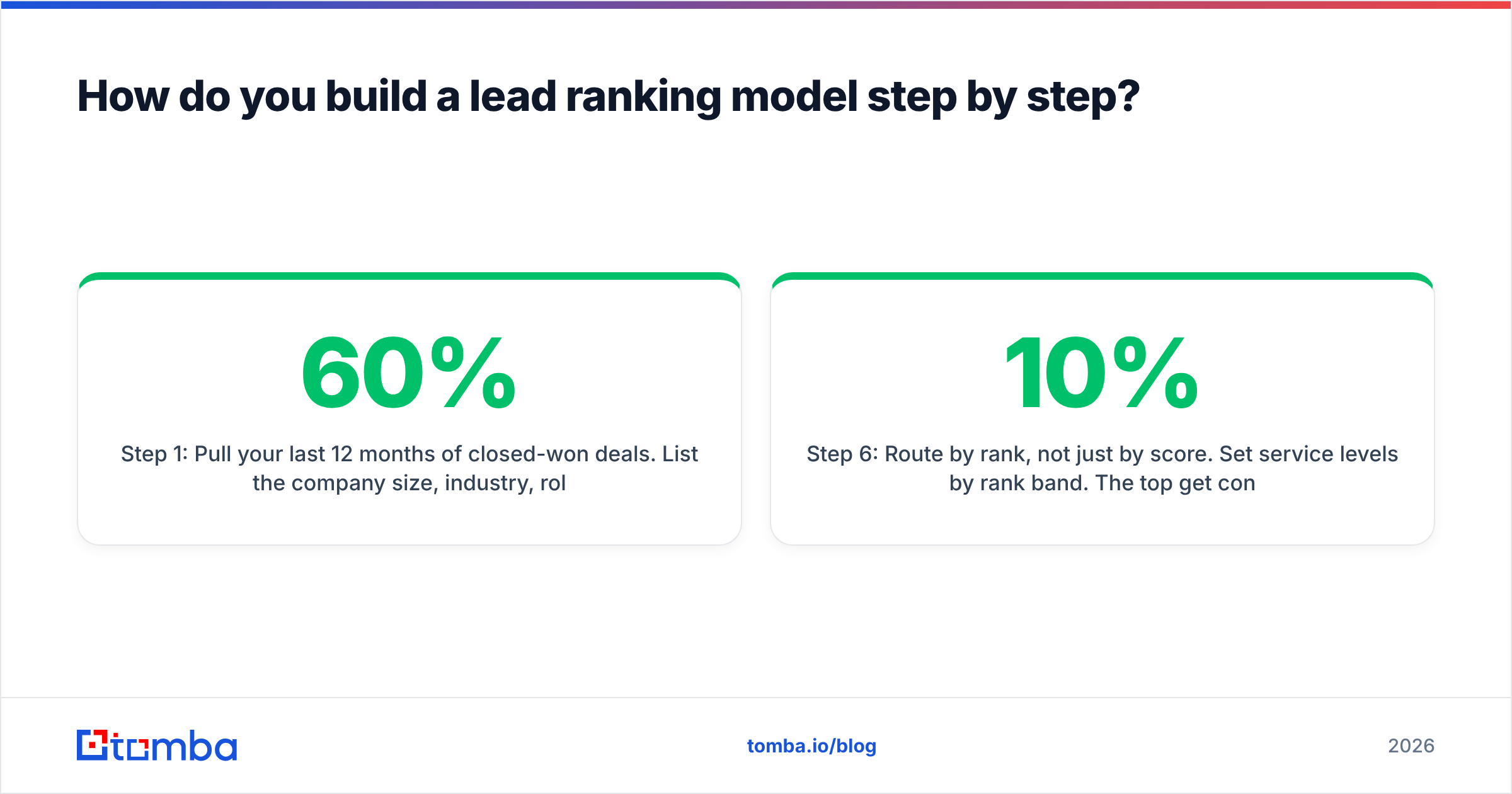
Step 1: Pull your last 12 months of closed-won deals. List the company size, industry, role of the champion, lead source, and the first few actions they took. Look for patterns that show up in at least 60% of wins.
Step 2: Define fit tiers from those patterns. Tier A matches all of your core attributes, Tier B matches most, Tier C matches a few, and Tier D matches none or hits a disqualifier. Keep it to four tiers. More granularity only adds noise.
Step 3: Pick 5 to 8 engagement actions and weight them. High-intent actions such as a demo request, pricing page visit, or email reply get high points. Low-intent actions such as a blog visit or newsletter open get low points. Add decay: halve engagement points every 14 to 30 days.
Step 4: Add a reachability gate. A lead can't enter the top tier of the queue without a verified email or a validated direct phone number. This one rule stops more wasted rep time than any weighting change.
Step 5: Enrich before you score. Fill in missing firmographic fields, confirm job titles, and find verified contact data for the decision-makers at Tier A accounts. Data enrichment run before scoring means your fit tier reflects the actual company, not an empty CRM field that defaulted to zero.
Step 6: Route by rank, not just by score. Set service levels by rank band. The top 10% get contacted within an hour, the next 30% within a day, and the rest go into nurture sequences.
Step 7: Review quarterly against outcomes. Compare conversion rates by rank band. If your top band doesn't convert at least two to three times better than the middle band, your weights are wrong.
What are the most common lead ranking mistakes?#
Most failed ranking projects fail in the same few ways.
- Ranking on stale data. B2B contact data decays quickly as people change jobs, get promoted, or leave. A contact who ranked A last spring may have left the company. Re-verify contact data on a schedule, not only at import.
- Letting engagement swamp fit. Without separating the axes, highly active but unqualified leads rise to the top and fill rep calendars with calls that go nowhere.
- No decay. A pricing page visit from eight months ago shouldn't carry the same weight as one from yesterday. Without decay, old leads stay at the top indefinitely.
- Ignoring reachability. This is the bounce problem again. If your top 100 includes 30 undeliverable addresses, you've burned sends, hurt your sender reputation, and taught reps not to trust the list. Run everything through an email verifier before it reaches the top of a queue.
- Setting weights once and forgetting them. Markets shift, your ICP changes, and product-led motions add new signals. A model nobody has reviewed in a year is just a historical record.
- Ranking only accounts, not people. In a buying committee, the right account with the wrong contact still stalls. Rank contacts within each account by role relevance and reachability.

Which tools help with lead ranking?#
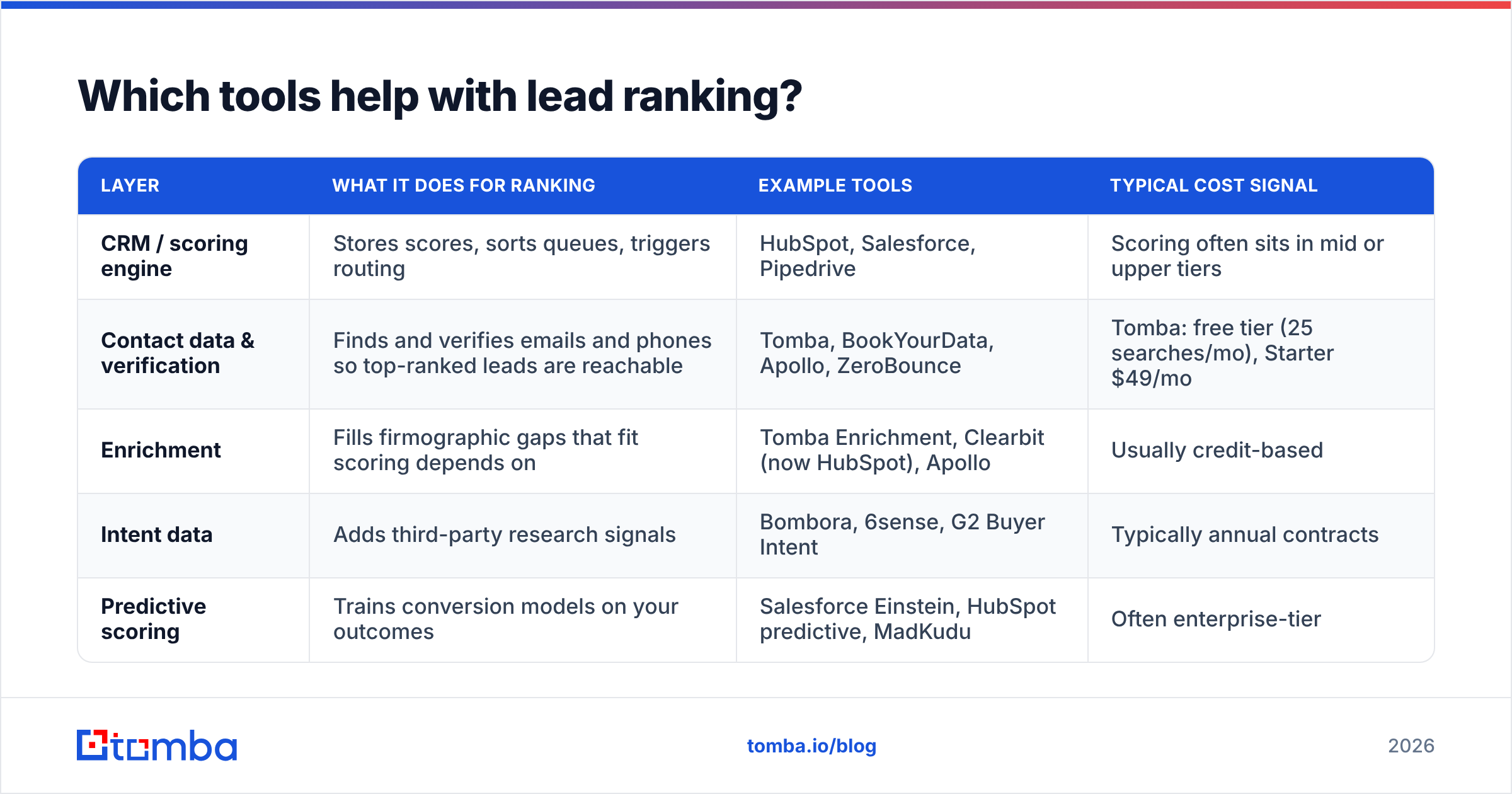
You don't need one platform that does everything. Most teams put ranking together from three layers: a CRM that stores and sorts, a data layer that makes records complete and reachable, and optionally a predictive or intent layer on top.
| Layer | What it does for ranking | Example tools | Typical cost signal |
|---|---|---|---|
| CRM / scoring engine | Stores scores, sorts queues, triggers routing | HubSpot, Salesforce, Pipedrive | Scoring often sits in mid or upper tiers |
| Contact data & verification | Finds and verifies emails and phones so top-ranked leads are reachable | Tomba, BookYourData, Apollo, ZeroBounce | Tomba: free tier (25 searches/mo), Starter $49/mo |
| Enrichment | Fills firmographic gaps that fit scoring depends on | Tomba Enrichment, Clearbit (now HubSpot), Apollo | Usually credit-based |
| Intent data | Adds third-party research signals | Bombora, 6sense, G2 Buyer Intent | Typically annual contracts |
| Predictive scoring | Trains conversion models on your outcomes | Salesforce Einstein, HubSpot predictive, MadKudu | Often enterprise-tier |
A few honest notes on the data layer:
- Tomba is a strong choice when your priority is finding and verifying emails for specific ranked contacts, whether by domain, by name and company, or in bulk. Its catch-all verification helps with enterprise domains that accept every address, where most verifiers can only return "unknown." Plans run from a free tier through Starter at $49/mo, Growth at $99/mo, and Pro at $249/mo. See Tomba pricing for credit breakdowns.
- BookYourData is a well-regarded option if you want pre-built, filterable contact lists to feed the top of your funnel, and it pairs well with a ranking model that then sorts those lists by fit.
- Apollo combines data and sequencing in one tool, which suits smaller teams that want fewer tools. Some teams still use a separate verifier for high-value accounts.
The combination matters more than any single vendor. A good scoring engine running on unverified data will underperform a spreadsheet running on clean, enriched records.
How do you measure whether your lead ranking works?#
Track these four metrics by rank band, not just across the whole pipeline:
- Conversion rate to opportunity. Your top band should convert well above the others. If the bands look similar, the model isn't separating anything.
- Speed to first touch. Are reps actually working the top of the queue first? Ranking doesn't help if nobody follows it.
- Bounce and connect rates. High bounces in the top band point to a reachability problem, not a scoring problem.
- Win rate and deal size by original rank. Check whether top-ranked leads close at better rates and higher values over a full sales cycle. That's the evidence the model is working.
A simple dashboard with these four views, reviewed monthly, will catch most drift before it turns into a missed quarter.
Is lead ranking worth the effort for small teams?#
Yes, but keep it small. A three-person sales team doesn't need predictive ML. It needs:
- A written ICP with 4 to 5 attributes
- A fit grade (A to D) on every lead
- One or two high-intent triggers that move a lead to the top
- A rule that nothing gets worked without a verified email
That can be built in an afternoon inside most CRMs and will noticeably change how reps spend their mornings. Add sophistication only when volume forces you to.
Start ranking leads you can actually reach#
A ranked list is only as good as the contact data on each row. Before you tune weights or buy a predictive tool, make sure your top-tier accounts have the right decision-makers attached, with verified email addresses your reps can send to with confidence. Tomba Email Finder lets you find professional emails by domain, name, or company, verify them in the same workflow, and push clean records into your CRM before scoring runs. Start on the free plan with 25 searches a month, run it against your current top 25 ranked leads, and see how many were reachable.
Related guides#
Ready to find emails that actually work?
Join 150,000+ professionals who stopped guessing and started sending. Free credits on signup — no credit card required.
Get the Tomba newsletter
Practical outbound tactics and product updates — once every two weeks.
About the author