Lead Scoring in 2026: How to Build a Model Sales Actually Trusts
Most lead scoring models end up rewarding people who click things, not people who buy. Here is how to build a fit + intent model with real point values, score decay, and a calibration loop your sales team will trust.
TL;DR
- Lead scoring ranks your prospects by how likely they are to buy, so reps call the best leads first and ignore the rest.
- Every model that works scores two things separately: fit (does this company and person match your ICP?) and intent (are they acting like a buyer right now?).
- Rules-based scoring is the right place to start for most teams under about 1,000 closed deals a year. Predictive scoring needs volume and clean data before it's worth paying for.
- Bad contact data is the quiet reason most models fail. If emails bounce and job titles are stale, your scores are wrong before anyone looks at them.
- Recalibrate every quarter against closed-won deals, and make intent points decay so a pricing-page visit from last March stops counting.
What is lead scoring?#
Lead scoring gives each lead a number based on how closely it matches your ideal customer and how strongly it is signaling purchase intent. Leads above a threshold go to sales. Leads below it stay in marketing nurture or get disqualified.
The concept has been around since marketing automation platforms first appeared (the Wikipedia entry on lead scoring covers the history). What has changed is the input data. In 2026 you can combine firmographics, technographics, website visitor identification, product usage, and third-party intent feeds. Having that many inputs means you can overweight the wrong ones much more easily than before.
A good model answers one question for a rep at 9 a.m. on Monday: who do I contact first, and why? If it can't answer that clearly, it's a dashboard nobody opens.
Why does lead scoring matter for B2B sales teams?#
It stops reps from spending their best hours on bad leads. Without scoring, reps work leads in whatever order they arrive, or they cherry-pick recognizable logos. With scoring, they work leads in order of expected value.
The effects you'll notice:
- Faster speed-to-lead on the right accounts. High-fit, high-intent leads get routed within minutes instead of sitting in a shared queue.
- Cleaner marketing-to-sales handoff. A marketing qualified lead becomes a number both teams agreed on, so there's less argument about what "qualified" means.
- Better forecasting. When you know the historical conversion rate of leads scoring 80+, you can project pipeline from the top of the funnel.
- Honest marketing attribution. Campaigns get judged on how many high-score leads they produce, not raw form fills.
How does a lead scoring model actually work?#
Every durable model has the same components, whichever tool runs it. These are the parts you need to design:
- Fit score (who they are). Company size, industry, geography, revenue, tech stack, and the contact's seniority and department. This measures whether the lead could buy from you.
- Intent score (what they're doing). Pricing-page visits, demo requests, webinar attendance, email replies, product sign-ups, third-party intent topics. This measures whether they want to buy now.
- Negative scoring. Competitors, students, job seekers, personal email domains, unsubscribes, and hard bounces subtract points. Most teams skip this, and it's the main reason their MQL lists fill up with junk.
- Score decay. Intent points lose value over time. A demo-page visit from 90 days ago shouldn't carry the same weight as one from yesterday.
- Thresholds and routing. Define what score makes a lead an MQL, what makes it sales-ready, and who owns it at each stage.
- Feedback loop. Closed-won and closed-lost outcomes go back into the model so you can reweight attributes that predicted revenue and cut the ones that didn't.
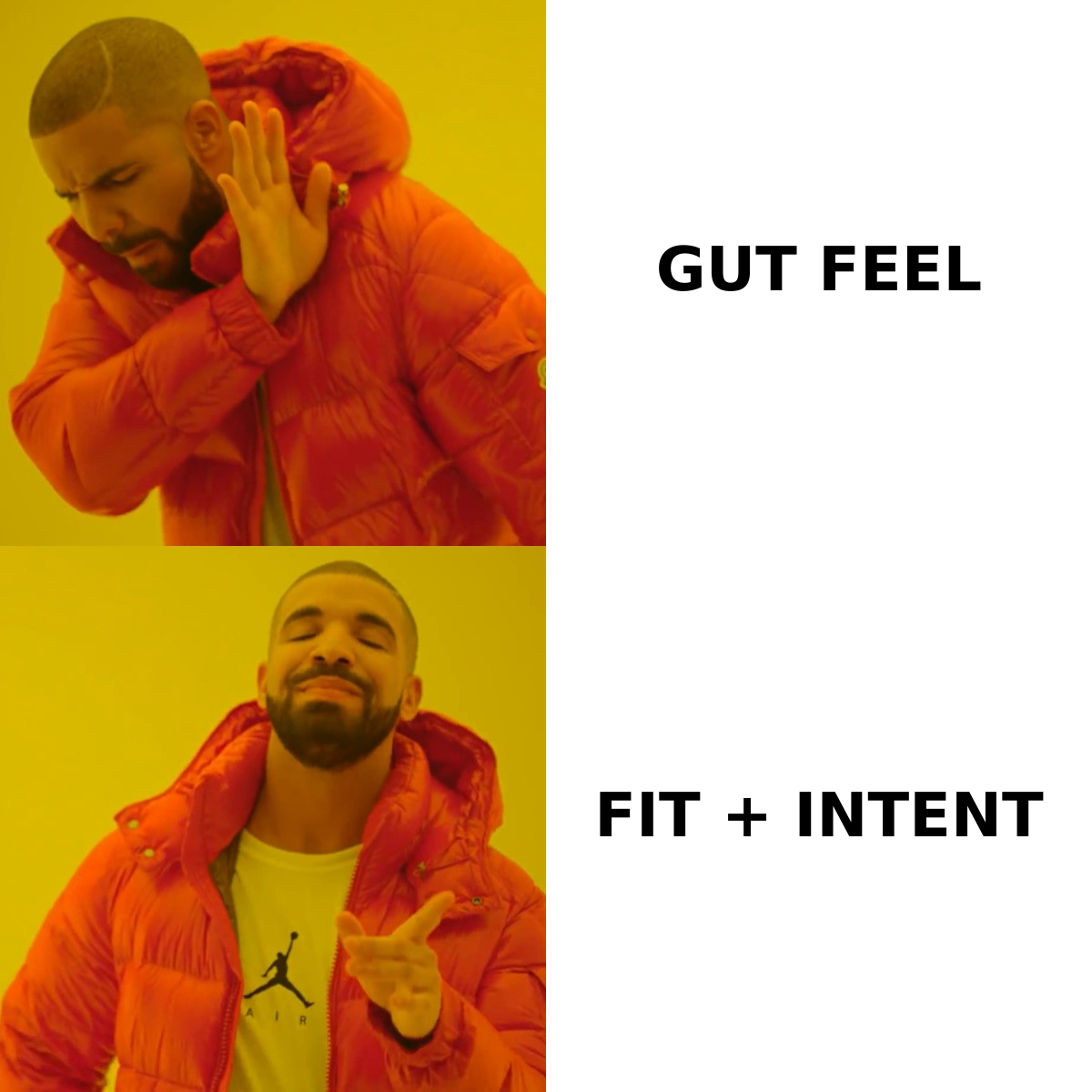
Keep fit and intent as two separate scores instead of adding them into one number. A VP of Sales at a 500-person SaaS company who hasn't engaged yet (high fit, low intent) needs a different play from a student who downloaded five ebooks (low fit, high intent). If you merge the two, those leads can end up with the same total.
A simple 2x2 grid makes routing obvious:
| High intent | Low intent | |
|---|---|---|
| High fit | Route to sales now (A1) | Outbound, account-based play (A2) |
| Low fit | Qualify quickly or self-serve (B1) | Nurture or disqualify (B2) |
What should you score? (Sample point values)#
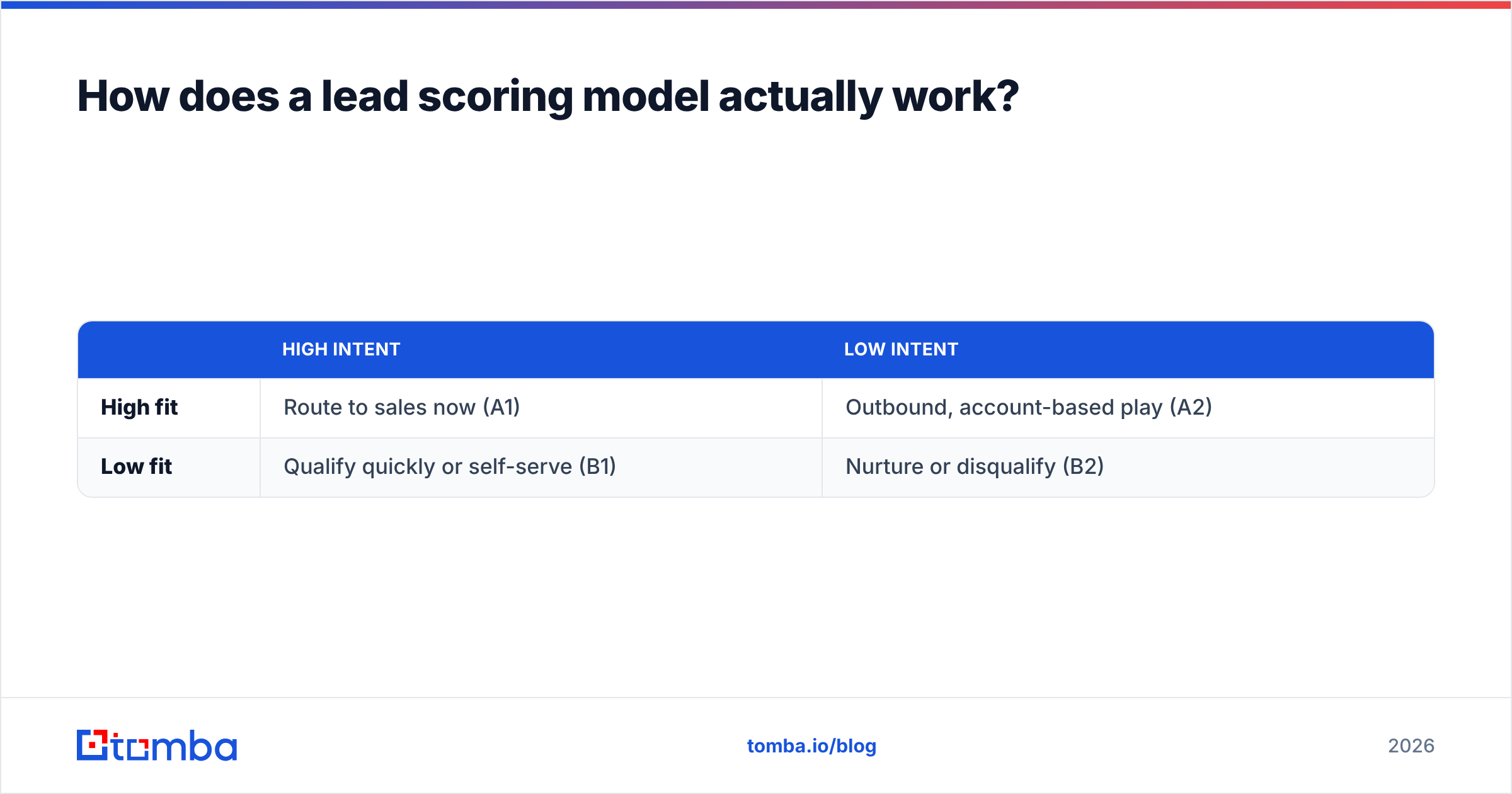
Start from something concrete and tune it. The values below are a reasonable starting template for a mid-market B2B SaaS company. Adjust them to your own closed-won data as soon as you have it.
| Attribute | Type | Example rule | Points |
|---|---|---|---|
| Company size | Fit | 50-1,000 employees | +15 |
| Industry | Fit | Matches top 3 ICP verticals | +10 |
| Seniority | Fit | Director, VP, or C-level | +15 |
| Department | Fit | Sales, RevOps, or Marketing | +10 |
| Tech stack | Fit | Uses a CRM you integrate with | +10 |
| Pricing page visit | Intent | 2+ visits in 7 days | +20 |
| Demo request | Intent | Form submitted | +30 |
| Email reply | Intent | Any positive reply | +15 |
| Webinar attended | Intent | Attended live (not just registered) | +8 |
| Personal email domain | Negative | Gmail, Yahoo, Outlook.com | -15 |
| Competitor domain | Negative | Known competitor | -100 |
| Hard bounce | Negative | Email invalid | -50 |
| Inactivity | Decay | No engagement for 30 days | -25% of intent score |
Rules of thumb:
- Scale points to observed conversion. If demo requests close at 10x the rate of webinar attendees, the points should reflect roughly that ratio, not a gut guess like 30 vs 20.
- Cap intent from low-value actions. Ten blog visits shouldn't outweigh one pricing-page visit. Set a ceiling per activity type.
- Separate the thresholds. A common setup is fit ≥ 40 and intent ≥ 30 for MQL. Needing both prevents a high number in one dimension from hiding a zero in the other.
Rules-based vs predictive lead scoring: which should you use?#
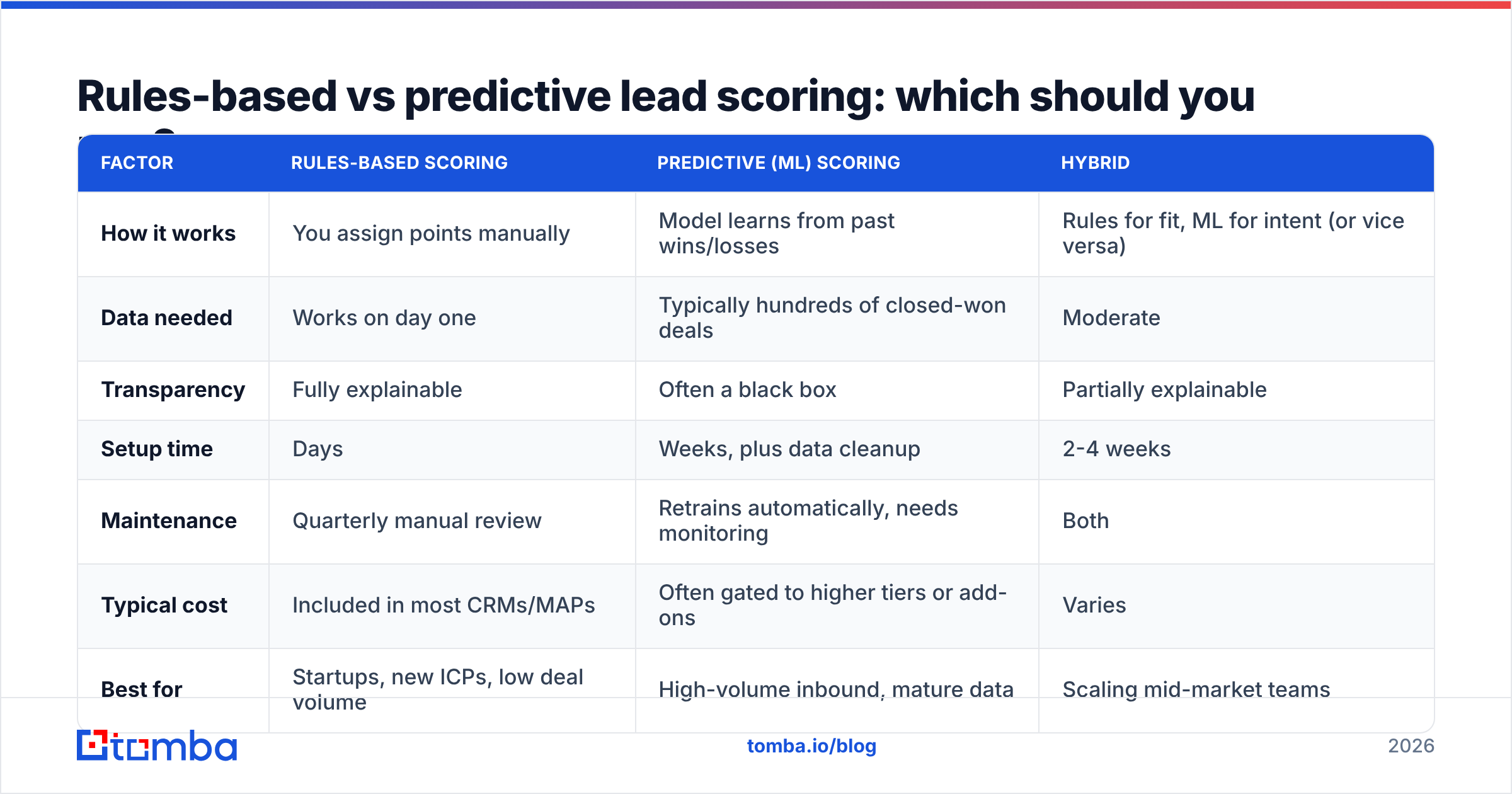
For most teams, start rules-based and move to predictive once you have the volume. Here's how the two approaches (plus a hybrid) compare:
| Factor | Rules-based scoring | Predictive (ML) scoring | Hybrid |
|---|---|---|---|
| How it works | You assign points manually | Model learns from past wins/losses | Rules for fit, ML for intent (or vice versa) |
| Data needed | Works on day one | Typically hundreds of closed-won deals | Moderate |
| Transparency | Fully explainable | Often a black box | Partially explainable |
| Setup time | Days | Weeks, plus data cleanup | 2-4 weeks |
| Maintenance | Quarterly manual review | Retrains automatically, needs monitoring | Both |
| Typical cost | Included in most CRMs/MAPs | Often gated to higher tiers or add-ons | Varies |
| Best for | Startups, new ICPs, low deal volume | High-volume inbound, mature data | Scaling mid-market teams |
| Biggest risk | Stale assumptions | Garbage in, garbage out | Complexity |
Most major platforms now offer both. HubSpot includes manual scoring in its Marketing and Sales Hubs and predictive scoring on higher tiers. Salesforce offers rules-based scoring in Account Engagement and predictive scoring through Einstein. Check the current edition requirements before you plan around a specific feature, because both vendors change packaging often.
Predictive models are good at spotting non-obvious patterns, such as "companies that hired two SDRs in the past 60 days close at 3x." Their weakness is also the reason they're useful: they learn from your history. If your CRM has duplicate records, missing industries, and 20% invalid emails, the model learns those errors along with everything else.
Why do most lead scoring models fail?#
Usually the problem isn't the scoring logic. It's one of these:
1. The data underneath is wrong. Fit scoring depends on accurate company size, industry, and job title. If a lead came in with only a name and a Gmail address, it has no fit score at all. If the contact changed jobs six months ago, the score describes someone who no longer works there. Running data enrichment at the point of capture fills in firmographics and titles before scoring runs, so a model never has to score a blank record.
2. Sales wasn't involved. If marketing builds the model alone, it tends to reward content engagement. Sales then ignores the MQLs, and marketing responds by adding more points for content. Put two senior reps in the design session and have them veto attributes.
3. No negative scoring. Without deductions, anyone who engages enough eventually crosses the threshold, including job seekers researching your company and competitors studying your pricing.
4. Scores never decay. Six months of accumulated low-value engagement can push a dormant lead into the MQL queue. Decay keeps the score about current behavior.
5. Nobody recalibrates. Your ICP moves as you launch products, move upmarket, or enter new regions. A model built for 2024's customers will misroute 2026's leads.
6. Invalid emails count as engagement. Some systems still score "email sent" or "added to sequence" as activity. A bounced email should cost points, and ideally it gets caught with an email verifier before it ever enters a sequence and hurts your sender reputation.
How do you build a lead scoring model step by step?#
Here's a practical sequence that works for a team setting up scoring for the first time or rebuilding a broken model.
Step 1: Pull your last 12 months of closed-won and closed-lost deals. Export company size, industry, contact title, lead source, and the key activities before conversion. If you have fewer than 50 wins, add the best current customers as a qualitative sample.
Step 2: Find the differences. Compare won vs lost. Which industries convert at 2x the average? Which titles show up in won deals but rarely in lost ones? Which activities come before a demo? These are your highest-weighted attributes.
Step 3: Define fit and intent separately. Build the fit rubric from firmographic and demographic attributes and the intent rubric from behavioral ones. Keep each on a 0-100 scale so they're easy to read.
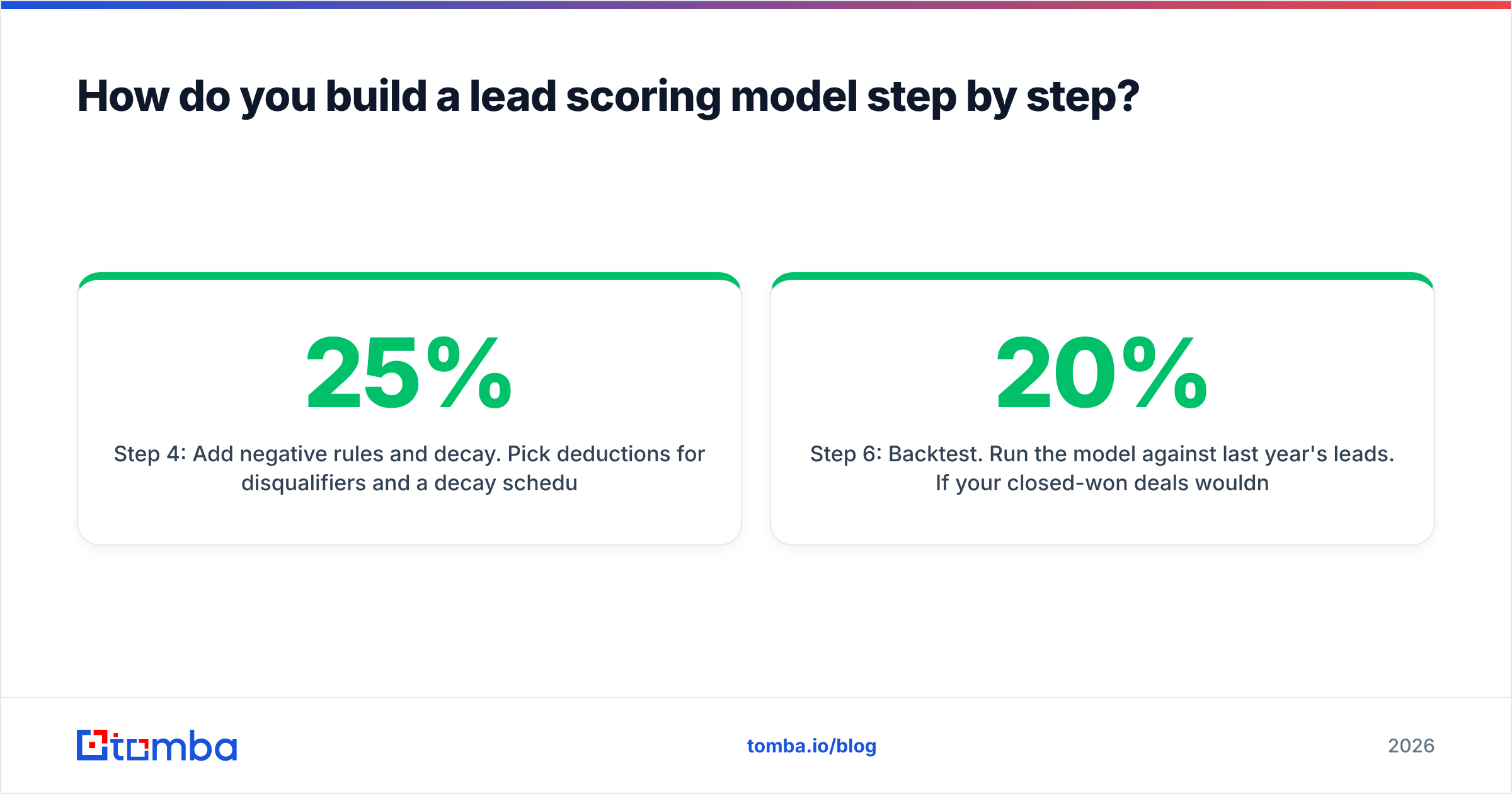
Step 4: Add negative rules and decay. Pick deductions for disqualifiers and a decay schedule for intent (for example, 25% reduction after 30 days of inactivity, 50% after 60).
Step 5: Set thresholds with sales. Agree on what makes an MQL and an SQL, and write down the SLA. For example, sales contacts A1 leads within 1 business hour and gives feedback on every rejected MQL within 48 hours.
Step 6: Backtest. Run the model against last year's leads. If your closed-won deals wouldn't have scored in the top 20%, the weights are off. Fix that before launch.
Step 7: Launch, then review every quarter. Track MQL-to-SQL conversion by score band. If leads scoring 60-70 convert the same as 80-90, your top band isn't adding signal and needs reweighting.

What metrics tell you whether lead scoring is working?#
Watch these every month:
- MQL-to-SQL conversion rate by score band. Higher bands should convert noticeably better. If the curve is flat, the model isn't separating good leads from bad ones.
- MQL acceptance rate. The share of MQLs sales accepts rather than rejects. Below about 50% usually means sales doesn't trust the model.
- Speed-to-lead for top-tier leads. Scoring is wasted if an A1 lead waits two days for a reply.
- Win rate by score at creation. This is the final test: did high-scoring leads produce revenue?
- Percentage of leads with complete fit data. If 30% of new leads are missing company size or title, fix enrichment before you touch any weights.
Analyst firms like Gartner have argued for years that B2B buying groups are getting larger and buyers are doing more research on their own before contacting sales. Individual lead scores can miss that. Consider rolling contact scores up into an account score so that three mid-engagement contacts from one company surface together instead of each staying below the threshold.
How does data quality affect lead scoring accuracy?#
It sets the upper limit on accuracy. A well-designed model on bad data will be confidently wrong.
Three data problems do the most damage:
- Missing fields. An inbound form with just "name + email" gives the model no fit inputs. Short forms help conversion, so enrich on the back end instead of adding fields to the form.
- Stale records. B2B contact data decays quickly as people change roles and companies. A lead scored as "VP at target account" who left last quarter is a false positive.
- Invalid or unverified emails. These inflate lead counts, hurt deliverability for every outbound touch, and can trigger negative scores that bury real buyers who simply mistyped.
The fix is operational. Verify emails at capture, enrich company and role data automatically, and re-verify older records before they re-enter sequences. For outbound-sourced leads, start from verified addresses tied to real roles, so the fit score is accurate from the moment the record is created.
Frequently asked questions about lead scoring#
What is a good lead score threshold? There's no universal number. Set it so the leads above it convert to opportunities at a rate sales considers worth working, often 2-3x your baseline conversion rate. Backtest before you commit to a threshold.
How often should you update a lead scoring model? Review quarterly and rebuild whenever your ICP, pricing, or core product changes significantly. Decay rules keep it current in between.
Should lead scoring include cold outbound leads? Yes, but mostly on fit. Outbound leads have no intent signals until they engage, so let fit decide who gets sequenced and let intent points (replies, clicks, meetings) move them up once they respond.
Is predictive lead scoring better than manual? Only with enough clean historical data. With a few dozen wins and messy CRM fields, a transparent rules-based model will usually do better and is easier to debug.
What's the difference between lead scoring and lead grading? In some platforms "score" means intent/engagement and "grade" means fit (for example, an A-F letter). It's the same fit-plus-intent idea with different labels.
What's the bottom line on lead scoring?#
Lead scoring works when you keep it simple, keep it honest, and keep it current. Score fit and intent separately, subtract points for disqualifiers, decay old activity, and recalibrate against closed-won deals every quarter. Most importantly, make sure the data going in is accurate, because a sophisticated model can't make up for bounced emails and outdated job titles.
If your scoring model keeps flagging leads with missing titles, unknown companies, or undeliverable addresses, start with the data. Tomba Email Finder finds verified professional email addresses by name, company, or domain, so every lead that enters your CRM already has the contact and company details your fit score depends on. Try it on the free tier (25 searches a month) and see how many more of your leads can be scored accurately.
Related guides#
// get started
Find, verify and enrich your first contacts today
Start on the free plan with 25 searches a month, then scale when your team is ready.
Free plan · No credit card required · GDPR & CCPA
Get the Tomba newsletter
Product and data updates
// about the author