Lead Scoring and Qualification: A Practical 2026 Framework
Most lead scores reward whoever clicked the most, not whoever is most likely to buy. Here is a fit-plus-intent framework for lead scoring and qualification, with point values, decay rules, and the data hygiene that makes it work.
TL;DR
- Lead scoring ranks leads by how likely they are to buy. Lead qualification decides what to do with each one: route it, nurture it, or drop it. You need both, and they run in that order.
- Score two things separately. Fit is who they are (firmographics, role, tech stack). Intent is what they are doing (pricing page visits, demo requests, replies). A single blended number hides which one is missing.
- Most scoring models fail because of the data underneath them, not the math. Missing job titles, bounced emails, and duplicate records push the wrong leads to the top.
- Start with a simple rules-based model of about 10 signals and add score decay. Review it against closed-won deals every quarter before you pay for predictive scoring.
- Qualification frameworks (BANT, MEDDIC, CHAMP) belong in the sales conversation. Scoring decides who gets that conversation.
What is lead scoring and qualification?#
Lead scoring gives each lead a number based on how closely it matches your ideal customer and how engaged it is. Lead qualification is the decision you make from that number: is this lead ready for sales, does it need more nurturing, or is it outside your market?
A hospital emergency room is a good comparison. Triage nurses don't treat anyone. They check vital signs, assign a priority level, and send each patient to the right place. Lead scoring is taking the vitals. Qualification is the triage decision. The sales call is the treatment.
In practice the two get mixed together because they share one field in your CRM. Keep them apart in your head anyway. A score is a probability estimate. Qualification is a routing rule with an owner and a service-level agreement attached. When reps complain that "marketing sends us junk," the scoring model usually isn't the whole problem. More often nobody agreed on what the qualification threshold means or who acts on it.
The standard definition on Wikipedia's lead scoring entry covers the basics: it's a way to rank prospects against a scale of perceived value. The rest of this guide is about making that ranking something your sales team will actually trust.
Why do most lead scoring models fail?#
They usually fail in one of four predictable ways, and only one of them involves the model itself.
- Engagement inflation. A student downloads six ebooks and ends up with a higher score than a VP who visited your pricing page once. If you add fit and intent into one number, heavy content consumers float to the top.
- No decay. A lead that was hot eleven months ago is still marked "hot." Points pile up and never expire, so your MQL list fills with people who stopped caring long ago.
- Garbage inputs. The form asked for a work email, the lead typed a Gmail address, the job title field is blank, and company size was never filled in. Fit scoring can't score fields that don't exist.
- No feedback loop. Nobody compares scores against closed-won and closed-lost deals, so the model keeps the assumptions it was built on in year one.

The third failure deserves the most attention because it quietly breaks everything after it. A fit score built on 40% empty firmographic fields is a guess. That's why teams that score well put money into data enrichment before they touch the scoring logic: they fill in title, seniority, company size, industry, and a verified work email so the model has real input to work with.
What are the core components of a lead score?#
A usable model has five building blocks. Each one answers a different question, and each should be visible on its own in your CRM, not just summed into one number.
- Firmographic fit. Is the company inside your ICP? Industry, headcount, revenue band, geography, and tech stack. This is usually the heaviest-weighted part because it rarely changes.
- Persona fit. Is this person someone who buys, influences, or blocks deals? Seniority, department, and function. A marketing coordinator and a CMO at the same account shouldn't score the same.
- Behavioral intent. What have they done lately? Demo requests, pricing page views, trial signups, replies to outbound, webinar attendance. Weight actions that point to buying above actions that point to curiosity.
- Negative signals. What rules them out? Competitor domains, student or personal emails, job seekers visiting your careers page, unsubscribes, hard bounces. Subtract points for these, or disqualify outright.
- Decay. How recent is the intent? Behavioral points should lose value over time, usually 25–50% per month of inactivity, so the score reflects current interest and not history.
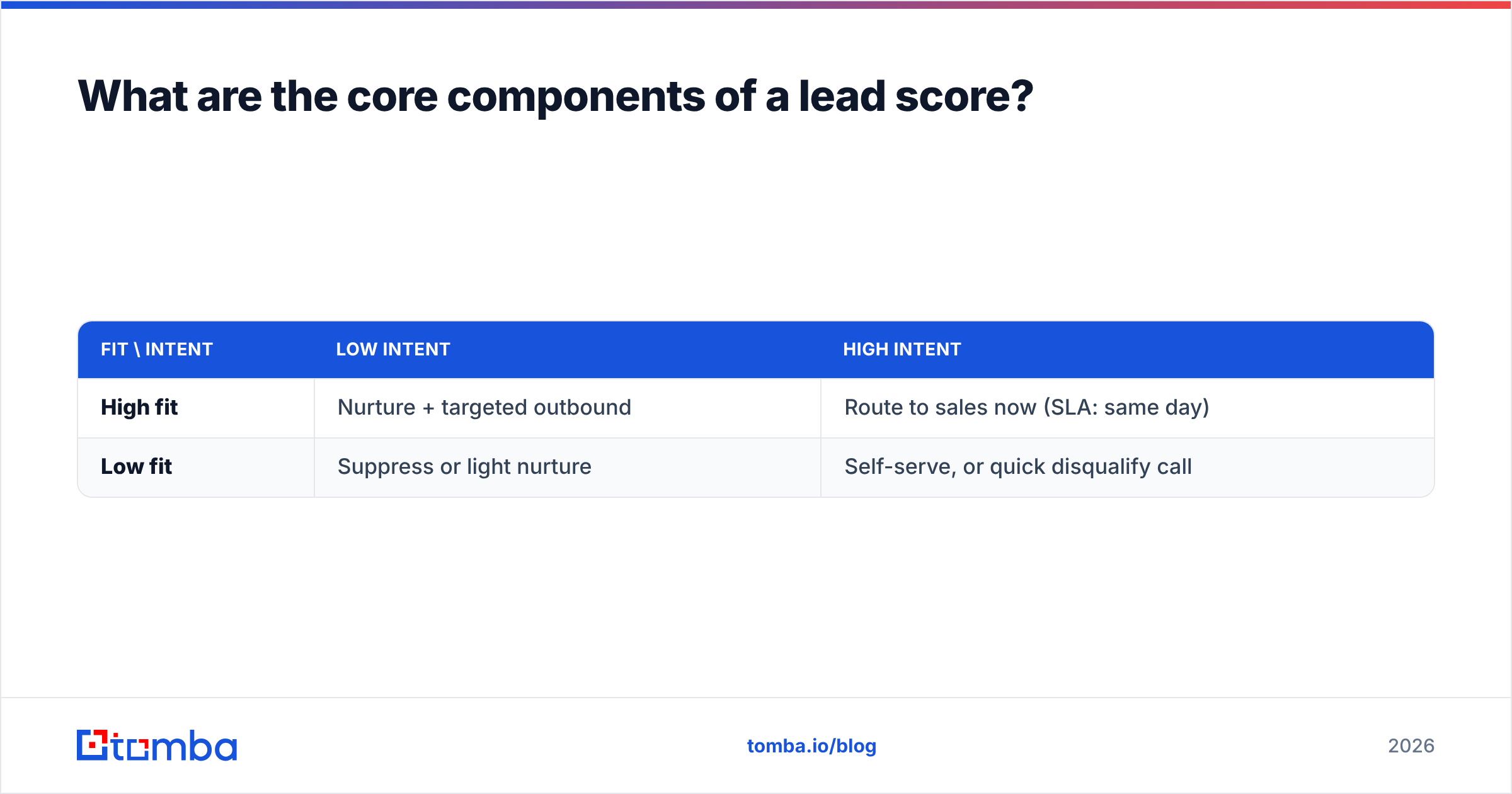
Tracking fit and intent as two separate axes gives you a simple 2x2 grid that sales reps understand right away:
| Fit \ Intent | Low intent | High intent |
|---|---|---|
| High fit | Nurture + targeted outbound | Route to sales now (SLA: same day) |
| Low fit | Suppress or light nurture | Self-serve, or quick disqualify call |
The top-right cell is your real MQL. The top-left cell is where outbound SDRs should prospect. The bottom-right cell catches the ebook-heavy student before a rep wastes a call on them.
How do you assign point values?#
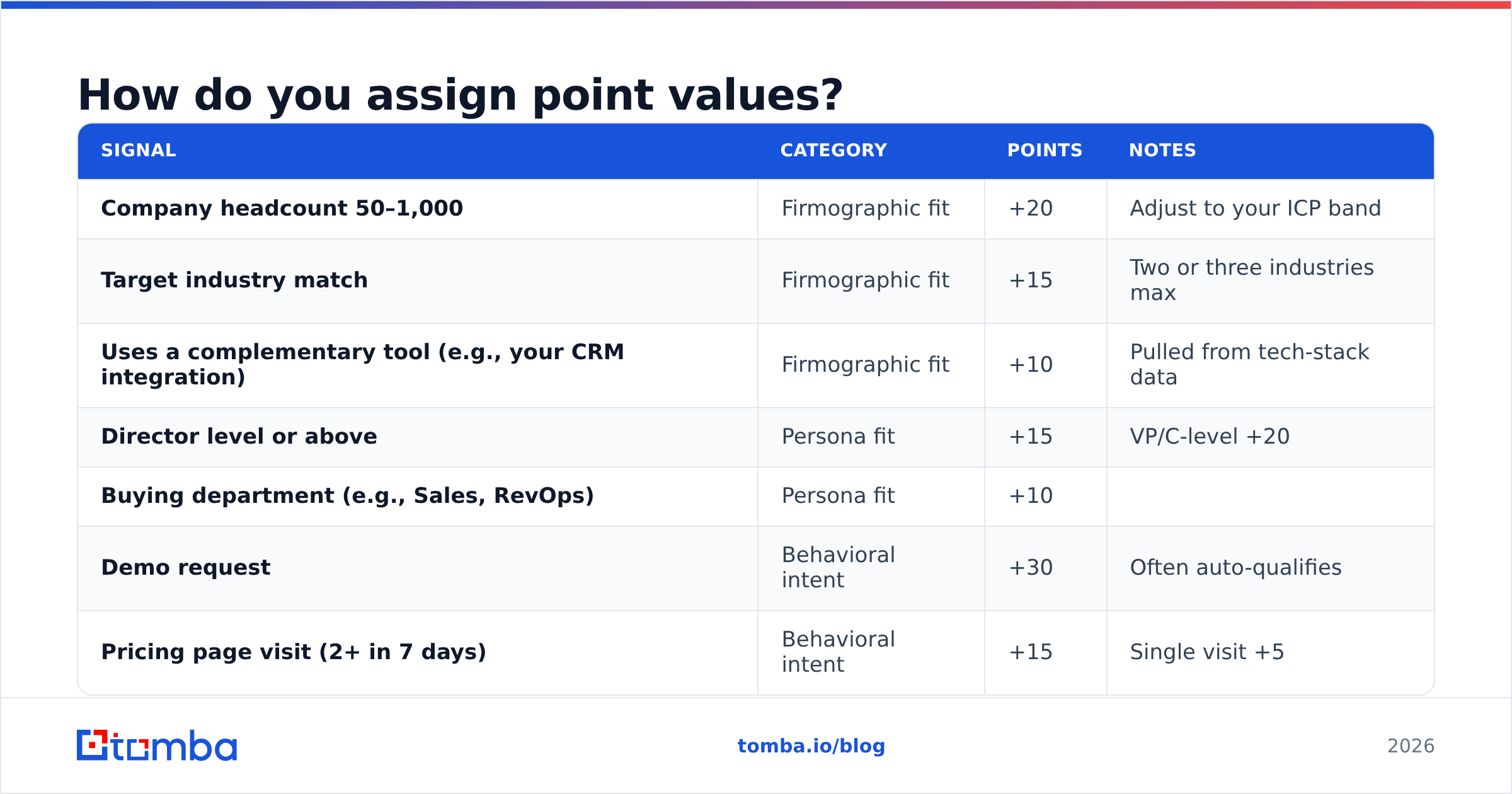
Start with rules you can explain to a rep in one sentence each. Here's a starter model for a mid-market B2B SaaS team. Treat the numbers as a baseline you'll adjust, not a benchmark.
| Signal | Category | Points | Notes |
|---|---|---|---|
| Company headcount 50–1,000 | Firmographic fit | +20 | Adjust to your ICP band |
| Target industry match | Firmographic fit | +15 | Two or three industries max |
| Uses a complementary tool (e.g., your CRM integration) | Firmographic fit | +10 | Pulled from tech-stack data |
| Director level or above | Persona fit | +15 | VP/C-level +20 |
| Buying department (e.g., Sales, RevOps) | Persona fit | +10 | |
| Demo request | Behavioral intent | +30 | Often auto-qualifies |
| Pricing page visit (2+ in 7 days) | Behavioral intent | +15 | Single visit +5 |
| Positive reply to outbound email | Behavioral intent | +20 | |
| Webinar attended (not just registered) | Behavioral intent | +5 | |
| Personal email domain | Negative | −15 | Unless you sell to SMB/freelancers |
| Competitor domain | Negative | Disqualify | |
| Hard bounce | Negative | −25 | Also flag for re-verification |
| No activity for 30 days | Decay | −25% of behavioral points | Compounds monthly |
A few design rules keep this honest:
- Cap each category. For example, fit maxes out at 60 and intent maxes out at 60. That way no amount of content downloads can make up for a bad-fit account.
- Set the MQL threshold by working backward. Pull your last 50 closed-won deals and score them as they looked when they first came in. Put the threshold where it would have caught about 80% of them.
- Give demo requests a fast lane. A high-fit lead asking for a demo shouldn't have to wait for a score to add up. Route it immediately.
If you use a marketing automation platform, the scoring engine is probably already built in. HubSpot's marketing tools and Salesforce's Account Engagement both support separate fit and engagement scores. The hard part isn't the software. It's agreeing on the rules.
Which qualification framework should you use?#
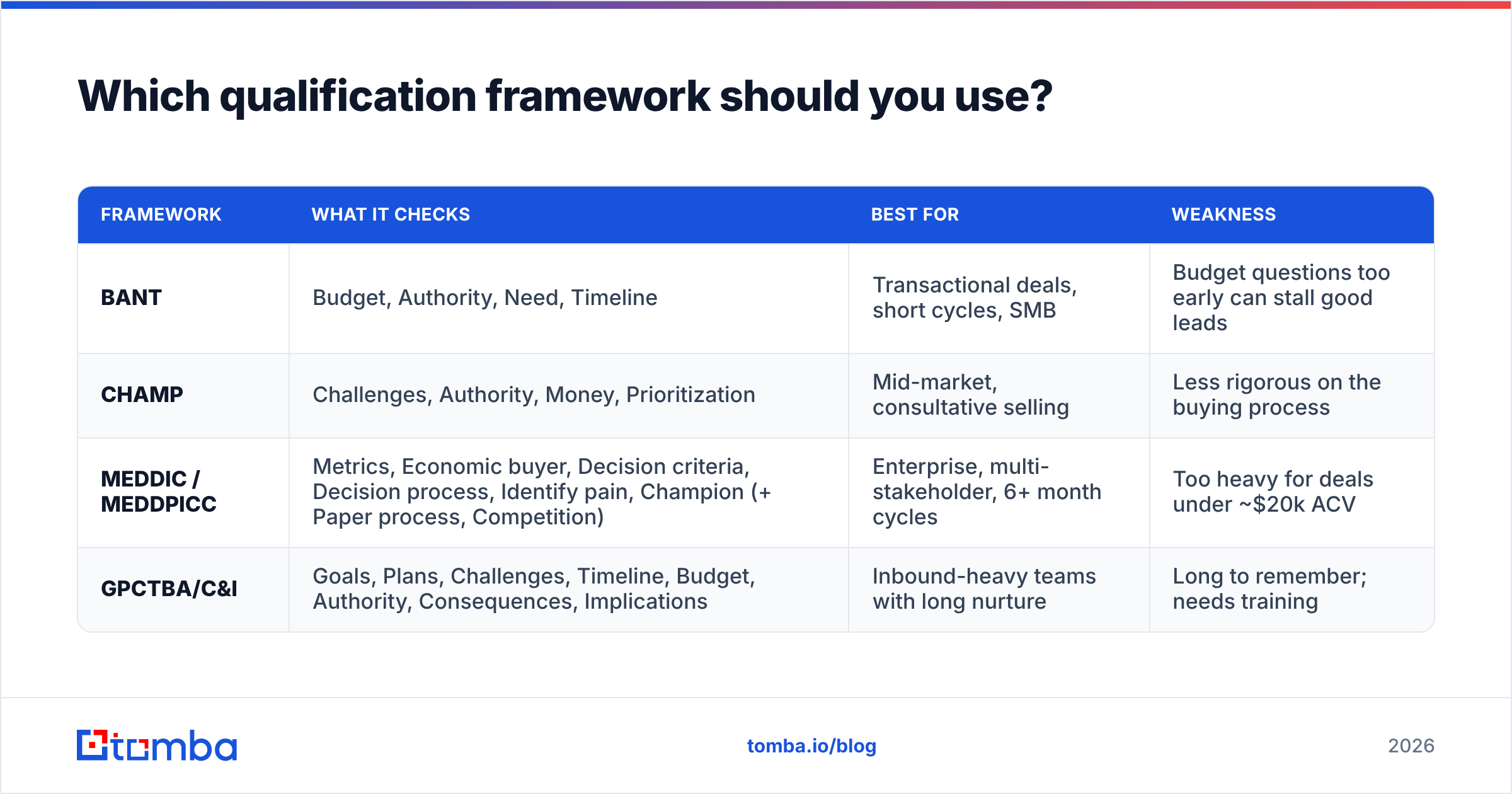
Scoring gets a lead to a rep. The qualification framework shapes what the rep checks on the first call. The three most common options suit different deal sizes:
| Framework | What it checks | Best for | Weakness |
|---|---|---|---|
| BANT | Budget, Authority, Need, Timeline | Transactional deals, short cycles, SMB | Budget questions too early can stall good leads |
| CHAMP | Challenges, Authority, Money, Prioritization | Mid-market, consultative selling | Less rigorous on the buying process |
| MEDDIC / MEDDPICC | Metrics, Economic buyer, Decision criteria, Decision process, Identify pain, Champion (+ Paper process, Competition) | Enterprise, multi-stakeholder, 6+ month cycles | Too heavy for deals under ~$20k ACV |
| GPCTBA/C&I | Goals, Plans, Challenges, Timeline, Budget, Authority, Consequences, Implications | Inbound-heavy teams with long nurture | Long to remember; needs training |
Many teams use a hybrid. Scoring handles the "should we talk?" question automatically, and reps use a small set of BANT or CHAMP questions on the discovery call to decide between a sales-accepted lead (SAL) and recycling it to nurture.
The handoff matters more than which framework you pick. Write down three definitions and get sign-off from both sales and marketing leadership:
- Marketing qualified lead (MQL): crosses the score threshold. Marketing owns it until it's accepted.
- Sales accepted lead (SAL): a rep has reviewed it and agrees it's worth a conversation. The acceptance deadline is typically 24–48 hours.
- Sales qualified lead (SQL): passed the discovery call against your chosen framework. An opportunity gets created.
If a lead sits as an MQL for a week without being accepted or rejected, you have a process problem, not a scoring problem.
How does data quality change your lead scores?#
Data quality decides whether your scores mean anything. Every point in the fit half of the model depends on a field somebody filled in correctly.
Take a typical inbound form fill. You get a first name, a last name, and an email address, and maybe a company name if the form asked. Without enrichment, the fit score for that lead is basically zero, however perfect the account might be. With enrichment, you can add title, seniority, company headcount, industry, and tech stack before the scoring rules run.
The email address causes its own problems. If it bounces, you can't nurture the lead, and your intent signals stop flowing. If it's a catch-all domain, you don't know whether messages are landing. Running new leads through an email verifier at the point of capture, and re-verifying anything older than about 90 days, stops a surprising number of high-scoring leads from turning out to be dead ends.
A practical order of operations:
- Capture — keep forms short. Ask for work email and name, and let enrichment fill in the rest.
- Verify — check deliverability right away. Flag catch-alls and route personal emails to a separate rule.
- Enrich — add firmographic and persona fields from a B2B data provider.
- Deduplicate — merge with existing contacts and accounts so intent signals roll up correctly.
- Score — run fit and intent rules on the clean record.
- Route — assign by territory, segment, and score band.
Outbound-sourced leads need the same pipeline. If your SDRs are building lists by account, a tool that can find email addresses by name and domain, verify them, and attach role data gives your scoring model complete records from day one. That's far better than half-empty rows imported from a spreadsheet.
Should you use predictive lead scoring?#
Maybe, but not yet if you haven't run a rules-based model for at least two quarters.
Predictive scoring uses machine learning to find patterns in your historical conversions. Salesforce Einstein, HubSpot's predictive scoring, and standalone platforms like 6sense and MadKudu all offer versions of it. The upside is real: they can catch signal combinations that no human would write a rule for.
The requirements are strict, though:
- Volume. Most vendors suggest at least a few hundred closed-won deals, plus a larger pool of closed-lost, before the model has enough to learn from. Early-stage companies rarely have that.
- Clean history. The model learns from your CRM exactly as it is. If past records are missing titles or have unverified emails, the predictions inherit that noise.
- Explainability. Reps will ignore a score they can't understand. Choose a tool that shows the top contributing factors for each lead.
Gartner's sales research has pointed out for years that buying groups are getting larger and buyers do more self-directed research before talking to sales. That makes account-level intent more valuable than individual lead scores for enterprise deals. If you sell into large accounts, look at account scoring (summing fit and intent across every contact at a company) before per-lead predictive models.
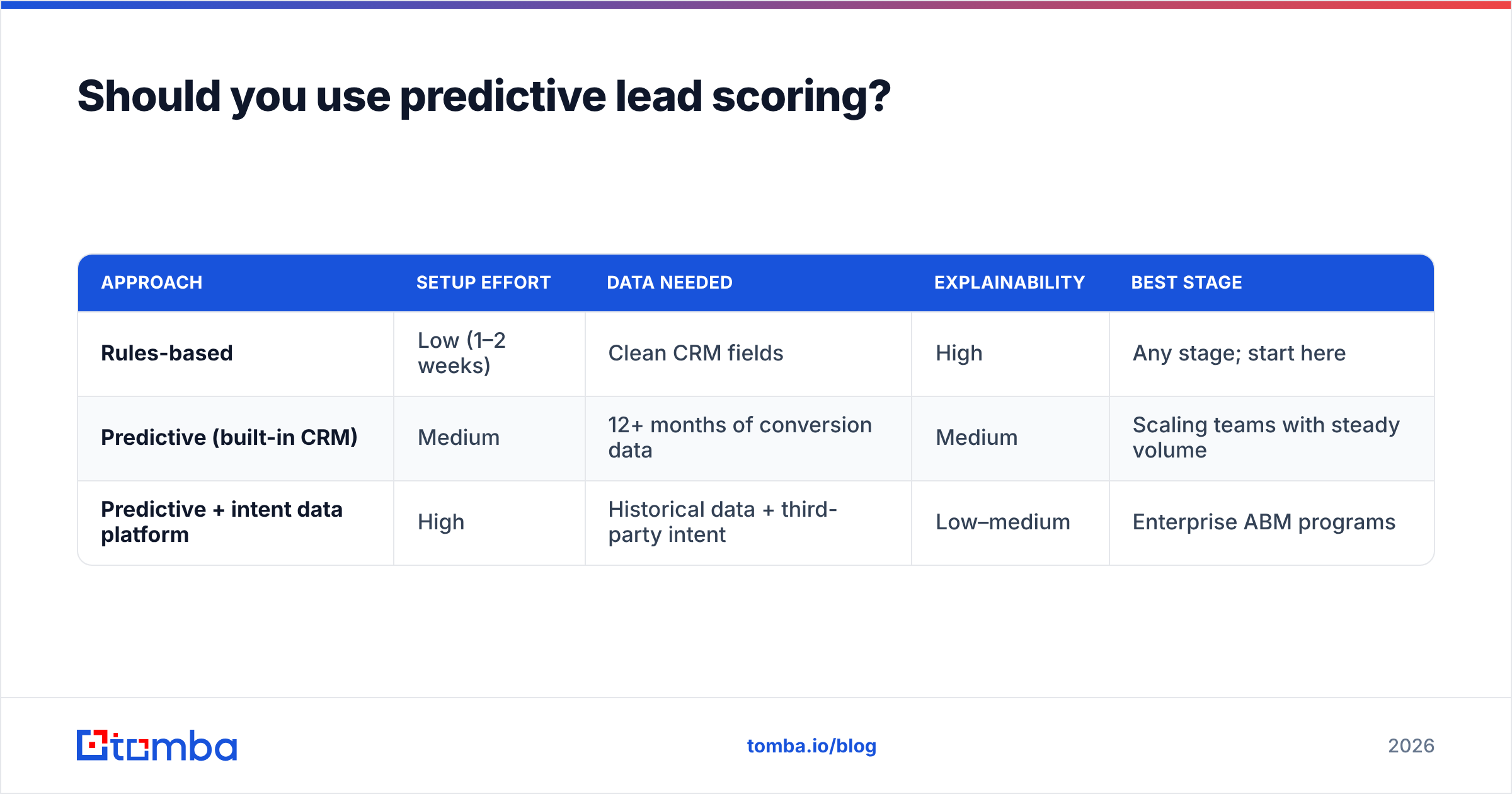
| Approach | Setup effort | Data needed | Explainability | Best stage |
|---|---|---|---|---|
| Rules-based | Low (1–2 weeks) | Clean CRM fields | High | Any stage; start here |
| Predictive (built-in CRM) | Medium | 12+ months of conversion data | Medium | Scaling teams with steady volume |
| Predictive + intent data platform | High | Historical data + third-party intent | Low–medium | Enterprise ABM programs |
How often should you review your scoring model?#
Quarterly, with a light monthly check.
Monthly: look at MQL-to-SAL acceptance rate and MQL-to-SQL conversion rate. If acceptance drops below about 50%, reps don't trust the scores, so find out why before changing any point values.
Quarterly: pull every deal closed in the quarter, both won and lost, and look at what the leads scored when they entered. Three questions tell you most of what you need:
- Did closed-won deals mostly come from the high-fit, high-intent quadrant? If not, your fit criteria are off.
- Which signals show up often in closed-lost deals? Lower their weight.
- Were there wins that never became MQLs? Those are the blind spots in your model, and they usually come from missing data, not missing rules.
Keep a changelog of every rule change and the date you made it. Six months from now, when conversion rates move, you'll want to know whether the market shifted or your model did.
What does a good lead scoring setup look like in practice?#
Here is the setup that works for most B2B teams between 5 and 50 reps:
- Two visible scores in the CRM: Fit (0–60) and Intent (0–60), plus a derived grade (A1, B2, and so on) for quick sorting.
- About 10–15 rules total, each explainable in one sentence.
- Behavioral decay of 25% per 30 days of inactivity.
- Hard disqualifiers for competitors, students, and invalid emails.
- Automatic enrichment and verification on every new record before scoring runs.
- A written MQL/SAL/SQL definition with a 24-hour acceptance SLA.
- A quarterly review against closed deals, with a changelog.
None of this needs an expensive platform. It needs clean records, agreement between sales and marketing, and the discipline to review the model on a schedule.
Where should you start?#
If your lead scores feel random, check your data before rewriting the rules. Pull 50 recent MQLs and count how many have a verified work email, a real job title, and a known company size. If that number is below 80%, fixing it will do more for your lead scoring and qualification than any change to point values.
Tomba Email Finder is a good place to begin. It finds and verifies professional email addresses by name, domain, or company, and returns role and company context your fit score can use. You can test it on the free tier (25 searches a month) against a sample of your current MQLs, then see Tomba pricing if you want to enrich the full pipeline. Plans start at $49/month.
Related guides#
// get started
Find, verify and enrich your first contacts today
Start on the free plan with 25 searches a month, then scale when your team is ready.
Free plan · No credit card required · GDPR & CCPA
// about the author