Lead Scoring for Cold Email: A Practical 2026 Framework
Most lead scoring models were built for inbound and fall apart in cold outbound. Here's a 100-point model built on fit, data quality, timing, and reply signals, plus the tools that make it work.
TL;DR
- Lead scoring for cold email is different from inbound scoring. Your prospects haven't engaged with you yet, so most of the score has to come from fit, data quality, and timing, not behavior.
- Use a 100-point model: roughly 40 points for fit, 20 for contact data quality, 25 for timing and intent, and 15 for engagement after you send.
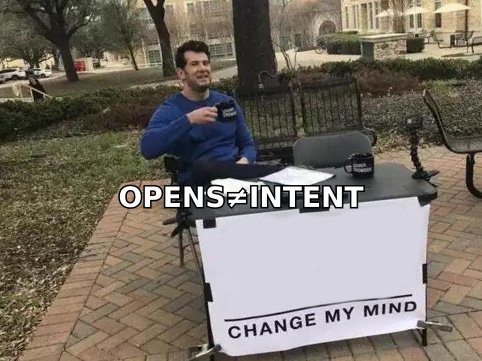
- Stop scoring opens. Apple Mail Privacy Protection and security scanners have turned open tracking into noise. Replies, clicks from real humans, and positive sentiment are what count.
- Score before you send. An unverified email or a catch-all address should cap a lead's priority no matter how well it fits your ICP.
- Start with a simple rules-based spreadsheet model. Move to predictive scoring only after you have at least a few hundred closed-won deals to train on.
What is lead scoring for cold email?#
Lead scoring is the practice of assigning points to prospects so your team works the most promising ones first. The classic version, described on Wikipedia's lead scoring entry, mixes explicit data (who the person is) with implicit data (what they've done: page visits, form fills, content downloads).
Cold email turns that model upside down. A cold prospect has no implicit history with you. They haven't downloaded your ebook or visited your pricing page. So if you import an inbound scoring model into your outbound tool, almost every lead scores between 0 and 10 and the ranking tells you nothing.
In cold outbound, lead scoring does two jobs:
- Pre-send prioritization. Which accounts and contacts get your best sequences, your manual personalization time, and your healthiest sending domains?
- Post-send routing. Once people start interacting, who gets a call from an AE today, who stays in automation, and who gets suppressed?
If you only do the second job, you're scoring after the fact. The real leverage in cold email comes from the first one, because every send costs you domain reputation and every hour of personalization costs you selling time.
Why do inbound scoring models fail in cold outbound?#
Inbound models assume the lead came to you. Three assumptions break when you reverse that.
Behavioral data is thin or missing. Inbound scoring gives heavy weight to actions like "visited pricing page 3x." A cold list has none of that until after the first touch.
Engagement signals are polluted. Open tracking was already unreliable. Since Apple's Mail Privacy Protection started pre-fetching images, a large share of "opens" are machine-generated. Corporate security tools like link scanners also click every URL in an email to check it for malware, which creates fake clicks within seconds of delivery. Score those, and your "hottest" leads end up being the companies with the most aggressive security tools.
Data quality is a variable, not a constant. Inbound leads type in their own email address. Cold leads come from databases, enrichment tools, and pattern guesses. A perfect-fit VP of Sales with an email that bounces is worth zero, and sending to them hurts every other lead in the campaign by damaging your sender reputation.
That third point gets overlooked the most. In cold email, contact data quality is a scoring dimension in its own right.
What should a cold email lead scoring model include?#
A workable model has four categories. Weight them to your motion, but start here:
- Fit (40 points): Does this account and person match your ideal customer profile? Industry, company size, tech stack, geography, job title, and seniority.
- Data quality (20 points): Is the email verified, is the domain catch-all, is there a direct phone number, is the job title current?
- Timing and intent (25 points): Is there a reason this account would buy now? Funding, hiring, leadership changes, tech changes, website visits, third-party intent topics.
- Engagement (15 points): After you send, did a human reply, click, book, or forward?
Engagement gets the smallest weight on purpose. In cold outbound, a reply is usually handled directly by routing ("positive reply → AE today"), not through a gradual score. The score matters most for the 95%+ of your list that hasn't replied yet.
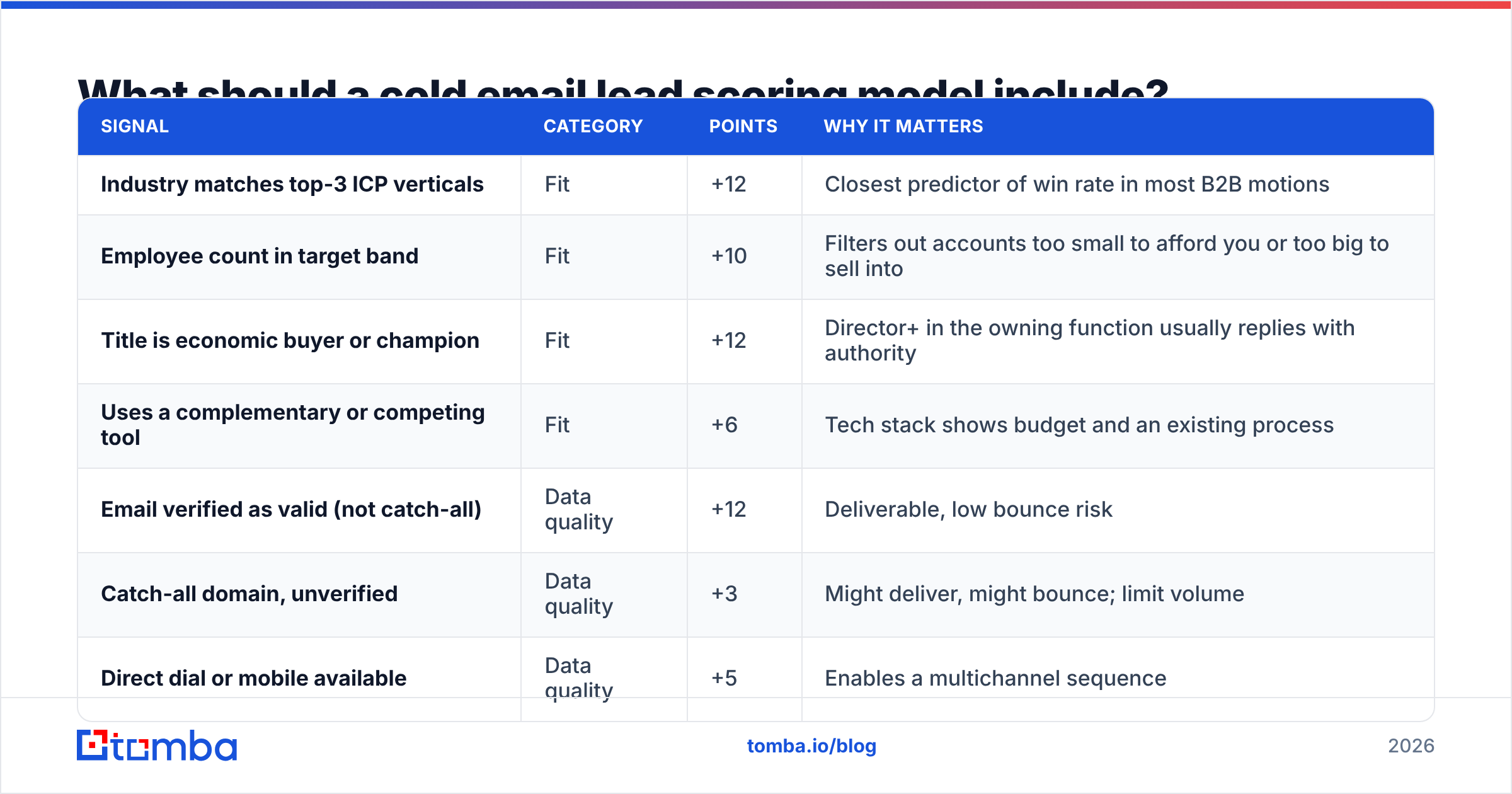
Sample 100-point scoring table#
| Signal | Category | Points | Why it matters |
|---|---|---|---|
| Industry matches top-3 ICP verticals | Fit | +12 | Closest predictor of win rate in most B2B motions |
| Employee count in target band | Fit | +10 | Filters out accounts too small to afford you or too big to sell into |
| Title is economic buyer or champion | Fit | +12 | Director+ in the owning function usually replies with authority |
| Uses a complementary or competing tool | Fit | +6 | Tech stack shows budget and an existing process |
| Email verified as valid (not catch-all) | Data quality | +12 | Deliverable, low bounce risk |
| Catch-all domain, unverified | Data quality | +3 | Might deliver, might bounce; limit volume |
| Direct dial or mobile available | Data quality | +5 | Enables a multichannel sequence |
| Role changed in last 90 days | Data quality | +3 | New leaders buy; also confirms the record is current |
| Raised funding in last 6 months | Timing | +8 | New budget, pressure to grow |
| Hiring for roles your product supports | Timing | +8 | Clear signal of a problem you solve |
| Visited your site in last 30 days (identified) | Timing | +9 | Account-level interest before you reached out |
| Human reply (any sentiment except unsubscribe) | Engagement | +10 | Real conversation, even an objection |
| Click from a human (delayed, single link) | Engagement | +5 | Weak but real interest |
| Email hard-bounced | Disqualifier | set to 0 | Remove from all sequences |
| Unsubscribe or "not interested" | Disqualifier | set to 0 | Suppress. Respect the opt-out |
A few design choices worth copying:
- Invalid data is a disqualifier, not a negative score. Don't let a great fit score push a bouncing address back into a sequence.
- Catch-all addresses get partial credit. They aren't bad leads. They're uncertain leads, so send to them in smaller batches from a separate sending pool.
- Opens get zero points. Leaving them out entirely is simpler than trying to guess which opens are real.
How do you score leads before sending a single email?#
This is where cold email scoring earns its keep. The goal is to sort your list into tiers before you load it into a sequencer.
Step 1: Build fit scores from firmographics. Pull industry, headcount, location, and tech stack for every account. Data enrichment tools fill in whatever your list source left out. If you can't reliably fill a field for at least 70% of your list, don't score on it yet. Sparse fields create false negatives.
Step 2: Verify every address and score the result. Run the list through an email verifier and map the statuses to points: valid gets full credit, catch-all gets partial credit, unknown gets minimal credit, invalid gets removed. Google's email sender guidelines make it clear that bounce and spam rates affect whether your mail reaches the inbox at all, so this step protects every lead on the list, not just the ones you're scoring.
Step 3: Layer on timing signals. Funding announcements, job postings, and leadership changes are all public. Many teams also add first-party signals: an identified company visiting your site through website visitor reveal often deserves a jump straight to tier 1.
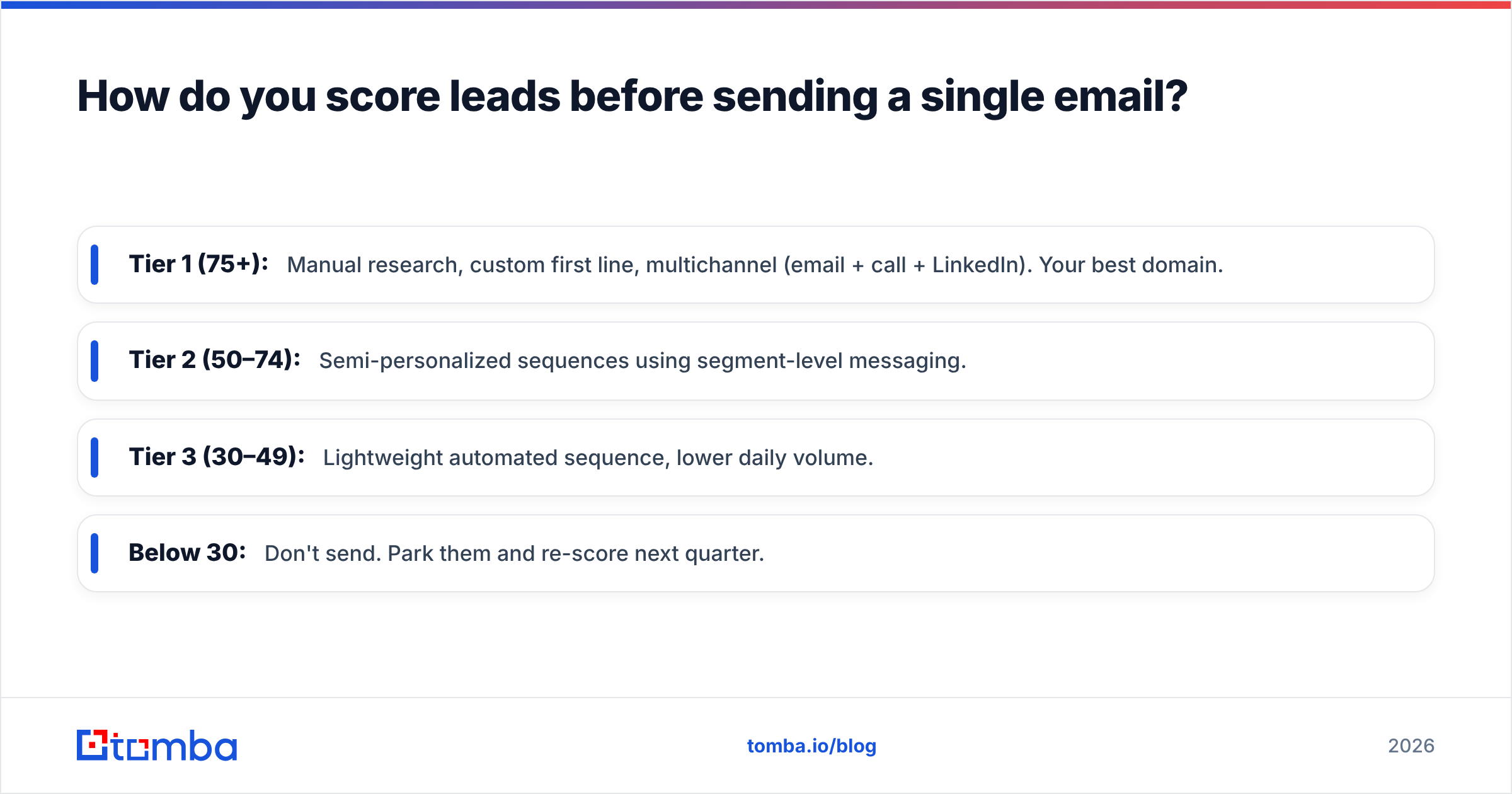
Step 4: Assign tiers, not just numbers. Reps don't prioritize by "63 vs. 58." They prioritize by bucket:
- Tier 1 (75+): Manual research, custom first line, multichannel (email + call + LinkedIn). Your best domain.
- Tier 2 (50–74): Semi-personalized sequences using segment-level messaging.
- Tier 3 (30–49): Lightweight automated sequence, lower daily volume.
- Below 30: Don't send. Park them and re-score next quarter.
The "don't send" bucket is the most valuable output of the whole exercise. Every weak lead you skip protects your domain for the strong ones.
Rules-based vs. predictive scoring: which should you use?#
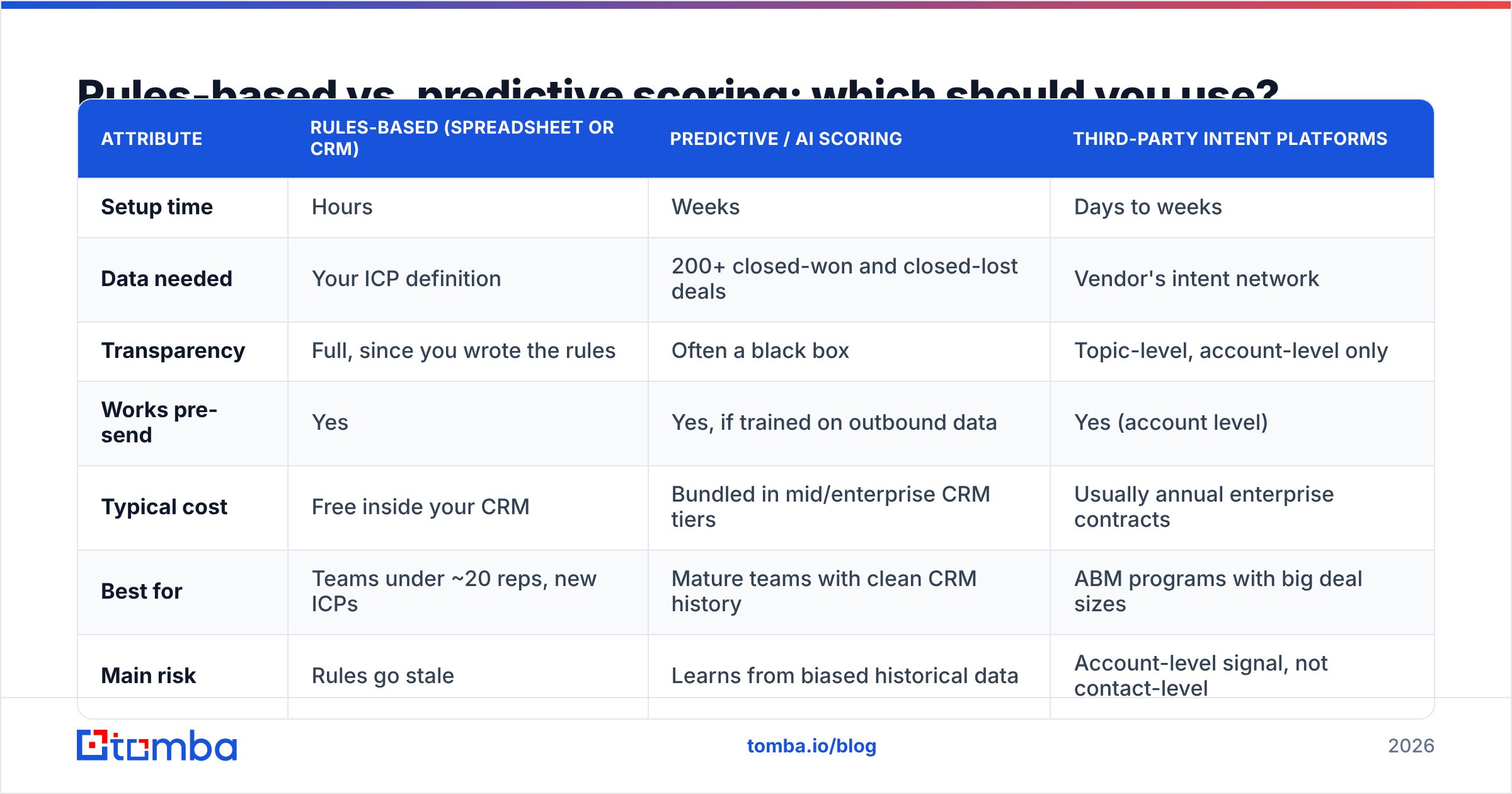
You'll see three approaches in the market. Here's how they compare for a cold email team:
| Attribute | Rules-based (spreadsheet or CRM) | Predictive / AI scoring | Third-party intent platforms |
|---|---|---|---|
| Setup time | Hours | Weeks | Days to weeks |
| Data needed | Your ICP definition | 200+ closed-won and closed-lost deals | Vendor's intent network |
| Transparency | Full, since you wrote the rules | Often a black box | Topic-level, account-level only |
| Works pre-send | Yes | Yes, if trained on outbound data | Yes (account level) |
| Typical cost | Free inside your CRM | Bundled in mid/enterprise CRM tiers | Usually annual enterprise contracts |
| Best for | Teams under ~20 reps, new ICPs | Mature teams with clean CRM history | ABM programs with big deal sizes |
| Main risk | Rules go stale | Learns from biased historical data | Account-level signal, not contact-level |
For most outbound teams the honest answer is to start rules-based. HubSpot and Salesforce both support manual scoring properties without special tooling, and you can prototype the whole model in a spreadsheet. Predictive models need a lot of labeled outcomes. If your team closed 40 deals last year, a model trained on 40 examples will fit noise. If you're shopping for dedicated software, the G2 lead scoring category is a reasonable place to shortlist vendors by team size.
Intent platforms can be worth it for enterprise ABM, but remember that they score accounts, not people. You still need a contact-level layer (right person, verified email) on top.
How should engagement signals update the score after sending?#
Once the sequence is live, the score should respond to what people actually do. Keep these rules tight.
Replies beat everything. Classify replies into positive, neutral/objection, referral ("talk to Sam"), out-of-office, and negative. Positive and referral replies go straight to a human. Don't wait for a score threshold. A referral reply should also create a new lead for the person named, carrying over the account's fit and timing points.
Filter bot clicks. A click within a few seconds of delivery, or clicks on every link in the email at once, is almost always a security scanner. Only count clicks that happen minutes or hours after delivery on a single link.
Treat out-of-office replies as data. They confirm the address is live (a small data-quality boost) and often include a return date, which is a timing signal for your next touch.
Decay old engagement. A click from 90 days ago means little now. Subtract engagement points after 30–60 days so old activity doesn't keep a lead artificially high.
Track by tier, not just overall. If tier 1 leads don't reply at a clearly higher response rate than tier 3, your model's weights are wrong. That comparison is the single best health check you have.
What are the most common lead scoring mistakes in cold email?#
Scoring on fields you can't fill. If "annual revenue" is blank for half your list, those leads silently lose points. Either enrich the field or drop it from the model.
Overweighting title keywords. "Head of Growth" means very different things at a 15-person startup and a 5,000-person enterprise. Score title together with company size, not on its own.
Ignoring data freshness. B2B contact data decays fast because people change jobs, get promoted, and leave. A lead record that hasn't been checked in six months should lose data-quality points until you re-verify it.
Never recalibrating. Pull closed-won deals every quarter and ask: what did these leads score before we first emailed them? If your wins keep coming from tier 2 or 3, your weights are telling you something.
Letting the score override judgment. A score is a sorting tool. If a rep has a warm intro into a tier-3 account, they should take it.
Mixing up account and contact scores. An account can be a perfect fit while the contact you picked is wrong. Keep two scores (account fit and contact fit) and combine them only when you prioritize.
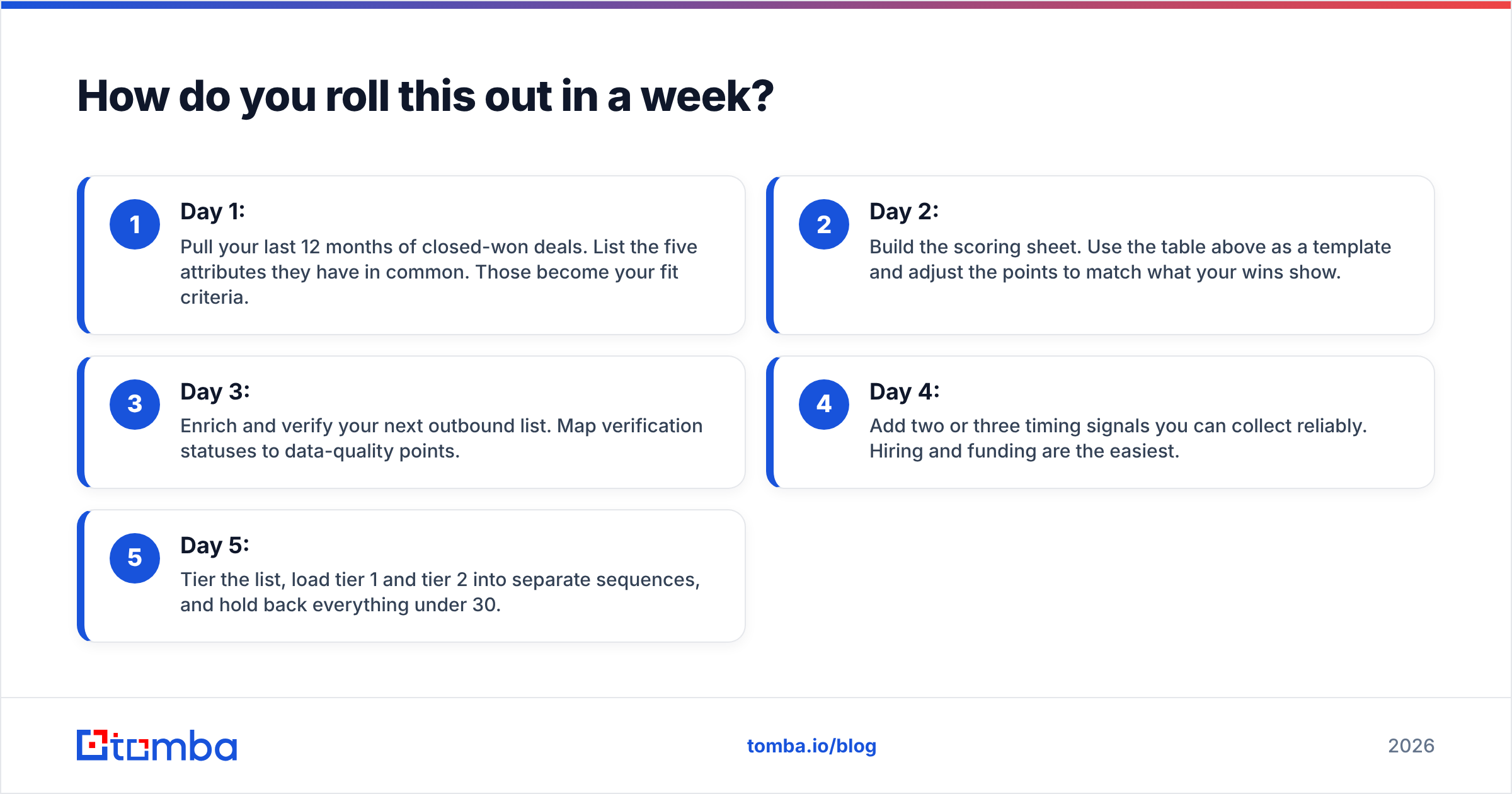
How do you roll this out in a week?#
You don't need a platform to start. A realistic week-one plan:
- Day 1: Pull your last 12 months of closed-won deals. List the five attributes they have in common. Those become your fit criteria.
- Day 2: Build the scoring sheet. Use the table above as a template and adjust the points to match what your wins show.
- Day 3: Enrich and verify your next outbound list. Map verification statuses to data-quality points.
- Day 4: Add two or three timing signals you can collect reliably. Hiring and funding are the easiest.
- Day 5: Tier the list, load tier 1 and tier 2 into separate sequences, and hold back everything under 30.
After two to four weeks of sending, compare reply rates and meetings booked by tier. Adjust weights, then repeat. Most teams need two or three rounds of calibration before the tiers clearly separate.
Does lead scoring actually improve cold email results?#
It improves results in three concrete ways, and only one of them is about conversion.
First, it protects deliverability. Removing invalid and low-fit leads lowers bounce rates and spam complaints, which keeps your domains healthy for the leads you do want to reach.
Second, it focuses rep time. Manual personalization is expensive. Putting it on the top 10–20% of your list instead of spreading it evenly is where most of the reply-rate gains come from.
Third, it creates a feedback loop. Once you're tracking results by tier, you can see which ICP assumptions hold up and which don't. That's useful well beyond email: it shapes targeting, messaging, and even which markets you go after.
What scoring won't do is rescue a weak offer or a generic message. If tier 1 leads with verified emails and clear buying signals still don't reply, the problem is the email, not the list.
Where should you start?#
Every score in this model depends on one input: a real, reachable email address for the right person. Fit and timing signals mean nothing if the address bounces or belongs to someone who left the company a year ago. Tomba Email Finder finds professional email addresses by name, domain, or company and runs verification alongside the search, so you can map deliverability straight to the data-quality points in your model. Start on the free tier with 25 searches a month to test it against your next outbound list, then move to a paid plan when your scoring model is ready to run at volume.
Related guides#
Ready to find emails that actually work?
Join 150,000+ professionals who stopped guessing and started sending. Free credits on signup — no credit card required.
Get the Tomba newsletter
Practical outbound tactics and product updates — once every two weeks.
About the author