Lead Scoring Framework: How to Build One That Sales Trusts
Most lead scores reward clicks, not buyers. Here's how to build a lead scoring framework from fit, intent, negative signals, and decay, with real point weights, thresholds, and a monthly calibration loop.
TL;DR
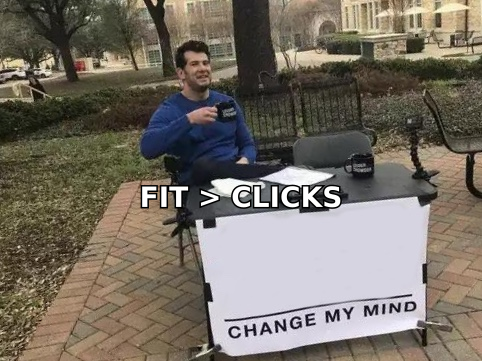
- A lead scoring framework combines two scores. Fit covers who the lead is. Intent covers what they're doing. Blending them into one number hides the most useful information you have.
- Most scoring models fail because they reward activity like email opens and page views instead of buying signals. They also never subtract points or let old scores decay.
- Start with a rules-based model built from your last 50 to 100 closed-won deals. Only move to predictive scoring when you have enough clean conversion data to train it.
- Your framework is only as good as the data behind it. Missing job titles, bad emails, and blank company fields make scores meaningless.
- Recalibrate every month for the first quarter, then every quarter after that. Track MQL-to-SQL conversion, not the number of MQLs.
What is a lead scoring framework?#
A lead scoring framework is a documented system for ranking leads by how likely they are to buy. It sets out which attributes and behaviors earn or lose points, how much each one is worth, and what score sends a lead to sales. It's the set of rules behind the number in your CRM field.
Think of it like triage in an emergency room. A nurse doesn't treat patients in arrival order. They look at a few vital signs and decide who sees a doctor first. Your SDRs have the same limit: a fixed number of hours and more leads than they can work. The framework decides who gets those hours.
The idea isn't new. Lead scoring has been standard in marketing automation for about 15 years. What has changed is the data. Intent data, product usage, and enrichment APIs mean the framework has far more inputs to weigh, which also gives it more ways to go wrong.
A usable framework answers four questions in writing:
- Which attributes make someone a good fit?
- Which actions signal real buying interest, as opposed to curiosity?
- What removes points?
- At what score, and for how long, does a lead belong to sales?
If your current setup can't answer all four, you have a points system but not a framework.
Why do most lead scoring models fail?#
They usually fail for one of three reasons, and all three come from how the model was designed, not from which tool runs it.
They reward noise. Opening an email earns 5 points. Visiting the blog earns 3. Downloading an ebook earns 10. A student writing a thesis can collect 60 points in an afternoon while a VP who looked at your pricing page once sits at 15. Opens are especially unreliable now that Apple Mail Privacy Protection pre-fetches images and inflates open counts.
They never subtract. Points only go up, so a lead who was active 14 months ago still carries a score of 80. Sales calls them, finds they've changed jobs, and stops trusting the scores.
They blend fit and intent into one number. A score of 70 might mean a perfect-fit account showing no activity, or a poor-fit freelancer who binge-read your blog. Those two leads need completely different next steps, and a single number treats them the same.
The downstream effect is predictable. Marketing hits its MQL target, sales ignores half of the leads, and the two teams argue about lead quality in every pipeline review. Research from Gartner's sales practice has repeatedly found that B2B buyers do most of their research before they talk to a rep. That makes it more important to read real buying signals correctly and less useful to count clicks.
What are the core components of a lead scoring framework?#
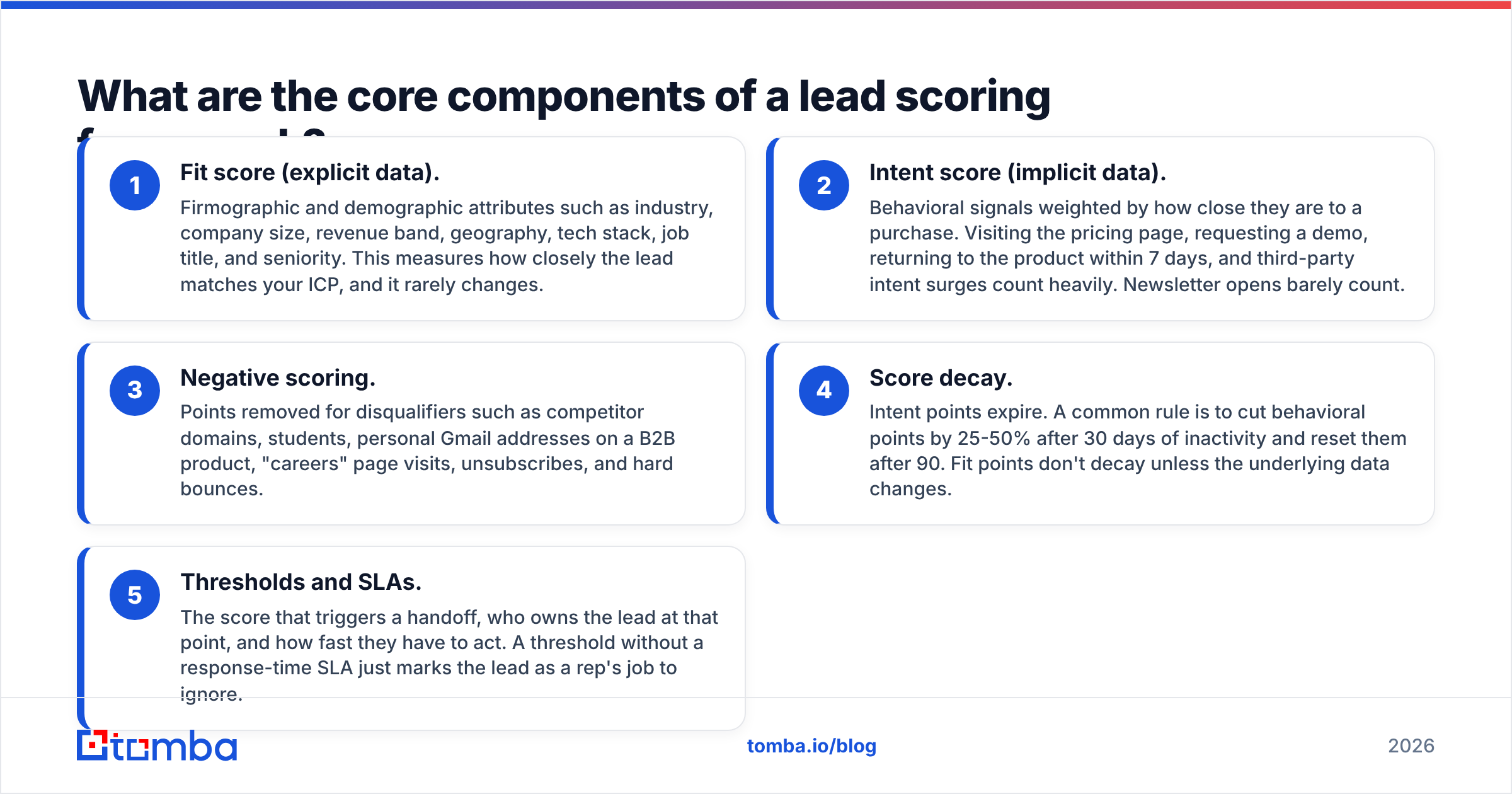
Every framework that holds up in practice has these five parts. If you drop one, the others get noisier.
- Fit score (explicit data). Firmographic and demographic attributes such as industry, company size, revenue band, geography, tech stack, job title, and seniority. This measures how closely the lead matches your ICP, and it rarely changes.
- Intent score (implicit data). Behavioral signals weighted by how close they are to a purchase. Visiting the pricing page, requesting a demo, returning to the product within 7 days, and third-party intent surges count heavily. Newsletter opens barely count.
- Negative scoring. Points removed for disqualifiers such as competitor domains, students, personal Gmail addresses on a B2B product, "careers" page visits, unsubscribes, and hard bounces.
- Score decay. Intent points expire. A common rule is to cut behavioral points by 25-50% after 30 days of inactivity and reset them after 90. Fit points don't decay unless the underlying data changes.
- Thresholds and SLAs. The score that triggers a handoff, who owns the lead at that point, and how fast they have to act. A threshold without a response-time SLA just marks the lead as a rep's job to ignore.
The most useful change you can make is to keep fit and intent as separate fields. Plot them as a 2x2 grid, with fit (A-D) on one axis and intent (1-4) on the other. An "A1" lead goes straight to an AE. An "A4" lead goes into targeted outbound. A "D1" lead, which is highly engaged but a poor fit, gets self-serve nurture and should never take up a sales call.
Which lead scoring model should you use?#
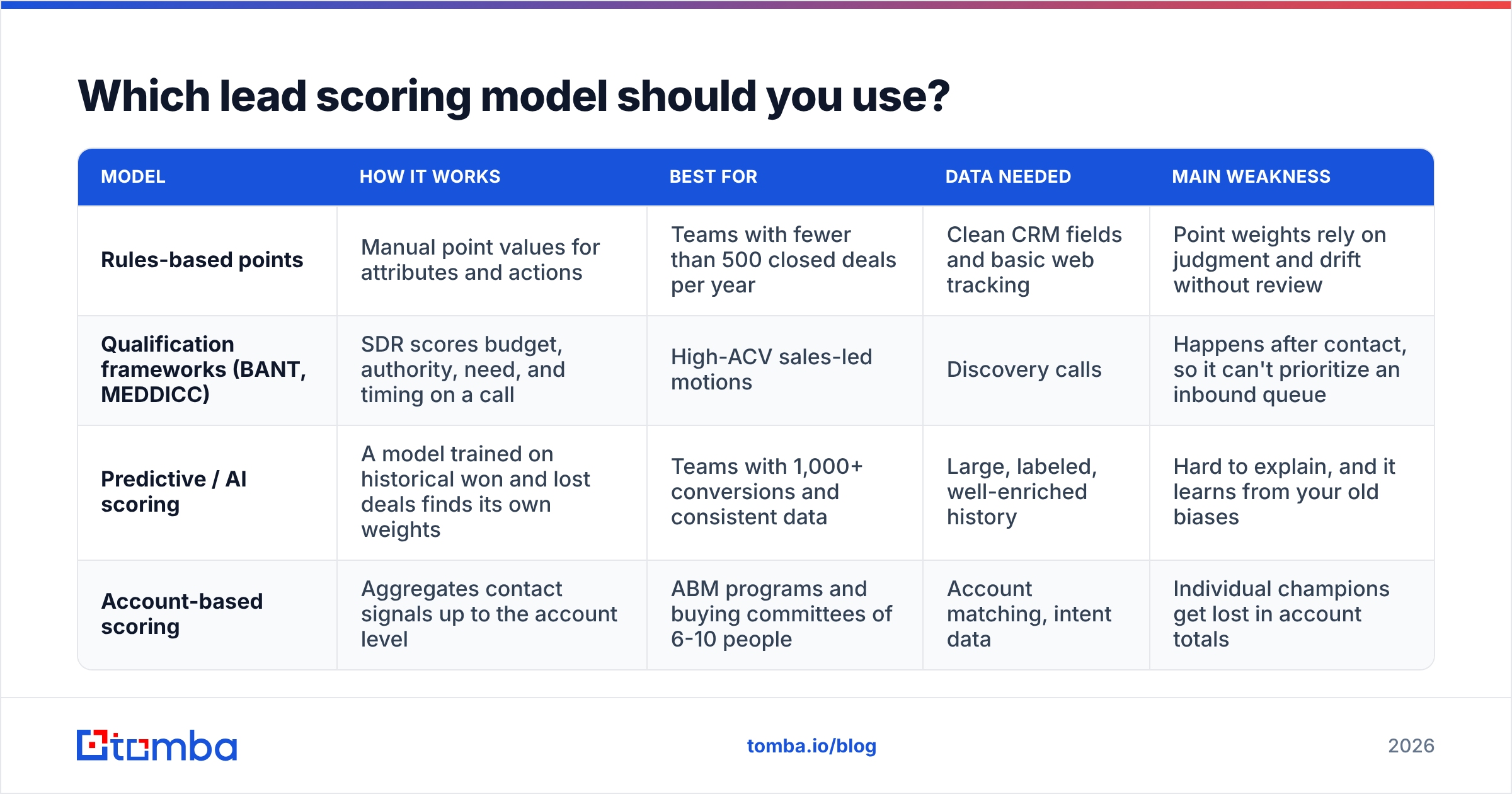
There are four common approaches. Most teams should start with the first, add the second as a check, and move to the third once they have the data to support it.
| Model | How it works | Best for | Data needed | Main weakness |
|---|---|---|---|---|
| Rules-based points | Manual point values for attributes and actions | Teams with fewer than 500 closed deals per year | Clean CRM fields and basic web tracking | Point weights rely on judgment and drift without review |
| Qualification frameworks (BANT, MEDDICC) | SDR scores budget, authority, need, and timing on a call | High-ACV sales-led motions | Discovery calls | Happens after contact, so it can't prioritize an inbound queue |
| Predictive / AI scoring | A model trained on historical won and lost deals finds its own weights | Teams with 1,000+ conversions and consistent data | Large, labeled, well-enriched history | Hard to explain, and it learns from your old biases |
| Account-based scoring | Aggregates contact signals up to the account level | ABM programs and buying committees of 6-10 people | Account matching, intent data | Individual champions get lost in account totals |
Built-in scoring in platforms like HubSpot and Salesforce handles the rules-based and predictive models well. The tool matters less than the inputs. A predictive model trained on 300 deals with half-empty industry fields will confidently tell you the wrong thing.
How do you build a lead scoring framework step by step?#
Follow these steps in order. Building from judgment first and checking against data later produces a model your team will spend months unlearning.
Step 1: Pull your closed-won and closed-lost data#
Export the last 12-18 months of opportunities. For each one, record industry, employee count, title, seniority, lead source, and the first five tracked activities before the opportunity was created. You need at least 50 wins to see patterns. Below that, you're guessing, so treat the model as a draft.
Step 2: Find the attributes that separate wins from losses#
Compare how often each attribute appears in won deals versus lost deals. If 40% of your wins come from 200-1,000 employee companies but only 12% of all leads do, that band deserves heavy weight. If "Marketing Manager" shows up in the same share of wins and losses, it tells you nothing and should get few points.
Step 3: Assign fit points#
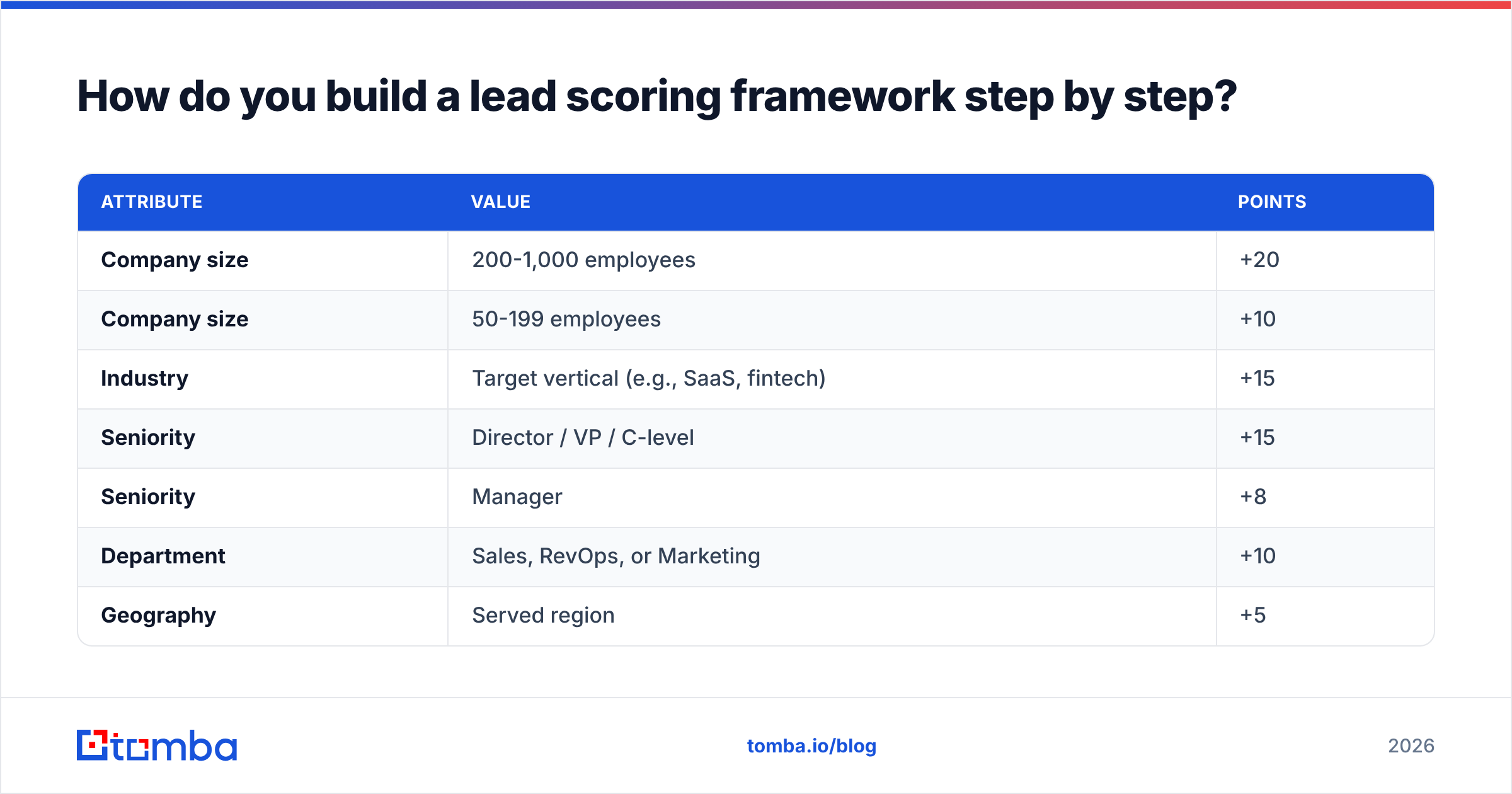
Put the most weight on the two or three attributes that matter most. A sample B2B SaaS fit model might look like this:
| Attribute | Value | Points |
|---|---|---|
| Company size | 200-1,000 employees | +20 |
| Company size | 50-199 employees | +10 |
| Industry | Target vertical (e.g., SaaS, fintech) | +15 |
| Seniority | Director / VP / C-level | +15 |
| Seniority | Manager | +8 |
| Department | Sales, RevOps, or Marketing | +10 |
| Geography | Served region | +5 |
| Email type | Personal domain (gmail.com, etc.) | -15 |
| Company type | Competitor or agency reseller | -50 |
Cap fit at 100 so scores are comparable across quarters.
Step 4: Assign intent points by proximity to purchase#
Rank actions by how close they are to a buying decision, not by how easy they are to track:
| Action | Points | Decay |
|---|---|---|
| Demo or pricing request | +40 | 60 days |
| Pricing page visit (2+ in 7 days) | +20 | 30 days |
| Free trial signup / product activation event | +25 | 30 days |
| Case study or comparison page view | +10 | 30 days |
| Webinar attended (not just registered) | +8 | 45 days |
| Blog visit | +2 | 14 days |
| Email open | 0 | n/a |
| Careers page visit | -20 | n/a |
| Unsubscribe | -30 | n/a |
Email opens are worth 0. Clicks can earn a few points. Opens have been unreliable for years, and scoring them rewards whoever has the most aggressive mail client.
Step 5: Set thresholds using your SDR capacity#
Work backward from capacity. If three SDRs can each work about 40 new leads per week, you need roughly 120 MQLs per week. Set the threshold so about that many leads clear it. If the threshold creates 400 MQLs a week, it isn't working as a threshold.
Pair it with an SLA, for example: "A1 and A2 leads contacted within 4 business hours; B1 and B2 leads within 24 hours."
Step 6: Backtest before launch#
Run the new model against last quarter's leads. If fewer than 60-70% of the deals you actually won would have crossed the threshold, the weights are off. Adjust them and run the backtest again.

How does data quality affect lead scoring?#
Data quality decides whether scoring works at all. Your fit score depends on fields like title, company size, and industry, and inbound forms rarely capture them. A lead who enters only an email address and a first name scores 0 on fit. That doesn't mean they're a bad fit. It means you don't know.
Three data problems quietly break most frameworks:
- Empty firmographic fields. Fix these with automatic data enrichment at the moment of form submission, so the score is calculated on complete records and not blanks. Enrichment can add company size, industry, and the role behind a work email.
- Invalid or risky emails. A lead with a hard-bouncing address can't be worked, however high it scores. Run every new lead through an email verifier before scoring, and apply negative points or suppression to invalid and disposable addresses.
- Stale contacts. B2B data decays by an estimated 20-30% per year as people change jobs. A contact scored A1 last spring may now work at a different company. Re-enrich active high-score records every quarter.
Enrichment also makes negative scoring possible. You can't penalize competitors or students if you can't identify them.
How do you measure whether your lead scoring framework works?#
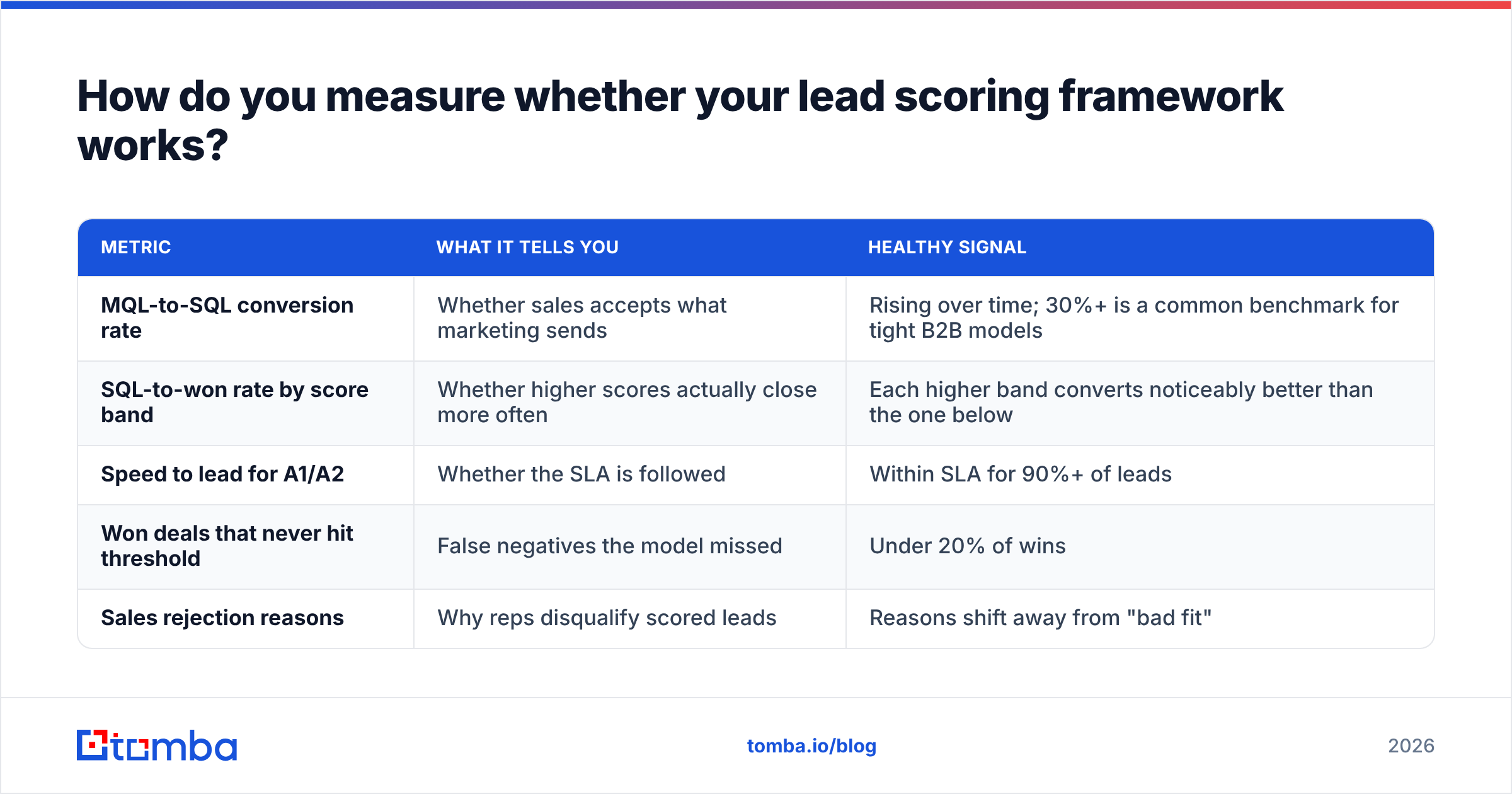
Track outcomes, not volume. Review these metrics every month:
| Metric | What it tells you | Healthy signal |
|---|---|---|
| MQL-to-SQL conversion rate | Whether sales accepts what marketing sends | Rising over time; 30%+ is a common benchmark for tight B2B models |
| SQL-to-won rate by score band | Whether higher scores actually close more often | Each higher band converts noticeably better than the one below |
| Speed to lead for A1/A2 | Whether the SLA is followed | Within SLA for 90%+ of leads |
| Won deals that never hit threshold | False negatives the model missed | Under 20% of wins |
| Sales rejection reasons | Why reps disqualify scored leads | Reasons shift away from "bad fit" |
The score-band check matters most. If leads scoring 80-100 close at the same rate as leads scoring 50-79, your weights aren't separating anything, and you should go back to Step 2.
Put a feedback field in your CRM so reps can mark a lead as "scored wrong" with a reason. It takes five seconds and gives you better calibration data than any dashboard.
When should you move to predictive lead scoring?#
Move to predictive scoring once three conditions are true: at least 1,000 historical conversions, fit fields populated for more than 85% of records, and a stable ICP. If your ICP changed last quarter, a model trained on older deals will aim at the customers you're moving away from.
Even then, keep the rules-based model running alongside for one or two quarters and compare the two. Predictive models are good at finding non-obvious interactions, like "mid-market fintech companies that view the API docs." They're poor at explaining themselves, and reps won't trust a score they can't understand. Salesforce's Einstein lead scoring and similar tools show the top contributing factors for each score for this reason. Show those factors to your reps.
What are the most common lead scoring mistakes to avoid?#
- Scoring form fills the same regardless of which form was filled. A demo request and a newsletter signup shouldn't earn the same points.
- Letting marketing build the model alone. Include two or three top AEs in the Step 2 analysis. They'll spot signals the data misses, and they'll defend the model later.
- Too many rules. A model with 60 scoring rules can't be debugged. Fifteen to twenty-five rules usually capture more than 90% of the predictive value.
- No recycle path. Leads that sales rejects should go back to nurture with their intent score reset, not stay stuck in the MQL stage.
- Setting it and forgetting it. Pricing changes, new products, and ICP changes all make old weights wrong. Put quarterly calibration on the calendar.
Your next step#
A lead scoring framework depends on the contact data underneath it. If half your inbound leads arrive without a verified work email or a company attached, fit scores stay at zero and your best-fit accounts sit unworked. Once the framework shows which segments convert, the Tomba Email Finder helps you work those segments directly. Find verified professional emails by name, company, or domain for the A-grade accounts your scoring identifies, and your SDRs can reach the right people before the intent signal decays. The free tier includes 25 searches a month, so you can test it on your top-scored accounts before committing to a plan.
Related guides#
// get started
Find, verify and enrich your first contacts today
Start on the free plan with 25 searches a month, then scale when your team is ready.
Free plan · No credit card required · GDPR & CCPA
// about the author