Lead Scoring Methods: 7 Models Compared and When to Use Each
Most lead scores fail because of bad data or the wrong model for the team's stage, not bad math. Here are 7 lead scoring methods compared, with sample weights and a clear pick for each stage of data maturity.
TL;DR
- There are seven lead scoring methods in common use: point-based, fit (firmographic), engagement (behavioral), negative scoring, two-axis fit × intent matrices, predictive/ML scoring, and account-based scoring.
- If you have fewer than about 500 closed deals, a rules-based model almost always beats predictive scoring. The algorithm doesn't have enough outcomes to learn from.
- Most scoring models break because of bad inputs: missing job titles, bounced emails, and duplicate records. The weights are rarely the real problem.
- A two-axis model (fit score + engagement score) is the best default for most B2B teams in 2026.
- Re-calibrate every quarter against closed-won data. A score nobody audits drifts into noise within six months.
What is lead scoring, and why do so many models fail?#
Lead scoring assigns each prospect a number or grade that estimates how likely they are to buy and how soon. Sales uses it to decide who gets a call today, who goes into a nurture sequence, and who gets ignored. The Wikipedia entry on lead scoring covers the textbook definition. In practice it comes down to one question: which of these 4,000 leads should your reps work first?
The failure rate is high. Here is the usual pattern. Marketing builds a model in a workshop. Downloading a whitepaper is worth 10 points, a VP title is worth 15, and anyone over 50 counts as a marketing qualified lead. Six months later, sales ignores the MQL queue because half the "hot" leads are students, competitors, or people whose email hard-bounces.
The problem is rarely the method you picked. It's usually one of these three:
- Unvalidated weights. Points were assigned by opinion and never checked against closed-won deals.
- Garbage inputs. Job title, company size, and industry fields are empty or wrong, so fit scoring can't work.
- No decay. A pricing-page visit from 2025 still counts the same as one from yesterday.
Keep those in mind as you compare the methods below. Each one handles them differently.
What are the main lead scoring methods?#
These are the seven approaches you'll see in B2B go-to-market teams, roughly ordered from simplest to most complex.
- Point-based (rules) scoring: You manually assign points to attributes and actions, then add them up. It's transparent and fast to launch, but it depends on the judgment of whoever wrote the rules.
- Fit (firmographic/demographic) scoring: This scores how closely a lead matches your ideal customer profile: industry, headcount, revenue, geography, seniority, department, and tech stack.
- Engagement (behavioral) scoring: This scores what the lead does: email opens and clicks, page views, demo requests, webinar attendance, and product usage for PLG companies.
- Negative scoring: This subtracts points for disqualifying signals, such as personal email domains, competitor domains, careers-page visits, unsubscribes, or a title like "student."
- Two-axis (fit × intent) matrix: Fit and engagement become separate scores, often a letter grade (A–D) and a number (1–100). An "A1" lead is a perfect fit and highly engaged. A "D1" is very active but a bad fit.
- Predictive (machine learning) scoring: A model trained on your historical wins and losses produces a probability of conversion. It usually relies on something like logistic regression or gradient-boosted trees under the hood.
- Account-based scoring: This scores the whole buying committee at a company instead of individuals. It's essential when deals involve five or more stakeholders.

How do lead scoring methods compare side by side?#
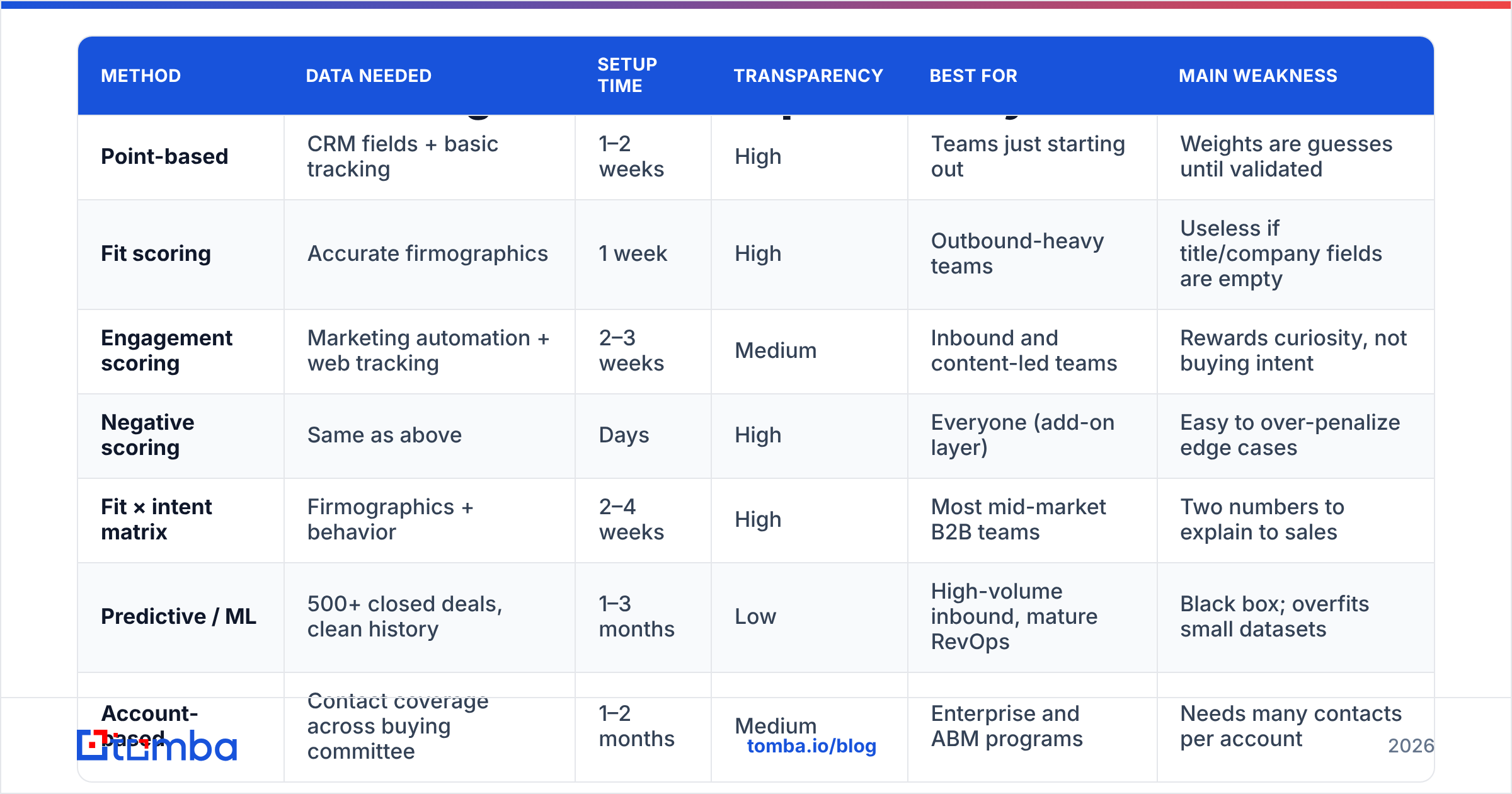
This table compares the seven methods on the attributes that matter most when you're choosing one.
| Method | Data needed | Setup time | Transparency | Best for | Main weakness |
|---|---|---|---|---|---|
| Point-based | CRM fields + basic tracking | 1–2 weeks | High | Teams just starting out | Weights are guesses until validated |
| Fit scoring | Accurate firmographics | 1 week | High | Outbound-heavy teams | Useless if title/company fields are empty |
| Engagement scoring | Marketing automation + web tracking | 2–3 weeks | Medium | Inbound and content-led teams | Rewards curiosity, not buying intent |
| Negative scoring | Same as above | Days | High | Everyone (add-on layer) | Easy to over-penalize edge cases |
| Fit × intent matrix | Firmographics + behavior | 2–4 weeks | High | Most mid-market B2B teams | Two numbers to explain to sales |
| Predictive / ML | 500+ closed deals, clean history | 1–3 months | Low | High-volume inbound, mature RevOps | Black box; overfits small datasets |
| Account-based | Contact coverage across buying committee | 1–2 months | Medium | Enterprise and ABM programs | Needs many contacts per account |
Two patterns stand out. First, the more sophisticated the method, the more it depends on data volume and data quality. Second, transparency drops as sophistication rises. That matters because reps won't act on a score they don't trust.
What does a point-based scoring model look like in practice?#
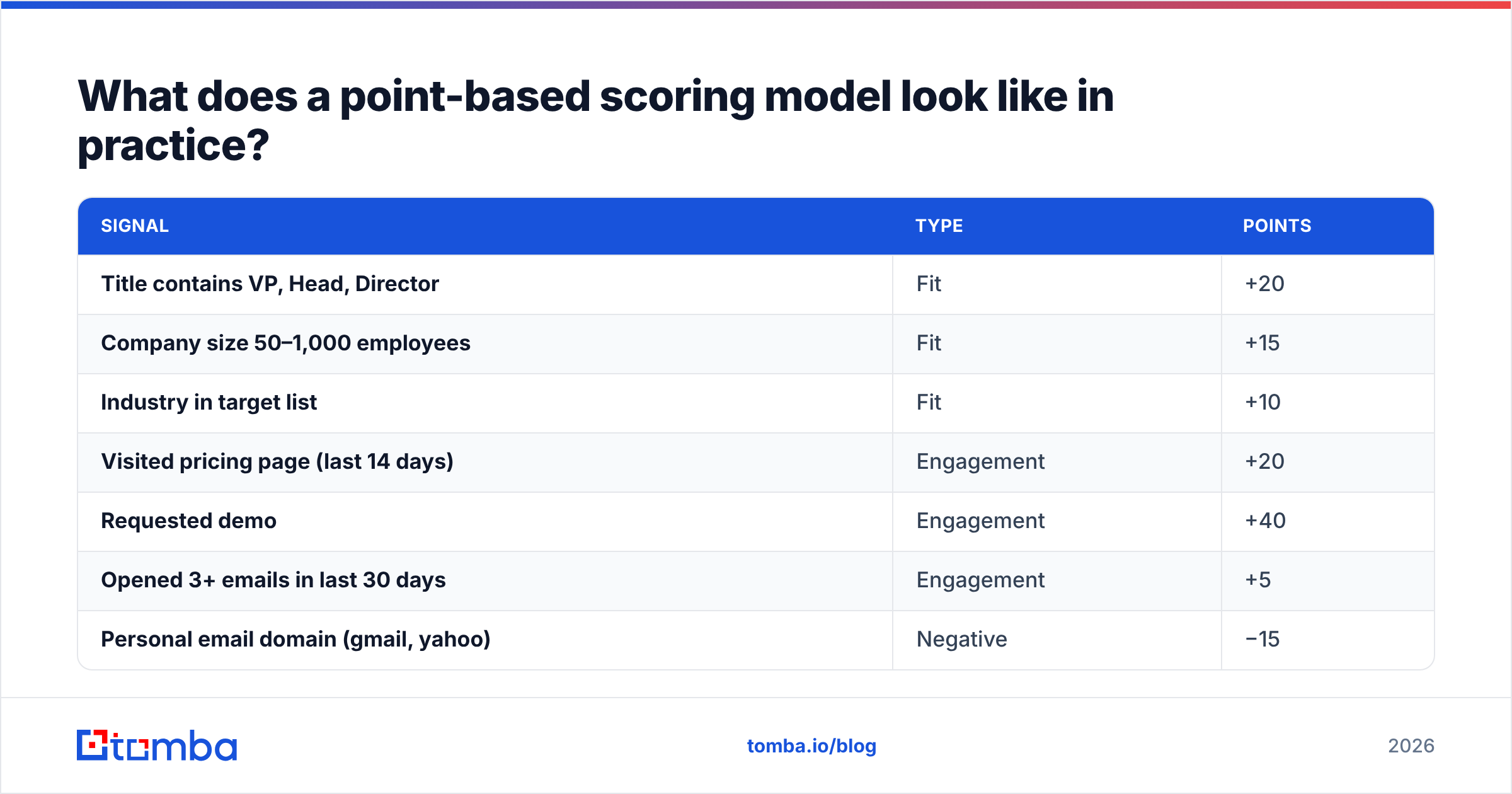
Here's a starter model for a B2B SaaS company selling to mid-market operations teams. Treat the numbers as a draft you'll validate, not as final weights.
| Signal | Type | Points |
|---|---|---|
| Title contains VP, Head, Director | Fit | +20 |
| Company size 50–1,000 employees | Fit | +15 |
| Industry in target list | Fit | +10 |
| Visited pricing page (last 14 days) | Engagement | +20 |
| Requested demo | Engagement | +40 |
| Opened 3+ emails in last 30 days | Engagement | +5 |
| Personal email domain (gmail, yahoo) | Negative | −15 |
| Visited careers page | Negative | −10 |
| Email hard-bounced | Negative | −50 |
| No activity in 60 days | Decay | −25% of engagement score |
A few design principles are built into this table.
- Demo requests dominate. A hand-raise should get a lead to sales on its own, whatever else is true.
- Email opens are worth almost nothing. Apple Mail Privacy Protection and corporate security scanners inflate open rates, so opens are a weak signal in 2026.
- Bounces are heavily penalized. A contact you can't reach isn't a lead. If a large share of your database bounces, fix the list before you touch the weights. Running records through an email verifier before they enter scoring removes the dead contacts that would otherwise distort the numbers.
- Decay is explicit. Engagement gets old quickly. Fit mostly doesn't.
Is predictive lead scoring better than rules-based scoring?#
Only if you have the data to support it. Predictive scoring sounds like an obvious upgrade because it removes human bias and finds patterns you'd miss. Most CRMs and marketing platforms now include some version of it, and HubSpot and Salesforce both market AI-driven scoring on their higher tiers.
A predictive model learns from outcomes, though. If you closed 80 deals last year, it has 80 positive examples to learn from. That's not enough. The model will latch onto coincidences, like "leads from Ohio convert 3x better," and present them with false confidence.
A practical rule of thumb:
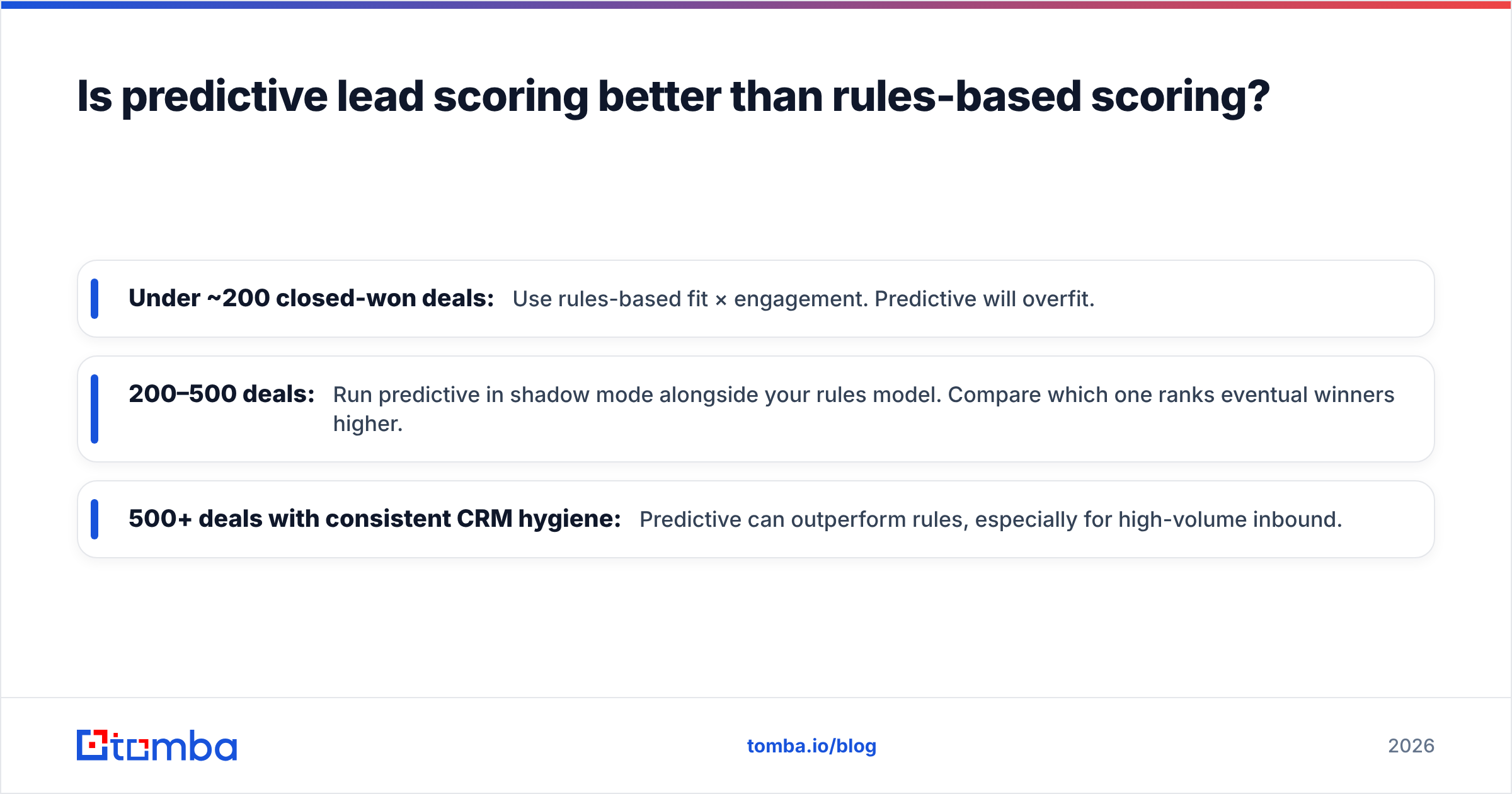
- Under ~200 closed-won deals: Use rules-based fit × engagement. Predictive will overfit.
- 200–500 deals: Run predictive in shadow mode alongside your rules model. Compare which one ranks eventual winners higher.
- 500+ deals with consistent CRM hygiene: Predictive can outperform rules, especially for high-volume inbound.
Explainability matters too. When a rep asks why a lead scored 87, "the model said so" doesn't build trust. The best predictive tools show the top contributing factors for each score. If yours doesn't, expect reps to ignore it.
Why does the fit × intent matrix work for most B2B teams?#
It keeps two different questions apart: should we sell to them? and are they ready to buy?
A single blended score hides important differences. A lead with 60 points could be a perfect-fit CFO who hasn't engaged yet, or an intern who downloaded twelve ebooks. Those two leads need completely different handling.
With a matrix, routing is straightforward:
| High engagement (1) | Medium (2) | Low (3) | |
|---|---|---|---|
| Fit A | Route to AE today | SDR outreach this week | Targeted outbound sequence |
| Fit B | SDR outreach this week | Nurture + retarget | Nurture |
| Fit C/D | Qualify quickly; likely wrong buyer | Nurture only | Suppress |
The A3 cell is the one teams underuse. These are great-fit accounts that haven't engaged at all, and they're your best outbound targets. An engagement-only model rates them as cold. A fit-aware model identifies them as the people you should be emailing first.
The fit axis only works if the fields feeding it are populated. Inbound forms usually capture a name and email and little else. Contact data enrichment fills in title, company size, industry, and location automatically, so fit scoring doesn't stall on empty fields.
How does account-based scoring change the picture?#
In enterprise deals, individual lead scores can mislead you. One engaged manager at a 5,000-person company may mean very little. Four engaged people across finance, IT, and operations at the same company almost always means a buying process has started.
Account-based scoring rolls individual signals up to the account:
- Coverage: How many buying-committee roles do you have contacts for?
- Breadth of engagement: How many distinct people from the account have engaged in the last 30 days?
- Depth: Did any of them reach high-intent pages such as pricing, security docs, or integrations?
- External intent: Are third-party intent signals showing research activity on your category?
The hard part is coverage. If your CRM holds one contact per target account, you can't score a committee. Filling that gap usually takes a domain search across each target account to surface the relevant decision-makers, followed by verification before anyone is sequenced.

How do you build and validate a scoring model step by step?#
Whichever method you choose, the process for building it is roughly the same.
- Pull 12–24 months of closed-won and closed-lost deals. Export the contact and account attributes that existed at the time the lead was created, not what the CRM says today.
- Compare the two groups. Look for attributes that show up far more often in wins than in losses, such as seniority, headcount band, industry, source, and specific page visits. These become your highest-weighted signals.
- Set thresholds from the distribution. Don't pick "50 = MQL" arbitrarily. Choose the threshold that captures about 70–80% of historical wins while filtering out most losses.
- Clean the database before launch. Deduplicate, verify emails, and enrich missing firmographics. Scoring a dirty database makes it look accurate when it isn't.
- Agree on SLAs with sales. Define how fast each score tier gets worked. A score without a response commitment is just a number.
- Track conversion by score band. Every month, check whether A1 leads really convert faster than B2 leads. If the bands don't separate, the model isn't working.
- Re-calibrate quarterly. Markets, products, and ICPs change, and your weights need to change with them.
This is a core revenue operations discipline. The model should belong to someone who reports on it, not sit in a marketing automation setting that nobody reviews.
Which lead scoring method should you choose?#
Match the method to your data maturity, not to what vendors are pushing this quarter.
- Early-stage, fewer than 100 deals, small team: Point-based fit scoring plus negative scoring. Keep it to 10–15 rules.
- Growth-stage, mixed inbound and outbound: A fit × intent matrix with time decay on engagement. This is the default recommendation for most readers.
- Mature RevOps, high inbound volume, 500+ deals: Add predictive scoring, but keep the rules model as a baseline and require explainable outputs.
- Enterprise or ABM: Account-based scoring layered on top of a contact-level fit × intent model.
For independent comparisons of the scoring features built into CRMs and marketing automation platforms, G2's marketing automation category is a reasonable place to see how users rate each tool's scoring capabilities.
What are the most common lead scoring mistakes?#
- Scoring activity that isn't intent. Blog reads and email opens show interest, not buying intent. Give them low weights.
- Never subtracting points. Without negative scoring and decay, scores only go up, and eventually everyone becomes an MQL.
- Letting marketing own it alone. If sales didn't help define "good," sales won't trust the output.
- Ignoring contactability. A perfect-fit lead with an invalid email and no phone number isn't actionable. Reachability should be a hard filter.
- Treating the model as finished. Scoring is a hypothesis you test every quarter, not something you build once.
How does Tomba fit into a lead scoring workflow?#
Every scoring method above depends on complete, accurate contact data. Fit scoring needs titles and company attributes. Account-based scoring needs several verified contacts per account. Every model needs emails that don't bounce.
That's where Tomba Email Finder helps. You can find verified professional email addresses by name, company, or domain, fill gaps in your buying-committee coverage, and give your scoring model reachable, well-attributed contacts instead of partial records. The free tier includes 25 searches a month so you can test it against your own target accounts, and paid plans start at $49/mo when you're ready to enrich at scale. Clean the inputs first, then tune the weights.
Related guides#
Ready to find emails that actually work?
Join 150,000+ professionals who stopped guessing and started sending. Free credits on signup — no credit card required.
Get the Tomba newsletter
Practical outbound tactics and product updates — once every two weeks.
About the author