Lead Scoring System: How to Build a Model Sales Actually Uses
Most lead scoring systems get built once, argued about for a quarter, then ignored by sales. This guide covers the fit-plus-intent model, point values, decay rules, and data hygiene that make a score worth acting on.
TL;DR
- A lead scoring system ranks prospects by two things: fit (does this account look like your best customers?) and intent (are they showing buying behavior right now?). Put them in one number and you lose information. Keep them as two scores.
- Build your first version from closed-won data, not opinions. Pull your last 50–100 won and lost deals and find the attributes that actually separate them.
- Scores need decay and negative points. Without them, stale leads pile up at the top of the queue and reps stop trusting the model.
- The biggest failure point is bad input data, not bad math. If contact records are missing, wrong, or undeliverable, every score built on them is wrong too.
- Start with a simple rules-based model. Move to predictive or AI scoring once you have enough conversion history to train it, usually a few hundred closed deals or more.
What is a lead scoring system?#
A lead scoring system gives each prospect a numeric value based on how likely they are to become a customer. Sales then works leads in order of that score, not in the order they arrived.
The idea has been around since marketing automation platforms first appeared (Wikipedia's lead scoring entry covers the history). It still matters because sales capacity is fixed. A team of five SDRs might each work 40–60 accounts a week well. If marketing sends 2,000 leads a month, most of them get a single generic touch or nothing at all. Scoring decides which few hundred get real attention.
A working system has four parts:
- Scoring criteria: the attributes and behaviors that earn or lose points.
- Point weights: how much each criterion is worth.
- Thresholds: the score where a lead changes stage, for example from nurture to marketing qualified lead (MQL) to sales-accepted.
- Feedback loop: a regular review of whether high scores actually converted, with weights adjusted to match.
Most companies build the first three and skip the fourth. That's why so many scoring models slowly drift until nobody believes them.
What is the difference between fit scoring and intent scoring?#
This is the most important design decision you'll make. Fit and intent answer different questions. Mixing them into one number hides the reason a lead scored high.
Fit scoring (also called explicit or demographic scoring) asks whether this person and company match your ideal customer profile. The inputs are mostly static: company size, industry, geography, tech stack, job title, seniority, department.
Intent scoring (also called implicit or behavioral scoring) asks whether they're acting like a buyer now. The inputs change daily: pricing page visits, demo requests, email replies, webinar attendance, product sign-ups, third-party intent topics.
Here's why you should keep them separate. Take a VP of Sales at a 300-person SaaS company who has never visited your site, and a student who has read 14 blog posts this week. A combined model could give both a score of 60. They need completely different treatment. The VP should get targeted outbound. The student should get nothing.
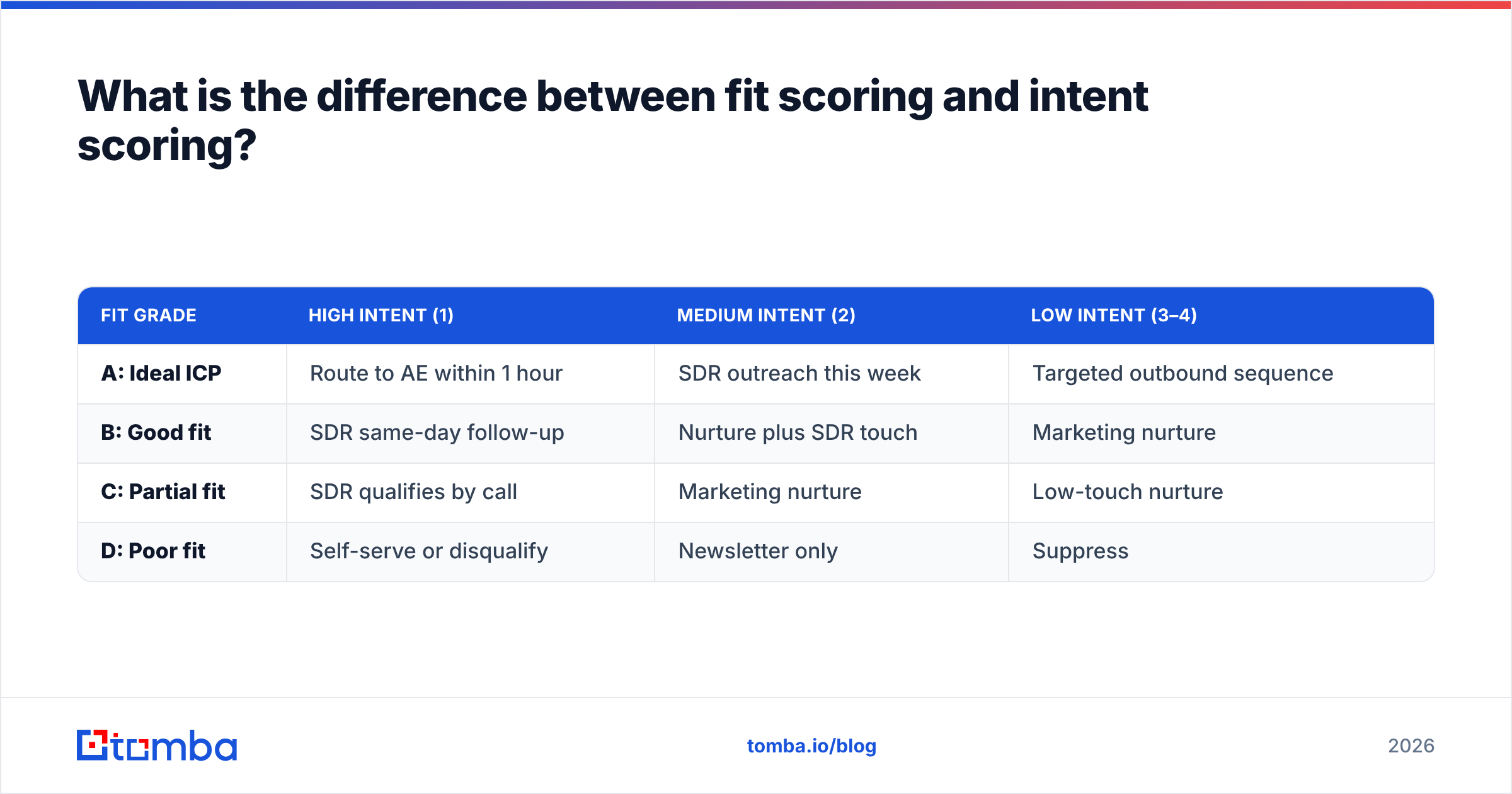
The common fix is a two-axis matrix, often shown as A1–D4:
| Fit grade | High intent (1) | Medium intent (2) | Low intent (3–4) |
|---|---|---|---|
| A: Ideal ICP | Route to AE within 1 hour | SDR outreach this week | Targeted outbound sequence |
| B: Good fit | SDR same-day follow-up | Nurture plus SDR touch | Marketing nurture |
| C: Partial fit | SDR qualifies by call | Marketing nurture | Low-touch nurture |
| D: Poor fit | Self-serve or disqualify | Newsletter only | Suppress |
With a matrix, every lead gets a routing rule that sales can explain in one sentence.
What types of lead scoring models can you use?#
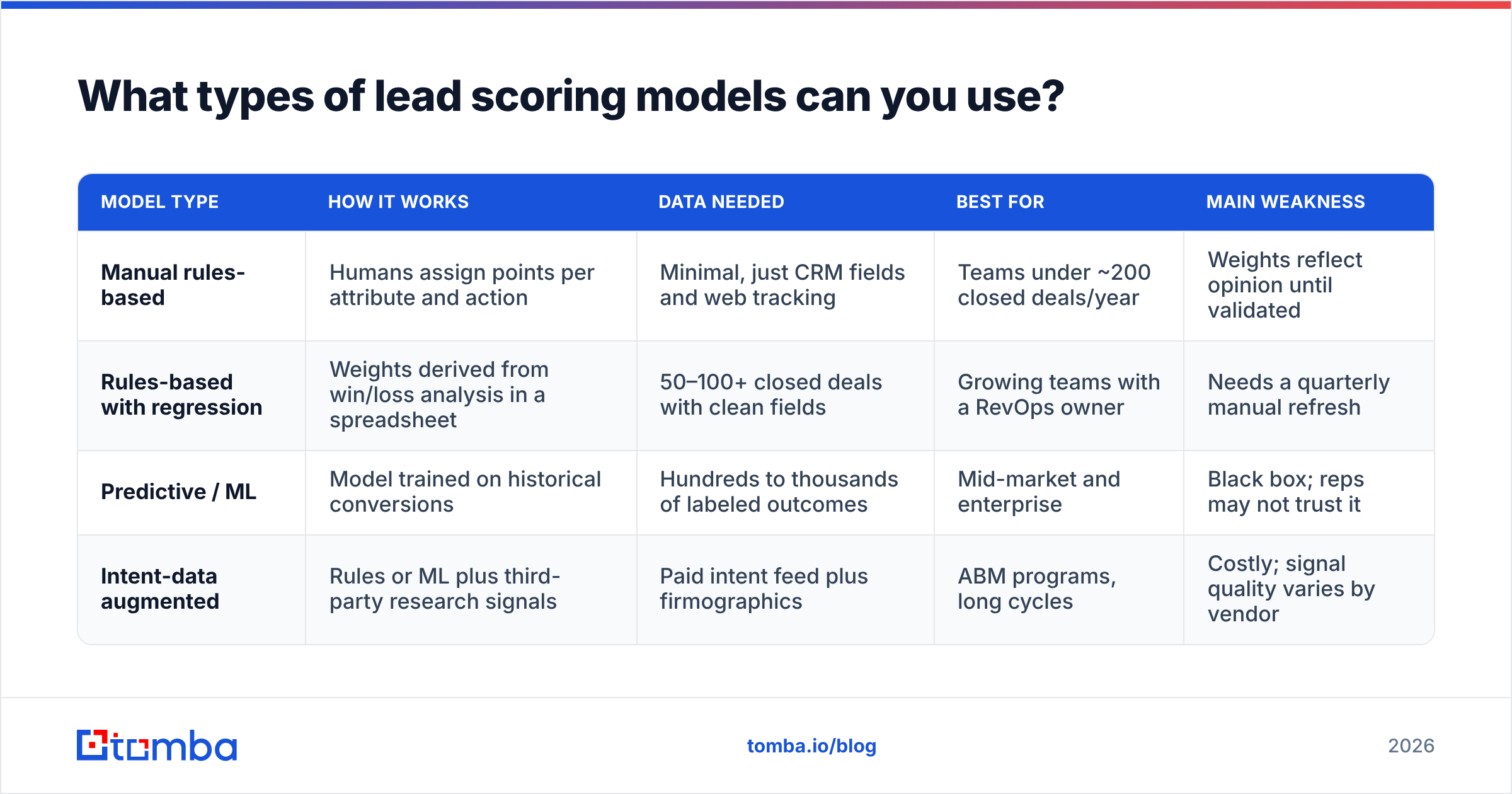
You'll run into four broad approaches. Each one fits a particular data maturity and team size.
| Model type | How it works | Data needed | Best for | Main weakness |
|---|---|---|---|---|
| Manual rules-based | Humans assign points per attribute and action | Minimal, just CRM fields and web tracking | Teams under ~200 closed deals/year | Weights reflect opinion until validated |
| Rules-based with regression | Weights derived from win/loss analysis in a spreadsheet | 50–100+ closed deals with clean fields | Growing teams with a RevOps owner | Needs a quarterly manual refresh |
| Predictive / ML | Model trained on historical conversions | Hundreds to thousands of labeled outcomes | Mid-market and enterprise | Black box; reps may not trust it |
| Intent-data augmented | Rules or ML plus third-party research signals | Paid intent feed plus firmographics | ABM programs, long cycles | Costly; signal quality varies by vendor |
Most CRMs and marketing platforms include at least rules-based scoring, and many now bundle a predictive option. HubSpot, Salesforce (through Einstein), Marketo, and Pardot/Account Engagement all do. If you want to compare dedicated tools, G2's lead scoring category lists user reviews by company size.
Buying a predictive tool doesn't fix bad inputs. If only 60% of your records have an accurate job title, the model learns from noise.

How do you build a lead scoring system step by step?#
Here's a practical sequence for a first version you can ship in two to three weeks.
Step 1: Pull closed-won and closed-lost data#
Export the last 12–18 months of opportunities with outcome, deal size, cycle length, and the attributes of the primary contact and account. You're looking for attributes that are over-represented in wins compared with losses. It doesn't help to know what's common among all leads.
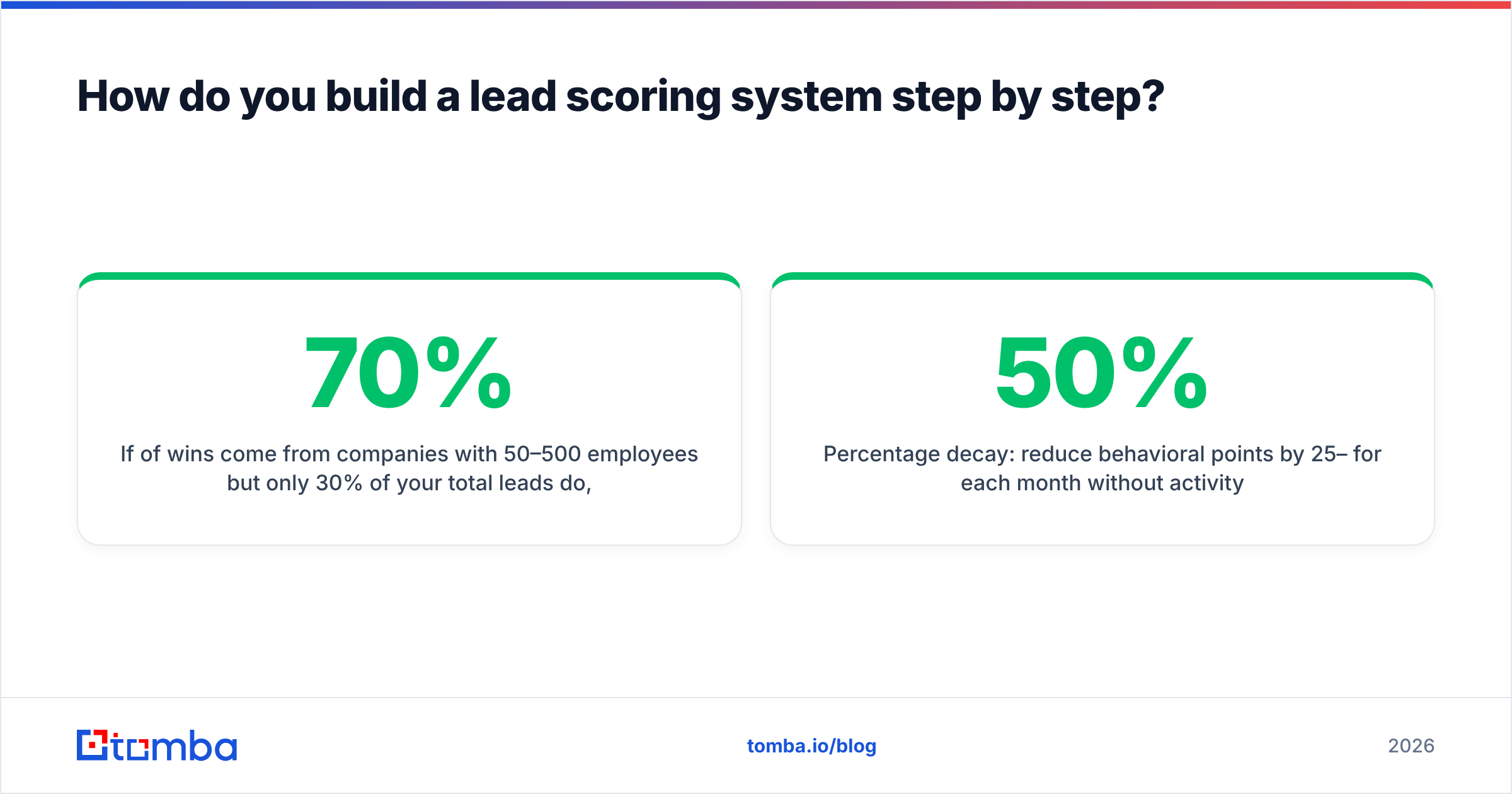
If 70% of wins come from companies with 50–500 employees but only 30% of your total leads do, company size is a strong fit signal. If job title splits evenly between wins and losses, it deserves fewer points than your gut says.
Step 2: Define fit criteria and weights#
Keep the fit model to 5–8 criteria. More than that and nobody can explain a score. A typical B2B SaaS fit model looks like this:
- Company size in ICP range: +20
- Target industry: +15
- Buyer-persona title (e.g. Head of Sales, RevOps): +20
- Decision-making seniority (Director+): +10
- Uses a complementary tool in their stack: +10
- Target geography: +5
- Competitor employee or student email: −50
Grade the total into A/B/C/D bands. Don't show raw fit points to sales. Letters are easier to act on.
Step 3: Define intent criteria and weights#
Weight intent signals by how close they sit to a purchase decision:
- Demo or contact-sales request: +50 (often an automatic MQL regardless of total)
- Pricing page visit: +15 per session, capped
- Reply to an outbound email: +20. Reply data is one of the clearest signals you have; see response rate benchmarks for context
- Product sign-up or trial activation: +30
- Webinar attended (not just registered): +10
- Blog visit: +1, capped at +5
- Unsubscribe or hard bounce: −25 or more
Put caps on low-value repeated actions. Without them, one enthusiastic reader can reach MQL on blog visits alone.
Step 4: Add decay#
Intent goes stale. A pricing page visit from 90 days ago means much less than one from yesterday. Two common approaches:
- Time-boxed windows: only count behavior from the last 30 or 60 days.
- Percentage decay: reduce behavioral points by 25–50% for each month without activity.
Fit scores decay too, just more slowly. If a champion changes jobs, their fit score for the old account should drop to zero.
Step 5: Set thresholds with sales in the room#
Choose the MQL threshold together with sales leadership and write down what it means: "An A or B fit lead with an intent score of 40+ gets a human touch within 24 hours." Then check capacity. If the threshold produces 900 MQLs a month and your team can properly work 300, raise it.
Step 6: Run it in shadow mode first#
Score leads for 2–4 weeks without changing routing. Then compare: did high-score leads convert to meetings at a noticeably higher rate than low-score leads? If they didn't, adjust the weights before anyone's queue changes.
Why do most lead scoring systems fail?#
Scoring projects usually fail for organizational and data reasons. The math is rarely the problem. The patterns repeat across companies:
- Built by marketing alone. When sales wasn't involved, reps see MQLs as marketing's number, not a real signal, and ignore them.
- No feedback loop. Weights set in January still run in December, even though the ICP, product, and market have all shifted.
- Activity mistaken for intent. Opens and clicks inflate scores. Apple Mail Privacy Protection has made open tracking unreliable, so weigh opens lightly or not at all.
- Bad contact data. Scores assume the email, title, and company are correct. If they aren't, the model confidently ranks leads you can't reach.
- Too many criteria. A 40-rule model can't be debugged. When a strange lead hits the top, nobody can say why.
Point 4 gets less attention than it deserves, so it's covered in the next section.
How does data quality affect your lead scoring system?#
Every score is a function of its inputs. Missing or wrong fields affect scoring in three specific ways.
Missing firmographics lower fit scores. A lead who signs up with a Gmail address and no company name gets zero points for size, industry, and tech stack, even if they run sales at a 400-person target account. Data enrichment fills these gaps by matching the person to a company domain and adding firmographic attributes before scoring runs.
Wrong titles skew persona weighting. Self-reported titles on forms are inconsistent ("Sales guy", "Head honcho", "VP"). Normalize them to a standard seniority and department taxonomy before they reach the scoring engine.
Undeliverable emails create false positives. This one causes the most damage. A lead can score 95 on fit and intent, route to your best SDR, and hard bounce on the first touch. That wastes the rep's time. It also hurts sender reputation when it happens at volume. Run addresses through an email verifier at the point of capture or before routing, and treat an invalid result as a negative scoring event.

A practical order of operations for inbound leads:
- Capture the form fill.
- Verify the email. Suppress or flag invalid and disposable addresses.
- Enrich company and person attributes.
- Normalize title and seniority.
- Calculate fit and intent scores.
- Route based on the matrix.
For outbound lists, apply the same logic before the list goes into a sequence. Scoring a list of unverified, guessed addresses and treating the result as prioritized is a common and costly mistake.
Should you use AI or predictive lead scoring?#
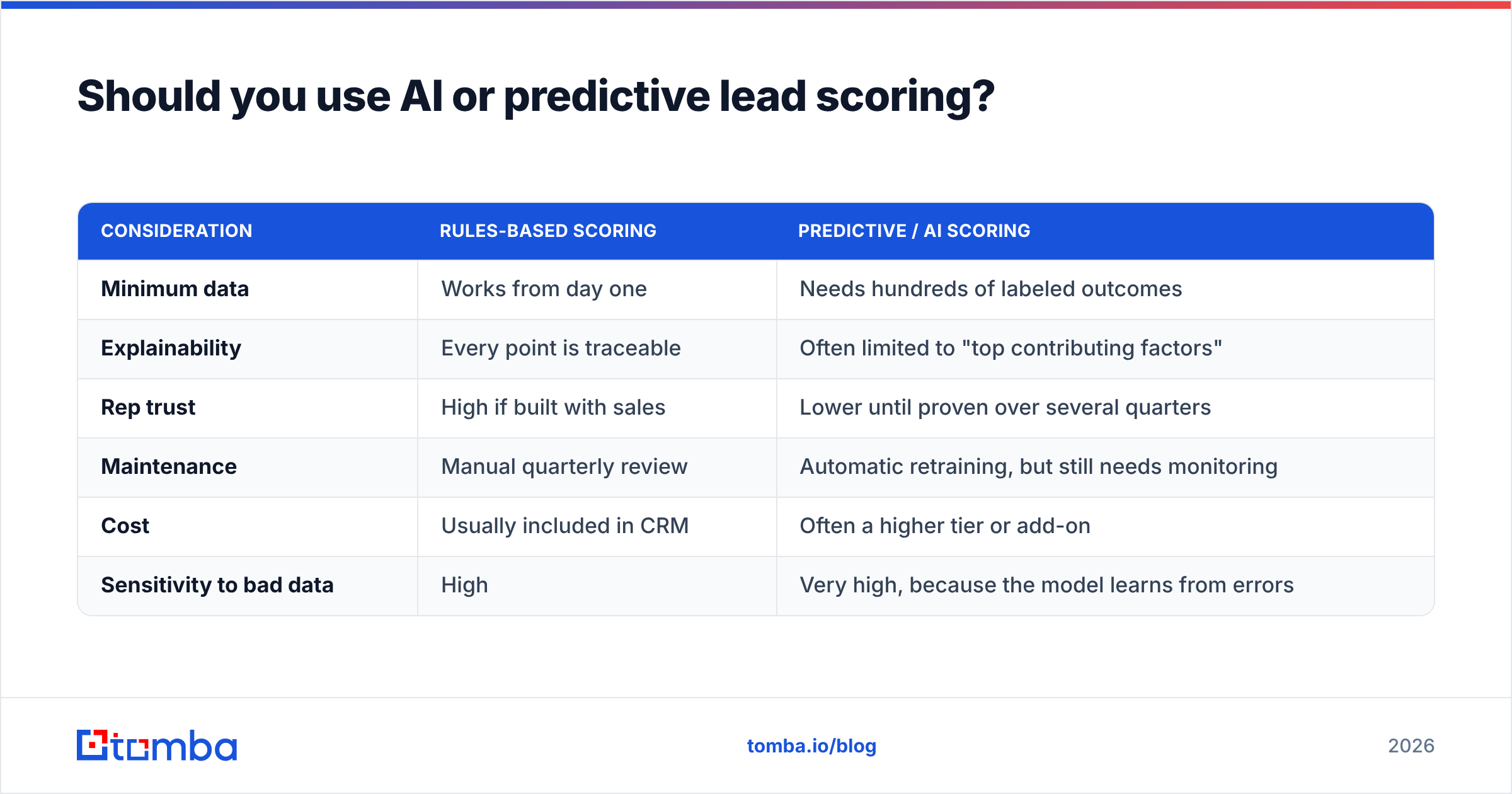
It depends on your data volume and on whether your reps need to understand why a lead scored high.
Predictive models find non-obvious patterns. For example, "companies that recently hired three or more SDRs convert at 2x" is something a human might never think to test. They also update continuously instead of waiting for a quarterly review. Analyst firms including Gartner have covered AI in sales for years, and most major CRMs now ship a version.
The tradeoffs are real, though:
| Consideration | Rules-based scoring | Predictive / AI scoring |
|---|---|---|
| Minimum data | Works from day one | Needs hundreds of labeled outcomes |
| Explainability | Every point is traceable | Often limited to "top contributing factors" |
| Rep trust | High if built with sales | Lower until proven over several quarters |
| Maintenance | Manual quarterly review | Automatic retraining, but still needs monitoring |
| Cost | Usually included in CRM | Often a higher tier or add-on |
| Sensitivity to bad data | High | Very high, because the model learns from errors |
A hybrid works well for many mid-sized teams. Keep a transparent rules-based fit grade that sales understands, and use a predictive model for the intent side, where behavioral patterns are too complex to hand-weight.
How do you measure whether your lead scoring system works?#
Track these metrics monthly and review them with sales every quarter:
- Conversion rate by score band. A-grade leads should convert to opportunities at a clearly higher rate than B, B higher than C, and so on. If the bands are flat, the model isn't separating anything.
- MQL-to-SQL acceptance rate. A low rate means sales rejects what scoring sends them. Find out why.
- Speed to lead by band. High-score leads that wait 48 hours for follow-up lose most of the value of scoring.
- Win rate and deal size by fit grade. This tells you whether the fit model reflects revenue quality or just meeting volume.
- Share of leads with complete scoring fields. If 30% of leads are missing core fit attributes, fix enrichment before touching the weights.
Keep a changelog of every weight or threshold change with its date. When conversion rates move, you'll be able to see whether the model or the market caused it.
What does a good lead scoring system look like in practice?#
Here's a sketch of a mature setup at a 50-person B2B SaaS company:
- Fit grade (A–D) from six firmographic and persona criteria, recalculated nightly from enriched CRM data.
- Intent score (0–100) from website behavior, product usage, and email replies, with 30-day decay.
- Hard overrides: a demo request from an A/B fit lead skips the queue. Competitor domains and invalid emails are suppressed automatically.
- Routing follows the fit/intent matrix, with SLAs visible on a shared dashboard.
- Quarterly review: RevOps pulls conversion by band, sales leaders flag false positives, and weights get adjusted and logged.
There's nothing exotic here. It works because the inputs are clean, the logic can be explained, and both teams own the result.
Where should you start?#
If you don't have scoring today, don't start with a predictive platform. Start with a spreadsheet of your last 100 closed deals, find the five attributes that best separate wins from losses, and build a simple fit grade. Add three or four high-intent behaviors. Run it in shadow mode for a month and see whether it predicts anything.
Fix the data layer at the same time. Scoring only helps if the contacts at the top of the queue are real people with deliverable addresses at the right companies. If your records are thin, the Tomba Email Finder can fill in verified professional emails by name, domain, or company before leads reach your scoring engine, so your A-grade leads are people your reps can actually reach. The free tier covers 25 searches a month for testing, and paid plans start at $49/mo. See Tomba pricing for the full breakdown.
Related guides#
Ready to find emails that actually work?
Join 150,000+ professionals who stopped guessing and started sending. Free credits on signup — no credit card required.
Get the Tomba newsletter
Practical outbound tactics and product updates — once every two weeks.
About the author