Lead Sources: 12 B2B Channels Ranked by Cost, Speed and Quality
Most teams can name their lead sources but can't say which ones actually make money. Here is how 12 B2B channels compare on cost, speed and deal quality, and how to track them properly.
TL;DR
- A lead source is the channel that first put a prospect in touch with you. Tracking it is the only way to know where your pipeline really comes from.
- B2B lead sources fall into four groups: inbound, outbound, partner/referral, and paid. Each group has its own cost profile and time to results.
- Referrals and organic search usually produce the best win rates. Outbound and paid ads are the fastest to switch on and the fastest to scale.
- Judge each source by cost per closed deal and pipeline velocity. Counting leads alone will send your budget to the wrong channels.
- Outbound only works if your data is clean. A bad list hurts your domain long before it produces a meeting.
Most revenue teams can list their lead sources. Far fewer can tell you which of those sources produced last quarter's closed-won revenue, what each one cost, or which one quietly stopped working three months ago. This guide covers the main B2B lead sources, how they compare, and how to set up tracking so your budget follows what actually converts.
What are lead sources?#
A lead source is the channel, campaign or touchpoint where a prospect first entered your funnel. Examples: someone who filled out a demo form after reading a blog post (organic search), a VP who replied to a cold email (outbound), or a CFO introduced by an existing customer (referral).
Most CRMs store this in a dedicated field. HubSpot, for example, sets an "Original Source" property on each contact automatically, and Salesforce ships with a standard Lead Source picklist on the Lead and Opportunity objects. The field looks trivial. It isn't, because every downstream report depends on it: cost per lead, channel ROI, win rate by source, and forecast accuracy.
Two terms get mixed up a lot:
- Lead source is the broad channel (e.g. "Paid Social").
- Lead source detail or campaign is the specific asset or campaign (e.g. "LinkedIn – Q3 RevOps webinar").
Keep the top-level list short and stable, with 8 to 12 values. Put the granularity in a second field. If you let reps type free text into the source field, you'll have 400 variations of "linkedin" within a year.
What are the main types of lead sources?#
B2B lead sources group naturally into four families. The family tells you more about cost and timing than the individual channel does.
- Inbound (earned attention). Organic search, content, webinars, social posts, product-led signups. Slow to build, cheap per lead once running, and high intent because the buyer came to you.
- Outbound (initiated by you). Cold email, cold calling, LinkedIn outreach, direct mail. Fully controllable volume and fast to start, but it depends on data quality and messaging.
- Referral and partner. Customer referrals, agency and tech partners, marketplaces, affiliates. Usually the highest close rates and lowest cost, but hard to scale on demand.
- Paid. Search ads, paid social, sponsored content, review-site listings, intent data. Instant volume, but costs rise as you scale and results stop the day you stop paying.
- Events and community. Trade shows, meetups, Slack/Discord communities, podcasts. Great for relationship depth, harder to attribute cleanly.
A healthy pipeline rarely depends on one family for more than about half of its opportunities. If a single algorithm change or budget cut can wipe out most of your pipeline, you have a concentration risk.
How do the top 12 lead sources compare?#
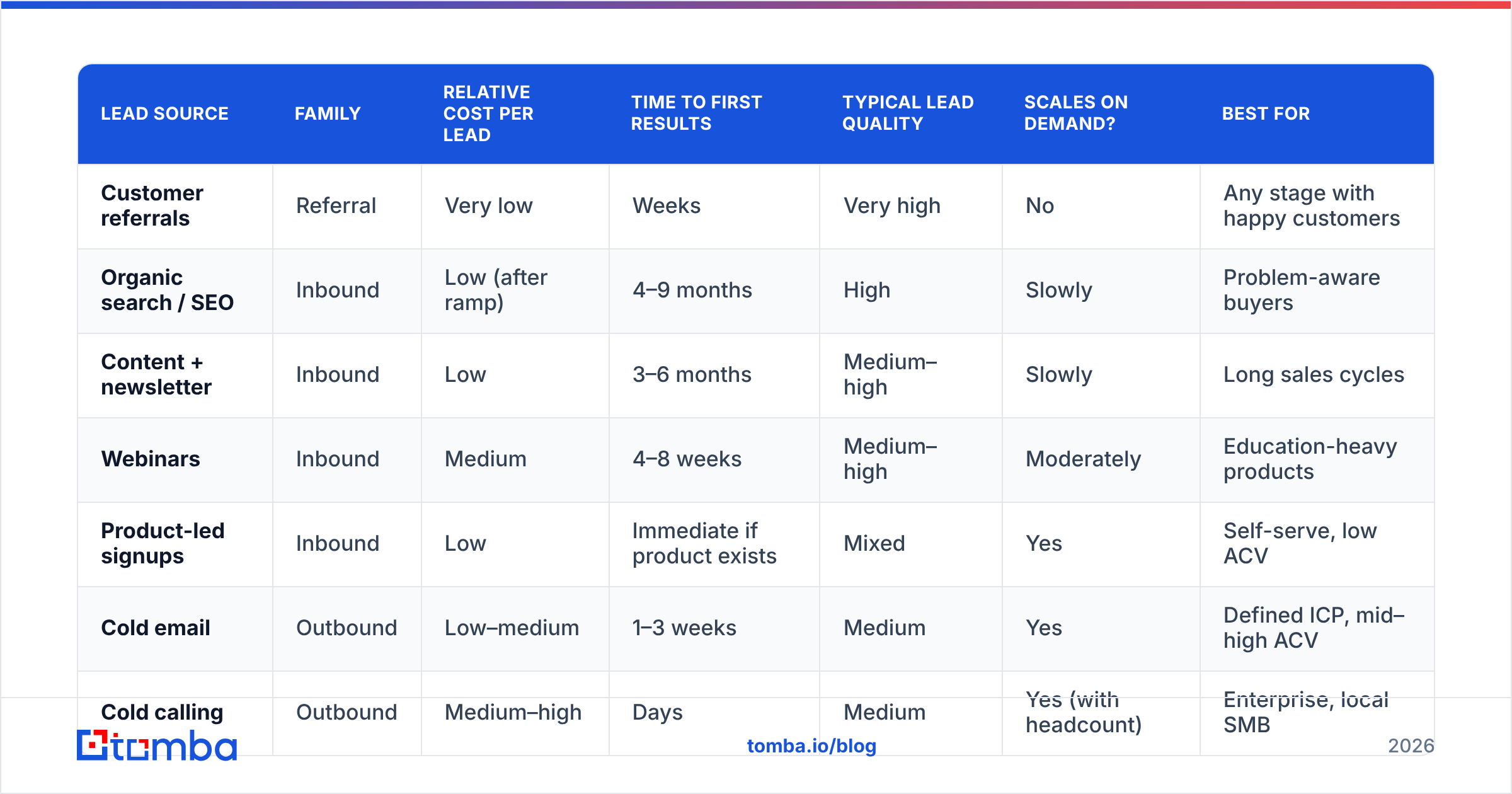
The ranges below are directional. They come from typical mid-market B2B SaaS motions, and your numbers will vary with deal size, ICP and brand strength. Use the table to compare the relative shape of each channel, and don't treat any figure as a benchmark to hold yourself to.
| Lead source | Family | Relative cost per lead | Time to first results | Typical lead quality | Scales on demand? | Best for |
|---|---|---|---|---|---|---|
| Customer referrals | Referral | Very low | Weeks | Very high | No | Any stage with happy customers |
| Organic search / SEO | Inbound | Low (after ramp) | 4–9 months | High | Slowly | Problem-aware buyers |
| Content + newsletter | Inbound | Low | 3–6 months | Medium–high | Slowly | Long sales cycles |
| Webinars | Inbound | Medium | 4–8 weeks | Medium–high | Moderately | Education-heavy products |
| Product-led signups | Inbound | Low | Immediate if product exists | Mixed | Yes | Self-serve, low ACV |
| Cold email | Outbound | Low–medium | 1–3 weeks | Medium | Yes | Defined ICP, mid–high ACV |
| Cold calling | Outbound | Medium–high | Days | Medium | Yes (with headcount) | Enterprise, local SMB |
| LinkedIn outreach | Outbound | Low–medium | 1–3 weeks | Medium | Capped by platform limits | Senior personas |
| Paid search | Paid | High | Days | High intent, variable fit | Yes | Category terms with search volume |
| Paid social (LinkedIn Ads) | Paid | High | 1–2 weeks | Medium | Yes | Precise firmographic targeting |
| Review sites (G2, Capterra) | Paid/Inbound | Medium–high | Weeks | High | Moderately | Buyers in evaluation mode |
| Events / trade shows | Events | Very high | Months (planning) | Mixed | No | Enterprise relationships |
Two patterns stand out. The channels with the best lead quality (referrals, SEO) are also the ones you can't turn up when the quarter looks thin. The channels you can turn up quickly (outbound, paid) need the most operational discipline to keep quality acceptable. Most good pipeline strategies pair one of each: a compounding inbound or referral engine plus a controllable outbound or paid lever.
Which lead sources convert best?#
Referrals win almost every time. A prospect introduced by a peer arrives with trust already in place, so there's less need to prove credibility, fewer stakeholders to convince, and usually a shorter cycle. Referral programs are small because they're capped by the size and happiness of your customer base, not because they underperform.
Organic search comes next for most B2B companies. Someone searching "how to reduce SDR ramp time" is describing their problem to you in their own words. Research summarised on HubSpot's marketing statistics page has consistently shown inbound channels outperforming outbound on cost per lead, but cost per lead is only half the story.
Outbound tends to have a lower lead-to-opportunity rate than inbound, but you pick every account. That means the deals it does win are often a better fit for your ICP and larger in value. A cold email to 300 carefully chosen accounts can outperform 3,000 random webinar registrants on revenue, even if it loses on raw conversion rate.
Paid channels vary the most. Branded and high-intent search terms convert well. Broad paid social often fills the top of the funnel with people who downloaded an ebook and will never buy.
The takeaway: rank sources by revenue per dollar spent and days to close, not by lead volume or even lead-to-MQL rate.
How do you measure the ROI of each lead source?#
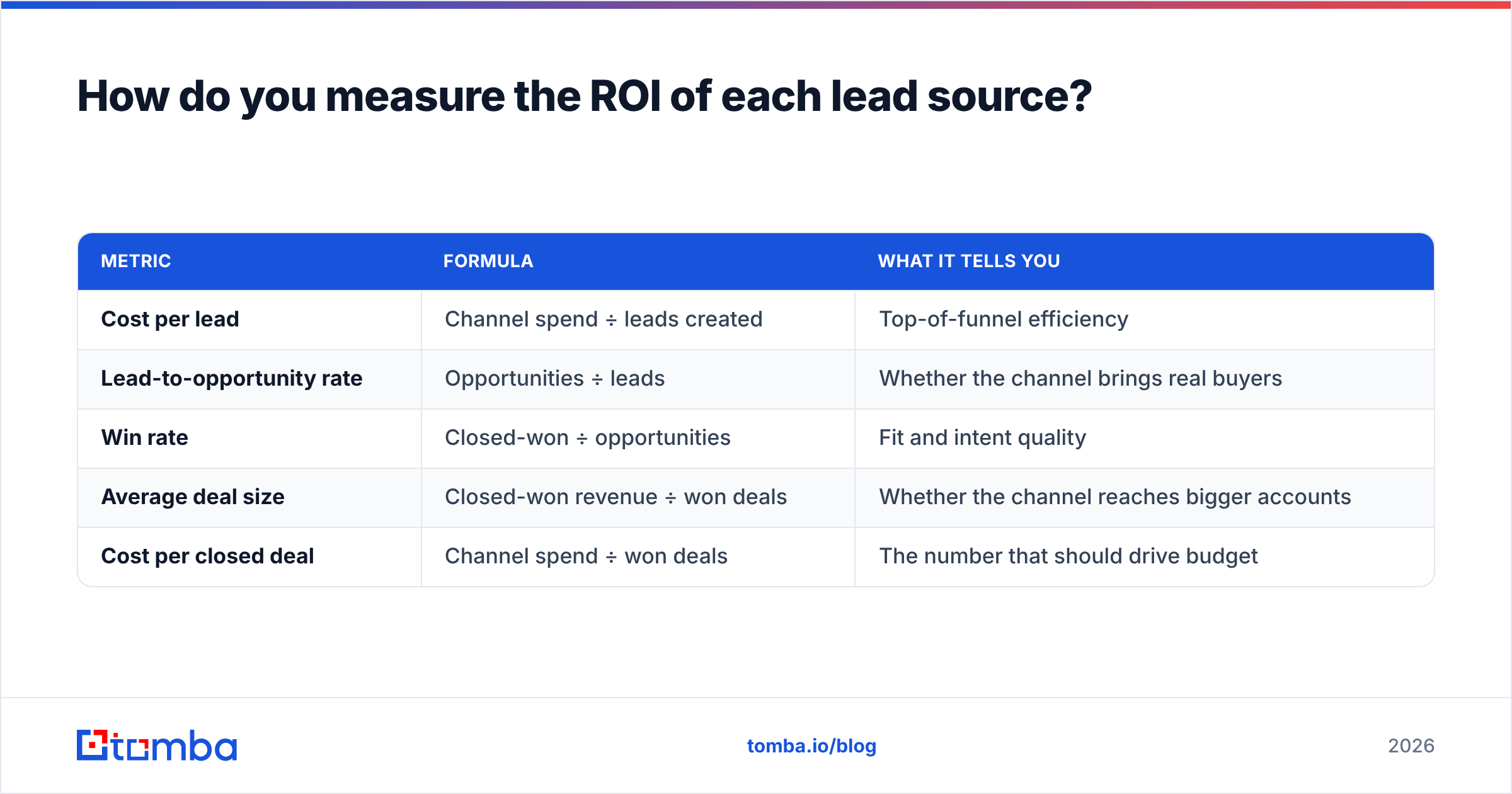
Here's a practical scorecard that works in any CRM. Calculate these five numbers per source, per quarter:
| Metric | Formula | What it tells you |
|---|---|---|
| Cost per lead | Channel spend ÷ leads created | Top-of-funnel efficiency |
| Lead-to-opportunity rate | Opportunities ÷ leads | Whether the channel brings real buyers |
| Win rate | Closed-won ÷ opportunities | Fit and intent quality |
| Average deal size | Closed-won revenue ÷ won deals | Whether the channel reaches bigger accounts |
| Cost per closed deal | Channel spend ÷ won deals | The number that should drive budget |
Include people costs in "spend." An outbound program run by two SDRs isn't cheap just because the software costs $300/month. Salary, tooling and data all go in the denominator.
Also watch pipeline velocity by source: (opportunities × win rate × deal size) ÷ sales cycle length. A channel with a slightly lower win rate but a 40% shorter cycle can be worth more to a company that needs cash this year.
For the underlying theory and the history of the practice, the Wikipedia entry on lead generation is a decent neutral primer.
How should you track lead sources in your CRM?#
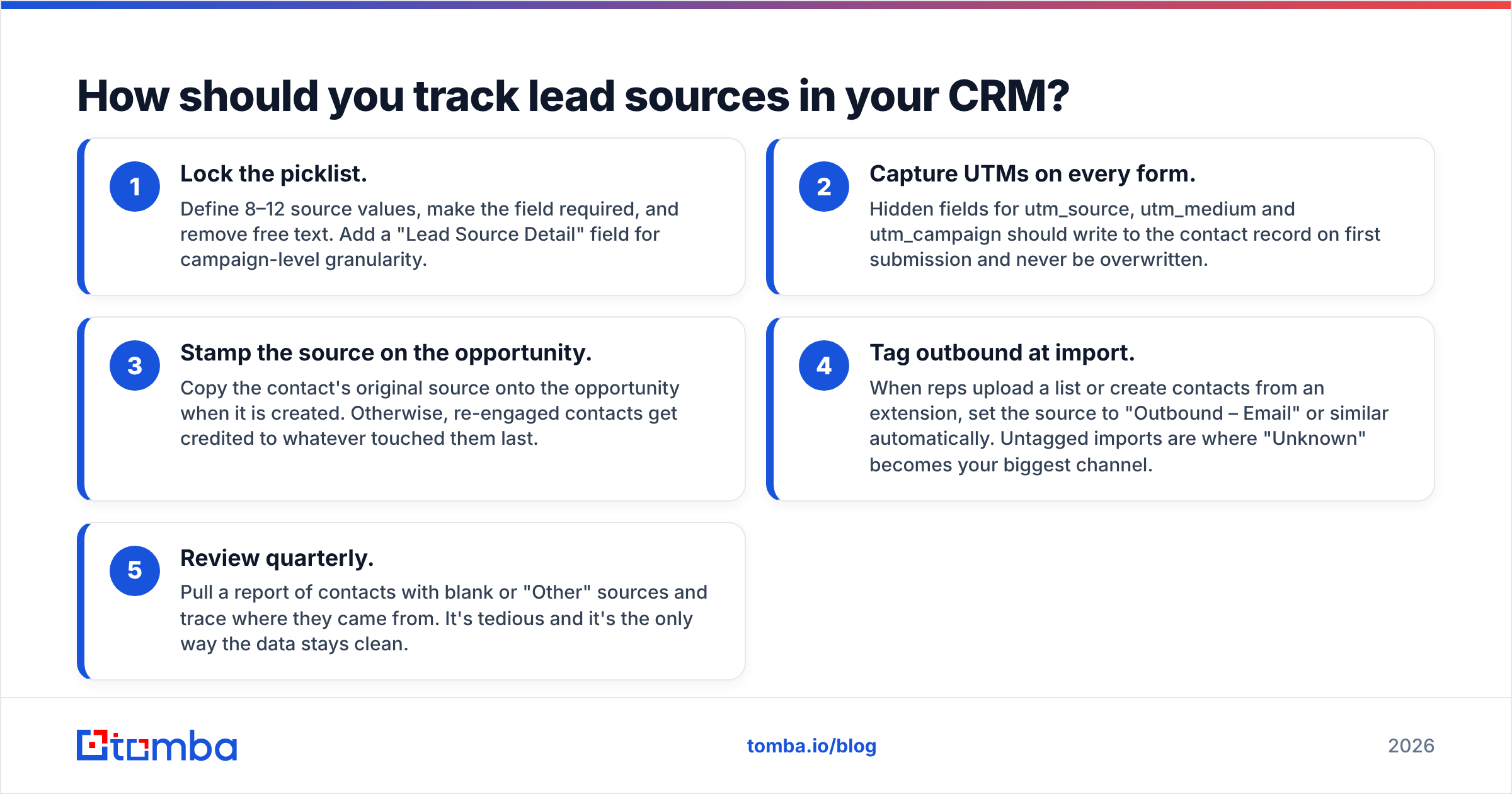
Attribution breaks in predictable places. Fix these five and your reports get far more trustworthy.
- Lock the picklist. Define 8–12 source values, make the field required, and remove free text. Add a "Lead Source Detail" field for campaign-level granularity.
- Capture UTMs on every form. Hidden fields for utm_source, utm_medium and utm_campaign should write to the contact record on first submission and never be overwritten.
- Stamp the source on the opportunity. Copy the contact's original source onto the opportunity when it is created. Otherwise, re-engaged contacts get credited to whatever touched them last.
- Tag outbound at import. When reps upload a list or create contacts from an extension, set the source to "Outbound – Email" or similar automatically. Untagged imports are where "Unknown" becomes your biggest channel.
- Review quarterly. Pull a report of contacts with blank or "Other" sources and trace where they came from. It's tedious and it's the only way the data stays clean.
If you run anonymous website traffic through visitor identification, give it its own source value. Otherwise identified visitors get lumped in with form fills and your organic numbers look better than they are.
Single-touch vs. multi-touch attribution is a separate debate. For most teams under about 50 sellers, first-touch source plus opportunity-creation source gives 80% of the insight with 10% of the complexity. Multi-touch models become worth the investment once you have enough volume for the weighting to mean something.
Is outbound still a reliable lead source in 2026?#
Yes, but the bar is higher. Gmail and Yahoo's sender requirements, introduced in 2024, made authentication (SPF, DKIM, DMARC), low spam-complaint rates and easy unsubscribes mandatory for bulk senders. Microsoft followed with its own enforcement for Outlook consumer domains. The practical effect is that sloppy outbound now gets filtered before anyone sees it.
What separates outbound that works from outbound that burns domains:
- Accurate contact data. Every hard bounce hurts your sender reputation. Aim for bounce rates well under 2%. That means verifying addresses before sending, not after.
- Narrow targeting. Smaller, tightly defined segments with messaging specific to that segment consistently beat large generic sends.
- Multichannel sequencing. Email plus LinkedIn plus a phone touch lifts reply rates compared to email alone, because each channel covers for the others' blind spots.
- Controlled volume per inbox. Spread sending across warmed secondary domains instead of pushing hundreds of emails a day from your main domain.
The data layer is where most teams cut corners. Some teams buy lists from established B2B data providers such as ZoomInfo, Apollo or BookYourData, which work well for building an initial account universe quickly. Others build lists by hand from LinkedIn and company websites. In both cases, run the final send list through an email verifier before it touches your sequencer. Contact data decays every month as people change jobs, and a list that was clean in January won't be clean in June.
How do you choose which lead sources to invest in?#
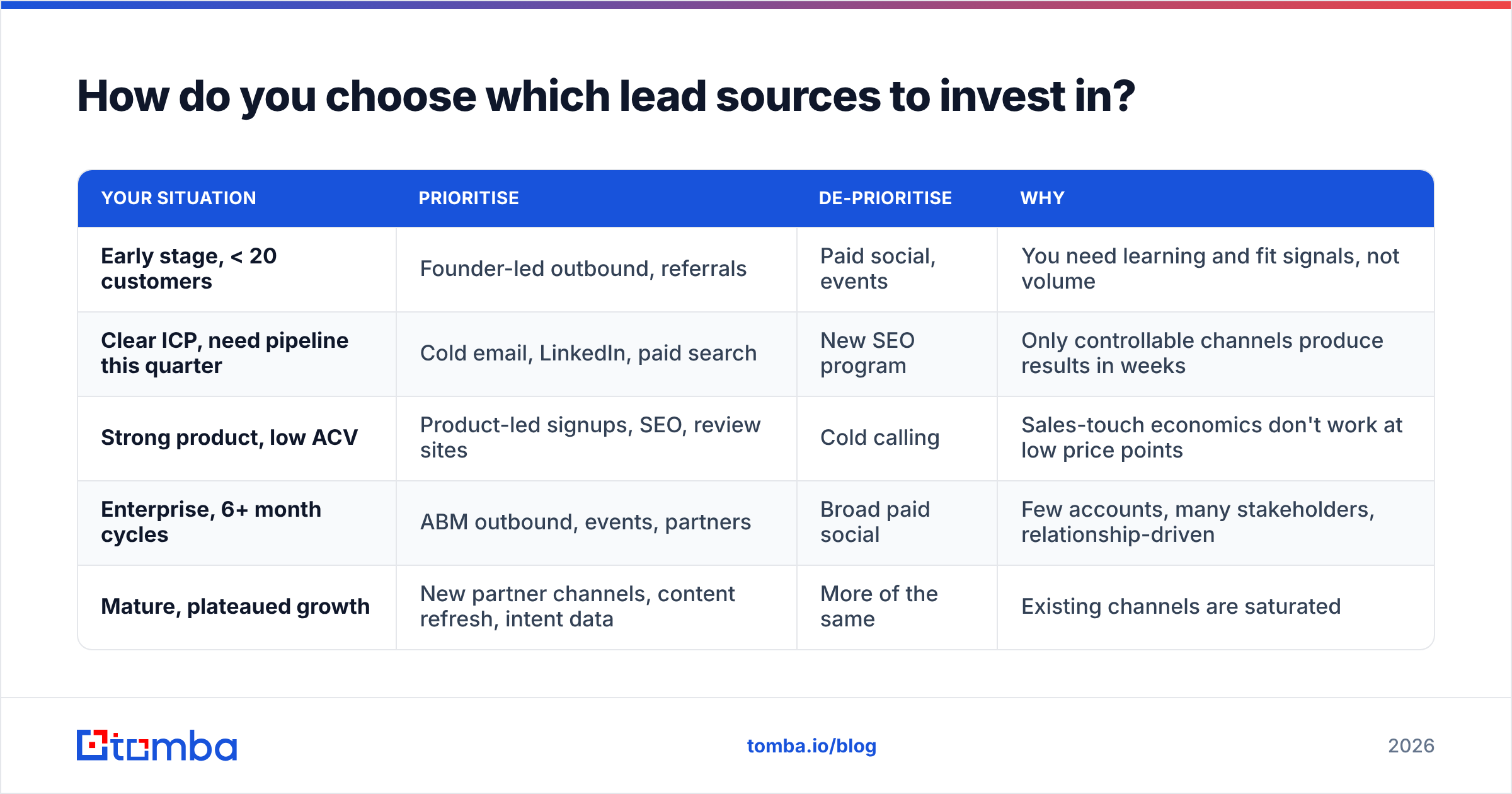
Start from your constraints, not from what's trendy. This decision matrix covers the most common situations:
| Your situation | Prioritise | De-prioritise | Why |
|---|---|---|---|
| Early stage, < 20 customers | Founder-led outbound, referrals | Paid social, events | You need learning and fit signals, not volume |
| Clear ICP, need pipeline this quarter | Cold email, LinkedIn, paid search | New SEO program | Only controllable channels produce results in weeks |
| Strong product, low ACV | Product-led signups, SEO, review sites | Cold calling | Sales-touch economics don't work at low price points |
| Enterprise, 6+ month cycles | ABM outbound, events, partners | Broad paid social | Few accounts, many stakeholders, relationship-driven |
| Mature, plateaued growth | New partner channels, content refresh, intent data | More of the same | Existing channels are saturated |
A simple budgeting rule: put roughly 70% of effort into the two or three sources with the best cost per closed deal, 20% into scaling a promising second-tier source, and 10% into experiments. Reassess every quarter using the scorecard above. Gartner's sales research has repeatedly found that B2B buyers now spend only a small share of their buying journey talking to vendors, which is one more reason to diversify beyond any single touchpoint.
What are the most common lead source mistakes?#
- Optimising for MQL volume. Marketing hits its lead target, sales complains about quality, and nobody looks at cost per closed deal. Align both teams on opportunity and revenue metrics per source.
- Letting "Other" and "Unknown" grow. If more than 10% of your pipeline has no meaningful source, your channel ROI numbers are mostly guesswork.
- Killing slow channels too early. SEO and content take months to compound. Judging them on a 60-day window almost always leads to cutting them.
- Scaling outbound on dirty data. Doubling send volume on an unverified list doubles your bounce rate and can get your domain throttled within a couple of weeks.
- Ignoring referrals because they aren't "a program." A simple ask at renewal or after a successful onboarding, plus a small incentive, often becomes the highest-ROI line in the whole report.
Where should you start this week?#
Pull last year's closed-won deals and group them by original lead source. Calculate cost per closed deal for each. You'll probably find one or two channels doing most of the work and one expensive channel that looks good on lead counts but rarely closes. Fund the first, fix or cut the second, and pick one controllable channel to build alongside your compounding ones.
If outbound is the lever you want to pull, data quality comes first. Tomba Email Finder finds professional email addresses from a name and company domain or by searching a whole domain, with verification built in so your list is clean before it reaches your sequencer. You can start on the free tier with 25 searches a month and move to the Starter plan at $49/mo when outbound becomes a real part of your pipeline. See the full Tomba pricing to match a plan to the volume you plan to send.
Related guides#
// get started
Find, verify and enrich your first contacts today
Start on the free plan with 25 searches a month, then scale when your team is ready.
Free plan · No credit card required · GDPR & CCPA
Get the Tomba newsletter
Product and data updates
// about the author