Lead Sourcing in 2026: Channels, Tools, and a Repeatable Process
Most lead sourcing problems are data problems in disguise. Here's how to rank the seven main channels by cost, quality, and speed, and how to build a process that keeps your pipeline full without burning your domain.
TL;DR
- Lead sourcing means finding and collecting the raw contacts that fit your ideal customer profile (ICP). It happens before qualification, scoring, or outreach.
- For most B2B teams, the best return comes from three channels: signal-based sourcing (hiring, funding, tech installs), domain-first email finding, and website visitor identification.
- Purchased static lists are the cheapest per row and usually the most expensive once you count bounces, spam complaints, and wasted rep time.
- A repeatable process has five steps: define the ICP, pick signals, source accounts, find and verify contacts, then enrich and route. Skip verification and the rest won't hold up.
- Measure sourcing by cost per verified, ICP-fit contact and by reply rate. Raw lead volume tells you very little.
What is lead sourcing?#
Lead sourcing is the work of finding people and companies who could plausibly buy from you and capturing enough data to contact them: name, role, company, and a working email or phone number.
It sits at the very top of the funnel. Lead generation is the broader discipline of creating interest. Lead sourcing is the narrower, more mechanical job of building the contact pool that your SDRs, sequences, and ad audiences draw from.
Think of it like a restaurant kitchen. Lead generation is the whole menu and the marketing that brings diners in. Lead sourcing is buying ingredients. If the produce is rotten, a great chef can't fix the dish, and a great cold email can't fix a list where a fifth of the addresses bounce.
In practice, lead sourcing answers four questions:
- Who fits your ICP (industry, size, geography, tech stack)?
- Which people inside those accounts own the problem you solve?
- How do you reach them: a verified email, a direct dial, or a LinkedIn profile?
- When are they most likely to care, based on signals like hiring, funding, or a new tool?
How is lead sourcing different from lead generation and prospecting?#
These terms get used interchangeably, and that causes real problems. When nobody owns sourcing, everyone assumes someone else checked the data.
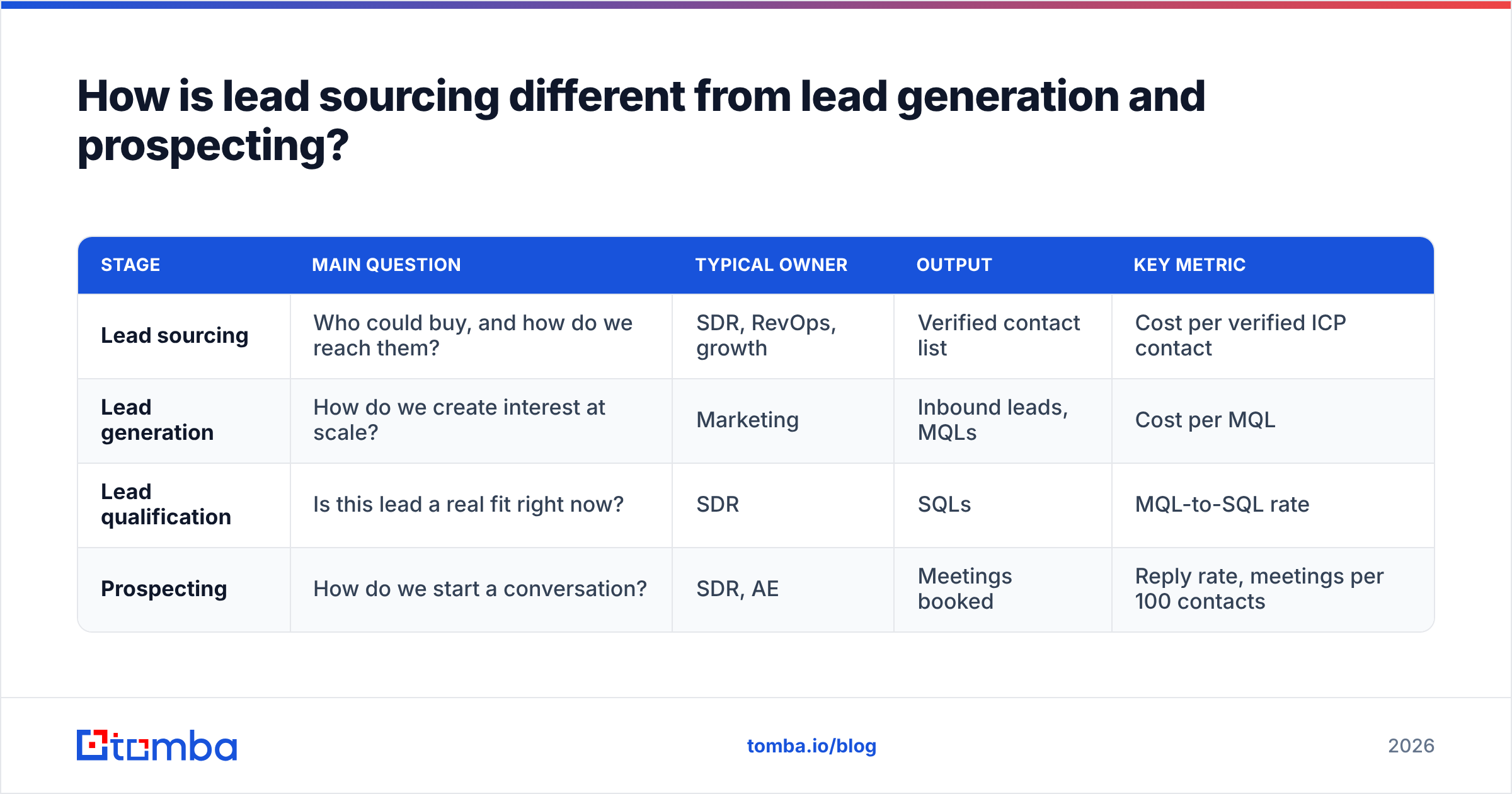
| Stage | Main question | Typical owner | Output | Key metric |
|---|---|---|---|---|
| Lead sourcing | Who could buy, and how do we reach them? | SDR, RevOps, growth | Verified contact list | Cost per verified ICP contact |
| Lead generation | How do we create interest at scale? | Marketing | Inbound leads, MQLs | Cost per MQL |
| Lead qualification | Is this lead a real fit right now? | SDR | SQLs | MQL-to-SQL rate |
| Prospecting | How do we start a conversation? | SDR, AE | Meetings booked | Reply rate, meetings per 100 contacts |
The practical takeaway: sourcing has its own budget, its own metric, and its own failure mode. The failure mode is bad data that makes every later stage look worse than it really is.

Which lead sourcing channels actually work in 2026?#
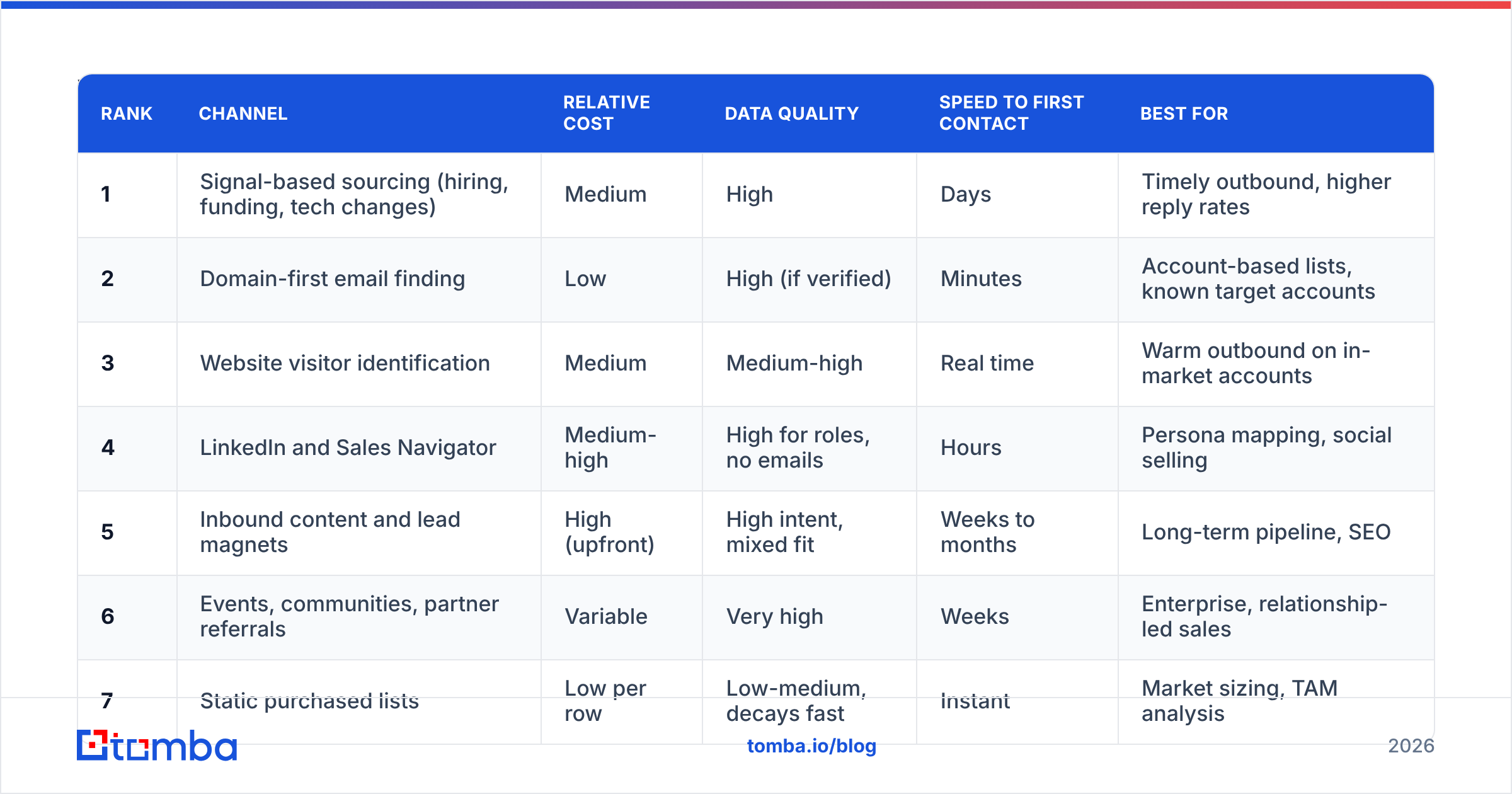
No single channel wins. They differ a lot in cost, data quality, and how quickly they produce contacts you can use. Here are seven channels, ranked by overall value for a typical B2B team selling a mid-market product.
| Rank | Channel | Relative cost | Data quality | Speed to first contact | Best for |
|---|---|---|---|---|---|
| 1 | Signal-based sourcing (hiring, funding, tech changes) | Medium | High | Days | Timely outbound, higher reply rates |
| 2 | Domain-first email finding | Low | High (if verified) | Minutes | Account-based lists, known target accounts |
| 3 | Website visitor identification | Medium | Medium-high | Real time | Warm outbound on in-market accounts |
| 4 | LinkedIn and Sales Navigator | Medium-high | High for roles, no emails | Hours | Persona mapping, social selling |
| 5 | Inbound content and lead magnets | High (upfront) | High intent, mixed fit | Weeks to months | Long-term pipeline, SEO |
| 6 | Events, communities, partner referrals | Variable | Very high | Weeks | Enterprise, relationship-led sales |
| 7 | Static purchased lists | Low per row | Low-medium, decays fast | Instant | Market sizing, TAM analysis |
1. Signal-based sourcing#
Start from an event, not a static filter. A company that just raised a Series B, posted three SDR roles, or started using a competitor's tool is more likely to answer right now. Signals give you relevance and timing, which are the two things generic lists can't give you.
2. Domain-first email finding#
If you already know your target accounts, work from the company domain. A domain search returns the publicly indexed professional emails at that company along with the company's email pattern. You then filter by department or seniority. It's the fastest way to turn a named account list into reachable people, and it's cheap per contact.
3. Website visitor identification#
Most B2B website traffic never fills out a form. Tools that match IP data to companies show you which accounts are reading your pricing page this week. Tomba's website visitor reveal and similar products turn anonymous sessions into account names. From there you can source the right contacts inside those accounts.
4. LinkedIn and Sales Navigator#
LinkedIn Sales Navigator is still the best place to map buying committees and check job titles. What it doesn't give you is a deliverable email. Most teams pair it with an email finder or browser extension to fill that gap.
5. Inbound content#
Inbound leads come in with intent, but you don't control fit or volume. Treat inbound as a separate stream. Enrich those leads the same way you enrich outbound contacts so your scoring stays consistent across both.
6. Events, communities, and referrals#
These are slow and hard to scale, and they often produce the highest win rates you'll see. For enterprise deals, a single warm intro can be worth more than a thousand cold contacts.
7. Static purchased lists#
Pre-built lists are useful for sizing your total addressable market and for filtering accounts. Used as a direct outbound source, they fall apart. Commonly cited estimates put B2B contact decay at roughly 20–30% per year, because people change jobs, companies rebrand, and domains lapse. Any list that isn't re-verified before sending will bounce.
What does a repeatable lead sourcing process look like?#
Ad-hoc sourcing is how teams end up with 40,000 contacts in the CRM and nobody to call. The process below works for a two-person startup and for a 50-seat SDR floor. What changes at scale is the tooling, not the order of the steps.
- Define an ICP you can filter on. "Mid-market SaaS" isn't something a tool can search. "B2B software, 50–500 employees, US/UK, uses HubSpot, hiring in sales" is. Every attribute should map to a field in your data source.
- Pick two or three buying signals. Choose signals that link to your value proposition. A sales-tool vendor cares about SDR hiring. A security vendor cares about new compliance requirements or a recent breach disclosure.
- Source accounts first, then people. Build the account list, then find two to four contacts per account across the buying committee. Account-first sourcing avoids spraying individuals at companies that will never buy.
- Find and verify every email before it touches a sequence. Run every address through an email verifier. Flag catch-all domains separately and send to them in smaller, monitored batches. This step does more than any other to protect your sender reputation.
- Enrich, dedupe, and route. Add firmographics, tech stack, and phone numbers where available. Dedupe against the CRM and assign by territory or segment. Log the source channel on every record so you can measure it later.
Run this as a weekly cadence rather than a quarterly list pull. Smaller, fresher batches beat a large import every time, because the data is still accurate when you actually send.
Which lead sourcing tools should you consider?#
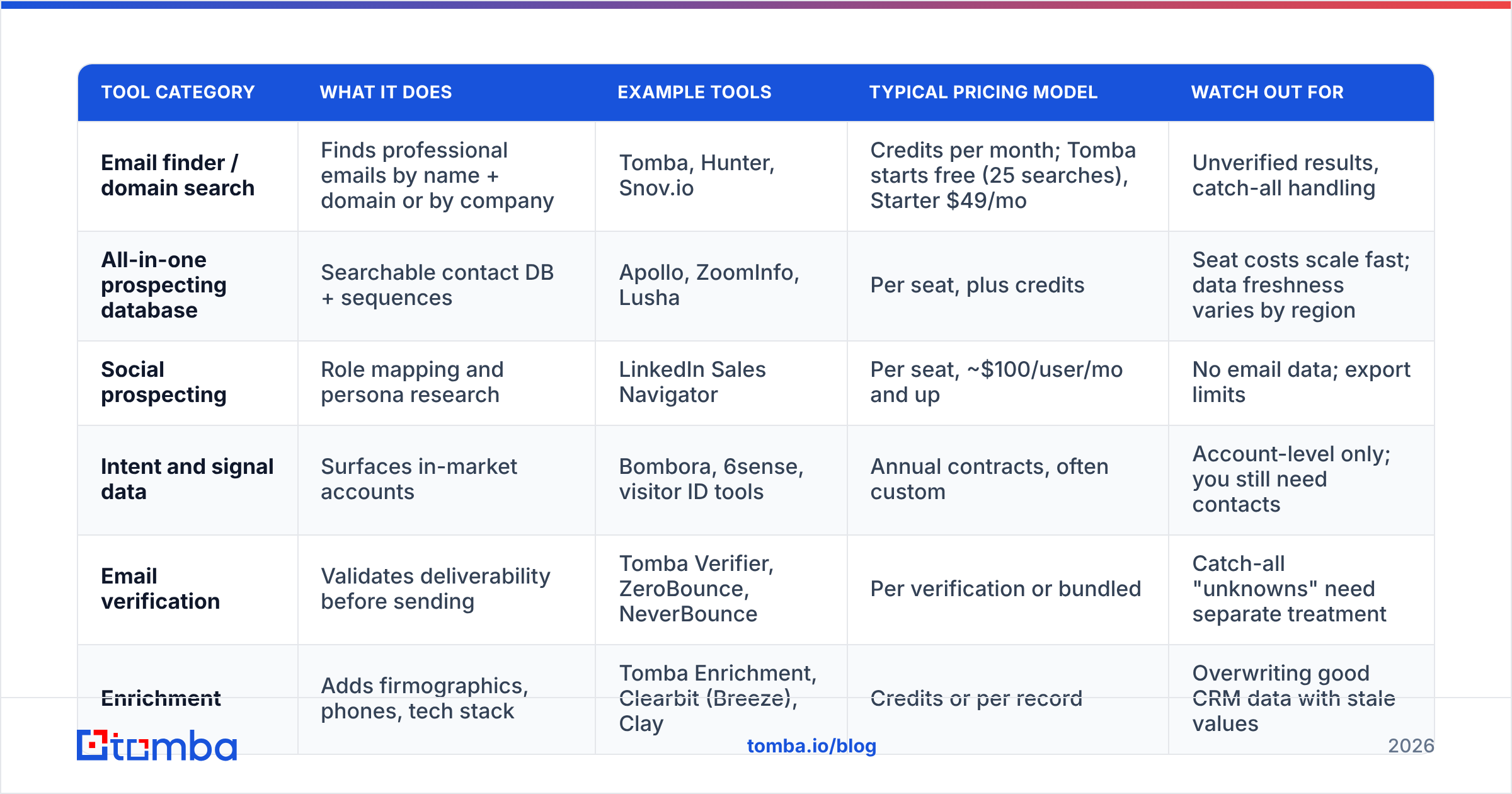
You don't need one tool for everything. Most effective stacks combine three or four categories. Browse category rankings on G2 for independent user reviews before you commit to annual contracts.
| Tool category | What it does | Example tools | Typical pricing model | Watch out for |
|---|---|---|---|---|
| Email finder / domain search | Finds professional emails by name + domain or by company | Tomba, Hunter, Snov.io | Credits per month; Tomba starts free (25 searches), Starter $49/mo | Unverified results, catch-all handling |
| All-in-one prospecting database | Searchable contact DB + sequences | Apollo, ZoomInfo, Lusha | Per seat, plus credits | Seat costs scale fast; data freshness varies by region |
| Social prospecting | Role mapping and persona research | LinkedIn Sales Navigator | Per seat, ~$100/user/mo and up | No email data; export limits |
| Intent and signal data | Surfaces in-market accounts | Bombora, 6sense, visitor ID tools | Annual contracts, often custom | Account-level only; you still need contacts |
| Email verification | Validates deliverability before sending | Tomba Verifier, ZeroBounce, NeverBounce | Per verification or bundled | Catch-all "unknowns" need separate treatment |
| Enrichment | Adds firmographics, phones, tech stack | Tomba Enrichment, Clearbit (Breeze), Clay | Credits or per record | Overwriting good CRM data with stale values |
A lean, capable stack for a small team might be: Sales Navigator for mapping, a domain-first email finder with built-in verification, and a spreadsheet or CRM for routing. Add intent data only after you've proven that basic outbound converts.
How do you measure lead sourcing quality?#
Volume is the vanity metric of sourcing. These are the numbers that actually tell you whether a channel is working:
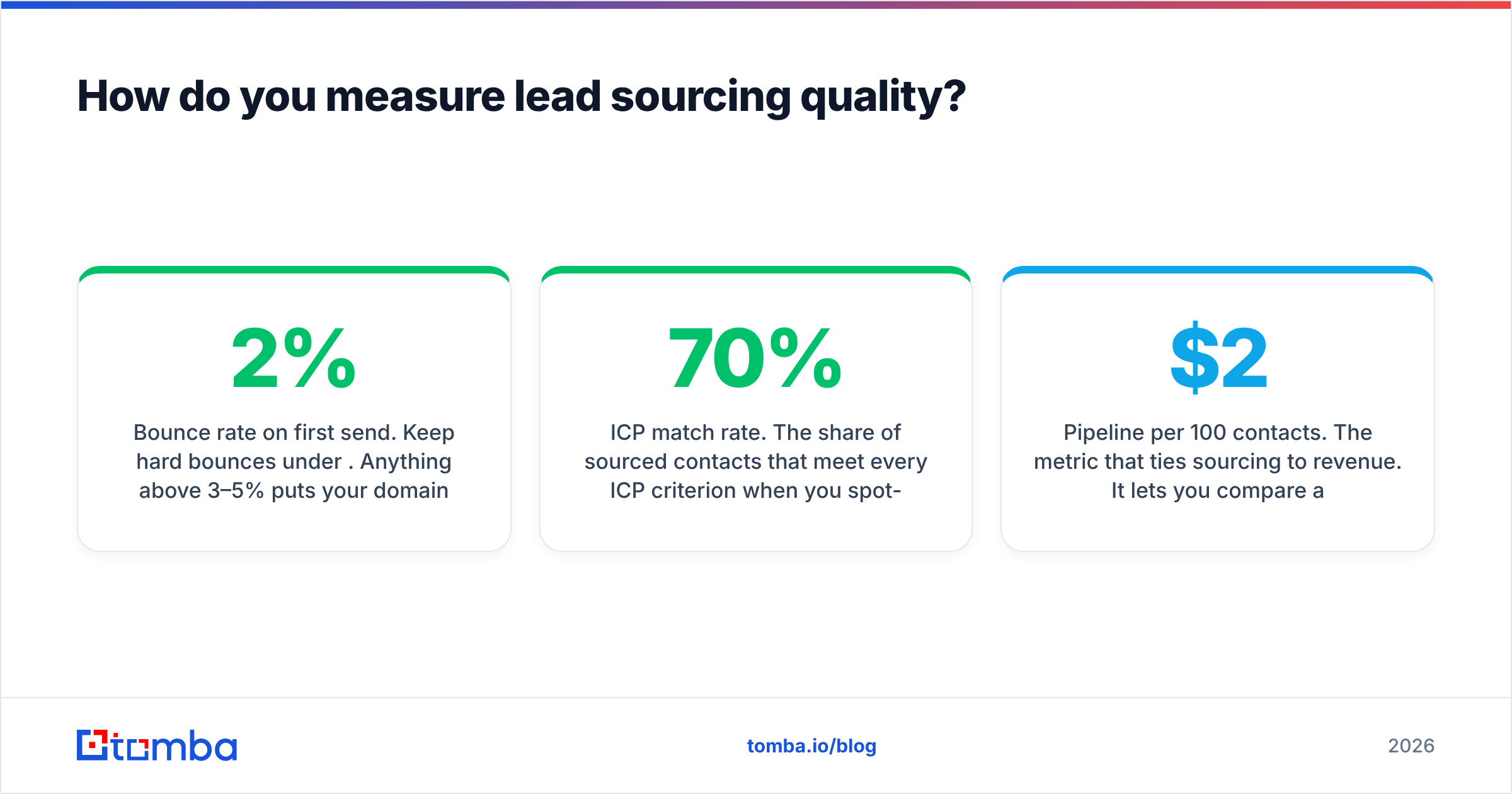
- Cost per verified ICP contact. Total channel spend (tools plus labor) divided by the contacts that pass both verification and ICP filters. This is your true unit cost.
- Bounce rate on first send. Keep hard bounces under 2%. Anything above 3–5% puts your domain at risk with Gmail and Microsoft filtering.
- ICP match rate. The share of sourced contacts that meet every ICP criterion when you spot-check them. Below 70% means your filters or data source are too loose.
- Reply rate by source. Tag every contact with its source channel. When signal-sourced contacts reply at twice the rate of list-sourced ones, that tells you where next quarter's budget should go.
- Pipeline per 100 contacts. The metric that ties sourcing to revenue. It lets you compare a $2 contact with a $0.20 contact on equal terms.
HubSpot's sales research and most RevOps practitioners make the same point: attribution by source is what separates teams that improve their sourcing from teams that just buy more of it.
What mistakes kill lead sourcing programs?#
Most sourcing failures come from the same short list of mistakes:
- Treating sourcing as a one-time project. A list pulled in January is meaningfully worse by June. Source continuously, in small batches.
- Skipping verification to save credits. Verification costs a fraction of a cent per address. A burned sending domain costs weeks of warmup and lost pipeline.
- Sourcing contacts before accounts. You end up with 12 people at a company that will never buy, and zero at the one that would.
- Ignoring catch-all domains. Many mid-market and enterprise domains accept all mail at the server level, so standard verifiers return "unknown." Either use a dedicated catch-all check or send to those contacts in isolated, low-volume batches.
- Not logging the source. Without a source field on every record, you can't tell which channel produced your best customers. Budget then goes to whichever vendor gives the best demo.
- Overlooking compliance. Cold B2B email is lawful in many jurisdictions under legitimate interest, but GDPR, CAN-SPAM, and CASL still require an honest identity, a working opt-out, and a defensible reason for contacting each person. Only source data from providers that can explain where it came from.
Is inbound or outbound lead sourcing better?#
Neither is better on its own. They do different jobs.
Inbound brings intent without control. You can't choose which companies download your ebook, and early-stage teams rarely get enough volume from it. Outbound gives you control without guaranteed intent. You pick the accounts, but many of them won't be in-market.
The strongest programs combine the two. Visitor identification and intent signals show which outbound accounts are already warming up, and domain-first sourcing turns those accounts into named, reachable people within hours. Inbound leads get the same enrichment and scoring as outbound ones, so reps see a single, consistent queue.
If you have to pick one to start with:
- Early stage, under $1M ARR: outbound, with tight ICP filters and signal-based timing. You need conversations now.
- Growth stage: add visitor identification and start investing in inbound content with a 6–12 month horizon.
- Enterprise sales motion: prioritize account-based sourcing, buying-committee mapping, and referrals over raw volume.
Frequently asked questions about lead sourcing#
What is the difference between lead sourcing and lead generation?#
Lead sourcing is finding and collecting contact data for people who fit your ICP. Lead generation is the broader effort to create interest, including content, ads, and events. Sourcing produces the list, and generation produces the demand.
How much should lead sourcing cost per contact?#
It varies widely. Domain-first email finding can come in well under $0.50 per verified contact, and fully enriched intent-based contacts can cost several dollars each. Compare channels on pipeline generated per 100 contacts, not on price per row.
How often should I re-verify my lead lists?#
Re-verify any contact that hasn't been emailed in the last 60–90 days before it goes back into a sequence. With B2B data decaying at a meaningful rate every year, lists older than a quarter reliably produce avoidable bounces.
Can I do lead sourcing without LinkedIn?#
Yes. Domain search, company databases, visitor identification, and signal data all work without LinkedIn. LinkedIn is still the most reliable source for current job titles, so most teams use it to check roles even when their emails come from elsewhere.
Is buying lead lists a bad idea?#
Pre-built lists are useful for market sizing and account filtering. The risk comes from sending to them without re-verifying first. If you buy a list, verify every address and check ICP fit before any contact enters a sequence.
Where should you start?#
Pick your top 50 target accounts this week. Source two to four contacts per account from their domain, verify every address, and log the source. Then compare reply rates against whatever list you're using now. That test will tell you more than any vendor demo.
If you want the fastest route from a list of company domains to verified contacts, try the Tomba Email Finder. You can search by domain, name, or company, and every result comes back with a confidence score and verification status. That covers steps 3 and 4 of the process above in one place. The free plan includes 25 searches a month to test it on your own target accounts, and paid plans start at $49/mo when you're ready to scale.
Related guides#
// get started
Find, verify and enrich your first contacts today
Start on the free plan with 25 searches a month, then scale when your team is ready.
Free plan · No credit card required · GDPR & CCPA
// about the author