Lead Sourcing vs Lead Generation: Differences and When to Use Each
Lead sourcing and lead generation both fill a pipeline, but they work in opposite directions. Here's how they differ, what each costs, and how to combine them without wasting SDR hours.
TL;DR
- Lead sourcing is outbound: you pick the accounts and people you want, then find their verified contact data yourself.
- Lead generation is inbound or demand-led: you create content, ads, or offers that get prospects to raise their hand and give you their details.
- Sourcing gives you control over who enters the pipeline. Generation gives you intent, meaning when they're ready to talk.
- Sourcing pays off faster and costs less for narrow ICPs, high ACVs, and new markets. Generation pays off over time for broad markets and self-serve products.
- Most teams that hit their numbers run both. Generation brings in the signal, and sourcing fills the gaps with accounts that never would have found you.
What is the difference between lead sourcing and lead generation?#
Here's the short version. Lead sourcing is when you go out and get the lead. Lead generation is when the lead comes to you.
The two terms get mixed up constantly, partly because vendors use them loosely and partly because both end in the same place: a name, a company, and a way to reach them, sitting in your CRM. What sets them apart is who starts the contact and what you know about the person when they arrive.
- With lead sourcing, your team starts. You define an ideal customer profile (ICP), build a list of target accounts, find the decision-makers, and get their email addresses and phone numbers. The prospect usually has no idea you exist until your first message lands.
- With lead generation, the prospect starts. They download a guide, sign up for a webinar, request a demo, or fill in a pricing form. You know they have at least some interest, but you have little say over who shows up.
Here's an analogy. Sourcing is like fishing with a spear: you choose the fish, aim, and throw. Generation is like fishing with a net: you pick the spot and the bait, and then you sort through whatever you pull up.
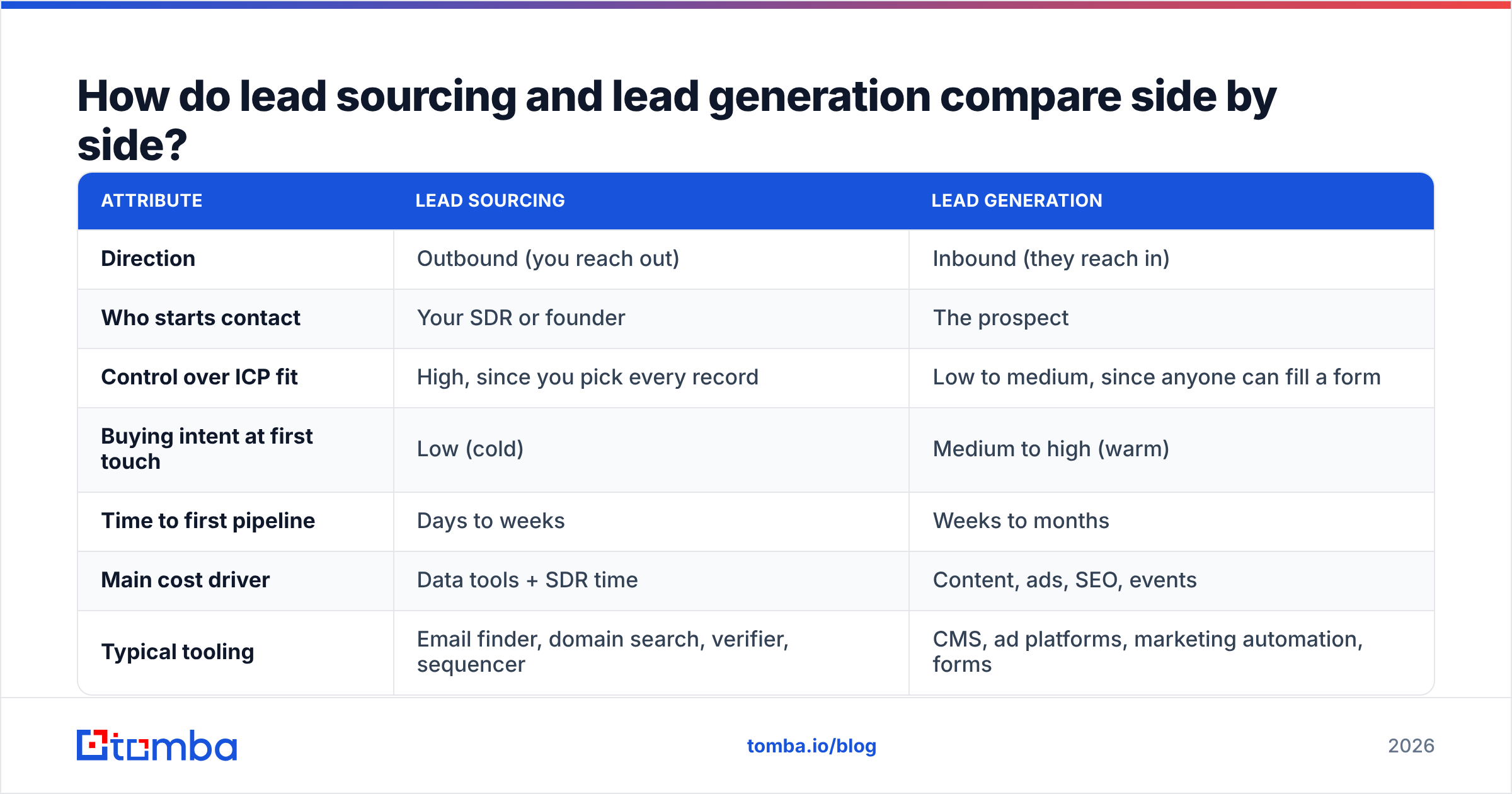
How do lead sourcing and lead generation compare side by side?#
Here's the practical comparison. The price ranges are typical market ranges, not quotes, and they vary a lot by industry and region.
| Attribute | Lead sourcing | Lead generation |
|---|---|---|
| Direction | Outbound (you reach out) | Inbound (they reach in) |
| Who starts contact | Your SDR or founder | The prospect |
| Control over ICP fit | High, since you pick every record | Low to medium, since anyone can fill a form |
| Buying intent at first touch | Low (cold) | Medium to high (warm) |
| Time to first pipeline | Days to weeks | Weeks to months |
| Main cost driver | Data tools + SDR time | Content, ads, SEO, events |
| Typical tooling | Email finder, domain search, verifier, sequencer | CMS, ad platforms, marketing automation, forms |
| Scales by | Adding reps and data credits | Adding content, budget, and channels |
| Biggest risk | Bounces, spam flags, low reply rates | Junk MQLs, rising CPL, slow ramp |
| Best for | Narrow ICP, high ACV, new markets, ABM | Broad markets, PLG, established brands |
If you remember one row, make it the one on ICP fit and intent. Sourcing gives you fit without intent. Generation gives you intent without guaranteed fit. Everything else follows from that.
What does a lead sourcing workflow actually look like?#
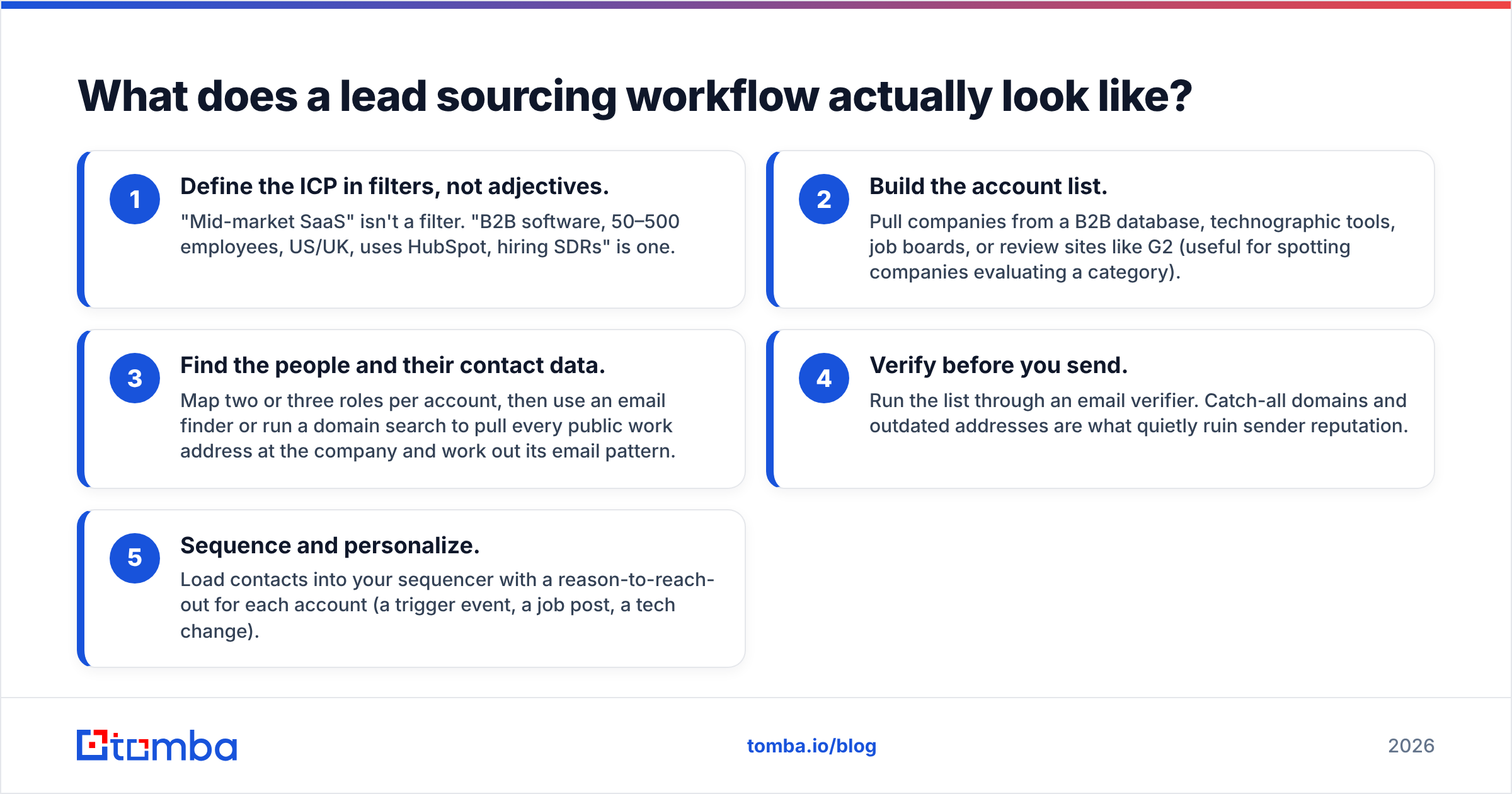
A working sourcing motion has five stages. If you skip any of them, the drop shows up in reply rates within two weeks.
- Define the ICP in filters, not adjectives. "Mid-market SaaS" isn't a filter. "B2B software, 50–500 employees, US/UK, uses HubSpot, hiring SDRs" is one.
- Build the account list. Pull companies from a B2B database, technographic tools, job boards, or review sites like G2 (useful for spotting companies evaluating a category).
- Find the people and their contact data. Map two or three roles per account, then use an email finder or run a domain search to pull every public work address at the company and work out its email pattern.
- Verify before you send. Run the list through an email verifier. Catch-all domains and outdated addresses are what quietly ruin sender reputation.
- Sequence and personalize. Load contacts into your sequencer with a reason-to-reach-out for each account (a trigger event, a job post, a tech change).
In practice, sourcing depends on how good your data is. A beautifully written sequence sent to 30% bad addresses won't succeed, and your domain takes the hit for months afterward.

What does a lead generation workflow actually look like?#
Lead generation is built around a funnel rather than a list. The usual components:
- Attract. SEO content, paid social, podcasts, partner co-marketing, events.
- Capture. Gated assets, demo requests, free trials, calculators, newsletter sign-ups.
- Qualify. Lead scoring on firmographics and behavior, turning raw form fills into a marketing qualified lead (MQL).
- Route. Hand-off to sales by territory, segment, or round-robin, ideally within minutes.
- Nurture. Email and retargeting for leads that aren't ready yet.
Platforms like HubSpot and Salesforce's marketing products were built around this model. The inbound approach, widely documented on Wikipedia and across the B2B marketing canon, depends on a simple premise: buyers do a large share of their research before they ever speak to sales, so you want to be present during that research.
The catch is volume versus quality. A single well-ranked guide can produce hundreds of sign-ups a month, and a large share of them may be students, competitors, job seekers, or people at companies that will never buy from you. You pay for that noise either in SDR time spent qualifying or in marketing budget spent attracting it.
Is lead sourcing better than lead generation?#
Neither one is better in every situation. The better choice depends on four variables, and you can usually score your own situation in five minutes.
Choose sourcing-first when:
- Your ICP is narrow. If only 2,000 companies in the world can buy from you, waiting for them to find a blog post is a poor bet. List them and go get them.
- Your deal size is large. At $20k+ ACV, spending an hour researching and personalizing outreach to a single account is easy to justify.
- You're entering a new market or launching a new product. Nobody is searching for you yet, so there's no inbound demand to capture.
- You need pipeline this quarter. A sourced list can be in-sequence within a week. An SEO program can take six to twelve months to compound.
Choose generation-first when:
- Your market is broad. Thousands of companies across many industries could use your product, and hand-picking them doesn't scale.
- Your ACV is low or you run product-led growth. At $50/month, you can't afford per-account research, so let the product and content do the selling.
- Your category already has search demand. If people are already googling the problem you solve, you want to rank for it.
- Your brand has trust already. An established brand converts inbound traffic far better than an unknown one does.
Most B2B companies between seed and Series C sit somewhere in the middle, which is why the useful question is usually how to split resources between the two rather than which one to pick.
How much does each approach cost?#
Cost structures differ more than people expect, and that changes how you budget.
Lead sourcing costs are mostly variable and predictable:
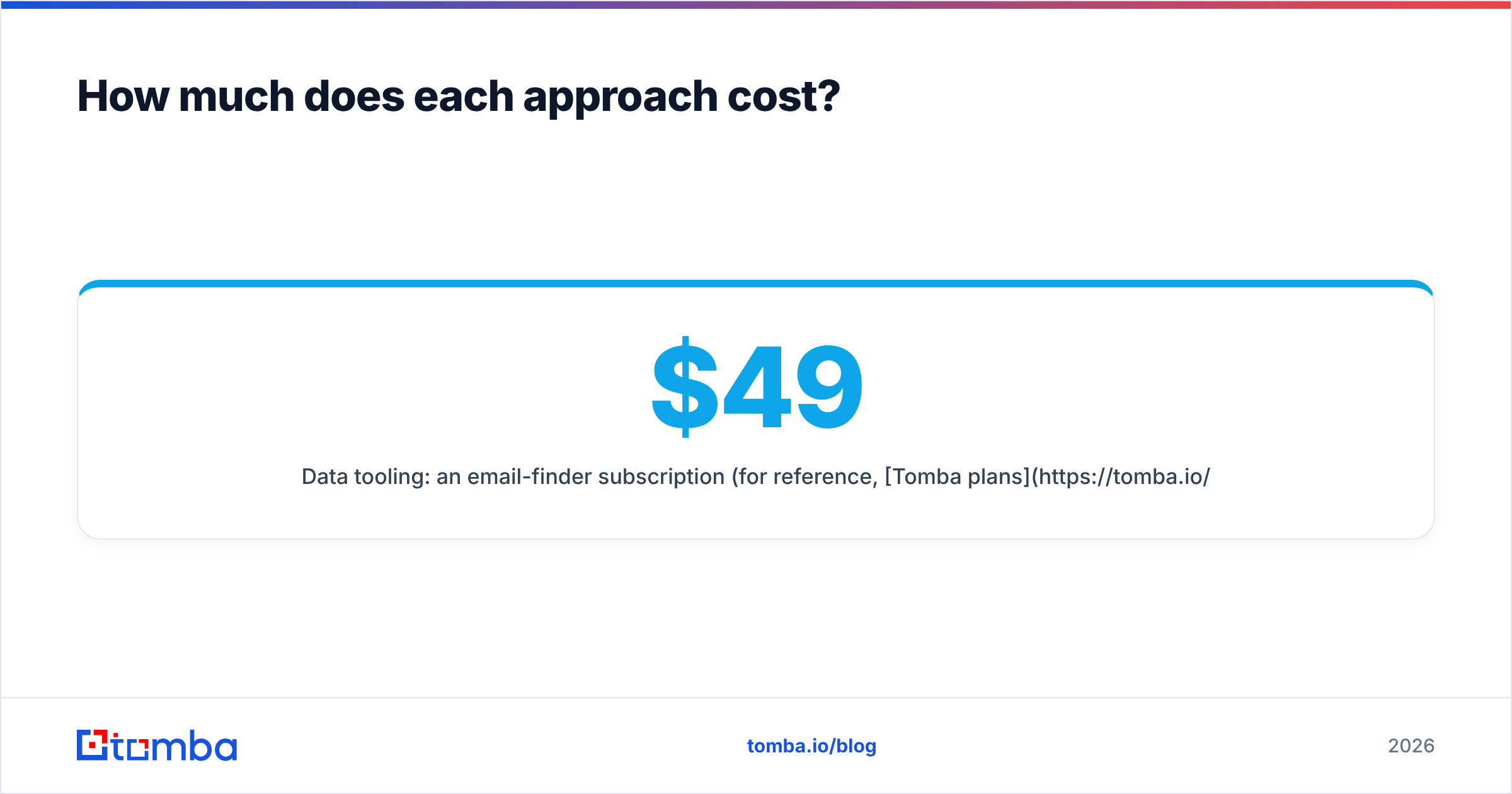
- Data tooling: an email-finder subscription (for reference, Tomba plans start with a free tier of 25 searches/month, then Starter at $49/mo, Growth at $99/mo, and Pro at $249/mo)
- Sending infrastructure: secondary domains, inboxes, warmup, a sequencer
- People: SDR salary and ramp time, which is by far the biggest line item
You can roughly calculate cost per meeting from day one: contacts sourced × reply rate × meeting rate, divided by spend.
Lead generation costs are front-loaded and harder to attribute:
- Content production (writers, designers, video)
- Paid media, where cost per lead often rises as you exhaust the cheap audiences
- Marketing automation platforms, which tend to price by contact count
- Time, since organic programs need months before they show clear return
The practical upshot is that sourcing is easier to start and stop, while generation is harder to start and keeps paying after you stop pushing. A new content asset can keep producing leads for years, and a paused outbound sequence produces nothing the day you pause it.
What are the most common mistakes with each?#
Lead sourcing mistakes
- Buying a generic list instead of building one. Purchased lists are often stale, shared with dozens of other buyers, and loosely matched to your ICP. Reputable data providers, including established players like BookYourData, offer filtered B2B lists, but even good data needs verification against your own criteria before you send.
- Skipping verification. Hard bounce rates above roughly 2–3% signal to mailbox providers that you don't know who you're emailing.
- Treating sourcing as volume. Five hundred well-researched contacts outperform five thousand random ones, and they don't burn your domain.
- Only sourcing one contact per account. If your single contact leaves or ignores you, the account is dead. Multi-thread from the start.
Lead generation mistakes
- Counting MQLs instead of pipeline. A 40% increase in form fills means nothing if meetings stay flat.
- Gating everything. Forms on every asset reduce reach and fill the CRM with fake emails.
- Slow follow-up. Inbound interest decays fast. A demo request answered the next day often loses to a competitor who answered in ten minutes.
- No enrichment. A form with just "email" leaves reps guessing who the person is and whether they fit.
How do you combine lead sourcing and lead generation?#
The strongest pipelines treat sourcing and generation as two halves of one system. They feed each other in three places.
1. Use inbound signal to guide outbound targeting. When a company shows up in your inbound data (a webinar sign-up, repeat pricing-page visits, one mid-level employee downloading a guide), treat it as a trigger. Source the other decision-makers at that account and reach out with context. The inbound lead might be an analyst, but the buyer is their VP, and you now have a reason to contact both.
2. Enrich every inbound lead as if you'd sourced it. Take the email from a form fill, identify the company from the domain, and fill in role, seniority, company size, and phone number. This turns a thin MQL into something a rep can prioritize. It also lets you disqualify quickly, so SDRs spend their time on fit.
3. Use outbound learnings to shape content. Your SDRs hear objections and pain points every day. The questions that come up most in cold replies are the topics for your next pieces of inbound content. Outbound effectively does your keyword research for you, with real buyer language.
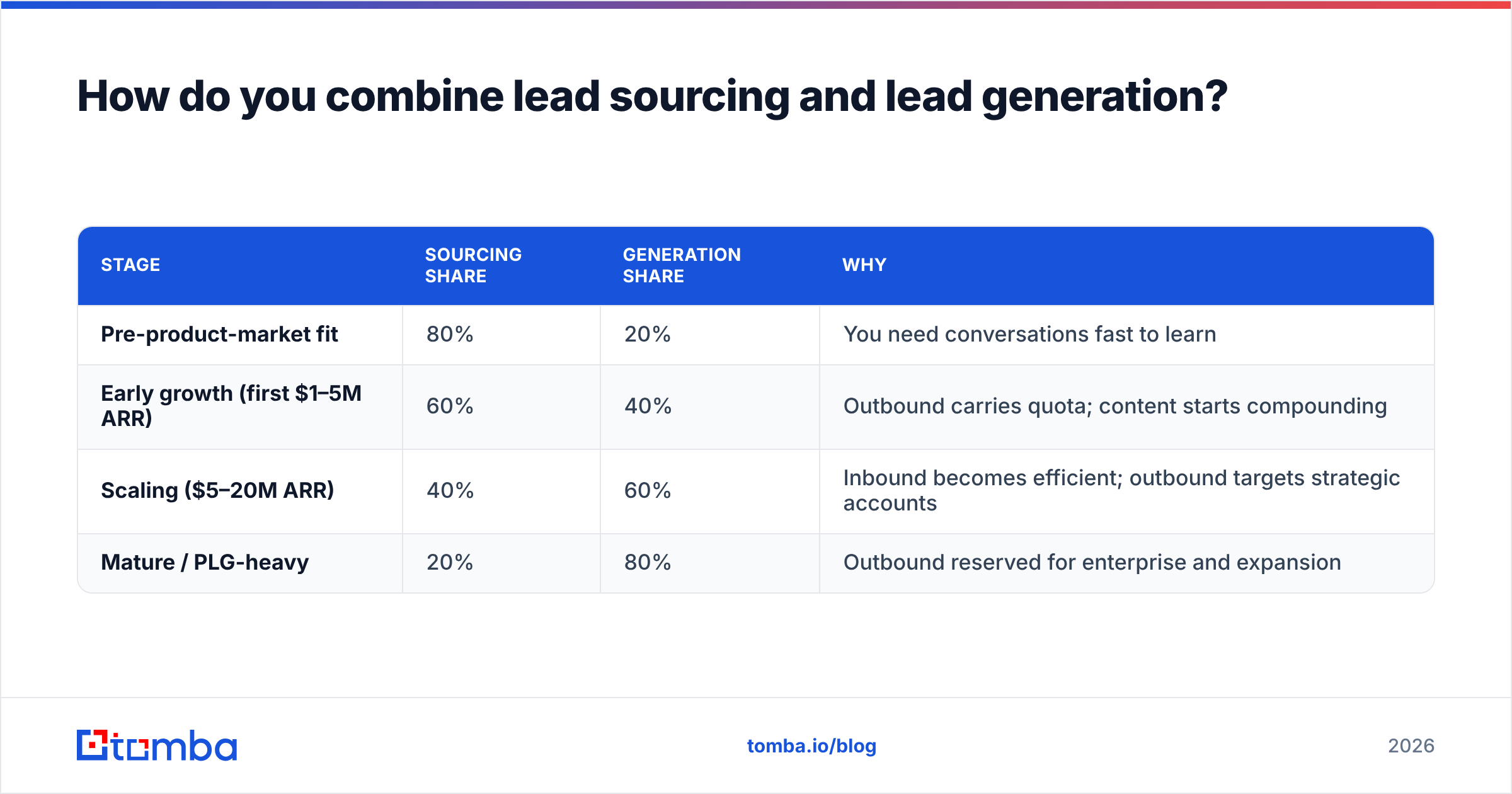
A simple operating split many teams use as a starting point:
| Stage | Sourcing share | Generation share | Why |
|---|---|---|---|
| Pre-product-market fit | 80% | 20% | You need conversations fast to learn |
| Early growth (first $1–5M ARR) | 60% | 40% | Outbound carries quota; content starts compounding |
| Scaling ($5–20M ARR) | 40% | 60% | Inbound becomes efficient; outbound targets strategic accounts |
| Mature / PLG-heavy | 20% | 80% | Outbound reserved for enterprise and expansion |
Treat these as defaults to argue with. They aren't rules. A $100k-ACV enterprise vendor might stay at 70% sourcing forever, and a $20/month tool might never source at all.
Which metrics should you track for each?#
Track the two motions with different scorecards, then compare them on the one metric they share: cost per qualified opportunity.
Lead sourcing metrics
- Email bounce rate (target under 2%)
- Positive response rate per sequence
- Meetings booked per 100 contacts sourced
- Accounts touched vs. accounts in the ICP universe (coverage)
Lead generation metrics
- Visitor-to-lead conversion by channel
- Lead-to-MQL and MQL-to-SQL conversion
- Speed to lead (minutes from form fill to first touch)
- Cost per lead and cost per opportunity by channel
If your outbound cost per opportunity is below inbound, lean into sourcing while you work out why content isn't converting. If it's the reverse, don't quit outbound. Tighten the ICP and the data quality first, because that's usually where outbound breaks.
FAQ#
Is lead sourcing the same as prospecting? They overlap heavily. Sourcing is the research-and-data half of prospecting: finding the right people and their contact details. Prospecting also covers the outreach and qualification conversations that follow.
Is lead sourcing legal under GDPR? Contacting business emails for relevant B2B purposes can be lawful under legitimate interest in many jurisdictions, but you need a documented basis, a clear opt-out, and respect for local rules (some countries are stricter than others). Check with counsel for your specific markets.
Can a small team do both? Yes. A founder can run a focused sourcing motion on 200 accounts a month while publishing one strong piece of content a week. Doing both at a small scale beats doing one of them badly at a large scale.
Do I need an SDR to do lead sourcing? Not at first. Founders are often the best early sourcers because they know the ICP well and can personalize credibly. Hire an SDR once the playbook is repeatable.
Where should you start?#
If you're deciding between lead sourcing and lead generation this quarter, start with the one that matches your ICP size and deal value, then add the other as soon as the first is working. For most B2B teams that means sourcing first, since it produces conversations in days and tells you what to write about.
Whichever motion comes first, it only works with contact data you can trust. Tomba Email Finder lets you find professional email addresses by name, company, or domain, verify them before they touch your sequencer, and enrich inbound form fills so every lead arrives with context. Start on the free tier with 25 searches a month and see how many of your target accounts you can actually reach.
Related guides#
Ready to find emails that actually work?
Join 150,000+ professionals who stopped guessing and started sending. Free credits on signup — no credit card required.
Get the Tomba newsletter
Practical outbound tactics and product updates — once every two weeks.
About the author