Lead Targeting: How to Pick B2B Accounts That Actually Reply
Most outbound campaigns fail at the list, not the copy. Here's how to do lead targeting: tighten your ICP, layer signals, score accounts, and send only to people likely to reply.
TL;DR
- Lead targeting means choosing which accounts and people get your outreach. It happens before you write a single email, and it has more effect on reply rates than copy does.
- Good targeting stacks four layers: firmographic fit, technographic fit, timing signals, and the right person at the account.
- A simple 100-point scorecard beats gut feel. Send only to tier A and tier B, and nurture the rest.
- A smaller, verified list protects your sender reputation. Sending to 10,000 loosely matched contacts burns domains faster than it books meetings.
- The tools matter less than the order you run them in: define, filter, enrich, verify, then send.
What is lead targeting?#
Lead targeting is the process of deciding which companies and which contacts inside them should get your sales or marketing outreach, and in what order. It sits between strategy (your ideal customer profile) and execution (sequences, calls, ads).
In practice, lead targeting answers three questions:
- Which accounts match what you sell well?
- Which of those accounts are likely to buy soon?
- Which person at each account owns the problem and can say yes?
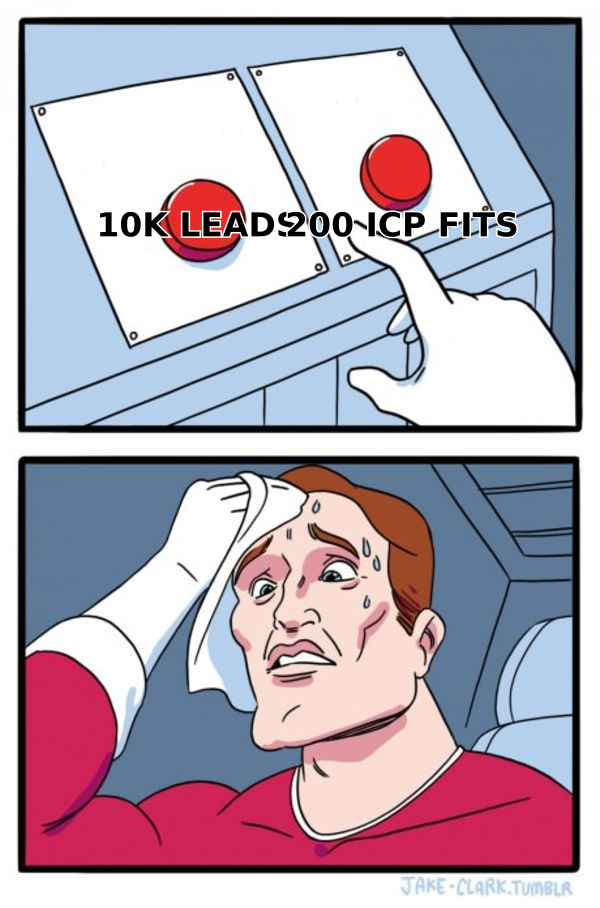
Lead generation is about volume: getting names into the funnel. Lead targeting is about precision: making sure those names are worth the funnel. If you have ever had a campaign with a 40% open rate and a 0.3% reply rate, the problem was probably targeting, not the subject line.
Targeting is also the foundation of account-based marketing, where you take the idea to its extreme and treat each high-value account as a market of one. Most B2B teams don't need full ABM. They do need a repeatable way to separate "good fit, good timing" from "technically in our industry."
Why does lead targeting matter more than your copy?#
Copy decides whether a good-fit buyer replies. Targeting decides whether a good-fit buyer ever sees the email. When those two conflict, targeting wins.
Some concrete reasons:
- Relevance does the persuading. A generic email sent to someone with the exact problem you solve often gets a reply. A brilliant email sent to someone who doesn't have the problem never will.
- Deliverability depends on it. Mailbox providers watch bounces, spam complaints, and engagement. Poorly targeted lists produce all three. Your sender reputation pays for every bad contact you add.
- Rep time is limited. Each SDR has a fixed number of good conversations in a week. Spending them on accounts that will never close is the most expensive mistake a sales team can make.
- Your data compounds. Tight targeting gives you cleaner win/loss data, so your ICP gets sharper each quarter. Loose targeting gives you noise.
What are the core layers of lead targeting?#
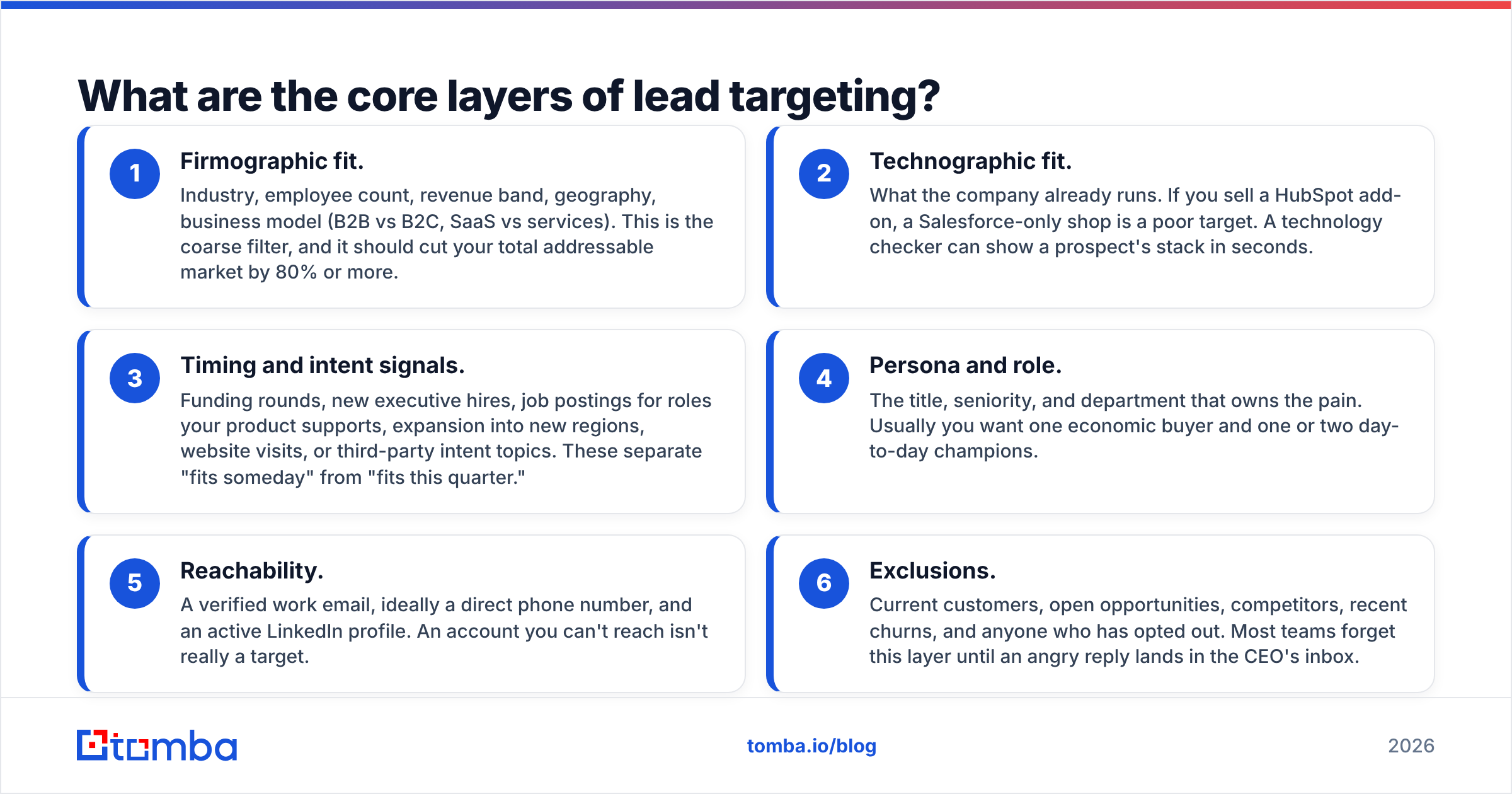
Effective lead targeting stacks filters from broad to narrow. Each layer removes accounts that would waste your time. Here is the model most high-performing outbound teams converge on:
- Firmographic fit. Industry, employee count, revenue band, geography, business model (B2B vs B2C, SaaS vs services). This is the coarse filter, and it should cut your total addressable market by 80% or more.
- Technographic fit. What the company already runs. If you sell a HubSpot add-on, a Salesforce-only shop is a poor target. A technology checker can show a prospect's stack in seconds.
- Timing and intent signals. Funding rounds, new executive hires, job postings for roles your product supports, expansion into new regions, website visits, or third-party intent topics. These separate "fits someday" from "fits this quarter."
- Persona and role. The title, seniority, and department that owns the pain. Usually you want one economic buyer and one or two day-to-day champions.
- Reachability. A verified work email, ideally a direct phone number, and an active LinkedIn profile. An account you can't reach isn't really a target.
- Exclusions. Current customers, open opportunities, competitors, recent churns, and anyone who has opted out. Most teams forget this layer until an angry reply lands in the CEO's inbox.
The order matters. Run the cheap, broad filters first (firmographic), and save the expensive steps (enrichment, verification, manual research) for the accounts that survive.
How do the main lead targeting approaches compare?#
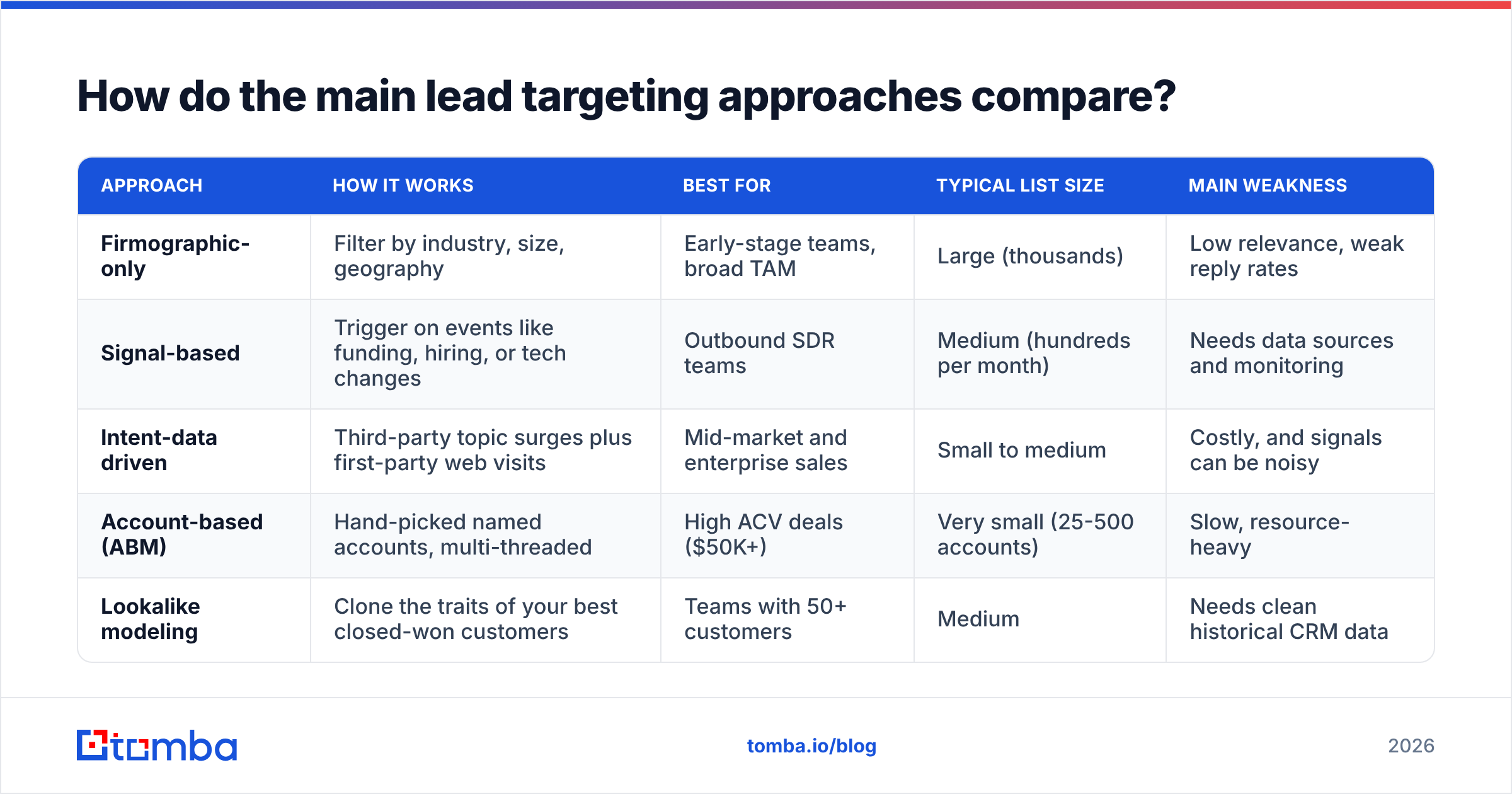
Teams usually pick one of four approaches, or mix them. Here's how they compare on what matters in practice:
| Approach | How it works | Best for | Typical list size | Main weakness |
|---|---|---|---|---|
| Firmographic-only | Filter by industry, size, geography | Early-stage teams, broad TAM | Large (thousands) | Low relevance, weak reply rates |
| Signal-based | Trigger on events like funding, hiring, or tech changes | Outbound SDR teams | Medium (hundreds per month) | Needs data sources and monitoring |
| Intent-data driven | Third-party topic surges plus first-party web visits | Mid-market and enterprise sales | Small to medium | Costly, and signals can be noisy |
| Account-based (ABM) | Hand-picked named accounts, multi-threaded | High ACV deals ($50K+) | Very small (25-500 accounts) | Slow, resource-heavy |
| Lookalike modeling | Clone the traits of your best closed-won customers | Teams with 50+ customers | Medium | Needs clean historical CRM data |
Most teams should start with firmographic plus signal-based targeting. It's cheap, it's fast, and it produces enough reply data to justify adding intent data or ABM later. If you're comparing intent vendors, category pages on G2 are a reasonable starting point for reading user reviews before you sit through demos.
How do you build an ICP you can actually target?#
An ideal customer profile is only useful if you can turn it into filters. "Innovative mid-market companies that value efficiency" can't be searched. "B2B SaaS, 50-500 employees, US/UK/DACH, uses HubSpot, hiring SDRs" can.
To build a targetable ICP:
Start from your closed-won deals, not your pitch deck. Pull your last 20-50 customers and sort them by revenue, speed to close, and retention. The top third is your real ICP. The bottom third often shows you who to exclude.
Find the common attributes. Look for patterns in industry, headcount, tech stack, funding stage, and the title of the person who signed. You'll usually find two or three clusters, not one.
Write each attribute as a filter. Every line of your ICP should map to a field in a data tool or a condition you can check. If it can't be filtered, it belongs in your messaging, not your targeting.
Define your negative ICP. Write down the company types that churned, stalled, or needed heavy support. Excluding them is just as valuable as including the right ones.
Pick personas per cluster. A 60-person startup's buyer might be the founder. A 400-person company's buyer might be a VP of Sales Ops. Target the title that owns the budget at that size.
Review the ICP every quarter. Markets move, your product changes, and last year's best segment may be saturated.
How do you score and prioritize targeted leads?#
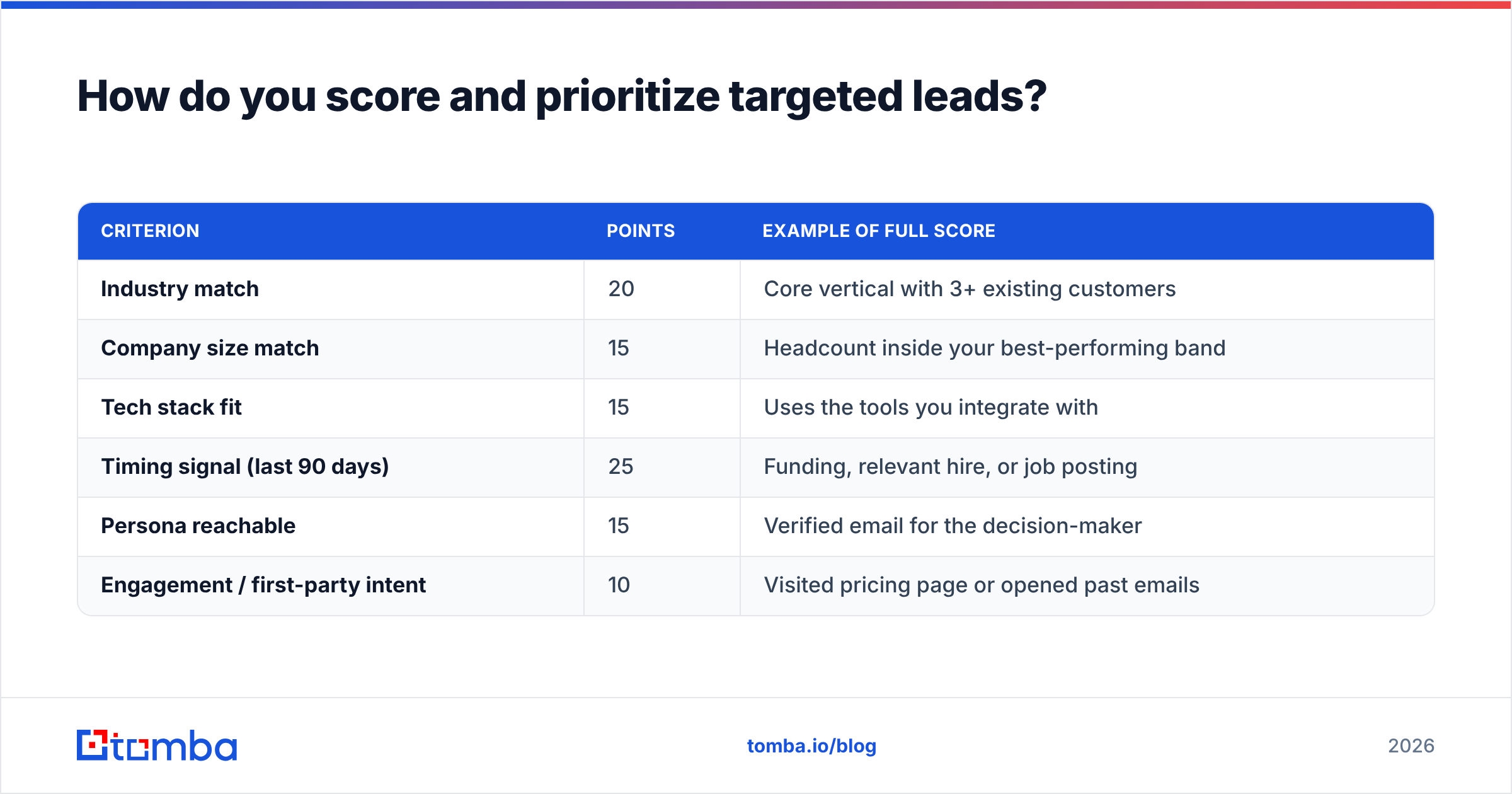
Once you have a filtered list, score it. A scorecard stops reps from cherry-picking familiar logos and makes prioritization consistent across the team.
Here's a simple 100-point model you can adapt:
| Criterion | Points | Example of full score |
|---|---|---|
| Industry match | 20 | Core vertical with 3+ existing customers |
| Company size match | 15 | Headcount inside your best-performing band |
| Tech stack fit | 15 | Uses the tools you integrate with |
| Timing signal (last 90 days) | 25 | Funding, relevant hire, or job posting |
| Persona reachable | 15 | Verified email for the decision-maker |
| Engagement / first-party intent | 10 | Visited pricing page or opened past emails |
Then tier the results:
- Tier A (75-100): Personalized, multi-channel outreach. Reps research each account.
- Tier B (50-74): Semi-personalized sequences with segment-level messaging.
- Tier C (below 50): Hold for nurture or marketing. Don't burn SDR time or mailbox capacity.
Timing signals get the most weight because they have the biggest effect on reply rates. A mediocre-fit company that just raised a Series B and is hiring five SDRs will usually beat a perfect-fit company with nothing going on.
If you run this inside your CRM, store the score as a field and recalculate it monthly. Scores decay: a funding round from nine months ago isn't a signal anymore.

Which data do you need to execute lead targeting?#
Targeting is only as good as the data behind it. You need four kinds:
Company data. Firmographics and technographics to run the first filters. Most B2B databases cover this well for larger companies and less well for companies under 20 employees.
Signal data. Funding databases, job boards, press releases, and website visitor identification. Many teams build a lightweight signal feed from public sources before paying for intent platforms.
Contact data. Names, titles, and above all verified work emails. This is where many targeting efforts fail quietly: you pick the right account and the right persona, then send to a guessed address that bounces. An email finder that searches by name and domain closes that gap, and running addresses through an email verifier before sending keeps your bounce rate under the 2% threshold most deliverability guides recommend.
Enrichment data. Extra fields like seniority, department, LinkedIn URL, phone, and company tech that feed your scorecard. Data enrichment on an existing CRM list is often faster than building a new list from scratch, especially if you already have a few thousand accounts with stale records.
Whatever sources you use, budget for data decay. B2B contact data goes stale fast as people change jobs and companies restructure. Re-verify any list older than about 90 days before you send to it.
What are the most common lead targeting mistakes?#
Even experienced teams fall into these:
- Targeting by industry label alone. "Software" covers a two-person agency and a 50,000-person enterprise. Always combine industry with size and business model.
- Treating titles literally. "Head of Growth" means different things at different companies. Check a few profiles before you commit to a title filter.
- Single-threading. Sending to one contact per account means one out-of-office or one job change kills the whole account. Target two or three people across roles.
- Ignoring exclusions. Emailing a current customer a cold pitch damages trust and wastes a send.
- Buying a list and calling it targeting. Purchased lists are usually broad, partly stale, and shared with other senders. Start from your ICP filters and pull only what fits.
- Never closing the loop. If you don't tag replies, meetings, and closed-won deals back to the targeting criteria, you can't learn which filters work.
- Over-segmenting too early. Twelve micro-segments with 30 contacts each produce no statistically useful data. Start with two or three segments of a few hundred accounts.
How do you measure whether your lead targeting is working?#
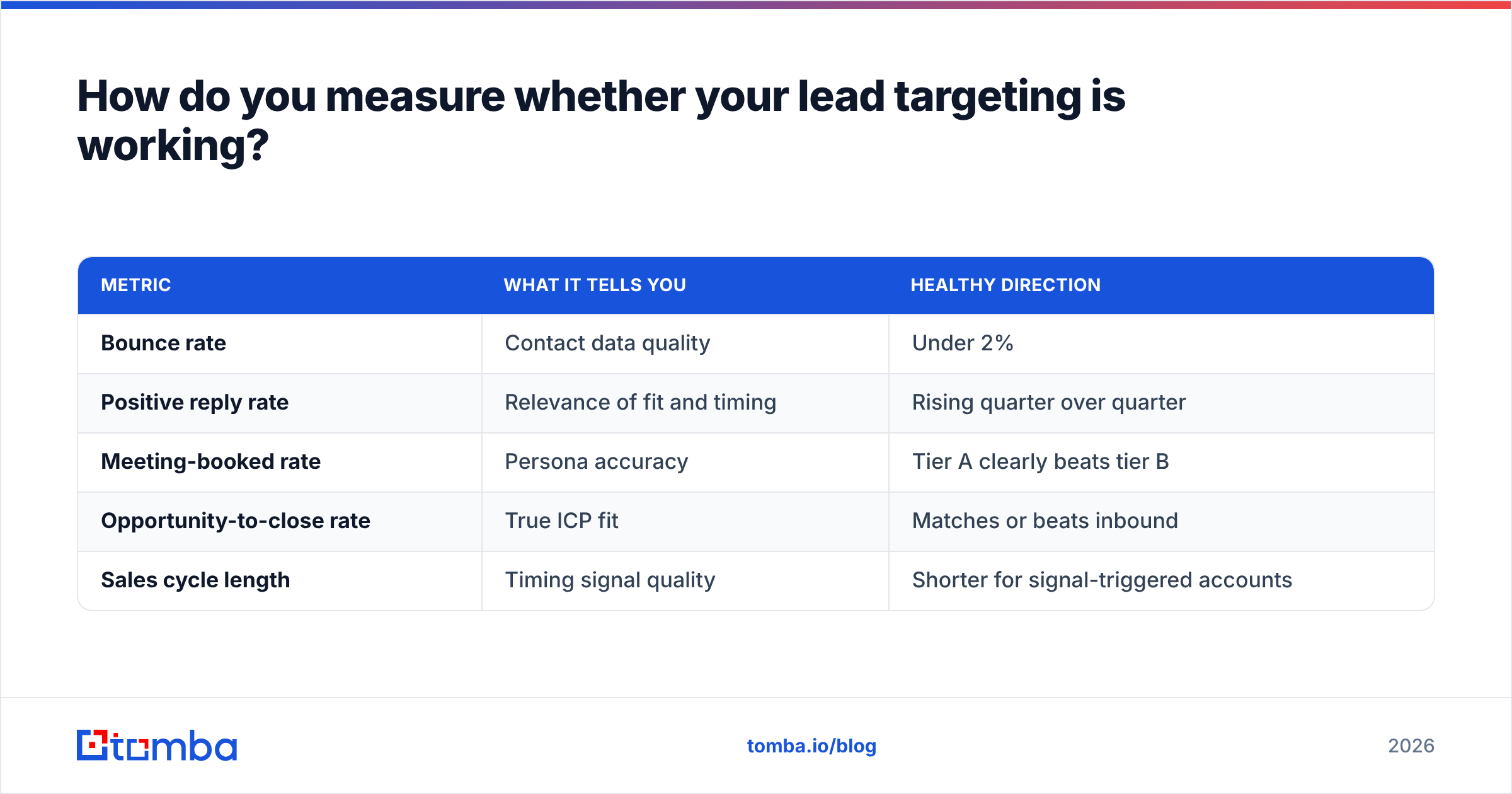
Measure targeting quality separately from copy quality. The easiest way is to hold your messaging roughly constant and compare segments.
Track these metrics per segment and per tier:
| Metric | What it tells you | Healthy direction |
|---|---|---|
| Bounce rate | Contact data quality | Under 2% |
| Positive reply rate | Relevance of fit and timing | Rising quarter over quarter |
| Meeting-booked rate | Persona accuracy | Tier A clearly beats tier B |
| Opportunity-to-close rate | True ICP fit | Matches or beats inbound |
| Sales cycle length | Timing signal quality | Shorter for signal-triggered accounts |
If tier A and tier C convert at the same rate, your scorecard isn't predicting anything and you need to reweight it. If bounce rates are high but reply rates on delivered mail are strong, targeting is fine and the contact data needs work. For broader benchmarks on sales team performance and buyer behavior, Gartner's sales research is worth following.
What does a lead targeting workflow look like end to end?#
Here's a weekly workflow a two-to-five-person outbound team can run without dedicated RevOps:
- Monday: refresh signals. Pull new funding announcements, relevant job postings, and website visitors from the past week that match your firmographic filters.
- Monday: filter and dedupe. Remove existing customers, open opportunities, and accounts contacted in the last 90 days.
- Tuesday: find and verify contacts. For each surviving account, identify two or three people in your target personas, find their work emails, and verify them.
- Tuesday: score and tier. Apply the scorecard. Route tier A to reps for manual research and tier B into segment sequences.
- Wednesday to Friday: send and follow up. Tier A gets multi-channel touches (email, LinkedIn, phone). Tier B gets email sequences.
- Friday: log outcomes. Tag replies and meetings by segment and signal type so next week's targeting improves.
This cadence keeps lists fresh, keeps volume manageable for your mailboxes, and builds the feedback data you need to improve the model.
Is lead targeting worth the extra effort?#
Yes, for nearly every B2B team that sells to a defined market. The work up front, meaning an ICP, a scorecard, and a verification step, pays off as higher reply rates, healthier sender domains, and reps spending time on accounts that can actually close. Sending fewer, better emails isn't a compromise. It's the reason good outbound works.
The one exception is a team with a very broad, low-price, self-serve product. There, volume plus good onboarding can matter more than precision. Even then, basic exclusions and verification are worth doing.
Where does Tomba fit into lead targeting?#
Once you've decided which accounts and personas to target, the step that most often breaks is reaching the right person. Tomba Email Finder lets you find professional email addresses by name and company domain, or pull every public contact at a target account, so your carefully built target list turns into reachable, verified contacts rather than guesses. You can start on the free tier with 25 searches a month to test it against your tier A accounts, then move to a paid plan when your weekly targeting workflow needs more volume.
Related guides#
// get started
Find, verify and enrich your first contacts today
Start on the free plan with 25 searches a month, then scale when your team is ready.
Free plan · No credit card required · GDPR & CCPA
// about the author