Lead Volume: How to Calculate the Leads You Actually Need
More leads does not always mean more pipeline. Learn how to work backward from revenue to the lead volume you need, and how to spot when extra volume starts to hurt your results.
TL;DR
- Lead volume is the number of new leads that enter your funnel in a set period. It only matters when you read it next to conversion rates and lead quality.
- Work backward from your revenue target: deals needed, then opportunities, then qualified leads, then raw leads. That gives you a volume target you can defend.
- Once your list reaches past your ICP, extra volume tends to lower reply rates, hurt sender reputation, and waste rep time.
- The most reliable way to raise useful lead volume is usually better targeting and verified contact data, not a bigger list.
- Track volume, qualification rate, and cost per qualified lead together. Any one of them alone will mislead you.
What is lead volume?#
Lead volume is the count of new leads your team generates in a given period, usually a week, month, or quarter. A "lead" here means any person or account that has entered your funnel. That could be an inbound form fill, a demo request, a webinar signup, or a contact added to an outbound sequence.
The idea is simple. Using it well is harder. A marketing team that reports "4,000 leads this month" has given you almost nothing to act on until you know three more things:
- How many of those leads match your ideal customer profile (ICP)?
- How many became qualified, whether that's a marketing qualified lead or a sales-accepted lead?
- How many turned into pipeline, and eventually revenue?
Lead volume is an input metric. It sits at the top of the funnel described in most lead generation models, and every stage below it filters it down. That makes it useful for forecasting and capacity planning. It also makes it an easy vanity metric, because it's the easiest number in the funnel to inflate.
Why does lead volume matter for B2B teams?#
Volume matters because sales is a probability game with limited capacity. If your close rate from opportunity to deal is 20%, you need five opportunities for every deal. If only 10% of leads become opportunities, you need 50 leads per deal. Get too few leads in and the pipeline dries up no matter how good your reps are.
Volume also drives three operational decisions:
- Headcount planning. How many SDRs and AEs can the incoming flow support without leads going stale?
- Budget allocation. Which channels deliver enough volume at a cost per lead your unit economics can carry?
- Forecasting. Leadership wants to know if next quarter's number is reachable. A steady, measurable lead flow is the earliest signal you have.
The trap is treating volume as the goal. Gartner's research on B2B buying (gartner.com/en/sales) keeps pointing out that buying groups are larger and buyers spend less time with vendors. A flood of loosely matched contacts doesn't reach those buying groups any faster. It just gives your reps more to sift through.
How do you calculate the lead volume you actually need?#
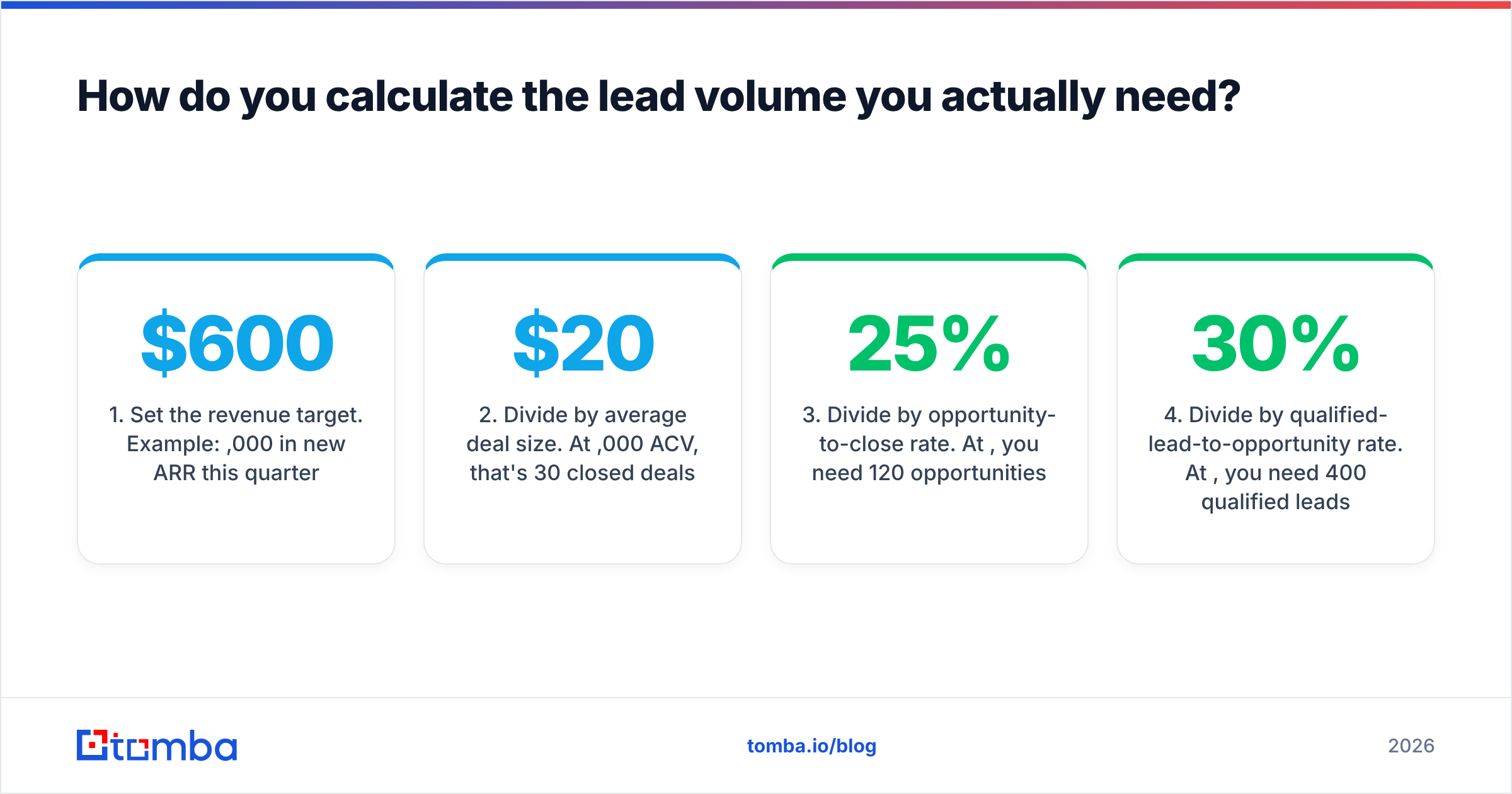
Start from revenue and work backward. This "reverse funnel" is the most defensible way to set a lead volume target, because each number connects to one above it.
Here's the sequence:
- Set the revenue target. Example: $600,000 in new ARR this quarter.
- Divide by average deal size. At $20,000 ACV, that's 30 closed deals.
- Divide by opportunity-to-close rate. At 25%, you need 120 opportunities.
- Divide by qualified-lead-to-opportunity rate. At 30%, you need 400 qualified leads.
- Divide by lead-to-qualified rate. At 20%, you need 2,000 raw leads.
Spread across a quarter, that's roughly 670 leads a month, or about 155 a week.
These rates are examples, not benchmarks. Take your own from the last two or three quarters of CRM data. If you don't have clean historical data, start with conservative assumptions and revisit them after 60 days.
The reverse funnel also shows where the leverage is. In the example above, raising the lead-to-qualified rate from 20% to 30% cuts the required raw volume from 2,000 to about 1,335. That's a third fewer leads for the same revenue, which comes from better targeting and cleaner data rather than more prospecting hours.
Is higher lead volume always better?#
No. Past a certain point, more volume hurts you, and the damage accumulates quietly until it shows up in pipeline.
These are the usual failure modes:
- Rep bandwidth collapses. An SDR can only do meaningful follow-up on so many accounts a day. Leads beyond that capacity go cold, and cold inbound leads rarely warm up again.
- Reply rates fall. When lists stretch past your ICP, messaging gets generic, and generic messaging gets ignored or reported as spam.
- Sender reputation takes the hit. For outbound, bad addresses bounce and spam complaints add up. Google's email sender guidelines require senders of 5,000+ messages a day to Gmail accounts to keep reported spam rates below 0.3%. A padded list makes that threshold much harder to stay under, and your email deliverability falls for every campaign on that domain, including your good ones.
- Metrics get distorted. A volume spike from a low-intent source (a giveaway, a broad content download) drags down every conversion rate below it and makes your forecast less reliable.
The healthier question is: what's the most volume we can produce while keeping qualification rate and cost per qualified lead stable? When either starts to slip, you've found your ceiling for that channel.
Lead volume vs lead quality: which should you optimize?#
You need both, but in a set order: fix quality first, then scale volume. Scaling a leaky funnel just produces bigger leaks.
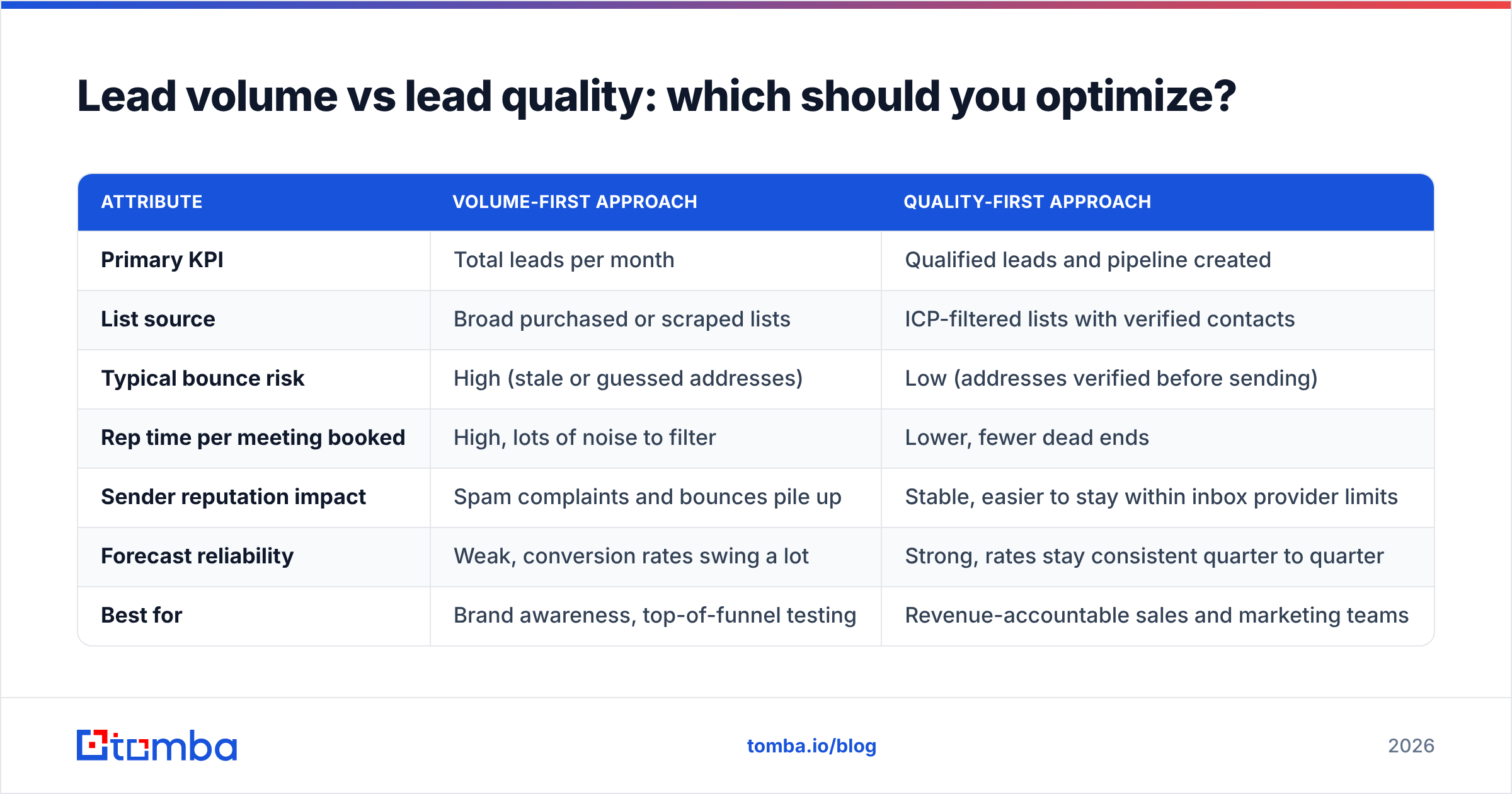
The table below compares the two approaches on the attributes that affect pipeline.
| Attribute | Volume-first approach | Quality-first approach |
|---|---|---|
| Primary KPI | Total leads per month | Qualified leads and pipeline created |
| List source | Broad purchased or scraped lists | ICP-filtered lists with verified contacts |
| Typical bounce risk | High (stale or guessed addresses) | Low (addresses verified before sending) |
| Rep time per meeting booked | High, lots of noise to filter | Lower, fewer dead ends |
| Sender reputation impact | Spam complaints and bounces pile up | Stable, easier to stay within inbox provider limits |
| Forecast reliability | Weak, conversion rates swing a lot | Strong, rates stay consistent quarter to quarter |
| Best for | Brand awareness, top-of-funnel testing | Revenue-accountable sales and marketing teams |
| Main risk | Burned domains and wasted headcount | Volume ceiling if the ICP is too narrow |
Neither column wins in every situation. Early-stage teams testing new markets sometimes want a burst of broad volume to learn which segments respond. For most revenue teams with a quota, though, the quality-first column is where pipeline comes from.
What metrics should you track alongside lead volume?#
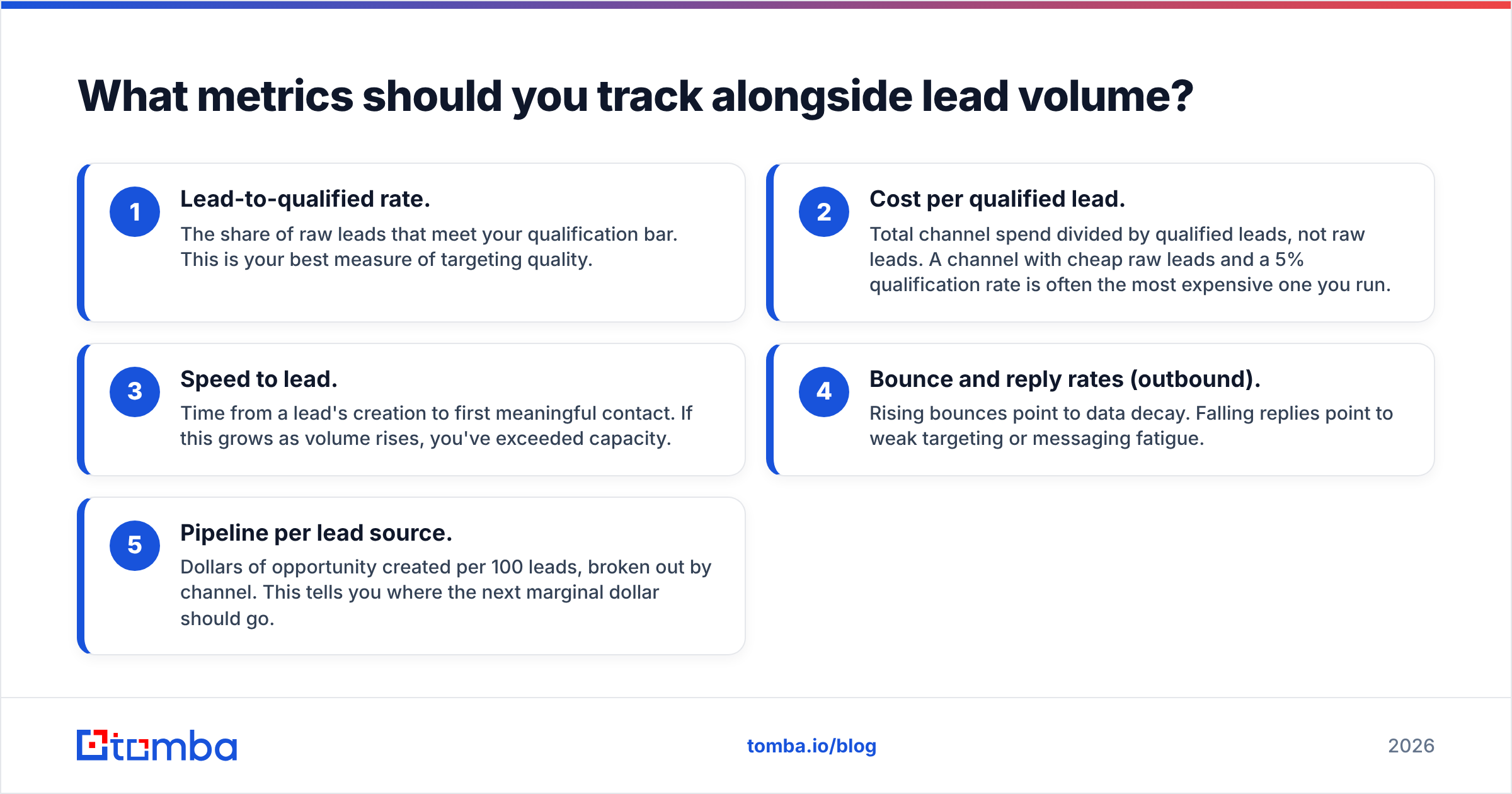
Lead volume only means something alongside the metrics that describe what happens to those leads. Track these five together on one dashboard:
- Lead-to-qualified rate. The share of raw leads that meet your qualification bar. This is your best measure of targeting quality.
- Cost per qualified lead. Total channel spend divided by qualified leads, not raw leads. A channel with cheap raw leads and a 5% qualification rate is often the most expensive one you run.
- Speed to lead. Time from a lead's creation to first meaningful contact. If this grows as volume rises, you've exceeded capacity.
- Bounce and reply rates (outbound). Rising bounces point to data decay. Falling replies point to weak targeting or messaging fatigue.
- Pipeline per lead source. Dollars of opportunity created per 100 leads, broken out by channel. This tells you where the next marginal dollar should go.
When you look at these alongside volume, most "we need more leads" problems turn out to be conversion or data problems. HubSpot's sales and marketing resources make the same case for aligning both teams on shared definitions of a qualified lead before debating volume targets.
How do you increase lead volume without killing quality?#
Aim to increase qualified volume. These are the levers that tend to raise the count without damaging conversion rates:
- Tighten the ICP before widening the list. Define firmographics (industry, headcount, revenue band), technographics, and the roles in the buying group. A precise ICP lets you find more good-fit accounts because you know exactly what to search for.
- Go multi-threaded within target accounts. Instead of adding new accounts, add two or three more relevant contacts at accounts you already know are a fit. Lead volume goes up and every added lead matches the ICP.
- Verify every contact before it enters a sequence. Running lists through an email verifier removes invalid and risky addresses so your volume is real, not inflated by records that will bounce.
- Refresh data on a schedule. B2B contact data decays as people change jobs and companies restructure. A quarterly refresh of your active lists keeps volume from shrinking without anyone noticing.
- Build channels, don't just blast one. Pair outbound email with LinkedIn touches, phone, and intent-triggered inbound follow-up. More channels mean more ways for the same qualified account to become a lead.
- Recycle closed-lost and dormant leads. Leads that went quiet six to twelve months ago are often better fits than brand-new cold contacts. A structured re-engagement track adds volume at almost no acquisition cost.
How do different lead sources compare on volume and quality?#
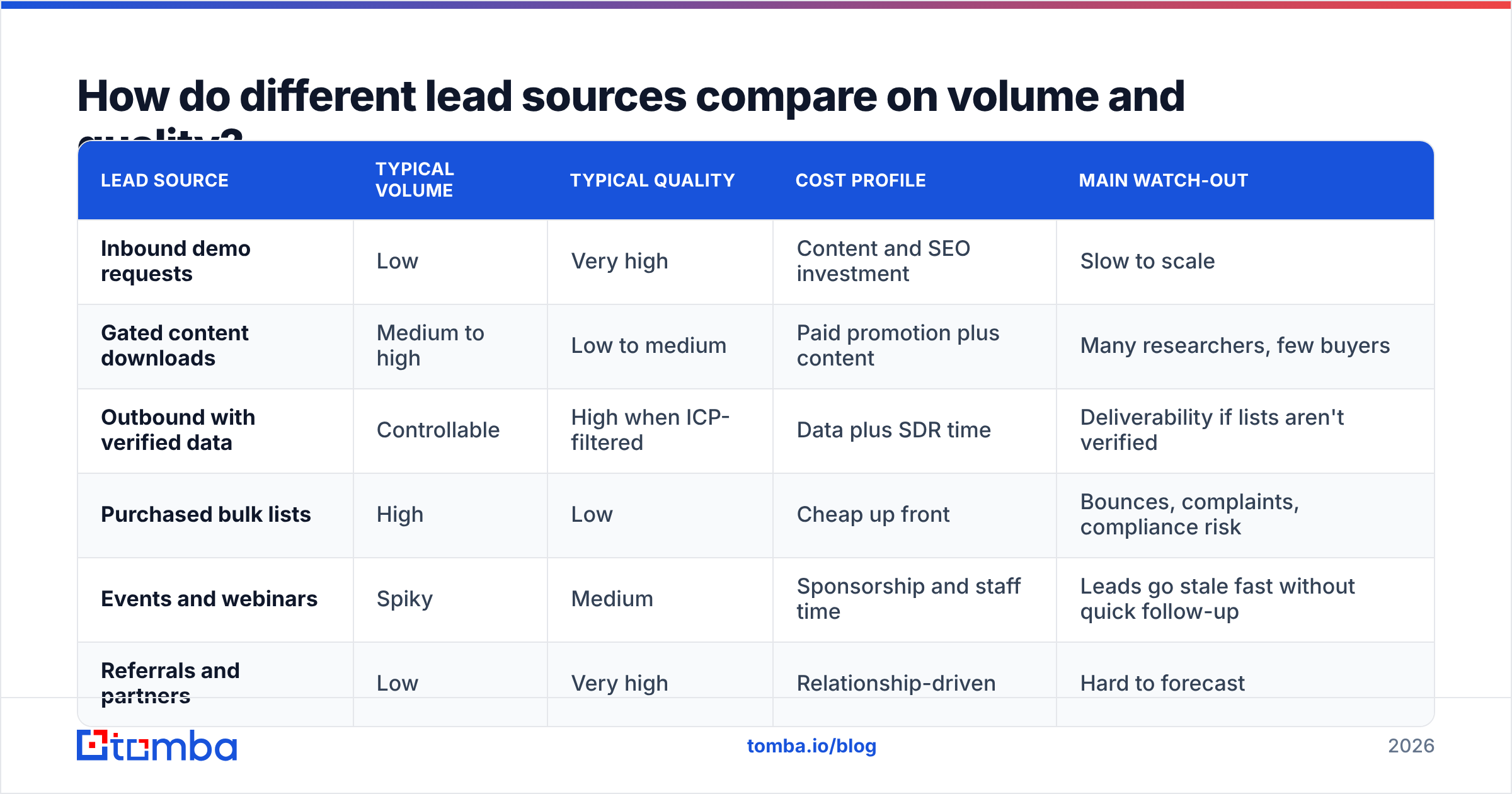
Each source trades volume against quality differently. Use a mix, and judge each one by pipeline created, not raw count.
| Lead source | Typical volume | Typical quality | Cost profile | Main watch-out |
|---|---|---|---|---|
| Inbound demo requests | Low | Very high | Content and SEO investment | Slow to scale |
| Gated content downloads | Medium to high | Low to medium | Paid promotion plus content | Many researchers, few buyers |
| Outbound with verified data | Controllable | High when ICP-filtered | Data plus SDR time | Deliverability if lists aren't verified |
| Purchased bulk lists | High | Low | Cheap up front | Bounces, complaints, compliance risk |
| Events and webinars | Spiky | Medium | Sponsorship and staff time | Leads go stale fast without quick follow-up |
| Referrals and partners | Low | Very high | Relationship-driven | Hard to forecast |
Outbound has one feature the others don't: you control the volume directly. You decide how many accounts to target and how many contacts per account. That's why data quality in outbound has such a large effect. The same verified-contact workflow can scale from 200 to 2,000 leads a month, while a bad list at any size just multiplies the problem.
What are the most common lead volume mistakes?#
These are the patterns that show up most often in teams struggling to hit pipeline targets:
- Reporting raw volume to leadership. It rewards the wrong behavior. Report qualified leads and pipeline created instead, with raw volume as supporting context.
- Setting a volume target with no conversion assumptions. "We need 5,000 leads" means nothing without the rates that connect it to revenue. Always show the reverse-funnel math.
- Ignoring rep capacity. If each SDR can properly work around 50 new accounts a week, doubling lead volume without adding headcount mostly doubles the number of neglected leads.
- Sending to unverified lists to hit a number. One bad campaign can damage a sending domain for weeks. The short-term volume isn't worth it.
- Treating all sources the same. A webinar lead and a demo request aren't equal. Weight or segment them in reporting so a surge from one low-intent source doesn't hide a drop in high-intent ones.
- Never revisiting the ICP. Markets shift. If your qualification rate falls over several quarters, the problem may be your ICP definition, not your lead sources.
How should you plan lead volume for 2026?#
Set targets quarterly and build them from the bottom up:
- Pull the last four quarters of funnel data from your CRM. Calculate actual conversion rates by stage and by source.
- Run the reverse funnel for next quarter's revenue target using those real rates.
- Check capacity. Compare the required volume against what your SDRs and AEs can handle. If there's a gap, you have three options: hire, improve conversion rates, or lower the target.
- Assign volume by channel based on pipeline per lead source, not cost per raw lead.
- Set guardrails. Define the bounce rate, spam complaint rate, and qualification rate that will trigger a pause and review if you cross them.
- Review monthly. Adjust channel mix when a source's qualified rate drifts more than a few points from plan.
This keeps volume tied to outcomes and gives you an early warning when a channel starts producing noise instead of pipeline.
Where does Tomba fit in a quality-first lead volume strategy?#
The reverse funnel shows that the cheapest way to lower your required lead volume is to raise the share of leads that qualify. For outbound teams, that starts with reaching the right people at the right accounts through addresses that actually work.
Tomba Email Finder lets you find professional email addresses by domain, by name, or by company, so you can build ICP-filtered lists and multi-thread target accounts without guessing formats. You can pair it with Tomba's verifier to clean addresses before they reach your sequences. There's a free tier with 25 searches a month to test your workflow, and paid plans start at $49/mo. If you want your lead volume to turn into pipeline rather than bounces, start by finding verified contacts for the accounts you already know are a fit.
Related guides#
// get started
Find, verify and enrich your first contacts today
Start on the free plan with 25 searches a month, then scale when your team is ready.
Free plan · No credit card required · GDPR & CCPA
// about the author