Lead vs Prospect vs Opportunity: Definitions, Stages, and Handoffs
Most pipeline problems start with a labeling problem. Here's how to tell a lead from a prospect from an opportunity, the exit criteria for each stage, and who should own the record at every step.
TL;DR
- A lead is any contact who might buy. You know little about them, and nobody has checked whether they fit.
- A prospect is a lead you have qualified against your ideal customer profile (ICP), and you have made two-way contact or clearly intend to.
- An opportunity is a prospect with a confirmed need, some budget, a timeline and a defined next step. It is a deal your team can forecast.
- Most pipeline problems come from moving records between stages too early. The fix is written exit criteria for each stage, a named owner, and a CRM field that enforces both.
- Clean contact data at the lead stage is the cheapest way to raise conversion at every later stage.
What is the difference between a lead, a prospect, and an opportunity?#
The three words describe one person at three levels of certainty. They are not three kinds of people.
- A lead means "this person might buy." You have their name and maybe an email. Nobody has confirmed they fit, want anything, or can pay.
- A prospect means "this person fits, and we are talking to them." They match your ICP, and there has been real contact in both directions, or a rep has picked them as a named target.
- An opportunity means "there is a real deal here." A problem is confirmed, someone with budget authority is involved, a rough timeline exists, and the next meeting is on the calendar.
The Wikipedia entry on sales leads calls a lead the first identification of a person or business that may become a customer. That word "may" carries the whole definition. Each later stage removes some of the doubt.
Where the lines sit depends on your sales motion. A PLG company selling a $20/month tool may never create formal opportunities. An enterprise team selling seven-figure contracts may have five sub-stages inside "opportunity." The principle holds either way: each stage needs an entry rule, an exit rule and an owner.
How do the three stages compare side by side?#
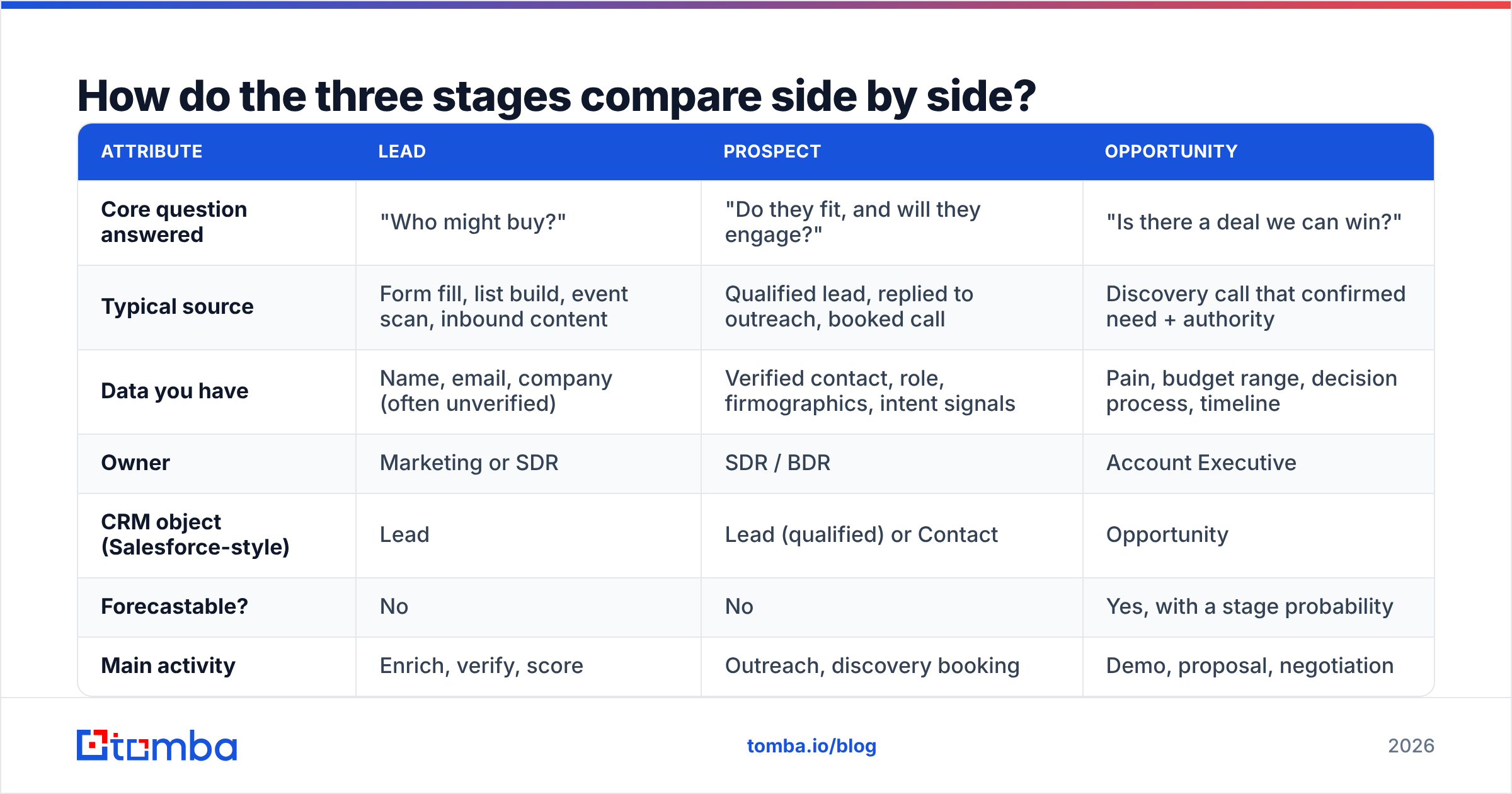
Here is the comparison most teams need on one page:
| Attribute | Lead | Prospect | Opportunity |
|---|---|---|---|
| Core question answered | "Who might buy?" | "Do they fit, and will they engage?" | "Is there a deal we can win?" |
| Typical source | Form fill, list build, event scan, inbound content | Qualified lead, replied to outreach, booked call | Discovery call that confirmed need + authority |
| Data you have | Name, email, company (often unverified) | Verified contact, role, firmographics, intent signals | Pain, budget range, decision process, timeline |
| Owner | Marketing or SDR | SDR / BDR | Account Executive |
| CRM object (Salesforce-style) | Lead | Lead (qualified) or Contact | Opportunity |
| Forecastable? | No | No | Yes, with a stage probability |
| Main activity | Enrich, verify, score | Outreach, discovery booking | Demo, proposal, negotiation |
| Key metric | Lead volume, lead-to-MQL rate | Reply rate, meeting-booked rate | Win rate, cycle length, deal size |
| Biggest failure mode | Bad or bouncing data | Chasing poor-fit accounts | Opportunities with no real buyer |
The "CRM object" row is where most confusion comes from. In Salesforce, a Lead is its own object. When you convert it, you get an Account, a Contact and, if you choose, an Opportunity. HubSpot uses one Contact record with a "lifecycle stage" property (Subscriber, Lead, MQL, SQL, Opportunity, Customer). "Prospect" is not a built-in object on either platform. It is a working label most sales teams use for qualified leads that are in active outreach.
What makes someone a lead?#
A lead needs two things: a way to reach them, and a plausible reason they could buy. Anything more is a bonus.
Common lead sources in 2026:
- Inbound: content downloads, webinar sign-ups, free-trial starts, pricing-page chat.
- Outbound list builds: accounts that match your ICP, where you then look up decision-makers with an email finder or a B2B database.
- Events and partners: badge scans, co-marketing lists, referrals.
- Website visitor identification: anonymous company visits resolved to an account, then matched to likely contacts.
Leads are cheap and plentiful, and they decay quickly. People change jobs and companies rebrand domains. A list that was 95% deliverable in January can be much worse by summer. So the lead stage is where data hygiene matters most. If you pass unverified addresses to an SDR, you waste their outreach and hurt your sender reputation before any qualification happens.
A practical lead-stage checklist:
- Verify the email before it enters a sequence.
- Add role, seniority, company size and industry to the record.
- Remove duplicates against existing Contacts and open Opportunities.
- Apply a fit score (ICP match) and an engagement score (behaviour).
That last point connects to the marketing qualified lead (MQL) concept. An MQL is a lead whose score crossed a threshold. It is still a lead. An MQL is not a prospect and not an opportunity. Treating an MQL as pipeline is the most common mistake in this whole area.
When does a lead become a prospect?#
A lead becomes a prospect when two conditions are both true:
- Fit is confirmed. The person and company match your ICP on attributes you can check: industry, headcount, tech stack, region, role.
- Engagement is real or deliberate. They replied, booked time, asked a question, or a rep has picked them as a named target account and started a multi-touch sequence.
Some teams define "prospect" strictly as a qualified lead that has responded. Others include qualified leads under active outreach. Either version works if everyone uses the same one. What does not work is reps privately using different definitions, because then your prospect-to-meeting conversion rate stops meaning anything.
What qualification frameworks help here?#
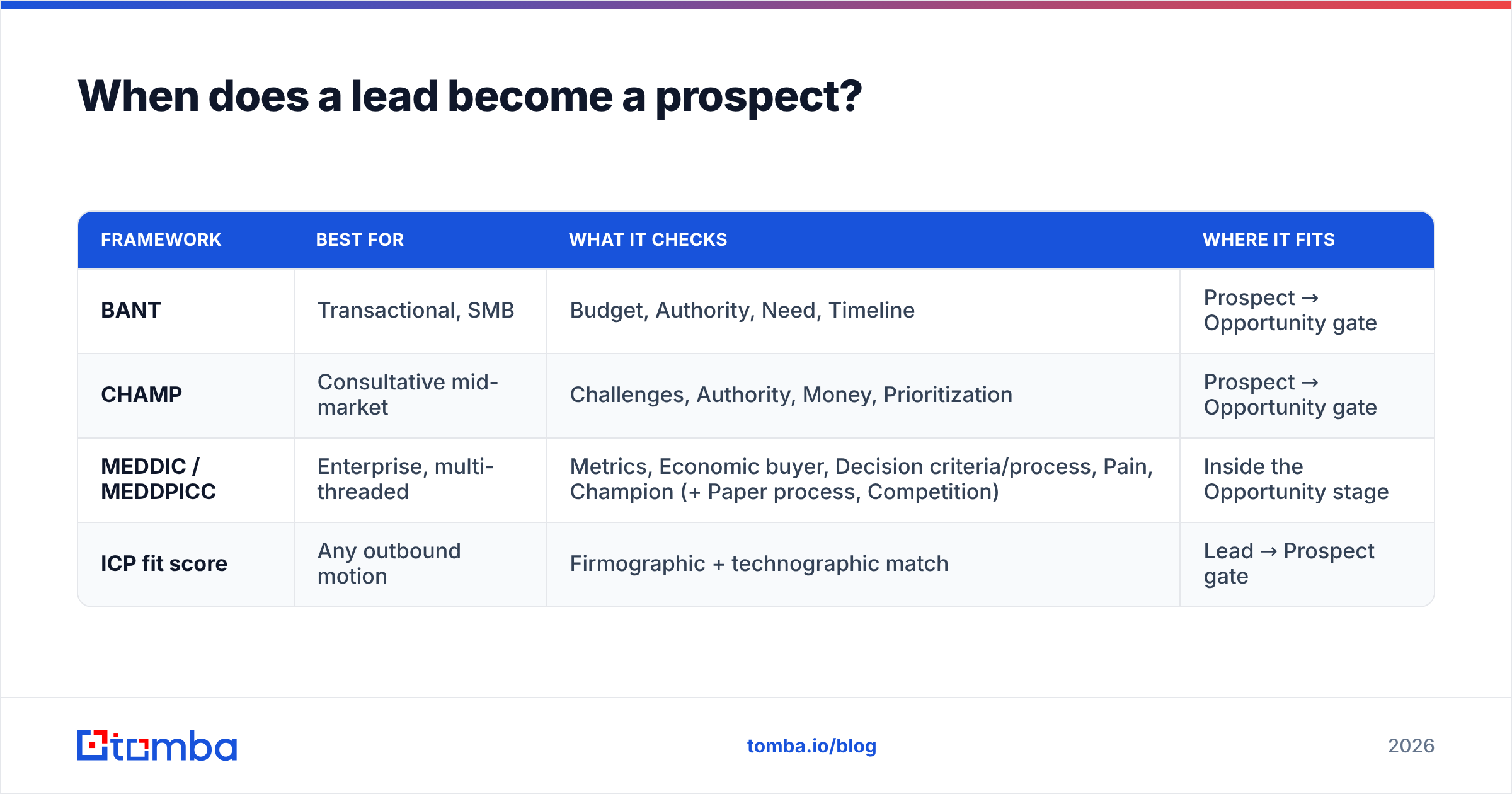
You don't need a full framework at the prospect stage, but a light check keeps poor-fit accounts out of the pipeline:
| Framework | Best for | What it checks | Where it fits |
|---|---|---|---|
| BANT | Transactional, SMB | Budget, Authority, Need, Timeline | Prospect → Opportunity gate |
| CHAMP | Consultative mid-market | Challenges, Authority, Money, Prioritization | Prospect → Opportunity gate |
| MEDDIC / MEDDPICC | Enterprise, multi-threaded | Metrics, Economic buyer, Decision criteria/process, Pain, Champion (+ Paper process, Competition) | Inside the Opportunity stage |
| ICP fit score | Any outbound motion | Firmographic + technographic match | Lead → Prospect gate |
The pattern: ICP fit decides lead to prospect. BANT or CHAMP decides prospect to opportunity. MEDDPICC governs the deal once it is an opportunity. If you run MEDDPICC on a cold lead, you slow reps down. If you skip it on a $200k deal, you lose to a competitor who didn't.
When does a prospect become an opportunity?#
This is the handoff that matters most, because it is when a record enters your forecast. Once someone creates an Opportunity, finance, leadership and board decks all start counting it.
A prospect should become an opportunity only when you can write down the following:
- A specific problem in the buyer's own words, not "they could use better data."
- A person with budget authority who is either in the conversation or has been named, with a path to reach them.
- A rough timeline tied to something real: renewal date, quarter-end, new hire, compliance deadline.
- A scheduled next step: a date on the calendar, not "they'll get back to us."
- An estimated deal value based on seats, volume or tier, not a placeholder.
If any of these are missing, keep it as a prospect and keep working it. Creating the opportunity early feels productive, but it inflates pipeline coverage, hides weak discovery, and lowers win rate. The opportunity was never real, so it eventually closes lost.
Who owns the record at each stage?#
Handoffs fail when nobody knows who owns what. A clean split for a typical B2B team:
- Marketing / RevOps owns leads: sourcing, enrichment, verification, scoring and routing.
- SDRs/BDRs own prospects: outreach, first conversations, discovery booking and the initial BANT/CHAMP check.
- AEs own opportunities: discovery depth, demo, proposal, negotiation and close.
- RevOps owns the rules: stage definitions, required fields, SLAs and reporting.
- Sales leadership owns disputes: when an AE rejects an SDR-sourced opportunity, one person decides and the reason is logged.
Write the SLA down. For example, "AE accepts or rejects a new opportunity within 2 business days, with a reason code." Without it, SDR-created opportunities sit untouched, SDRs get paid on meetings that go nowhere, and the two teams stop trusting each other.
Why does mislabeling stages hurt your pipeline so much?#
Mislabeling affects every number downstream. Three common patterns:
1. MQLs counted as pipeline. Marketing reports 400 "opportunities" this quarter, 380 of which are content downloads. Leadership plans hiring around that figure. The quarter ends at a fraction of plan, and everyone acts surprised.
2. Opportunities created at first meeting. Every booked call becomes an Opportunity at 10% probability. Pipeline coverage looks like 5x, but most of those deals never had a buyer. Win rate drops to single digits, and forecast calls turn into debates over which deals to believe.
3. Prospects that never age out. Records sit as "working" for 14 months with no activity. Reps keep them because deleting pipeline looks bad. Your prospect-to-opportunity conversion rate looks low when the real issue is that no one closes out dead records.

A healthy pipeline does three things: it kills records deliberately at each stage, requires evidence to promote them, and keeps stage definitions separate from compensation. If SDRs are paid per opportunity created, you will get lots of opportunities. Pay on AE-accepted or stage-2 opportunities instead.
How should you set this up in your CRM?#
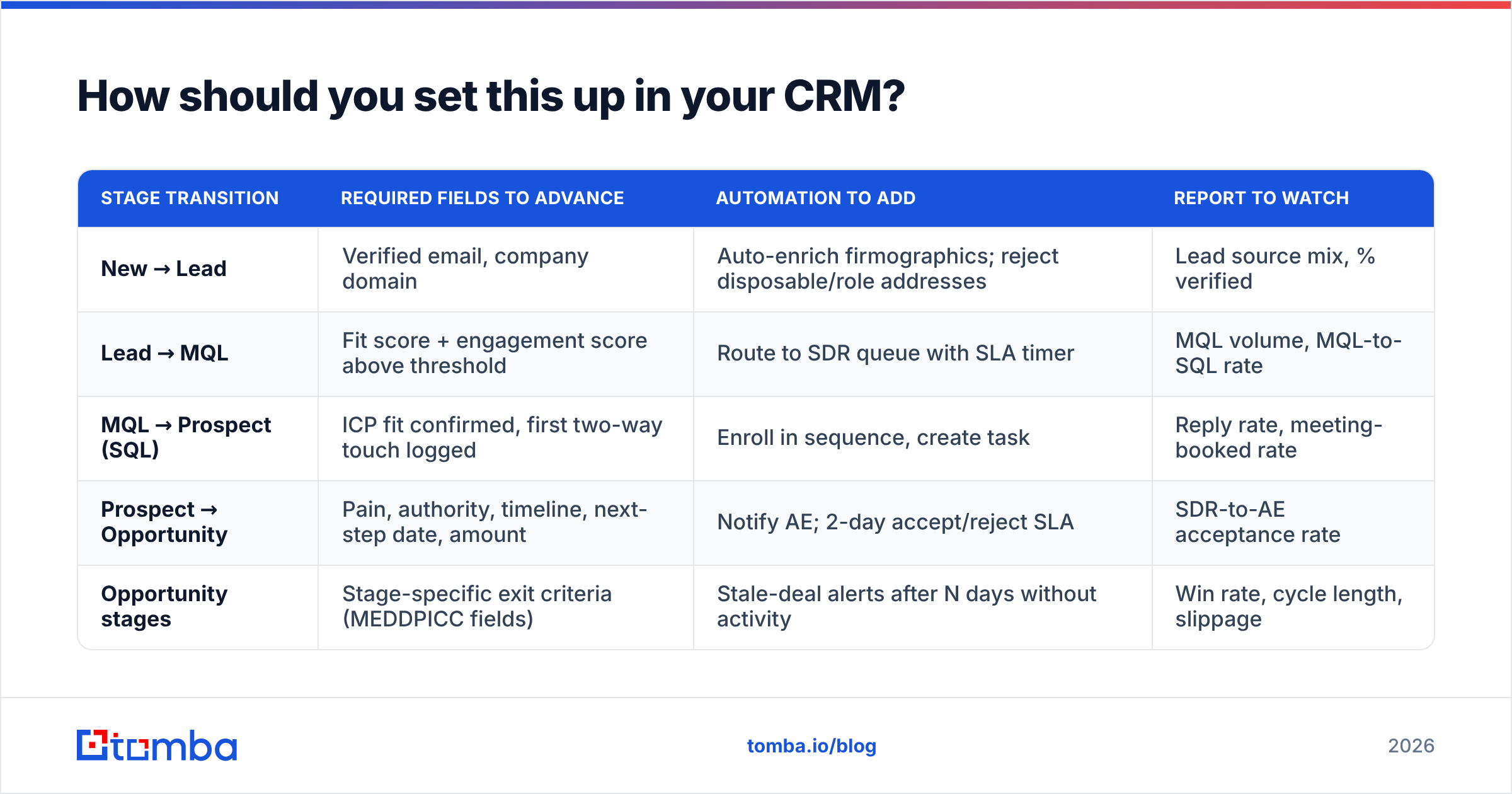
Stage definitions only matter if the CRM enforces them. A practical setup:
| Stage transition | Required fields to advance | Automation to add | Report to watch |
|---|---|---|---|
| New → Lead | Verified email, company domain | Auto-enrich firmographics; reject disposable/role addresses | Lead source mix, % verified |
| Lead → MQL | Fit score + engagement score above threshold | Route to SDR queue with SLA timer | MQL volume, MQL-to-SQL rate |
| MQL → Prospect (SQL) | ICP fit confirmed, first two-way touch logged | Enroll in sequence, create task | Reply rate, meeting-booked rate |
| Prospect → Opportunity | Pain, authority, timeline, next-step date, amount | Notify AE; 2-day accept/reject SLA | SDR-to-AE acceptance rate |
| Opportunity stages | Stage-specific exit criteria (MEDDPICC fields) | Stale-deal alerts after N days without activity | Win rate, cycle length, slippage |
A few implementation notes:
- Make exit fields required, not optional. If "next-step date" is optional, nobody fills it in.
- Use reason codes for disqualification. "Bad fit," "no budget," "went dark," "wrong contact" and "bad data" each point to a different fix. If "bad data" keeps showing up, the problem is at the lead stage, not the sales stage.
- Timestamp every transition. Time-in-stage is one of the best leading indicators of deal health you have, and you can only measure it if the timestamps exist.
Where does contact data quality fit into all this?#
Most funnel conversations skip this part. Every conversion rate in the funnel depends on the data you started with.
If 15% of your leads bounce, those records never get a chance to become prospects. If your lead has the wrong contact (a coordinator instead of the budget owner), you might still get a reply, but the prospect-to-opportunity step stalls because authority is missing. Bad data at the top shows up as a sales-execution problem further down, so teams end up coaching reps on a problem that started in the lead list.
What fixes it at the lead stage:
- Find the right person, not just any person at the company. Search by domain and role so the lead is already the likely decision-maker.
- Verify before sequencing. Running addresses through an email verifier protects deliverability and keeps bounce-driven "no response" results out of your stage metrics.
- Enrich once, centrally. Add title, seniority, company size and tech stack at creation with data enrichment, so SDRs aren't looking things up by hand.
- Re-verify aging records. Anything that has been a prospect for 90+ days without engagement should be checked again before the next touch.
Tools vary here. Tomba, BookYourData, Apollo, ZoomInfo and others cover overlapping ground with different strengths in coverage, pricing model and workflow. Choose based on your ICP's regions and seniority levels, and test on a sample of your own target accounts. Vendor-wide accuracy claims won't tell you how a tool performs on your list.
What does a full lead-to-opportunity journey look like in practice?#
Here is a concrete example. A mid-market SaaS company sells a compliance tool to finance teams at companies with 200 to 2,000 employees.
- Lead. RevOps builds a list of 600 target accounts from firmographic filters. For each one, they look up the Controller and VP Finance by domain, verify the emails and enrich the records. This produces 1,100 verified leads.
- MQL. 140 of those leads open three or more emails or visit the pricing page. Their combined score passes the threshold and they route to SDRs.
- Prospect. SDRs check ICP fit (right industry, confirmed headcount, uses an ERP the product integrates with) and start personalized sequences. 62 reply, and 31 book discovery calls.
- Opportunity. On discovery, 12 confirm an audit deadline in the next two quarters, name the CFO as the budget owner, and agree to a demo date. Those 12 become Opportunities. The other 19 stay as prospects with nurture tasks and a reason code.
- Close. AEs run MEDDPICC on the 12. Four close within the quarter.
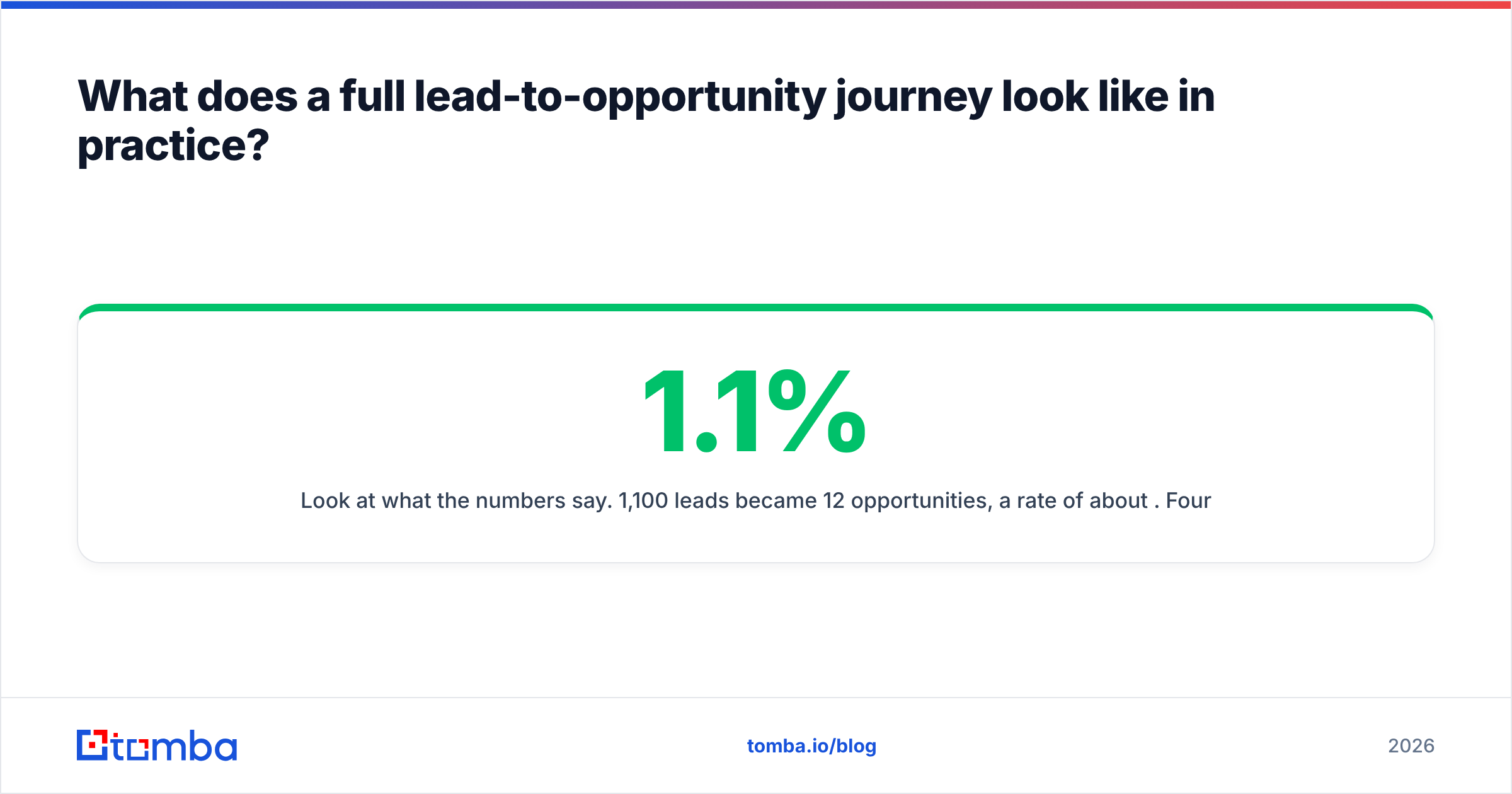
Look at what the numbers say. 1,100 leads became 12 opportunities, a rate of about 1.1%. Four wins out of 12 opportunities is a 33% win rate, which makes the forecast reliable. Suppose all 31 discovery calls had become opportunities. The same four wins would then show a 13% win rate, and leadership would conclude the AEs have a closing problem when the real issue is how opportunities were created.
Frequently asked questions#
Is a prospect the same as a sales qualified lead (SQL)?#
They are close but not always identical. An SQL is a lead that sales has accepted as worth working. Many teams use "prospect" for the same thing, sometimes adding the condition that two-way engagement has started. Pick one definition and document it.
Can you skip the prospect stage?#
Yes, in some motions. A high-intent inbound demo request from a company that clearly fits your ICP can go directly to opportunity after a short qualification call. You still need the opportunity entry criteria: need, authority, timeline, next step. Skipping a stage never means skipping the evidence.
Should opportunities ever move back to prospect?#
Yes. If the buyer goes dark, loses budget or the champion leaves, it is more honest to downgrade the record, or close it lost with a reason, than to leave it in the forecast. Many CRMs make moving backward awkward, so create a clear "recycle to nurture" path.
How many leads do you need per opportunity?#
It depends on channel and ICP. Cold outbound often needs dozens to a few hundred verified leads per opportunity. Warm inbound can be under ten. Measure your own ratios by source. A blended average hides the channels that actually work.
How should you apply this starting this week?#
You don't need a new tool to fix stage hygiene. You need three written definitions, required fields that enforce them, and a weekly review of anything stuck in a stage too long. Begin with the prospect-to-opportunity gate, because it affects your forecast the most. Then work backward to the lead stage, where data quality determines what everything after it can achieve.
If your leads are mostly unverified addresses or the wrong contacts, fix that first. Tomba Email Finder lets you find verified professional email addresses by domain, name or company. That way, every lead that reaches an SDR is a real, reachable decision-maker who can progress to prospect and then opportunity. The free tier includes 25 searches a month for testing on your own target accounts, and paid plans start at $49/mo on the Tomba pricing page when you are ready to scale.
Related guides#
// get started
Find, verify and enrich your first contacts today
Start on the free plan with 25 searches a month, then scale when your team is ready.
Free plan · No credit card required · GDPR & CCPA
// about the author