Lead Warming: How to Turn Cold Prospects Into Warm Replies
Lead warming means getting a prospect to recognize your name before your first real ask. Here are the touches that actually do that, the ones that don't, and a 14-day sequence you can copy.
TL;DR
- Lead warming is the set of low-friction touches you make before your first real sales ask, so the prospect recognizes your name when that ask lands.
- It is not the same as email warmup. Email warmup builds your domain's reputation with inbox providers. Lead warming builds familiarity with a person.
- The touches that work are specific and cheap for the prospect: a relevant comment, a profile view followed by a connection, a useful resource, an intro through a mutual contact. Mass likes and generic "saw your post" messages don't count.
- A good warming window is 7 to 14 days and 3 to 5 touches before the first email or call. If you stretch it longer, you're procrastinating and calling it strategy.
- Warming only pays off if the contact data underneath is right. Verify emails and enrich records before you invest two weeks in someone.
What is lead warming?#
Lead warming is the process of building light familiarity with a prospect before you ask for their time. The goal is modest. You're not trying to create a relationship in a week. You want your name, face, or company to feel slightly familiar when your first email reaches their inbox or your call shows up on their phone.
Think of it as the gap between a stranger knocking on your door and a neighbor you've waved at a few times knocking on your door. The request might be identical. The reaction isn't.
In practice, lead warming covers things like:
- Engaging thoughtfully with a prospect's LinkedIn posts
- Connecting on LinkedIn with a short note that asks for nothing
- Sharing a relevant resource, benchmark, or teardown
- Getting mentioned or introduced by a mutual connection
- Showing up in the places they already spend time: a podcast they listen to, a community they post in, an event they attend
Much of this overlaps with social selling. The difference is intent and timing. Social selling is an ongoing posture. Lead warming is a short, deliberate sequence aimed at one named account or contact, and it ends with a defined first ask.
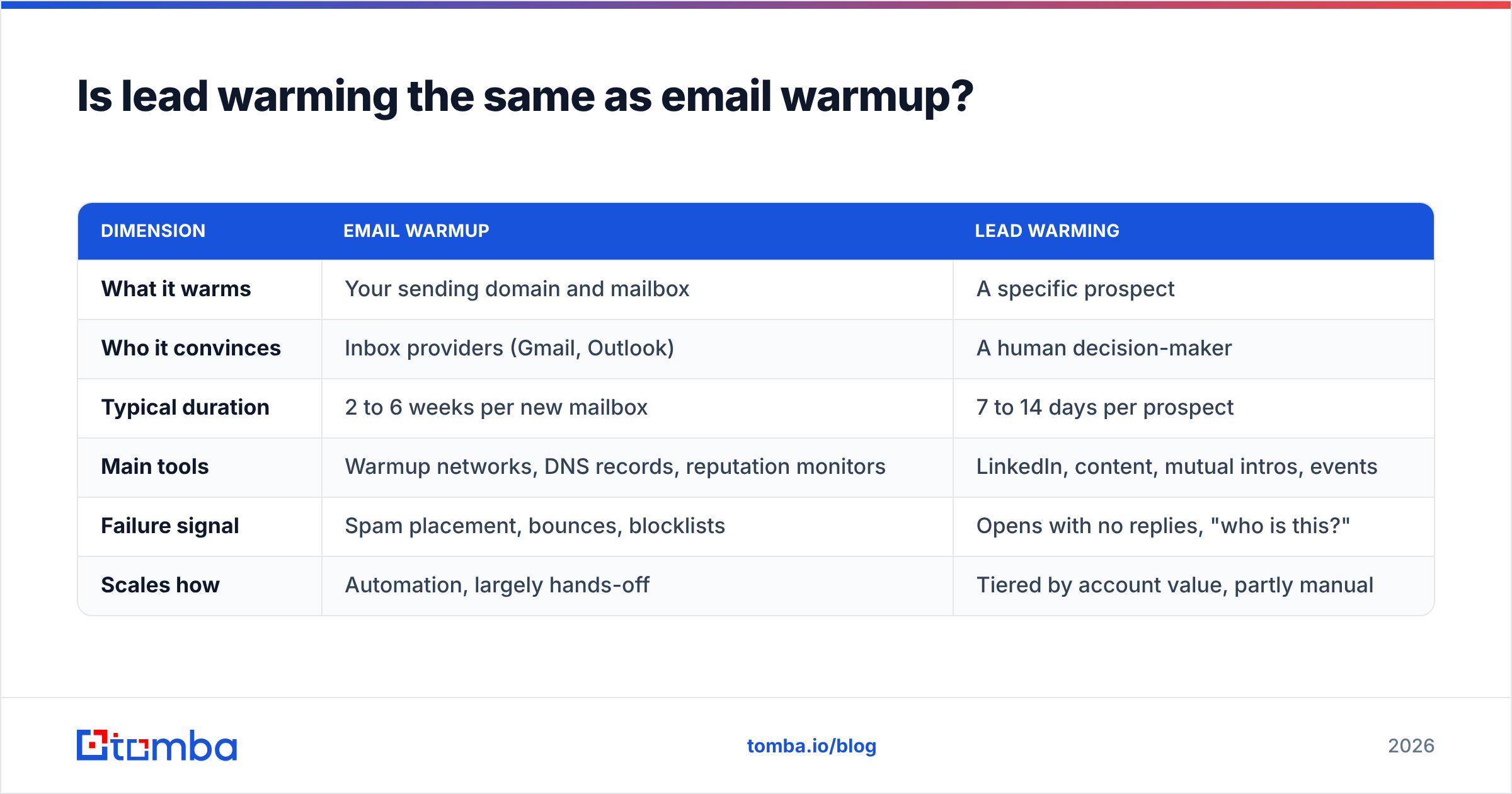
Is lead warming the same as email warmup?#
No, and mixing them up leads to bad decisions.
Email warmup is technical. You gradually increase sending volume from a new domain or mailbox, usually with automated tools that send and reply to messages across a network, so Gmail and Outlook learn to trust you. It protects deliverability. Google's sender guidelines describe the authentication and spam-rate thresholds that warmup is trying to keep you under.
Lead warming is human. It's about whether the person reading your email already has some context for who you are.
You need both. A perfectly warmed prospect won't see an email that lands in spam, and a perfectly warmed domain won't save a pitch the reader has zero context for. Warmup gets you into the inbox. Lead warming gets you opened and answered.
| Dimension | Email warmup | Lead warming |
|---|---|---|
| What it warms | Your sending domain and mailbox | A specific prospect |
| Who it convinces | Inbox providers (Gmail, Outlook) | A human decision-maker |
| Typical duration | 2 to 6 weeks per new mailbox | 7 to 14 days per prospect |
| Main tools | Warmup networks, DNS records, reputation monitors | LinkedIn, content, mutual intros, events |
| Failure signal | Spam placement, bounces, blocklists | Opens with no replies, "who is this?" |
| Scales how | Automation, largely hands-off | Tiered by account value, partly manual |
Why does lead warming work?#
Three mechanisms do the heavy lifting.
Mere exposure. People tend to rate things more favorably once they've seen them a few times. A name that has appeared in someone's notifications twice feels less like an intrusion the third time.
Reciprocity. If you've given something useful first, like a sharp comment that added to their post or a benchmark that answered a question they'd been asking, the ask that follows reads more like a trade than a cold pitch.
Pattern interruption. Decision-makers delete most cold outreach on sight because it all looks the same. A first email that says "Following up on the thread under your post about territory planning" doesn't match the pattern they're filtering out.
None of this is magic. Warming won't turn a bad-fit prospect into a buyer, and it won't rescue a vague offer. What it does is move the prospect from "delete without reading" to "read it, then decide." That's a real change, and for high-value accounts it's where most of the gain sits.
Which lead warming touches actually work?#
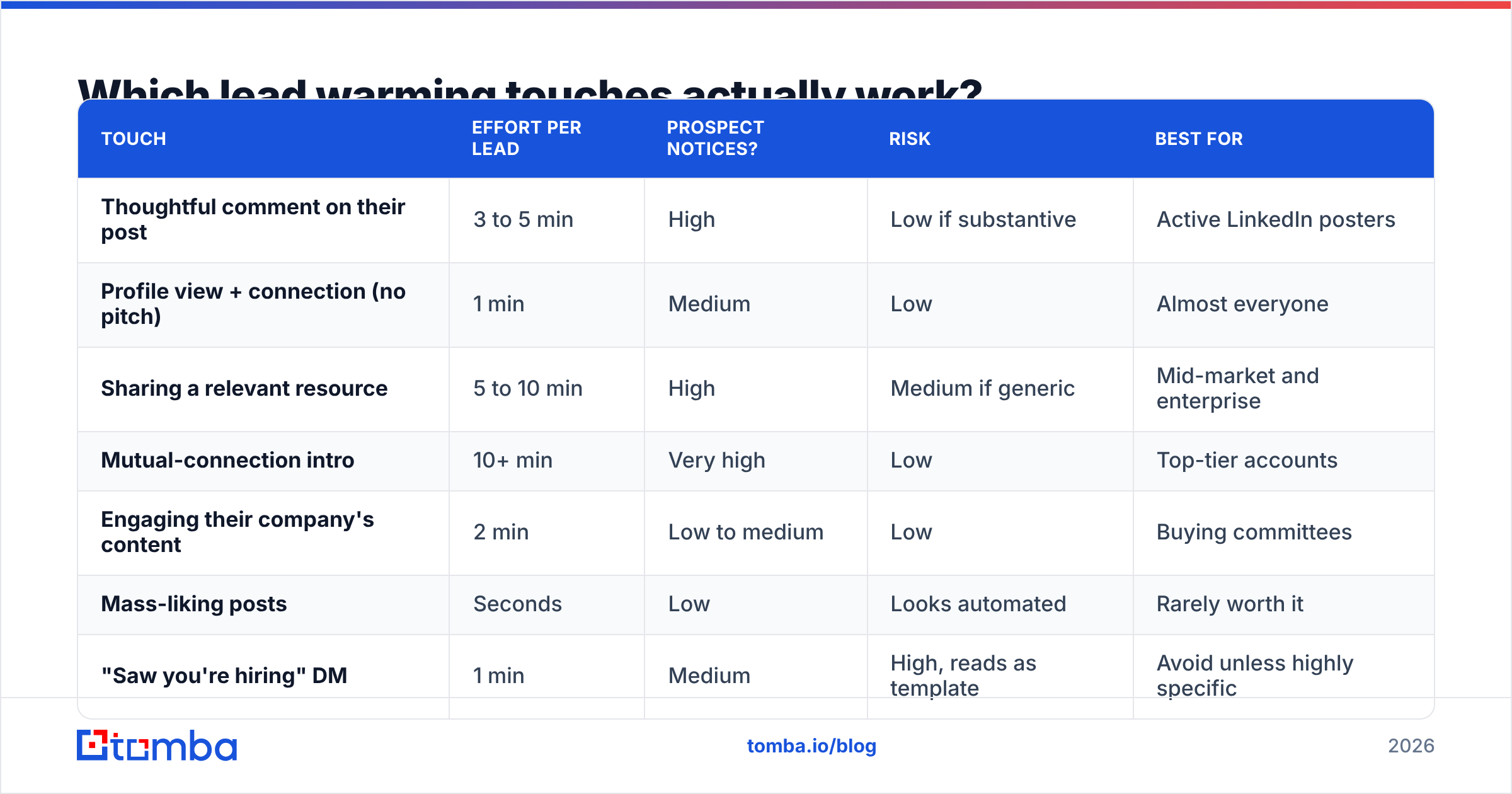
Some touches earn attention. Others are noise, and they can make you look like a bot. Here is how the common ones compare.
| Touch | Effort per lead | Prospect notices? | Risk | Best for |
|---|---|---|---|---|
| Thoughtful comment on their post | 3 to 5 min | High | Low if substantive | Active LinkedIn posters |
| Profile view + connection (no pitch) | 1 min | Medium | Low | Almost everyone |
| Sharing a relevant resource | 5 to 10 min | High | Medium if generic | Mid-market and enterprise |
| Mutual-connection intro | 10+ min | Very high | Low | Top-tier accounts |
| Engaging their company's content | 2 min | Low to medium | Low | Buying committees |
| Mass-liking posts | Seconds | Low | Looks automated | Rarely worth it |
| "Saw you're hiring" DM | 1 min | Medium | High, reads as template | Avoid unless highly specific |
The pattern is simple: effort you can see is the signal. Prospects can tell a like from a comment that shows you actually read their post. The low-effort touches only work as supporting cast.
A few rules keep your touches on the right side of that line:
- Add, don't echo. "Great post!" is invisible. "We saw the same thing when reps owned both SMB and mid-market. The fix for us was splitting by deal size, not region" starts a conversation.
- Don't pitch in the warming phase. The moment a warming touch contains a calendar link, it becomes a cold pitch with extra steps.
- Match their channel. If a VP hasn't posted on LinkedIn in two years, commenting there does nothing. Look for podcasts, conference talks, community posts, or their company blog.
- Stay under the creep line. Three touches across two weeks feels attentive. Eight touches in four days feels like surveillance.
How do you build a lead warming sequence?#
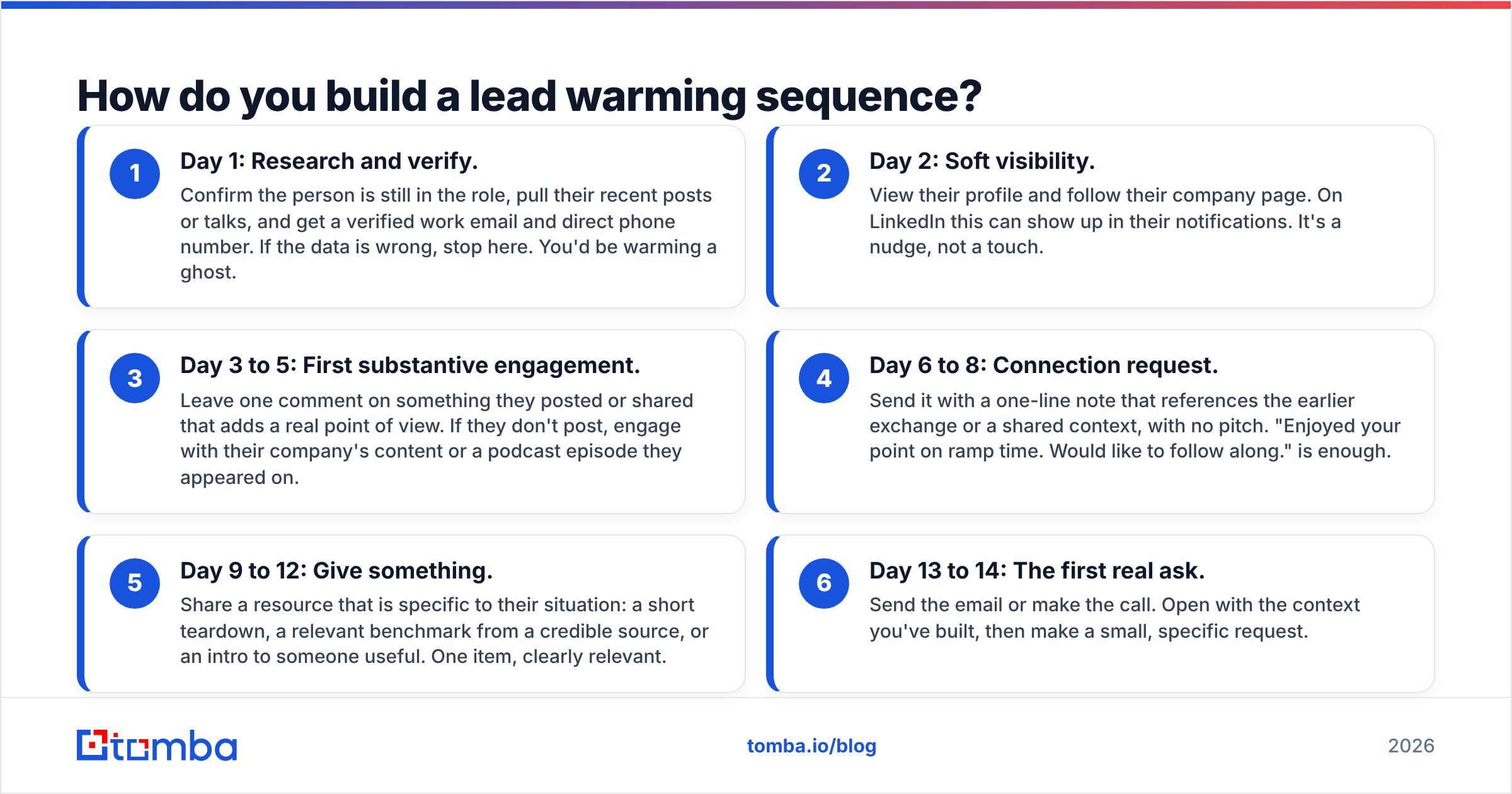
A good sequence has a clear start, a fixed number of touches, and a defined handoff to the first real ask. Here is a 14-day structure that works for mid-market and enterprise prospects. Compress it to 7 days for SMB.
- Day 1: Research and verify. Confirm the person is still in the role, pull their recent posts or talks, and get a verified work email and direct phone number. If the data is wrong, stop here. You'd be warming a ghost.
- Day 2: Soft visibility. View their profile and follow their company page. On LinkedIn this can show up in their notifications. It's a nudge, not a touch.
- Day 3 to 5: First substantive engagement. Leave one comment on something they posted or shared that adds a real point of view. If they don't post, engage with their company's content or a podcast episode they appeared on.
- Day 6 to 8: Connection request. Send it with a one-line note that references the earlier exchange or a shared context, with no pitch. "Enjoyed your point on ramp time. Would like to follow along." is enough.
- Day 9 to 12: Give something. Share a resource that is specific to their situation: a short teardown, a relevant benchmark from a credible source, or an intro to someone useful. One item, clearly relevant.
- Day 13 to 14: The first real ask. Send the email or make the call. Open with the context you've built, then make a small, specific request.
That final step is where warming turns into pipeline. A first email after a warming sequence might look like this:
Subject: your point on ramp time
Hi Dana, I commented on your post last week about new reps taking six months to ramp. We see the same thing with teams that give new hires the full territory on day one.
We've helped a few RevOps teams cut that by staging territory access. Worth a 15-minute look at how two of them set it up?
It works because every sentence references something real. Compare that to the cold version, which opens with "I hope this finds you well" and a paragraph about your company.
Which leads are worth warming?#
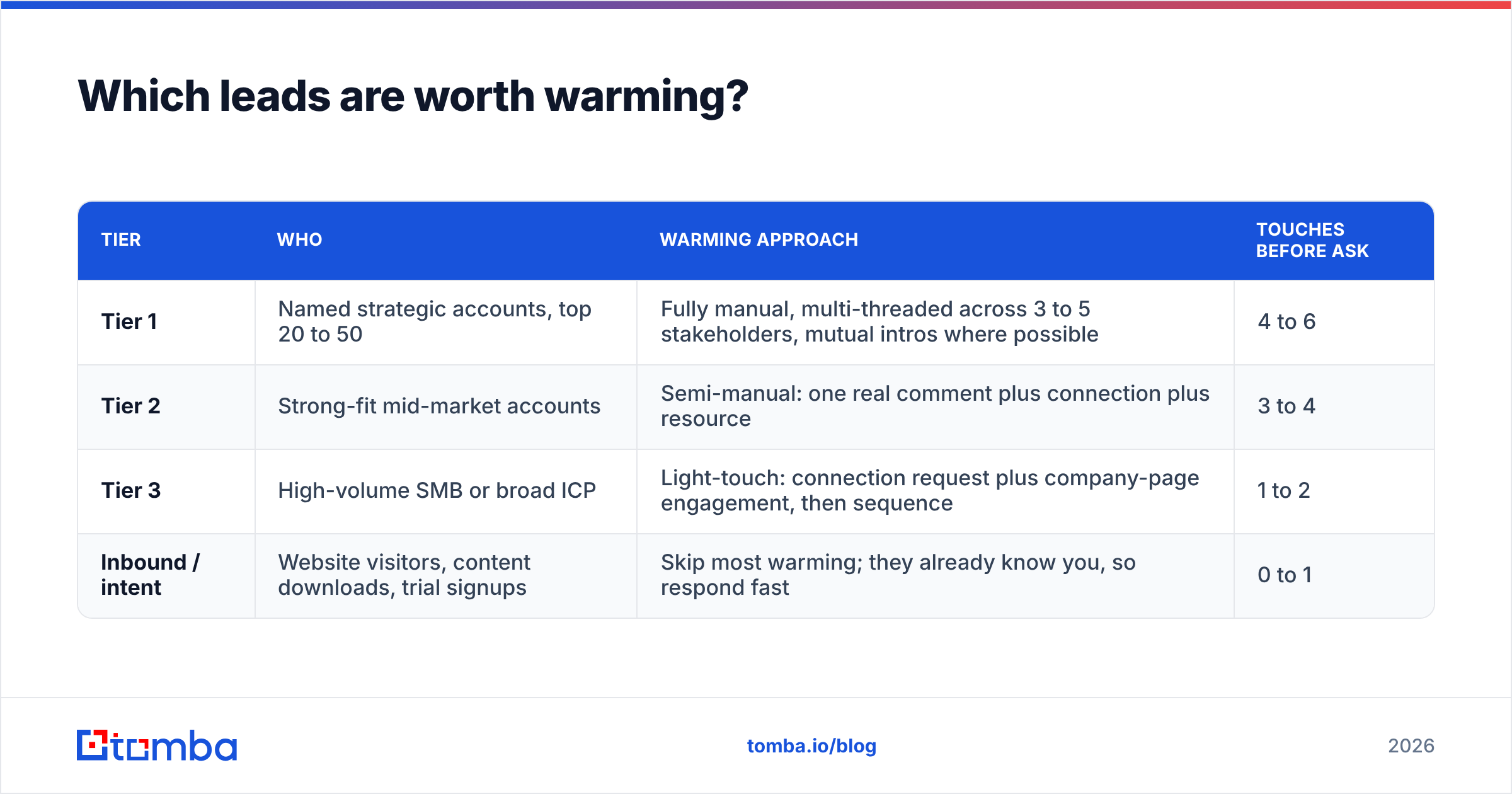
Not all of them. Warming costs rep time, and rep time is the most expensive thing in outbound. Tier your list by account value and match the effort to it.
| Tier | Who | Warming approach | Touches before ask |
|---|---|---|---|
| Tier 1 | Named strategic accounts, top 20 to 50 | Fully manual, multi-threaded across 3 to 5 stakeholders, mutual intros where possible | 4 to 6 |
| Tier 2 | Strong-fit mid-market accounts | Semi-manual: one real comment plus connection plus resource | 3 to 4 |
| Tier 3 | High-volume SMB or broad ICP | Light-touch: connection request plus company-page engagement, then sequence | 1 to 2 |
| Inbound / intent | Website visitors, content downloads, trial signups | Skip most warming; they already know you, so respond fast | 0 to 1 |
The last row matters more than people expect. If someone just spent eight minutes on your pricing page, a 14-day warming sequence is a mistake. They're already warm. Tools for website visitor identification help you spot those accounts so you can skip straight to a relevant, well-timed first touch.
Industry research backs up the underlying point: B2B buyers do a large share of their research before they ever talk to a seller. Gartner's B2B buying research is a useful reference if you need to make that case internally. Warming is how you get into the picture during that silent research phase instead of after it.
What are the most common lead warming mistakes?#
Warming the wrong person. The most common and most expensive error. You spend two weeks engaging with a Director of Sales Ops who left the company three months ago, or whose email bounces on day 14. Every touch you invested disappears. Check role, company, and contact data first, and run addresses through an email verifier before the sequence starts, not after.
Automating the human part. Tools that auto-like every post or send templated connection notes at scale defeat the purpose. The prospect sees a pattern, and LinkedIn's limits on automation can restrict your account. Automate the logistics (reminders, task queues, data enrichment) and keep the actual touches human.
Never getting to the ask. Some reps fall in love with warming because it feels productive and never feels like rejection. Set a hard rule: after the planned touches, you make the ask. If you've done five touches and still aren't ready to email, the problem isn't warmth.
Generic value. Sending a prospect your company's latest ebook is not "giving value." It's a disguised pitch. A useful resource answers a question they have right now, ideally one they've mentioned publicly.
Single-threading. Warming one champion in a 12-person buying committee leaves you exposed. For Tier 1 accounts, warm two or three stakeholders in parallel so a job change doesn't wipe out the deal.
How do you measure whether lead warming is working?#
Warming is easy to feel good about and hard to prove, so measure it deliberately. Run a simple split: take a batch of similar-fit prospects, warm half, send the same first email to both halves, and compare.
Track these metrics:
- Reply rate on the first email. The core number. Compare warmed vs. unwarmed cohorts with the same copy and offer.
- Positive reply rate. Replies like "not interested" don't mean warming worked. Count replies that move toward a meeting.
- Meetings booked per 100 prospects. This normalizes for the extra time warming takes.
- Connection acceptance rate. A leading indicator. If most connection requests go unanswered, your earlier touches aren't landing.
- Time cost per meeting. Warming takes rep hours. If it doubles reply rate but triples time per prospect, it only pays on high-value tiers.
Log touches in your CRM so the data exists. HubSpot's sales blog has solid templates for activity tracking if you're setting this up from scratch. Without touch-level logging, you'll be guessing about which part of the sequence moves the number.
Expect results to vary a lot by segment. Warming usually matters most with senior buyers and enterprise accounts, where inboxes are crowded and trust thresholds are high. For SMB owners who answer their own email, a sharp, well-targeted cold email often beats a two-week warm-up.
What does a lead warming tech stack look like?#
You don't need much. Most teams run lead warming with four layers:
- Data layer. Accurate names, titles, verified emails, and phone numbers. Contact enrichment fills in missing fields and flags people who've changed jobs.
- Signal layer. Where you find warming opportunities: LinkedIn Sales Navigator alerts, website visitor identification, job-change tracking, and funding or hiring news.
- Task layer. Your CRM or sales engagement platform, set up to queue manual touches (comment, connect, share) as tasks alongside automated emails.
- Outreach layer. The email and phone sequences that take over once warming ends, sent from mailboxes with proper authentication and email warmup in place.
The order matters. Teams often buy the outreach tool first and treat data as an afterthought. Then they discover that 15% of their carefully warmed Tier 1 contacts have stale emails. Start at the bottom of the stack.
Is lead warming worth it in 2026?#
For the right accounts, yes. Inboxes are more crowded than they've ever been, AI has made generic personalization nearly free, and buyers have gotten good at spotting it. A reference to a real conversation from last week is one of the few signals that's still hard to fake at scale.
But warming is a multiplier, not a strategy. It multiplies good targeting, accurate data, and a clear offer. If any of those are zero, warming them doesn't help. Use it on Tier 1 and Tier 2 accounts, keep it to a fixed window with a hard handoff to the ask, measure it against a control group, and skip it entirely for leads that are already showing intent.
The foundation of any warming sequence is knowing you're reaching the right person at the right address. Before you spend two weeks building familiarity with a prospect, make sure the email you'll send on day 14 actually reaches them. Tomba Email Finder finds verified professional email addresses by name, domain, or company, so the leads you warm are leads you can actually contact. Start with the free tier's 25 monthly searches on your Tier 1 list, and scale up once the warming sequence proves itself.
Related guides#
// get started
Find, verify and enrich your first contacts today
Start on the free plan with 25 searches a month, then scale when your team is ready.
Free plan · No credit card required · GDPR & CCPA
// about the author