Lead411 vs Apollo.io (2026): Pricing, Data Accuracy, Verdict
Lead411 vs Apollo.io, compared on the things that decide the bill: data accuracy, credit math, seat pricing, and the costs neither vendor lists. Lead411 sells unlimited exports. Apollo sells an all-in-one outbound engine. Here is which one your team should buy.
Lead411 vs Apollo.io is a choice between two shapes of tool. One sells data. The other sells a machine that sends. This guide compares both on accuracy, credits, seat price, and the costs nobody lists.
TL;DR
- Apollo.io bundles a database, a sequencer, a dialer, and a light CRM into one seat.
- Lead411 is data-first. It leans on unlimited contact exports and intent signals.
- Pick Apollo if you want one tool to find contacts and send the email.
- Pick Lead411 if you already own a sequencer and just want clean, exportable contacts.
- Both charge per seat. That is where the bill triples once you add SDRs. Apollo starts near $49–$79 per user per month. Lead411 starts near $99.
- Neither "verified" label holds up on a real send. Budget for an independent email verifier either way.
- Need emails and an API, but no sequencer and no dialer? A focused email finder at $49 a month flat costs less than both.
What are Lead411 and Apollo.io?#
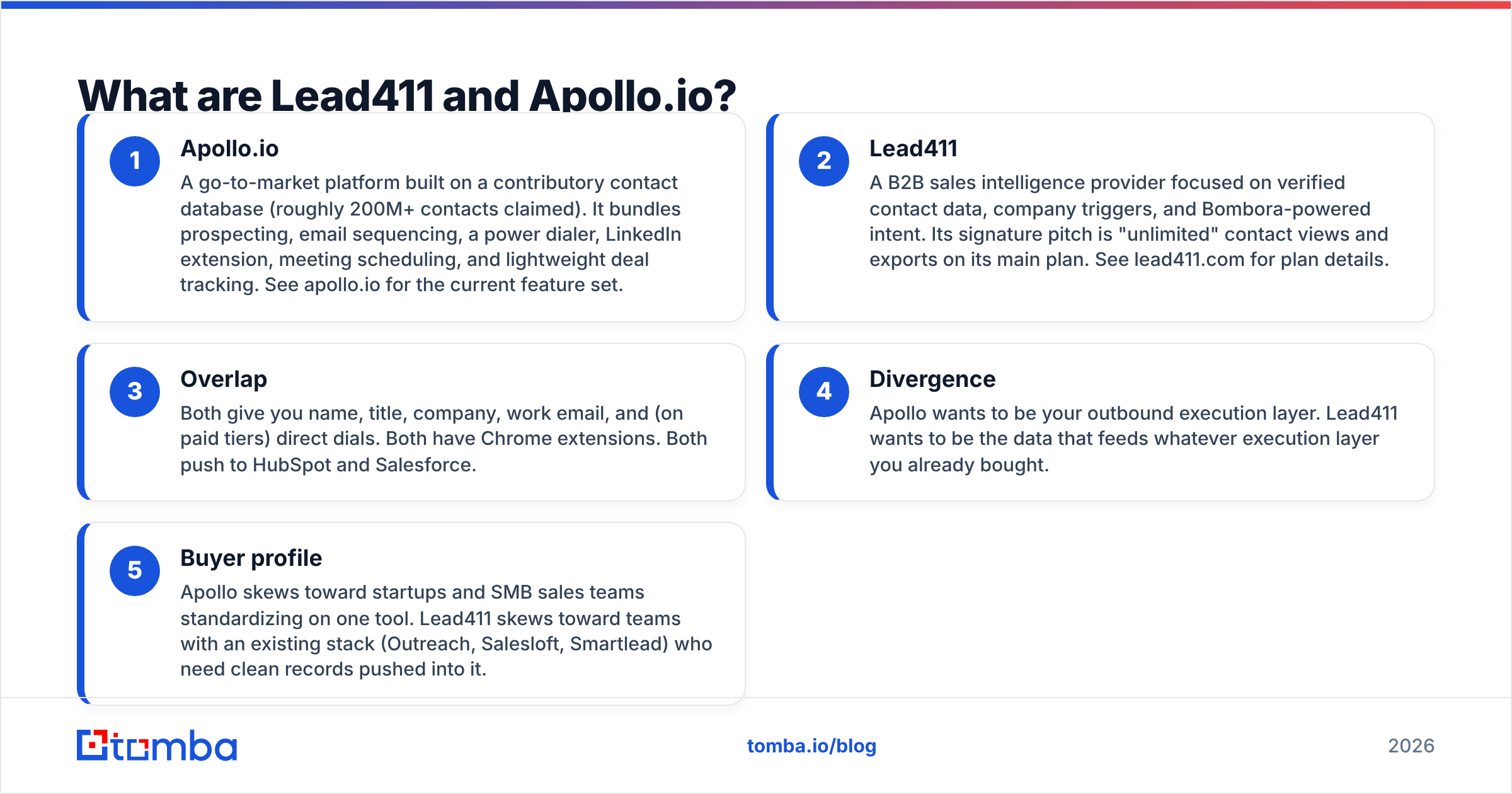
They solve the same problem from opposite ends. Think of a kitchen. Apollo sells the whole fitted kitchen, appliances included. Lead411 sells a very good pantry and assumes you own a stove.
- Apollo.io — A go-to-market platform built on a shared contact database. It claims 200M+ contacts. One seat covers prospecting, email sequences, a power dialer, a LinkedIn extension, meeting booking, and light deal tracking. See apollo.io for the current feature set.
- Lead411 — A B2B sales intelligence provider. It focuses on verified contacts, company triggers, and Bombora intent. Its pitch is "unlimited" views and exports on the main plan. See lead411.com for plan details.
In a Lead411 vs Apollo.io comparison, here is where the two meet and where they split:
- Overlap — Both give you name, title, company, work email, and direct dials on paid tiers. Both ship a Chrome extension. Both push to HubSpot and Salesforce.
- Divergence — Apollo wants to be your sending layer. Lead411 wants to feed the sender you already bought.
- Buyer profile — Apollo suits startups and small teams standardizing on one tool. Lead411 suits teams with a stack already in place: Outreach, Salesloft, Smartlead.
That split matters more than any feature grid. Buy Lead411 expecting a sequencer and you will be unhappy. Buy Apollo expecting deep niche data and you will be unhappy too.
How accurate is the data in Lead411 vs Apollo.io?#
Short answer: both land in the same band. Expect roughly 70–90% deliverable on mainstream US tech and SaaS contacts. Expect worse outside that. The gap between the two tools is small. The gap between either one and a freshly verified list is large.

Three things drive the real number. Neither vendor controls all three.
- Record age. A contact scraped 14 months ago has about a one-in-four chance of being stale. B2B job changes run 20–30% a year. Apollo refreshes fast on popular accounts and slowly on the rest. Lead411 re-verifies more, but over a smaller pool.
- Catch-all domains. A quarter to a third of mid-market domains accept all mail. Both tools will mark a guessed pattern as "verified" there, because the server never says no. That is not proof. It is just silence. A catch-all verifier is the honest way to score those.
- Geography. Europe and APAC coverage is thinner than the marketing suggests. GDPR-sensitive records are often held back or left unverified.
So do not settle Lead411 vs Apollo.io on a stated accuracy number. Pull 200 contacts on trial from your exact ICP. Use your industry, your size band, your region. Push them through a neutral verifier and count. The test costs an afternoon. It saves you a year on a bad contract.

Which is cheaper, Lead411 or Apollo.io?#
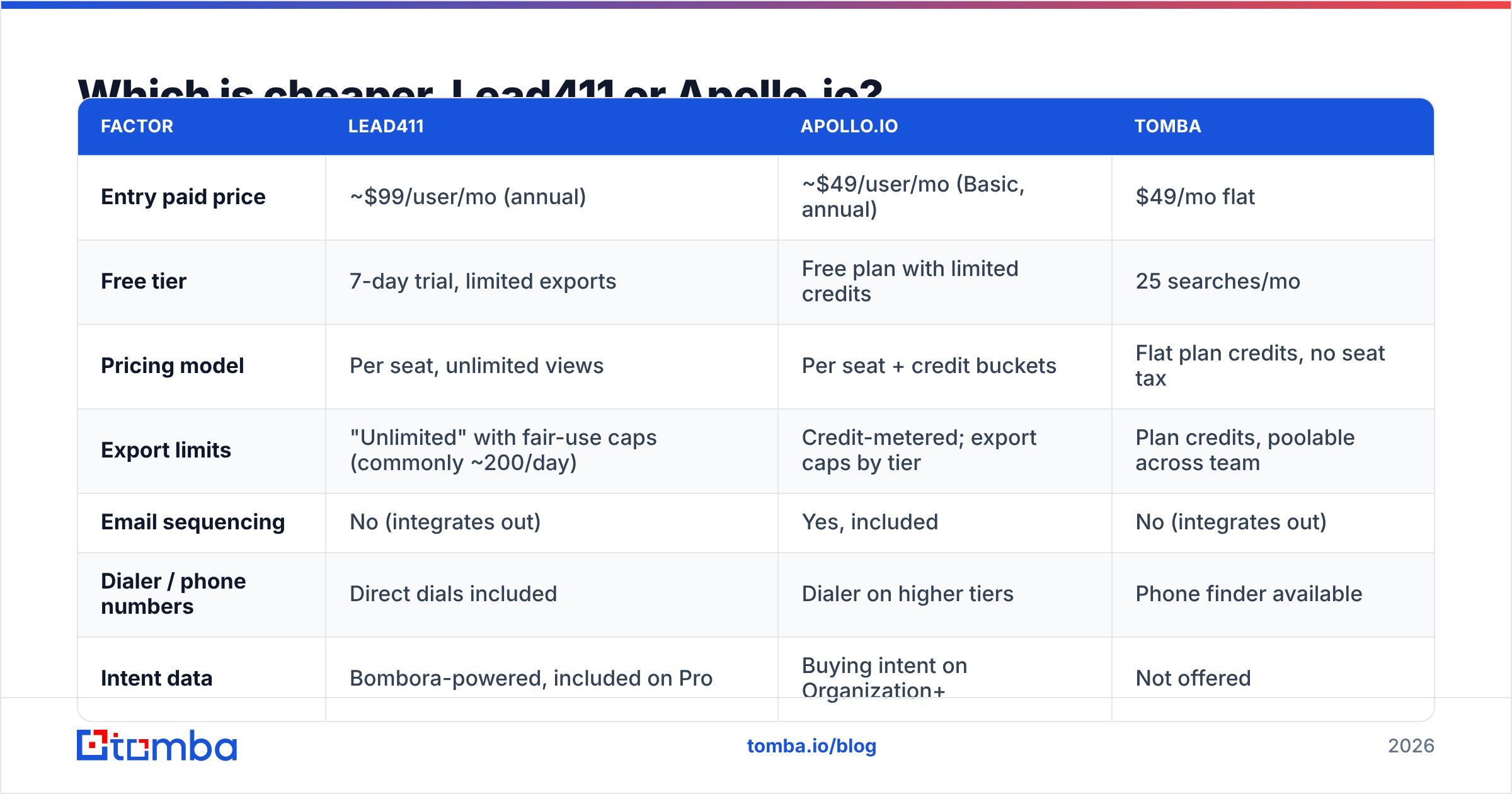
Apollo is cheaper on the sticker. Lead411 is cheaper if you export heavily and need two or three seats. Both get expensive the same way: per-seat math.
Prices below were public at the time of writing. Both vendors change tiers often, so check before you sign.

| Factor | Lead411 | Apollo.io | Tomba |
|---|---|---|---|
| Entry paid price | ~$99/user/mo (annual) | ~$49/user/mo (Basic, annual) | $49/mo flat |
| Free tier | 7-day trial, limited exports | Free plan with limited credits | 25 searches/mo |
| Pricing model | Per seat, unlimited views | Per seat + credit buckets | Flat plan credits, no seat tax |
| Export limits | "Unlimited" with fair-use caps (commonly ~200/day) | Credit-metered; export caps by tier | Plan credits, poolable across team |
| Email sequencing | No (integrates out) | Yes, included | No (integrates out) |
| Dialer / phone numbers | Direct dials included | Dialer on higher tiers | Phone finder available |
| Intent data | Bombora-powered, included on Pro | Buying intent on Organization+ | Not offered |
| API access | Available, higher tiers | Available, credit-metered | Full email finder API on all paid plans |
| Best for | Data-only teams with an existing sequencer | Startups wanting one tool end-to-end | Teams that just need accurate emails at scale |
Read the "unlimited" row twice. Lead411's unlimited is buffet unlimited: there is a plate limit. Fair-use caps often land near 200 exports a day per seat. That is plenty for one AE on named accounts. It is nowhere near enough for a list-building sprint.
Apollo fails the other way. Credits look generous at first. Then you learn that exports, enrichment, and mobile reveals draw from different buckets at different rates. The sequencer also tempts you to burn credits on contacts you would never pull by hand.
What does Apollo.io do better?#
Execution in one place. Apollo's edge is not data. It is that you go from filter to sent sequence without leaving the tab. For a three-person team, folding four tools into one is worth real money. Each part is a B+, and that is fine.
Specific strengths:
- Sequencer quality. Email steps, call tasks, and LinkedIn touches in one flow, with A/B tests. Not Outreach-grade, but genuinely usable.
- Filtering depth. Tech stack, headcount growth, funding, and job-post filters that rival dedicated tools.
- Chrome extension. Strong on LinkedIn, where most SDRs live. Compare it with a dedicated LinkedIn finder before you assume bundled is better.
- A free tier you can test with before you pay for anything.
- Ecosystem. A big reviewer base on G2, lots of tutorials, and easy hiring.
The cost is deliverability risk. In a Lead411 vs Apollo.io race, this is Apollo's weak lap. Thousands of teams send from one platform to the same contacts. Those lists get hammered, and spam filters have noticed.
What does Lead411 do better?#
Signal, and export sanity. The database is smaller but curated harder. The trigger data is the real draw: funding rounds, hiring surges, exec changes, IPO news. It helps you time a touch, not just target one.
- Intent without an enterprise deal. Bombora topics on a mid-market plan is rare. Rivals gate that behind $30k contracts.
- Direct dials. Strong on mobile numbers for US mid-market buyers.
- No credit math. Nobody has to watch a meter on every export. That removes real team friction.
- Less list fatigue. A smaller user base means fewer teams emailing the same people.
- Cleaner CRM pushes. Field mapping to Salesforce and HubSpot makes fewer duplicates than Apollo's bulk push.
Where it falls short, and why Lead411 vs Apollo.io is rarely a landslide: no sending engine, thin coverage abroad, a dated UI, and support that feels like an account manager rather than self-serve.
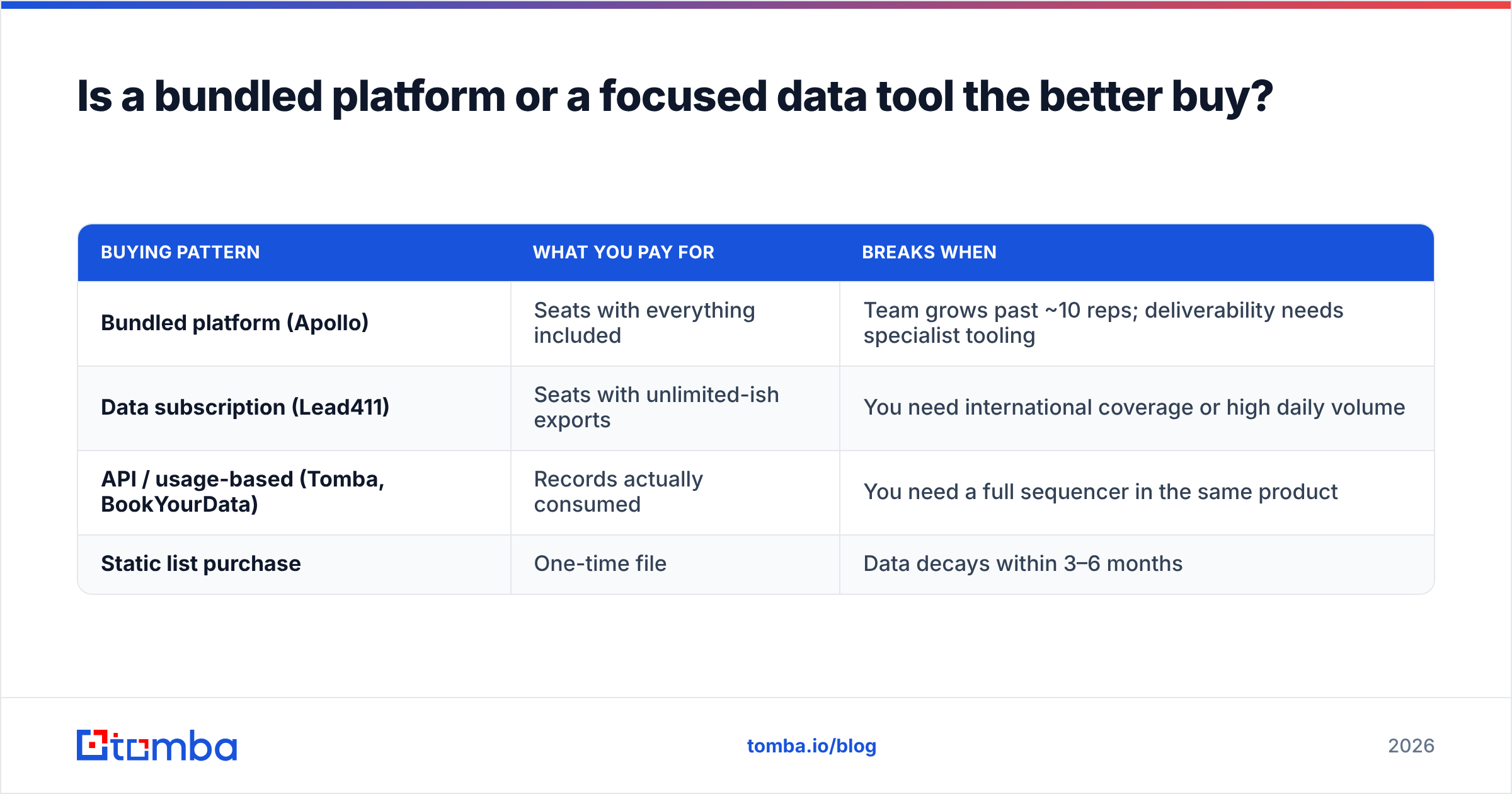
Is a bundled platform or a focused data tool the better buy?#
It depends on one thing. Is your bottleneck finding contacts, or contacting them?
The bundled case is Apollo's. One tool cuts cost and admin. That holds at three seats. It stops holding at fifteen. By then you pay full platform price for reps who only touch the database. Your deliverability lead also wants sending moved to dedicated infrastructure.
The unbundled case is Lead411's, and it favors focused tools in general. Each layer should be swappable. Your sequencer, your data, and your verification stay on three contracts. A bad one goes in a week, not at renewal.
A third pattern is growing in 2026: data on demand via API. You skip seats and lists. You call an endpoint at the moment of need. A lead fills a form, your system enriches it. An account lands in your CRM, your workflow finds the contacts. Seat pricing gets awkward here. You pay for human logins to run a machine process.
| Buying pattern | What you pay for | Breaks when |
|---|---|---|
| Bundled platform (Apollo) | Seats with everything included | Team grows past ~10 reps; deliverability needs specialist tooling |
| Data subscription (Lead411) | Seats with unlimited-ish exports | You need international coverage or high daily volume |
| API / usage-based (Tomba, BookYourData) | Records actually consumed | You need a full sequencer in the same product |
| Static list purchase | One-time file | Data decays within 3–6 months |
One more option sits outside the Lead411 vs Apollo.io frame. BookYourData sells pay-as-you-go lists with a stated accuracy guarantee and no subscription. Running one campaign rather than a constant program? That beats renting seats you will use twice.
How should you run the evaluation?#
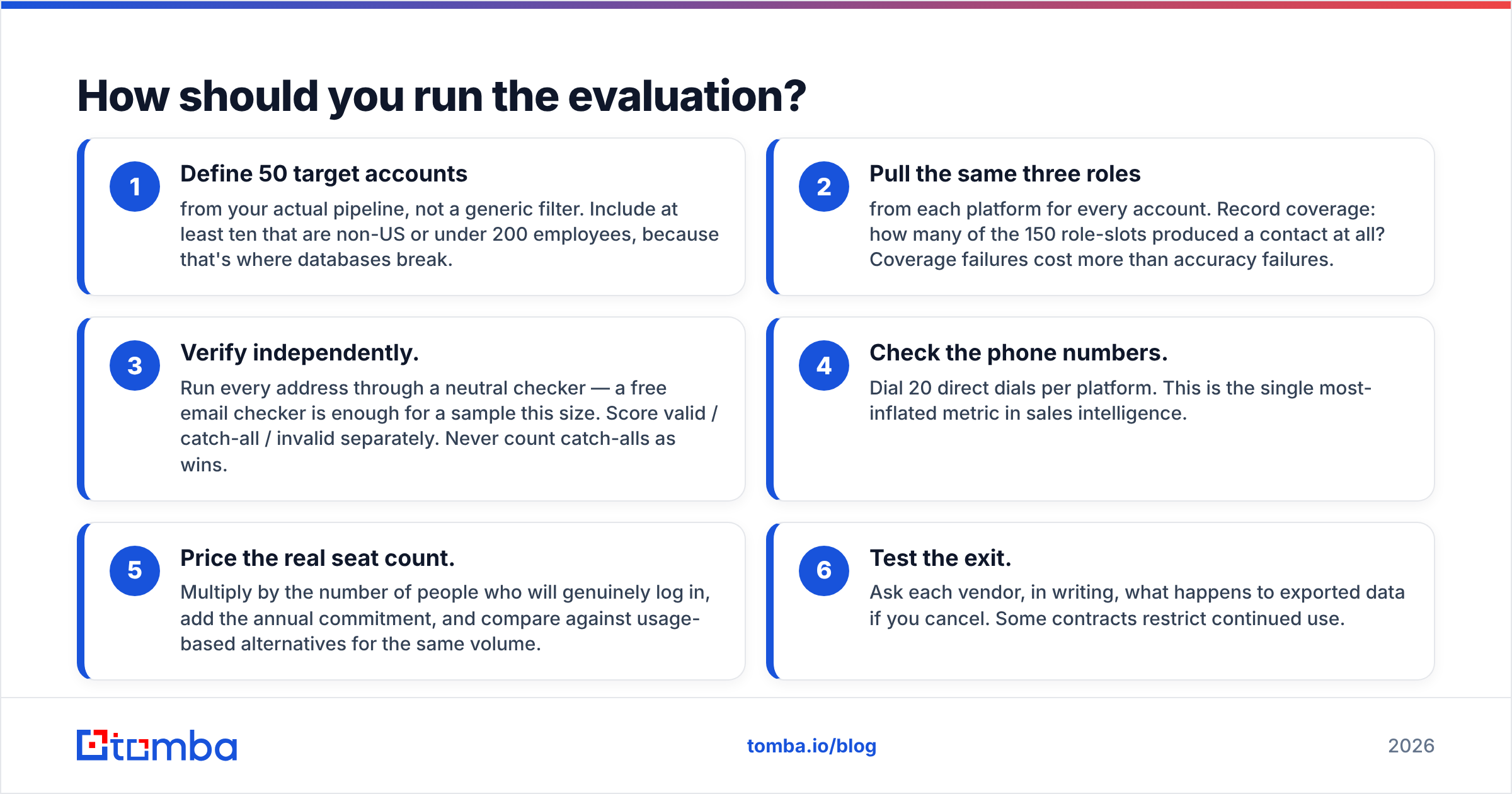
Skip the feature grid. A Lead411 vs Apollo.io trial only helps if you test both on your own ICP. Here is a one-week test that ends in a defensible answer.
- Pick 50 target accounts from real pipeline, not a generic filter. Include ten that sit outside the US or under 200 staff. That is where databases break.
- Pull the same three roles per account from each tool. Record coverage. How many of the 150 slots returned a contact at all? Coverage gaps cost more than bad data.
- Verify on your own. Run every address through a neutral checker. A free email checker handles a sample this size. Score valid, catch-all, and invalid apart. Never count a catch-all as a win.
Then price the thing properly.
- Dial 20 numbers per platform. Phone accuracy is the most inflated metric in this market.
- Count real seats. Multiply by the people who will truly log in. Add the annual term. Compare that with usage-based pricing at the same volume.
- Test the exit. Ask each vendor in writing what happens to exported data if you cancel. Some contracts limit later use.
Teams that run this test usually land somewhere other than where they started. The common result is a split. One platform for execution. A cheaper focused source for bulk discovery. A separate verification step in front of the sender.
Which should you choose?#
The Lead411 vs Apollo.io call comes down to what you already own.
Choose Apollo.io if you run under ten reps, you do not own a sequencer yet, and one login beats best-in-class anything. The free tier lets you test the database before you commit. Most rivals do not offer that.
Choose Lead411 if you already run Outreach, Salesloft, Instantly, or Smartlead. It fits teams that need US mid-market dials and intent for timing. The unlimited plan is real value for two to four heavy users. Check the daily cap against your workflow first.
Choose neither if what you need is accurate email at volume, by API or spreadsheet. Otherwise you pay for a sequencer and a dialer you never open. That is a different product category, and it costs a fraction of both.
Whatever you pick, put verification between the database and the send. Both tools will hand you addresses marked valid that bounce. Your sender reputation pays for every one.
Ready to test the data layer on its own?#
Pull a sample of your real ICP through Tomba Email Finder before you sign an annual seat contract with anyone. The free tier gives you 25 searches a month. That is enough to benchmark coverage on your own target accounts.
Paid plans start at $49 a month, flat. You get full API access, bulk email finder processing, and built-in verification. There is no per-seat tax as the team grows. Run it beside your Lead411 vs Apollo.io trials and let the bounce rate decide, not the feature grid. See Tomba pricing for the full breakdown.
Related guides#
// get started
Find, verify and enrich your first contacts today
Start on the free plan with 25 searches a month, then scale when your team is ready.
Free plan · No credit card required · GDPR & CCPA
Get the Tomba newsletter
Product and data updates
// about the author