Lead411 vs LeadRocks: Which B2B Data Tool Wins in 2026?
Lead411 sells intent data and direct dials on annual contracts. LeadRocks sells a cheap LinkedIn-sourced database by the credit. Here is the honest breakdown of which one actually fits your outbound motion — and when neither is the right buy.
TL;DR
- Lead411 is a full sales-intelligence platform: verified emails, direct dials, Bombora-powered intent data, hiring and funding triggers, CRM sync. It is priced per seat, usually on an annual commitment, and lands in the ~$99/user/month range for its main plan.
- LeadRocks is a low-cost, LinkedIn-sourced contact database with a Chrome extension and credit-based plans starting under $30/month. No intent data, no trigger alerts, much lighter tooling.
- They are not really the same product. Lead411 competes with ZoomInfo and Apollo. LeadRocks competes with cheap list exports and one-off scrapers.
- Pick Lead411 if you sell into US mid-market, need direct dials, and buy on timing signals. Pick LeadRocks if you already know your target accounts and just need contact details at the lowest possible cost per record.
- Pick neither if your real bottleneck is email accuracy on a defined list — that is a job for a verification-first email finder API, not a seat-based intelligence suite.
What are Lead411 and LeadRocks, exactly?#
They solve different halves of the same problem.
Lead411 is a B2B sales intelligence platform that has been around since 2001. It sells a database of company and contact records, wrapped in a layer of "why now" signals: funding rounds, hiring surges, technology installs, and Bombora intent topics. The pitch is that you should not just get a list — you should get a list of accounts that are in-market this quarter.
LeadRocks is newer, smaller, and deliberately cheaper. It markets a database of roughly 100M+ B2B contacts sourced heavily from LinkedIn profiles, exposed through a web app, a Chrome extension, and bulk enrichment. There is no intent layer and no trigger engine. You search, you filter, you reveal, you export.
Here is the practical split:
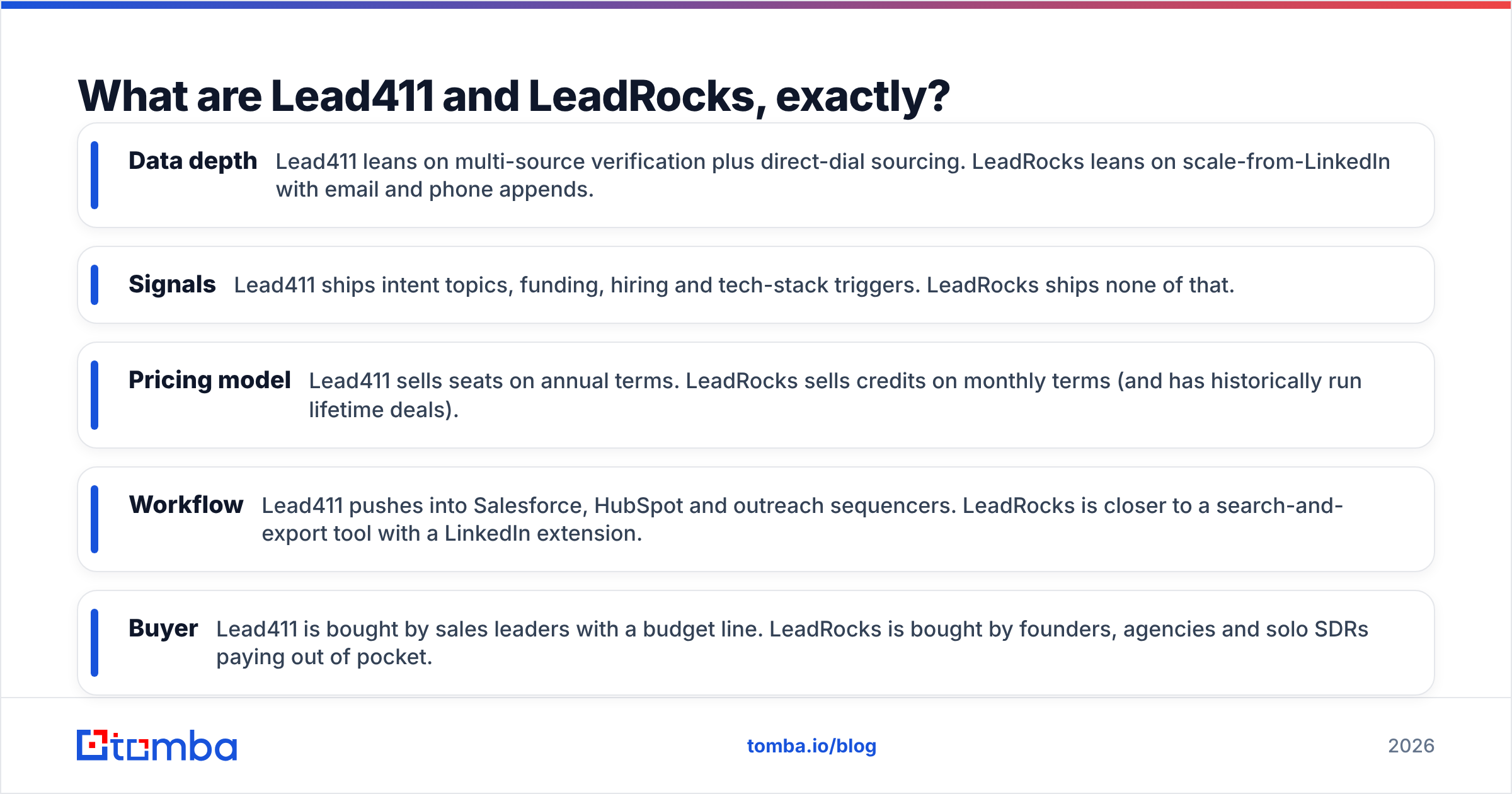
- Data depth — Lead411 leans on multi-source verification plus direct-dial sourcing. LeadRocks leans on scale-from-LinkedIn with email and phone appends.
- Signals — Lead411 ships intent topics, funding, hiring and tech-stack triggers. LeadRocks ships none of that.
- Pricing model — Lead411 sells seats on annual terms. LeadRocks sells credits on monthly terms (and has historically run lifetime deals).
- Workflow — Lead411 pushes into Salesforce, HubSpot and outreach sequencers. LeadRocks is closer to a search-and-export tool with a LinkedIn extension.
- Buyer — Lead411 is bought by sales leaders with a budget line. LeadRocks is bought by founders, agencies and solo SDRs paying out of pocket.
If you read those five lines and already know which side you sit on, you can stop here. If not, the money and the accuracy questions are where the real decision gets made.
How do Lead411 and LeadRocks compare on pricing?#
Pricing on both platforms shifts, and Lead411 in particular quotes rather than publishes for anything above its entry tier. Treat these as directional and confirm on the vendors' own pages before you sign anything.
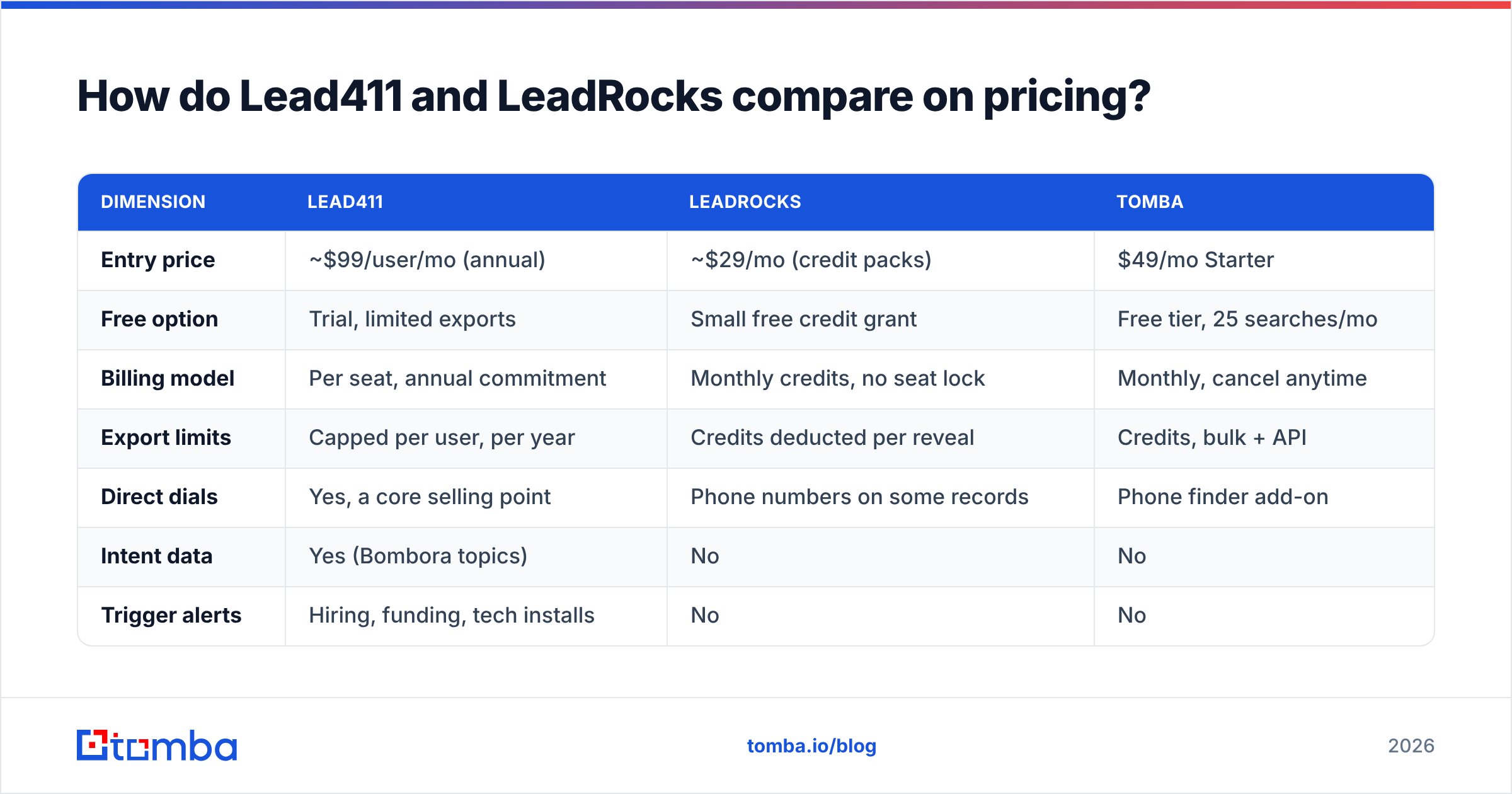
| Dimension | Lead411 | LeadRocks | Tomba |
|---|---|---|---|
| Entry price | ~$99/user/mo (annual) | ~$29/mo (credit packs) | $49/mo Starter |
| Free option | Trial, limited exports | Small free credit grant | Free tier, 25 searches/mo |
| Billing model | Per seat, annual commitment | Monthly credits, no seat lock | Monthly, cancel anytime |
| Export limits | Capped per user, per year | Credits deducted per reveal | Credits, bulk + API |
| Direct dials | Yes, a core selling point | Phone numbers on some records | Phone finder add-on |
| Intent data | Yes (Bombora topics) | No | No |
| Trigger alerts | Hiring, funding, tech installs | No | No |
| API access | Enterprise tiers | Limited | Full Tomba API on all paid plans |
| Best for | US mid-market outbound teams | Budget prospecting, agencies | Verified email at scale |
The gap that matters is not the sticker price — it is the shape of the commitment. Lead411's model assumes you are staffing a team and will burn a seat's worth of exports every month for twelve months. LeadRocks assumes you will buy credits when you need them and go quiet in between.
A two-person agency that does three client campaigns a quarter will waste most of a Lead411 contract. A six-rep SDR team calling into US SaaS will exhaust LeadRocks' usefulness in about three weeks, because no amount of cheap records fixes the "who do I call today" problem.

Which one has better data accuracy?#
Accuracy is where most of these comparisons get lazy, so be specific about what you are measuring.
There are three distinct numbers that vendors blur together:
- Coverage — what percentage of your target list returns any contact at all.
- Email validity — of the emails returned, what share actually accept mail.
- Freshness — how recently the record was confirmed, which matters enormously in a market with constant job changes.
Lead411 generally performs better on validity and direct-dial accuracy, and it publishes a reclaim/refund posture around bad records. Its weakness is coverage outside North America — European and APAC records thin out fast, and GDPR-driven suppression makes EU direct dials unreliable.
LeadRocks performs well on coverage for LinkedIn-active personas — marketing, sales, tech leadership at companies with a real social footprint — because that is the sourcing pipeline. Its weakness is freshness. A LinkedIn-derived record tells you where someone worked when the profile was indexed, not whether the corporate mailbox still routes. Reviews on G2 for LinkedIn-sourced databases consistently flag the same pattern: high match rates, uneven bounce rates.

The operational answer is the same regardless of which you buy: never send to a database export without an independent verification pass. Run exports through an email verifier before they hit your sequencer. A 4% bounce rate on a 5,000-record send is 200 hard bounces, and Google and Microsoft both treat that as a reputation event, not a rounding error. The cost of verification is trivial against the cost of a burned sending domain.
Is Lead411's intent data worth the premium?#
Sometimes. It depends entirely on whether you can act on it within a week.
Intent data works like a smoke detector in a big building. It tells you something is happening in that account — several people there have been reading about a category you sell into. It does not tell you which floor, who lit the match, or whether it is just someone burning toast. The signal is account-level and probabilistic.
That has two consequences:
- It pays off when you have enough rep capacity to work a surging account within days, and enough contacts per account to reach the right buying-committee member. Intent plus a five-person committee map is a real advantage.
- It is dead weight when you have two reps, a 400-account TAM, and you are already touching every account every quarter. You do not need a prioritization layer for a list you can work exhaustively.
Lead411's hiring and funding triggers are often more actionable than the intent topics themselves, because they are deterministic events rather than aggregated content consumption. A company that just posted eight SDR reqs has a knowable, dateable reason to hear from you. That is a better opener than "our data says you have been researching our category."
LeadRocks offers none of this. If timing signals are central to your motion, the comparison ends here and Lead411 wins on capability — you are only arguing about price.
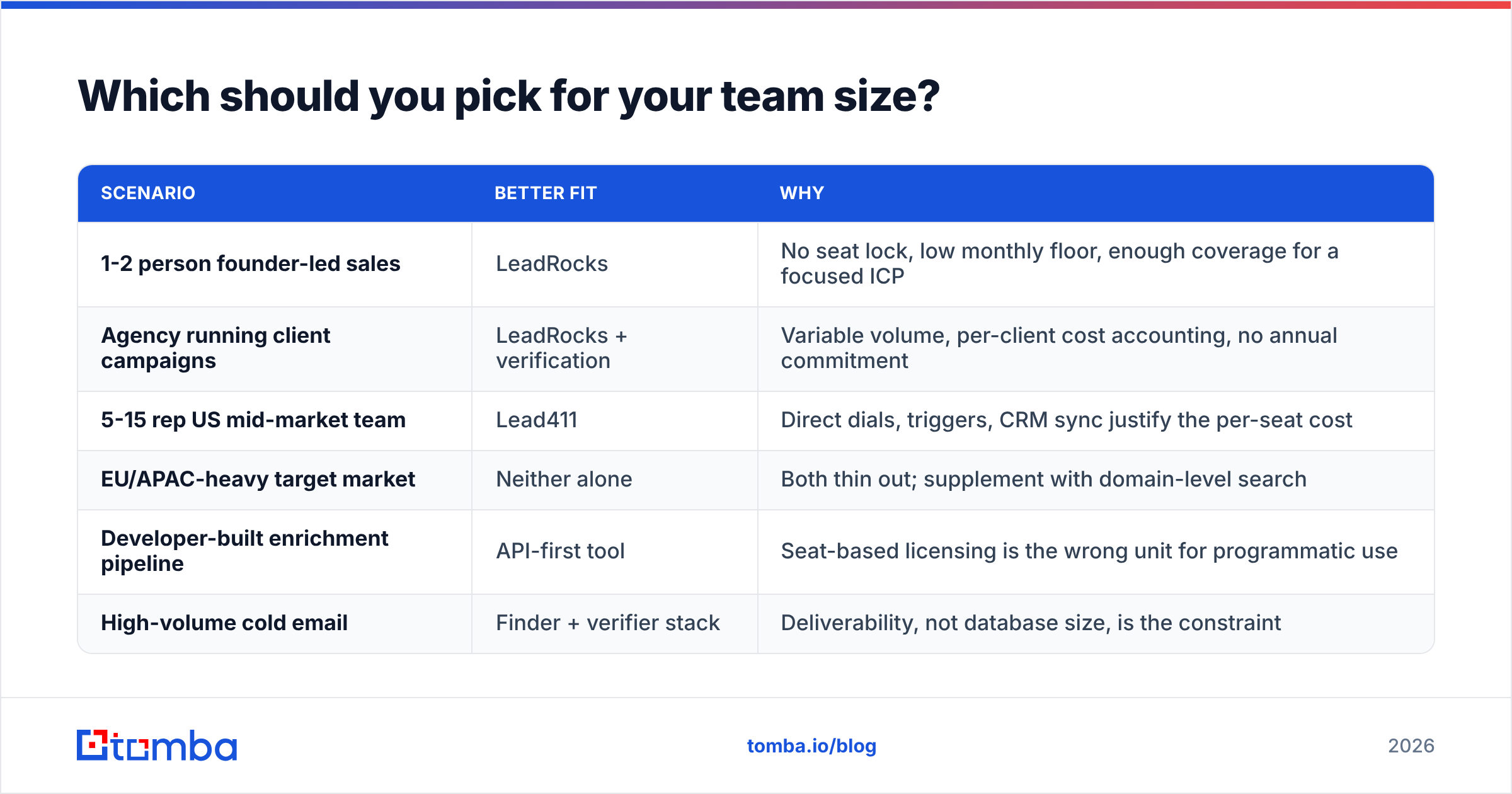
Which should you pick for your team size?#
| Scenario | Better fit | Why |
|---|---|---|
| 1-2 person founder-led sales | LeadRocks | No seat lock, low monthly floor, enough coverage for a focused ICP |
| Agency running client campaigns | LeadRocks + verification | Variable volume, per-client cost accounting, no annual commitment |
| 5-15 rep US mid-market team | Lead411 | Direct dials, triggers, CRM sync justify the per-seat cost |
| EU/APAC-heavy target market | Neither alone | Both thin out; supplement with domain-level search |
| Developer-built enrichment pipeline | API-first tool | Seat-based licensing is the wrong unit for programmatic use |
| High-volume cold email | Finder + verifier stack | Deliverability, not database size, is the constraint |
Notice how often the honest answer is "neither, alone." That is not a dodge. Most teams that churn off one of these platforms do so because they bought a database when their actual problem was a pipeline problem — bad list hygiene, no verification step, or no way to get data into the CRM without a CSV round trip.
What are the real drawbacks of each?#
Lead411 — where it frustrates buyers:
- Annual contracts with per-seat export caps mean unused capacity does not roll over in most configurations.
- International coverage is noticeably weaker than domestic US coverage.
- The UI carries two decades of feature accumulation; onboarding a new rep takes longer than with a modern single-purpose tool.
- Intent data is only as good as your ability to staff against it.
LeadRocks — where it frustrates buyers:
- No timing signals at all. You are buying rows, not priorities.
- LinkedIn-derived freshness decay means older records need re-verification before use.
- Integration surface is thin compared to platforms built for RevOps teams.
- Support and roadmap velocity reflect a much smaller company than Lead411.
Neither of these is disqualifying. They are just the shape of what you are buying. A $29/month tool that does not have an intent engine is not a defect — it is the product working as designed, and the price reflects it.

Where does a dedicated email finder fit in this stack?#
In the gap both platforms leave open: you have a list of companies or people and you need working email addresses for them, right now, without buying a seat.
That happens constantly:
- Marketing hands you 300 webinar registrants with company names but no work emails.
- You scraped a conference attendee list and need to resolve contacts by domain.
- Your CRM has 8,000 records where the email field is empty or bounced eighteen months ago.
- An engineer wants enrichment inside a product signup flow, called from code.
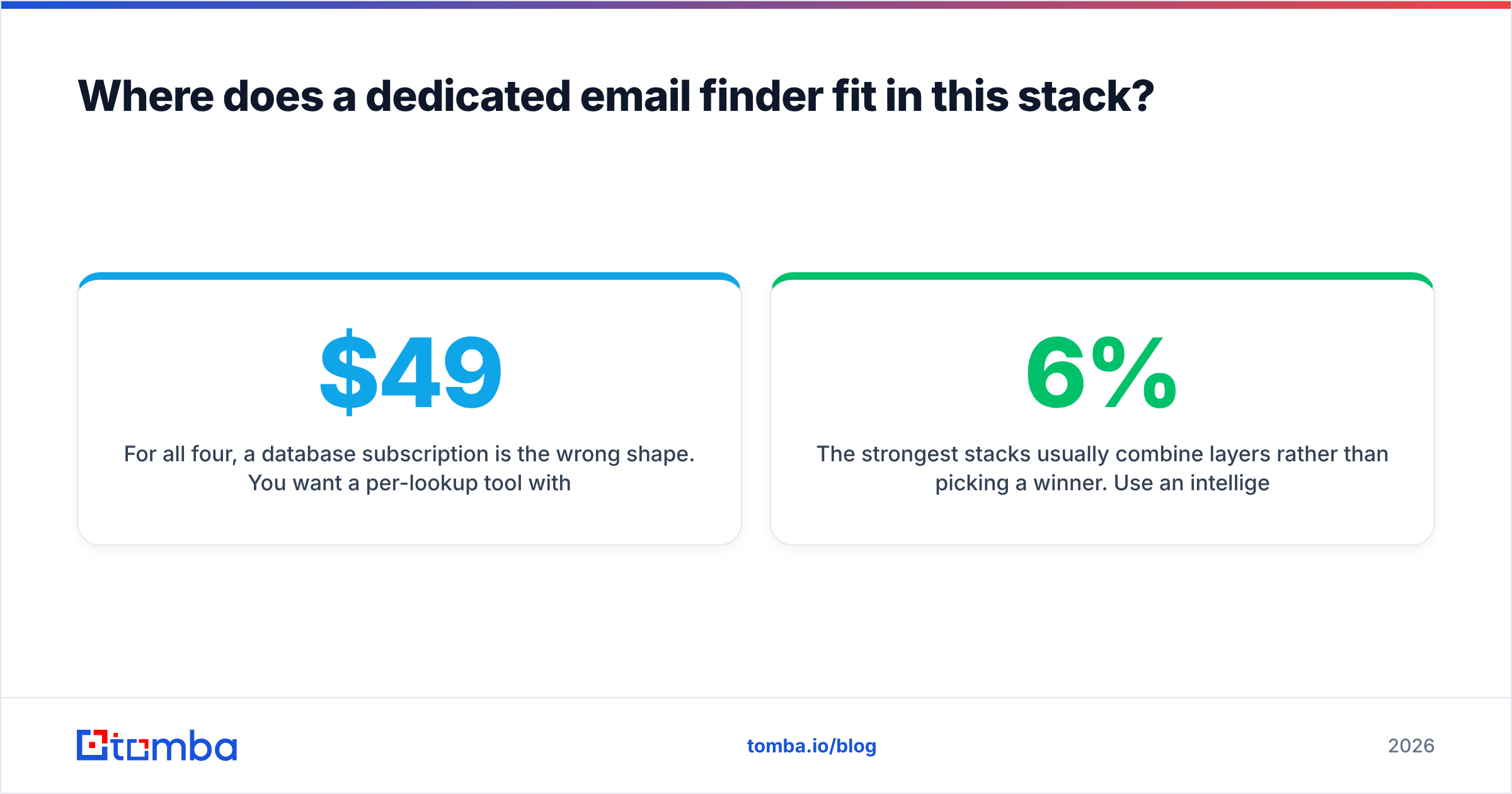
For all four, a database subscription is the wrong shape. You want a per-lookup tool with an API. That is where Tomba fits: domain search to pull every known address at a company, the email finder for name-plus-domain resolution, verification on the same call, and a bulk email finder for list work. Tomba pricing starts free at 25 searches a month, with Starter at $49/month and Growth at $99/month — no seats, no annual lock.
The strongest stacks usually combine layers rather than picking a winner. Use an intelligence platform for account selection and timing if your motion needs it. Use a finder-and-verifier for the last mile, because that is where deliverability is won or lost. Buying one tool to do both is how you end up overpaying for coverage you never use and still bouncing 6% of your sends.
So which wins: Lead411 or LeadRocks?#
Lead411 wins on capability. LeadRocks wins on cost per record. Neither wins on email hygiene.
Choose Lead411 if you sell into the United States, you need direct dials, you have reps who will actually work intent surges, and the annual spend fits a real budget line. It is a legitimate ZoomInfo alternative at a lower price point.
Choose LeadRocks if your ICP is LinkedIn-visible, your volume is spiky, and you would rather spend $29 a month and verify aggressively than commit to twelve months of anything.
Choose a third path if what you actually need is accurate email addresses against a list you already have. That is not a sales-intelligence purchase — it is an infrastructure purchase, and it should cost accordingly.
Start with the last mile. Before you sign an annual data contract, test how many of your target contacts you can resolve for free. Run your next 25 prospects through the Tomba Email Finder — name and domain in, verified email out, with the API and bulk tooling ready when you scale past a spreadsheet. If the match rate covers your list, you may not need a seat-based platform at all.
Related guides#
// get started
Find, verify and enrich your first contacts today
Start on the free plan with 25 searches a month, then scale when your team is ready.
Free plan · No credit card required · GDPR & CCPA
// about the author