Lead411 vs Leadsforge (2026): Which B2B Data Tool Wins?
Lead411 sells intent-backed contact data on annual seats. Leadsforge sells AI-built lead lists on a self-serve model. Here is where each one wins, where each one breaks, and what an API-first stack costs instead.
TL;DR
- Lead411 is a mature B2B sales intelligence database: verified emails, direct dials, growth intent signals, and Bombora-style buyer intent, sold mostly on annual per-seat contracts.
- Leadsforge is a newer AI-first lead list builder: you describe your ICP in plain language, it assembles and verifies a list. Faster to start, far lighter on intent and firmographic depth.
- Pick Lead411 if you need intent data, direct dials, and CRM-grade coverage of US mid-market accounts, and you can live with a seat-based contract.
- Pick Leadsforge if you are a founder or small team who wants a list this afternoon without a demo call or annual commitment.
- Pick neither if your real job is "turn a list of domains and names into verified emails at scale" — that is an API problem, and per-seat platforms are the most expensive way to solve it.
What is Lead411?#
Lead411 has been in the B2B contact data market since 2001, which makes it one of the older names in a category now crowded with AI-branded newcomers. Its pitch is unlimited-ish contact data plus buying signals in a single subscription.
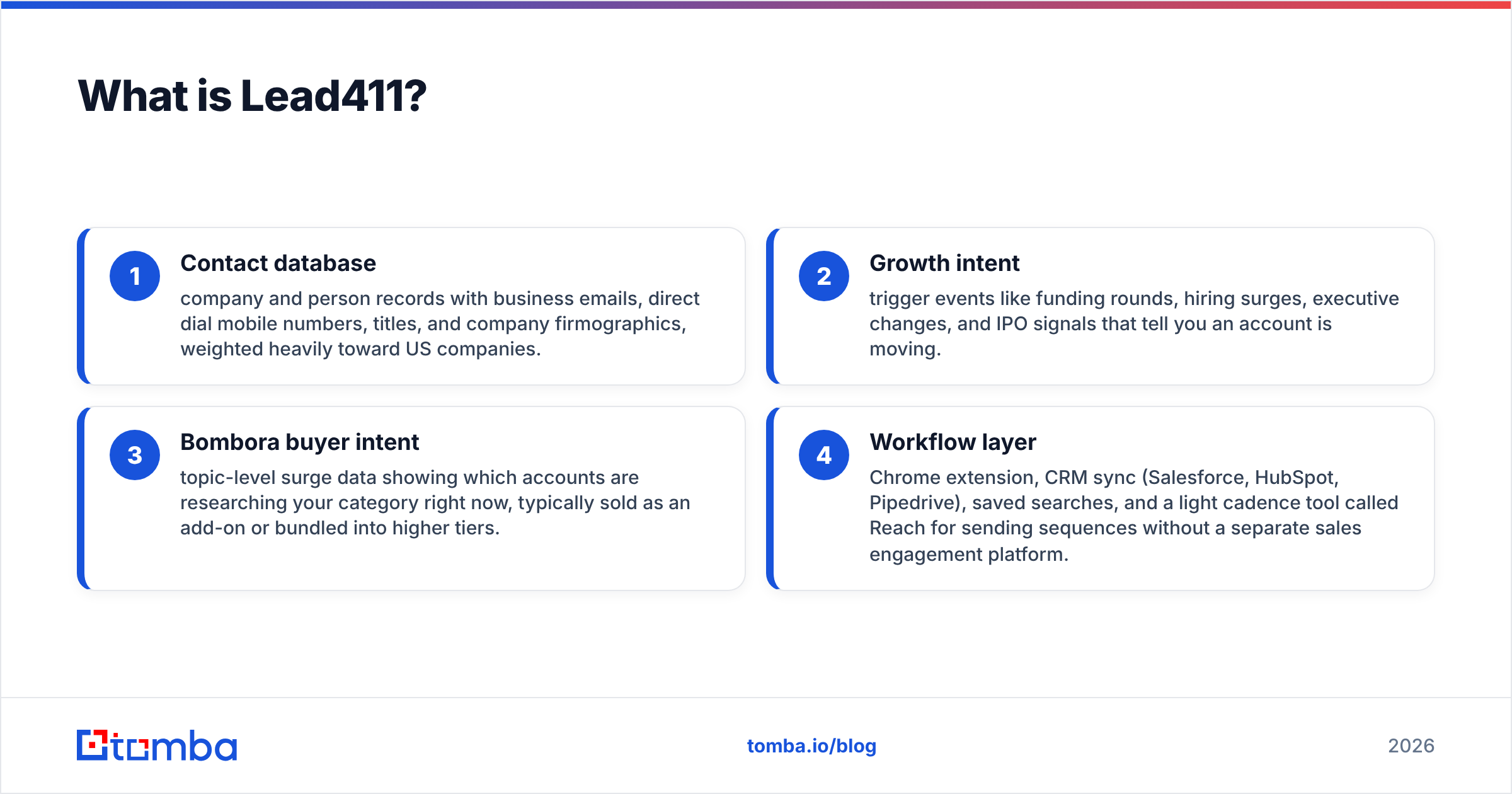
The product breaks down into four pieces:
- Contact database — company and person records with business emails, direct dial mobile numbers, titles, and company firmographics, weighted heavily toward US companies.
- Growth intent — trigger events like funding rounds, hiring surges, executive changes, and IPO signals that tell you an account is moving.
- Bombora buyer intent — topic-level surge data showing which accounts are researching your category right now, typically sold as an add-on or bundled into higher tiers.
- Workflow layer — Chrome extension, CRM sync (Salesforce, HubSpot, Pipedrive), saved searches, and a light cadence tool called Reach for sending sequences without a separate sales engagement platform.
The commercial model matters as much as the feature list. Lead411 sells seats, usually annually, with export caps attached to each seat. Their public "Basic Plus Unlimited" tier has historically sat around $99 per user per month billed annually, with everything involving intent data or higher export volume moving into quote territory. Always confirm current numbers directly — B2B data pricing moves quietly and often.
What is Leadsforge?#
Leadsforge belongs to the 2024–2026 wave of AI-native lead tools. Instead of a filter panel with 40 checkboxes, you type something like "heads of RevOps at Series B SaaS companies in Germany using HubSpot," and the system interprets that into a list, then verifies the emails before handing it back.
What you get:
- Conversational search — natural-language ICP definition instead of boolean filter stacking.
- List assembly and verification — contacts are checked before delivery, so bounce rates stay lower than raw scraped exports.
- Self-serve onboarding — no mandatory demo, no annual signature, credits you can buy and burn.
- Export-first workflow — CSV out, into whatever sequencer you already use.
What you do not get: deep intent data, a large direct-dial phone database, or the enterprise governance features (SSO, admin roles, audit trails) that procurement teams ask about. That is not a knock on the product. It is a different product for a different buyer.
Whose data is actually more accurate, Lead411 or Leadsforge?#
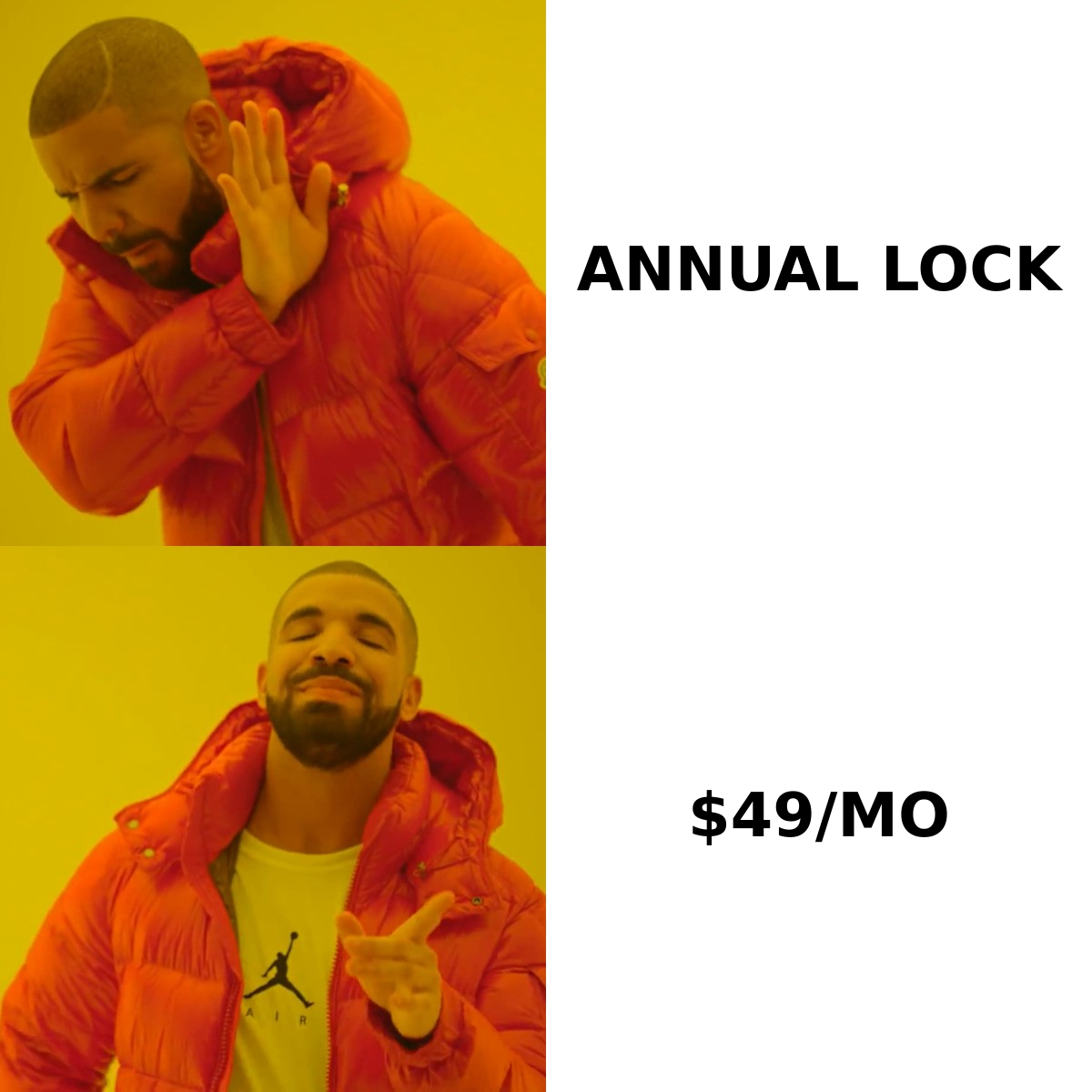
Neither vendor's published accuracy number should be taken at face value, and that applies to every company in this market including ours. "95% accurate" usually means "95% of records we chose to measure passed our own verification step," which is not the same as "95% of the emails you export will land."
Here is how to test the claim yourself in an afternoon:
- Build the same 250-contact list in both tools. Same ICP, same geography, same seniority band.
- Measure coverage, not accuracy, first. How many of your 250 target people did each tool actually return? A tool with perfect accuracy on 40% coverage is worse than one with 92% accuracy on 85% coverage.
- Re-verify both exports with a neutral third party. Run each file through an independent email verifier and compare the valid/catch-all/invalid split. This is the number that predicts your bounce rate.
- Check the catch-all handling. Both tools will return catch-all domains. A vendor that marks them honestly is more useful than one that quietly labels them "valid."
- Send to a 100-contact control batch. Real bounce data from a warmed inbox beats every vendor benchmark.
In practice, the pattern we see across US mid-market data: legacy databases like Lead411 win on direct dials and on companies with 50–5,000 employees, while AI-first tools win on obscure verticals and non-US coverage where the legacy crawl is thin but the live-search approach can still find something. Neither wins everywhere.

One more thing that skews accuracy comparisons: freshness. A record that was correct in 2023 is not correct today. Roughly a fifth of B2B contacts change jobs annually, so the meaningful question is not "is this database accurate?" but "when was this specific record last re-verified?" Tools that expose a verification timestamp per record let you answer that. Tools that do not are asking for trust you have no way to audit.
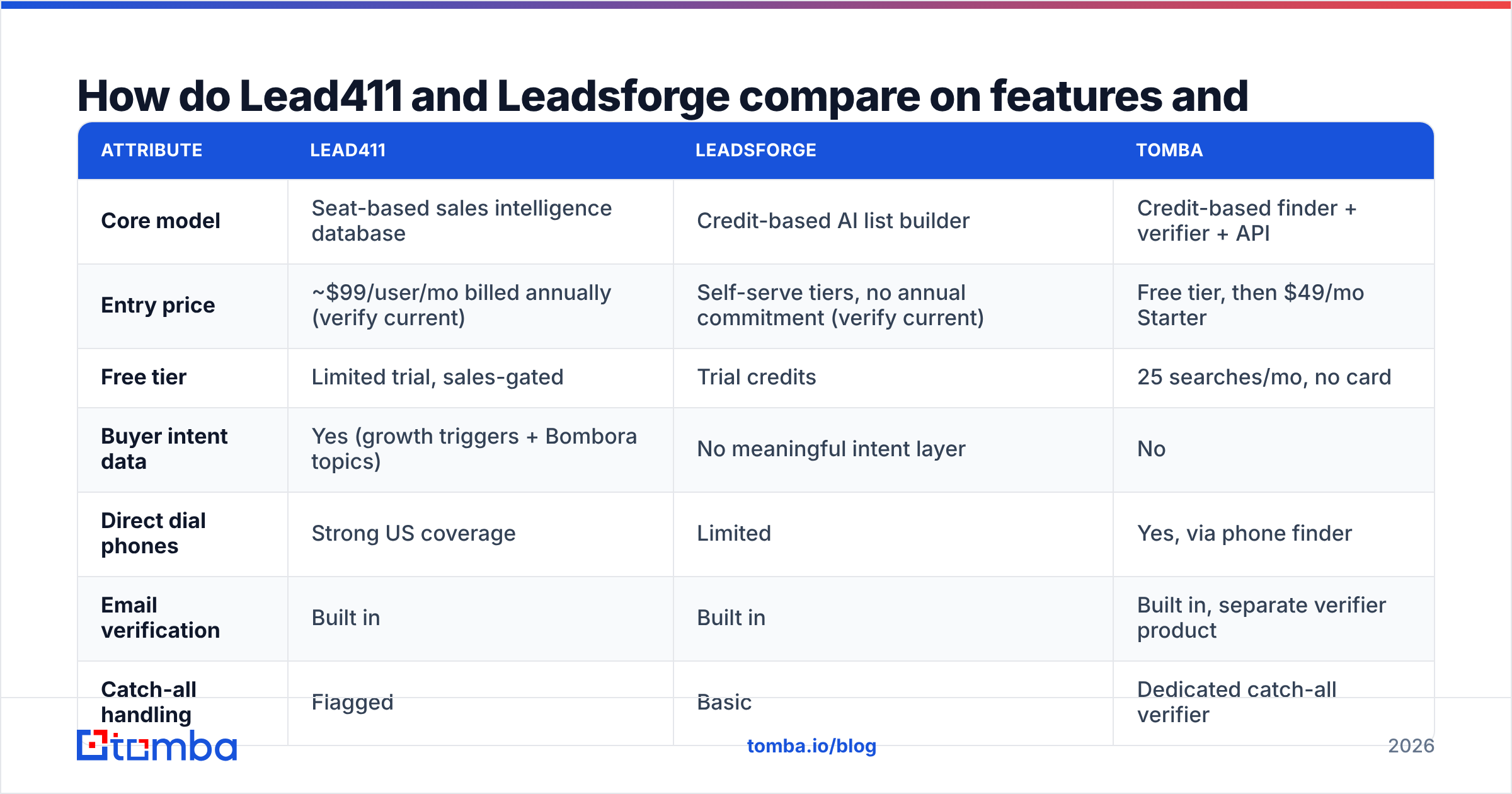
How do Lead411 and Leadsforge compare on features and pricing?#

| Attribute | Lead411 | Leadsforge | Tomba |
|---|---|---|---|
| Core model | Seat-based sales intelligence database | Credit-based AI list builder | Credit-based finder + verifier + API |
| Entry price | ~$99/user/mo billed annually (verify current) | Self-serve tiers, no annual commitment (verify current) | Free tier, then $49/mo Starter |
| Free tier | Limited trial, sales-gated | Trial credits | 25 searches/mo, no card |
| Buyer intent data | Yes (growth triggers + Bombora topics) | No meaningful intent layer | No |
| Direct dial phones | Strong US coverage | Limited | Yes, via phone finder |
| Email verification | Built in | Built in | Built in, separate verifier product |
| Catch-all handling | Flagged | Basic | Dedicated catch-all verifier |
| Public API | Available on higher tiers | Limited | Full REST API on every paid plan |
| Contract | Typically annual, per seat | Month to month | Month to month |
| Best for | AE teams working US mid-market with intent plays | Founders and small teams needing lists fast | Dev-led and ops-led enrichment at volume |
Two structural differences drive almost every buying decision here.
Seats versus credits. Lead411 charges per user. If four SDRs need access, you pay four times, whether they export ten records or ten thousand. Leadsforge and credit-based tools charge for data consumed. When a single RevOps person enriches lists on behalf of a 12-person sales team, seat pricing is brutal and credit pricing is obvious.
Sales-gated versus self-serve. Lead411 will generally route a serious evaluation through a demo and a quote. That is fine for a $30k annual purchase with procurement involved. It is friction you do not want when you are testing whether a data source covers your niche at all.
Which one fits your team?#
Match the tool to the shape of your motion, not to the feature count.
- Outbound team of 5+ AEs selling to US mid-market: Lead411. The intent signals and direct dials justify the seat cost when each rep is working named accounts and needs a phone number that rings the right person.
- Solo founder doing first 200 cold emails: Leadsforge. You need a list today, not a procurement cycle. Buy credits, export, send.
- Agency running outbound for 6 clients: Neither, alone. Seat pricing punishes you and AI list tools will not give you per-client governance. Use a credit-based bulk email finder and keep lists separate per client.
- Product or growth engineer enriching signups: API-first tool. Neither platform is designed as infrastructure, and you will end up paying for a UI nobody logs into.
- Recruiting or partnerships: Leadsforge's natural-language search handles fuzzy ICPs better than rigid filter panels, but check coverage in your specific geography before committing.

What are the hidden costs in both tools?#
The sticker price is rarely the real price. Budget for these:
Export caps. "Unlimited" in this category almost never means unlimited. Read the fair-use clause: most unlimited plans cap monthly exports somewhere between 200 and 2,000 records per seat. If your campaign needs 10,000 contacts a month, the unlimited plan is not unlimited for you.
Annual lock-in. A twelve-month commitment on a data source you have tested for two weeks is a real risk. Data quality varies enormously by vertical and geography, and the vertical you test in month one may not be the vertical you sell into in month six.
Re-verification. Any list older than 30 days needs re-verification before you send. If your provider charges credits for that, factor it in. If you use a separate verifier, that is a second line item — but usually a cheaper one, and it gives you an independent read on the first vendor's quality claims.
Deliverability damage. This is the cost nobody prices. A 6% bounce rate on a 5,000-contact send does not just waste 300 emails; it damages your email deliverability for every subsequent campaign from that domain. Cheap bad data is the most expensive kind.
Integration work. If the tool lacks a proper API, someone on your team is building a CSV pipeline. That is engineering time billed at engineering rates, recurring forever.
Are there better alternatives to both?#
Depends entirely on what you actually need.
If you need intent data specifically, Lead411 is genuinely competitive on price against ZoomInfo and Apollo at the same feature level. Check current reviews on G2 across your company size band, not the aggregate score — enterprise reviewers and solo-founder reviewers are rating completely different experiences.
If you want verified lists without a subscription, BookYourData is a strong option in this space. It sells pay-as-you-go verified B2B contact lists with a bounce guarantee, which suits teams running occasional campaigns rather than continuous outbound. No seat math, no annual signature.
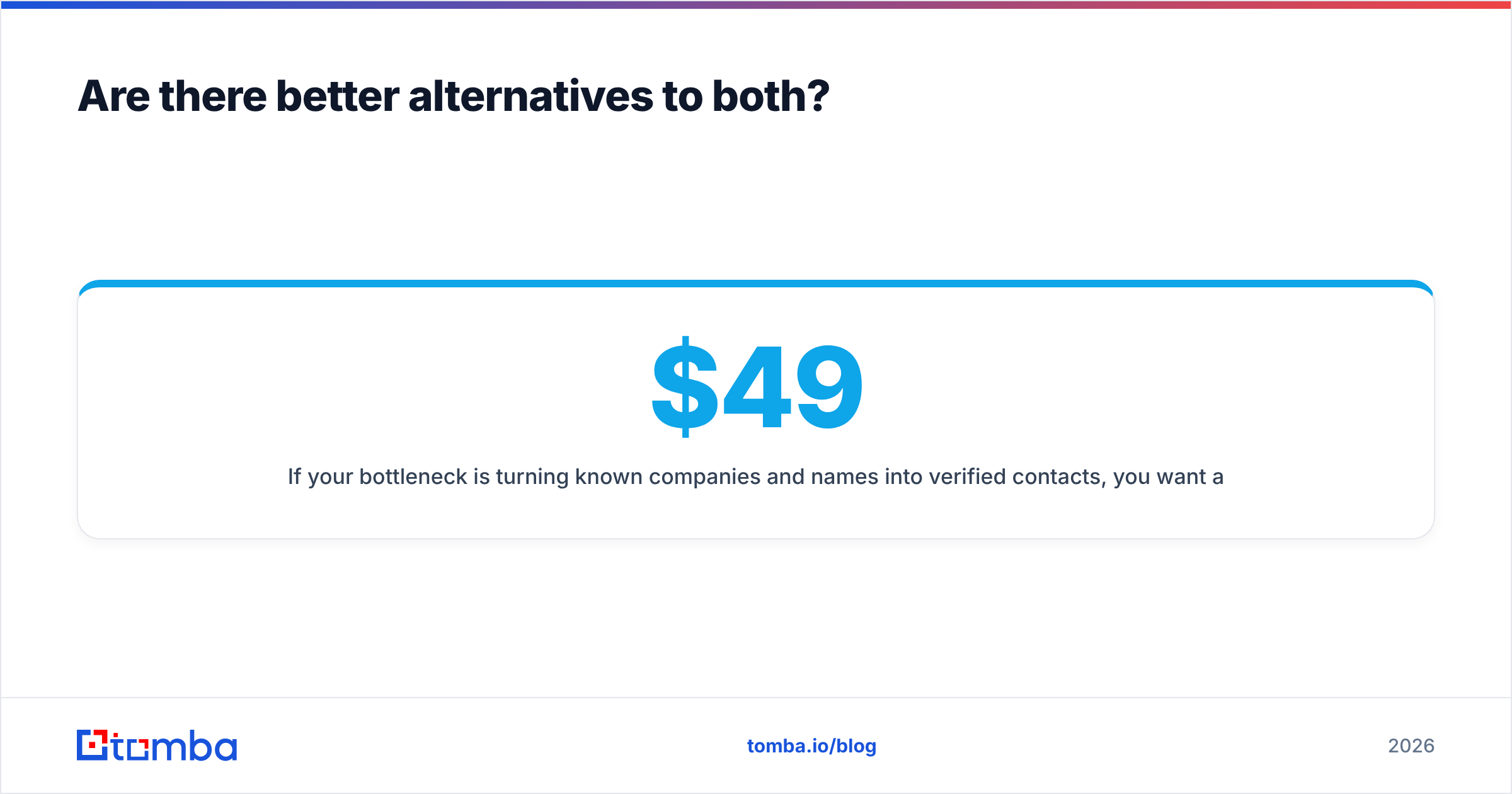
If your bottleneck is turning known companies and names into verified contacts, you want an API-first stack, not a platform. That is where Tomba fits. Use domain search to pull every public email pattern on a target company, the email finder to resolve a specific first name, last name, and domain into a verified address, and the Tomba API to run all of it inside your own workflow, CRM, or enrichment job. Tomba pricing starts with a free tier at 25 searches per month, then $49/mo Starter, $99/mo Growth, and $249/mo Pro, with no per-seat charge and no annual commitment.
If you want all three, run them in layers: a database for discovery, an independent verifier before every send, and an API for continuous enrichment of inbound. Most teams that complain about data quality are actually running one layer and expecting three layers of results.
So which should you choose in 2026?#
Choose Lead411 if intent data changes what your reps do. If a funding-round trigger genuinely reroutes a rep's day, the seat cost is earned. If nobody on your team will look at the intent dashboard after week three, you are paying for a feature as decoration.
Choose Leadsforge if speed and zero commitment matter more than depth. It is a good first data tool and a bad only data tool — validate coverage in your specific vertical before you scale spend.
Choose an API-first tool if your real workload is enrichment at volume, if more than three people need data but only one person needs a login, or if you would rather own the workflow than rent a dashboard.
Whatever you pick, run the 250-contact bake-off before signing anything annual. Two afternoons of testing will tell you more than every comparison article on the internet, including this one.
Ready to test data quality with your own list? Start with the Tomba Email Finder — 25 free searches a month, no card, no demo call. Drop in the same 250 target contacts you are testing against Lead411 and Leadsforge, compare the verified-valid rate side by side, and let the bounce numbers pick your vendor for you.
Related guides#
// get started
Find, verify and enrich your first contacts today
Start on the free plan with 25 searches a month, then scale when your team is ready.
Free plan · No credit card required · GDPR & CCPA
// about the author