Lead411 vs LeadsGorilla 2026: Which Lead Tool Wins?
Lead411 sells verified B2B contact data with intent signals. LeadsGorilla hunts local businesses with weak online presence. They solve different problems, and only one belongs in most outbound stacks.
TL;DR
- They are not competitors. Lead411 is a B2B sales intelligence database with verified emails, direct dials, and intent data. LeadsGorilla is a local lead-generation app that scores small businesses on their online presence so agencies can pitch them.
- Pick Lead411 if you sell software or services to companies with named buyers and you need contact data plus buying signals inside a CRM workflow.
- Pick LeadsGorilla if you run a marketing agency selling websites, SEO, or ads to restaurants, dentists, and gyms, and your bottleneck is finding businesses with bad Google profiles.
- Both have the same weak spot: the contact layer. Lead411 locks unlimited exports behind annual seats; LeadsGorilla surfaces generic
info@addresses that bounce or route to nobody. - Cheapest fix: keep whichever prospecting layer fits your motion, then attach a dedicated finder and verifier per contact instead of paying seat prices for records you will never touch.
What is Lead411, exactly?#
Lead411 is a B2B contact database. You search by company attributes (industry, headcount, revenue, tech stack, location) or by person attributes (title, seniority, department), and it returns work emails, mobile numbers, and company firmographics. Its differentiator versus older databases is Bombora-powered intent data plus growth triggers: funding rounds, hiring spikes, IPO filings, and executive changes that tell you a company might be in-market right now.
The platform is aimed at SDR teams and demand-gen marketers. It pushes data into Salesforce, HubSpot, Outreach, and Salesloft, and it ships a Chrome extension for LinkedIn and company sites. The headline commercial promise is "unlimited" exports on the main tier, which is the pitch that pulls buyers away from ZoomInfo and Apollo. Check the current terms on lead411.com before you sign, because "unlimited" has always carried a fair-use ceiling and the seat minimum moves.
What is LeadsGorilla, exactly?#
LeadsGorilla is a different species. It is a desktop-style web app sold mostly as a one-time license to marketing agencies and freelancers. You type a niche and a city ("dentists in Austin"), and it pulls business listings from Google Maps, Facebook, and Yelp-style sources, then scores each one on how bad their digital presence is: no website, unclaimed Google Business Profile, no Facebook pixel, missing reviews, non-mobile-friendly site, poor SEO signals.
That score is the product. LeadsGorilla then generates a white-labeled PDF audit report you can attach to a cold email, plus templated outreach copy. It is a "find the weakest business in town and show them the receipt" machine. You can see the current feature set at leadsgorilla.io.
So the honest framing of Lead411 vs LeadsGorilla is not "which database is bigger." It is: are you selling to enterprises with org charts, or to Main Street businesses with one owner and a broken website?

How do Lead411 and LeadsGorilla compare head-to-head?#
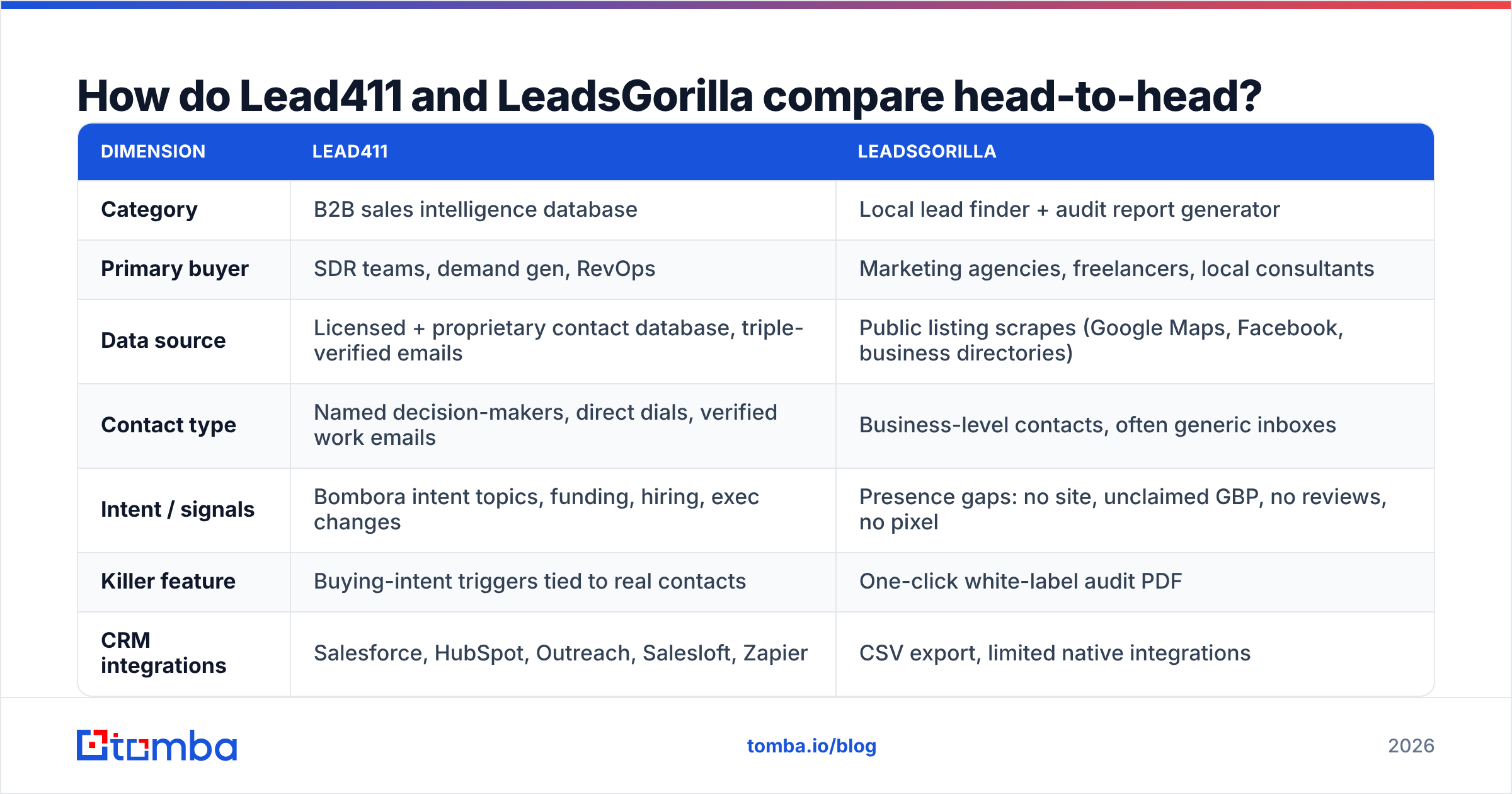
| Dimension | Lead411 | LeadsGorilla |
|---|---|---|
| Category | B2B sales intelligence database | Local lead finder + audit report generator |
| Primary buyer | SDR teams, demand gen, RevOps | Marketing agencies, freelancers, local consultants |
| Data source | Licensed + proprietary contact database, triple-verified emails | Public listing scrapes (Google Maps, Facebook, business directories) |
| Contact type | Named decision-makers, direct dials, verified work emails | Business-level contacts, often generic inboxes |
| Intent / signals | Bombora intent topics, funding, hiring, exec changes | Presence gaps: no site, unclaimed GBP, no reviews, no pixel |
| Killer feature | Buying-intent triggers tied to real contacts | One-click white-label audit PDF |
| CRM integrations | Salesforce, HubSpot, Outreach, Salesloft, Zapier | CSV export, limited native integrations |
| Pricing model | Per-seat subscription, annual commitment typical | One-time license with upsells, plus agency tiers |
| Learning curve | Moderate (filters, credits, CRM mapping) | Low (search a niche, export, send) |
| Best-fit deal size | $5k–$250k ACV B2B | $300–$3k/mo local retainers |
The table makes the split obvious. Lead411 is infrastructure for a sales org. LeadsGorilla is a prospecting hack for a small agency. Buying the wrong one is not a marginal mistake, it is a total mismatch.
Which one has better data accuracy?#
Lead411, and it is not close for named-contact accuracy. Lead411 runs a verification layer over its email records and publishes accuracy claims in the 93–96% range for its verified set. Independent reviews on G2 tend to back the direction of that claim while noting the usual database reality: coverage is excellent for US mid-market tech and thinner for EMEA, SMB services, and non-English markets.
LeadsGorilla is not really trying to win on contact accuracy. It harvests whatever contact is publicly listed, which in practice means:
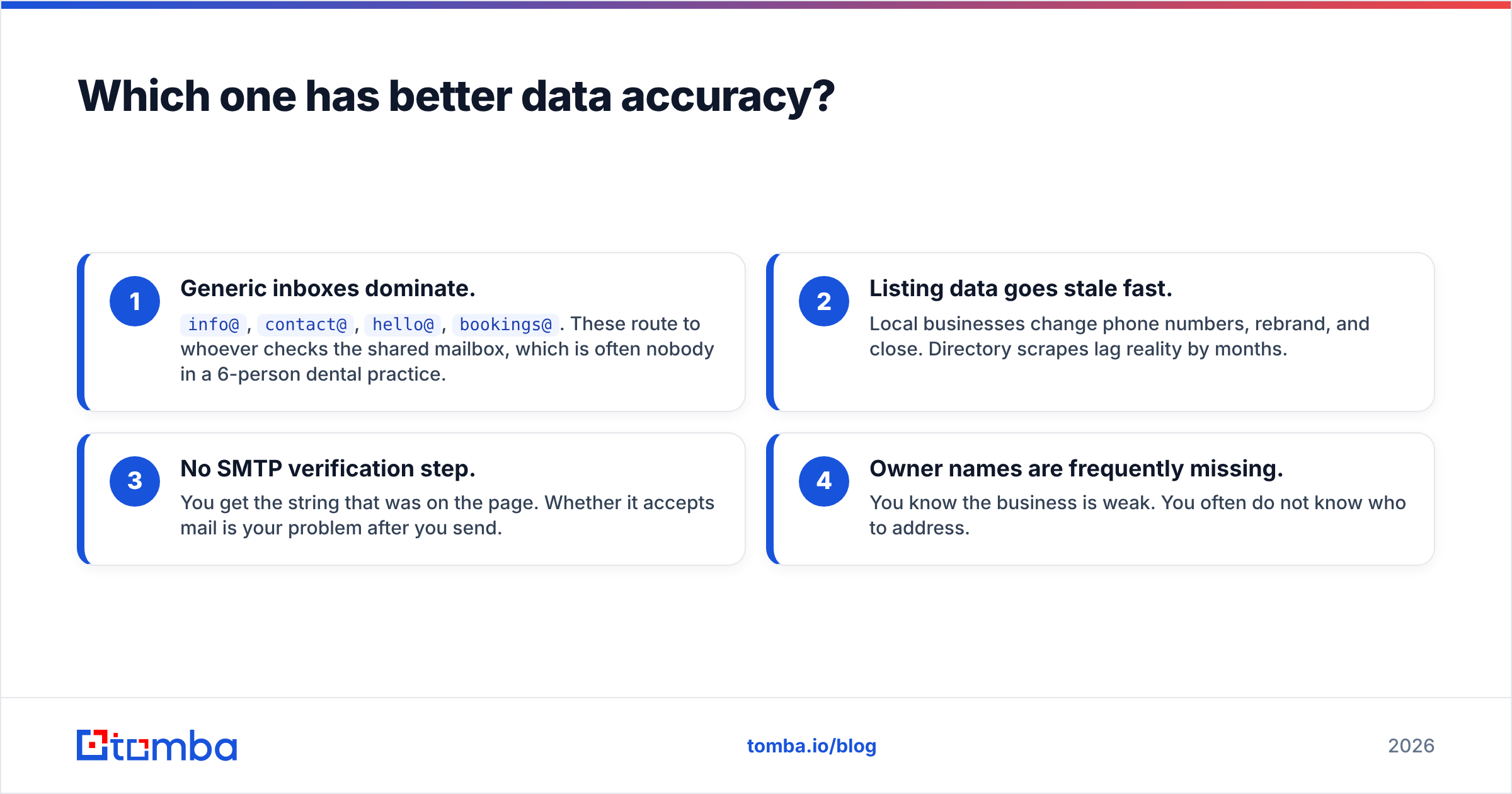
- Generic inboxes dominate.
info@,contact@,hello@,bookings@. These route to whoever checks the shared mailbox, which is often nobody in a 6-person dental practice. - Listing data goes stale fast. Local businesses change phone numbers, rebrand, and close. Directory scrapes lag reality by months.
- No SMTP verification step. You get the string that was on the page. Whether it accepts mail is your problem after you send.
- Owner names are frequently missing. You know the business is weak. You often do not know who to address.
That last point is the expensive one. A cold email to info@smilebrightdental.com addressed to "Hi there" converts at a fraction of one addressed to the practice owner by name. If you run LeadsGorilla, you still need a way to turn a domain into a named human, which is exactly what a domain search does: feed it smilebrightdental.com, get back the people and the company's email pattern.
Before either list touches your sending domain, run it through an email verifier. Bounce rate is the single fastest way to destroy a new sending domain, and scraped local data is the highest-bounce input you can feed a sequencer.
How does pricing really work for each?#
Pricing is where most buyers get surprised, so read the structure, not the sticker.
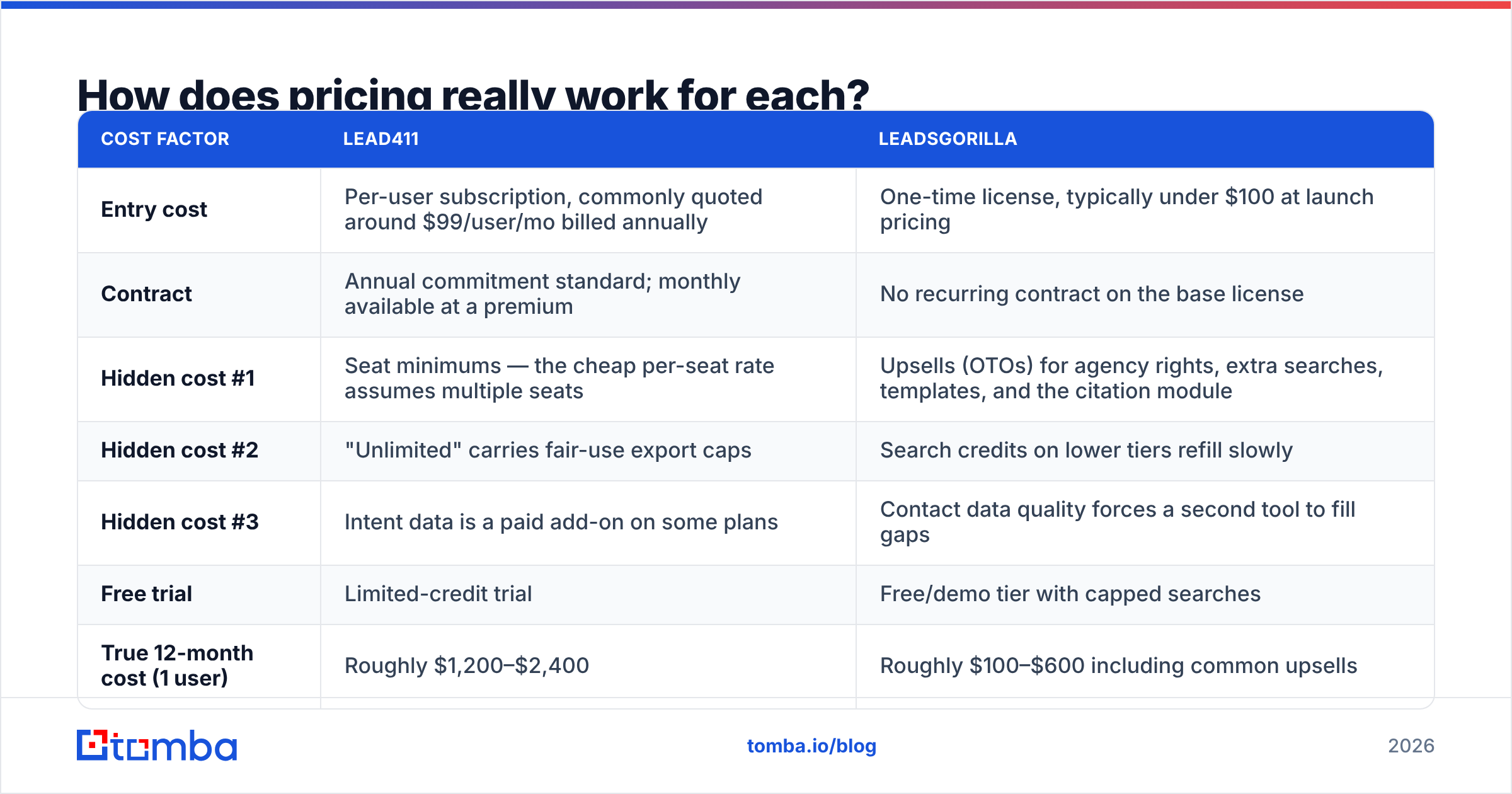
| Cost factor | Lead411 | LeadsGorilla |
|---|---|---|
| Entry cost | Per-user subscription, commonly quoted around $99/user/mo billed annually | One-time license, typically under $100 at launch pricing |
| Contract | Annual commitment standard; monthly available at a premium | No recurring contract on the base license |
| Hidden cost #1 | Seat minimums — the cheap per-seat rate assumes multiple seats | Upsells (OTOs) for agency rights, extra searches, templates, and the citation module |
| Hidden cost #2 | "Unlimited" carries fair-use export caps | Search credits on lower tiers refill slowly |
| Hidden cost #3 | Intent data is a paid add-on on some plans | Contact data quality forces a second tool to fill gaps |
| Free trial | Limited-credit trial | Free/demo tier with capped searches |
| True 12-month cost (1 user) | Roughly $1,200–$2,400 | Roughly $100–$600 including common upsells |
Do not read that bottom row as "LeadsGorilla is 10x cheaper." It is 10x cheaper at a completely different job. The relevant comparison is cost per usable, named, deliverable contact — and on that metric, a cheap tool that hands you 2,000 unverified generic inboxes can easily cost more than a database that hands you 200 verified decision-makers, once you price in the burned domain and the SDR hours.
For reference on what a pure contact layer costs when you unbundle it from the prospecting UI: Tomba pricing starts with a free tier at 25 searches/month, Starter at $49/mo, Growth at $99/mo, and Pro at $249/mo, with no per-seat minimum. That gives you a clean benchmark for judging whether a bundled platform's seat price is actually buying you data or buying you UI.
Who should choose Lead411?#
Choose Lead411 if three things are true:
- You sell to named buyers inside companies. VP of Engineering, Head of RevOps, CFO. Titles matter in your ICP, and you filter on them.
- Timing changes your win rate. Intent topics and funding triggers are Lead411's real moat. If your product is bought reactively (after a funding round, after a hiring spike, after a compliance deadline), those signals are worth the seat price on their own.
- Data has to land in a CRM, not a spreadsheet. Lead411's Salesforce and HubSpot sync is the difference between a database and a workflow. If your team lives in Outreach or Salesloft, the push matters more than the raw record count.
Where Lead411 disappoints: international coverage outside North America, SMB and local-services coverage, and the annual-contract lock-in that leaves you paying for eleven more months after your team decides they prefer something else. If that lock-in is the dealbreaker, the honest move is to compare it against per-credit tools rather than against other enterprise databases — the same logic behind most Apollo alternatives evaluations.

Who should choose LeadsGorilla?#
Choose LeadsGorilla if you are running a local marketing agency and your offer is "your online presence is broken and I will fix it." Specifically:
- Your ICP is a business, not a person. You do not care whether you reach the owner or the manager, you just need someone with the checkbook.
- Your pitch is audit-led. The white-label PDF report is the actual product here. It turns a cold email into a consultation, and it is genuinely faster than building audits by hand in Looker Studio.
- You need volume in a defined geography. "Every roofer in three counties" is a query LeadsGorilla answers well and Lead411 answers badly.
- You want to avoid recurring software cost. The one-time license model is real, and for a solo operator that matters more than data depth.
Where LeadsGorilla disappoints: the contact layer, the integrations, and the fact that the audit templates are used by thousands of other agencies, so prospects in competitive niches have seen your exact PDF before.
What does a better stack look like for each motion?#
Neither tool is complete on its own. The pattern that works is: use the prospecting tool for targeting, use a dedicated contact tool for reachability.
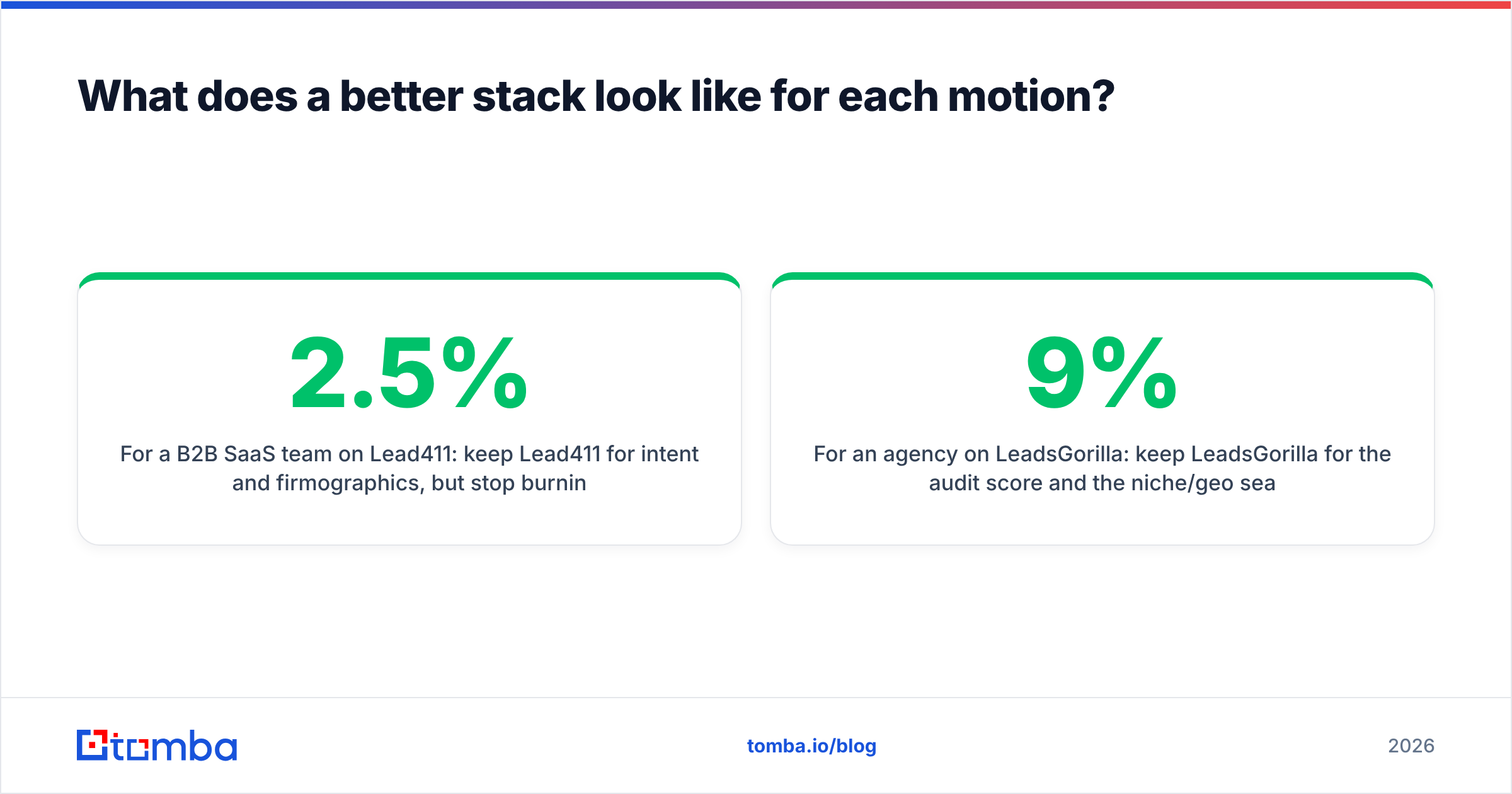
For a B2B SaaS team on Lead411: keep Lead411 for intent and firmographics, but stop burning "unlimited" seats on contact records you can source per-credit. Pull the account list, then resolve contacts through an email finder at the moment of outreach so you are paying for data you actually send to, not data sitting in a CRM decaying at 2.5% per month.
For an agency on LeadsGorilla: keep LeadsGorilla for the audit score and the niche/geo search, then enrich the domain list. Run the exported domains through a bulk email finder to get owner-level contacts instead of info@, verify the results, and only then load the sequencer. That one step typically moves a local campaign from a 6–9% bounce rate into the sub-2% range where inbox providers stop punishing you.
If you are building this into a repeatable process rather than doing it by hand, the Tomba API does the same job programmatically: domain in, verified contacts out, straight into whatever list your sequencer reads from.
Frequently asked questions#
Is LeadsGorilla a Lead411 alternative? No. If someone recommended LeadsGorilla as a cheaper Lead411, they misunderstood one of the two. LeadsGorilla cannot filter by job title across a national database; Lead411 cannot tell you which bakery in Tulsa has an unclaimed Google Business Profile.
Does Lead411 really offer unlimited exports? It advertises unlimited on its main tier, subject to fair-use limits documented in the contract. Ask for the specific monthly export ceiling in writing before you sign an annual deal.
Is LeadsGorilla's data GDPR-safe? Public business listing data carries different risk than personal contact data, but "publicly listed" is not the same as "lawful to email at scale" in the EU and UK. If you prospect into Europe, get the legal basis right before you scale either tool.
Can I use both? Yes, if you run two motions — an enterprise SaaS line and a local services line. Most teams do not, and paying for both is usually a sign the ICP is not defined.
The bottom line#
Lead411 wins for B2B teams selling to named buyers who need intent signals and CRM-native workflow. LeadsGorilla wins for local agencies whose entire pitch is a presence audit. The comparison only feels close if you have not written down who you sell to.
Whichever side you land on, the contact layer is the part that decides whether your sequences land or bounce — and it is the part both tools treat as an afterthought. Start with the Tomba Email Finder on the free tier (25 searches/month, no card), run one of your existing exported lists through it, and compare the verified hit rate against what your current platform handed you. If the gap is what it usually is, you just found the cheapest upgrade in your stack.
Related guides#
// get started
Find, verify and enrich your first contacts today
Start on the free plan with 25 searches a month, then scale when your team is ready.
Free plan · No credit card required · GDPR & CCPA
Get the Tomba newsletter
Product and data updates
// about the author