Lead411 vs LeadzenAI (2026): Which B2B Data Tool Wins?
Lead411 sells verified US direct dials and intent data. LeadzenAI sells AI-driven real-time lookups at a fraction of the price. Here's which one actually fits your outbound motion in 2026 — and where both fall short.
TL;DR
- Lead411 is a US-centric sales intelligence platform: verified emails, direct dials, Bombora-powered intent data, and hiring/funding triggers. It's priced per seat, usually with an annual commitment.
- LeadzenAI is an AI-first lead discovery tool built in India, strongest on APAC and India coverage, with real-time lookups, image/name/phone search, and credit pricing that undercuts most US vendors.
- Pick Lead411 if you sell into North America and need direct dials plus intent signals in one subscription. Pick LeadzenAI if you sell into India/APAC, want a low monthly floor, or need on-demand enrichment without a seat contract.
- Neither is a great fit if your only real need is finding and verifying work emails at volume — that's where a dedicated email finder at $49/mo beats a $1,200/year intelligence seat.
- Whatever you buy, run a 50-contact bounce test against your own ICP before signing. Vendor-published accuracy numbers are marketing, not measurement.
What are Lead411 and LeadzenAI?#
Think of these two as a stocked warehouse versus a same-day courier. Lead411 keeps a large, pre-verified inventory of US business contacts on the shelf and sells you access to it. LeadzenAI runs out to fetch the record when you ask for it, assembling data in real time from public and partner sources.
Lead411 has been around since 2001 and positions itself as a sales intelligence suite rather than a contact list. Its pitch is triple-verified emails, mobile direct dials, and buying-intent signals in a single subscription, with a Chrome extension and CRM push into Salesforce, HubSpot, and Pipedrive. Its natural buyer is a mid-market SDR team running phone-plus-email sequences into US accounts.
LeadzenAI is younger and built around AI-assisted discovery. Instead of browsing a static database, you feed it a name, a domain, a phone number, or even a LinkedIn profile, and it returns an enriched contact record on demand. It sells in credits with a low entry price, which makes it popular with founders, agencies, and SMB teams — particularly in India and Southeast Asia, where US-built databases are famously thin.
Both tools claim to do "B2B contact data." They are not solving the same problem.
How do Lead411 and LeadzenAI compare head-to-head?#
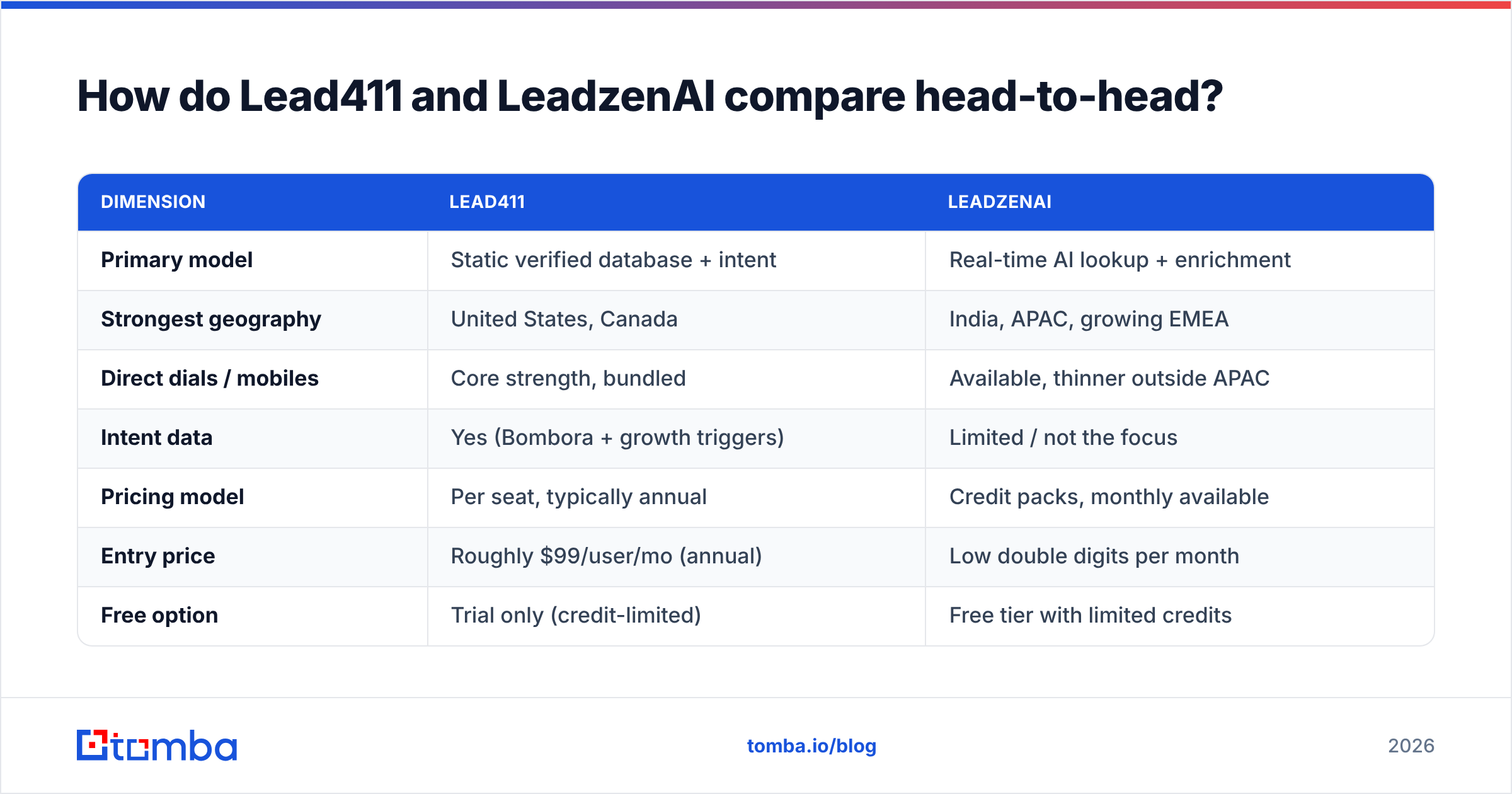
Here's the practical breakdown before we get into the nuance:
| Dimension | Lead411 | LeadzenAI |
|---|---|---|
| Primary model | Static verified database + intent | Real-time AI lookup + enrichment |
| Strongest geography | United States, Canada | India, APAC, growing EMEA |
| Direct dials / mobiles | Core strength, bundled | Available, thinner outside APAC |
| Intent data | Yes (Bombora + growth triggers) | Limited / not the focus |
| Pricing model | Per seat, typically annual | Credit packs, monthly available |
| Entry price | Roughly $99/user/mo (annual) | Low double digits per month |
| Free option | Trial only (credit-limited) | Free tier with limited credits |
| Bulk export | Capped by plan, export limits apply | Credit-metered |
| API access | Available on higher tiers | Available, developer-friendly |
| Best fit | US mid-market SDR teams | India/APAC prospecting, SMB, agencies |
Prices shift and both vendors negotiate, so treat those figures as a starting point and confirm on their own pricing pages. The structural differences — geography, intent, and pricing model — are what actually matter, and those don't change quarter to quarter.
Which tool has better data accuracy?#
Accuracy is the only spec that matters, and it's the one every vendor inflates.
Lead411 markets a "triple verification" process and a high deliverability claim on US records. In practice, teams selling into North American mid-market and enterprise accounts report solid results on corporate emails and genuinely useful mobile numbers — the direct dials are the reason most customers stay. Where it degrades is exactly where you'd expect: non-US SMBs, recently-changed roles, and companies under about 20 employees. Independent reviews on G2 repeat the same two themes — good phone data, occasional stale titles.
LeadzenAI's real-time model has the opposite failure profile. Because records are assembled at request time, you're less likely to get a contact who left the company 14 months ago. But real-time assembly also means variance: the same query can return a rich record for one prospect and a bare name for the next, and the confidence signals matter more than the raw hit rate. On Indian and APAC companies it routinely finds contacts that US-built databases simply don't carry.

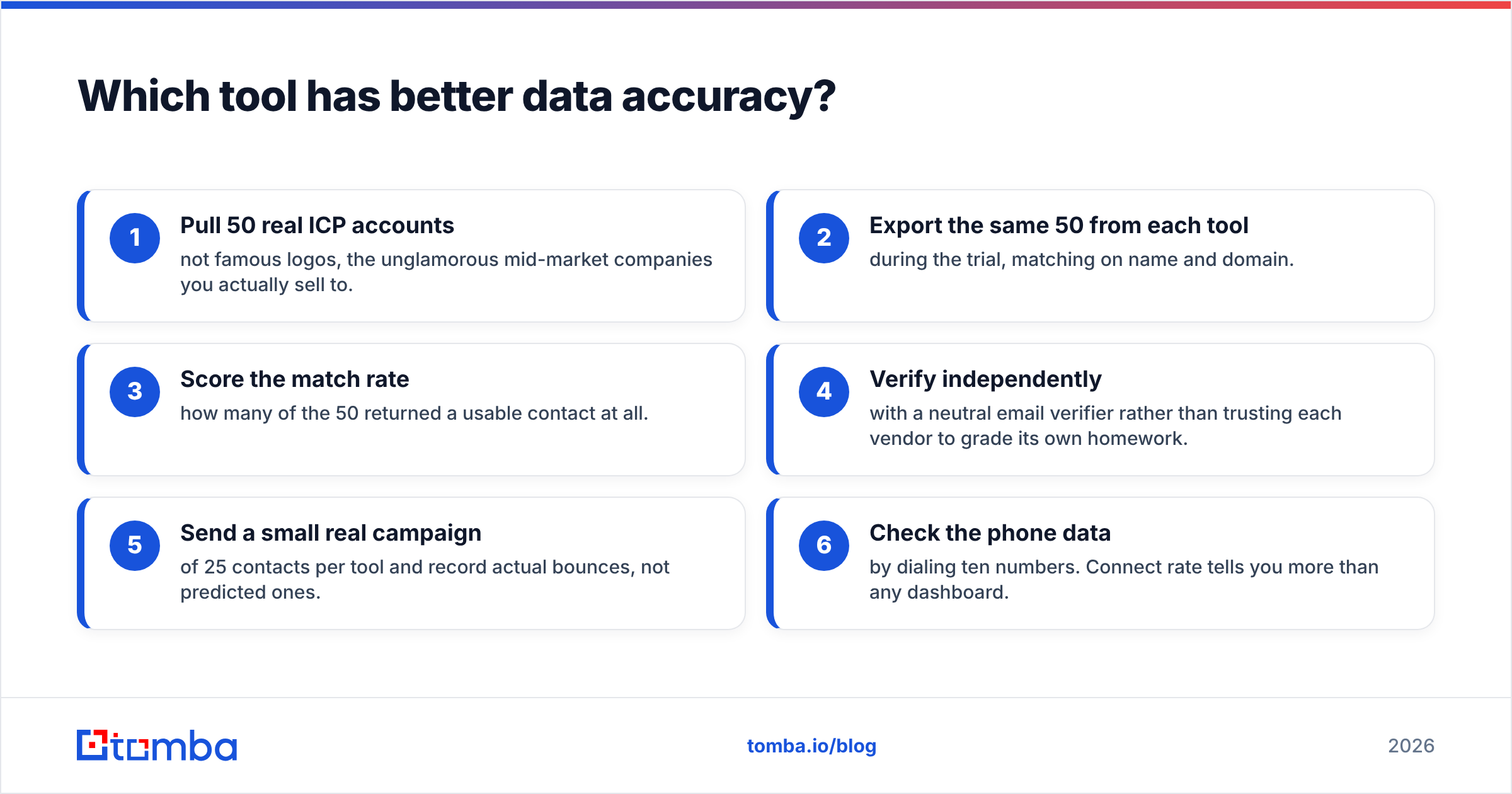
The honest answer: neither vendor's published accuracy number will predict your bounce rate, because accuracy is ICP-dependent. A tool that's 94% accurate on Fortune 5000 US software companies can be 60% accurate on 30-person Indian logistics firms. Run your own test:
- Pull 50 real ICP accounts — not famous logos, the unglamorous mid-market companies you actually sell to.
- Export the same 50 from each tool during the trial, matching on name and domain.
- Score the match rate — how many of the 50 returned a usable contact at all.
- Verify independently with a neutral email verifier rather than trusting each vendor to grade its own homework.
- Send a small real campaign of 25 contacts per tool and record actual bounces, not predicted ones.
- Check the phone data by dialing ten numbers. Connect rate tells you more than any dashboard.
That five-hour exercise is worth more than every comparison article on the internet, including this one.
How does pricing actually compare?#
Lead411 and LeadzenAI don't just charge different amounts — they charge in different shapes, and the shape is what bites you.
Lead411 prices per seat, and its most-quoted plan sits around $99 per user per month billed annually, with "unlimited" view limits that come with fair-use export caps. Add seats and the number scales linearly. A five-person SDR team is looking at roughly $6,000 a year before intent add-ons. What you get for that is a bundle: emails, mobiles, intent, triggers, and CRM sync in one subscription.
LeadzenAI prices in credits with a genuinely low floor and a free tier to start. That makes it attractive for spiky usage — a two-week list build, an agency project, an enrichment backfill. The tradeoff is that heavy, continuous usage can get expensive per record, and you're metering every lookup instead of browsing freely.
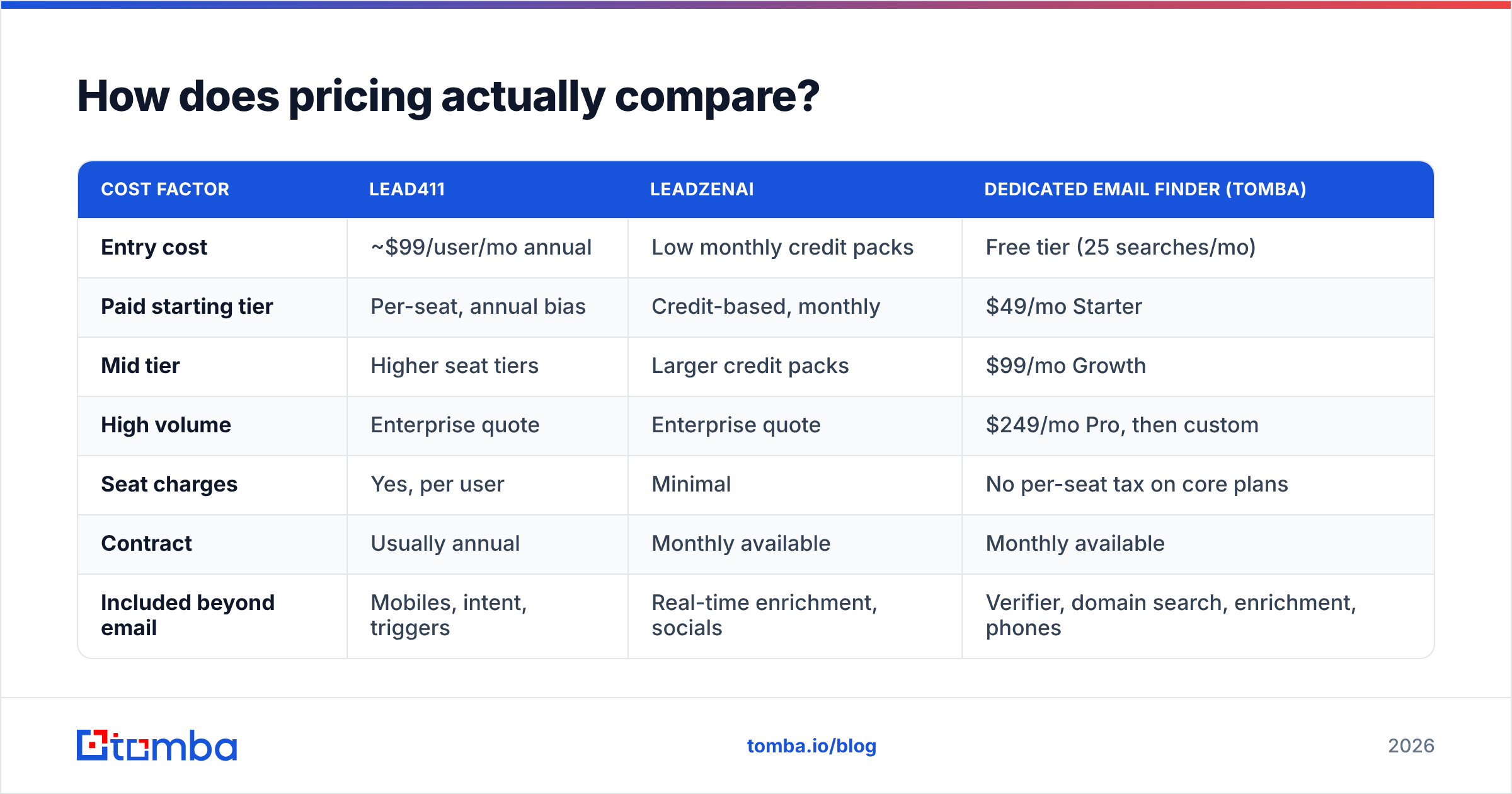
| Cost factor | Lead411 | LeadzenAI | Dedicated email finder (Tomba) |
|---|---|---|---|
| Entry cost | ~$99/user/mo annual | Low monthly credit packs | Free tier (25 searches/mo) |
| Paid starting tier | Per-seat, annual bias | Credit-based, monthly | $49/mo Starter |
| Mid tier | Higher seat tiers | Larger credit packs | $99/mo Growth |
| High volume | Enterprise quote | Enterprise quote | $249/mo Pro, then custom |
| Seat charges | Yes, per user | Minimal | No per-seat tax on core plans |
| Contract | Usually annual | Monthly available | Monthly available |
| Included beyond email | Mobiles, intent, triggers | Real-time enrichment, socials | Verifier, domain search, enrichment, phones |
The comparison isn't apples to apples on purpose. If you need intent data and direct dials, a $99/seat intelligence platform is a reasonable spend. If you've been buying one of these because you needed work emails and everything else came along for the ride, you're paying an intelligence premium for an email-finding job. Compare Tomba pricing against a five-seat Lead411 renewal and the math gets uncomfortable fast.

Who should choose Lead411?#
Buy Lead411 if three things are true at once:
- You sell into North America. This is where its database is deepest and where the direct dials justify the price.
- Your motion is phone-first or phone-heavy. Mobile numbers are the product. If your SDRs don't dial, you're paying for a feature you won't touch.
- You want intent in the same tool. Bombora topic surges and growth triggers (hiring, funding, tech installs) are bundled, which beats stitching a separate intent vendor into your stack.
Skip it if your team is under three people, if your ICP sits outside the US, or if your annual budget can't absorb a seat-based contract that renews whether you used it or not. The most common complaint isn't data quality — it's paying for seats that went quiet after a headcount change.
Who should choose LeadzenAI?#
Choose LeadzenAI when:
- Your market is India or APAC. This is the clearest reason to pick it. US-built databases have visible holes in these regions, and LeadzenAI fills them.
- Your usage is bursty. Credit pricing fits project work, agency retainers, and one-off list builds far better than annual seats.
- You want to start free. Getting real records out of a free tier before you spend anything is a genuine advantage over trial-gated competitors.
- You need flexible input types. Searching by phone, name, or profile URL rather than only by company is useful for reverse-engineering inbound leads.
Skip it if you need deep US enterprise coverage, if intent data is central to your territory planning, or if you need the kind of procurement paperwork (SOC 2 artifacts, MSAs, dedicated CSMs) that a large enterprise buyer typically demands.

What are the alternatives to both?#
Most teams comparing Lead411 vs LeadzenAI are really asking a budget question: what's the cheapest way to get contactable prospects into a sequence without burning my domain?
Three credible directions:
- Dedicated email finder + verifier. If email is the channel, buy the tool built for email. Tomba's email finder starts at $49/mo with a free tier at 25 searches, and pairs with a catch-all verifier for the domains that break most validation tools. You give up intent data; you keep most of your budget.
- Purchased verified lists. BookYourData takes a different path — pay-as-you-go, pre-verified B2B lists with a bounce guarantee and no subscription. For teams that want a clean list now rather than a seat to log into, it's a legitimate option and a well-regarded one.
- API-first enrichment. If you have an engineer, an email finder API plugged into your CRM removes the seat problem entirely. You enrich records at the moment they enter the pipeline instead of exporting CSVs from a UI nobody logs into.
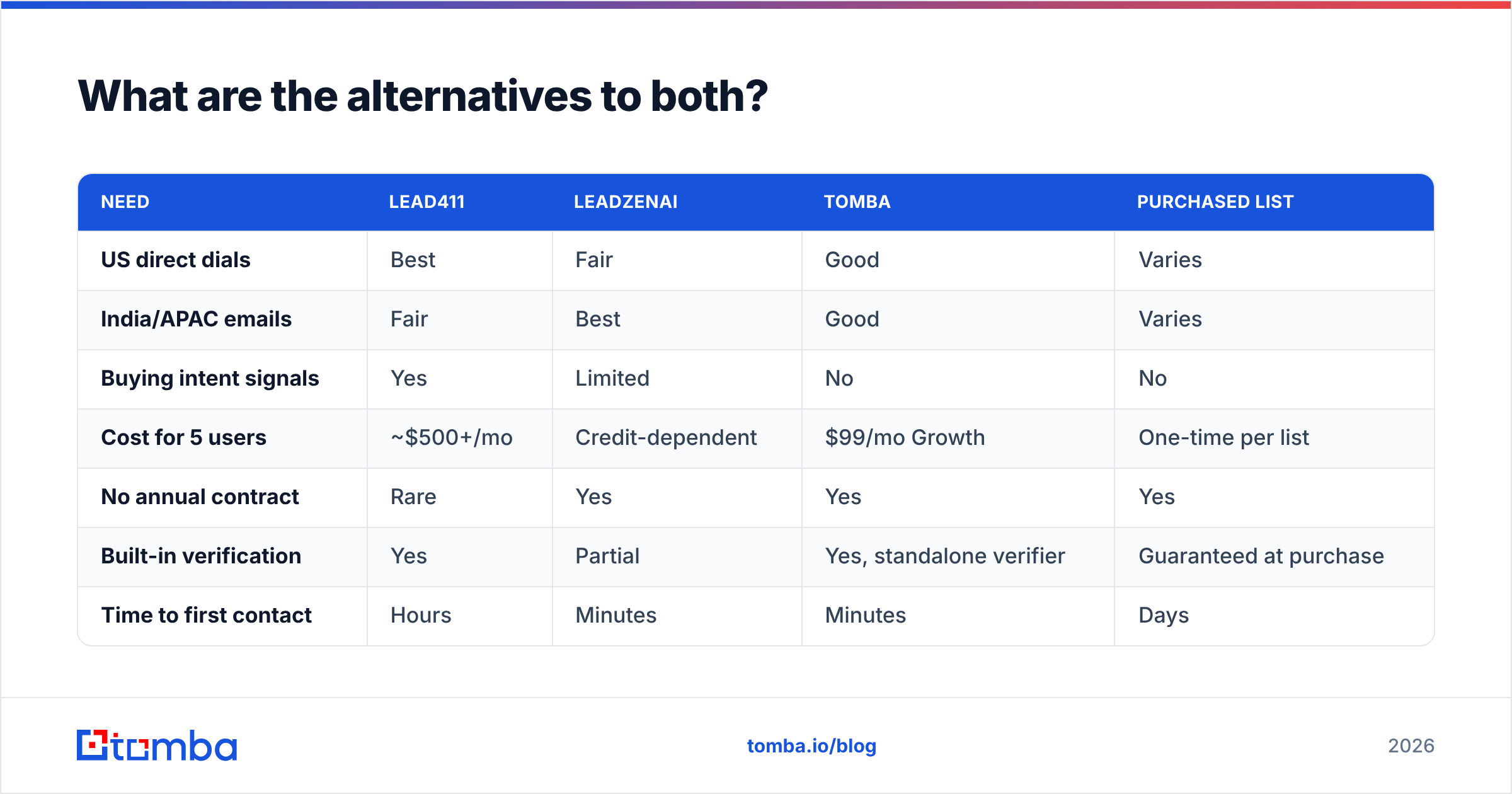
Here's how the categories stack up on the decisions that actually drive the purchase:
| Need | Lead411 | LeadzenAI | Tomba | Purchased list |
|---|---|---|---|---|
| US direct dials | Best | Fair | Good | Varies |
| India/APAC emails | Fair | Best | Good | Varies |
| Buying intent signals | Yes | Limited | No | No |
| Cost for 5 users | ~$500+/mo | Credit-dependent | $99/mo Growth | One-time per list |
| No annual contract | Rare | Yes | Yes | Yes |
| Built-in verification | Yes | Partial | Yes, standalone verifier | Guaranteed at purchase |
| Time to first contact | Hours | Minutes | Minutes | Days |
How do you avoid burning your domain with either tool?#
This is where most evaluations go wrong. Teams optimize for match rate and ignore what the extra matches cost them.
Every database — Lead411, LeadzenAI, or anything else — carries a slice of records that are technically real but functionally dead: catch-all domains that accept everything, shared inboxes, and people who left six months ago. Sequencing those at volume is how a healthy sending domain turns into a spam-folder resident in three weeks.
Four rules that hold regardless of vendor:
- Re-verify every export through a neutral verifier, even from a vendor that claims verification. Verification decays; a record validated 90 days ago is not validated today.
- Quarantine catch-alls into a separate, lower-volume segment instead of deleting or blasting them. A dedicated catch-all finder will tell you which domains those are.
- Cap daily sends per mailbox at a level your warmup and email deliverability setup can actually support. Data quality can't rescue a mailbox sending 400 cold emails a day.
- Track bounce rate per source. Tag records by vendor in your CRM. After 60 days you'll know which subscription is earning its renewal — and you'll have a real number to bring to the negotiation.
Do this and the Lead411 vs LeadzenAI question stops being a leap of faith. You'll have evidence.
So which one wins?#
There's no universal winner, and any article claiming one is selling something. Lead411 wins for US phone-first mid-market teams that need intent data bundled in. LeadzenAI wins for India/APAC coverage, bursty usage, and budget-constrained teams that want to start free. Those buyer profiles barely overlap, which is why both companies still exist.
The scenario neither wins is the most common one: a small outbound team that mostly needs accurate work emails, verified before send, at a price that doesn't require a procurement cycle.
If that's you, start with Tomba's Email Finder. Free tier gives you 25 searches a month to test against your own list, Starter is $49/mo, and the email verifier, domain search, and enrichment sit alongside it — no seat tax, no annual lock-in. Run your 50-contact bounce test against it at the same time you trial Lead411 and LeadzenAI, and let the bounce numbers pick the winner instead of the pricing page.
Related guides#
// get started
Find, verify and enrich your first contacts today
Start on the free plan with 25 searches a month, then scale when your team is ready.
Free plan · No credit card required · GDPR & CCPA
Get the Tomba newsletter
Product and data updates
// about the author