Lead411 vs LetsExtract: Which B2B Email Tool Wins in 2026?
One sells verified B2B contacts with intent data. The other scrapes addresses off web pages for a one-time fee. Here's how Lead411 and LetsExtract actually compare on accuracy, cost, and compliance risk.
Lead411 vs LetsExtract comes down to one question. Do you want verified B2B contacts, or a tool that scrapes addresses off the open web?
TL;DR
- These are not the same kind of product. Lead411 is a subscription B2B database with verified emails, direct dials, and Bombora intent data. LetsExtract is a Windows app you buy once. It scrapes email addresses out of web pages, search results, and local files.
- Lead411 wins on data quality and targeting. You filter by title, industry, headcount, tech stack, and growth signals, then push contacts to your CRM. LetsExtract has no filters. It returns any string that looks like an email.
- LetsExtract wins on upfront cost. A perpetual license costs less than two months of one Lead411 seat. That gap closes fast once you count bounces, domain damage, and cleanup hours.
Two more points decide most cases. Compliance is the real dividing line: Lead411 runs opt-out and suppression processes, while a scraper hands you the whole GDPR and CAN-SPAM burden. And most teams need neither extreme. A verified email finder with an API gives you targeted, deliverable addresses without a $1,200/year seat or a scraping liability.
What is Lead411?#
Lead411 is a B2B contact and company database. It launched in 2001 and targets sales and marketing teams doing outbound in North America. You search the database, apply filters, then export or sync the results.
What you actually get:
- Verified business emails and direct dials — Lead411 markets triple-verified emails and mobile numbers. That is its main pitch against cheap list vendors.
- Intent data through Bombora — see which accounts research your topic, so reps work warm accounts first.
- Growth and trigger alerts — funding rounds, hiring spikes, IPO activity, and leadership changes, routed straight into a sequence.
- Technographic and firmographic filters — search by installed tech, revenue band, employee count, SIC/NAICS, and location.
- Chrome extension and CRM sync — grab contacts while you browse LinkedIn, then push them to Salesforce, HubSpot, Pipedrive, or Outreach.
- "Unlimited" export plans — headline unlimited viewing and exporting, subject to fair-use caps in the plan terms.
Lead411 is seat-based SaaS. You pay per user per month, usually on an annual contract, and the data stays in their cloud. Check lead411.com for the current plan structure. It changes more often than most vendors.
What is LetsExtract?#
LetsExtract Email Studio is a Windows desktop app that harvests email addresses. It is a power tool, not a data provider. It owns no database. It collects addresses from the sources you point it at.
The product bundles three modules:
- Email Extractor — crawls websites, search results, local files (DOC, PDF, CSV, TXT), and connected mailboxes. It pulls out anything shaped like an email address.
- Email Verifier — runs syntax, MX, and SMTP checks on the harvested list to strip obvious dead addresses.
- Email Sender — a bulk mailer that sends through your own SMTP. This is where most deliverability trouble starts.
Licensing is a one-time purchase per edition (Lite, Pro, Business). There is no subscription. See letsextract.com for current edition pricing and feature splits.
The structural point is simple. LetsExtract gives you volume without targeting. Point it at 5,000 URLs and you will get thousands of addresses. Most will be info@, sales@, support@, and contact@. You will not know who owns them, what they do, or whether the company fits your ICP.

Lead411 vs LetsExtract: how do they compare head-to-head?#
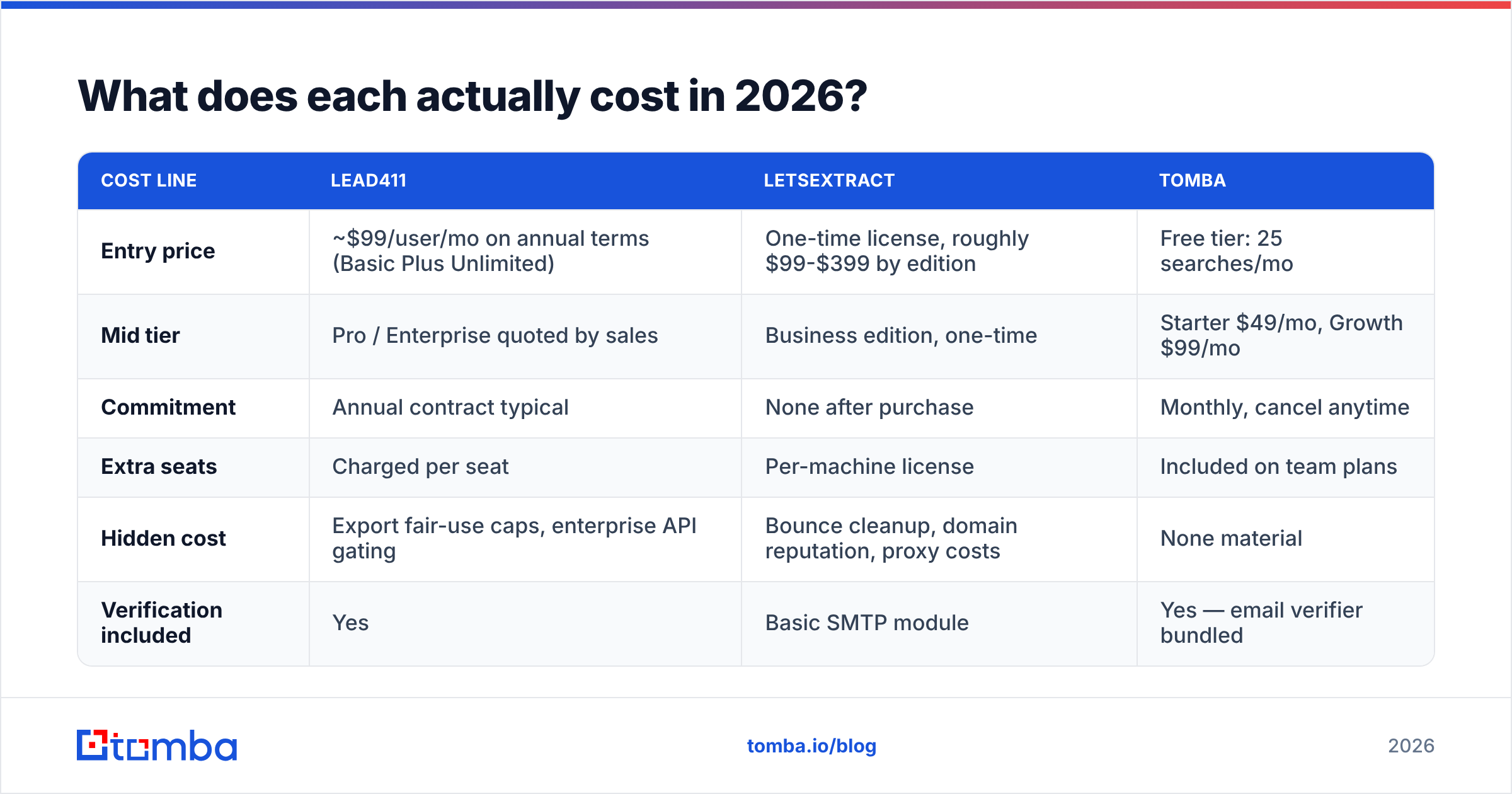
| Attribute | Lead411 | LetsExtract |
|---|---|---|
| Product type | Cloud B2B sales-intelligence database | Windows desktop extraction + mailer |
| Data source | Licensed, curated, human + automated verification | Whatever you scrape, live |
| Pricing model | Per seat, per month, annual contract | One-time perpetual license per edition |
| Contact targeting | Title, seniority, department, industry, revenue, headcount, tech stack | None — URL/keyword scope only |
| Direct dials / mobiles | Yes | No |
| Intent data | Yes (Bombora) | No |
| Typical output | Named person + role + verified email | Role-based catch-all addresses |
| Verification | Built into the database refresh cycle | SMTP check module, run manually |
| CRM integration | Salesforce, HubSpot, Pipedrive, Outreach, Zapier | CSV export only |
| API | Yes (enterprise-tier) | No public API |
| Platform | Browser + Chrome extension | Windows desktop only (no macOS) |
| Compliance posture | Documented opt-out / suppression process | Entirely your responsibility |
| Best fit | AE/SDR teams selling into defined ICPs | Bulk address harvesting, research, local file mining |
Read that table once and the decision usually makes itself. If your outbound depends on reaching a specific person in a specific role, LetsExtract cannot get you there. It does not model people, only strings. If you just need a big pile of generic addresses, Lead411 is an expensive way to get them.

Which one produces more accurate data?#
Lead411, by a wide margin. There are caveats worth knowing.
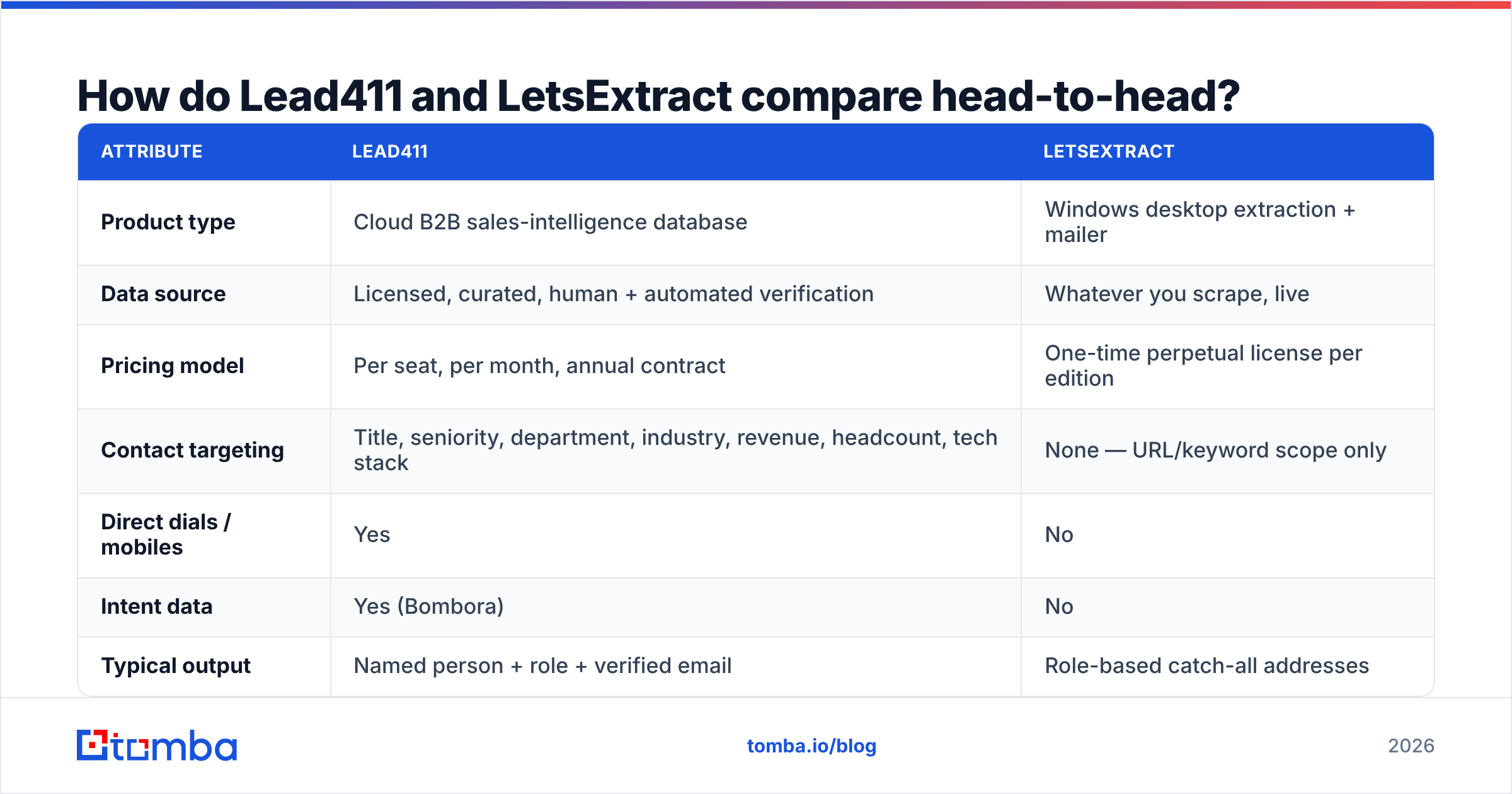
Lead411's advantage is structural. Records are maintained, re-verified on a cycle, and tied to a company profile. Review data on G2 puts its data quality above budget list vendors. The usual complaints still apply. Coverage thins out outside the US and in mid-market SaaS, and some records go stale between refreshes. No database escapes that. B2B contact data decays about 2-3% per month as people change jobs.
LetsExtract has a different problem, and it is harder to fix. The tool does its job well. It finds text that looks like an email address. The failure is upstream. A published address on a website is usually a role inbox, a spam trap, or a dead contact nobody removed from the footer. Its SMTP verifier catches hard-dead mailboxes. It cannot tell you that jobs@acme.com will never reach a buyer. It also cannot resolve catch-all domains, and that is where scraped lists hide their worst addresses. That is why a catch-all verifier is a separate discipline from basic SMTP checking.

The practical rule: scraped lists bounce at 20-40% before any filtering. Google and Microsoft treat sustained bounce rates above 2-3% as a spam signal. One 10,000-address scraped send can cost you months of sender reputation repair. The license was cheap. The recovery is not.

What does each actually cost in 2026?#
| Cost line | Lead411 | LetsExtract | Tomba |
|---|---|---|---|
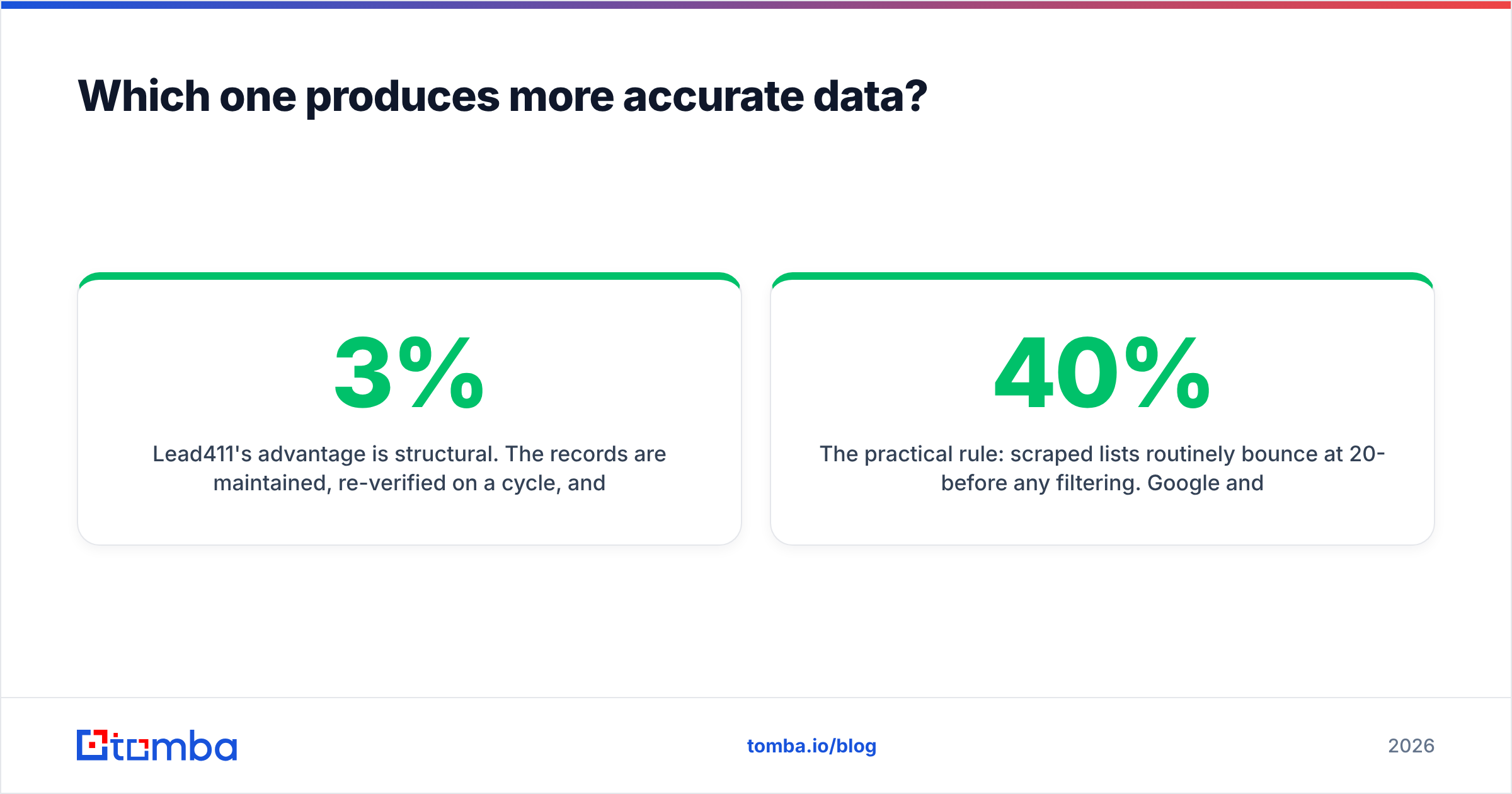
| Entry price | ~$99/user/mo on annual terms (Basic Plus Unlimited) | One-time license, roughly $99-$399 by edition | Free tier: 25 searches/mo |
| Mid tier | Pro / Enterprise quoted by sales | Business edition, one-time | Starter $49/mo, Growth $99/mo |
| Commitment | Annual contract typical | None after purchase | Monthly, cancel anytime |
| Extra seats | Charged per seat | Per-machine license | Included on team plans |
| Hidden cost | Export fair-use caps, enterprise API gating | Bounce cleanup, domain reputation, proxy costs | None material |
| Verification included | Yes | Basic SMTP module | Yes — email verifier bundled |
Always check the vendor's live pricing page before you budget. Both have changed tiers in the last year. Full Tomba pricing is public and needs no sales call.
Here is the honest framing. LetsExtract's one-time fee looks unbeatable until you count the hours. Say you scrape 20,000 addresses. Deduplication, role-address stripping, catch-all handling, and re-verification take a full day at minimum. You still end up with maybe 4,000 usable addresses and no job titles. At a loaded SDR cost, that day is worth more than the license.
Lead411's price is honest but front-loaded. A four-person SDR team runs about $4,800 a year before intent add-ons. That is defensible if you push steady volume into a US-heavy ICP. It is hard to justify for a founder who sends 200 emails a month.
Is Lead411 or LetsExtract safer from a compliance standpoint?#
Lead411, clearly. But "safer" is not "safe."
Lead411 operates as a data broker with a stated collection method, an opt-out path, and suppression handling. That does not make your outbound GDPR-compliant on its own. It does give you a documented lawful-basis argument and a vendor to point to during a data subject access request.
LetsExtract moves all of that burden to you. Under GDPR, scraping business emails of identifiable people in the EU or UK counts as processing personal data. Article 14 then requires you to notify them. Under CAN-SPAM, harvesting addresses from websites is called out as an aggravating factor that raises penalties. Under CASL in Canada, the implied-consent carve-out for a published business address only covers messages relevant to that person's role. A mass blast is not.
If you sell into Europe or Canada, that gap is not academic. See the GDPR overview on Wikipedia for the baseline rules. "The tool made it easy" is not a defense.
Who should choose Lead411?#
Pick Lead411 if most of these are true:
- You sell into US and Canadian mid-market or enterprise accounts. That is where coverage runs deepest.
- You need direct dials. Cold calling is the strongest reason to pay database prices. LetsExtract offers no phone data at all.
- Intent signals change your prioritization. If reps would really work a Bombora surge list differently, you are buying something real. If not, you are paying for a dashboard nobody opens.
- You have 3+ seats and a CRM you live in. Native sync is where seat-based tools earn their keep.
- Your motion is account-based. Trigger alerts plus firmographic filters make ABM lists much faster to build.
Skip it if you are a solo founder, sell mostly outside North America, or send a few hundred targeted emails a month. The per-seat math does not work at that scale. Lighter Apollo alternatives and database tools are priced for smaller volume.
Who should choose LetsExtract?#
LetsExtract is a legitimate tool when the job is extraction rather than prospecting:
- Mining your own archives. Pulling contacts out of old local files, invoices, or exported mailboxes is exactly what it was built for. There is no compliance question about your own data.
- Market research and coverage mapping. Seeing which domains in a vertical publish contact addresses at all is useful reconnaissance.
- One-off technical scraping where you control the source and know who owns the addresses.
- Offline or air-gapped environments where a cloud database is not an option.
What it should not do is build a cold outbound list for the bundled sender. That workflow is how domains land on blacklists. To check where you stand today, run your sending domain through a blacklist checker first.
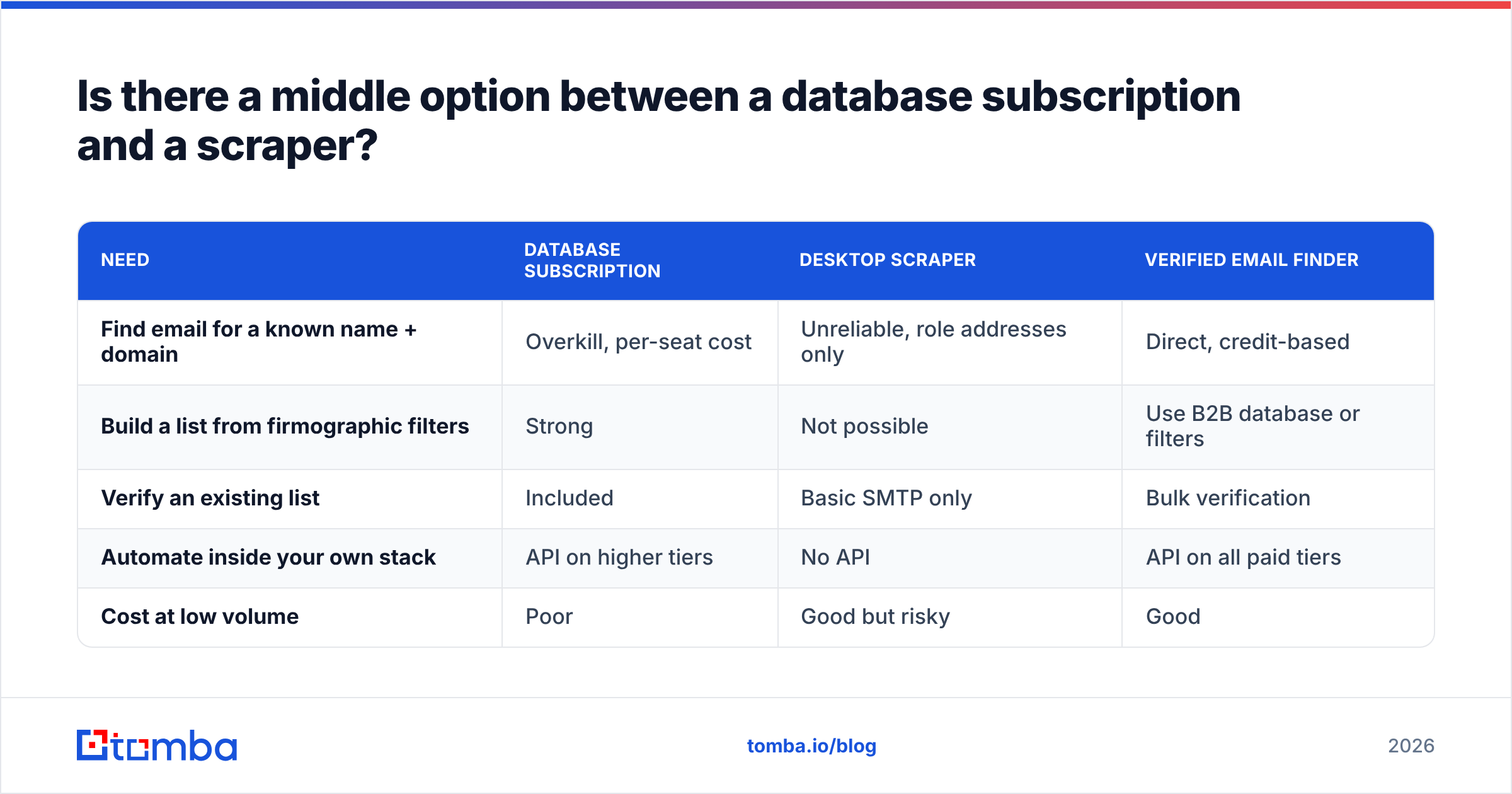
Is there a middle option between a database subscription and a scraper?#
Yes. For most teams it is the right answer.
Lead411 vs LetsExtract leaves one gap wide open. You often already know who you want to reach. You have a company list, a set of names from LinkedIn, or a target account list from marketing. You do not need to rent a whole database, and you should not scrape blind. You need one thing: a verified email address for a specific person at a specific company.
That is a lookup problem, and it is priced very differently:
| Need | Database subscription | Desktop scraper | Verified email finder |
|---|---|---|---|
| Find email for a known name + domain | Overkill, per-seat cost | Unreliable, role addresses only | Direct, credit-based |
| Build a list from firmographic filters | Strong | Not possible | Use B2B database or filters |
| Verify an existing list | Included | Basic SMTP only | Bulk verification |
| Automate inside your own stack | API on higher tiers | No API | API on all paid tiers |
| Cost at low volume | Poor | Good but risky | Good |
Tomba sits in that third column. The Tomba Email Finder turns a name and domain into a verified professional address. Domain search returns every public address pattern for a company. The bulk email finder handles list work with no desktop install. Verification runs on the same pipeline, so you do not pay two vendors for one job. The free tier is 25 searches a month, Starter is $49/mo, and Growth is $99/mo — the same sticker as one Lead411 seat, without the annual lock-in.
One honest limit: Tomba does not sell intent data or direct dials at Lead411's depth. It is not a replacement if intent-based account prioritization is core to your motion. Pick the tool that matches the job.
Lead411 vs LetsExtract: the verdict#
Lead411 wins on data quality, targeting, and compliance posture. LetsExtract wins on upfront cost, and nothing else that matters for outbound. If you run a funded SDR team into a US ICP, and you will really use intent signals and direct dials, Lead411 earns its seat price. If the one-time fee is what drew you to LetsExtract, price in the bounce rate first. That number usually ends the conversation.
And if you only need verified emails for people you have already named, you are shopping in the wrong category. Start with the Tomba Email Finder. You get 25 free searches a month, no contract, real-time verification on every result, and an API that drops into whatever you already run. Find the 200 people who matter instead of scraping 20,000 who don't.
Related guides#
// get started
Find, verify and enrich your first contacts today
Start on the free plan with 25 searches a month, then scale when your team is ready.
Free plan · No credit card required · GDPR & CCPA
// about the author