Lead411 vs LFBBD Lead For Business: Which B2B Data Wins?
One sells a sales-intelligence subscription with intent signals. The other sells B2B contact lists. We compare Lead411 vs LFBBD Lead For Business on accuracy, pricing, coverage, and who should actually buy each.
TL;DR
- Lead411 is a subscription sales-intelligence platform — verified emails, direct dials, Bombora-powered intent signals, and trigger alerts, priced per seat.
- LFBBD (Lead For Business B2B Database) is a list vendor — you buy a file of contacts filtered by industry, title, or geography, and you own the rows outright.
- The two solve different problems. Lead411 is for reps who prospect continuously. LFBBD is for teams that want a one-time volume drop into a sequencer or CRM.
- Accuracy is the deciding factor either way. A static list decays roughly 2–2.5% per month; an intent platform is only as good as its verification layer.
- A third path exists: pay only for the contacts you actually need via an API or on-demand lookup. That is where Tomba pricing at $49/mo Starter undercuts both models for teams under 5,000 lookups a month.
What is Lead411?#
Lead411 is a B2B sales-intelligence platform built around a contact database plus buyer-intent signals. It has been around since 2001, which makes it one of the older names in the category — older than Apollo, ZoomInfo's current incarnation, or most of the AI-first entrants.
The pitch is straightforward: you search a database of company and contact records, filter by firmographics and technographics, layer on intent topics sourced through Bombora, and export or push contacts into your CRM. Lead411 advertises "unlimited" exports on its main plan, which is unusual in a category where credit throttling is the norm.
What you actually get:
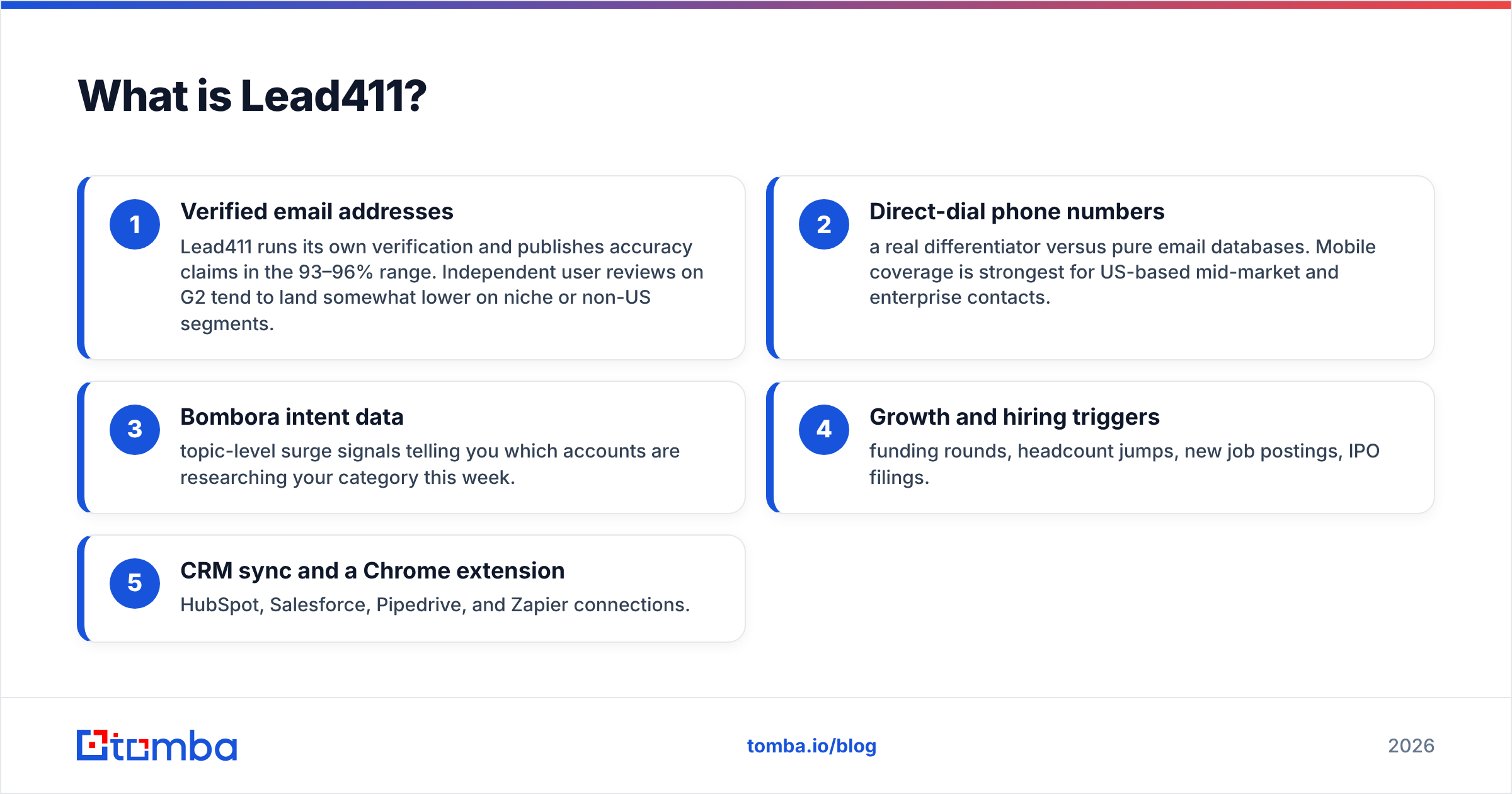
- Verified email addresses — Lead411 runs its own verification and publishes accuracy claims in the 93–96% range. Independent user reviews on G2 tend to land somewhat lower on niche or non-US segments.
- Direct-dial phone numbers — a real differentiator versus pure email databases. Mobile coverage is strongest for US-based mid-market and enterprise contacts.
- Bombora intent data — topic-level surge signals telling you which accounts are researching your category this week.
- Growth and hiring triggers — funding rounds, headcount jumps, new job postings, IPO filings.
- CRM sync and a Chrome extension — HubSpot, Salesforce, Pipedrive, and Zapier connections.
Pricing has historically sat around $99 per user per month on the Basic Plus Unlimited plan when billed annually, with Enterprise quoted case by case. Confirm the current number directly — Lead411 has revised packaging more than once, and annual commitment is usually required to hit the advertised rate.

What is LFBBD Lead For Business?#
LFBBD Lead For Business sits at the other end of the spectrum: it is a B2B contact list provider rather than a seat-based software subscription. You specify a segment — "SaaS companies in DACH, 50–500 employees, VP Marketing and above" — and you receive a file.
This model is older than SaaS itself, and it has not disappeared because it genuinely fits some buyers. The economics are different in three ways:
- You pay per record, not per seat. Ten SDRs can work the same file without ten licences.
- You own the data permanently. No renewal, no access cutoff, no export cap.
- There is no ongoing refresh. The file is a snapshot of the day it was compiled.
That third point is the whole argument. B2B contact data decays at roughly 22–30% per year — people change jobs, companies rebrand, domains get consolidated. A list bought in January is materially worse by July and close to unusable at eighteen months.
Be honest about the research limits here: LFBBD publishes far less public detail than Lead411 does. Pricing is quote-based, there is no widely reviewed G2 profile with hundreds of entries, and coverage claims are hard to verify independently. That is not automatically disqualifying — plenty of solid regional list vendors operate this way — but it does mean you should insist on a paid sample before committing. More on how to run that test below.
Which one has more accurate contact data?#
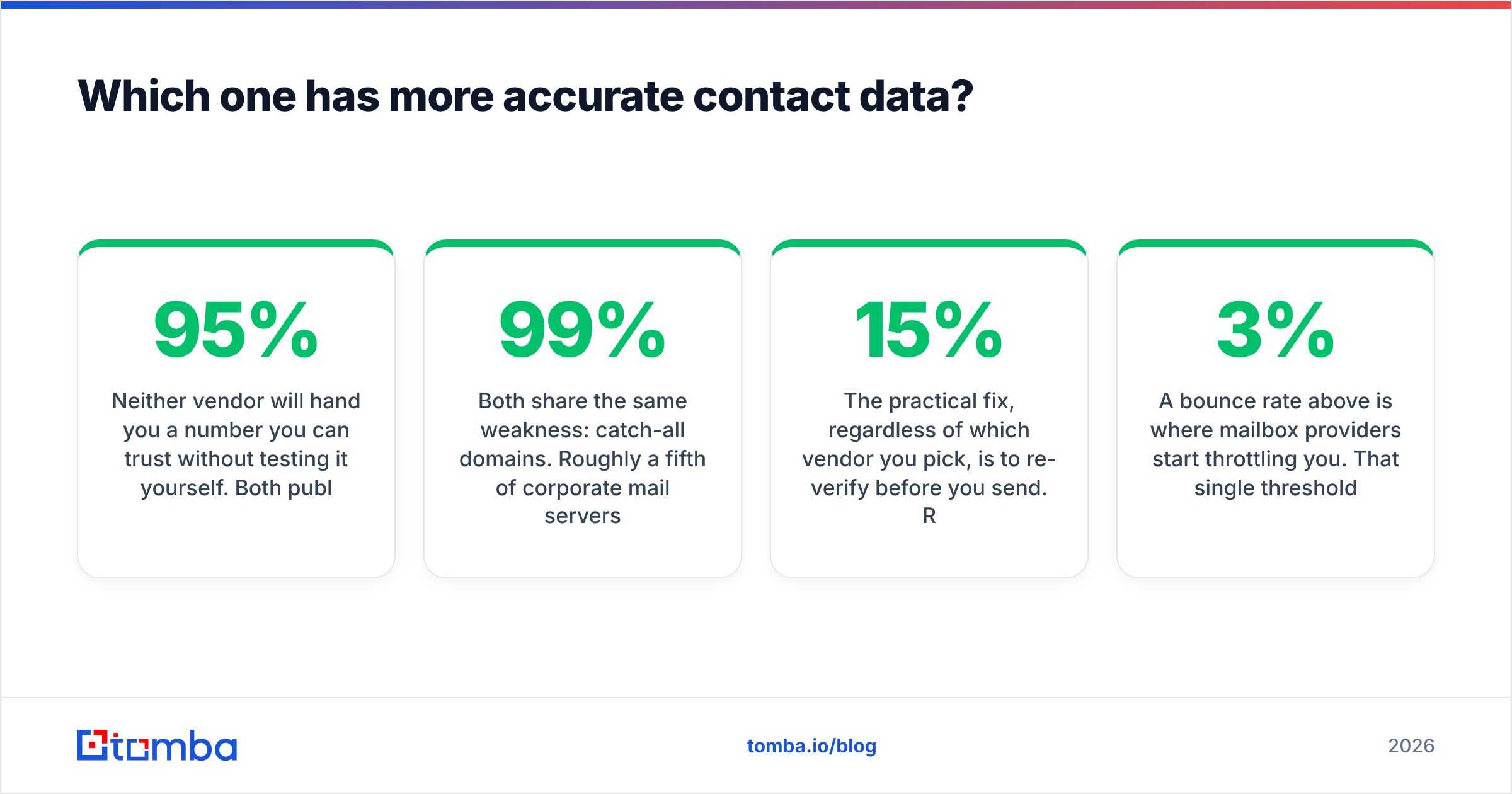
Neither vendor will hand you a number you can trust without testing it yourself. Both publish accuracy claims; both measure differently. "95% accurate" can mean syntactically valid, SMTP-acceptable, human-confirmed, or simply "not bounced in our last internal run" — four wildly different bars.

Here is what actually drives accuracy in each model:
- Lead411's advantage is recency. Records get re-verified on a rolling basis because the platform is live. If a contact left three months ago, there is a reasonable chance the profile reflects it.
- LFBBD's advantage is depth per segment. List vendors often out-cover platforms in specific verticals or regions the big databases under-index — European SMBs, trades, manufacturing, non-English-speaking markets.
- Both share the same weakness: catch-all domains. Roughly a fifth of corporate mail servers accept everything, so no SMTP check can confirm the mailbox exists. Any vendor claiming 99% accuracy on a catch-all-heavy list is measuring the wrong thing.
The practical fix, regardless of which vendor you pick, is to re-verify before you send. Run the file through an independent email verifier and a catch-all verifier so you are scoring the data with a tool that has no incentive to grade its own homework. On a 10,000-row list that costs a few dollars and routinely strips out 8–15% of rows that would otherwise have bounced.
A bounce rate above 3% is where mailbox providers start throttling you. That single threshold matters more than any vendor's marketing claim.
How do Lead411 and LFBBD Lead For Business compare head-to-head?#

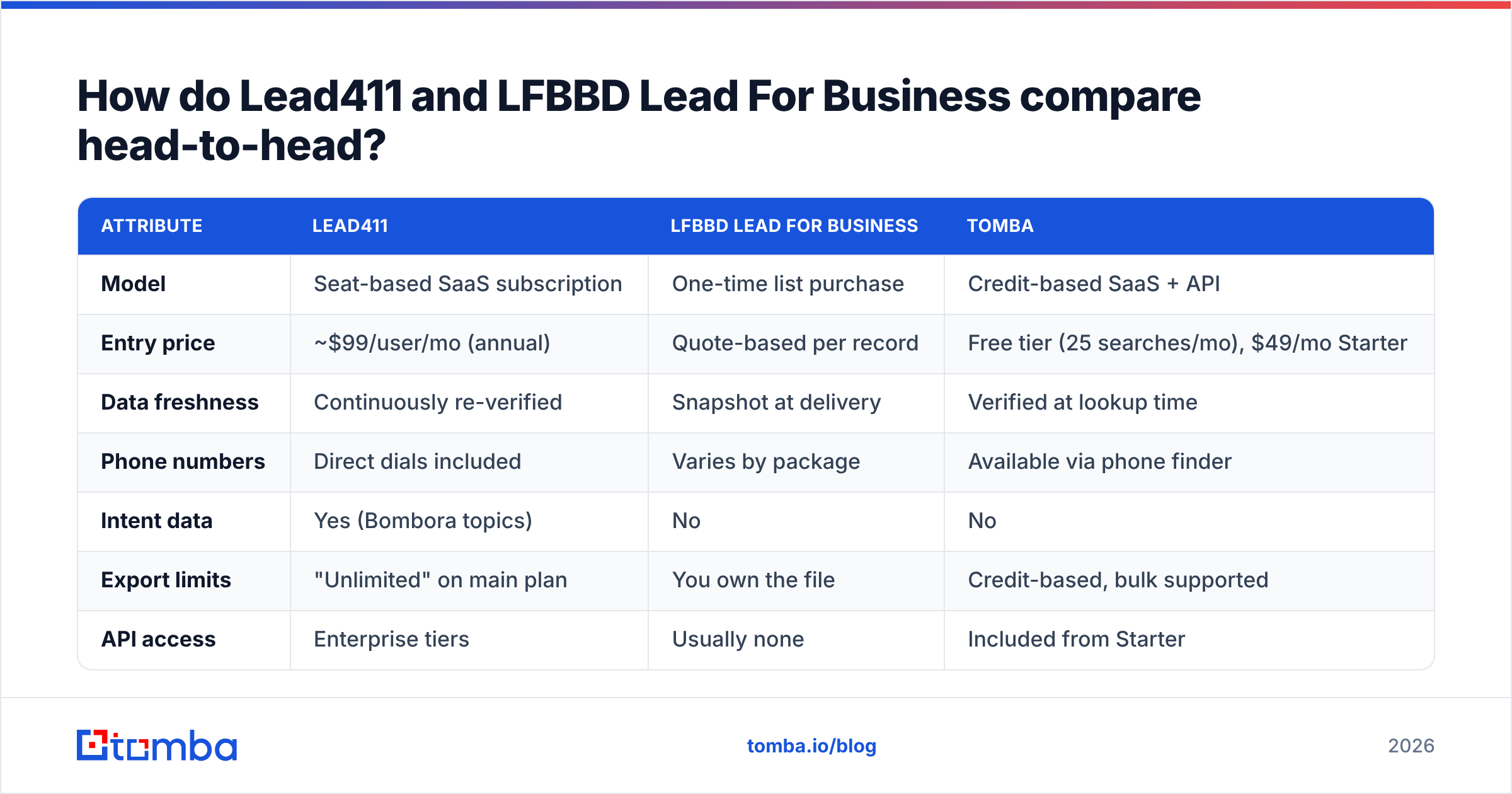
| Attribute | Lead411 | LFBBD Lead For Business | Tomba |
|---|---|---|---|
| Model | Seat-based SaaS subscription | One-time list purchase | Credit-based SaaS + API |
| Entry price | ~$99/user/mo (annual) | Quote-based per record | Free tier (25 searches/mo), $49/mo Starter |
| Data freshness | Continuously re-verified | Snapshot at delivery | Verified at lookup time |
| Phone numbers | Direct dials included | Varies by package | Available via phone finder |
| Intent data | Yes (Bombora topics) | No | No |
| Export limits | "Unlimited" on main plan | You own the file | Credit-based, bulk supported |
| API access | Enterprise tiers | Usually none | Included from Starter |
| Best for | Continuous outbound teams | One-off volume campaigns | Targeted, lower-volume lookups |
| Contract | Annual commitment typical | Per-purchase | Monthly, cancel anytime |
The pattern is clear once you lay it out. Lead411 charges for ongoing access and signals. LFBBD charges for volume you keep. A per-lookup tool charges for precision.
None of those is inherently better. They are priced for different buying behaviour, and the mistake teams make is buying the wrong shape — paying seat licences for occasional use, or buying 50,000 rows when they will only ever email 4,000 of them.
How does the pricing math actually work out?#
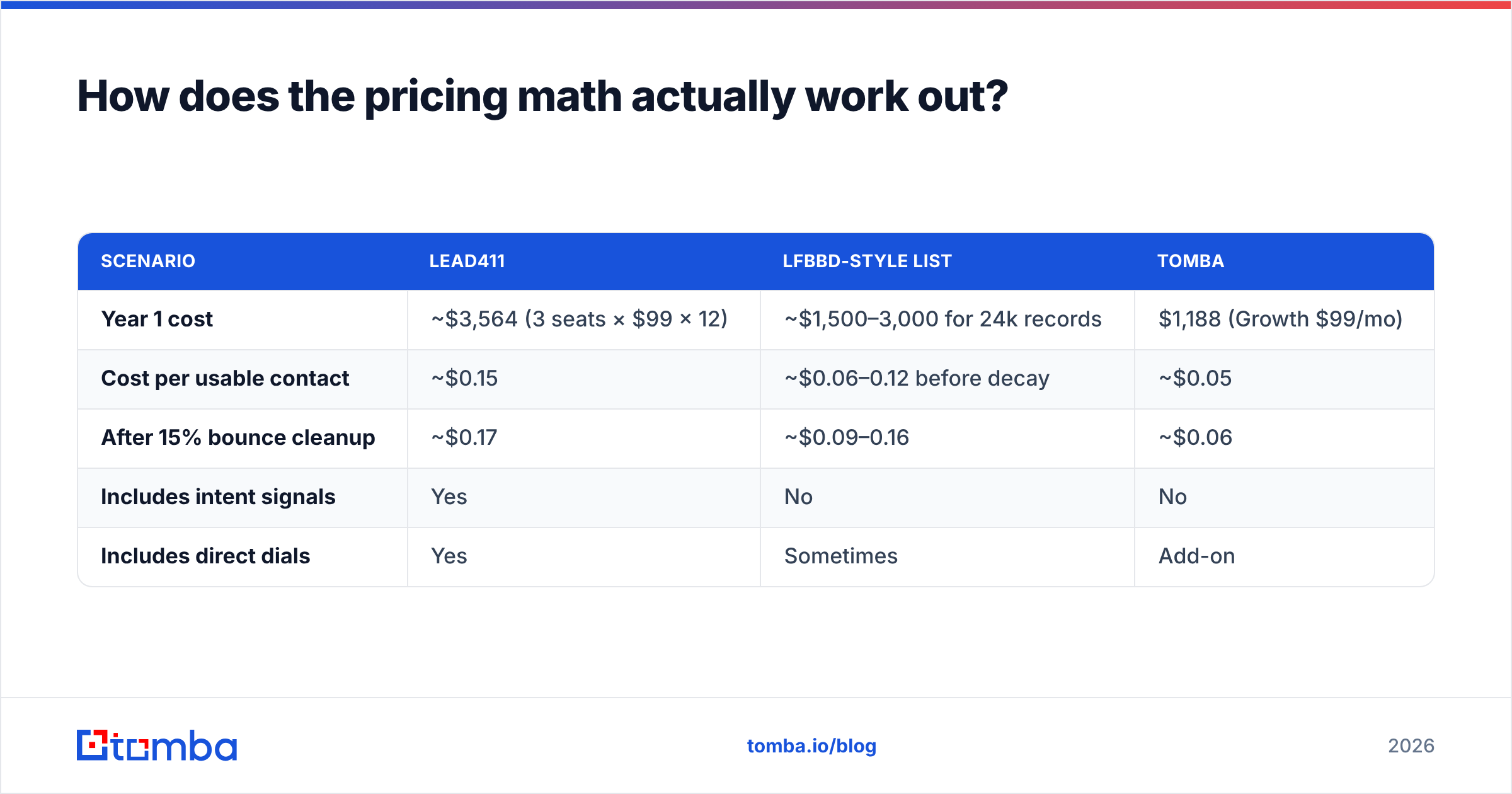
Run the numbers on a realistic scenario: three SDRs, 2,000 new contacts needed per month.
| Scenario | Lead411 | LFBBD-style list | Tomba |
|---|---|---|---|
| Year 1 cost | ~$3,564 (3 seats × $99 × 12) | ~$1,500–3,000 for 24k records | $1,188 (Growth $99/mo) |
| Cost per usable contact | ~$0.15 | ~$0.06–0.12 before decay | ~$0.05 |
| After 15% bounce cleanup | ~$0.17 | ~$0.09–0.16 | ~$0.06 |
| Includes intent signals | Yes | No | No |
| Includes direct dials | Yes | Sometimes | Add-on |
Two honest caveats on that table. First, the list-vendor cost per contact looks best on paper but assumes you use the whole file — most teams work through 40–60% of a purchased list before it goes stale, which quietly doubles the real cost. Second, Lead411 looks expensive per contact until you price the intent data separately; Bombora access on its own is not cheap, and if surge signals genuinely change who your reps call first, that line item earns its keep.

Who should choose Lead411, and who should choose LFBBD?#
Choose Lead411 if:
- You run continuous outbound — reps prospect daily, not in quarterly bursts, so a live database beats a snapshot.
- Phone matters as much as email — direct dials are Lead411's strongest single asset, and cold calling is still where mid-market deals get opened.
- You want timing signals — intent topics and hiring triggers tell you when, not just who, which is the harder half of prospecting.
- Your ICP is US-centric mid-market — that is where coverage is densest.
Choose an LFBBD-style list if:
- You need one large drop, not a subscription — a launch campaign, a trade-show follow-up, a market test in a new region.
- Your target segment is poorly covered by the big platforms — regional SMBs, non-tech verticals, non-English markets.
- Many people need the same data — no per-seat multiplication.
- You have a verification step already — you must re-clean a purchased file, and you need to budget for that.
Choose a per-lookup tool if:
- Your list is built, not bought — you already have target accounts from your CRM, a conference roster, or LinkedIn research, and you just need contact details filled in.
- You want to pay only for hits — a bulk email finder run against 800 named accounts costs a fraction of a 25,000-row file you will never finish.
- You need this inside your own systems — an email finder API beats any CSV export workflow once you are enriching automatically on form fill or CRM create.
What about other alternatives worth shortlisting?#
The Lead411-vs-LFBBD framing is narrower than most buyers realise. A few other options cover the same jobs:
- BookYourData — a strong pick if the list-purchase model suits you but you want more transparency than typical list brokers offer. Pay-as-you-go pricing, a published bounce guarantee, and self-serve filtering make it a credible peer to both vendors here, particularly for teams that want to buy volume without a sales call.
- Apollo — database plus sequencer in one, cheapest entry point of the big platforms, weaker on European data. See the Apollo alternative breakdown if you are comparing directly.
- RocketReach — good individual-contact lookup, thinner on firmographic filtering. Covered in our RocketReach alternative comparison.
- Clay or similar orchestration tools — waterfall enrichment across several providers, which solves coverage gaps at the cost of complexity and a steeper price floor.
For a grounding on what the category actually includes, sales intelligence on Wikipedia is a reasonable neutral primer, and vendor-neutral review volume on G2 is more useful than any single vendor's case-study page.
How should you test either vendor before you commit?#
Do not buy on a demo. Run the same five-step test on both:
- Build a 100-row control set. Pick real accounts in your actual ICP — including the awkward ones: small companies, non-US domains, generic role titles.
- Request the same 100 rows from each vendor. Lead411 in trial, LFBBD as a paid sample. If a vendor will not sell a sample, that is your answer.
- Verify independently. Run both files through a third-party checker. Record valid, invalid, catch-all, and unknown as four separate buckets — collapsing catch-all into "valid" is how vendors inflate scores.
- Check coverage, not just accuracy. A vendor that returns 40 of 100 rows at 98% accuracy is worse than one returning 85 at 92%. Multiply fill rate by accuracy to get usable contacts per 100.
- Send a small real campaign. 200 emails, measure hard bounces and reply rate. Nothing simulates deliverability like actually sending.
Most teams skip step 3 and 4 and end up arguing about vendor marketing claims. Twenty minutes of testing settles it with your own data.
Verdict: which one wins?#
Lead411 wins for continuous outbound teams that need phones and timing signals. The intent layer and direct dials justify the seat cost if your reps are in the platform every day. LFBBD-style list buying wins for one-off volume in segments the big platforms under-cover, provided you treat verification as mandatory rather than optional and negotiate a sample first.
But if you looked at both and thought "I don't need 25,000 rows and I don't need six seats" — you are the majority, and neither model is priced for you. Building a targeted list of named accounts and filling in contact details on demand is cheaper and produces better campaigns, because a 600-person list you researched will always outperform a 25,000-person list you filtered.
That is the gap the Tomba Email Finder is built for. Start on the free tier with 25 searches a month, test it against the same control set you use for Lead411 and LFBBD, and scale to $49/mo Starter or $99/mo Growth only when your volume justifies it. API, Chrome extension, bulk processing, and verification are included rather than gated behind an enterprise call — so you can test the data before anyone asks you for an annual commitment.
Related guides#
// get started
Find, verify and enrich your first contacts today
Start on the free plan with 25 searches a month, then scale when your team is ready.
Free plan · No credit card required · GDPR & CCPA
// about the author