Lead411 vs Mattermark (2026): Which B2B Data Tool Wins?
Lead411 sells verified contacts. Mattermark sells company signals. They get compared constantly, but they solve different halves of the same problem — here is how to pick, and what each actually costs.
TL;DR
- They are not the same category. Lead411 is a contact database — verified emails, direct dials, intent signals. Mattermark is a company-intelligence product built around funding, headcount, and growth signals. Comparing them straight across is like comparing a phone book to a stock screener.
- Pick Lead411 if your bottleneck is "I know who to call, I just need their email and mobile."
- Pick Mattermark if your bottleneck is "I don't know which 400 companies are worth calling this quarter."
- Pricing is the real divider. Lead411 publishes a per-seat entry plan in the $99/user/month range on annual billing; Mattermark has been quote-driven since it changed hands, and pricing varies by dataset access.
- Most teams end up buying both halves. The cheaper path is usually a signal source plus a per-credit email finder like Tomba ($49/mo Starter, free tier at 25 searches) rather than two enterprise seats.
What are Lead411 and Mattermark, actually?#
Start here, because half the confusion in the "lead411 vs mattermark" search comes from assuming they compete.
Lead411 (lead411.com) has been in the B2B data business since 2001, out of Boulder, Colorado. Its product is a sales-intelligence database: search by title, industry, revenue, tech stack, or location, and get back contact records with verified work emails and direct-dial phone numbers. It layers on intent data (sourced through Bombora) and "growth intent" triggers like hiring spikes and funding events so you can filter accounts that are actively in-market.
Mattermark (mattermark.com) started in 2012 as a company-data engine for investors. The core idea was a quantified feed of private-company momentum: employee growth, web traffic trend, funding rounds, social following, and a composite "Mattermark Score." It was acquired by FullContact in 2017 and has changed hands since, and the product today leans on company discovery and market mapping rather than rep-facing outreach workflows.
So the honest framing: Lead411 answers "how do I reach this person?" Mattermark answers "which companies are worth my time?" One is the endpoint of prospecting, the other is the starting point.

How do Lead411 and Mattermark compare head-to-head?#
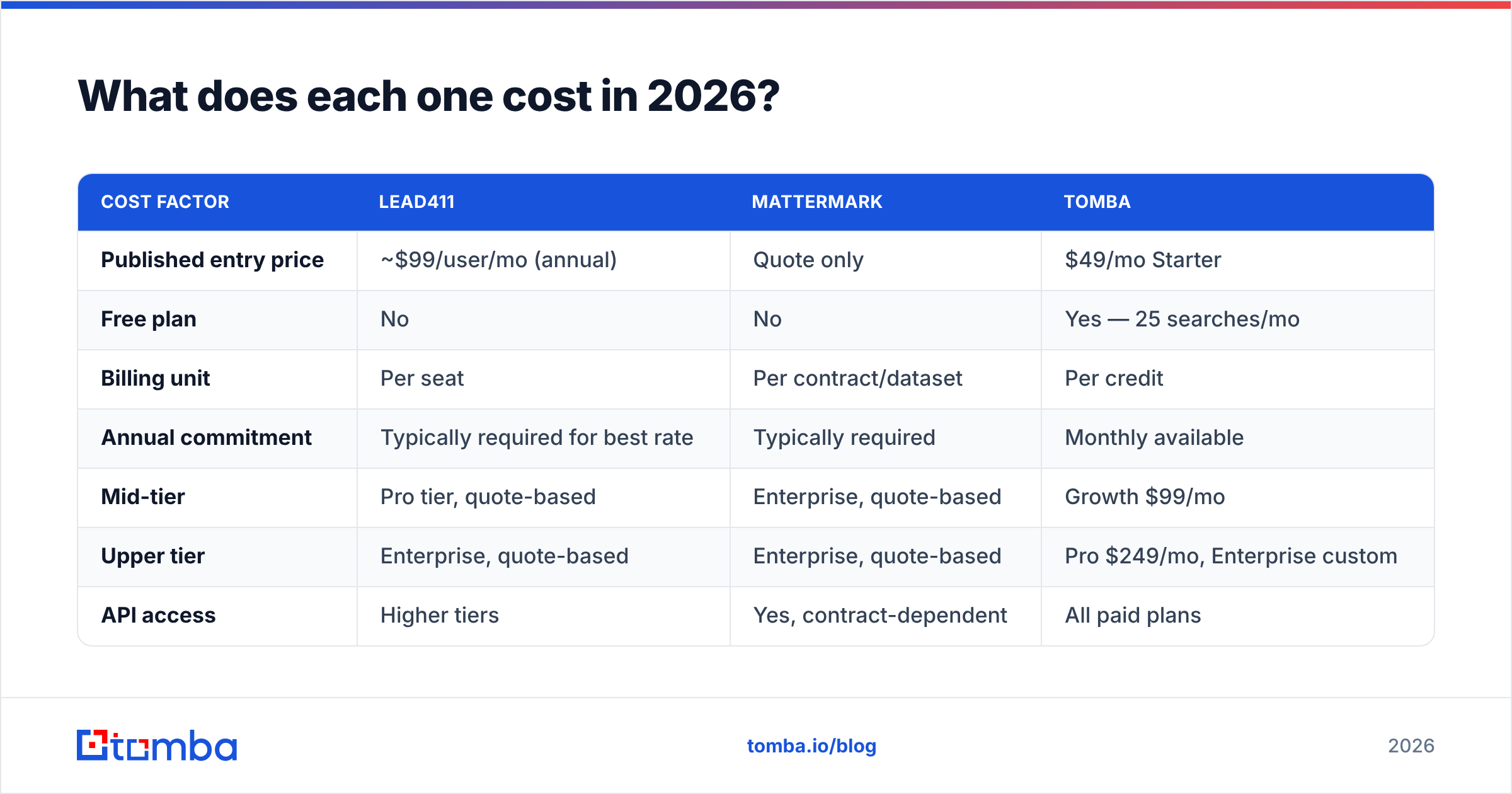
| Attribute | Lead411 | Mattermark |
|---|---|---|
| Primary job | Contact data for outbound reps | Company intelligence and market mapping |
| Core record | Person (email, direct dial, title) | Company (funding, headcount, growth trend) |
| Verified emails | Yes — core product | Not the focus; firmographics first |
| Direct-dial phones | Yes, a headline feature | No |
| Intent data | Yes (Bombora-powered) | Growth/momentum signals, not buyer intent |
| Entry pricing | Around $99/user/mo (annual billing) | Quote-based; varies by dataset |
| Free tier | Limited trial, no perpetual free plan | Trial only |
| Best-fit buyer | SDR teams, agencies, recruiters | VC, corp dev, market research, ABM planners |
| Export model | Per-seat with monthly export caps | Dataset/API access depending on contract |
| CRM push | Salesforce, HubSpot, outreach tools | Lighter; more export/API oriented |
Two rows deserve underlining. Direct dials are the single strongest reason people buy Lead411 — if you run a phone-first motion, Mattermark simply does not serve that need. And export caps are the single most common Lead411 complaint you will find in G2 reviews: the "unlimited" language in plan names refers to viewing, while actual downloads are metered. Read the plan sheet line by line before you sign.
Which one has better data quality?#
Wrong question, but here's the useful version of it.
Data quality splits into four dimensions, and each tool is strong in a different one:
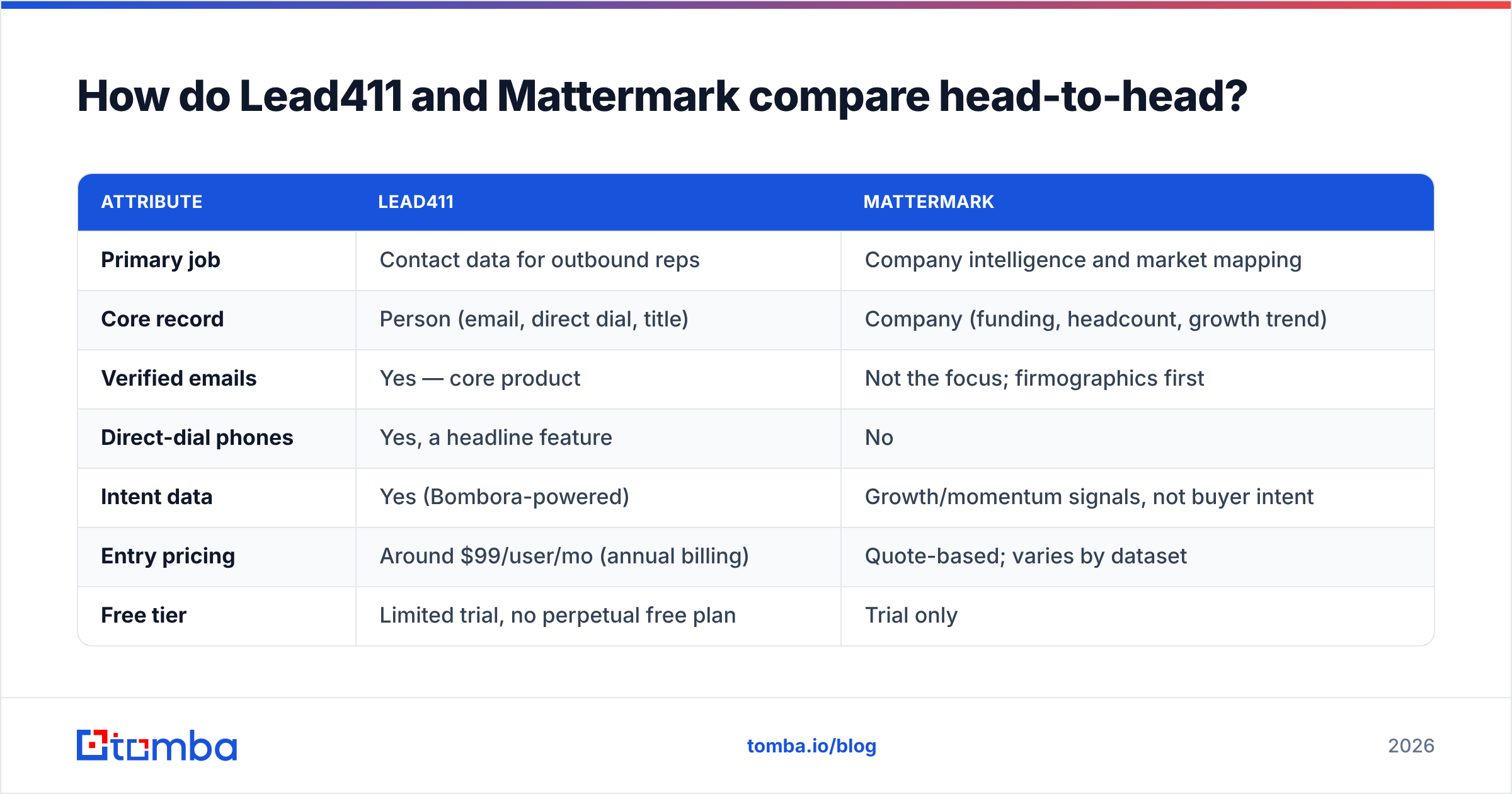
- Contact-level accuracy — is this person's email deliverable today? Lead411 wins by default; Mattermark does not really play here. Even so, no contact database is static. Work emails decay at roughly 20–30% a year as people change jobs, so any list you pull in January is measurably worse by June.
- Firmographic freshness — is this headcount number current? Mattermark's entire heritage is tracking company momentum over time, and its trend data is more useful than a static employee-count field.
- Coverage depth — Lead411 skews heavily North American. If you sell into EMEA or APAC, run a coverage test on your actual ICP before committing to an annual seat.
- Signal timeliness — funding rounds, hiring surges, tech-stack changes. Lead411 packages these as sales triggers; Mattermark packages them as analysis. Same raw material, different delivery.
The practical move for either tool is the same: never trust a vendor's accuracy claim, verify a sample yourself. Export 200 records, run them through an independent email verifier, and measure the real bounce-risk rate. If a vendor advertises 96% accuracy and your sample comes back at 78%, you now have a pricing negotiation instead of an argument.
That step matters even more with catch-all domains, where standard SMTP checks return "accept-all" and tell you nothing. A dedicated catch-all verifier is the difference between a usable list and a burned sending domain.
What does each one cost in 2026?#
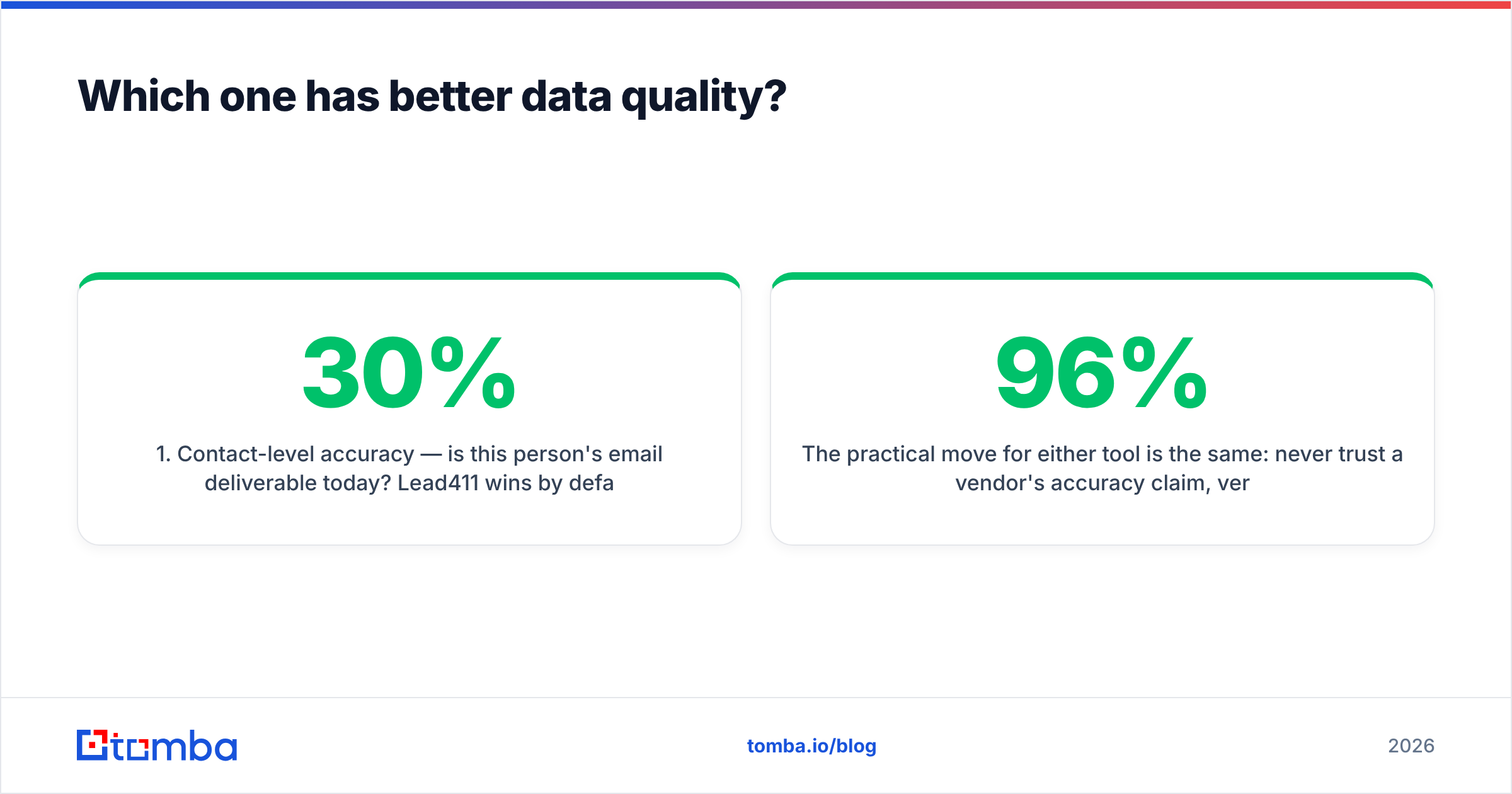
Lead411 publishes pricing; Mattermark generally does not. That asymmetry itself is a signal about who each product is sold to.
| Cost factor | Lead411 | Mattermark | Tomba |
|---|---|---|---|
| Published entry price | ~$99/user/mo (annual) | Quote only | $49/mo Starter |
| Free plan | No | No | Yes — 25 searches/mo |
| Billing unit | Per seat | Per contract/dataset | Per credit |
| Annual commitment | Typically required for best rate | Typically required | Monthly available |
| Mid-tier | Pro tier, quote-based | Enterprise, quote-based | Growth $99/mo |
| Upper tier | Enterprise, quote-based | Enterprise, quote-based | Pro $249/mo, Enterprise custom |
| API access | Higher tiers | Yes, contract-dependent | All paid plans |
The structural point: per-seat pricing punishes teams that use data unevenly. If you have five reps and one of them runs 80% of the list building, you are still paying five seats. Per-credit pricing bills the work, not the chairs. That is the main reason lean teams route list building through an API or a bulk email finder and keep seat-based tools for the one or two people who actually live in them.
Always confirm current numbers directly — B2B data pricing changes quietly, and the plan names ("Basic Plus Unlimited," "Pro") rarely mean what they sound like. Compare against published Tomba pricing if you want a fixed reference point.
Who should choose Lead411?#
Lead411 is the right call when all of these are true:
- You run a phone-and-email motion. Direct dials are the feature you are actually paying for. If nobody on your team dials, you are overpaying for half the product.
- Your ICP is US-centric. Coverage is strongest in North America across mid-market and SMB.
- You want intent baked in. Bombora-powered topic surges plus hiring and funding triggers let you filter to accounts showing activity, which beats alphabetical list-walking.
- You have stable seat count. Per-seat economics work fine when everyone uses their seat daily.
- You need CRM hygiene. Push-to-CRM and enrichment workflows into Salesforce and HubSpot are mature here.
Where it frustrates people: export caps, annual lock-in, and the gap between "unlimited" marketing language and metered downloads. Those are contract problems, not data problems — negotiate them up front.
Who should choose Mattermark?#
Mattermark earns its keep in a different building:
- Investment and corp-dev research. Tracking which private companies are accelerating is literally the original use case.
- Market mapping and TAM sizing. When you need to know how many Series-B fintechs in the UK grew headcount 40%+ last year, this is the shape of question it answers.
- Account-based marketing planning. Building a tiered account list before you ever touch contact data.
- Competitive and category tracking. Watching a segment over quarters, not pulling a list for Tuesday's call block.
Where it frustrates people: it is not an outbound tool. Handing Mattermark to an SDR and expecting dials is a category error. You will still need a contact layer on top.

Can you just use one, or do you need both?#
Most teams that seriously evaluate both end up realising they need a signal layer and a contact layer — and that buying two full enterprise platforms is the expensive way to get there.
The cheaper architecture looks like this:
- Source the account list from whatever gives you the best signal — Mattermark, funding databases, job boards, your own product analytics, or website visitor reveal on traffic you already have.
- Resolve companies to domains, because everything downstream keys off the domain, not the company name.
- Find the people with domain search to pull every public email pattern at that company, then target by role.
- Verify before sending. Bounces above 2–3% start damaging sender reputation, and reputation damage is slow and expensive to reverse.
- Enrich what survives with firmographics, tech stack, and phone numbers only for records that passed verification — enriching junk records is pure waste.
- Push to CRM with a source field, so in ninety days you can tell which data source actually produced pipeline.
Step 4 is the one teams skip, and it is the one that costs the most. A dirty list does not just fail to convert; it degrades the deliverability of every campaign that follows it.
What are the alternatives worth testing?#
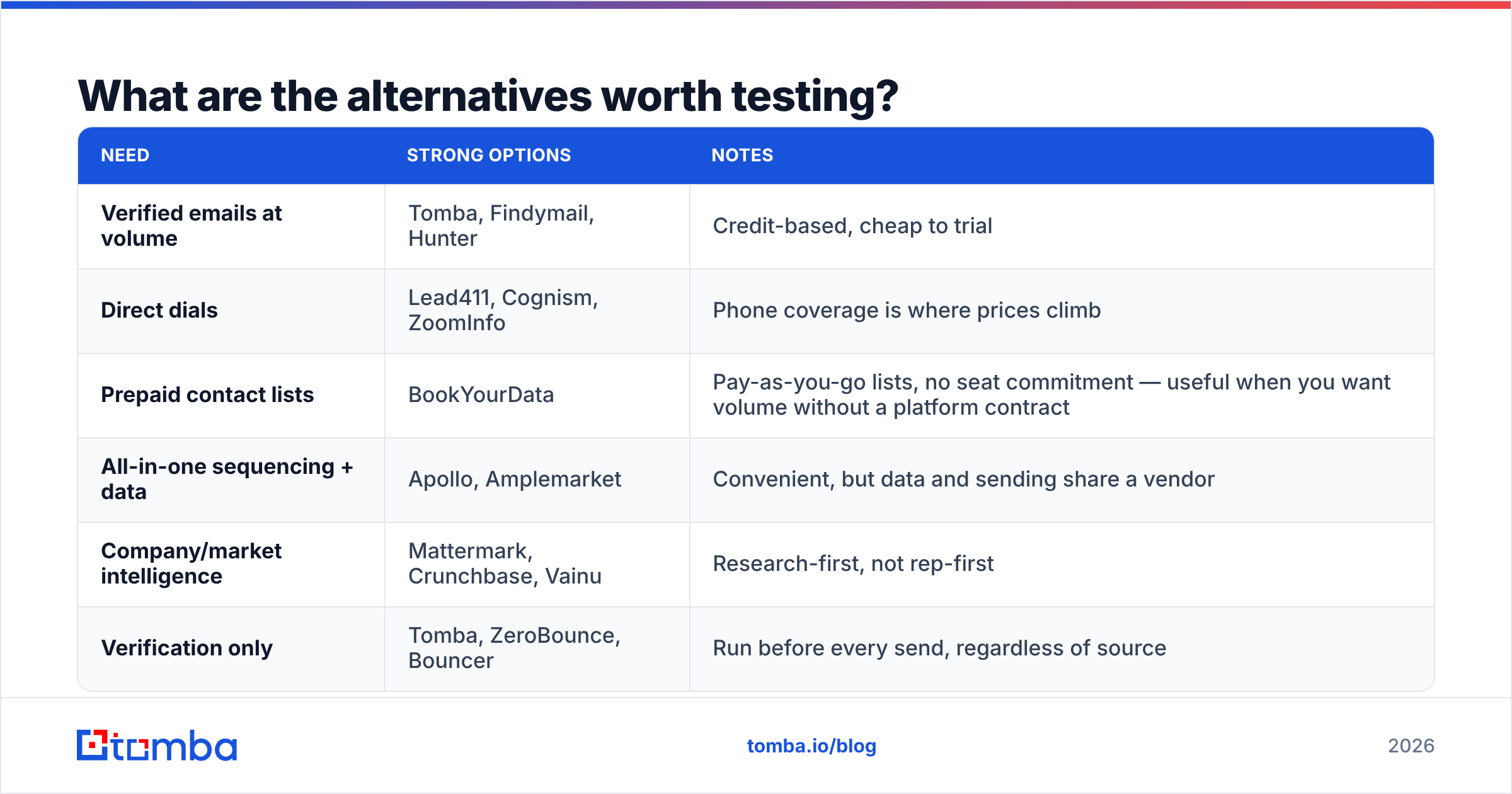
If neither tool clears your bar, the realistic shortlist splits by what you actually need:
| Need | Strong options | Notes |
|---|---|---|
| Verified emails at volume | Tomba, Findymail, Hunter | Credit-based, cheap to trial |
| Direct dials | Lead411, Cognism, ZoomInfo | Phone coverage is where prices climb |
| Prepaid contact lists | BookYourData | Pay-as-you-go lists, no seat commitment — useful when you want volume without a platform contract |
| All-in-one sequencing + data | Apollo, Amplemarket | Convenient, but data and sending share a vendor |
| Company/market intelligence | Mattermark, Crunchbase, Vainu | Research-first, not rep-first |
| Verification only | Tomba, ZeroBounce, Bouncer | Run before every send, regardless of source |
A note on the all-in-one path: bundling data and sending into one vendor feels efficient until deliverability drops and you cannot tell whether the list or the sending infrastructure is at fault. Keeping the data layer separate — via an email finder API or a Chrome extension your reps already use — preserves your ability to swap one without rebuilding the other. If you are already leaning toward a bundled suite, it is worth reading through the Apollo alternative breakdown before committing.
How should you run the evaluation?#
Do not evaluate on demos. Evaluate on your own ICP, with a scoring sheet:
- Pull 250 records matching a real segment you sell to, from each tool's trial.
- Measure match rate — how many of your target companies returned any usable contact at all? This number is usually far below the marketing claim.
- Measure verified rate — run both exports through the same independent verifier so the comparison is apples to apples.
- Measure role accuracy — spot-check 25 records on LinkedIn. Stale titles are the quietest form of bad data.
- Price the real workload. Multiply your monthly list volume by each pricing model. Per-seat versus per-credit flips the answer more often than people expect.
Whichever way that scorecard lands, the verification step should stay in your process permanently. Data sourcing is a vendor decision; data hygiene is an internal discipline.
The verdict#
Lead411 wins for outbound teams that need emails and direct dials in North America. Mattermark wins for research teams mapping private-company momentum. Neither wins by beating the other — they are answering different questions.
If your honest constraint is contact data cost, the question isn't "lead411 vs mattermark" at all. It is whether you need a per-seat platform contract to get verified emails. For most teams under 20 reps, you don't.
Start with the Tomba Email Finder — the free tier gives you 25 searches a month to test coverage on your real ICP before you spend a dollar, Starter runs $49/mo, and everything is credit-based so you pay for work done rather than seats occupied. Run the same 250-record test against it that you run against Lead411 and Mattermark, verify all three exports, and let the match rate decide.
Related guides#
// get started
Find, verify and enrich your first contacts today
Start on the free plan with 25 searches a month, then scale when your team is ready.
Free plan · No credit card required · GDPR & CCPA
// about the author