Lead411 vs PlusVibe: Data vs Sending Compared for 2026
Lead411 sells you contacts. PlusVibe sends the emails. They are not really competitors — and picking the wrong one is how outbound budgets get wasted. Here is the honest breakdown.
TL;DR
- Lead411 and PlusVibe are not direct competitors. Lead411 is a B2B contact database with intent data; PlusVibe is a cold email sending platform with warmup and inbox rotation. One fills the list, the other mails it.
- If you are comparing them because you can only buy one thing this quarter, buy the layer you are weakest at. Bad data kills a good sender. A great list still needs somewhere to send from.
- Lead411 is priced per seat with annual commitments and export caps that make "unlimited" mean less than it sounds. PlusVibe is priced per sending volume and inbox count, which scales differently.
- Neither tool gives you a clean, verified email at API-level cost. That gap is where a dedicated finder-plus-verifier layer pays for itself.
- The common 2026 stack: a data/verification API for accuracy, a sending platform for volume, and a CRM to hold the outcome. Lead411 and PlusVibe can each occupy one slot — not both.
What are Lead411 and PlusVibe, actually?#
Start here, because half the confusion in this comparison is category confusion.
Lead411 is a sales intelligence provider. You log in, build a filter (industry, headcount, tech stack, growth signal, job title), and export a list of contacts with emails and direct-dial phone numbers. It bundles Bombora-powered intent data, hiring and funding triggers, and a Chrome extension that pulls contacts while you browse LinkedIn or a company site. Its buyers are SDR managers and RevOps leads who need a list source that does not require scraping.
PlusVibe sits at the other end of the same funnel. It is a cold email sending platform: connect unlimited mailboxes, warm them up, rotate sends across them, run multi-step sequences, and manage replies in a unified inbox. It competes with Instantly, Smartlead and Saleshandy — not with a database. PlusVibe does resell a contact database as an add-on, but that is a secondary feature, not the reason people sign up.
So the honest framing of Lead411 vs PlusVibe is not "which is better." It is "which layer of your outbound stack is currently broken, and which of these two fixes it."
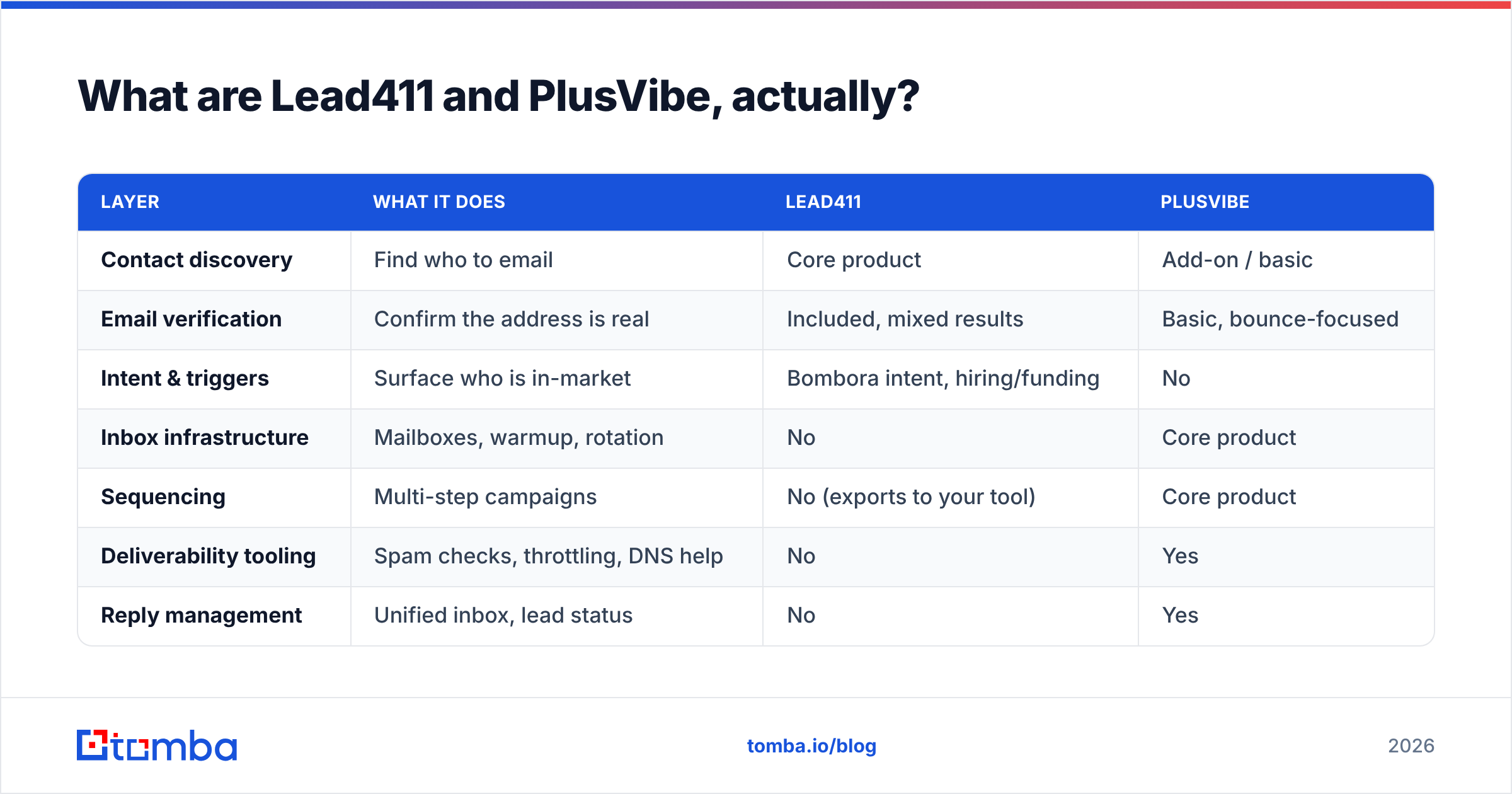
| Layer | What it does | Lead411 | PlusVibe |
|---|---|---|---|
| Contact discovery | Find who to email | Core product | Add-on / basic |
| Email verification | Confirm the address is real | Included, mixed results | Basic, bounce-focused |
| Intent & triggers | Surface who is in-market | Bombora intent, hiring/funding | No |
| Inbox infrastructure | Mailboxes, warmup, rotation | No | Core product |
| Sequencing | Multi-step campaigns | No (exports to your tool) | Core product |
| Deliverability tooling | Spam checks, throttling, DNS help | No | Yes |
| Reply management | Unified inbox, lead status | No | Yes |
| CRM sync | Push to HubSpot/Salesforce | Yes | Yes |
Read that table once and the decision gets simpler. There are only two rows of overlap — contact discovery and verification — and neither tool is best-in-class at both.
Which problems does each one actually solve?#
Here is the version you can take to a budget conversation:
- You have a sending setup but nobody to email. Your mailboxes are warm, your sequences are built, your reply rate on the lists you do have is fine — you have just exhausted them. This is a Lead411 problem. Buy data, not another sender.
- You have a great list but everything lands in spam. Your open rates dropped below 20%, your domain got flagged, you are sending from one Google Workspace account. This is a PlusVibe problem. Buy infrastructure, not more records.
- You need accuracy at scale, not a UI. You are enriching a CRM, a signup flow, or a product feature and you need programmatic lookups with predictable cost. Neither tool is designed for this — you want an email finder API layer.
- You are running ABM on a named account list. You already know the 300 companies. You need the right people inside them and their real addresses. Lead411's filters help; so does a domain search that maps an entire company's email pattern in one call.
- You are one founder doing outbound between product work. Buying both is overkill. Pick a cheap finder plus a cheap sender and skip the enterprise data contract entirely.

How accurate is Lead411 data compared to what you send through PlusVibe?#
Accuracy is the number that decides whether either purchase works, and it is the number both vendors are vaguest about.
Lead411 markets "triple-verified" emails. In practice, independent reviews on G2 and buyer forums put real-world bounce rates on Lead411 exports somewhere in the 4–10% band depending on vertical, with tech and SaaS contacts cleaner than SMB, local services, and non-US records. That is normal for a database product. Databases are snapshots; people change jobs roughly every two to three years, and a snapshot taken in March is measurably worse by September.
PlusVibe does not really have an accuracy number to quote, because PlusVibe does not source most of your data. What PlusVibe controls is what happens to a bad address once you send to it: whether the bounce is caught, whether it is retried, whether it burns the sending mailbox. Its built-in verification is a bounce shield, not a discovery engine.
This is the trap. Teams buy Lead411 for data quality, push the export into a sender like PlusVibe, and assume the sender's verification will clean the remainder. It will not — basic SMTP checks miss catch-all domains entirely, and catch-all domains are roughly a fifth of mid-market B2B. A catch-all verifier is a separate capability, and neither product here treats it as a first-class feature.
The practical rule for 2026: re-verify any purchased list within 48 hours of sending, regardless of who sold it to you. A dedicated email verifier pass costs cents per thousand and routinely strips 5–12% of records off a database export that was sold as clean. That is not a knock on Lead411 specifically — it is true of every database vendor, including the good ones.
What does Lead411 vs PlusVibe pricing look like in 2026?#
Both vendors have moved their pricing around, so treat these as directional and confirm on their own pages before you sign anything.
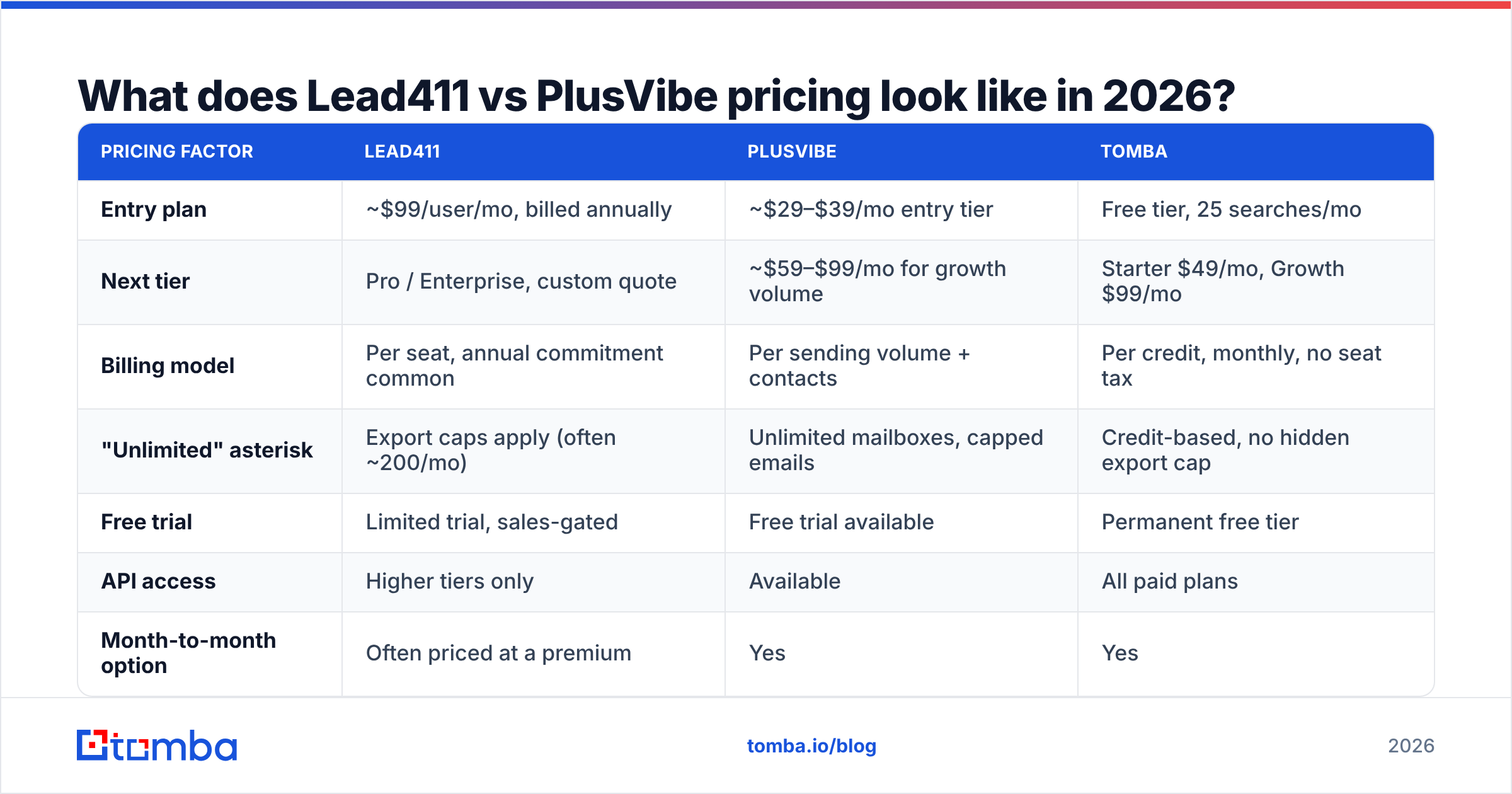
| Pricing factor | Lead411 | PlusVibe | Tomba |
|---|---|---|---|
| Entry plan | ~$99/user/mo, billed annually | ~$29–$39/mo entry tier | Free tier, 25 searches/mo |
| Next tier | Pro / Enterprise, custom quote | ~$59–$99/mo for growth volume | Starter $49/mo, Growth $99/mo |
| Billing model | Per seat, annual commitment common | Per sending volume + contacts | Per credit, monthly, no seat tax |
| "Unlimited" asterisk | Export caps apply (often ~200/mo) | Unlimited mailboxes, capped emails | Credit-based, no hidden export cap |
| Free trial | Limited trial, sales-gated | Free trial available | Permanent free tier |
| API access | Higher tiers only | Available | All paid plans |
| Month-to-month option | Often priced at a premium | Yes | Yes |
Three things matter more than the headline numbers.
Seat pricing versus volume pricing. Lead411 charges per user. If four SDRs need data, you multiply. PlusVibe charges for sending capacity, which one person can administer for the whole team. A five-person SDR pod hits a very different total cost in each model.
The "unlimited" footnote. Lead411's Basic Plus Unlimited plan has historically carried a monthly export ceiling despite the name. That is a legitimate business decision, but it surprises buyers who budgeted for genuinely unlimited pulls. Read the export limit line in the contract before you compare it to anything.
Annual commitment. Data vendors push annual deals because churn is high once teams realize how fast records decay. Sending platforms usually let you go monthly because their value is continuous. If you are testing outbound rather than scaling it, a 12-month data contract is the riskiest line item on the page. Compare that to a credit model — see Tomba pricing — where an idle month costs you nothing.
Is Lead411 better than PlusVibe for cold email?#
No, and yes — depending on which half of "cold email" you mean.
For building the audience, Lead411 wins outright. PlusVibe's bundled contact data is a convenience feature; Lead411's is the product, with real filter depth, intent signals, and direct dials. If your bottleneck is "who do we email next month," PlusVibe does not solve it.
For actually getting mail delivered, PlusVibe wins outright. Lead411 has no sending infrastructure at all. It exports a CSV or syncs to your CRM and stops there. Warmup, inbox rotation, throttling, spintax, reply detection, bounce handling — none of that exists in a database product, and trying to substitute a Gmail account and a mail-merge extension is how domains get burned.
The nuance: deliverability in 2026 is more a data problem than an infrastructure problem. Google and Microsoft's bulk sender requirements made complaint rate and bounce rate the dominant reputation signals. You can run perfect warmup on twenty rotated inboxes and still tank your sender reputation by mailing a stale list. Which means a sending platform's value is capped by the quality of what you feed it.

What are the real weaknesses of each tool?#
Where Lead411 frustrates buyers:
- Coverage outside North America thins out fast. EMEA and APAC records are noticeably sparser and staler than US data.
- The annual contract plus per-seat model makes it expensive to scale a team, and hard to exit if coverage disappoints in your specific vertical.
- Export caps on plans marketed as unlimited generate a predictable wave of complaints in review sites.
- The UI shows its age next to newer prospecting tools, and bulk workflows lean on CSV round trips.
- Intent data is genuinely useful, but Bombora surge signals are company-level, not person-level. You still have to guess who inside the account is the buyer.
Where PlusVibe falls short:
- It is a younger platform than Instantly or Smartlead, with a smaller integration ecosystem and less third-party tooling built around it.
- Its bundled data is not a serious substitute for a dedicated provider — treat it as a bonus, not a reason to buy.
- Deliverability features help, but no platform can rescue a domain you have already burned. Warmup is prevention, not cure.
- Heavy multi-inbox sending still requires you to buy and configure domains and mailboxes yourself. The platform orchestrates; it does not provision your DNS.
- Reporting is adequate rather than deep if you need attribution back into a CRM pipeline model.
Neither list is disqualifying. Both are the normal trade-offs of a specialist tool doing one job.
Which should you choose for your team size?#
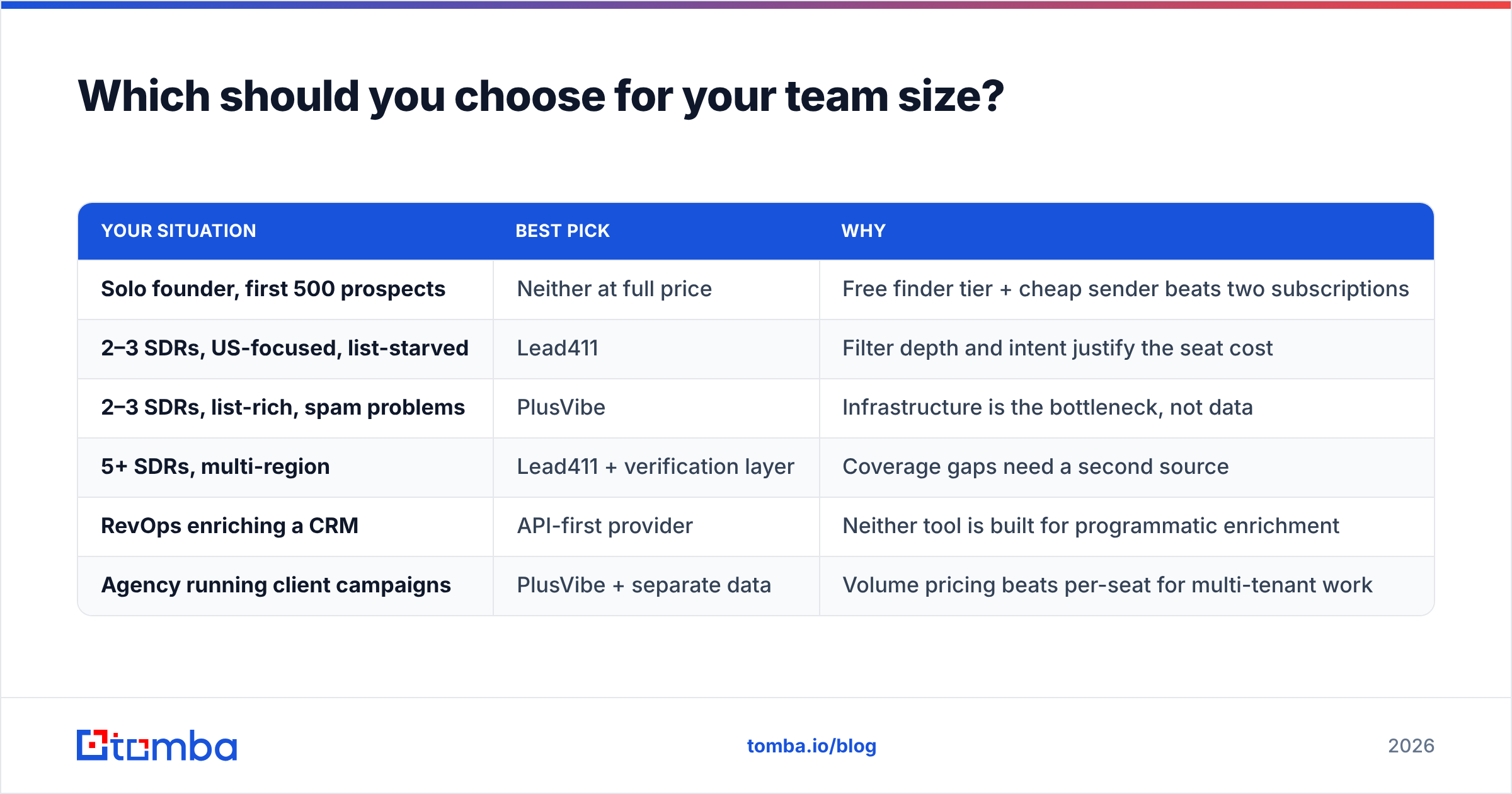
| Your situation | Best pick | Why |
|---|---|---|
| Solo founder, first 500 prospects | Neither at full price | Free finder tier + cheap sender beats two subscriptions |
| 2–3 SDRs, US-focused, list-starved | Lead411 | Filter depth and intent justify the seat cost |
| 2–3 SDRs, list-rich, spam problems | PlusVibe | Infrastructure is the bottleneck, not data |
| 5+ SDRs, multi-region | Lead411 + verification layer | Coverage gaps need a second source |
| RevOps enriching a CRM | API-first provider | Neither tool is built for programmatic enrichment |
| Agency running client campaigns | PlusVibe + separate data | Volume pricing beats per-seat for multi-tenant work |
The pattern across every row: the winning setup is almost never one of these two tools alone. It is a data layer plus a sending layer, and the cheapest way to get an accurate data layer is usually not a per-seat database contract.
Can you build a cheaper stack than either?#
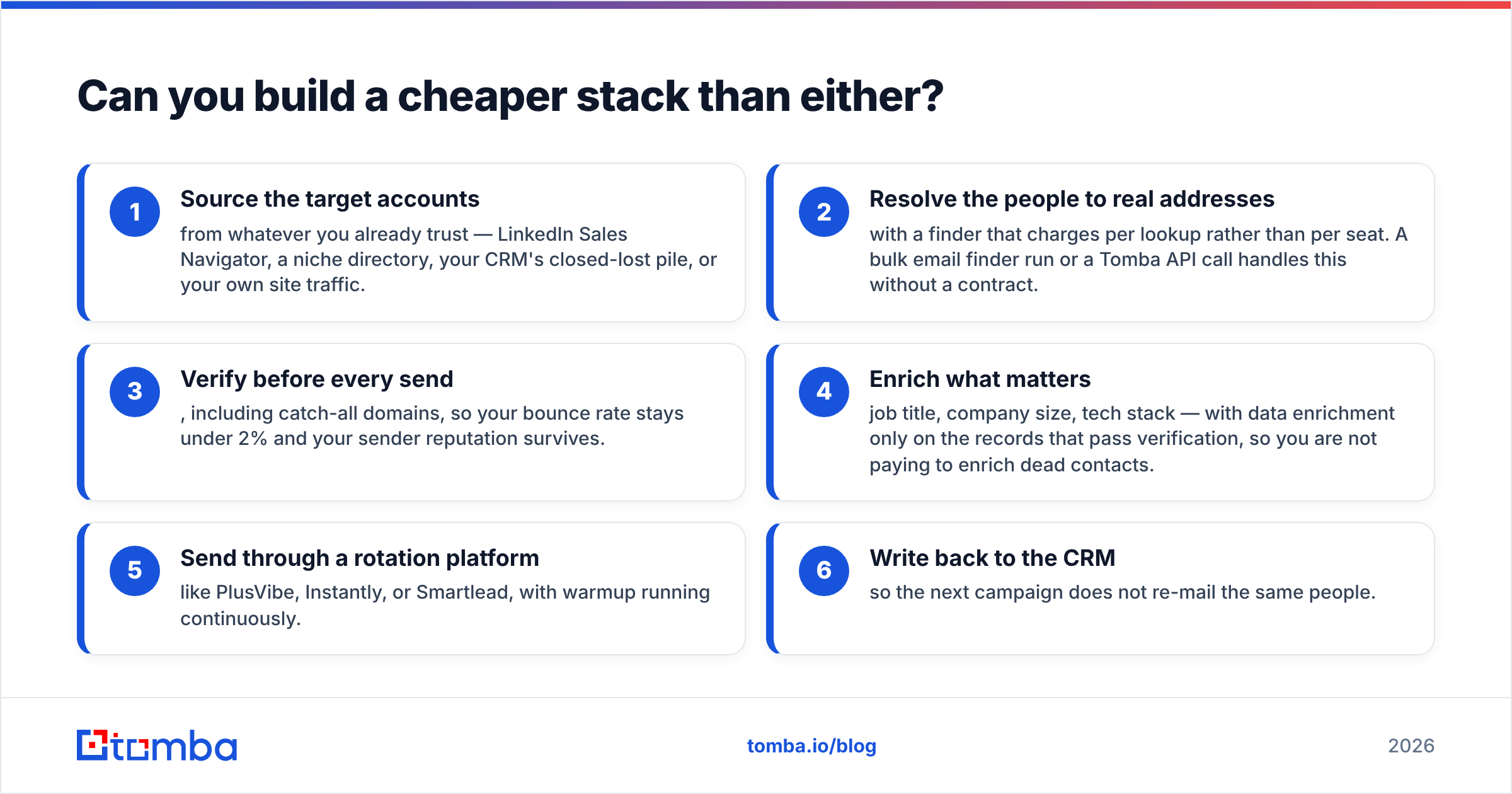
Yes, and most lean teams already have. The shape looks like this:
- Source the target accounts from whatever you already trust — LinkedIn Sales Navigator, a niche directory, your CRM's closed-lost pile, or your own site traffic.
- Resolve the people to real addresses with a finder that charges per lookup rather than per seat. A bulk email finder run or a Tomba API call handles this without a contract.
- Verify before every send, including catch-all domains, so your bounce rate stays under 2% and your sender reputation survives.
- Enrich what matters — job title, company size, tech stack — with data enrichment only on the records that pass verification, so you are not paying to enrich dead contacts.
- Send through a rotation platform like PlusVibe, Instantly, or Smartlead, with warmup running continuously.
- Write back to the CRM so the next campaign does not re-mail the same people.
That stack costs meaningfully less than a multi-seat database contract plus a sending platform, and it is modular: if the data layer underperforms in your vertical, you swap it next month instead of next year.
Worth noting that specialist database vendors still have a place in this picture. If you need deep firmographic filtering or verified direct dials at volume, providers like Lead411 and BookYourData both do things a pure finder API does not — pre-built list building with intent and firmographic depth. The question is whether you need that depth every month or twice a year.
Frequently asked questions#
Is PlusVibe a Lead411 alternative? Not really. PlusVibe can send the emails Lead411 finds, but it cannot replace Lead411's filtering, intent data, or direct dials. If you cancel Lead411 and keep PlusVibe, you still need a list source.
Does Lead411 send cold emails? No. It exports contacts and syncs to CRMs and sequencers. You need a separate sending tool.
Which has better email accuracy? Lead411, because it is the one actually sourcing the data. But re-verify any export before sending — database records decay continuously, and catch-all domains slip past basic checks in both products.
Can I use both together? That is the intended pattern: Lead411 for the list, PlusVibe for delivery. Add a verification pass between them and you have covered the gap neither one fully closes.
What is the cheapest way to test outbound in 2026? A free finder tier, a verified list of 200 highly targeted contacts, one warmed inbox, and a manual sequence. Buy tooling after you have proof the message works — not before.
Where to start#
Pick the layer that is actually broken. If your reply rate is fine but your list is empty, a database like Lead411 earns its cost. If your list is fine but your mail lands in spam, a sending platform like PlusVibe earns its cost. If you are honestly unsure which, the diagnostic is free: verify 500 of your existing contacts. If more than 8% fail, your problem is data, not delivery.
For the data half, start with Tomba Email Finder. The free tier covers 25 searches a month with no card, Starter runs $49/mo, and every paid plan includes API access — so you can test accuracy against your own accounts before committing a single dollar to an annual contract. Find the address, verify it, then let your sending platform do the one job it is good at.
Related guides#
// get started
Find, verify and enrich your first contacts today
Start on the free plan with 25 searches a month, then scale when your team is ready.
Free plan · No credit card required · GDPR & CCPA
// about the author