Lead411 vs Quickenrich: Which B2B Data Tool Wins in 2026?
Lead411 sells intent-backed contact data with triggers; Quickenrich sells cheap waterfall enrichment. We compare accuracy, pricing, contracts, and export limits to find which one actually fits your outbound motion.
Lead411 vs Quickenrich is a false choice for most teams. One is a full sales-intelligence platform. The other is a pay-per-result enrichment pipe. Here is how they differ, and when neither is the right buy.
TL;DR
- Lead411 is a full sales-intelligence platform. You get a contact database, intent signals, hiring and funding triggers, and a built-in email cadence tool. It sells on annual contracts, and real cost starts near $1,000 per seat per year.
- Quickenrich is a waterfall enrichment service. You send a name plus a domain, it queries several data vendors in turn, and you pay only for hits.
- They are not really competitors. Lead411 answers "who should I contact, and why now?" Quickenrich answers "I know who — give me the email."
- Accuracy: both lean on the same upstream sources. Waterfalls win on find rate. Databases win on speed and context.
- Need verified emails at a flat price? Tomba Email Finder does that job at $49/mo, with no annual contract.
What is Lead411 and who actually buys it?#
Lead411 is a B2B sales-intelligence platform. It launched in 2001, so its data operation is older than most tools it competes with today. You can see the current positioning on lead411.com. The pitch is one workspace. A rep finds a company, sees that it just raised a Series B or posted twelve sales-engineer roles, pulls a direct dial and a verified email, then drops the contact into a sequence. No tab switching.
SDR teams that run trigger-based outbound get the most value. Say your ICP is "companies that just hired a VP of RevOps." Lead411 sells you that signal first, and the contact record is almost a bonus. Its intent layer runs on third-party topic data, so you get a weekly list of accounts reading up on your category.
Procurement is where it gets harder. Lead411 sells by the year and by the seat, with export caps written into the contract. Reviews on G2 praise the data and grumble about those caps and renewal terms. That is the trade. You get a curated platform, and you commit for a year.

What is Quickenrich and how does waterfall enrichment work?#
Quickenrich belongs to a newer category: waterfall enrichment. Instead of keeping one database, it works as a router. You send a contact — a name plus a company domain, or a LinkedIn URL. It asks provider A. If A has nothing, it tries B, then C, then D, until something comes back.
Think of it like calling three locksmiths instead of one. Any single locksmith might be out of town. The odds that all three are out drop sharply. That is the whole pitch of a waterfall: the combined find rate beats any single source.
The billing follows from that. You pay per successful enrichment, not per lookup. A miss costs nothing. For teams with uneven volume — 4,000 contacts one month, 300 the next — that is far cheaper than a seat licence sitting idle.
The catch is that a waterfall gives you a field, not a workflow. There is no intent feed, no company news, and no built-in sequencer. You cannot ask it for "every fintech company in Austin with 50–200 employees." You have to know who you want already. If your list comes from somewhere else — a scraper, a Sales Navigator export, a partner list, your own CRM — the waterfall finishes the job. With no list, it has nothing to enrich.
Lead411 vs Quickenrich: how do they compare?#
Here is the practical breakdown. Quickenrich pricing is credit-based, so the monthly figure depends on how many contacts you enrich.
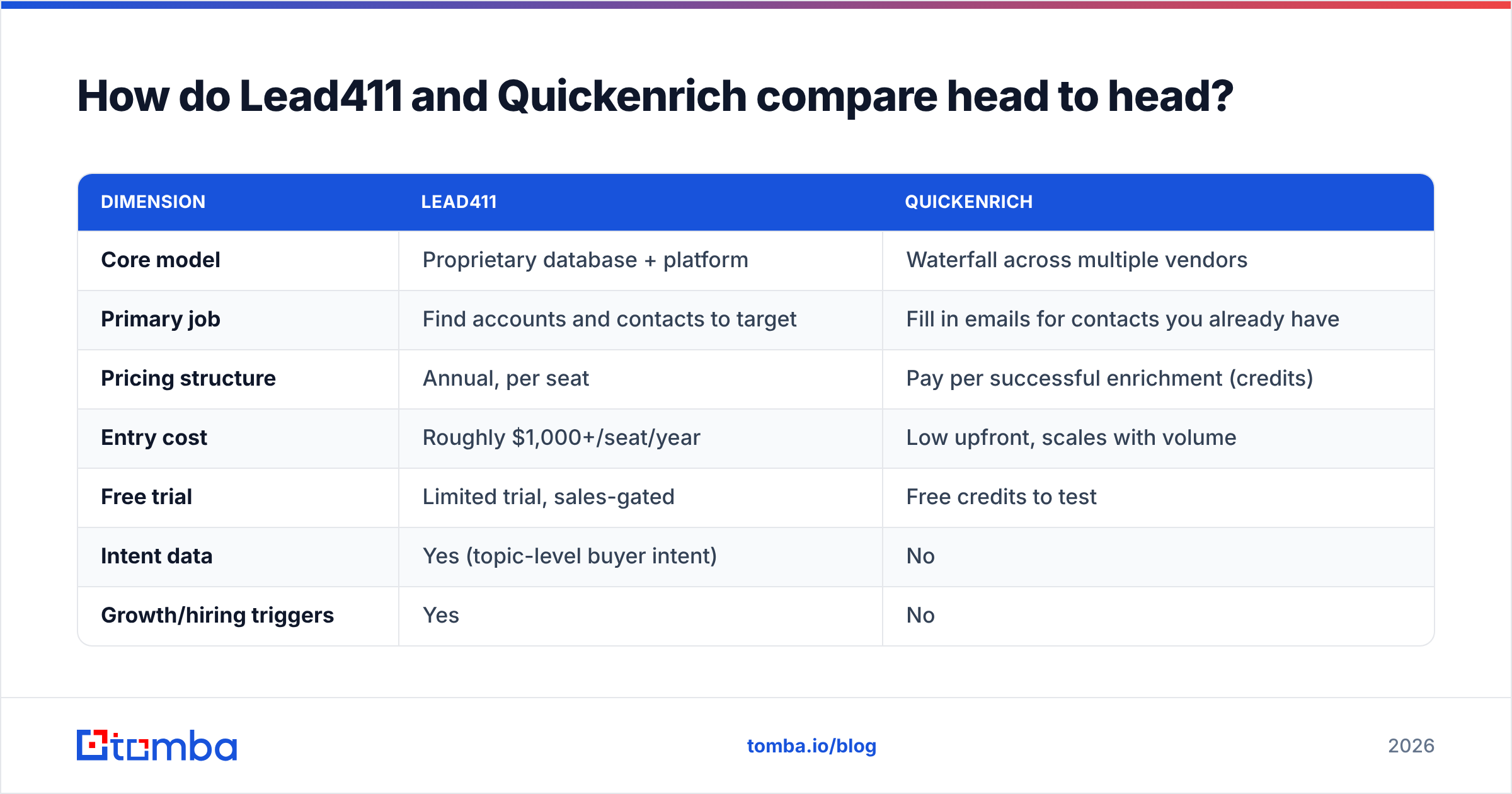
| Dimension | Lead411 | Quickenrich |
|---|---|---|
| Core model | Proprietary database + platform | Waterfall across multiple vendors |
| Primary job | Find accounts and contacts to target | Fill in emails for contacts you already have |
| Pricing structure | Annual, per seat | Pay per successful enrichment (credits) |
| Entry cost | Roughly $1,000+/seat/year | Low upfront, scales with volume |
| Free trial | Limited trial, sales-gated | Free credits to test |
| Intent data | Yes (topic-level buyer intent) | No |
| Growth/hiring triggers | Yes | No |
| Direct dials / phone | Yes, a core selling point | Varies by upstream provider |
| Bulk CSV enrichment | Yes, subject to export caps | Yes, core use case |
| API access | Yes, higher tiers | Yes, central to the product |
| Built-in email sequencer | Yes (Reach) | No |
| Best for | Trigger-based outbound teams | Ops teams cleaning and filling lists |
| Worst for | Low-volume or spiky usage | Teams with no list-building source |
The pattern is clear once you lay it out. Lead411 is a demand-generation platform with data inside it. Quickenrich is a data utility with no opinion about your go-to-market.
Which one has better data accuracy?#
Neither wins outright, and anyone who says otherwise is selling something. Accuracy in B2B contact data is not one number. It shifts by country, company size, seniority, and how recently the person changed jobs.
Some honest points that hold up in testing:
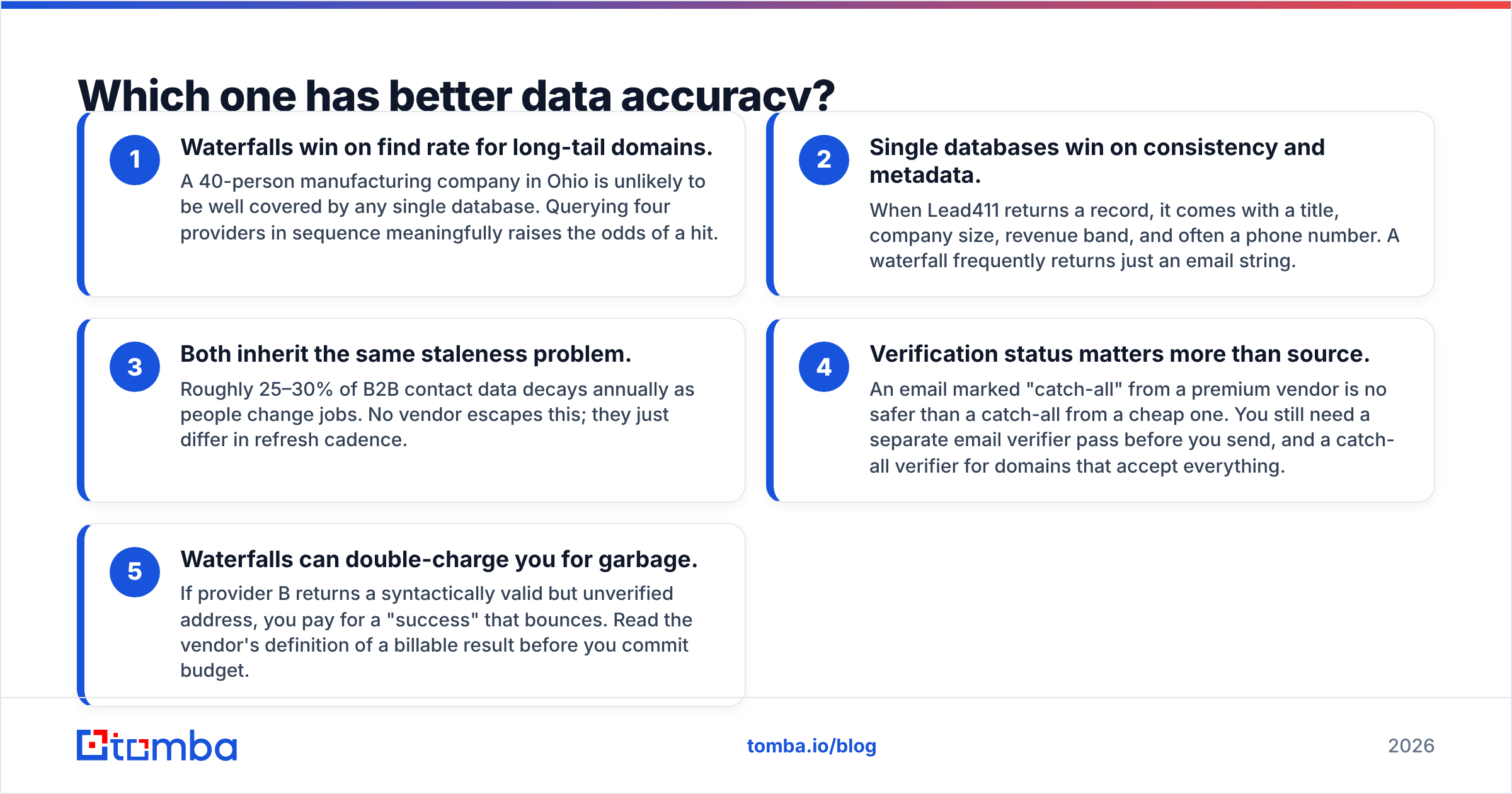
- Waterfalls win on find rate for long-tail domains. A 40-person manufacturer in Ohio is rarely covered by one database. Asking four providers raises the odds of a hit.
- Single databases win on context. A Lead411 record arrives with a title, company size, revenue band, and often a phone number. A waterfall often returns just an email.
- Both go stale. About 25–30% of B2B contact data decays each year as people change jobs. Vendors differ only in refresh speed.
Two more things matter more than the vendor name:
- Verification beats source. A "catch-all" from a premium vendor is no safer than one from a cheap vendor. Run an email verifier pass before you send, and a catch-all verifier for risky domains.
- Waterfalls can bill you for junk. A provider may return a valid-looking address that bounces. You still pay for that "success." Check how the vendor defines a billable result.
The takeaway is simple. Verify before you send, whichever tool you buy. Treat every enrichment result as a candidate, not a fact. A bounce rate above 3% starts to damage your sender reputation, no matter what the list cost.
Is Lead411 worth the annual contract?#
It comes down to one question: does your outbound actually use intent signals?
If your reps work from trigger lists — funding events, hiring surges, tech installs, topic intent — the contract makes sense. You are not paying for emails. You are paying for the layer that tells a rep which 200 of 8,000 accounts to touch this week. That layer is hard to rebuild from point tools.
If your reps work from a static ICP list that changes each quarter, you are paying platform prices for a lookup service. The intent feed turns into a dashboard nobody opens. Then the annual commitment is dead weight. This is the most common complaint in Lead411 reviews on Capterra: teams that bought the platform and used 10% of it.
Two procurement details are worth negotiating before you sign:
- Export caps. Ask for the per-user monthly export limit in writing. Platform-wide "unlimited" claims often carry a fair-use ceiling.
- Seat minimums and mid-term adds. Confirm what a new seat costs in month seven versus at renewal.
Is Quickenrich cheaper than it looks?#
Sometimes. Pay-per-result is genuinely attractive. Three things still inflate the real cost.
Credit use is hard to predict. You pay per hit. So a clean list with a 90% find rate costs three times more to enrich than a messy list with a 30% find rate. Teams budget for the miss rate, then get surprised by the hit rate.
Verification is usually separate. Finding an address and proving it accepts mail are two jobs. If the waterfall bills you for the find and you then run a verifier, your true cost per usable contact is both bills added up.
Bulk jobs run into rate limits. A waterfall works in sequence, so each provider in the chain adds delay. A 10,000-row file that a single API returns in minutes can take much longer through four vendors.
None of these are dealbreakers. They just mean the sticker price ("pennies per contact!") rarely survives a real 20,000-row job.
What are the alternatives to both?#
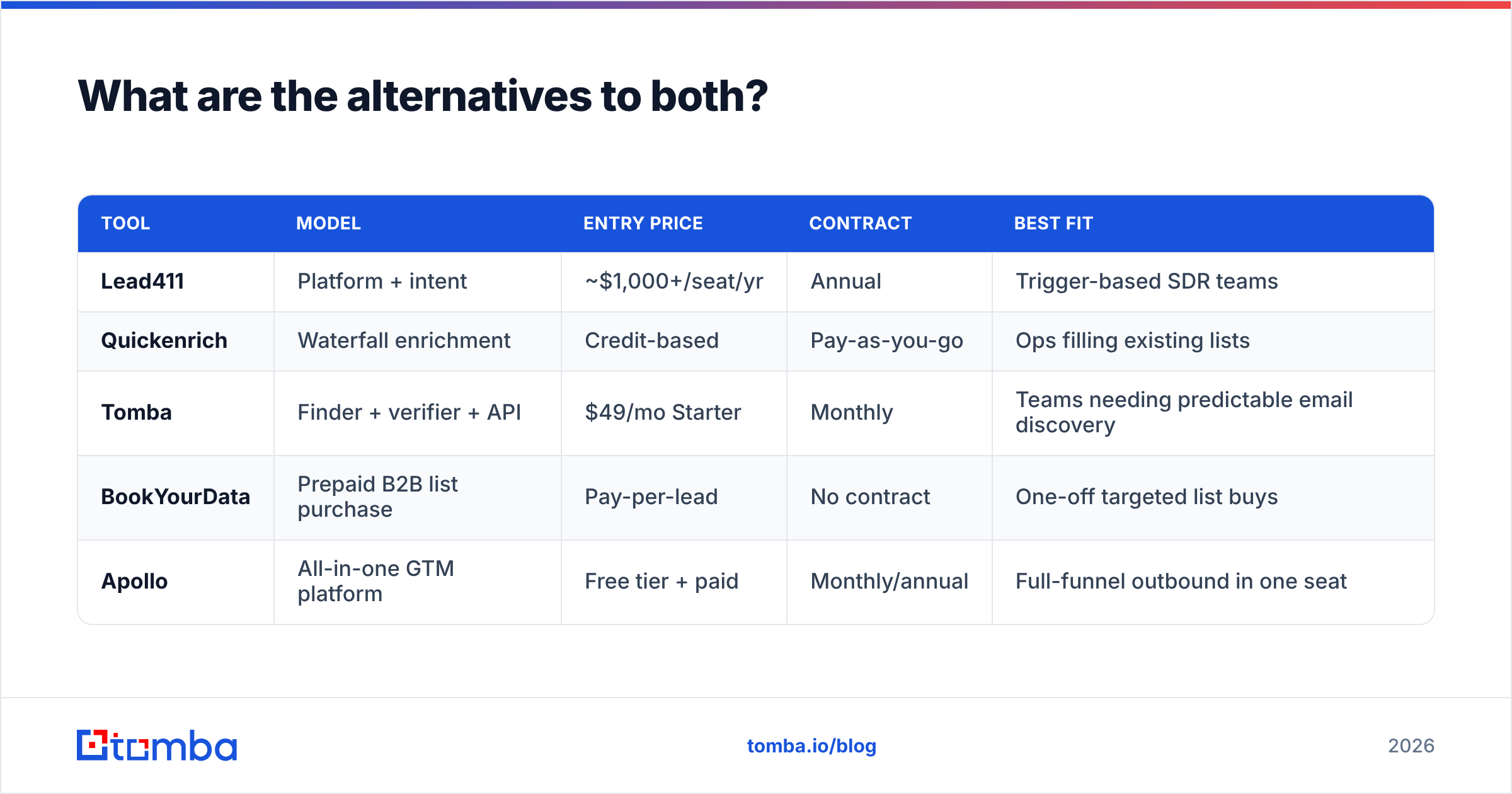
The Lead411 vs Quickenrich framing assumes you must pick between a heavy platform and a pure enrichment pipe. Most teams land on a third shape: a focused finder and verifier with a flat price and an API.
| Tool | Model | Entry price | Contract | Best fit |
|---|---|---|---|---|
| Lead411 | Platform + intent | ~$1,000+/seat/yr | Annual | Trigger-based SDR teams |
| Quickenrich | Waterfall enrichment | Credit-based | Pay-as-you-go | Ops filling existing lists |
| Tomba | Finder + verifier + API | $49/mo Starter | Monthly | Teams needing predictable email discovery |
| BookYourData | Prepaid B2B list purchase | Pay-per-lead | No contract | One-off targeted list buys |
| Apollo | All-in-one GTM platform | Free tier + paid | Monthly/annual | Full-funnel outbound in one seat |
BookYourData solves a different problem well. If you want a clean, targeted, verified list up front instead of an enrichment subscription, buying credits outright is often cheaper than licensing a platform you use twice a quarter.
For the finder-and-verifier lane, Tomba pricing runs Free (25 searches/mo), Starter $49/mo, Growth $99/mo, Pro $249/mo, and Enterprise custom. The difference versus both tools above is structural. You get monthly billing, no seat minimum, and domain search plus verification in one place. If you already have your account list and need emails at a known monthly cost, that fits better than a platform licence or a metered waterfall.
If you are weighing other platforms, the Apollo alternative and RocketReach alternative breakdowns cover the same trade-offs.
How should you decide between them?#
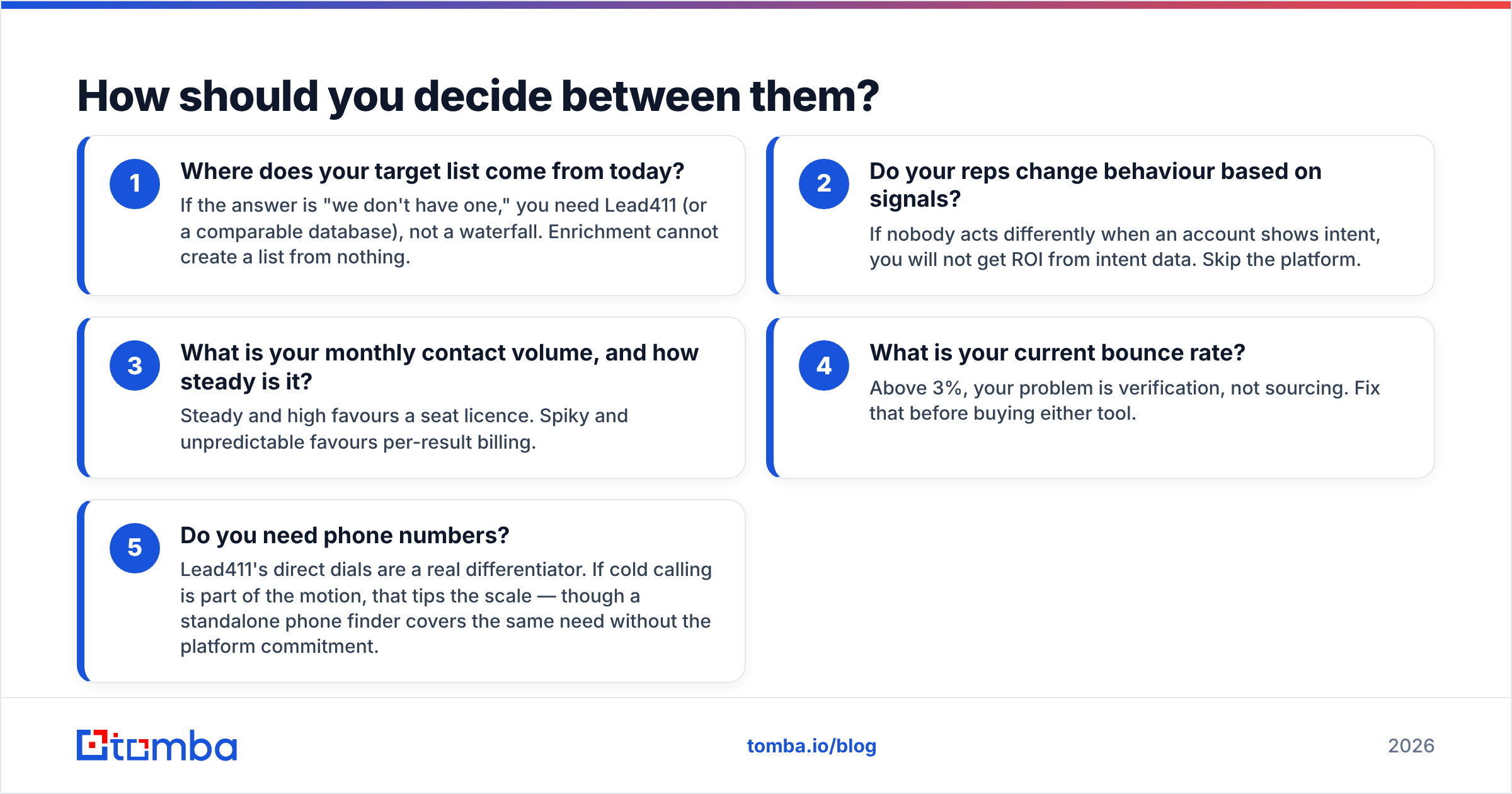
Run this sequence honestly:
- Where does your target list come from today? If the answer is "we don't have one," you need Lead411 or a comparable database, not a waterfall. Enrichment cannot create a list from nothing.
- Do your reps change behaviour based on signals? If nobody acts differently when an account shows intent, intent data will not pay for itself. Skip the platform.
- What is your monthly contact volume, and how steady is it? Steady and high favours a seat licence. Spiky volume favours per-result billing.
- What is your current bounce rate? Above 3%, your problem is verification, not sourcing. Fix that before you buy either tool.
- Do you need phone numbers? Lead411 direct dials are a real differentiator. If cold calling is part of the motion, that tips the scale. A standalone phone finder covers the same need without the platform commitment.
The teams that regret their purchase almost always skip step one. They buy an enrichment API because it is cheap, then find they have no reliable source of names to enrich. Or they buy a platform because the demo was impressive, then use it as a very expensive lookup box.
What does a realistic stack look like?#
Most working outbound stacks in 2026 split three jobs instead of buying one tool that claims all three:
- Targeting — deciding which accounts matter. Intent platforms, your own product analytics, or manual ICP research.
- Sourcing — getting names and emails for those accounts. A finder, a waterfall, or a purchased list.
- Validation — proving the addresses are safe to send to. A dedicated verifier, run right before every send, not at import time.
Lead411 tries to own all three plus sequencing. Quickenrich owns the middle one. Neither is wrong. They answer different questions. Splitting the stack usually costs less and breaks less often, because you can swap a weak layer without reopening a contract.
One habit is worth adopting whatever you buy. Re-verify any contact older than 90 days before it enters a sequence. Data decay is the silent killer of email deliverability, and it does not care what you paid.
The Lead411 vs Quickenrich verdict#
Pick Lead411 if your outbound is signal-driven and you have the budget for a platform seat. The intent and trigger layer is the product. The contact data is how it gets delivered. Just negotiate the export caps before signing.
Pick Quickenrich if you already have a list-building engine and need find rates higher than one source can deliver. Budget for the hit rate, not the miss rate, and plan a separate verification pass.
Pick neither if what you need is predictable, verified email discovery at a flat monthly cost. That is a narrower job than either tool is built for, and paying platform or metered prices for it is how outbound budgets quietly leak.
If that last line describes your team, start with the Tomba Email Finder. Find emails by domain, name, or company, verify them in the same pass, and stay on a monthly plan you can cancel. The free tier gives you 25 searches to test the find rate against your own ICP before you spend anything. That beats any comparison table, including this one.
Related guides#
// get started
Find, verify and enrich your first contacts today
Start on the free plan with 25 searches a month, then scale when your team is ready.
Free plan · No credit card required · GDPR & CCPA
Get the Tomba newsletter
Product and data updates
// about the author