Lead411 vs SignalHire: Which B2B Data Tool Wins in 2026?
Lead411 sells intent-driven sales intelligence with unlimited exports; SignalHire sells cheap credit-based contact lookup with phone numbers. Here is how they actually compare on data, pricing, and workflow fit.
Lead411 vs SignalHire looks like a fair fight. It is not. One tool builds target lists. The other digs up a phone number. This Lead411 vs SignalHire guide covers price, data quality, and the job each tool is really built for.
TL;DR
- Lead411 is a full sales intelligence platform. You get company and contact records, buyer intent from Bombora, growth triggers, and unlimited exports on most plans. Price: about $999 per user per year, usually on an annual deal.
- SignalHire is a light contact lookup tool. A browser extension pulls emails and phone numbers from LinkedIn and other profiles. Price: about $49 a month for 350 credits.
- These are not the same product. Lead411 sells who to call this quarter. SignalHire sells the phone number for this one person, right now.
- SignalHire often wins on mobile numbers per dollar. Lead411 wins on intent data, list building, and clean company records.
- Need verified work emails at scale through an API? Neither one is the cheap path. A finder and verifier like Tomba covers that layer for $49/mo, and you can keep or drop the heavier platform.
Lead411 vs SignalHire: what is each tool?#
Lead411 launched in 2001. It sells B2B sales intelligence, the category ZoomInfo rules. You search a database of companies and decision makers. You filter by tech stack and hiring signals. You get Bombora intent topics. It pushes records into HubSpot, Salesforce, and Pipedrive. The loudest selling point is unlimited exports. Most plans let you pull records without watching a credit counter drain.
SignalHire began as a recruiting tool, and it still shows. The core is a Chrome extension. Open a LinkedIn profile, a GitHub account, or a company page, then click the button. SignalHire returns emails and, the real draw, direct and mobile phone numbers. There is a web app with filters and an API. Still, the extension is what most users touch every day.
So the split is simple. Lead411 is where you pick who to contact. SignalHire is where you get the number for a person you already found. Teams that mix the two up overpay for one and feel let down by the other.
Lead411 vs SignalHire: how do they compare head to head?#
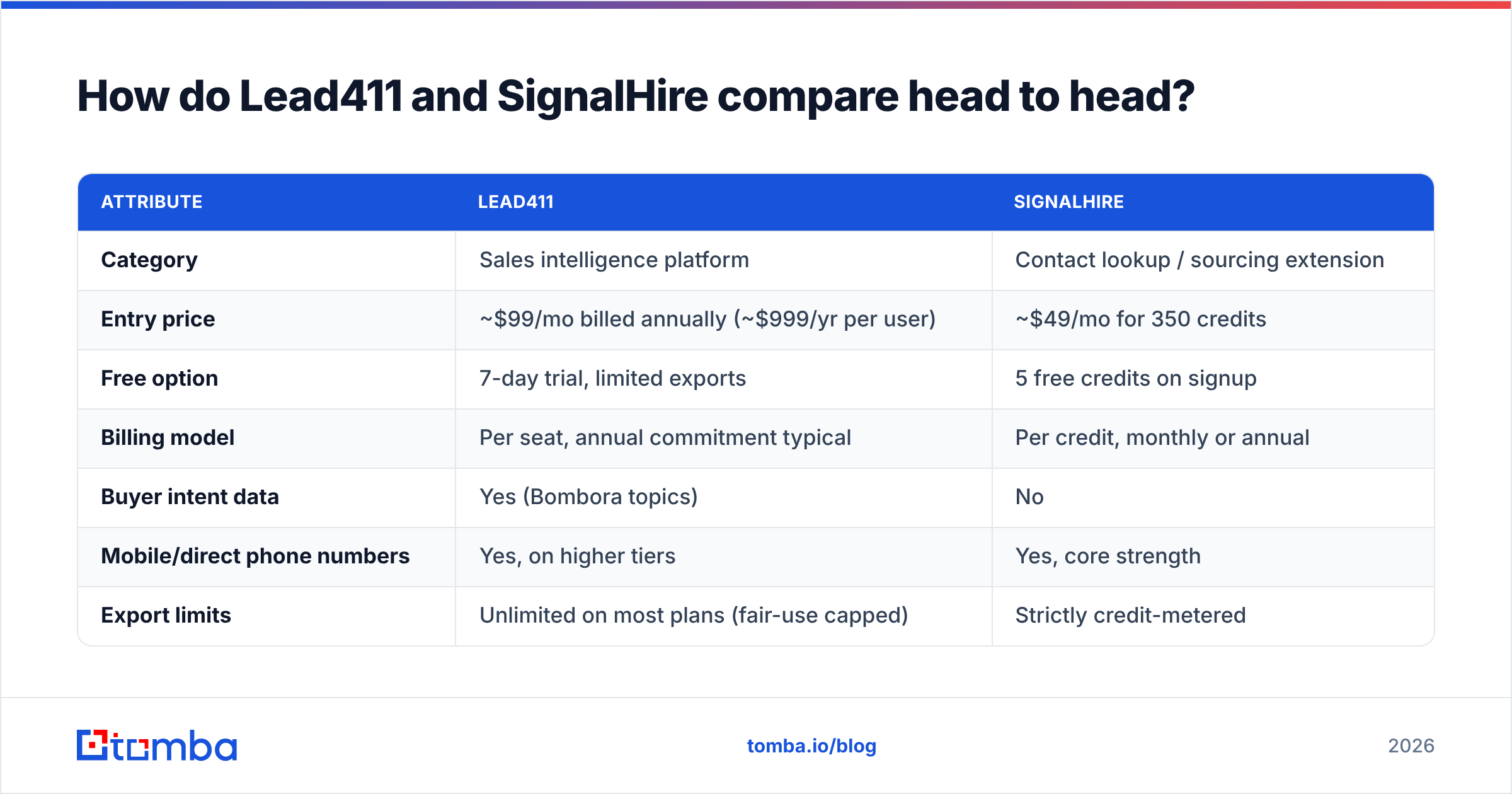
| Attribute | Lead411 | SignalHire |
|---|---|---|
| Category | Sales intelligence platform | Contact lookup / sourcing extension |
| Entry price | ~$49/mo for 350 credits | |
| Free option | 7-day trial, limited exports | 5 free credits on signup |
| Billing model | Per seat, annual commitment typical | Per credit, monthly or annual |
| Buyer intent data | Yes (Bombora topics) | No |
| Mobile/direct phone numbers | Yes, on higher tiers | Yes, core strength |
| Export limits | Unlimited on most plans (fair-use capped) | Strictly credit-metered |
| Browser extension | Yes | Yes — the primary interface |
| API access | Yes, add-on/enterprise | Yes, included on paid plans |
| Best for | Building target lists, ABM, intent-triggered outbound | Recruiting, one-off lookups, phone-first prospecting |
| Worst for | Teams needing <500 contacts/mo | Teams needing firmographic list-building |
Read that table twice before you book a demo. Half the Lead411 vs SignalHire debates on G2 compare a platform to a small utility. Then people act shocked that the utility has no intent scoring.
Lead411 vs SignalHire: how accurate is the data?#
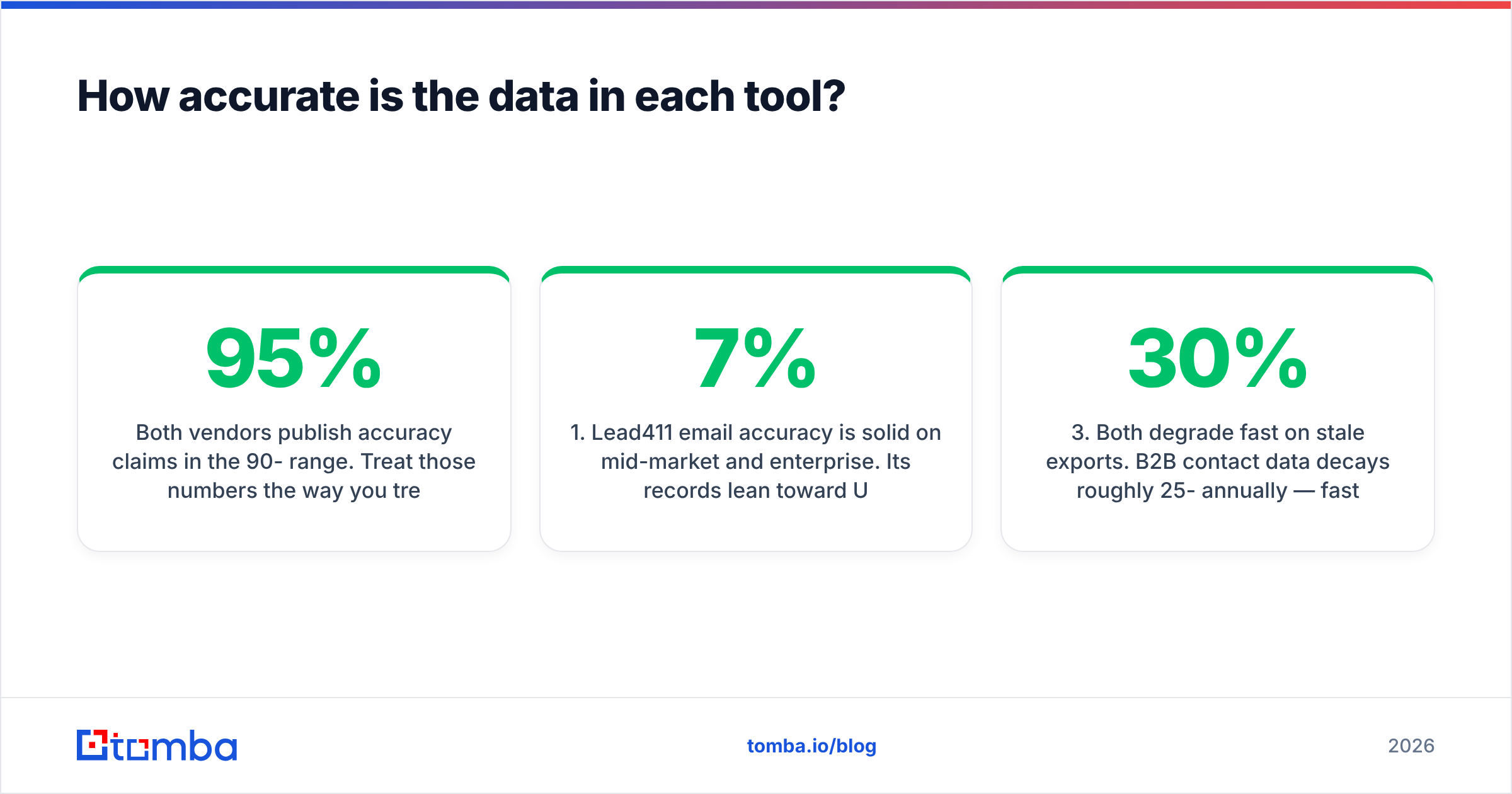
Both vendors claim 90-95% accuracy. Treat that like a restaurant grading its own food. Here is what holds up in real use.
- Lead411 email data is solid in the US mid-market. Its records lean to US firms with 50+ staff and a clear web presence. Bounce rates of 3-7% are normal when you export fresh and send within two weeks.
- SignalHire phone data beats its email data. Users say the mobile numbers earn the credits. The emails are hit or miss, mostly outside the US and at small firms.
- Both rot fast. B2B contact data decays 25-30% a year. Layoffs and job changes made that worse in 2025 and 2026. A list you pulled in March is much weaker by September.
- Neither tool verifies. Both return addresses with a confidence flag. Neither runs the deep SMTP and catch-all checks that a real email verifier runs. Cold sending needs that second pass.
- Catch-all domains are the quiet killer. Many "valid" B2B emails sit behind servers that accept every address. Without a catch-all verifier you cannot tell a real inbox from a black hole. Your sender score pays for the guess.
Here is the honest read. Freshness beats brand name. Pull the record late and verify it before you send, and the vendor matters much less.
Lead411 vs SignalHire pricing: what does each one cost?#
Price is where the two split hardest. It is also where buyers get caught out.
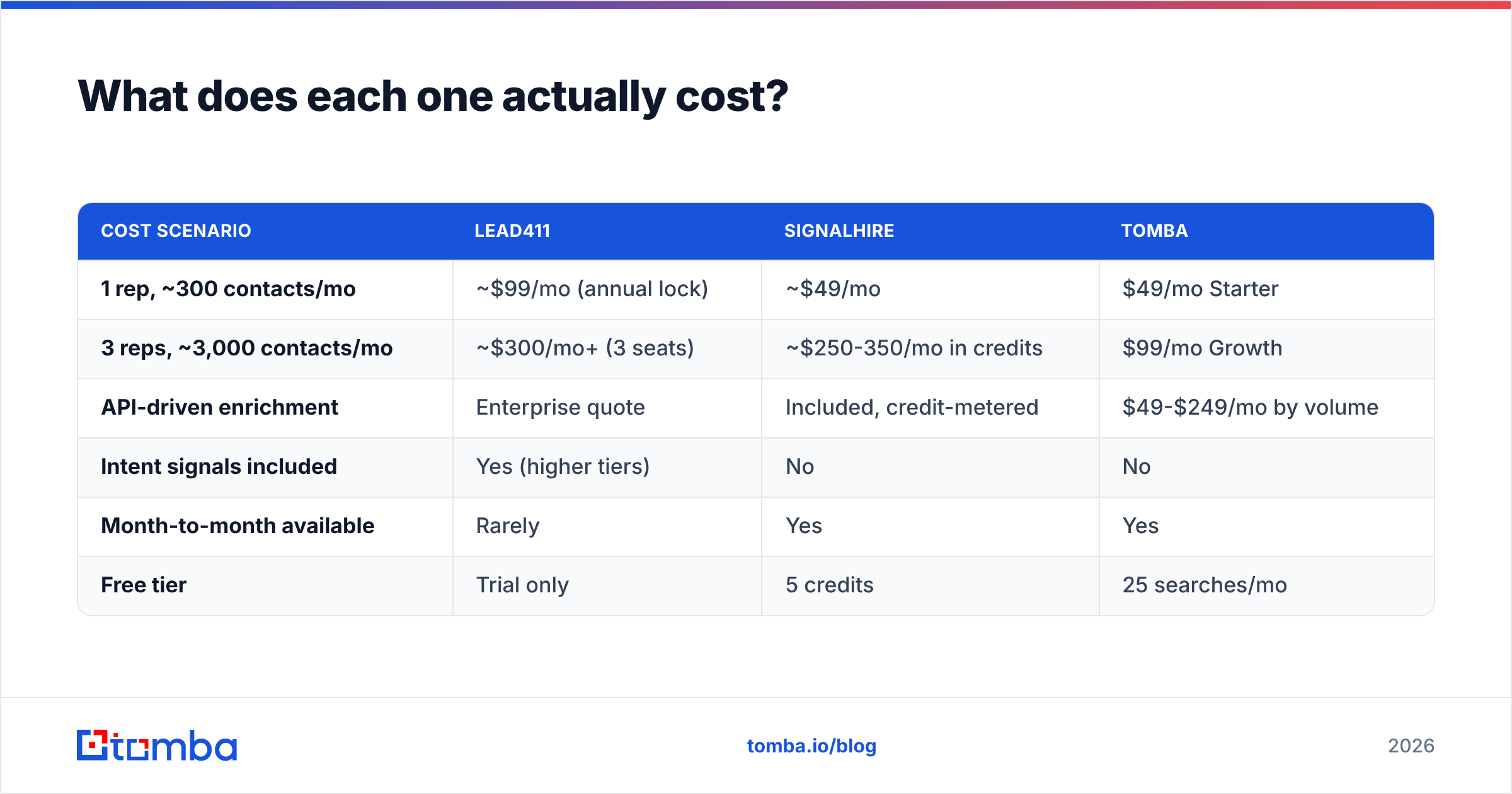
Lead411 lists a Basic Plus plan near $99 a month per user on an annual deal. Call it $999 to $1,188 per seat per year. You get unlimited email and company views within fair use, some direct dials, and core CRM links. Intent data, better filters, and bigger dial pools sit on Pro and Enterprise quotes.
The common gripe on review sites is the contract. Terms run a year, renewal is automatic, and mid-term downgrades are hard. Read the renewal clause before you sign.
SignalHire is much simpler. About $49 a month buys roughly 350 credits. Bigger bundles push the cost toward $0.10-$0.15 per credit. One credit reveals one contact. There are no seat minimums and no annual lock on standard plans. Credit rollover differs between monthly and annual plans, so check the current terms on signalhire.com.
| Cost scenario | Lead411 | SignalHire | Tomba |
|---|---|---|---|
| 1 rep, ~300 contacts/mo | ~$99/mo (annual lock) | ~$49/mo | $49/mo Starter |
| 3 reps, ~3,000 contacts/mo | ~$300/mo+ (3 seats) | ~$250-350/mo in credits | $99/mo Growth |
| API-driven enrichment | Enterprise quote | Included, credit-metered | $49-$249/mo by volume |
| Intent signals included | Yes (higher tiers) | No | No |
| Month-to-month available | Rarely | Yes | Yes |
| Free tier | Trial only | 5 credits | 25 searches/mo |
The pattern is easy to see. Lead411 gets cheaper per record as volume grows, because exports are unlimited. SignalHire cost rises in a straight line. Pull 10,000 records a month and Lead411 wins the math. Pull 200 and SignalHire wins, while the annual deal is dead weight.

Is Lead411 intent data worth the extra spend?#
Sometimes. Intent data shows which accounts are reading about topics near your product. Think surges on "email deliverability tools" or "data warehouse migration". Lead411 buys this from Bombora, the co-op behind most of the category.
Intent pays off in three cases:
- Your deal size is big enough. Under about $10K a year, account-based plays cost more than they return.
- You can act in days, not weeks. Intent fades. Work a surge three weeks late and it is just a cold call.
- Your market is large. With 400 target accounts, call them all. You do not need a model to rank them.
If none of that fits, the intent tier is a line item you will never use. Forrester keeps finding the same gap. Buying intent data is easy. Acting on it is not. The tool is rarely the problem. The process is.
SignalHire has no answer here, and it does not pretend to. It is a lookup tool.
Lead411 vs SignalHire: which tool fits your team?#
Pick Lead411 if:
- You sell outbound to US mid-market or enterprise and build lists every week
- You want intent and hiring triggers next to your contact data
- Your export volume is high enough that credits would hurt
- You can live with a seat model and a year-long deal
Pick SignalHire if:
- You recruit, or you work the phone from LinkedIn
- Your volume is low or steady
- Mobile numbers matter more than company filters
- You want month to month, with no procurement cycle
Pick neither, or add a third layer, if:
- Your real problem is verified work emails at scale via API
- You already have a list source: a scraper, a B2B database, or your CRM
- You need to check catch-all domains before a send
- You are a small team, and $999 per seat per year is a real decision
That third group is bigger than vendors admit. Many teams weighing Lead411 vs SignalHire really have one problem. They hold 4,000 names and domains and need valid emails. That is a finder and verifier job, not a sales intelligence job. Tomba's email finder and bulk verify cover it for $49 a month on Starter and $99 on Growth. There is an email finder API if you want it inside your own pipeline.
How do they handle compliance and data sourcing?#
Both work under the same rules. Both had to adapt to GDPR, CCPA, and tighter EU enforcement.
Lead411 says it runs CCPA and GDPR processes, handles opt-outs, and sources from public web data, partners, and its own research. The data set is US-first. European coverage is thinner, so the rules matter more there.
SignalHire pulls from public profiles and its contributor network. The extension works on LinkedIn pages, so it sits in the same gray zone as every LinkedIn-adjacent tool. LinkedIn bans automated scraping, and it keeps going after scrapers. SignalHire does offer a removal and access flow. In short: if you sell into the EU, have your DPO read the sub-processor list first.
No vendor page replaces your own legal check. If you run cold outbound into Germany or France, that check protects you. A badge on a pricing page does not.
What do real users say on review sites?#
G2 and Capterra reviews from the last 18 months repeat the same points.
Lead411 praise: unlimited exports, fast support, strong US mid-market data, and intent that helps when you act quickly. Lead411 gripes: rigid contracts, renewal surprises, a dated UI, and thin data outside the US.
SignalHire praise: phone hit rate, simple pricing, a fast extension, and a good fit for recruiting. SignalHire gripes: shaky email data outside the US, credits that burn fast, and a thin search screen.
Notice the symmetry. Nobody complains about Lead411 credit limits. Nobody complains about a SignalHire contract. Each weakness is the other tool's design choice.
What is the smarter stack in 2026?#
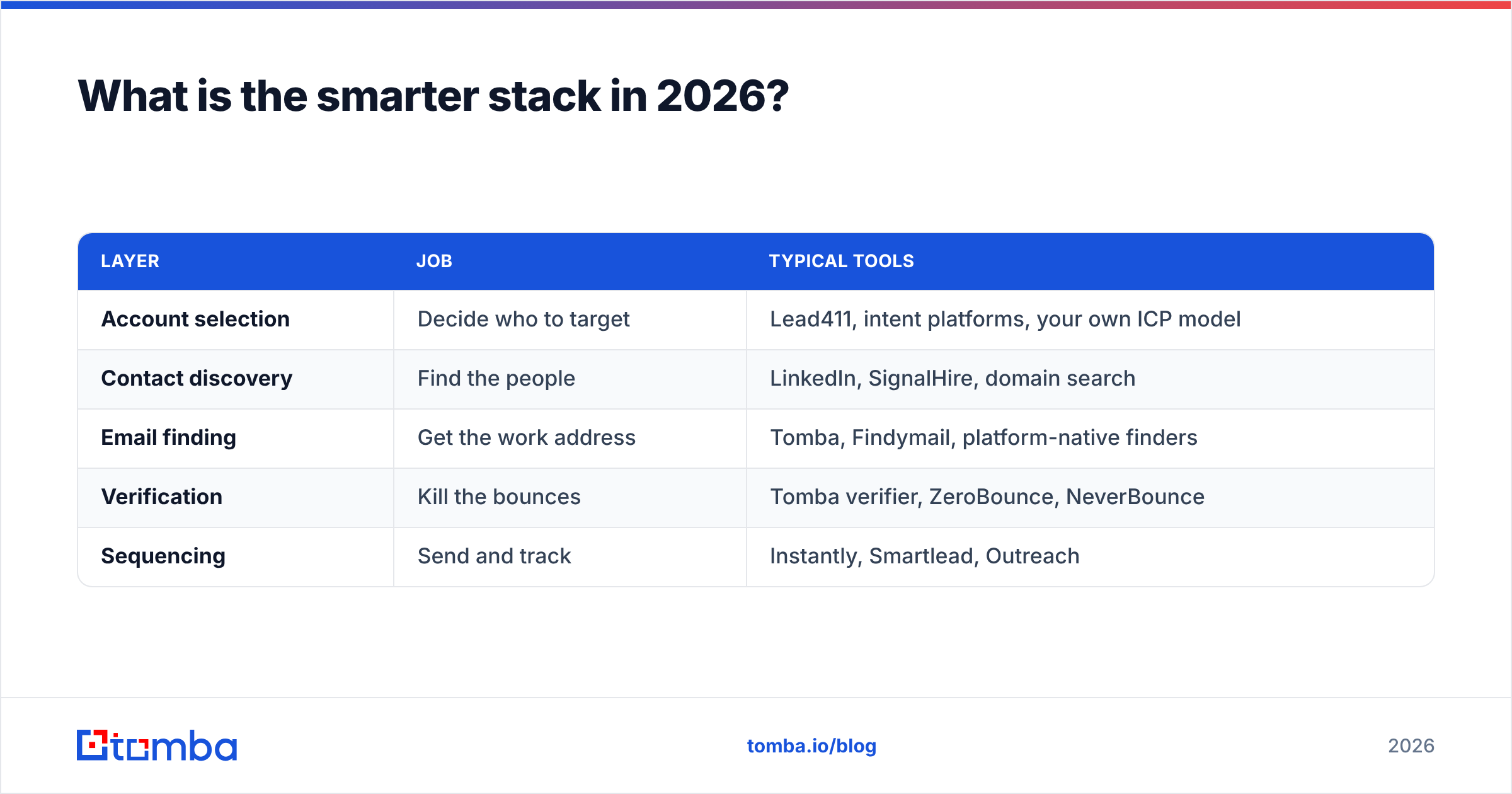
Teams that cut their spend tend to unbundle. Instead of one pricey platform doing everything at 70% quality, they split the job.
| Layer | Job | Typical tools |
|---|---|---|
| Account selection | Decide who to target | Lead411, intent platforms, your own ICP model |
| Contact discovery | Find the people | LinkedIn, SignalHire, domain search |
| Email finding | Get the work address | Tomba, Findymail, platform-native finders |
| Verification | Kill the bounces | Tomba verifier, ZeroBounce, NeverBounce |
| Sequencing | Send and track | Instantly, Smartlead, Outreach |
One vendor for all five layers is easy. It is also the priciest way to get a usable contact. Five best-in-class tools cost the least per contact and the most in glue work. Most teams land on two or three: a list source, a finder and verifier, and a sequencer.
Your broken layer picks the winner. If account selection is the bottleneck, Lead411 earns its price. If you cannot reach people by phone, SignalHire earns its credits. If your bounce rate is 12%, neither tool fixes it. A verify step does.
How should you run the evaluation?#
Skip the demo. Run a bake-off on your own data.
- Take 100 real target contacts. Use names and company domains from accounts you want.
- Run them through each trial. Lead411 gives 7 days, SignalHire gives free credits, Tomba gives 25 free searches a month.
- Measure match rate. What share came back with any contact detail?
- Measure bounce rate. Verify, or send a small batch, then count hard bounces.
- Work out cost per usable contact. Divide total spend by contacts that matched and passed.
That last number is the only one that counts. It is almost never the number on the pricing page. A tool at $0.10 a credit with a 45% match rate costs $0.22 per usable contact. A tool at $0.20 a credit with a 90% match rate costs $0.22 too. The second one just saved you half the cleanup.
The Lead411 vs SignalHire verdict#
Lead411 wins when you need intelligence. It brings intent, triggers, list building at volume, and solid company records. You do have to absorb about $1,000 per seat per year on an annual term.
SignalHire wins when you need reach. It brings phone numbers, quick lookups from LinkedIn, and month-to-month pricing with no procurement cycle.
Neither one wins the email layer. That gap is worth closing on its own.
Is your outbound stalling on bad addresses rather than bad targeting? Start with the Tomba Email Finder. Search by domain, name, or company. Verify before you send. Run it through the API or the Chrome extension, with no annual contract. The free tier gives 25 searches a month to test your own list. Tomba pricing starts at $49 a month for Starter and $99 for Growth. Run the 100-contact bake-off above, and let cost per usable contact pick the winner.
Related guides#
// get started
Find, verify and enrich your first contacts today
Start on the free plan with 25 searches a month, then scale when your team is ready.
Free plan · No credit card required · GDPR & CCPA
Get the Tomba newsletter
Product and data updates
// about the author