Lead411 vs SphereScout: Which B2B Data Tool Wins in 2026?
One vendor has 20 years of contact data and intent signals. The other has almost no public footprint. Here is how to run the Lead411 vs SphereScout decision without signing a bad annual contract.
TL;DR
- Lead411 is a 20-year-old US-centric B2B sales intelligence platform: contact records with verified emails and direct-dial phones, plus Bombora-style intent data and growth triggers. Pricing is per-seat and effectively annual.
- SphereScout has almost no verifiable public footprint — no G2 review corpus, no published pricing page, no documented API reference that survives a search. That is not proof it is bad; it is proof you have to do the diligence yourself.
- If you need intent signals and a searchable US database, Lead411 is the safer default of the two.
- If you mostly need accurate emails at volume with an API, a dedicated email finder costs far less per record than either seat-based platform.
- Never sign an annual seat contract before a live bounce test on 200 of your own ICP records. That single step settles most vendor arguments in an afternoon.
What is Lead411 and what is SphereScout?#
Lead411 is a B2B sales intelligence provider that has been selling contact and company data since the mid-2000s. The product is a searchable database: you filter by title, industry, headcount, location, technology and revenue, then export or push contacts into your CRM. On top of the database it layers buyer-intent topics and "growth intent" triggers — hiring spikes, funding rounds, leadership changes — that are meant to tell you when an account is in-market, not just who works there. You can confirm the current feature set on the vendor's own site at lead411.com and read unfiltered practitioner feedback on its G2 profile.
SphereScout is the harder half of this comparison. Searches for the name do not surface a stable vendor site, a review corpus, published pricing, or public API documentation. There are a few possibilities: it is a very new entrant, a regional or white-labelled product, an internal tool name a team has adopted, or a brand that has since been renamed. We are not going to invent specifications to fill that gap.
So this post does two things. First, it gives you the honest Lead411 profile — what it does well, what it costs, where it frustrates people. Second, it gives you a repeatable evaluation framework you can point at SphereScout (or any low-visibility vendor) to decide in a week whether it belongs on your stack.
Here is the core of that framework — five checks, in order of how often they kill a deal:
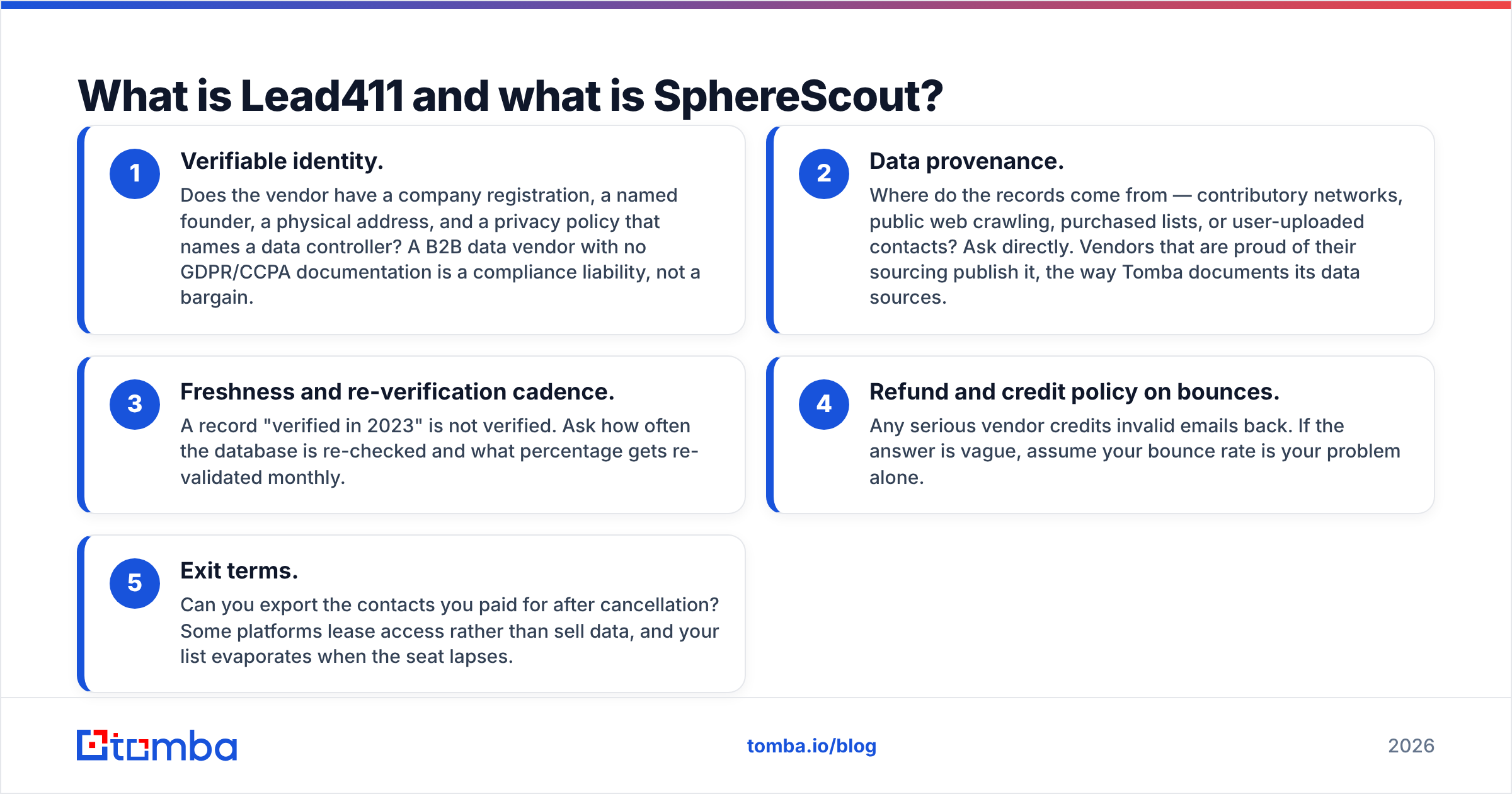
- Verifiable identity. Does the vendor have a company registration, a named founder, a physical address, and a privacy policy that names a data controller? A B2B data vendor with no GDPR/CCPA documentation is a compliance liability, not a bargain.
- Data provenance. Where do the records come from — contributory networks, public web crawling, purchased lists, or user-uploaded contacts? Ask directly. Vendors that are proud of their sourcing publish it, the way Tomba documents its data sources.
- Freshness and re-verification cadence. A record "verified in 2023" is not verified. Ask how often the database is re-checked and what percentage gets re-validated monthly.
- Refund and credit policy on bounces. Any serious vendor credits invalid emails back. If the answer is vague, assume your bounce rate is your problem alone.
- Exit terms. Can you export the contacts you paid for after cancellation? Some platforms lease access rather than sell data, and your list evaporates when the seat lapses.

How do Lead411 and SphereScout compare head to head?#
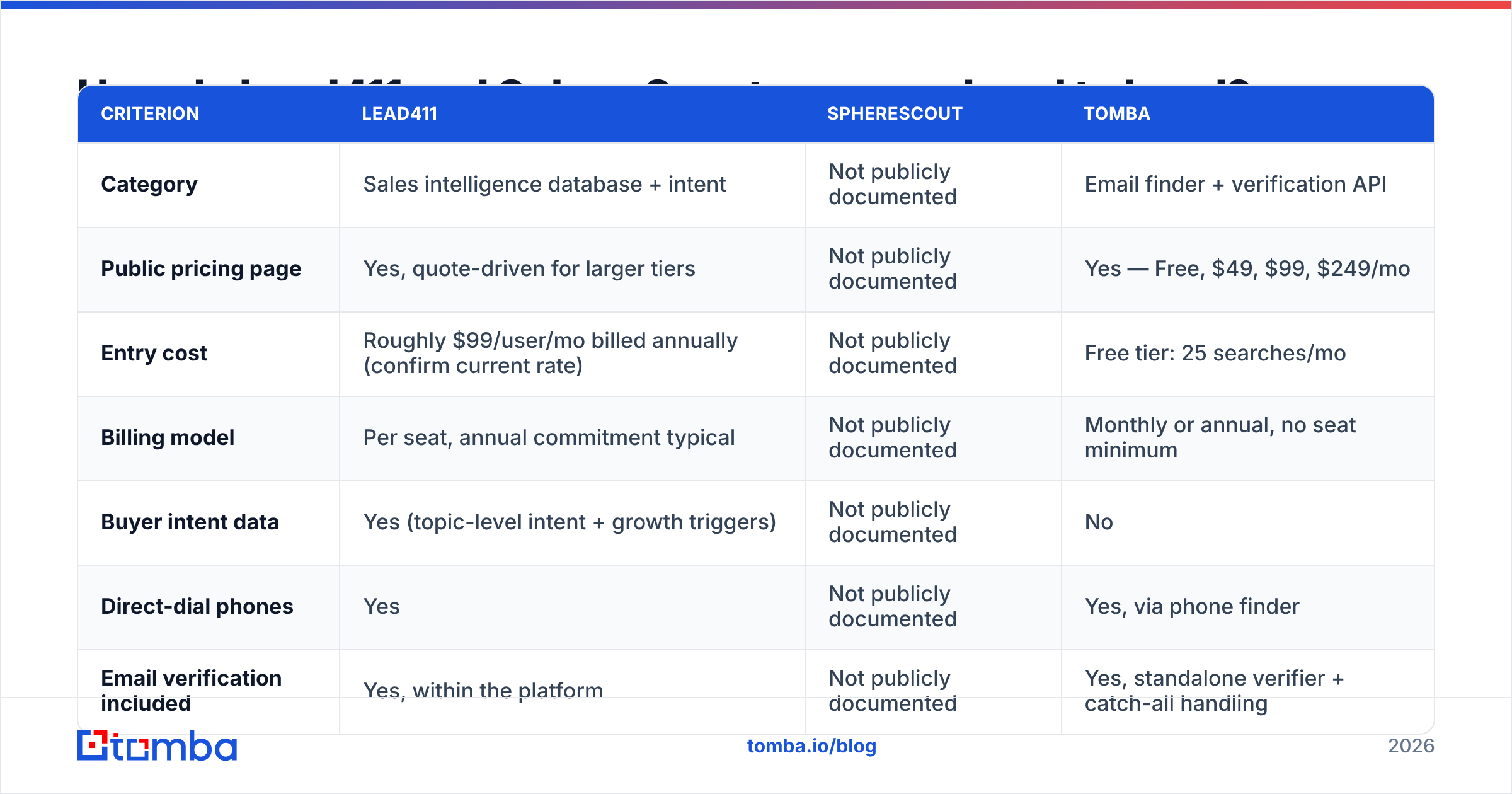
The table below is deliberately honest about the unknowns. "Not publicly documented" means exactly that — we could not verify it, and neither can you until the vendor tells you in writing. Treat every blank as a question for your sales call, and confirm all pricing directly with each vendor before you budget.
| Criterion | Lead411 | SphereScout | Tomba |
|---|---|---|---|
| Category | Sales intelligence database + intent | Not publicly documented | Email finder + verification API |
| Public pricing page | Yes, quote-driven for larger tiers | Not publicly documented | Yes — Free, $49, $99, $249/mo |
| Entry cost | Roughly $99/user/mo billed annually (confirm current rate) | Not publicly documented | Free tier: 25 searches/mo |
| Billing model | Per seat, annual commitment typical | Not publicly documented | Monthly or annual, no seat minimum |
| Buyer intent data | Yes (topic-level intent + growth triggers) | Not publicly documented | No |
| Direct-dial phones | Yes | Not publicly documented | Yes, via phone finder |
| Email verification included | Yes, within the platform | Not publicly documented | Yes, standalone verifier + catch-all handling |
| Public API | Yes, on higher tiers | Not publicly documented | Yes, documented and self-serve |
| Geographic strength | Strongest in North America | Not publicly documented | Global, domain-based |
| Third-party review volume | Hundreds of reviews on G2 | Minimal to none found | Public reviews on G2 and Capterra |
The asymmetry in that table is the finding. When one column is full of verifiable specifics and the other is full of blanks, the risk is not that the unknown vendor is worse — it is that you cannot price the risk at all. Enterprise procurement teams call this vendor viability risk, and it is the single most common reason a cheaper data contract gets rejected in review.
How accurate is the data, really?#
Accuracy is the only metric that survives contact with a real campaign. Everything else — UI polish, filter depth, Chrome extension speed — is secondary to whether the address you exported actually receives mail.

Two things distort vendor accuracy claims, and both are worth understanding before you read any marketing page:
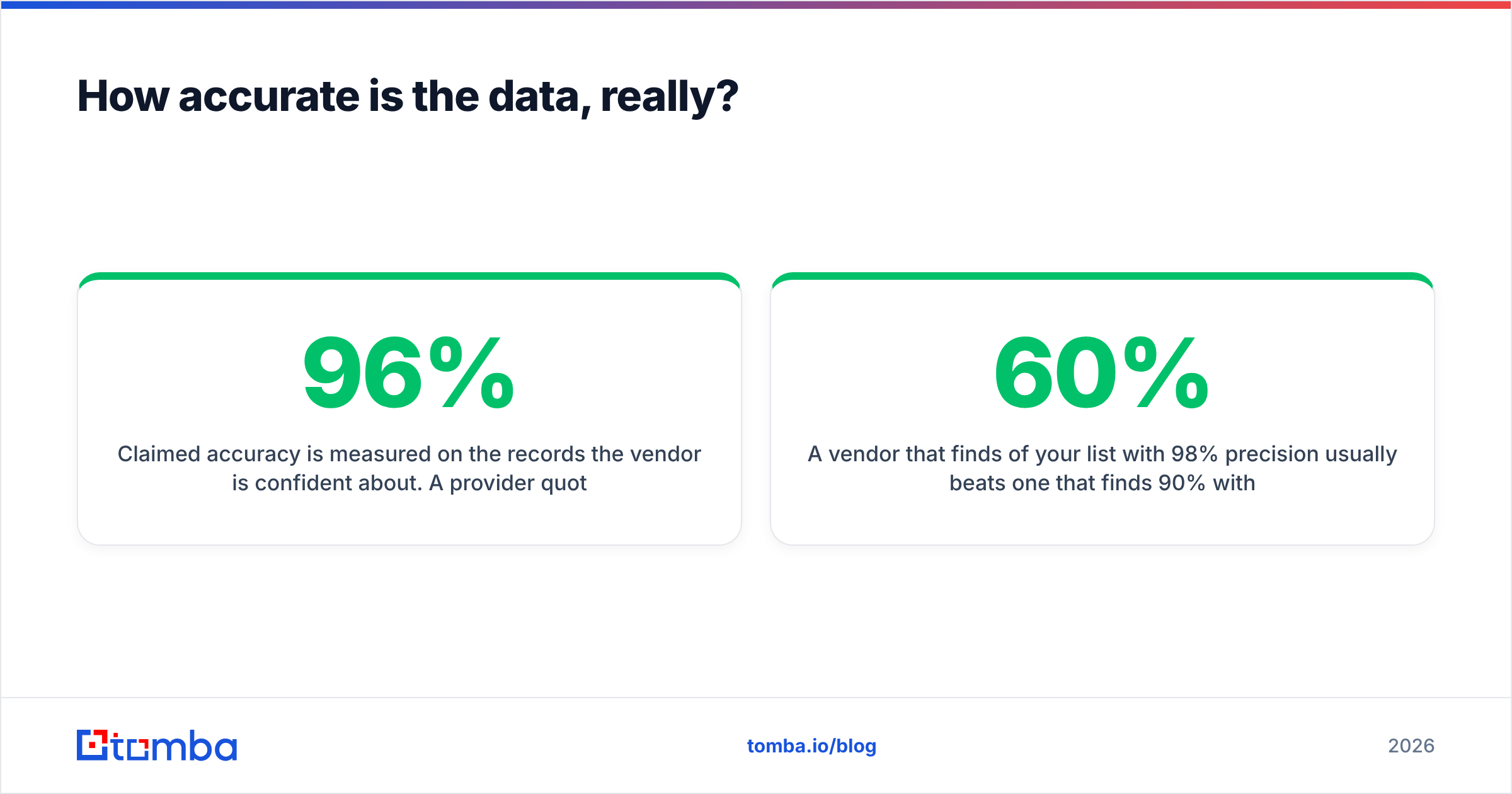
Claimed accuracy is measured on the records the vendor is confident about. A provider quoting "96% accuracy" is usually reporting on records it returned as valid, after suppressing everything ambiguous. If it declined to return an address for 40% of your list, that 96% is true and useless. The number you care about is coverage × accuracy — how many of your 1,000 target contacts you got a deliverable address for.
Catch-all domains inflate everything. A large share of B2B domains accept mail for any address at the SMTP layer, so a naive verifier marks them "valid" and moves on. Those records look fine in the export and bounce three weeks later, after they have already damaged your sender reputation. This is why a dedicated catch-all verifier matters more than another filter dropdown.
Run this test on both vendors before you commit:
- Pull 200 contacts you already know are real — current customers, past deals, people in your CRM with confirmed replies.
- Strip the emails and ask each vendor's trial to find them.
- Score three numbers: match rate (how many it found), exact-match rate (how many matched your known-good address), and catch-all share (how many it returned with no hard confirmation).
- Then send a warm, low-volume campaign to a 50-record sample and measure the actual bounce rate.
A vendor that finds 60% of your list with 98% precision usually beats one that finds 90% with 80% precision, because the second one costs you deliverability. If you want to sanity-check a handful of records without wiring anything up, a free email checker will settle individual cases in seconds.
What does Lead411 actually cost in 2026?#
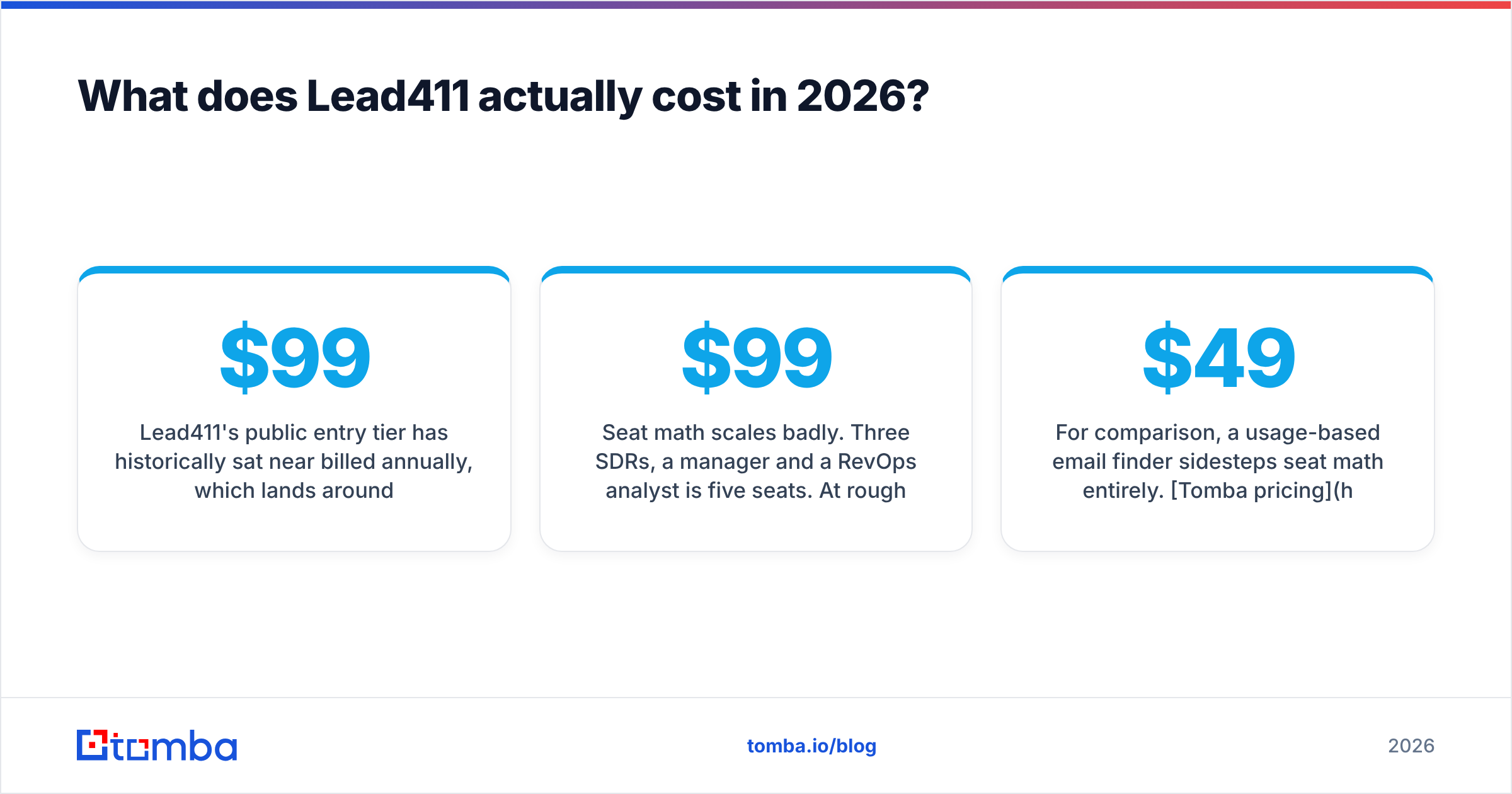
Lead411's public entry tier has historically sat near $99 per user per month billed annually, which lands around $1,188 per seat per year before any add-ons. Intent data, higher export limits and API access push the number up, and those tiers are quote-driven. Confirm the current figures with the vendor — data pricing moves, and anyone quoting you a hard number from a blog post is guessing.
Three cost patterns catch teams out, and none of them are unique to Lead411:
Seat math scales badly. Three SDRs, a manager and a RevOps analyst is five seats. At roughly $99/seat/month that is about $5,940 a year for a team that might only need 2,000 enriched records a month.
Export caps are the real unit of value. "Unlimited" usually means unlimited viewing with a monthly export ceiling. Compare vendors on exports per month, not on the word unlimited.
Annual commitment is the default. Monthly billing, where offered, carries a premium. That means your evaluation window is the trial — after signing, you own the decision for twelve months.

For comparison, a usage-based email finder sidesteps seat math entirely. Tomba pricing runs a free tier at 25 searches a month, Starter at $49/mo, Growth at $99/mo, Pro at $249/mo, and custom enterprise terms — billed on volume, not headcount. That is a different product shape, not a strictly better one: you do not get intent topics or a filterable firmographic database. But if the job is "find and verify emails for a list we already built," you are paying for the job rather than for the seats.

Which tool fits which team?#
Pick based on the job you actually have this quarter, not the platform you might grow into:
- You need to discover accounts you do not know yet. A searchable database with firmographic and technographic filters is the right shape. Lead411 handles this; a pure email finder does not.
- You already have the account list and need contacts. You need coverage and accuracy, not filters. A domain search that returns every public address at a company, plus verification, does this at a fraction of seat pricing.
- You need timing signals. Intent topics and growth triggers are Lead411's genuine differentiator among the two named options. If your motion depends on reaching accounts inside a buying window, that capability is worth paying for.
- You need US direct-dial phones. Lead411 is credible here. Validate the sample yourself — phone data decays faster than email, and a phone validator pass before dialing saves your reps hours of dead numbers.
- You need programmatic enrichment inside your own product or workflow. Prioritise documented API access, rate limits and per-call pricing over UI features. Seat-based platforms often gate the API behind the top tier.
- You are buying verified lists outright rather than subscribing. BookYourData is a solid peer option in that pay-as-you-go segment, with a bounce guarantee and no seat commitment — a different purchasing model that suits teams running occasional campaigns rather than continuous prospecting.
How should you evaluate a vendor with no public footprint?#
If SphereScout is on your shortlist because someone recommended it or it quoted an attractive price, run this sequence before you spend anything:
Ask for a sample against your own list, not theirs. Send 200 of your ICP records. A vendor confident in coverage will run them. One that insists on demoing with its own curated sample is telling you something.
Get the data-sourcing answer in writing. "Proprietary methods" is not an answer. Under GDPR you need a lawful basis for processing EU contact data, and "our supplier said it was fine" does not survive a complaint.
Check the company, not just the product. Company registry lookup, LinkedIn employee count, domain registration age, whether the support email resolves to a real mailbox. A reverse email lookup on the sales rep who contacted you takes thirty seconds and occasionally ends the evaluation early.
Insist on month-to-month for the first term. If the answer is annual-only for an unproven vendor, the risk sits entirely with you. That is a fine reason to walk.
Test the export path. Run a real export, open it, count the filled fields. Demos hide null columns; CSVs do not.
None of this is hostile. Good new vendors pass these checks easily and appreciate a buyer who knows what to ask. Vendors that cannot pass them were going to cost you more than the subscription fee.
What is the verdict on Lead411 vs SphereScout?#
Lead411 wins on verifiability. It is a known quantity with two decades of operating history, a public review corpus, genuine intent capability and US phone coverage. It is also seat-priced, annual by default, and strongest in North America — so it is a poor fit for a two-person team doing global outbound, and an expensive way to solve "we just need emails."
SphereScout cannot be recommended or dismissed on the evidence available. Run the five-point diligence above. If it clears every step and undercuts Lead411 meaningfully on your own test list, it may be the right call. If it stalls on sourcing or contract terms, you have your answer.
The third option is worth pricing before you choose either. Many teams shopping this category do not need a full intelligence platform — they need accurate addresses, verified before send, delivered through an API or a spreadsheet, without buying five seats. Split that job out and the budget question usually resolves itself.
Start with a real test rather than another demo. Point the Tomba Email Finder at 25 of your known-good contacts on the free tier, check the match and exact-match rates against your own records, then run the same list through whichever platform is quoting you an annual contract. Whichever way you decide, you will decide on your data instead of theirs — and that is the only comparison that ever holds up in a QBR.
Related guides#
// get started
Find, verify and enrich your first contacts today
Start on the free plan with 25 searches a month, then scale when your team is ready.
Free plan · No credit card required · GDPR & CCPA
Get the Tomba newsletter
Product and data updates
// about the author