Lead411 vs Startup Tracker: Which B2B Data Tool Wins in 2026?
Lead411 sells verified contacts with buying intent. Startup Tracker sells early-stage company signals. They solve different halves of the same problem — here's which one your pipeline actually needs, and what it costs.
TL;DR
- Lead411 is a contact database with intent. You search by title, industry, revenue, and technographics, then export verified emails and direct-dial phone numbers. Intent data (Bombora-powered) is its main differentiator.
- Startup Tracker is a company-signal tool. It watches funding rounds, new company registrations, hiring spikes, and early-stage momentum. It tells you who to target and when — not usually who to email.
- They are not substitutes. Lead411 answers "give me 500 VP Ops contacts at 50–200 employee SaaS firms." Startup Tracker answers "which companies just raised a seed round in fintech this month."
- Cost reality: Lead411 starts around $99/user/mo billed annually with export caps that bite fast. Startup-tracking tools cluster in the $0–$99/mo range but give you thin contact data.
- The common fix: pair a signal source with a dedicated email finder so you control contact discovery independently of whichever list vendor you rent this year.
If you searched "Lead411 vs Startup Tracker," you're probably deciding where a limited data budget goes. The honest answer is that these two categories overlap less than their marketing suggests, and picking wrong costs you a quarter of wasted outbound. Let's break down what each actually delivers.
What is Lead411 and who is it for?#
Lead411 is a B2B contact and company database that has been around since 2001. Its pitch is unlimited-ish access to verified emails and direct-dial mobile numbers, layered with buying-intent signals licensed from Bombora and growth triggers like recent funding or executive hires.
The practical workflow looks like this: you build a filter (industry, headcount, revenue band, tech stack, geography, title), preview the matching contacts, then export or push them into your CRM. A Chrome extension surfaces the same data while you browse LinkedIn or a company site.
Who it fits:
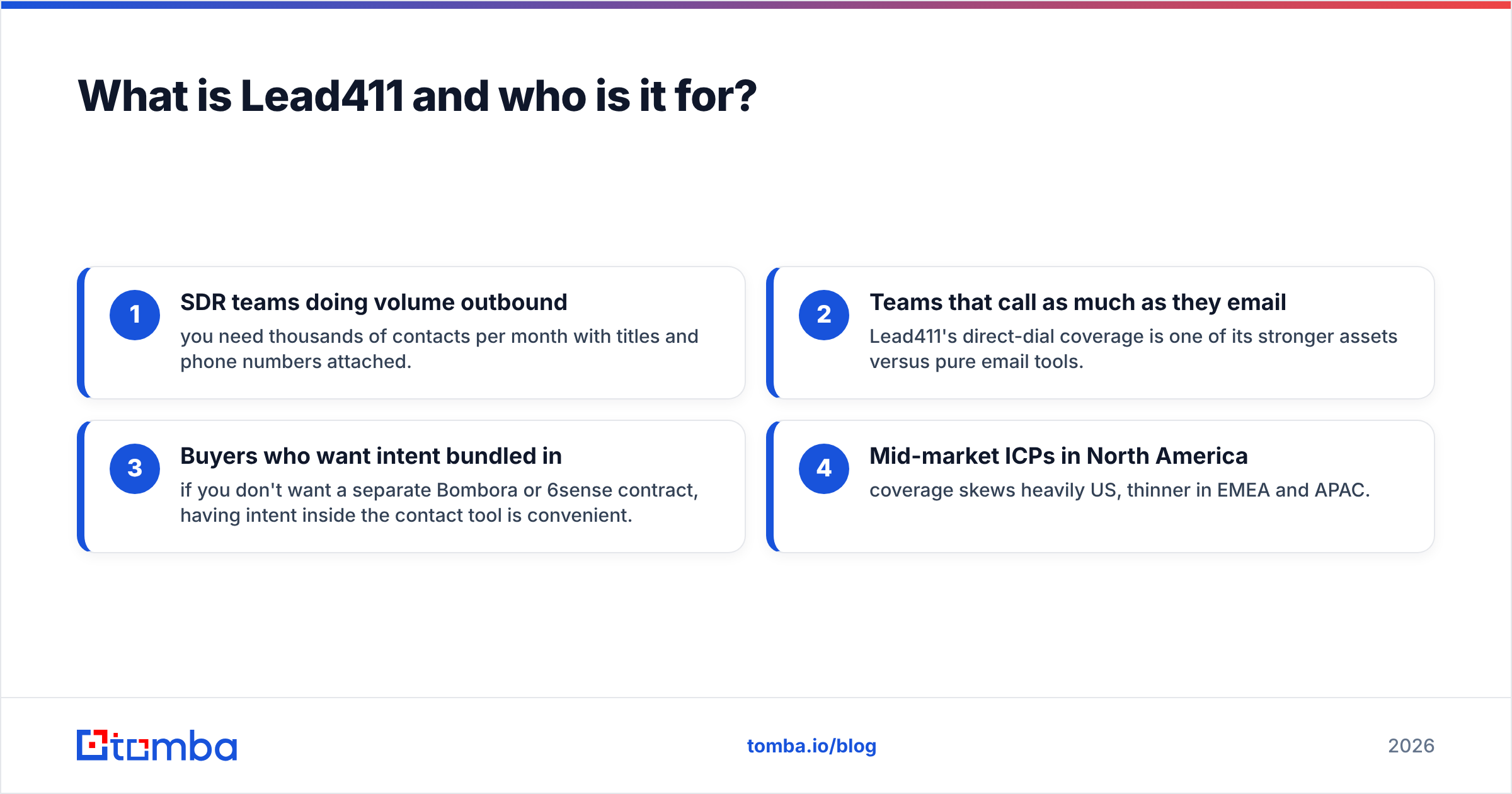
- SDR teams doing volume outbound — you need thousands of contacts per month with titles and phone numbers attached.
- Teams that call as much as they email — Lead411's direct-dial coverage is one of its stronger assets versus pure email tools.
- Buyers who want intent bundled in — if you don't want a separate Bombora or 6sense contract, having intent inside the contact tool is convenient.
- Mid-market ICPs in North America — coverage skews heavily US, thinner in EMEA and APAC.
Where it frustrates people: export limits. The marketing language around "unlimited" typically refers to viewing, not exporting. Annual export caps are the thing most reviewers on G2 flag, alongside per-seat pricing that makes it expensive to give the whole team access.

What is Startup Tracker and what problem does it solve?#
"Startup Tracker" refers to a category of tools — and several products carrying close variants of the name — that monitor early-stage company activity. The common feature set: newly registered companies, funding announcements pulled from filings and press, hiring velocity, website launches, and founder profiles.
The value is timing, not volume. A company that closed a $3M seed round eleven days ago has budget, a mandate to spend it, and no entrenched vendor relationships. That is a materially better moment to reach out than a cold list of 5,000 companies filtered only by SIC code.
What these tools typically give you:
- Funding events with round size, date, and investor names
- New company registrations from public business registries
- Headcount deltas scraped from LinkedIn or job boards
- Tech-stack adoption signals when a site starts loading a new script
- Founder/exec names — but often without verified work emails
That last bullet is the catch. Most startup-signal tools hand you a company and a founder name, then stop. You still need to resolve firstname@company.com yourself, which is where a domain search or dedicated finder enters the workflow.
Lead411 vs Startup Tracker: how do they compare head to head?#
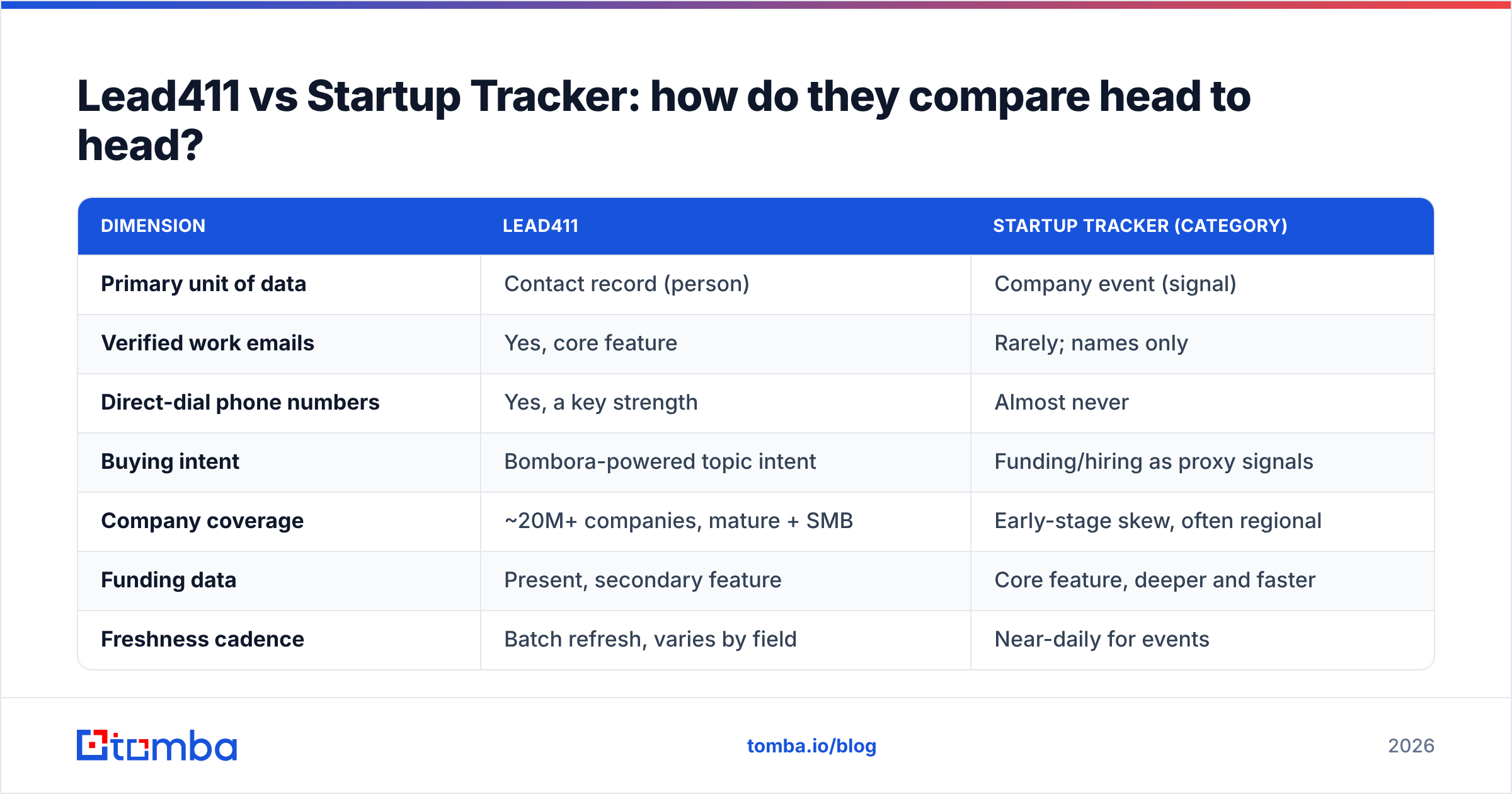
| Dimension | Lead411 | Startup Tracker (category) |
|---|---|---|
| Primary unit of data | Contact record (person) | Company event (signal) |
| Verified work emails | Yes, core feature | Rarely; names only |
| Direct-dial phone numbers | Yes, a key strength | Almost never |
| Buying intent | Bombora-powered topic intent | Funding/hiring as proxy signals |
| Company coverage | ~20M+ companies, mature + SMB | Early-stage skew, often regional |
| Funding data | Present, secondary feature | Core feature, deeper and faster |
| Freshness cadence | Batch refresh, varies by field | Near-daily for events |
| Typical entry price | ~$99/user/mo (annual) | $0–$99/mo, many free tiers |
| Export caps | Yes — annual limits per plan | Varies; often generous but thin data |
| CRM push | HubSpot, Salesforce, Pipedrive native | Usually CSV or Zapier only |
| Best for | Volume outbound, cold calling | Timing-based, low-volume ABM |
| Worst for | EU/APAC-heavy ICPs | Anyone needing contactable emails today |
Read that table as a division of labor rather than a scoreboard. Lead411 loses on signal freshness and early-stage coverage. Startup trackers lose on everything downstream of "here's an interesting company."
Which one has better data accuracy?#
Neither category publishes independently audited accuracy, so treat vendor claims of "95% verified" with the same skepticism you'd apply to any self-reported number. What you can control is verification at the point of use.
Lead411 runs its own verification and re-verification passes; in practice, users report solid results on US-based mid-market contacts and noticeably weaker results on non-English-speaking regions and companies under 20 employees. Startup trackers generally don't claim email accuracy at all because they mostly aren't supplying emails.
The workaround for both: run every exported list through an independent email verifier before it touches your sending domain. A 12% bounce rate on a 2,000-contact export will damage your sender reputation far more than the verification cost.
How does pricing actually compare?#
Published pricing on both sides is partial, so budget for a sales call with Lead411 and for free-tier limits with startup trackers.
| Plan tier | Lead411 | Typical startup tracker | Tomba (for reference) |
|---|---|---|---|
| Free | Limited trial, ~50 credits | Often free with delayed data | 25 searches/mo |
| Entry | ~$99/user/mo annual | $29–$49/mo | $49/mo Starter |
| Mid | ~$149+/user/mo | $79–$99/mo | $99/mo Growth |
| High volume | Custom enterprise | Rare; API add-on | $249/mo Pro |
| Seat model | Per-user, strict | Usually flat account | Flat, API-first |
| API access | Enterprise add-on | Sometimes | Included across paid tiers |
Two structural differences matter more than the headline numbers. First, per-seat vs flat: Lead411's per-user model means a five-person SDR pod costs five times the base. Second, export credits vs API calls: if you're enriching programmatically, a per-seat UI tool is the wrong shape, and you want something with an email finder API instead.
Compare against Tomba pricing not because it replaces intent data — it doesn't — but because the contact-resolution layer is the part you overpay for when it's bundled.
Should you use a signal tool, a database, or both?#
Both, if your motion is genuinely trigger-based. Here's the stack that works in practice:
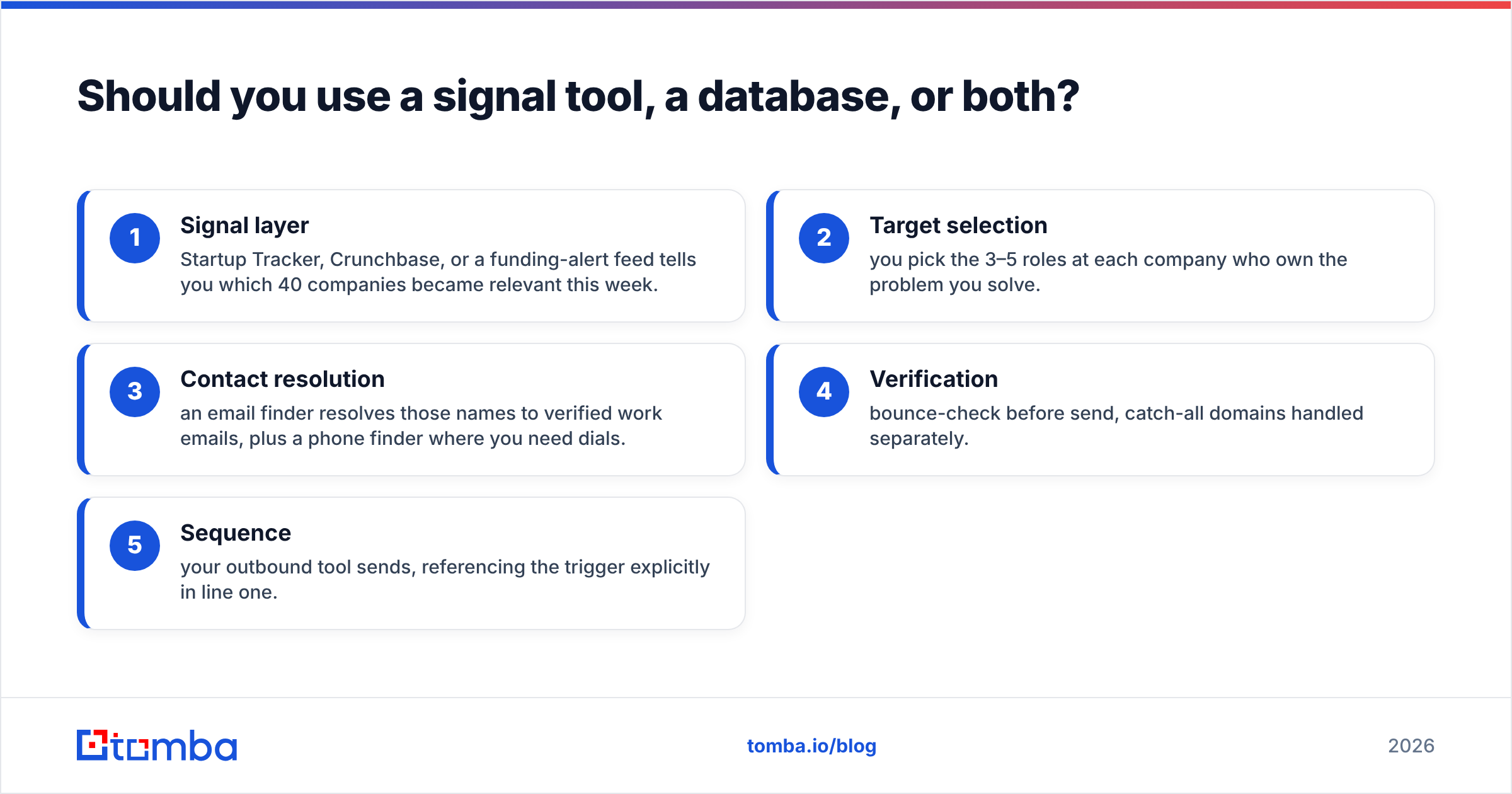
- Signal layer — Startup Tracker, Crunchbase, or a funding-alert feed tells you which 40 companies became relevant this week.
- Target selection — you pick the 3–5 roles at each company who own the problem you solve.
- Contact resolution — an email finder resolves those names to verified work emails, plus a phone finder where you need dials.
- Verification — bounce-check before send, catch-all domains handled separately.
- Sequence — your outbound tool sends, referencing the trigger explicitly in line one.
The reason to keep step 3 separate from step 1 is portability. Signal sources change constantly — a tracker that had great EU registry coverage in 2024 may lose it when a data partnership lapses. If your contact resolution lives inside the same contract, you rebuild the whole pipeline. If it's an independent API, you swap the signal source and nothing else breaks.

When is Lead411 clearly the right pick?#
Choose Lead411 when all three of these are true:
- You need phone numbers. If cold calling is a real channel for you, Lead411's direct-dial coverage is a genuine reason to pay. Most signal tools and many email finders don't compete here.
- Your ICP is US mid-market. 50–1,000 employees, North America, established industries. This is where the database is deepest.
- You want intent without a second contract. Bombora topic intent inside your contact tool is a real convenience if you'd otherwise buy it separately.
Skip it when your ICP is primarily European, primarily sub-20-employee companies, or when your team is two people who'd be paying per-seat for capacity you won't use.
When is a startup tracker clearly the right pick?#
Choose the signal tool when:
- Your product sells to new companies specifically — dev tools, fintech infrastructure, HR software for first-time hiring managers, accounting for newly incorporated firms.
- Volume is not your constraint. You send 200 highly personalized emails a month, not 5,000 templated ones.
- The funding event is the pitch. "Congrats on the seed — most teams at your stage hit X problem around month four" is a real opening line. A generic list gives you nothing comparable.
Skip it if you need to fill a 2,000-contact sequence next Monday. It won't get you there.
What are the credible alternatives to both?#
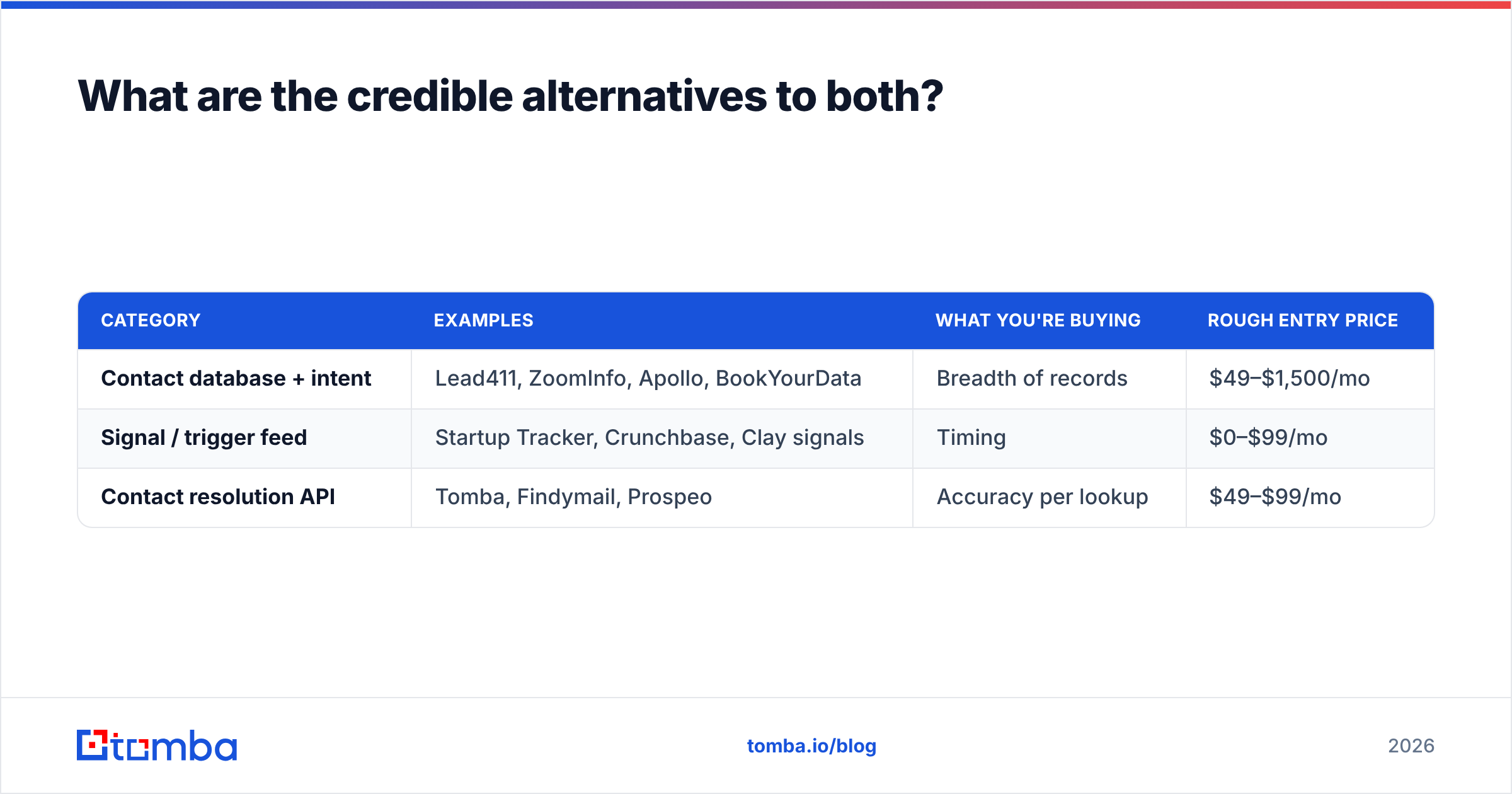
The market splits into three shapes, and most teams end up with one from each column:
| Category | Examples | What you're buying | Rough entry price |
|---|---|---|---|
| Contact database + intent | Lead411, ZoomInfo, Apollo, BookYourData | Breadth of records | $49–$1,500/mo |
| Signal / trigger feed | Startup Tracker, Crunchbase, Clay signals | Timing | $0–$99/mo |
| Contact resolution API | Tomba, Findymail, Prospeo | Accuracy per lookup | $49–$99/mo |
BookYourData sits interestingly here — it sells verified, pay-as-you-go B2B lists without a per-seat subscription, which solves the "I need 3,000 contacts once, not a $1,200 annual commitment" problem that both Lead411 and most trackers handle badly. If your buying pattern is project-based rather than continuous, that model is worth a look.
Apollo remains the default all-in-one for teams that want database plus sequencing in one bill; if that's your direction, the tradeoffs are covered in our Apollo alternative breakdown. For teams whose problem is specifically "the contact data inside my current tool bounces too much," the answer is usually an independent resolution layer rather than switching databases wholesale.
One more option worth naming: Crunchbase itself. It's the reference dataset most startup trackers derive from, and for funding-event monitoring alone its Pro tier is often cheaper and more complete than a wrapper product.
How do you evaluate either tool before committing?#
Run the same test on both, with your real ICP, before any annual contract:
- Build one ICP query. Not a broad one — the exact filter you'd use in production. Note how many records come back and how many have the fields you actually need populated.
- Export 100 records. Check field completeness: email present, phone present, title current, company size plausible.
- Verify independently. Run those 100 emails through a third-party verifier. Anything above 5% hard bounce is a problem at scale.
- Spot-check 10 by hand. Open the LinkedIn profile. Is the person still in that role? Role churn is the silent killer in B2B data — a record can be perfectly "valid" and completely useless.
- Test the trigger latency. For signal tools: find a funding round you know closed last week. Is it in the tool? How many days late?
- Price the real seat count. Not the demo seat. The number of people who'll actually log in.
That six-step test takes an afternoon and routinely saves teams from a $12,000 annual mistake. Vendors who won't give you enough trial credits to run it are telling you something.
What's the verdict?#
Lead411 wins if you need contactable people at scale, especially with phone numbers, in US mid-market. It's a mature database with a legitimate intent layer, priced per seat, with export caps you should read carefully before signing.
Startup Tracker wins if timing is your edge and volume isn't. It's cheap, the signals are genuinely actionable, and for products that sell to newly funded or newly formed companies, nothing a static database offers competes with a funding alert three days old.
Neither solves contact resolution well enough to be your only data vendor. Lead411 gives you emails but locks them behind seats and export limits. Startup trackers give you companies but leave you guessing at addresses. The durable architecture is a signal source you can swap, a resolution API you keep, and verification before every send.
If your gap is the middle layer — turning a company name and a person's name into a verified, deliverable work email — start with the Tomba Email Finder. The free tier gives you 25 searches a month to test accuracy against your own ICP, Starter runs $49/mo, and every paid plan includes API access so you can wire it behind whatever signal source you're using this quarter. Run your next 100 signal-sourced companies through it and compare the bounce rate against whatever you're paying for today.
Related guides#
// get started
Find, verify and enrich your first contacts today
Start on the free plan with 25 searches a month, then scale when your team is ready.
Free plan · No credit card required · GDPR & CCPA
// about the author