Lead411 vs Tomba: Which B2B Data Tool Wins in 2026?
Lead411 sells intent data and verified direct dials on annual contracts. Tomba sells email discovery and verification by the credit. Here's which one actually fits your outbound motion — and where each one falls apart.
TL;DR
- Lead411 is a full contact database with intent signals, verified direct-dial phone numbers, and a Chrome extension — sold mostly on annual contracts starting around $99/user/month billed yearly.
- Tomba is an email discovery and verification engine with a free tier (25 searches/mo) and paid plans at $49, $99, and $249/mo, plus a developer-grade API.
- Pick Lead411 if you need a triggered lead list with intent data and phone numbers, and you have budget for a seat-based annual commitment.
- Pick Tomba if you already know who you want to reach and need accurate, verified emails at volume — or if you're building the sourcing step into your own stack.
- The honest answer for most teams under 10 reps: run Tomba for discovery and verification, and only add an intent platform once you can prove you'd act on the signals.
What are Lead411 and Tomba, actually?#
They solve adjacent problems, not the same one.
Lead411 is a B2B data provider. You log in, build a filtered list (industry, headcount, tech stack, growth signals, job changes), and export contacts with emails and direct-dial numbers. Its differentiator is Bombora-powered intent data — a signal that a company is researching topics related to what you sell. Lead411 is a list-building and triggering tool first, a contact-finder second.
Tomba is the opposite shape. It starts from a domain or a person and resolves the email address. Its email finder takes a name plus a company domain and returns a verified address with a confidence score and the sources it was found on. Around it sit domain search, an email verifier, a catch-all verifier, phone finder, and data enrichment. Tomba is a resolution and verification layer — you bring the target, it brings the deliverable contact.
That difference drives almost every other comparison below. If you don't know who to call, Lead411 is the more useful starting point. If you know who but not how to reach them, Tomba is.

How do Lead411 and Tomba compare on features and pricing?#
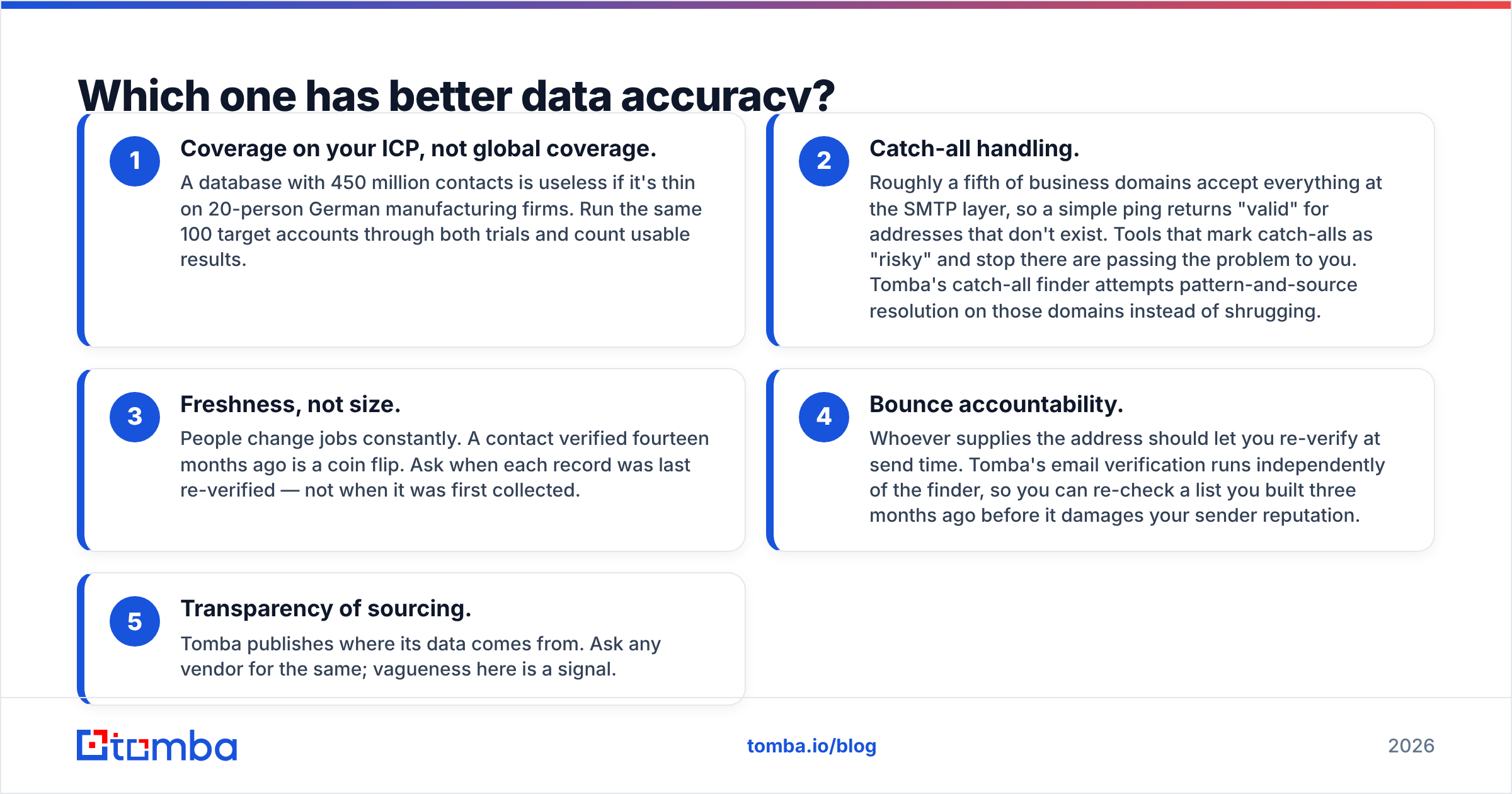
| Dimension | Lead411 | Tomba |
|---|---|---|
| Primary job | Build filtered lead lists with intent triggers | Find and verify email addresses at scale |
| Entry price | ~$99/user/mo, typically billed annually | $49/mo Starter, no annual lock-in |
| Free option | 7-day trial (limited exports) | Free tier, 25 searches/mo, no card |
| Mid tier | Pro / Enterprise, custom quoted | Growth $99/mo |
| Top published tier | Enterprise, sales-led | Pro $249/mo, Enterprise custom |
| Intent data | Yes (Bombora topics) | No |
| Direct-dial phones | Yes, a core strength | Yes, via phone finder + validator |
| Email verification | Included, bundled | Standalone verifier + catch-all handling |
| API | Available, enterprise-oriented | First-class, documented, self-serve |
| Bulk workflows | CSV export from list builder | Bulk finder/verifier + Sheets, Excel, Airtable |
| Contract flexibility | Annual commitment is the norm | Monthly, cancel anytime |
| Best for | AEs and SDR teams working a defined ICP | Growth teams, agencies, and developers |
Two things stand out.
First, the billing model is the real fork in the road. Lead411's published pricing centers on per-user annual plans; month-to-month is possible but priced higher, and export credits are allocated per seat. That's fine if you have five reps who will use it daily for twelve months. It's punishing if you're a two-person team testing a new segment for six weeks. Tomba's pricing is credit-based and monthly — you can spend $49 to test a hypothesis and stop.
Second, credit accounting differs in a way that bites. On seat-based platforms, unused export credits usually don't travel between users or roll over indefinitely. On a credit model, a search that returns no result generally shouldn't consume a credit. Ask both vendors this specific question before you buy: what exactly consumes a credit, and what happens to unused ones? The answer changes your effective cost per usable contact more than the sticker price does.
Which one has better data accuracy?#
Neither vendor's marketing number should be taken at face value, and that includes Tomba's.
Every B2B data provider quotes accuracy in the 95–98% range, and every one of them is measuring something slightly different. Lead411 leans on a "triple verification" process and reports bounce rates under 5%. Tomba scores each result with a confidence value and exposes the sources behind it, so you can see why it thinks first.last@domain.com is correct.
Here's what actually matters in practice:
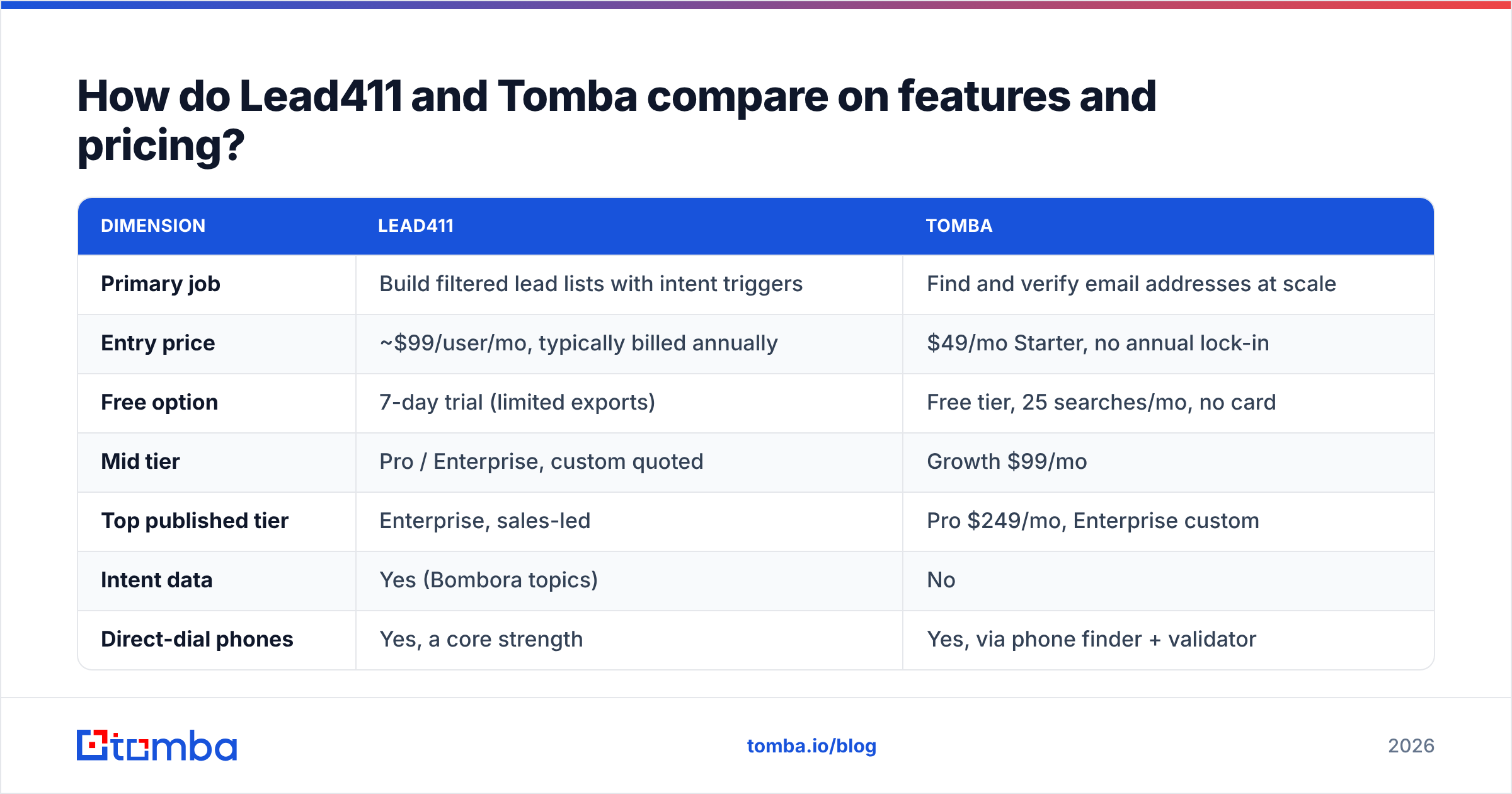
- Coverage on your ICP, not global coverage. A database with 450 million contacts is useless if it's thin on 20-person German manufacturing firms. Run the same 100 target accounts through both trials and count usable results.
- Catch-all handling. Roughly a fifth of business domains accept everything at the SMTP layer, so a simple ping returns "valid" for addresses that don't exist. Tools that mark catch-alls as "risky" and stop there are passing the problem to you. Tomba's catch-all finder attempts pattern-and-source resolution on those domains instead of shrugging.
- Freshness, not size. People change jobs constantly. A contact verified fourteen months ago is a coin flip. Ask when each record was last re-verified — not when it was first collected.
- Bounce accountability. Whoever supplies the address should let you re-verify at send time. Tomba's email verification runs independently of the finder, so you can re-check a list you built three months ago before it damages your sender reputation.
- Transparency of sourcing. Tomba publishes where its data comes from. Ask any vendor for the same; vagueness here is a signal.

The useful framing: Lead411 optimizes for breadth of record (email + phone + intent + firmographics on one row). Tomba optimizes for depth of certainty on the email itself. If your outbound is email-led and volume-heavy, deliverability is the constraint, and depth of certainty is what protects it. If your motion is call-led, breadth of record wins.
Suggested visual: side-by-side screenshots of a Lead411 contact record and a Tomba email finder result showing its confidence score and source list.
Is intent data worth the price difference?#
Only if you've built the motion to use it. That's the honest version.
Intent data tells you a company has been consuming content about a topic you sell into. The promise is obvious: reach out while they're already shopping. Gartner and Forrester have both documented the gap between buying intent tooling and extracting value from it — and the gap is usually operational, not technical.
Intent data pays off when all of these are true:
- You have enough volume that prioritization actually changes what a rep does today.
- Your sales cycle is long enough that early-stage research is a real window, not noise.
- Someone owns the workflow — signal fires, list refreshes, sequence triggers, without a human remembering to check a dashboard.
- Your messaging changes based on the signal. If the email is identical either way, you paid for a sorting order.
If you can't tick all four, the extra spend on an intent platform buys you a dashboard people look at twice and then ignore. In that case, a cheaper discovery layer plus a disciplined ICP list outperforms — you'll spend the difference on volume and testing, which is where early-stage outbound actually improves.
Note also that intent data is not exclusive to Lead411. Bombora syndicates its topic data to many platforms, so "has intent data" is not by itself a moat. What differs is how well it's wired into the list builder and how much you pay for the bundle.
How do they fit into an existing outbound stack?#
This is where the two tools diverge most sharply, and where a lot of buyers get it wrong.
Lead411's assumed workflow is human-in-the-browser: log in, filter, export, push to CRM. It has CRM connectors and a Chrome extension, and that covers the majority of SDR use cases well. It's less comfortable as infrastructure — if you want to enrich 40,000 records nightly inside your own pipeline, you're negotiating an enterprise API agreement.
Tomba assumes the opposite. The Tomba API is self-serve from the first paid tier, with a CLI, an MCP server for AI agents, and add-ons for Google Sheets, Excel, and Airtable. If your RevOps team already runs a data pipeline, Tomba slots in as a function call rather than a destination you visit.
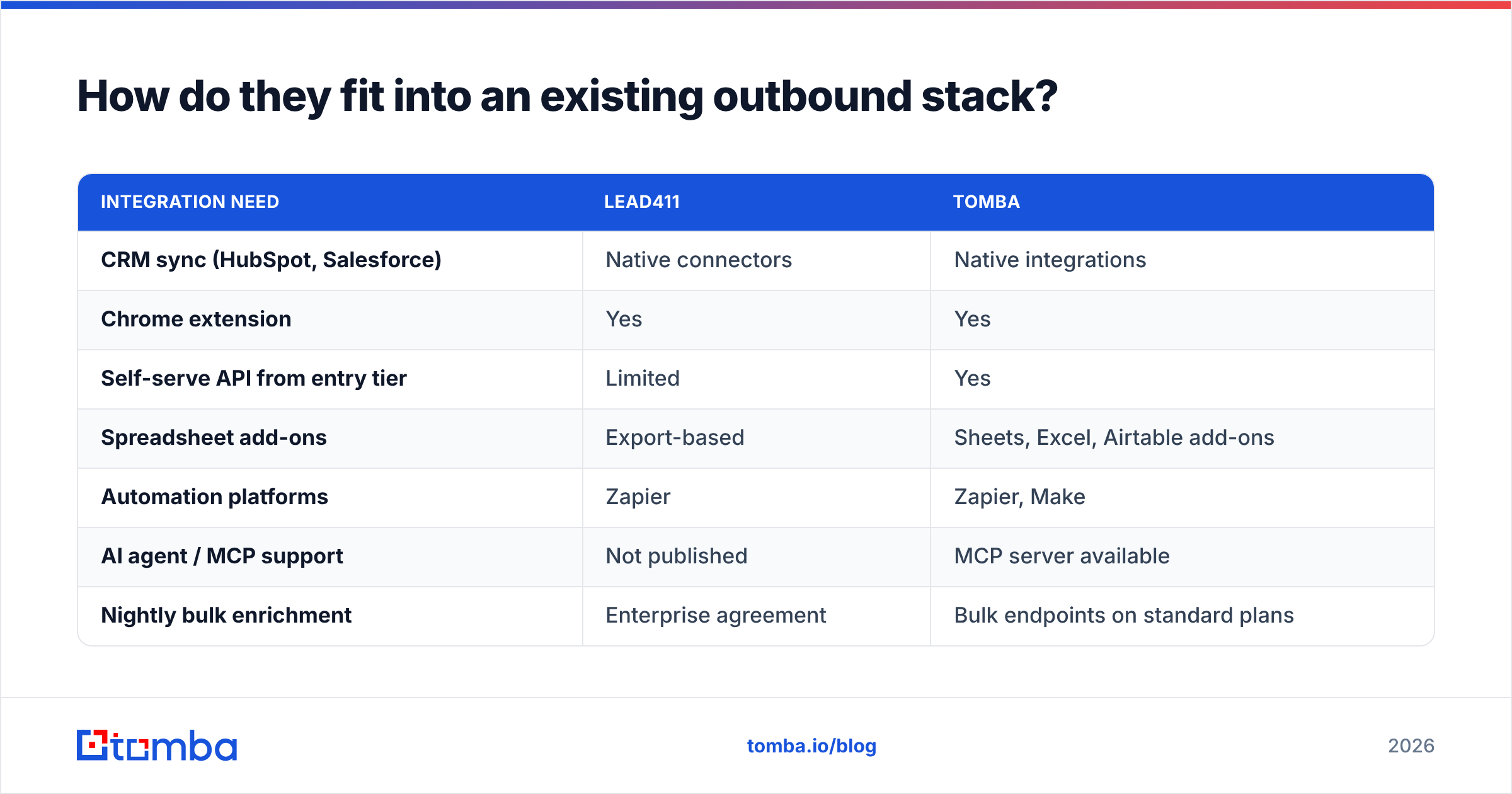
| Integration need | Lead411 | Tomba |
|---|---|---|
| CRM sync (HubSpot, Salesforce) | Native connectors | Native integrations |
| Chrome extension | Yes | Yes |
| Self-serve API from entry tier | Limited | Yes |
| Spreadsheet add-ons | Export-based | Sheets, Excel, Airtable add-ons |
| Automation platforms | Zapier | Zapier, Make |
| AI agent / MCP support | Not published | MCP server available |
| Nightly bulk enrichment | Enterprise agreement | Bulk endpoints on standard plans |
A practical pattern: use a list-building platform to define the account universe once a quarter, then use a resolution layer continuously to keep contacts fresh as people churn in and out of roles. Those are different purchase cycles, and bundling them into one annual seat contract is often what makes the bill feel large.

Who should pick which — and what about the alternatives?#
Straight recommendations:
Choose Lead411 if:
- Your reps live in a list builder and you want intent triggers surfaced in the same UI.
- Phone-led outbound is a meaningful share of your pipeline and direct dials are non-negotiable.
- You have 4+ seats and budget approval for an annual commitment.
- Your ICP sits squarely in North American mid-market, where Lead411's coverage is strongest.
Choose Tomba if:
- You already know your target accounts and the bottleneck is reaching the right person.
- You want to test a segment this month without signing for twelve.
- You're a developer, agency, or RevOps team wiring discovery into an existing pipeline.
- Email deliverability is your constraint and you need verification as a first-class step, not a bundled afterthought.
Consider a third option if: neither shape fits. If you want a prebuilt, human-verified list you buy outright rather than a subscription seat, BookYourData is a reasonable peer to evaluate — it sells pay-as-you-go B2B lists with a bounce guarantee, which suits one-off campaigns better than either subscription model here. If you want an all-in-one prospecting-plus-sequencing suite, look at the broader Apollo alternatives landscape instead; that's a different category again.
What does a realistic monthly cost look like?#
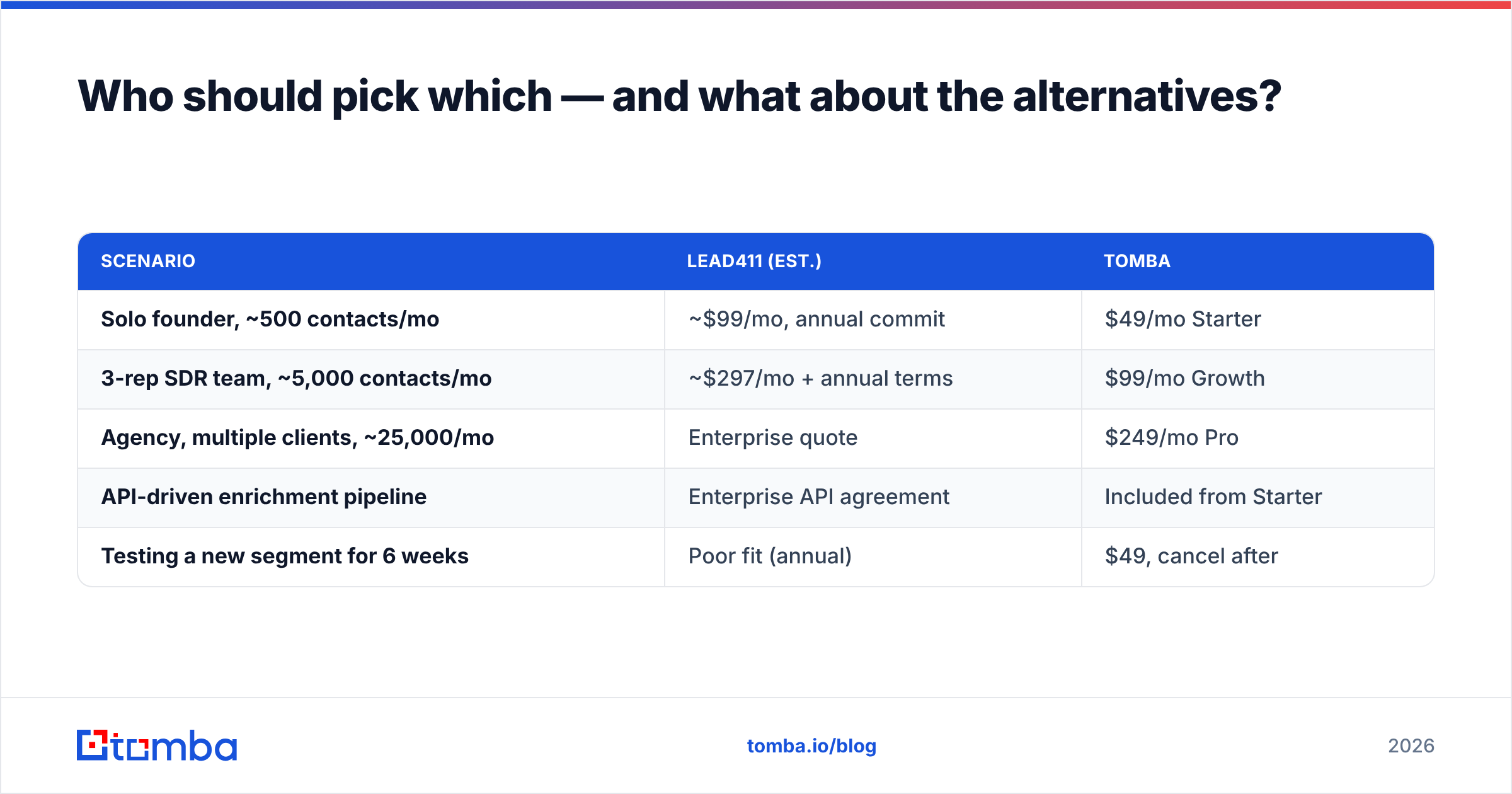
| Scenario | Lead411 (est.) | Tomba |
|---|---|---|
| Solo founder, ~500 contacts/mo | ~$99/mo, annual commit | $49/mo Starter |
| 3-rep SDR team, ~5,000 contacts/mo | ~$297/mo + annual terms | $99/mo Growth |
| Agency, multiple clients, ~25,000/mo | Enterprise quote | $249/mo Pro |
| API-driven enrichment pipeline | Enterprise API agreement | Included from Starter |
| Testing a new segment for 6 weeks | Poor fit (annual) | $49, cancel after |
Treat the Lead411 column as directional — its pricing is seat-and-credit based and moves with negotiation, so get a live quote. The pattern holds regardless of the exact numbers: seat-based annual pricing rewards stable, full-time usage and penalizes experimentation. Credit-based monthly pricing does the reverse.
What should you actually test before buying?#
Run the same benchmark on both. Thirty minutes of work, and it beats any review including this one.
- Pick 100 real target contacts from your actual ICP — names and company domains you already know.
- Run them through both tools and record: how many returned an address, how many returned a phone, how many were marked risky or catch-all.
- Verify the winners independently with a neutral checker so you're not grading the vendor's homework with the vendor's pen.
- Send a small, warm campaign — 50 addresses, real inboxes — and measure the actual bounce rate. That number is the only accuracy stat that belongs in your decision.
- Price it out per usable contact, not per credit. A cheaper credit that fails 30% of the time costs more than an expensive one that works.
Most teams discover the two tools aren't really competing. Lead411 answers "who should I talk to this week." Tomba answers "how do I actually reach them, and will it bounce." Buying the first without solving the second gives you a beautifully prioritized list of undeliverable addresses.
The bottom line#
Lead411 is a solid, established B2B database with genuine strengths in direct dials and intent triggers, priced for teams who'll use it every day for a year. Tomba is a sharper, cheaper, more flexible instrument for the specific job of turning a name and a domain into a verified, deliverable email — with an API that treats you like a builder rather than a seat.
If your outbound lives or dies on whether your emails land, start where the deliverability problem is. Try the Tomba Email Finder free — 25 searches a month, no card — and run your own 100-contact benchmark against whatever you're using now. If the numbers don't beat your current tool, you've lost thirty minutes. If they do, you've just fixed the most expensive leak in your pipeline.
Related guides#
// get started
Find, verify and enrich your first contacts today
Start on the free plan with 25 searches a month, then scale when your team is ready.
Free plan · No credit card required · GDPR & CCPA
// about the author