Leadboxer Pricing, Reviews, Pros and Cons: 2026 Breakdown
Leadboxer promises to turn anonymous website traffic into named companies and contacts. Here is what the plans actually cost, where the data holds up, and when a cheaper stack wins.
TL;DR
- Leadboxer is a website-visitor identification and lead-scoring tool, not an email database. It tells you which companies visited your site — it rarely hands you a verified inbox to write to.
- Pricing starts around $195/month for the entry plan and climbs into the $400–$1,000+/month range as you add tracked visitors, seats, and integrations. There is no permanent free tier, only a trial.
- Reviews are broadly positive on tracking accuracy for mid-market and enterprise visitors, and consistently critical on price, SMB/ISP match rates, and the learning curve on filters.
- The biggest hidden cost is not the subscription. It is the second tool you still need to turn "Acme Corp visited pricing 4x" into a named person with a working email.
- If your goal is contact data rather than intent signals, a $49/month email finder plus a cheap analytics layer usually beats a $195/month visitor platform.
What is Leadboxer and who is it actually for?#
Leadboxer is a lead generation and visitor-identification platform. You drop a tracking script on your site, and it does three things: resolve anonymous traffic to companies via IP and firmographic lookup, score those visitors on behavior (pages viewed, return visits, time on site, form interactions), and push the qualified ones into your CRM or Slack.
Think of it like a doorbell camera for your website. It tells you someone from Acme Corp walked up to your pricing page three times this week. What it does not do is tell you their name, their title, or how to reach them — that part is still on you.
That distinction matters more than any feature comparison, because it determines whether Leadboxer replaces a tool in your stack or adds one. For most teams it adds one.
Leadboxer fits best when:
- You sell to mid-market or enterprise. Corporate networks resolve cleanly to company names. Consumer ISPs and remote workers on home Wi-Fi usually do not.
- You already have meaningful traffic. Below roughly 3,000–5,000 monthly visitors, the number of identifiable, sales-worthy companies is too small to justify the spend.
- You run account-based outbound. Intent data is only valuable if a human is going to act on it within 48 hours.
- Your sales cycle is long and considered. Repeat-visit scoring only pays off when buyers research before they buy.
It fits poorly when you sell to SMBs, run high-volume transactional sales, or simply need a list of contacts at target accounts. For that last case you want a domain search tool, not a visitor tracker.
What does Leadboxer pricing actually cost in 2026?#
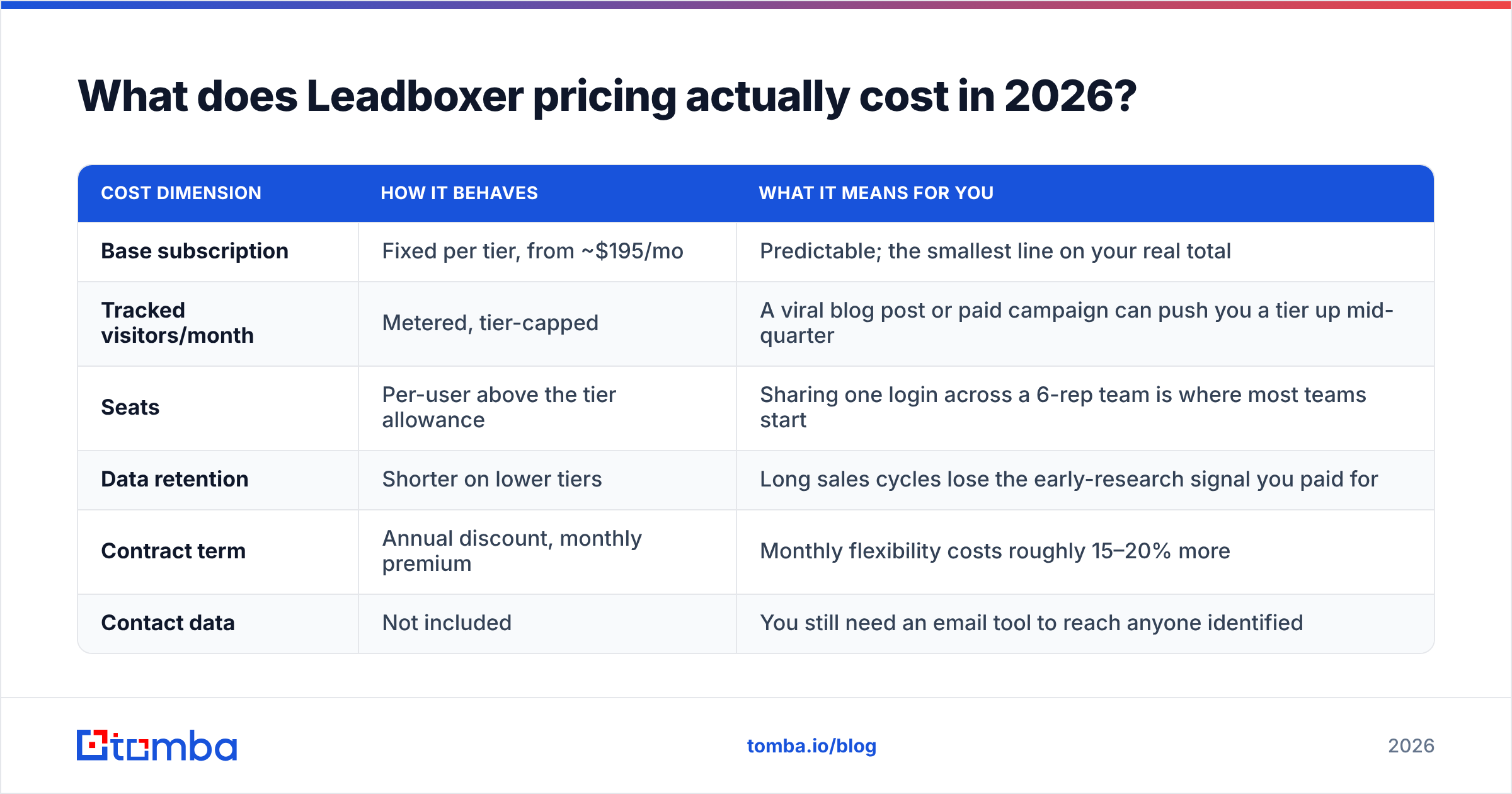
Leadboxer publishes tiered pricing that scales on tracked visitors and seats. Published entry pricing has historically sat around $195/month billed monthly, with mid-tier plans in the $400–$600 range and enterprise quotes above that. Check leadboxer.com for current figures before you budget, because visitor-identification vendors reprice more often than most SaaS categories.
The structure, rather than the sticker, is what catches people out:
| Cost dimension | How it behaves | What it means for you |
|---|---|---|
| Base subscription | Fixed per tier, from ~$195/mo | Predictable; the smallest line on your real total |
| Tracked visitors/month | Metered, tier-capped | A viral blog post or paid campaign can push you a tier up mid-quarter |
| Seats | Per-user above the tier allowance | Sharing one login across a 6-rep team is where most teams start |
| Data retention | Shorter on lower tiers | Long sales cycles lose the early-research signal you paid for |
| Contract term | Annual discount, monthly premium | Monthly flexibility costs roughly 15–20% more |
| Contact data | Not included | You still need an email tool to reach anyone identified |
Run the math on cost-per-actionable-lead rather than cost-per-month. If your entry plan surfaces 120 identified companies a month, maybe 25 match your ICP, and your reps work 15 of them, you are paying about $13 per worked account before you have spent a cent on finding contacts. That is fine for a $30k ACV. It is indefensible for a $3k ACV.
How do Leadboxer reviews break down?#
Aggregate sentiment on G2 and Capterra puts Leadboxer in the solid-but-pricey bucket. Reading through the pattern rather than the star average, four themes repeat.
What reviewers consistently praise:
- Setup speed. One script tag, data flowing within a day. Reviewers routinely contrast this with heavier ABM platforms that need weeks of onboarding.
- Lead scoring flexibility. You can weight specific pages, events, and recency. Teams that invest in configuring this report meaningfully better signal-to-noise than teams that use defaults.
- Responsive support. Small-vendor advantage — support tends to answer quickly and with real answers.
- CRM and Slack routing. The alert-to-rep loop works, and it works fast enough to matter.
What reviewers consistently criticize:
- Price relative to output. The most common complaint by a wide margin, especially from teams under 50 employees.
- Match rate variability. Enterprise traffic resolves well. Remote workers, mobile traffic, and small businesses often resolve to an ISP rather than a company.
- Company-level, not person-level. Reviewers expecting contact details are disappointed. The product never promised them, but the category's marketing blurs the line.
- Filter learning curve. Getting from raw visitor firehose to a clean daily digest takes real configuration time.
The honest summary: Leadboxer does what it says. The dissatisfaction almost always comes from a buyer who expected an intent tool to also be a contact database.
Leadboxer vs. the alternatives: what should you compare it against?#
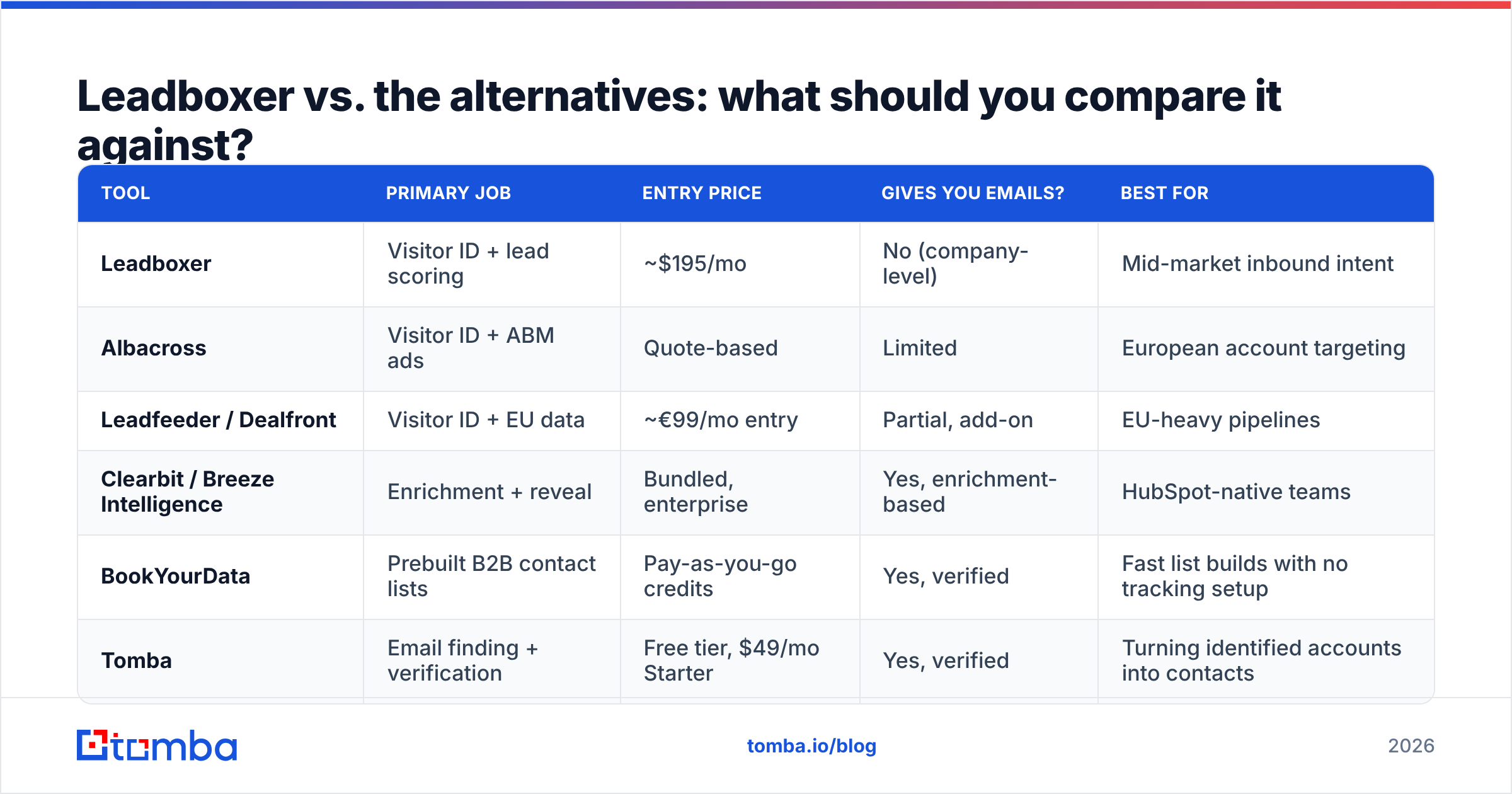
Because visitor identification and contact data are different jobs, the useful comparison spans both categories. Here is how the realistic options line up.
| Tool | Primary job | Entry price | Gives you emails? | Best for |
|---|---|---|---|---|
| Leadboxer | Visitor ID + lead scoring | ~$195/mo | No (company-level) | Mid-market inbound intent |
| Albacross | Visitor ID + ABM ads | Quote-based | Limited | European account targeting |
| Leadfeeder / Dealfront | Visitor ID + EU data | ~€99/mo entry | Partial, add-on | EU-heavy pipelines |
| Clearbit / Breeze Intelligence | Enrichment + reveal | Bundled, enterprise | Yes, enrichment-based | HubSpot-native teams |
| BookYourData | Prebuilt B2B contact lists | Pay-as-you-go credits | Yes, verified | Fast list builds with no tracking setup |
| Tomba | Email finding + verification | Free tier, $49/mo Starter | Yes, verified | Turning identified accounts into contacts |
Two notes on reading that table. First, BookYourData solves a genuinely different problem well — if you already know the accounts and want contacts immediately without a tracking script, a pay-as-you-go list is often the faster path. Second, Tomba is not a Leadboxer competitor. It is the layer that makes Leadboxer's output usable, which is exactly why so many teams end up running both.
If you want to pressure-test the reveal category more broadly, Tomba's own website visitor reveal covers similar ground and is worth benchmarking against your current spend.
What are the real pros and cons of Leadboxer?#
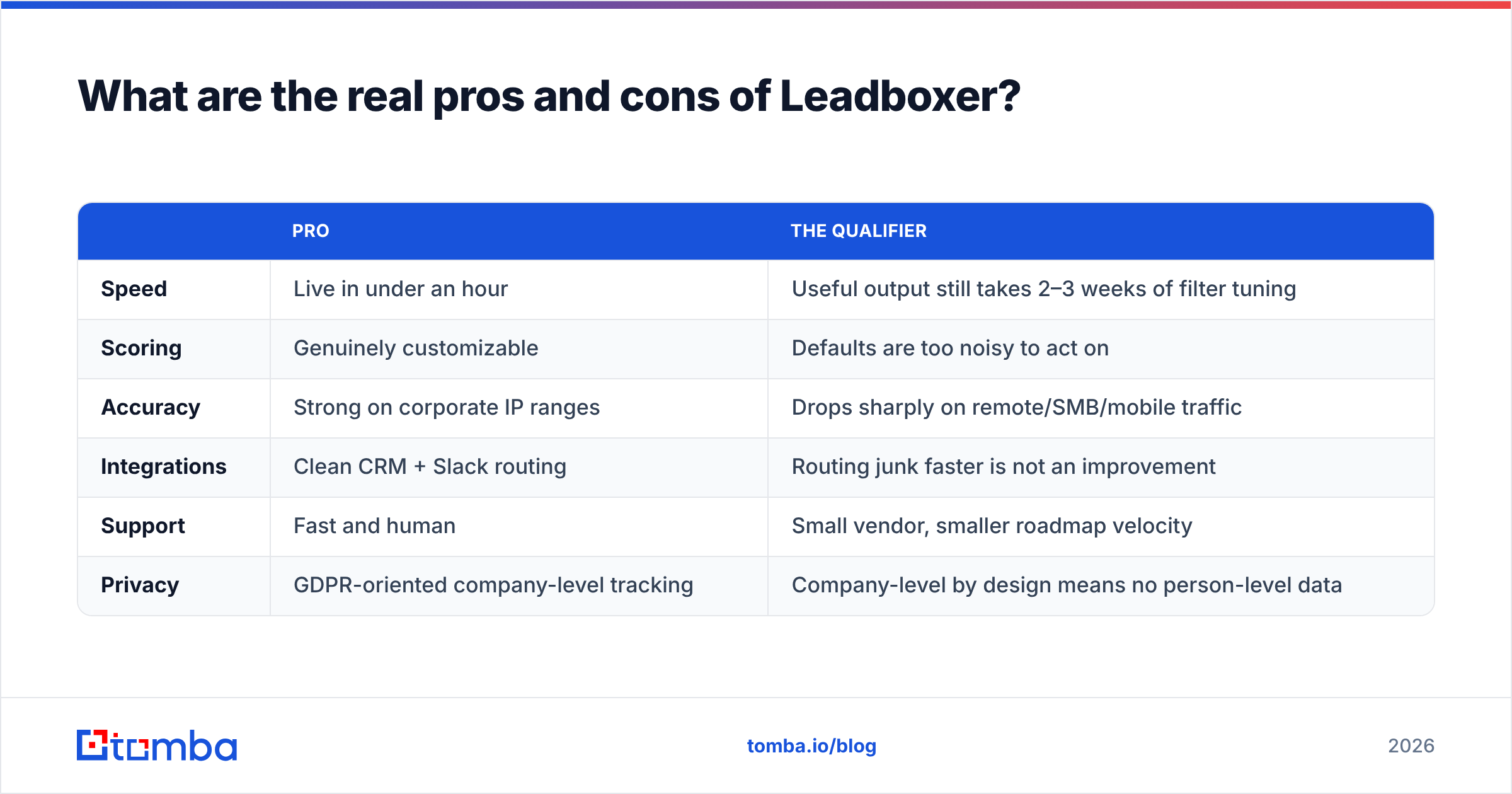
Here is the balanced ledger, with the qualifier that matters attached to each line.
| Pro | The qualifier | |
|---|---|---|
| Speed | Live in under an hour | Useful output still takes 2–3 weeks of filter tuning |
| Scoring | Genuinely customizable | Defaults are too noisy to act on |
| Accuracy | Strong on corporate IP ranges | Drops sharply on remote/SMB/mobile traffic |
| Integrations | Clean CRM + Slack routing | Routing junk faster is not an improvement |
| Support | Fast and human | Small vendor, smaller roadmap velocity |
| Privacy | GDPR-oriented company-level tracking | Company-level by design means no person-level data |
And the cons that are not offset by anything:
- No contact data. Every identified account needs a second tool before a rep can send anything.
- Entry price is high for the category. $195/month before you have found a single email address is a hard sell to a scrappy team.
- Match rate is traffic-dependent. You cannot forecast ROI accurately before you trial it, which makes budget approval awkward.
- Value decays without process. Without a rep committed to working alerts daily, the subscription becomes a dashboard nobody opens.

How do you turn identified companies into actual replies?#
This is the step where most visitor-tracking investments quietly fail. You have the company. You need a person, a role match, and an inbox that accepts mail.
The workflow that works looks like this:
- Filter hard at the account level. Employee count, industry, and page-intent (pricing and docs beat blog) should cut your daily list to under 10 accounts. More than that and nobody works any of them.
- Find the right role, not the CEO. Use a domain search to pull the company's contacts by department, then pick the person who owns the problem your pricing page describes.
- Verify before you send. Run every address through an email verifier and drop catch-alls you cannot confirm. A 5% bounce rate on a small warm list will damage sender reputation faster than a big cold campaign will.
- Reference the signal without being creepy. "Saw you were comparing integration options" is fine. "I saw you visited our pricing page three times on Tuesday" is not. Reference the topic, never the surveillance.
- Move within 48 hours. Research intent has a short half-life. A perfect email sent two weeks late performs worse than a decent one sent same-week.
- Log the outcome back to scoring. Feed reply and meeting data back into which pages and behaviors actually predicted revenue, then reweight.
Step 2 and 3 are where your real per-lead cost lands. Tomba's Free tier covers 25 searches a month — enough to sanity-check whether the accounts Leadboxer surfaces are even reachable before you commit to an annual contract. Starter at $49/month handles most inbound-intent volumes, and you can see the full breakdown on the Tomba pricing page.
Is Leadboxer worth it in 2026?#
Yes, conditionally — and the conditions are narrow.
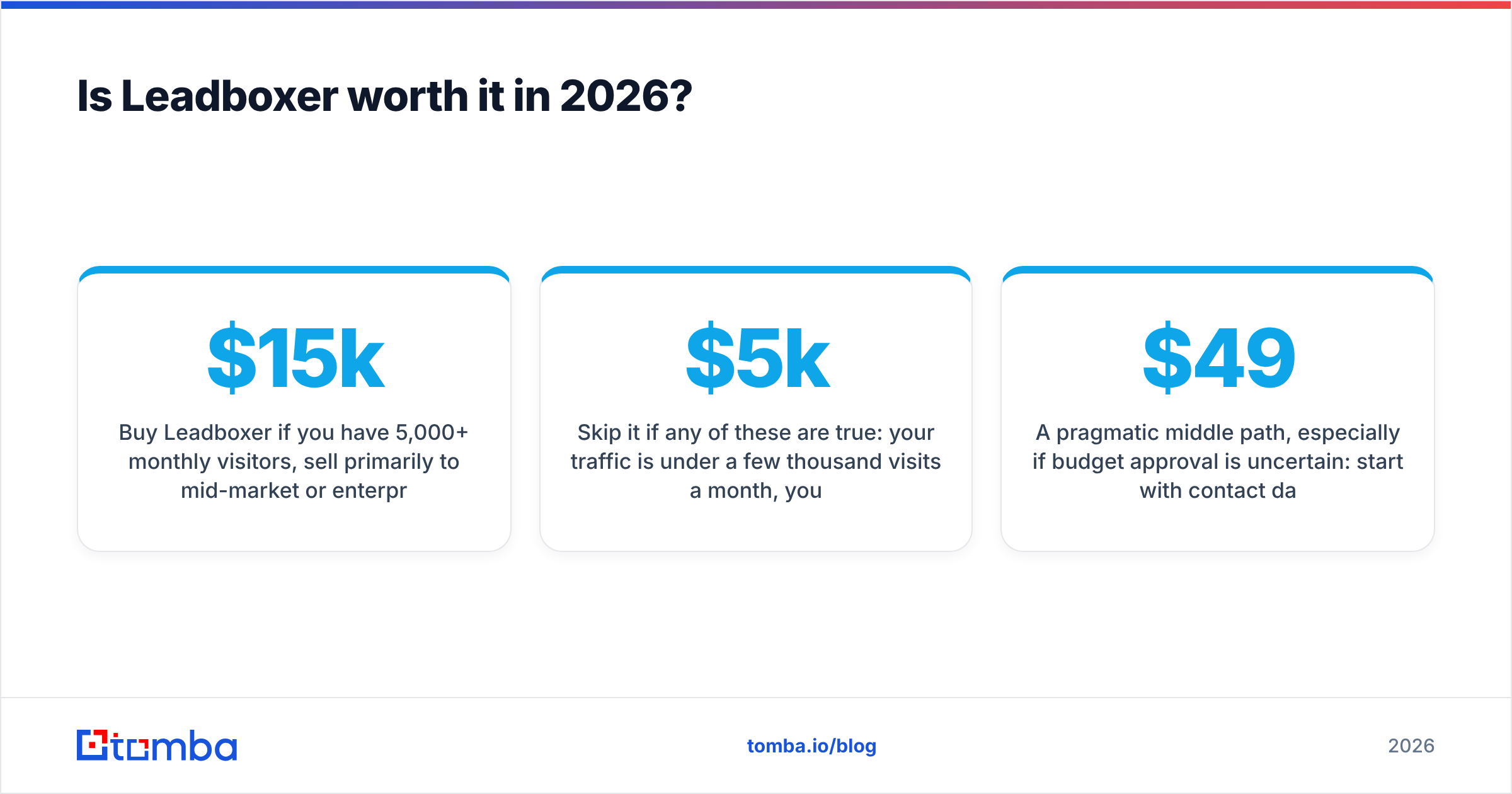
Buy Leadboxer if you have 5,000+ monthly visitors, sell primarily to mid-market or enterprise companies with real office networks, run a deal size above roughly $15k, and have at least one person whose job includes working inbound alerts every morning. Under those conditions the $195+/month is easy to justify: a single closed deal sourced from an intent alert pays for a year.
Skip it if any of these are true: your traffic is under a few thousand visits a month, you sell to SMBs or consumers, your ACV is under $5k, or nobody on the team has clear ownership of alert follow-up. In those cases you are buying a dashboard, not pipeline.
A pragmatic middle path, especially if budget approval is uncertain: start with contact data rather than intent data. Build a target account list from your ICP, use bulk lead generation to pull and verify contacts across those domains, and run outbound against known accounts for a quarter. If your problem turns out to be "we don't know who to contact," you just solved it for $49/month. If your problem turns out to be "we don't know which known accounts are warm," then Leadboxer or a peer becomes the obvious next purchase — and you will have the pipeline data to justify it.
The failure mode to avoid is buying intent tooling to fix a contact-data problem. Those look similar on a vendor comparison sheet and behave nothing alike in a quarter-end pipeline review.
What should you do next?#
Run the cheap experiment first. Take the 20 accounts you most want to win this quarter, find and verify the decision-makers, and send a real sequence. If replies come back, your gap was contact data and you just closed it. If accounts go quiet, your gap is timing — and that is the moment a visitor-identification platform earns its price.
Start with the Tomba Email Finder. The Free tier gives you 25 searches a month to test reachability across your target list, Starter is $49/month for ongoing prospecting, and Growth at $99/month covers most teams running inbound plus outbound together. Whatever you decide about Leadboxer, you will need verified contacts on the other side of it — so prove that layer works before you sign an annual visitor-tracking contract.
Related guides#
// get started
Find, verify and enrich your first contacts today
Start on the free plan with 25 searches a month, then scale when your team is ready.
Free plan · No credit card required · GDPR & CCPA
Get the Tomba newsletter
Product and data updates
// about the author