9 Best Leadbrowser Alternatives for B2B Prospecting in 2026
Leadbrowser is a solid lightweight prospecting tool, but it is not the only option. Here are nine Leadbrowser alternatives compared on data accuracy, credit models, export limits and real monthly cost.
TL;DR
- Leadbrowser works well for lightweight, browser-based prospecting, but teams usually outgrow it on export limits, verification depth, or API access.
- If your bottleneck is finding and verifying work emails at scale, a dedicated email finder like Tomba ($49/mo Starter, free tier included) is the cheapest swap.
- If your bottleneck is list volume and intent data, Apollo, Cognism or BookYourData cover more ground — at a much higher price point.
- The single biggest cost driver is not the sticker price. It is the bounce rate, because wasted credits and burned domains cost more than any subscription.
- Test any alternative on 100 of your own known-good contacts before you sign an annual deal. Vendor-published accuracy numbers are marketing, not benchmarks.
What is Leadbrowser and who is it for?#
Leadbrowser is a browser-first B2B prospecting tool. You browse company sites and professional networks, and it surfaces contact data for the people you are already looking at — the "find leads while you research" workflow, rather than the "query a 200-million-row database" workflow.
That framing is its strength and its ceiling. For a founder doing 20 targeted outreach touches a week, browsing to your prospect and pulling their email is faster than building a filter set in a heavyweight platform. For an SDR team that needs 3,000 verified contacts loaded into a sequencer on Monday morning, a browser-driven flow becomes the bottleneck.
Most people searching for Leadbrowser alternatives are not unhappy with the product. They have simply crossed a volume, accuracy, or integration threshold that a lightweight tool was never built to clear.

Why do teams look for Leadbrowser alternatives?#
In practice, five reasons come up repeatedly when teams switch away from any lightweight prospecting tool:
- Export and credit ceilings. Browser-based tools tend to meter aggressively. When you need 5,000 rows, per-lookup pricing gets expensive fast compared with a bulk plan.
- No real verification layer. Finding a plausible email and confirming it accepts mail are two different jobs. Tools that skip SMTP-level checks hand you a list that looks clean and bounces at 8–15%.
- Missing API or automation hooks. If your RevOps stack runs on Clay, n8n, Make or a custom enrichment job, you need an endpoint — not a Chrome sidebar.
- Catch-all domains. A large share of B2B domains accept everything. Without a dedicated catch-all check, those contacts are either discarded (wasted spend) or sent blind (deliverability risk).
- Coverage gaps outside the US. EMEA and APAC coverage varies wildly between vendors, and mobile numbers are governed by very different compliance rules in each region.
If none of those five apply to you, stay where you are. Switching tools has a real cost in workflow disruption, and "the new one has more logos on the pricing page" is not a reason.
What should you compare in a Leadbrowser alternative?#
Before looking at any vendor list, fix your evaluation criteria. Otherwise you will be sold on database size, which is the least meaningful number on any pricing page.
- Verified accuracy on YOUR ICP, not global averages. A tool at 95% accuracy on US SaaS may be at 60% on German manufacturing. Run the same 100-contact test list through every finalist.
- Credit model and rollover. Does a failed search burn a credit? Do unused credits roll over? Are exports charged separately from searches? These three questions change effective cost by 2–3x.
- Verification depth. Look for syntax check, MX record check, SMTP handshake, disposable detection, role-account flagging, and an explicit catch-all verdict — not a single binary "valid" flag.
- API and integration surface. REST API, native CRM sync (HubSpot, Salesforce, Pipedrive), spreadsheet add-ons, and Zapier/Make support. If enrichment is not automated, someone on your team is a human ETL job.
- Compliance posture. GDPR/CCPA handling, documented data sourcing, opt-out processing, and DPA availability. Ask for this in writing before you buy.
- Exit cost. Can you export your enriched data in full, in CSV, without a support ticket? If not, you are renting your own list.
Write those six criteria into a scoring sheet and give each finalist a number. It takes an afternoon and prevents a year-long contract regret.
Which Leadbrowser alternatives are worth testing in 2026?#
Here are the nine tools that consistently make shortlists, grouped by what they actually solve. Pricing below reflects publicly listed entry plans at the time of writing — always confirm on the vendor's own page, since list prices move.

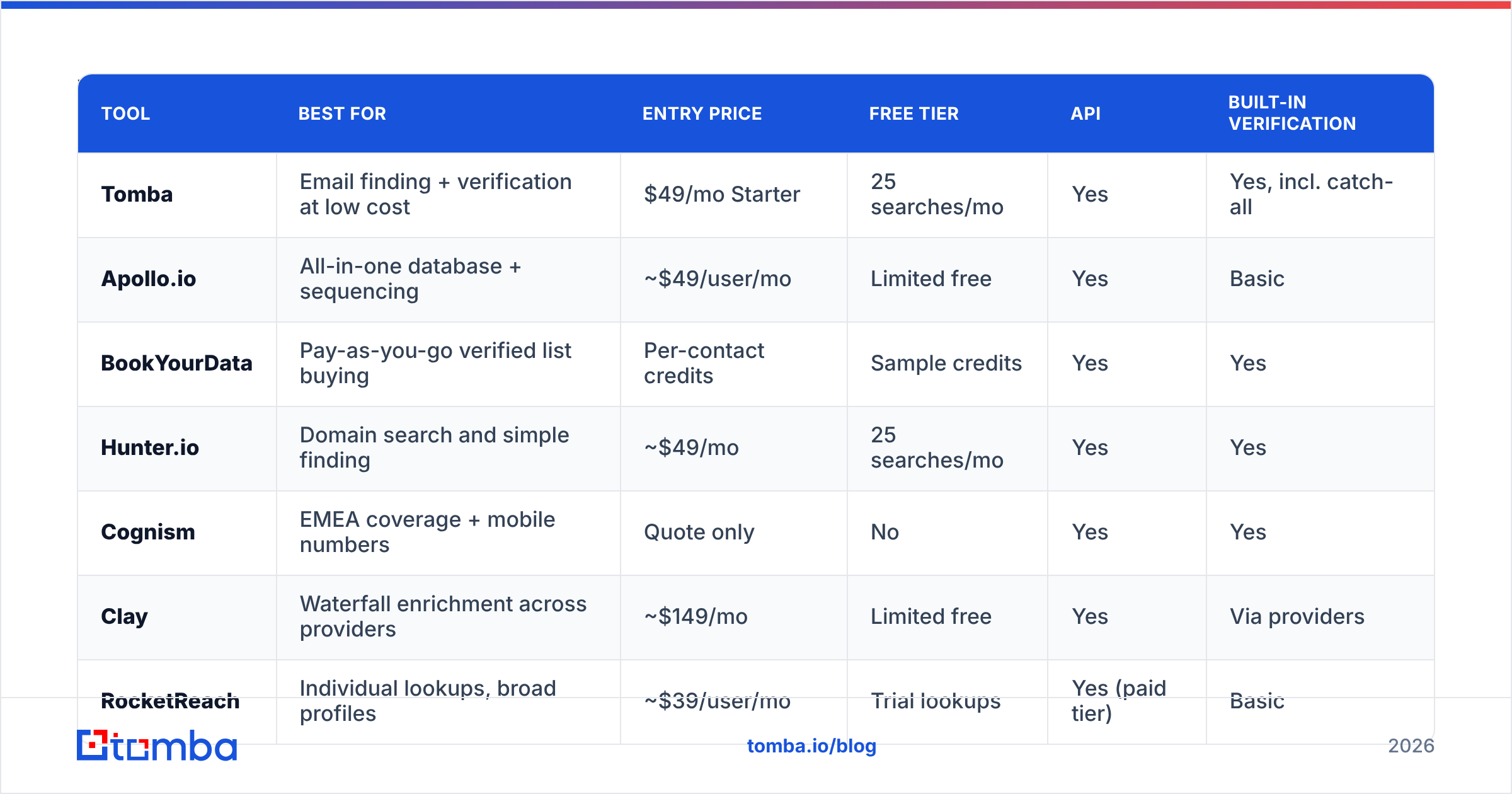
| Tool | Best for | Entry price | Free tier | API | Built-in verification |
|---|---|---|---|---|---|
| Tomba | Email finding + verification at low cost | $49/mo Starter | 25 searches/mo | Yes | Yes, incl. catch-all |
| Apollo.io | All-in-one database + sequencing | ~$49/user/mo | Limited free | Yes | Basic |
| BookYourData | Pay-as-you-go verified list buying | Per-contact credits | Sample credits | Yes | Yes |
| Hunter.io | Domain search and simple finding | ~$49/mo | 25 searches/mo | Yes | Yes |
| Cognism | EMEA coverage + mobile numbers | Quote only | No | Yes | Yes |
| Clay | Waterfall enrichment across providers | ~$149/mo | Limited free | Yes | Via providers |
| RocketReach | Individual lookups, broad profiles | ~$39/user/mo | Trial lookups | Yes (paid tier) | Basic |
| Lusha | Chrome-extension direct dials | ~$36/user/mo | 5 credits/mo | Yes (higher tiers) | Basic |
| Findymail | Agency-style bulk finding | ~$49/mo | Trial | Yes | Yes |
Tomba — the cheapest way to fix the email layer#
If the thing you actually need is "give me a correct work email for this person at this company, and tell me if it will bounce," Tomba is the narrowest and cheapest fix. The email finder handles name-plus-domain lookups, domain search pulls every discoverable address at a company, and the email verifier runs the full validation chain including an explicit catch-all verdict rather than an unhelpful "unknown."
Pricing is flat and seat-independent: a free tier at 25 searches/month, Starter at $49/mo, Growth at $99/mo, Pro at $249/mo, and custom Enterprise. Full Tomba pricing is public, which is more than several vendors on this list can say. There is a Tomba API, a CLI, Sheets and Excel add-ons, and a Chrome extension — so it drops into an existing stack instead of replacing it.
What it is not: a sequencer, a dialer, or an intent-data platform. If you want one vendor to do everything, look further down this list.
Apollo.io — the database-plus-sequencer default#
Apollo bundles a very large contact database with sequencing, a dialer, and basic CRM features. For a team that wants a single tool from list build to first reply, that consolidation is genuinely valuable. See Apollo's own site for current plan details.
The trade-offs are well documented in G2 reviews: data accuracy varies by segment, export limits on lower tiers surprise people, and per-seat pricing scales painfully as the team grows. Many teams end up pairing Apollo for discovery with a dedicated verifier before send — which is why the Apollo alternative comparison gets so much traffic.
BookYourData — buy verified lists without a subscription#
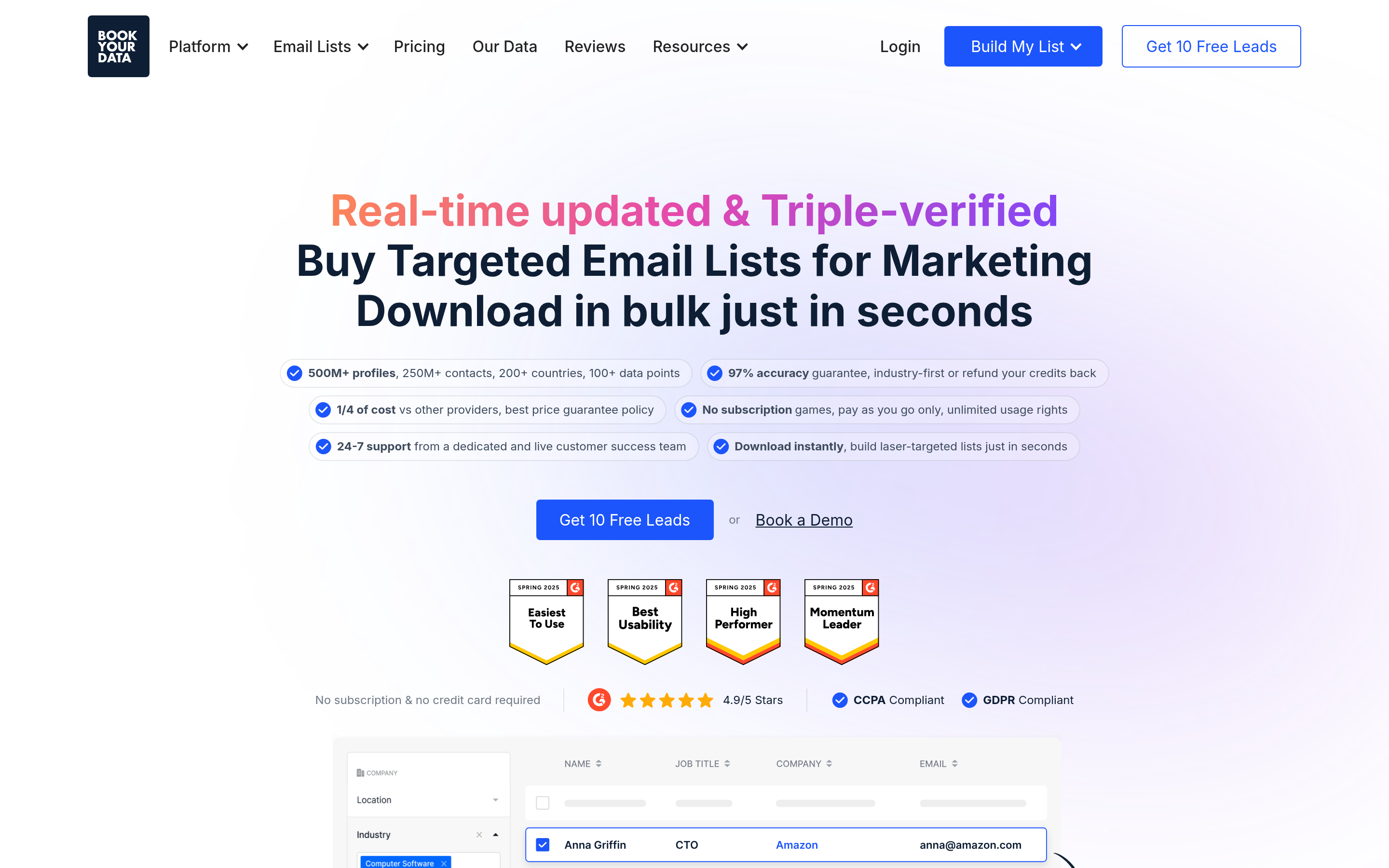
BookYourData takes a different approach: you build a targeted list with filters, see the count, and pay per contact rather than committing to a monthly platform fee. Contacts come verified, and the pay-as-you-go model suits teams running periodic campaigns rather than continuous outbound. Details on bookyourdata.com.
It is a strong fit when you know exactly which segment you want and would rather buy a clean 2,000-row file than operate a tool. It is a weaker fit when you need continuous, per-account enrichment tied into a live workflow.
Cognism — the EMEA and mobile-number play#
Cognism's differentiator is phone-verified mobile numbers and strong European coverage with an explicit compliance posture (see cognism.com). If your motion is calling into DACH, France or the Nordics, it is on the shortlist almost by default.
Pricing is quote-only and typically lands in enterprise territory. For a two-person startup this is overkill; for a 20-rep EMEA outbound team it may be the only viable answer.
Clay — orchestration, not a data source#
Clay is best understood as a waterfall layer. You bring providers (including email finders), and Clay runs them in sequence until a row resolves, then enriches with AI research. Powerful, and increasingly the standard for RevOps teams — but you still pay for the underlying data providers, and the credit math gets complicated fast.
RocketReach, Lusha, Findymail — the middle band#
RocketReach is strong for one-off individual lookups across broad profile data. Lusha's Chrome extension is popular with reps who live on professional networks and want direct dials. Findymail leans into bulk finding with built-in verification and an agency-friendly price. All three are reasonable Leadbrowser alternatives; none of them meaningfully change your stack architecture.

How accurate is the data behind these tools?#
Treat every published accuracy figure as a marketing claim until you reproduce it. Vendors measure accuracy differently: some count "deliverable" as anything that does not hard-bounce, others exclude catch-all domains from the denominator entirely, which inflates the number by several points.

Run this test instead:
- Pull 100 contacts you already have confirmed emails for — ideally from closed-won accounts, spread across your real geographies and company sizes.
- Strip the emails. Feed name + domain into each tool's free tier or trial.
- Score three buckets: exact match, wrong address returned, no result. The second bucket is the dangerous one, because a confidently wrong address bounces and damages sender reputation.
- Repeat for catch-all domains specifically. This is where tools diverge most.
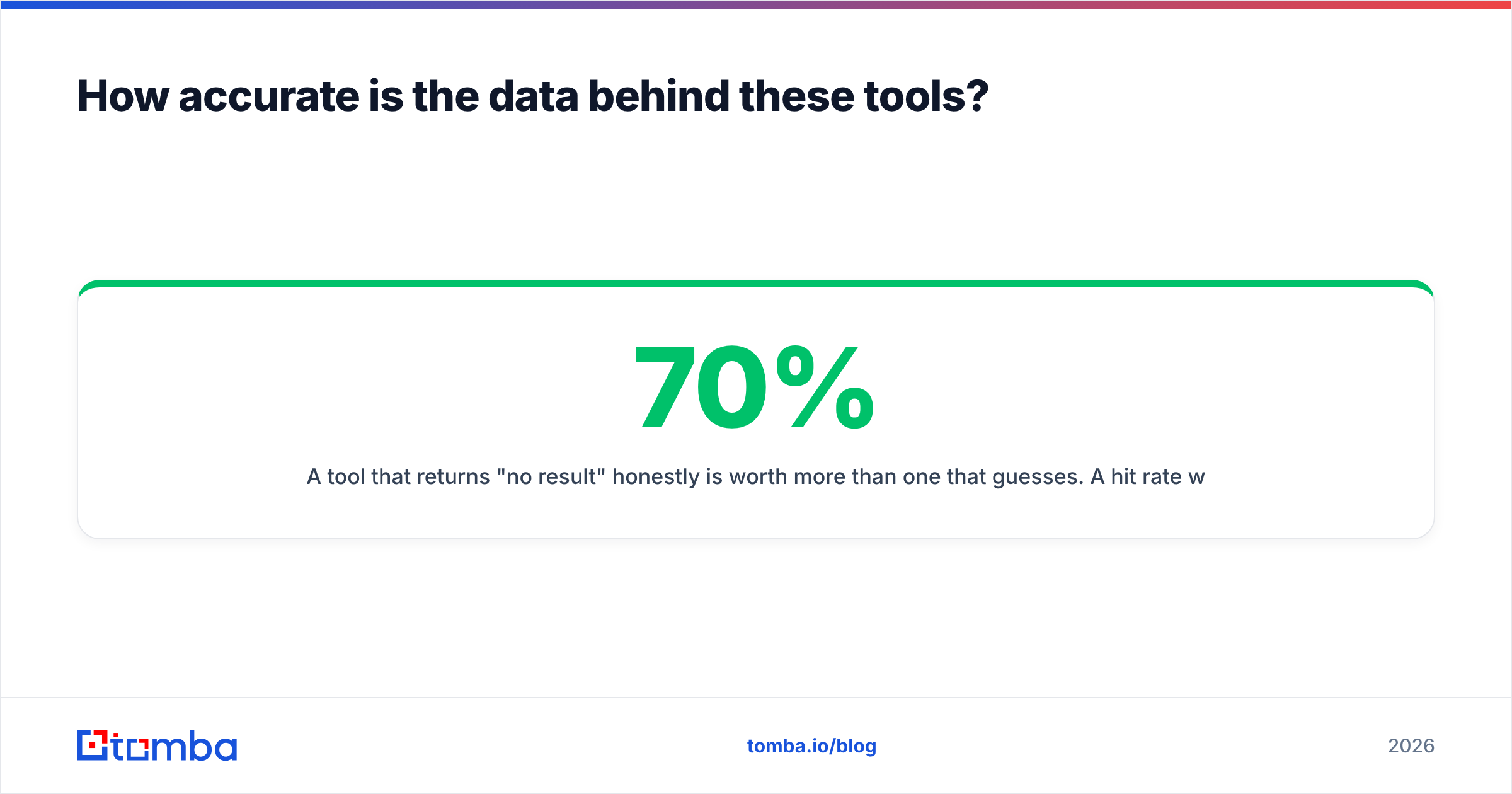
A tool that returns "no result" honestly is worth more than one that guesses. A 70% hit rate with zero false positives beats a claimed 95% that includes 10% garbage — because at typical cold-email volumes, a 10% bounce rate is enough to push a domain into spam foldering across major providers.
How much do Leadbrowser alternatives actually cost?#
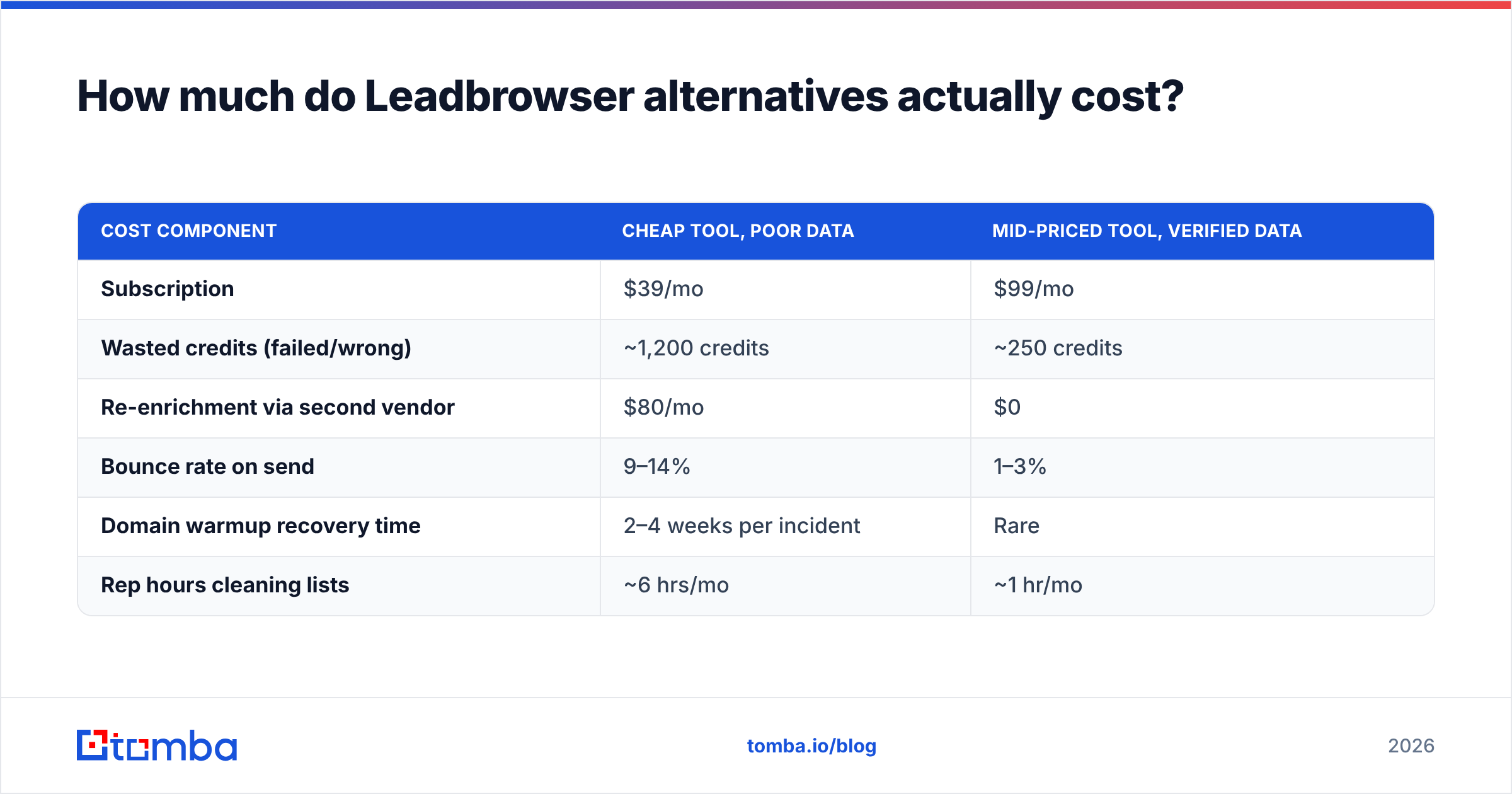
Sticker price is the smallest line item. Here is the fuller picture for a team enriching 5,000 contacts a month:
| Cost component | Cheap tool, poor data | Mid-priced tool, verified data |
|---|---|---|
| Subscription | $39/mo | $99/mo |
| Wasted credits (failed/wrong) | ~1,200 credits | ~250 credits |
| Re-enrichment via second vendor | $80/mo | $0 |
| Bounce rate on send | 9–14% | 1–3% |
| Domain warmup recovery time | 2–4 weeks per incident | Rare |
| Rep hours cleaning lists | ~6 hrs/mo | ~1 hr/mo |
At a loaded SDR cost of even $35/hour, five recovered hours a month covers the price difference outright — before you count the revenue impact of a deliverability incident. This is why "cheapest per credit" is almost always the wrong optimization target.
Also check the fine print on three things: whether failed searches consume credits, whether credits roll over, and whether exports are metered separately from lookups.
Which Leadbrowser alternative is right for you?#
Match the tool to the actual constraint:
- You need correct, verified work emails and nothing else → Tomba. Flat pricing, free tier to test, real catch-all handling, API and spreadsheet add-ons.
- You want one platform for list building and sending → Apollo, accepting per-seat costs and variable data quality.
- You want a clean list without a subscription → BookYourData's pay-as-you-go model.
- You sell into EMEA by phone → Cognism, if the budget supports it.
- You have a RevOps engineer and want maximum coverage → Clay as the orchestration layer with two or three data providers behind it.
- You are a solo founder doing low volume → stay on a free tier as long as you can. Tomba's free plan, Hunter's free plan, and Apollo's free tier will carry you further than most people expect.
One more architectural point: you do not have to pick one. The most resilient stacks separate discovery (who to contact) from resolution (what their email is) from verification (will it deliver). Leadbrowser or Apollo can own discovery while a dedicated finder-and-verifier owns the last two steps. That separation also means swapping one layer later does not blow up your whole workflow.
What should you do next?#
Shortlist two tools, not five. Run the 100-contact accuracy test on both. Compare exact-match rate and — more importantly — false-positive rate. Then check the credit fine print and the export path before you pay for anything annual.
If the honest answer is that your problem is email accuracy rather than list volume, start with the Tomba Email Finder. The free tier gives you 25 searches a month with no card, which is enough to run the benchmark above, and Starter is $49/mo if it wins. Verified emails in, low bounce rate out — that is the part of the stack where a bad decision costs the most.
Related guides#
// get started
Find, verify and enrich your first contacts today
Start on the free plan with 25 searches a month, then scale when your team is ready.
Free plan · No credit card required · GDPR & CCPA
Get the Tomba newsletter
Product and data updates
// about the author