LeadEngine AI vs Apollo.io (2026): An Honest Comparison
One is an AI-first newcomer with thin public documentation. The other is a 200M+ contact incumbent with per-seat pricing. Here is how LeadEngine AI and Apollo.io actually compare on data, cost, and workflow fit.
LeadEngine AI vs Apollo.io comes down to one word: proof. Apollo has years of public reviews, a published price list, and a database you can test today. LeadEngine AI has a website and a promise. Here is what can be verified, what cannot, and how to settle it yourself in about an hour.
TL;DR
- Apollo.io is the known quantity. A 200M+ contact database, sequences, a dialer, and a light CRM. It sells per seat, and that is where the bill grows.
- LeadEngine AI is the unknown quantity. An AI-first lead tool with thin public docs, no audited accuracy data, and almost no review footprint. Treat any claimed number as unproven until you test it.
- Neither is the cheapest path to a verified email. Apollo bundles data with a whole outreach stack you may already own. LeadEngine AI bundles it with AI research features you may not need.
Two more notes before the detail:
- If you only need clean contact data for tools you already run, a focused email finder plus verifier is usually cheaper. Tomba, Findymail, or BookYourData, depending on your region and volume.
- Run a 200-contact bake-off before you sign anything. Same list, same day, then hard-verify every result. That test settles the argument faster than any comparison post, including this one.
What is LeadEngine AI?#
LeadEngine AI sells itself as AI-native lead generation. You describe your ideal customer in plain language. An agent builds and enriches the list, then pushes it into your outbound tool. The category has grown fast since 2024. It now includes Clay, Ocean.io, Common Room, and a long tail of smaller names.
Here is the honest part, and it matters more than any feature list: LeadEngine AI has a thin public footprint. There is no real volume of verified reviews on G2. There is no public accuracy benchmark. There is no note on where the data comes from, which larger vendors do publish. That is not an accusation. Every tool starts somewhere, and young products often beat incumbents on one narrow job. It only means you cannot judge this one the way you judge Apollo. You have to test it yourself.
So the rule is simple. Do not move a working outbound motion to a tool you cannot check. Run it in parallel on a slice of your list. Measure bounce rate and reply rate against your current source. Expand only if it wins.
What is Apollo.io?#
Apollo.io is one of the most widely used sales platforms in B2B. It rolls four things into one product that most teams buy separately:
- A contact database — commonly cited at 200M+ contacts and 60M+ companies. Filters cover title, headcount, tech stack, funding, and intent signals.
- Sequences — multi-step email and task cadences, run from the platform.
- A dialer — click-to-call with recording and basic call logging.
- A lightweight CRM — pipeline and deal tracking for teams not yet on Salesforce or HubSpot.
Apollo's real edge is not any single part. All four share one contact record, so a rep never leaves the tab. The flip side is that same fact inverted. You pay for four tools when you wanted one, and you pay per seat.

Two traits of Apollo catch buyers off guard:
- Email credits and export credits are two different things. Lower tiers cap exports hard. Seeing a contact in the app is not the same as owning the record.
- Data freshness swings by segment. US mid-market tech is excellent. EMEA SMB, non-English markets, and sub-20-employee companies drop off sharply. Users report this often, and a trial confirms it fast.
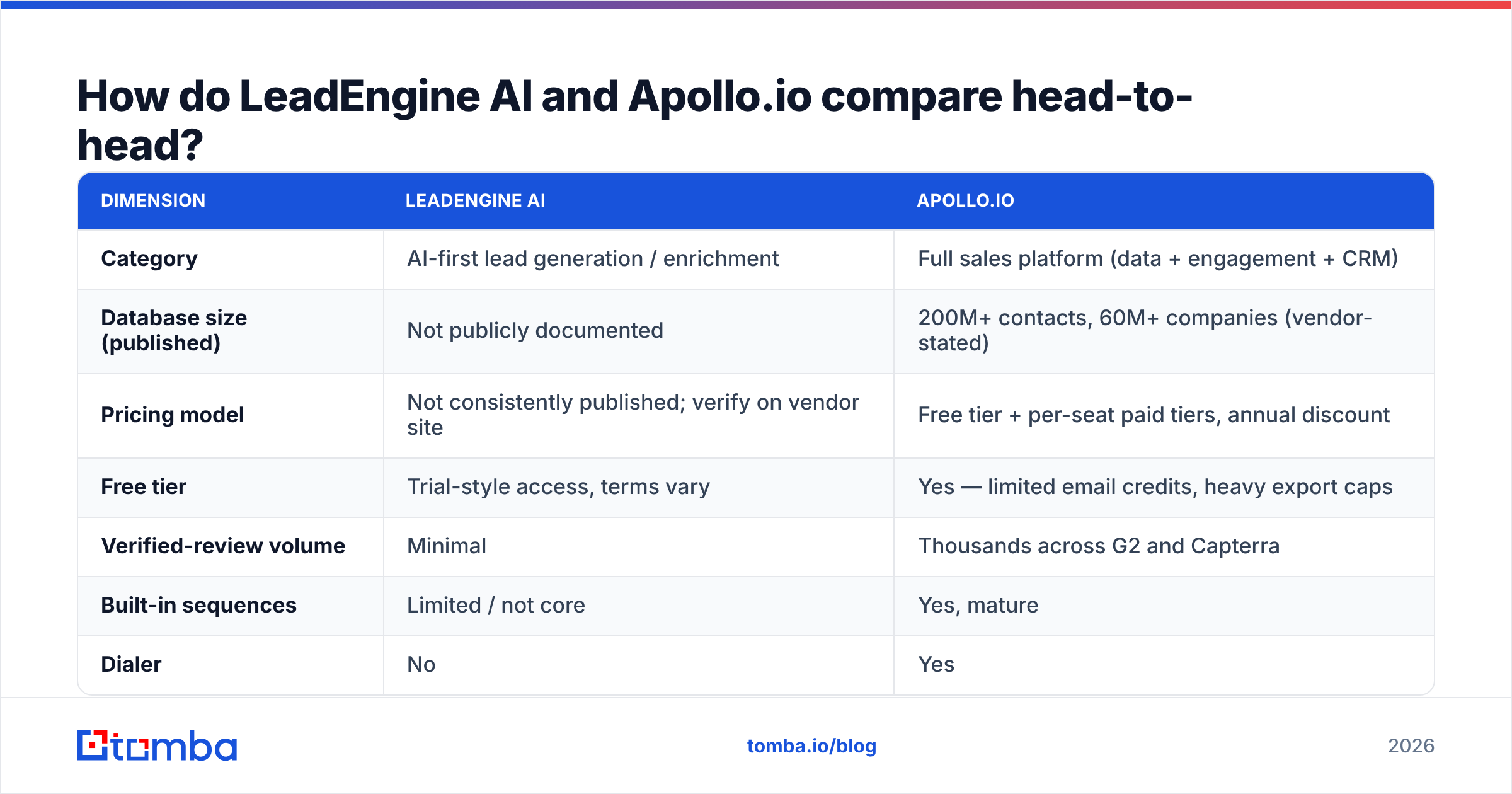
LeadEngine AI vs Apollo.io: how do they compare head-to-head?#
Where a cell says "not publicly documented," that is the finding. An undisclosed spec is a real buying risk, not a neutral gap.
| Dimension | LeadEngine AI | Apollo.io |
|---|---|---|
| Category | AI-first lead generation / enrichment | Full sales platform (data + engagement + CRM) |
| Database size (published) | Not publicly documented | 200M+ contacts, 60M+ companies (vendor-stated) |
| Pricing model | Not consistently published; verify on vendor site | Free tier + per-seat paid tiers, annual discount |
| Free tier | Trial-style access, terms vary | Yes — limited email credits, heavy export caps |
| Verified-review volume | Minimal | Thousands across G2 and Capterra |
| Built-in sequences | Limited / not core | Yes, mature |
| Dialer | No | Yes |
| API for enrichment | Advertised; limits unclear | Yes, tier-gated |
| Data sourcing disclosure | Not publicly documented | Partially documented |
| Best fit | Teams experimenting with AI list-building | Teams wanting one tool for data + outreach |
| Main risk | Unverifiable accuracy, vendor longevity | Seat costs and export caps at scale |
The table settles more than a feature war ever will. This is not a close race on evidence. Apollo is a mature platform you can check before you buy. LeadEngine AI is a bet. It may pay off, but size it like a bet.
Which one has better data accuracy?#
Nobody outside the company can answer that for LeadEngine AI. Anyone who says otherwise is guessing. What you can do is learn how accuracy breaks down, then test for it.

Three numbers matter, and vendors love to blur them:
- Coverage, or hit rate — of 1,000 target contacts, how many return any email at all? Apollo scores well on US tech and weaker on European SMB.
- Precision — of the emails returned, how many actually land? This is the number that sets your bounce rate.
- Catch-all handling — about a fifth of B2B domains accept every address at the SMTP layer. A naive verifier marks them "valid," and you learn the truth when the bounce arrives. How a tool labels catch-alls tells you more than any marketing page. A dedicated catch-all verifier exists because generic checks fail here.
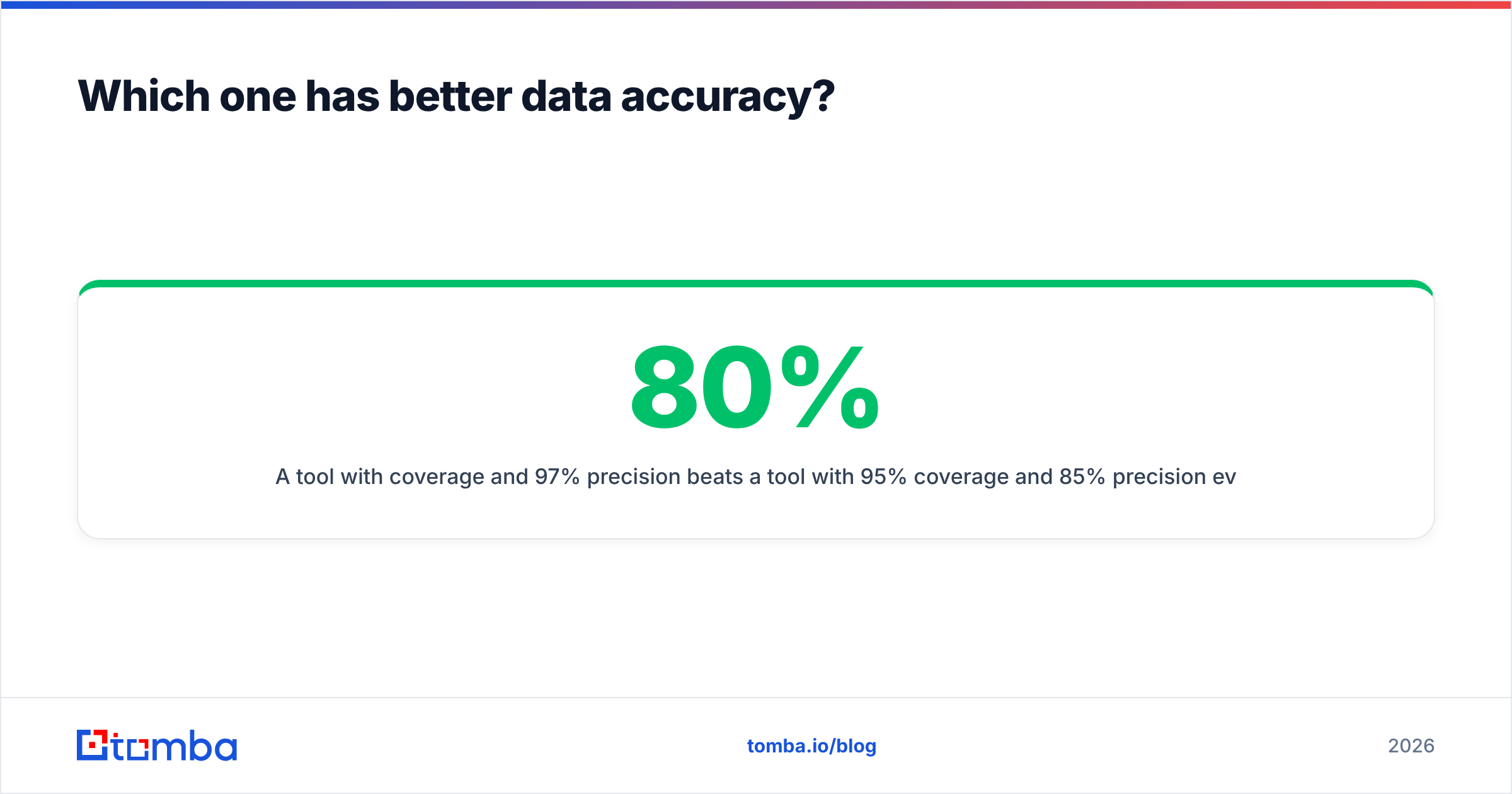
A tool with 80% coverage and 97% precision beats one with 95% coverage and 85% precision. Every time. The second one burns your sender reputation to hit a headline number. Google and Yahoo cap bulk senders at a 0.3% spam-complaint rate. You do not get many bad sends before inboxing collapses.
The bake-off protocol takes about an hour:
- Pull 200 real target contacts. Same accounts, same seniority, same region you sell into.
- Run both tools on the same list, on the same day. Freshness drifts week to week.
- Push every result through one neutral verifier so neither vendor grades its own homework.
- Record coverage, precision, and catch-all rate separately. Three columns, not one score.
- Send a 100-contact test batch from a warmed domain. Watch the real bounce and reply rates.
Skip step 5 and you are grading a spreadsheet, not a revenue channel.
How does pricing really work?#
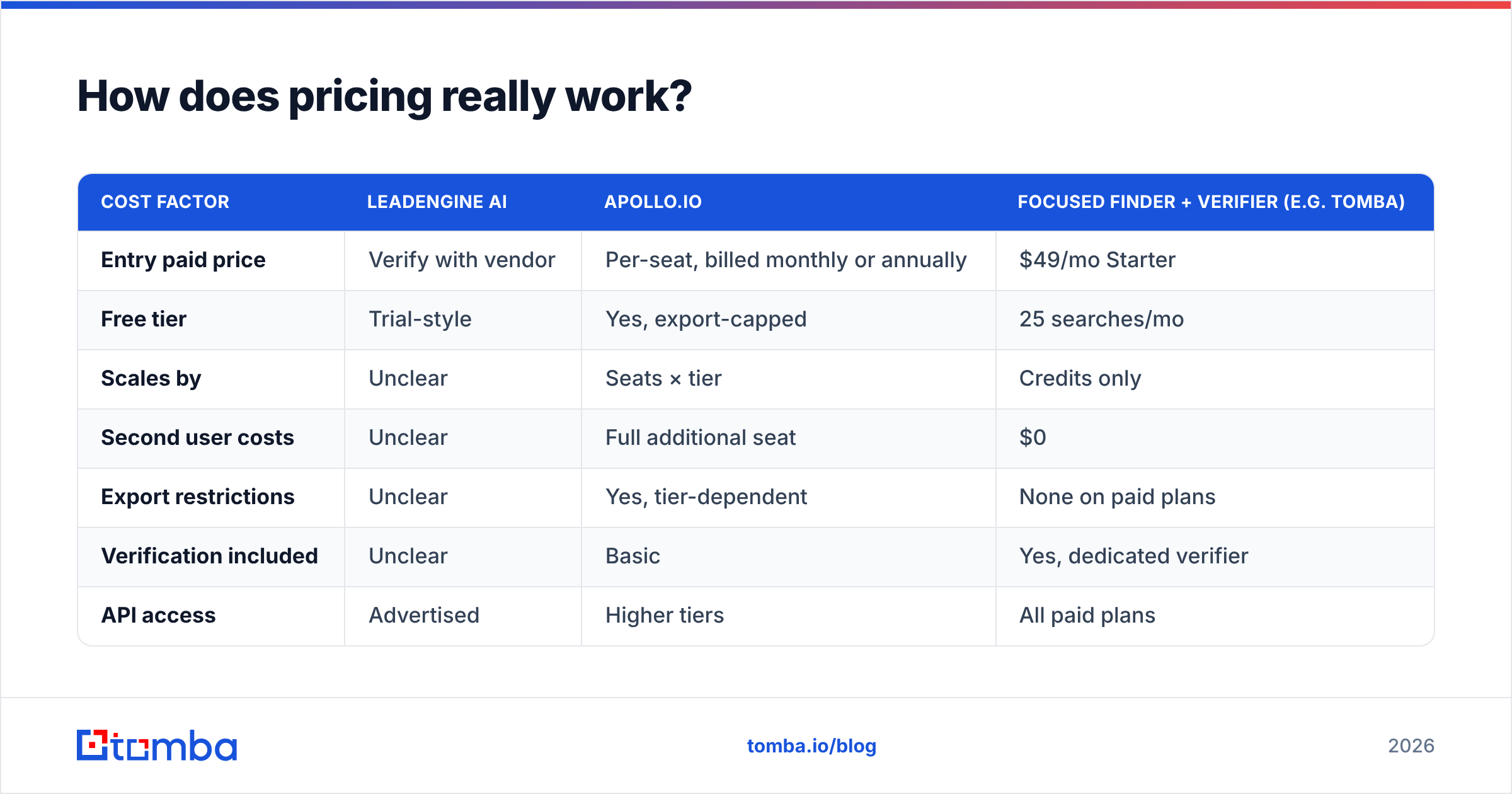
Compare the cost per usable verified contact. Not cost per seat, and not cost per credit. That one change reframes most buying decisions.
| Cost factor | LeadEngine AI | Apollo.io | Focused finder + verifier (e.g. Tomba) |
|---|---|---|---|
| Entry paid price | Verify with vendor | Per-seat, billed monthly or annually | $49/mo Starter |
| Free tier | Trial-style | Yes, export-capped | 25 searches/mo |
| Scales by | Unclear | Seats × tier | Credits only |
| Second user costs | Unclear | Full additional seat | $0 |
| Export restrictions | Unclear | Yes, tier-dependent | None on paid plans |
| Verification included | Unclear | Basic | Yes, dedicated verifier |
| API access | Advertised | Higher tiers | All paid plans |
The per-seat model is the quiet budget killer. A five-person SDR team on a mid-tier Apollo plan pays five times for one database. Say four of those reps only need contact data flowing into a sequencer they already own. You are funding four spare copies of the sequencer, the dialer, and the CRM. Tomba's pricing runs the other way. Free covers 25 searches a month, Starter is $49/mo, Growth $99/mo, Pro $249/mo, and Enterprise is custom. It is priced on credits, not headcount, which is why API-driven and ops-led teams often land there.
Some teams are not buying lookups at all. They buy compliance-cleared lists in bulk. BookYourData fits that shape well: pre-built, filterable, verified lists. Price it alongside both tools here.
Who should choose which?#
Five patterns cover almost every team. Find yours.
- Choose Apollo.io if you want one tool for everything. No sequencer, no dialer, no CRM, a US-centric ICP, and a team small enough that seat count stays sane. Bundling is a real advantage when you start from zero.
- Pilot LeadEngine AI if AI list-building is the actual bottleneck. Some teams struggle to define and find accounts, not to find emails at known accounts. AI-native tools can win that job. Pilot it in parallel, measured, on a slice.
Three more patterns, in rough order of how often they show up:
- Choose a focused finder plus verifier if your stack is already built. You send with Instantly or Smartlead and track deals in HubSpot or Salesforce. You just need clean contacts flowing in. Paying for a second sequencer and a second CRM to get data is how outbound budgets quietly double. An email finder plus email verifier covers it for a fraction of the price.
- Choose a list vendor if you buy in bulk, rarely. Quarterly campaigns against a fixed segment do not need a per-seat subscription running all year.
- Choose an API-first provider if engineering owns enrichment. When enrichment runs inside your product, your warehouse, or an automation, UI quality is irrelevant. Rate limits are everything. The Tomba API and bulk email finder exist for exactly this pattern.
What should you actually watch out for?#
Export caps are the number one complaint after purchase. Read the export limit before you read the database size. A 200M-contact database you can export 1,000 records from each month is a 1,000-contact database.
Regional coverage collapses faster than vendors admit. If you sell into DACH, the Nordics, LATAM, or APAC, US benchmark figures tell you almost nothing. Test in your region, or budget for the disappointment.
Contract length compounds vendor risk. Annual prepay with a tool that has no public review base and no stated data sourcing is a concentrated bet. Go monthly, or pilot, until the data proves itself.
Verification is not optional, whichever tool wins. Every provider returns some stale records, because people change jobs at roughly 20% a year. That includes Apollo, LeadEngine AI, and Tomba. Verify right before you send, not at list-build time. That one habit is the gap between a 1% and a 7% bounce rate. HubSpot's email deliverability guidance makes the same point from the sending side.
Frequently asked questions#
Is Apollo.io's free plan enough to evaluate the data? For coverage, yes. For precision at scale, no. Export caps stop you before the sample gets useful. Use the free plan to check whether your ICP exists in the database, then trial a paid plan for the accuracy test.
Can I use LeadEngine AI and Apollo together? Yes, and during evaluation you should. Run AI list-building on one side and database filtering on the other. Deduplicate, then see which source books better meetings. The winner takes the renewal.
Does an AI-first tool beat a traditional database? It depends on where your bottleneck sits. AI tools win at defining a hard-to-filter segment, such as companies hiring their first RevOps lead. Databases win at coverage of a clear one, such as VP Sales, 50-200 employees, SaaS, US. Most teams need both, at different moments.
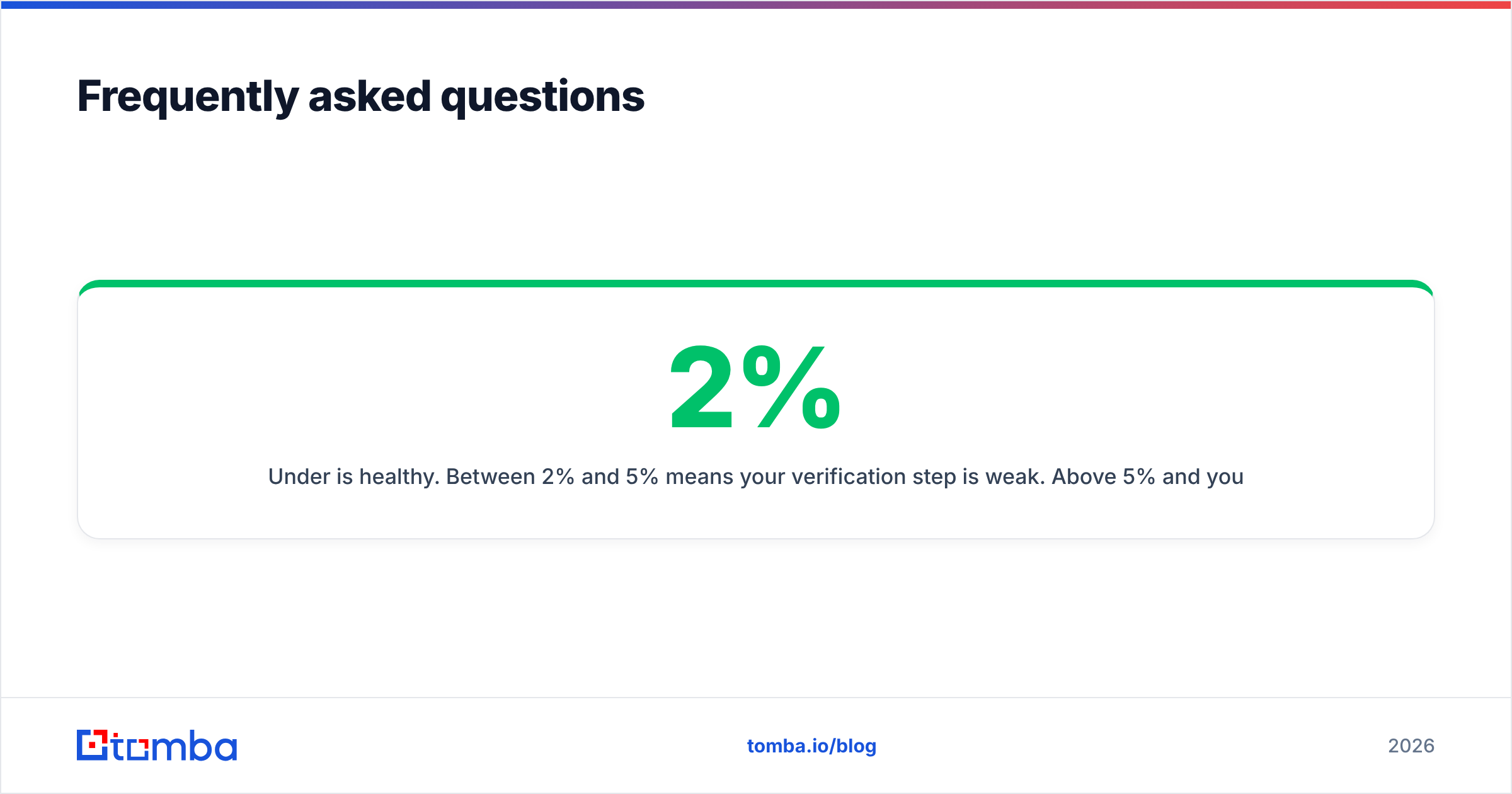
What bounce rate is acceptable? Under 2% is healthy. Between 2% and 5% means your verification step is weak. Above 5% you are actively damaging email deliverability. Pause and fix the data before the next send.
The verdict#
Apollo.io wins on evidence, not necessarily on fit. It is verifiable, widely reviewed, and mature. If you need a whole outbound stack in one subscription, it is a defensible default. LeadEngine AI may well be excellent. It has simply not published enough for anyone to judge it from outside, so it belongs in a pilot, not a migration. That is the honest end of the LeadEngine AI vs Apollo.io question.
There is a third answer, and most teams land on it after the math. If your sending, CRM, and sequencing already work, you are shopping for contact data, not a platform. Point the Tomba Email Finder at your target domains. Verify before every send. Keep the $49/mo flat plan instead of five seats you do not need. Start free with 25 searches, run the 200-contact bake-off against whatever you use today, and let the bounce rate pick the winner.
Related guides#
// get started
Find, verify and enrich your first contacts today
Start on the free plan with 25 searches a month, then scale when your team is ready.
Free plan · No credit card required · GDPR & CCPA
// about the author