LeadEngineAI vs LeadMine: Which B2B Lead Tool Wins in 2026?
LeadEngineAI and LeadMine both promise verified B2B contacts, but they solve different problems. Here is an honest breakdown of data quality, pricing models, and which one actually belongs in your 2026 outbound stack.
LeadEngineAI vs LeadMine comes down to one question. Do you need better targeting, or better contact data? The answer decides which tool earns your budget.
TL;DR
- LeadEngineAI is AI-first. You describe your ICP in plain English. The system builds and scores the list for you.
- LeadMine is a searchable B2B contact database with a browser extension. You filter, you pull emails, you burn credits.
- Neither vendor publishes a third-party accuracy audit. Treat every "98% accurate" claim as marketing. Run your own 200-contact test instead.
- LeadMine wins on price clarity for small teams doing manual research. LeadEngineAI wins on speed when your ICP is still fuzzy.
- Both are weak in the same spot. Catch-all domains are where most cold-email bounces start.
- Need work emails at scale through an API? A finder like Tomba usually costs less per valid contact than either one. It also plugs into whichever list builder you keep.
What are LeadEngineAI and LeadMine?#
Start with the honest framing. These are two mid-market tools in a crowded space, not two flagship platforms with years of public benchmarks. Neither shows up in a Gartner Magic Quadrant. What you will find is a scatter of reviews on G2's sales intelligence category and Capterra, plus each vendor's own landing page.
LeadEngineAI calls itself an AI lead-generation engine. You type something like "Series A fintech firms in the UK, 20-100 staff, hiring engineers." The product hands back a scored, enriched list. The AI does two jobs here. First it turns your words into filters. Then it ranks the results by fit. Contact data comes from crawled public sources, partner feeds, and a bit of guesswork.
LeadMine runs the older, plainer model. It is a searchable B2B contact database plus a Chrome extension. You filter by title, industry, location, and company size. You pull emails. You burn credits. It feels like a classic prospecting database, not an AI copilot.
That gap changes what the word "accurate" even means. A database is accurate when the email it hands you lands. An AI engine is accurate when the company it surfaced really fits your ICP. The email is a side issue, and it often farms that job out to other vendors.

The four layers behind any LeadEngineAI vs LeadMine choice#
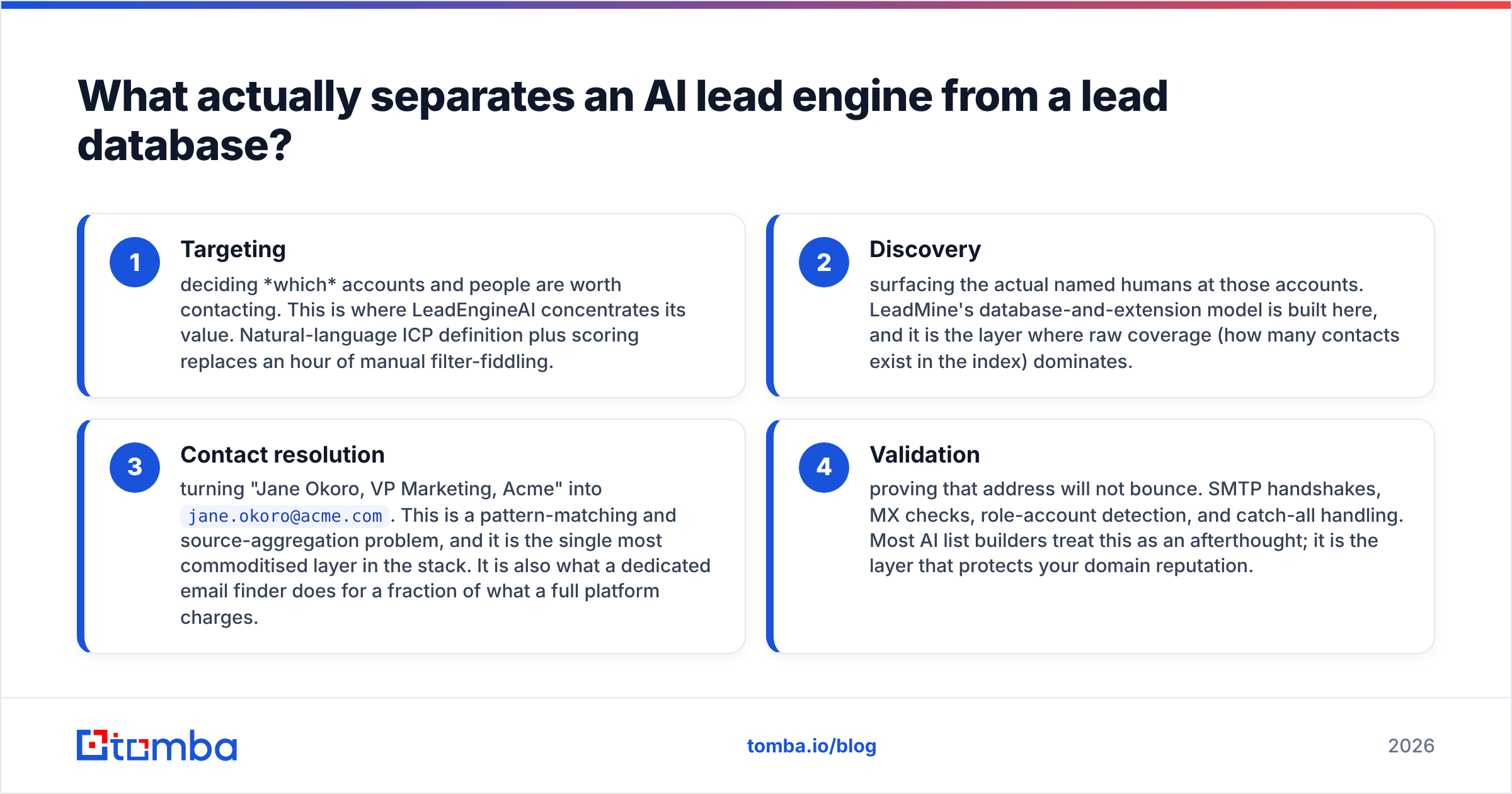
Before you read a feature list, get clear on the four layers of a prospecting stack. Most bad buys start when a team assumes one tool covers all four.
- Targeting. This is picking which accounts and people are worth a message. It is where LeadEngineAI puts its value. A plain-English ICP plus scoring saves you an hour of filter-fiddling.
- Discovery. This is finding the named humans at those accounts. LeadMine's database and extension live here. Raw coverage rules this layer: how many contacts sit in the index.
- Contact resolution. This turns "Jane Okoro, VP Marketing, Acme" into
jane.okoro@acme.com. It is pattern matching plus source merging, and it is the most commodity layer in the stack. A dedicated email finder does it for a sliver of what a full platform charges. - Validation. This proves the address will not bounce. Think SMTP checks, MX checks, role-account flags, and catch-all rules. Most AI list builders bolt this on late. It is also the layer that guards your domain.
A tool that aces layer 1 and flunks layer 4 will still sink your deliverability. A tool that owns layers 3 and 4 with no targeting leaves your reps guessing. You need all four layers covered. One vendor does not have to supply them.
LeadEngineAI vs LeadMine: how do they compare feature by feature?#
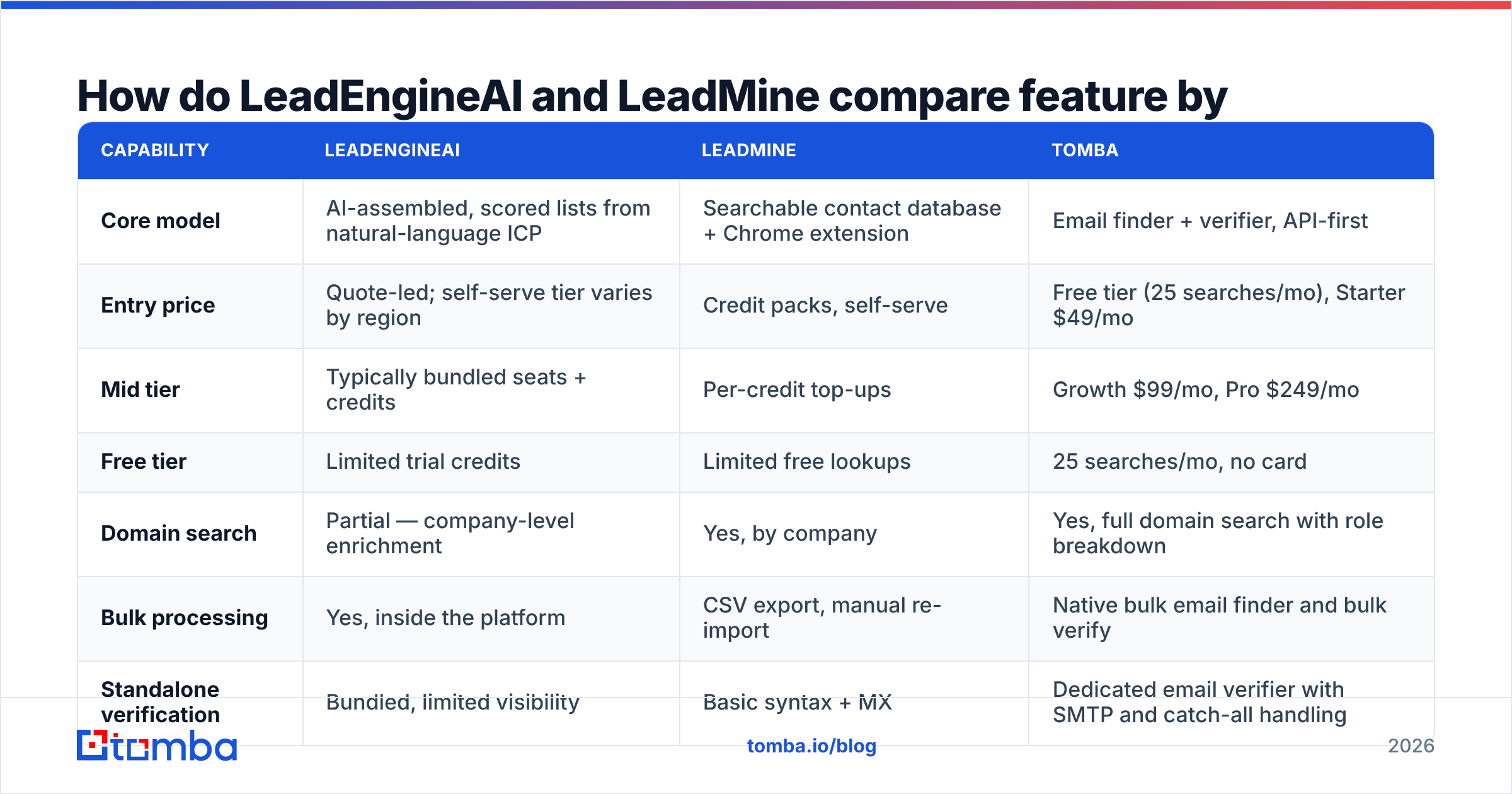
Here is the side-by-side, with Tomba as a yardstick for the discovery and checking layers. Prices move often, and some tiers hide behind a demo. Check each vendor's own pricing page before you commit. The shape of the pricing matters more than today's sticker.
| Capability | LeadEngineAI | LeadMine | Tomba |
|---|---|---|---|
| Core model | AI-built, scored lists from a plain-English ICP. | Contact database plus Chrome extension. | Email finder and verifier, API-first. |
| Entry price | Quote-led; self-serve tier varies by region. | Credit packs, self-serve. | Free tier (25 searches/mo), Starter $49/mo. |
| Mid tier | Bundled seats plus credits. | Per-credit top-ups. | Growth $99/mo, Pro $249/mo. |
| Free tier | A few trial credits. | A few free lookups. | 25 searches/mo, no card. |
| Domain search | Partial: company-level enrichment only. | Yes, by company. | Yes, full domain search with role breakdown. |
| Bulk work | Yes, inside the platform. | CSV export, then manual re-import. | Native bulk email finder and bulk verify. |
| Standalone checks | Bundled, with little visibility. | Basic syntax and MX. | Dedicated email verifier with SMTP and catch-all handling. |
| Public API | On higher tiers only. | Limited. | Full API on all paid plans. |
| Best for | Teams with a fuzzy ICP and no analyst. | Solo founders and small SDR teams. | Engineering-led teams enriching at volume. |

A pattern shows up fast. LeadEngineAI charges a platform premium for the targeting layer. LeadMine charges a commodity price for the discovery layer. Neither one is priced like a checking specialist. Send 5,000 emails a month and checking stops being a nice-to-have. It is the line between a warm domain and a blocked one.
Which one finds more valid emails?#
Nobody outside the two firms can settle this, and you should distrust any blog that claims it can. You can run a controlled test yourself, though. It takes about two hours.
Build a 200-row control list from a segment you know well. Pick accounts where you already hold confirmed addresses for 20-30 contacts. Run the same list through both tools. Then measure four things.
- Match rate. How many rows came back with any address at all?
- Verified match rate. How many did the tool itself label valid or deliverable?
- True accuracy. Of your known-good contacts, how many did each tool get exactly right? A close-but-wrong guess does not count.
- Cost per valid contact. Divide credits spent by correct results. This is the only number that belongs in a budget talk.

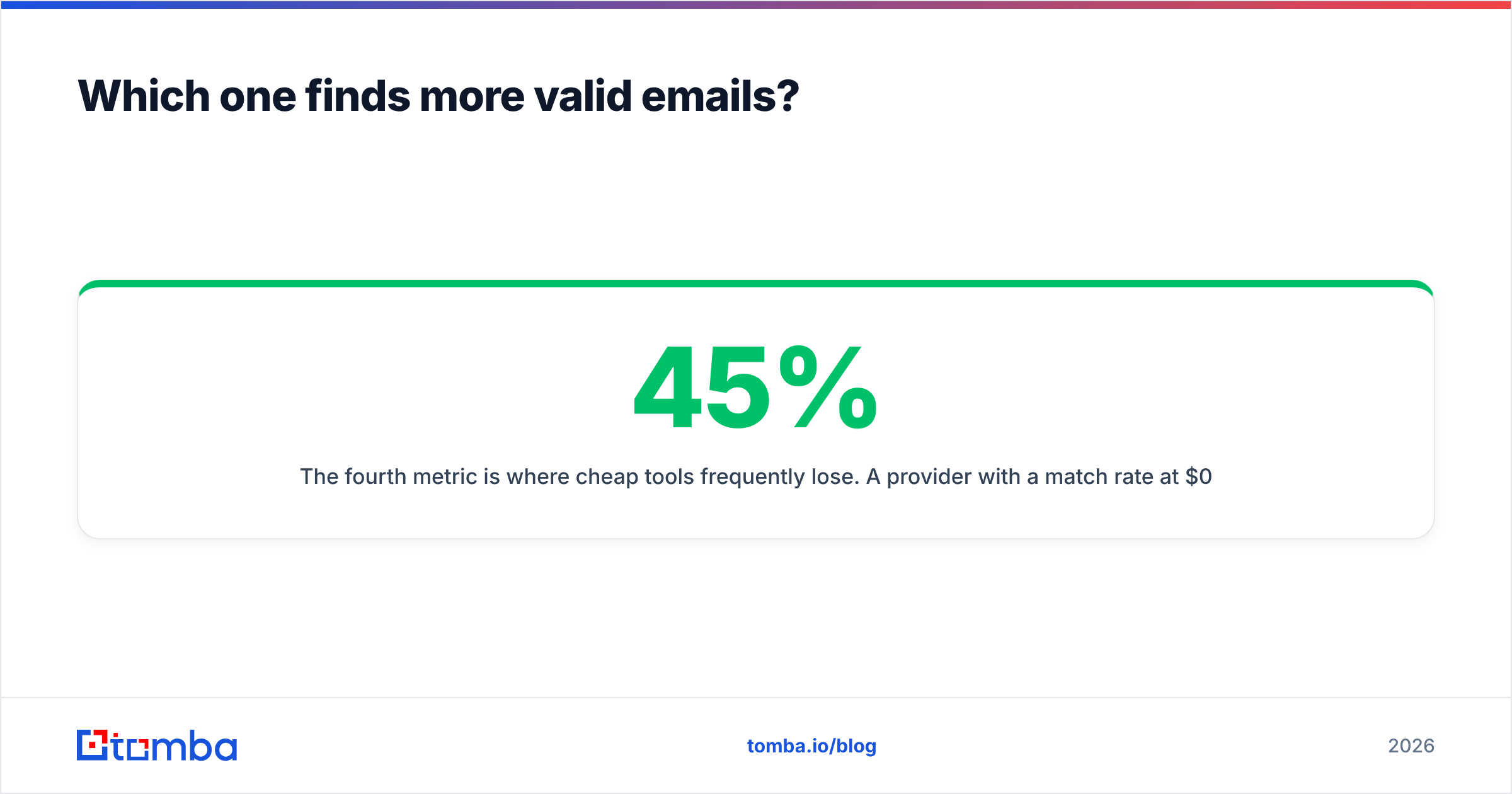
The fourth metric is where cheap tools lose. Say one tool hits a 45% match rate at $0.02 per credit. Another hits 70% at $0.05. The cheap one can still cost more per usable contact, because you pay for the misses too. So read each credit policy with care. Some vendors refund credits when a lookup finds nothing. Some do not. That single clause can swing your real cost by 30%.
Why do catch-all domains break both tools?#
A catch-all server accepts every address at the door. So an SMTP check cannot tell jane@acme.com from notarealperson@acme.com. Both come back as accepted. Roughly a fifth to a quarter of B2B domains work this way. Big firms and heavy spam filters skew that share higher.
Most list-building platforms mark the address "risky" and move on. That leaves you a bad choice. Send it and risk the bounce, or drop a chunk of your best-fit accounts. Neither LeadEngineAI nor LeadMine is unusually strong here. It is a limit of the SMTP protocol, not a bug in either product.
The workaround is pattern confidence. You match the firm's known email format against several sightings of that one person's address. A catch-all verifier does this on purpose, rather than dumping the contact in a "risky" pile. Catch-all domains are also where LeadEngineAI vs LeadMine ends in a draw. If many of your buyers sit on those domains, make this a hard requirement.

What does each one cost in practice?#
Sticker price is the dullest part of a lead-tool budget. Three things matter more.
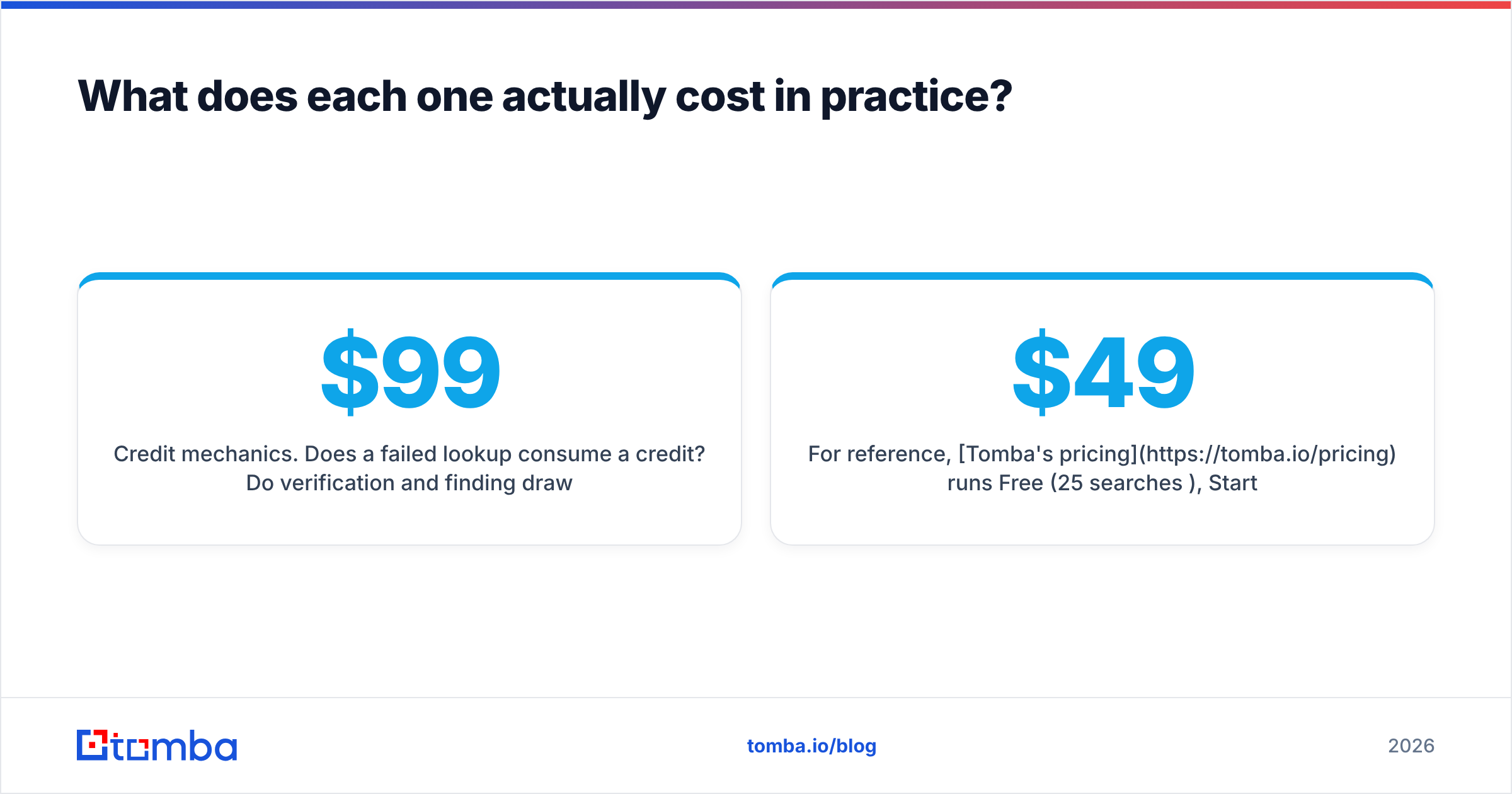
Credit rules. Does a failed lookup still burn a credit? Do finding and checking draw on one pool or two? Do unused credits roll over? A $99 plan with no rollover and charge-on-miss can be worse value than a $249 plan with rollover and refunds.
Seat structure. Platform tools like LeadEngineAI often charge per seat. That punishes teams who want to give every rep light access. Credit-based tools like LeadMine, and API-first tools in general, do not care how many people log in.
Export rights. Read the contract clause on data export. Some platforms block bulk export of enriched data. Others forbid loading it into a rival system. If you plan to keep those contacts in your CRM for good, this is not a footnote.
For reference, Tomba's pricing runs Free at 25 searches a month, then Starter at $49, Growth at $99, and Pro at $249, plus custom Enterprise. The API is in every paid tier, with no sales call first. That detail is worth flagging. API gating is the most common upsell in this category. Teams buy the cheap tier, build a workflow, then learn that code access costs three times as much.
Which should you pick for your team?#
There is no universal winner. So here is the call, framed by situation.
- You have a vague ICP and nobody to research it. LeadEngineAI earns its premium. You are buying analyst time, not data.
- You know exactly who you want and just need contacts. LeadMine is faster and cheaper. Paying for targeting you will not use is waste.
- You are enriching a CRM or an inbound list. Neither tool is the right pick. You need contact resolution and checks through an API. That is a data enrichment job.
- You send more than 5,000 cold emails a month. Add a dedicated checking step before your sequencer, whatever you pick. A burned domain costs more than credits.
- You are two people testing whether outbound works at all. Start on free tiers, run the 200-row test above, and sign nothing for 30 days.
One more note on the "one platform for everything" urge. At this size it is usually a mistake. Bundles are priced on their strongest layer, and your money props up the weak ones. A good targeting tool plus a good checking tool often costs less and performs better than one mid-tier suite. That only holds if both pieces have real APIs. Which is why API access on the entry plan matters so much.
Is there a third option worth testing?#
Yes, and not only Tomba. BookYourData is a fair option if you would rather buy pre-checked, filterable lists outright. It suits teams who want one flat cost per list instead of metered credits. Findymail and Clearout each own a slice of the problem too. So treat LeadEngineAI vs LeadMine as a false binary, unless you have already settled on a single-vendor workflow.
Run three tools in your bake-off, not two. The third one is where the surprises show up. Adding one more free tier to the test costs you nothing.
The bottom line on LeadEngineAI vs LeadMine#
Both tools are reasonable, and they aim at different buyers. One sells you targeting smarts. The other sells contact volume at a commodity price. So pick the layer that is actually your bottleneck. Check every vendor claim with your own 200-row test. And never let a list builder be your last line of defence before the send button.
Is the missing layer reliable contact resolution, turning a name and a domain into an address that lands? Start with the Tomba Email Finder. The free tier gives 25 searches a month with no card, which is enough to run the test above. The API ships from Starter at $49 a month, so whatever you build during the test keeps working in production.
Related guides#
// get started
Find, verify and enrich your first contacts today
Start on the free plan with 25 searches a month, then scale when your team is ready.
Free plan · No credit card required · GDPR & CCPA
// about the author