LeadEngineAI vs LeadRocks: Which B2B Lead Tool Wins in 2026
LeadEngineAI sells AI-driven lead discovery. LeadRocks sells a big LinkedIn-sourced contact database. We compare sourcing, accuracy, pricing models, and who each one actually fits.
TL;DR
- LeadEngineAI is an AI-first prospecting layer: you describe an ICP in plain language, it assembles a list and drafts outreach. Speed is the selling point, not verified depth.
- LeadRocks is a database-first tool: a large pool of LinkedIn-sourced B2B contacts with emails and phone numbers, usually sold as credit packs or lifetime-style deals rather than a per-seat SaaS subscription.
- Accuracy is the real dividing line. AI-assembled lists tend to guess patterns; static databases tend to go stale. Both failure modes end the same way, in your bounce rate.
- Pricing models are not comparable head to head. One charges for AI runs and seats, the other for credits and lookups. Cost per usable contact is the only fair metric.
- Neither replaces a verification layer. Whichever you pick, run the exported list through a dedicated email verifier before your sequencer touches it.
What are LeadEngineAI and LeadRocks?#
They solve the same business problem from opposite ends of the pipeline.
LeadEngineAI belongs to the 2024-2026 wave of AI prospecting agents. The pitch is that you skip filters entirely: type "Series A fintech companies in the UK hiring a Head of Compliance," and the tool interprets the request, searches its sources, and returns a list with contact details and sometimes a drafted first-touch email. Less clicking, more describing.
LeadRocks is the older, more literal model. It maintains a contact database built primarily from LinkedIn profile data — names, titles, companies, work emails, and direct dials — and you query it with filters. Its distribution history leans heavily on lifetime and credit-pack offers, which is why it shows up constantly in "cheap Apollo alternative" threads. You can check its current plan structure at leadrocks.io.
The practical difference: LeadEngineAI optimises for time to first list. LeadRocks optimises for cost per record. Those are different problems, and the one you have determines the answer.
How do LeadEngineAI and LeadRocks source their data?#
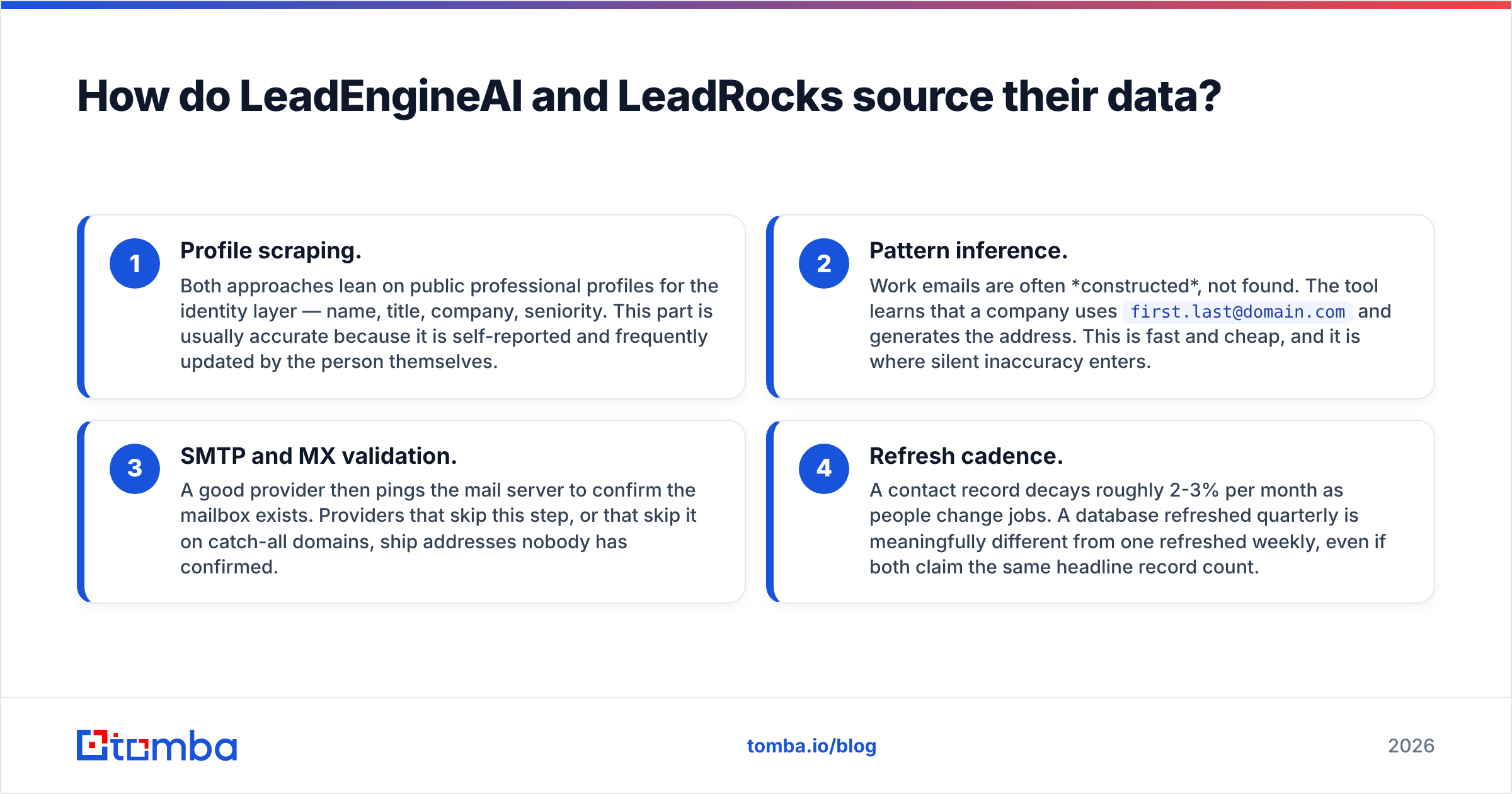
This is the part vendors describe vaguely and buyers ignore, which is why so many trials end in a 30% bounce rate. Four sourcing mechanics matter:
- Profile scraping. Both approaches lean on public professional profiles for the identity layer — name, title, company, seniority. This part is usually accurate because it is self-reported and frequently updated by the person themselves.
- Pattern inference. Work emails are often constructed, not found. The tool learns that a company uses
first.last@domain.comand generates the address. This is fast and cheap, and it is where silent inaccuracy enters. - SMTP and MX validation. A good provider then pings the mail server to confirm the mailbox exists. Providers that skip this step, or that skip it on catch-all domains, ship addresses nobody has confirmed.
- Refresh cadence. A contact record decays roughly 2-3% per month as people change jobs. A database refreshed quarterly is meaningfully different from one refreshed weekly, even if both claim the same headline record count.
Ask each vendor which of those four they do, and how often. If a rep cannot answer step 3 and step 4 precisely, treat the accuracy claim on the pricing page as marketing copy.

Which one has better data accuracy?#
Neither wins outright, and the honest answer depends on your target segment.
LeadRocks tends to perform best on mid-market and enterprise contacts at companies with stable domains and predictable email conventions. Its weakness is freshness: a large static database inevitably carries records for people who left the job eighteen months ago. Reviews on G2's lead intelligence category show this pattern across nearly every database-first vendor, not just this one.
LeadEngineAI has the opposite profile. Because it assembles lists at query time, the company-level signals are usually current. But AI-assembled prospecting is only as good as the contact layer underneath it, and when that layer comes up empty, the model has a strong incentive to produce a plausible-looking address rather than return nothing. A guessed address that passes syntax checks but fails at the mail server is worse than no address, because it costs you sender reputation.
Here is the test that settles it for your list, not for a generic benchmark:
- Pull 100 contacts from each tool, same ICP, same seniority.
- Run all 200 through an independent verifier.
- Count only
validresults. Ignoreaccept-allandunknown— those are unresolved, not wins. - Divide the plan cost by that count.
Most teams find the ranking flips depending on the segment. SMB and non-English domains are where both tools degrade fastest.

How do LeadEngineAI and LeadRocks pricing compare?#
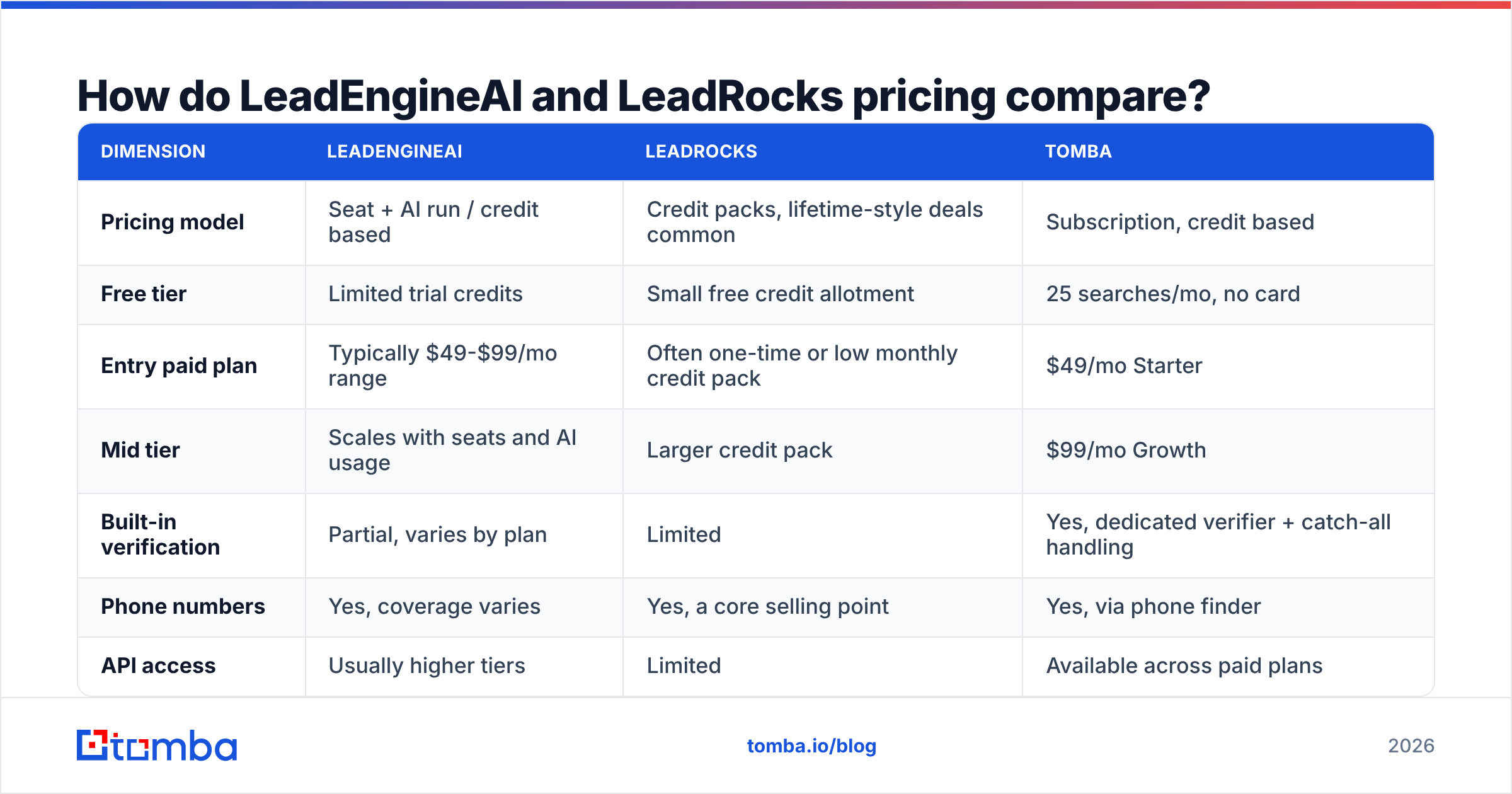
Compare cost per verified contact, not the sticker price. Plan details change often, so confirm current numbers on each vendor's own pricing page before you commit — the table below reflects the structural model each tool uses rather than a guaranteed quote.
| Dimension | LeadEngineAI | LeadRocks | Tomba |
|---|---|---|---|
| Pricing model | Seat + AI run / credit based | Credit packs, lifetime-style deals common | Subscription, credit based |
| Free tier | Limited trial credits | Small free credit allotment | 25 searches/mo, no card |
| Entry paid plan | Typically $49-$99/mo range | Often one-time or low monthly credit pack | $49/mo Starter |
| Mid tier | Scales with seats and AI usage | Larger credit pack | $99/mo Growth |
| Built-in verification | Partial, varies by plan | Limited | Yes, dedicated verifier + catch-all handling |
| Phone numbers | Yes, coverage varies | Yes, a core selling point | Yes, via phone finder |
| API access | Usually higher tiers | Limited | Available across paid plans |
| Best for | Fast ICP exploration | Cheap bulk contact volume | Accuracy-first outbound at scale |
The structural trap in both models is different. With AI-run pricing, your cost scales with experimentation — every re-run of a prompt burns budget, including the runs that returned junk. With credit packs, your cost is front-loaded and non-refundable, so a low hit rate on your specific ICP is money already spent.
Tomba's pricing sits in the same band as LeadEngineAI's entry tier at $49/mo for Starter and $99/mo for Growth, but the credits buy finder and verifier operations rather than AI generation cycles. That is a preference, not a universal advantage: if your bottleneck is genuinely list ideation rather than deliverability, an AI-first tool earns its price.

What happens when you skip verification?#
You find out at scale, in week three, after the damage is already recorded against your domain.
The failure sequence is predictable. You import 3,000 unverified contacts. The first send goes out at 200/day. Bounce rate lands somewhere between 12% and 40%. Google and Microsoft both read hard bounce rate as a spam signal, so your placement drops for the entire domain, including replies to warm threads and your renewal emails. Fixing it takes weeks of reduced volume and re-warming, which costs far more than the verification credits would have.

The mitigation is unglamorous and takes ten minutes:
- Deduplicate first. Overlapping exports from two tools inflate credit spend and send the same person two cold emails.
- Verify everything, regardless of source. Both LeadEngineAI and LeadRocks output records they label as valid. Treat that label as a hypothesis.
- Segregate catch-all domains. Roughly a fifth of B2B domains accept all mail, so a standard verifier returns
unknown. Route those to a catch-all verifier or a lower-volume, higher-personalisation track instead of dropping them. - Cap the first send. 50/day for the first week on a new domain. HubSpot's own prospecting guidance makes the same point: volume without hygiene is negative ROI.
Which tool fits which team?#
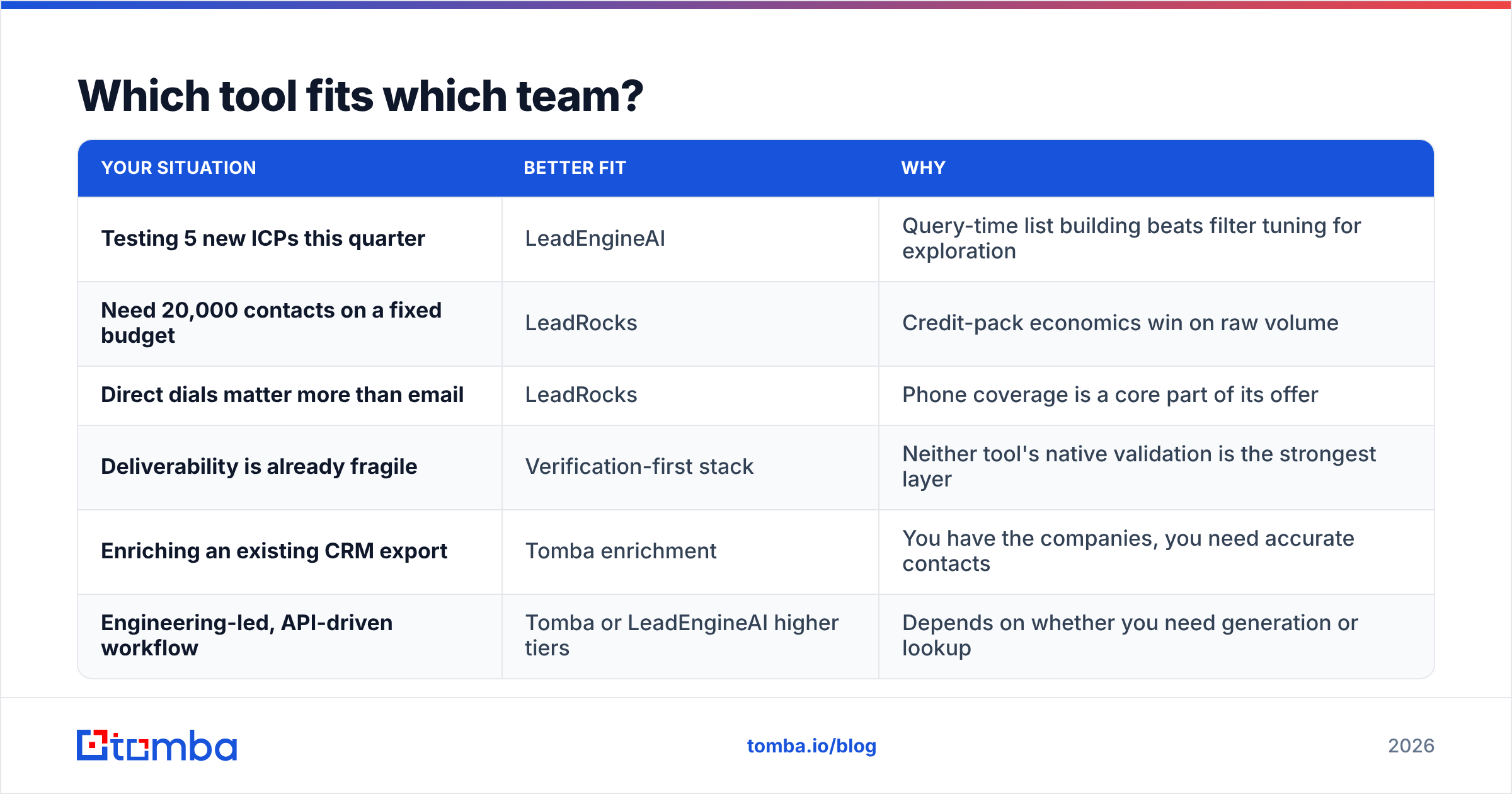
| Your situation | Better fit | Why |
|---|---|---|
| Testing 5 new ICPs this quarter | LeadEngineAI | Query-time list building beats filter tuning for exploration |
| Need 20,000 contacts on a fixed budget | LeadRocks | Credit-pack economics win on raw volume |
| Direct dials matter more than email | LeadRocks | Phone coverage is a core part of its offer |
| Deliverability is already fragile | Verification-first stack | Neither tool's native validation is the strongest layer |
| Enriching an existing CRM export | Tomba enrichment | You have the companies, you need accurate contacts |
| Engineering-led, API-driven workflow | Tomba or LeadEngineAI higher tiers | Depends on whether you need generation or lookup |
A pattern worth naming: many teams end up running two tools, not one. They use an AI-first product for discovery and a lookup-and-verify product for the contact layer, because the skills genuinely are separate. If your budget allows only one, choose based on which failure hurts more — an empty pipeline or a burned domain.
How do these compare to the broader alternatives market?#
LeadEngineAI and LeadRocks are both reacting to the same pressure: Apollo, ZoomInfo, and Clearbit set the enterprise price anchor high, and a whole tier of tools exists to undercut it. Before you sign an annual contract with either, it is worth benchmarking against the category more broadly.
Worth including in a bake-off:
- BookYourData — strong on verified, pay-as-you-go B2B lists with a clear accuracy guarantee. A good reference point when you want to test whether a vendor's accuracy claim actually holds on your segment.
- Apollo.io — the volume incumbent, with sequencing built in. Heavier and pricier, but a fair baseline. If you are pricing it out, the Apollo alternative comparison covers where the credits actually go.
- Findymail, Wiza, Icypeas — waterfall-style finders that query several sources per lookup. Often better hit rates on hard domains, at a higher per-record cost.
- Tomba — finder plus verifier plus catch-all handling in one stack, with data sourcing documented publicly rather than described as proprietary magic.
Run the same 100-contact test across three of them. It costs one afternoon and usually changes the decision.
What should you actually check during the trial?#
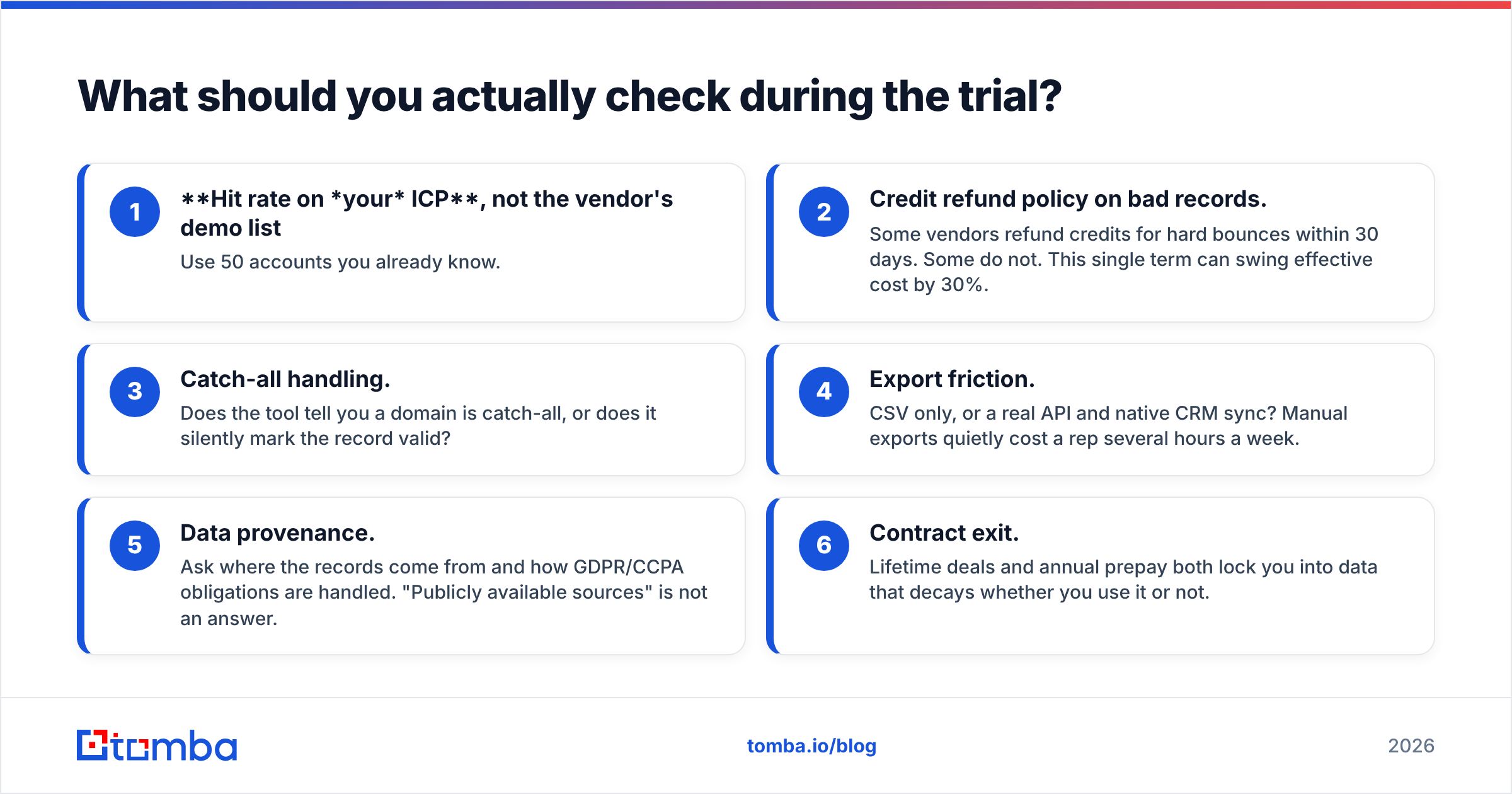
Ignore the dashboard. Check these six things:
- Hit rate on your ICP, not the vendor's demo list. Use 50 accounts you already know.
- Credit refund policy on bad records. Some vendors refund credits for hard bounces within 30 days. Some do not. This single term can swing effective cost by 30%.
- Catch-all handling. Does the tool tell you a domain is catch-all, or does it silently mark the record valid?
- Export friction. CSV only, or a real API and native CRM sync? Manual exports quietly cost a rep several hours a week.
- Data provenance. Ask where the records come from and how GDPR/CCPA obligations are handled. "Publicly available sources" is not an answer.
- Contract exit. Lifetime deals and annual prepay both lock you into data that decays whether you use it or not.
If a vendor is evasive on items 2, 3, or 5, that tells you more about the data than any accuracy percentage on the homepage.
The verdict: LeadEngineAI or LeadRocks?#
Pick LeadEngineAI if your constraint is list ideation — you are still figuring out who to sell to, you value speed over completeness, and you are prepared to verify everything downstream.
Pick LeadRocks if your constraint is budget per record — you already know your ICP precisely, you need bulk volume and direct dials, and the credit-pack economics beat a monthly subscription for your usage pattern.
Pick neither as your only tool if deliverability is already a problem. The common failure in both stacks is the same: a contact layer that ships unverified addresses under a confident label, and a cold email program that pays for it three weeks later.
If accuracy is the thing you cannot compromise on, start with the layer that does one job well. The Tomba Email Finder returns a confidence score and sourcing detail for every address, pairs directly with the verifier and catch-all checks, and starts free with 25 searches a month so you can run the 100-contact test above before spending anything. Paid plans begin at $49/mo. Run your list through it alongside whichever tool you are trialling, compare valid counts, and let the bounce rate decide.
Related guides#
// get started
Find, verify and enrich your first contacts today
Start on the free plan with 25 searches a month, then scale when your team is ready.
Free plan · No credit card required · GDPR & CCPA
// about the author