LeadEngineAI vs LimeLeads: Which B2B Lead Tool Wins in 2026?
LeadEngineAI sells AI-scored intent lists. LimeLeads sells a verified static B2B database. They solve different problems — and one of them probably isn't the problem you have. Here's the honest breakdown.
TL;DR
- LeadEngineAI is an AI-layer play: intent signals, scoring, and generated lists. You pay for the model's opinion about who is in-market.
- LimeLeads is a classic static B2B database: filter by industry, size, title, export a CSV, done. Cheaper, simpler, more predictable, and less magical.
- Neither is primarily a verification engine. Both hand you records that still need a real-time SMTP check before they touch your sending domain.
- If your bottleneck is finding the right accounts, an intent-scored tool earns its price. If your bottleneck is reaching a known list of companies accurately, a domain-level email finder plus a verifier costs less and bounces less.
- The most common working setup in 2026 is a hybrid: use a database or intent tool for account discovery, then resolve and verify contacts at send time through an API.
What are LeadEngineAI and LimeLeads, actually?#
They are not the same category, which is why head-to-head reviews of the two tend to be muddled.
LeadEngineAI positions itself in the AI-enrichment and intent-scoring lane. The pitch: instead of you writing filters, a model ingests firmographic data, web activity signals, and technographics, then ranks accounts by how likely they are to buy in the next quarter. You get a prioritized list plus contacts attached to it. The value proposition is judgment, not raw volume.
LimeLeads is the older, plainer model. It is a searchable B2B contact database with a filter-and-export workflow. You pick industry, headcount, revenue band, geography, and job title, you preview matching records, and you export credits' worth of rows. There is no scoring layer telling you which of those 4,000 records is warm. There is also no scoring layer to be wrong.
That distinction shapes everything downstream — price, data freshness behavior, and how much cleanup lands on your SDRs.
How do LeadEngineAI and LimeLeads compare head-to-head?#
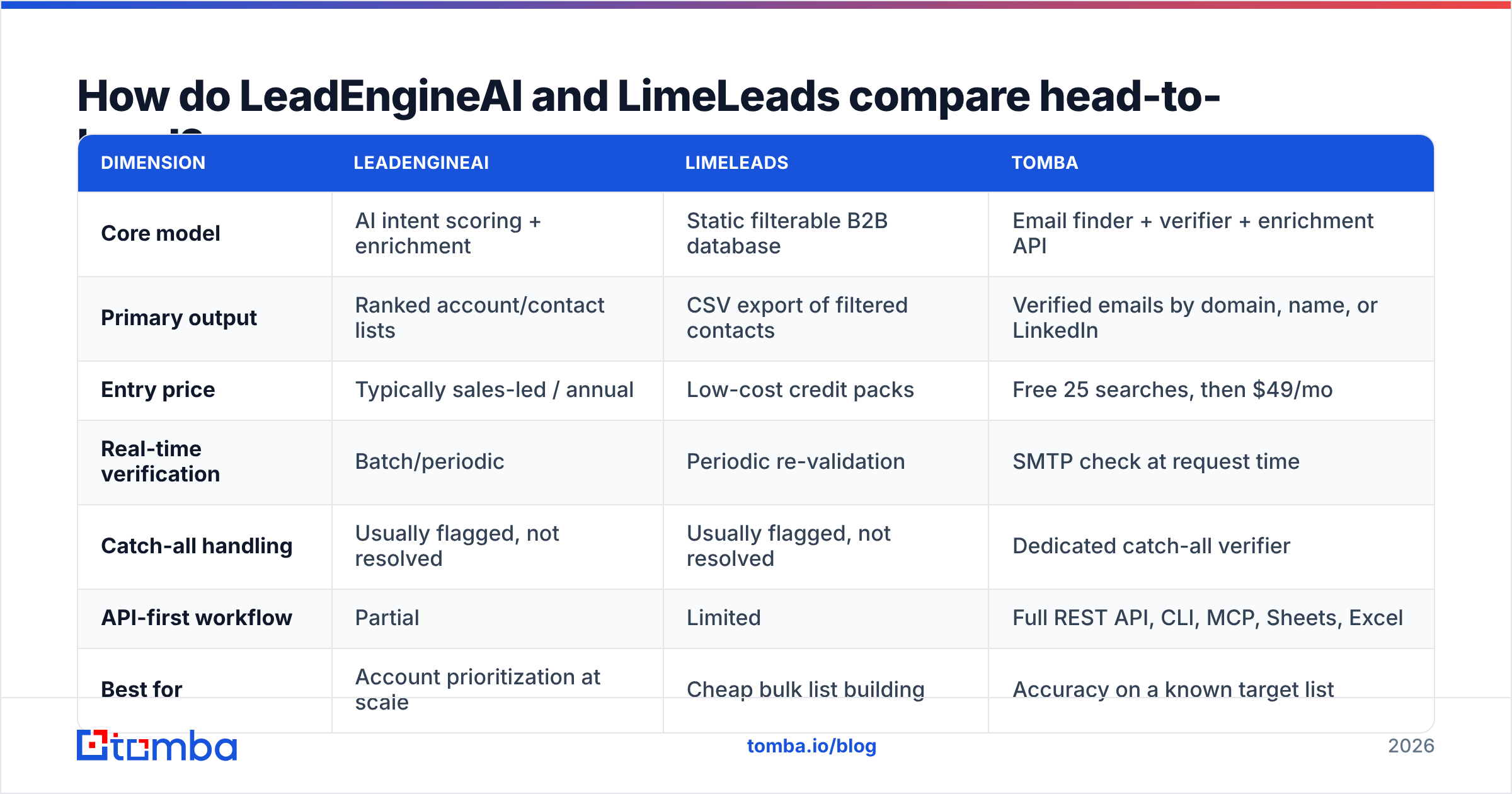
| Dimension | LeadEngineAI | LimeLeads | Tomba |
|---|---|---|---|
| Core model | AI intent scoring + enrichment | Static filterable B2B database | Email finder + verifier + enrichment API |
| Primary output | Ranked account/contact lists | CSV export of filtered contacts | Verified emails by domain, name, or LinkedIn |
| Entry price | Typically sales-led / annual | Low-cost credit packs | Free 25 searches, then $49/mo |
| Real-time verification | Batch/periodic | Periodic re-validation | SMTP check at request time |
| Catch-all handling | Usually flagged, not resolved | Usually flagged, not resolved | Dedicated catch-all verifier |
| API-first workflow | Partial | Limited | Full REST API, CLI, MCP, Sheets, Excel |
| Best for | Account prioritization at scale | Cheap bulk list building | Accuracy on a known target list |
| Worst for | Small teams with a fixed ICP list | Teams needing intent or freshness | Discovering accounts you don't know yet |
The pattern here is worth naming: LeadEngineAI sells who to contact, LimeLeads sells a lot of contacts, and an email-finding layer sells the address actually being right. Buying one and expecting the other two is how teams end up disappointed with all three.
Which one has better data accuracy?#
Neither vendor's headline accuracy number means what you think it means, and that applies across this whole category.
Most B2B data vendors quote accuracy as a percentage of records that passed validation at the time the record was added or last refreshed. That is not the same as the record being correct when you press send. B2B email decay runs roughly 25-30% per year, and it spikes during layoff cycles and reorgs. A database refreshed quarterly is, on average, six weeks stale at the moment you export from it.
Here's how the two behave differently on this axis:
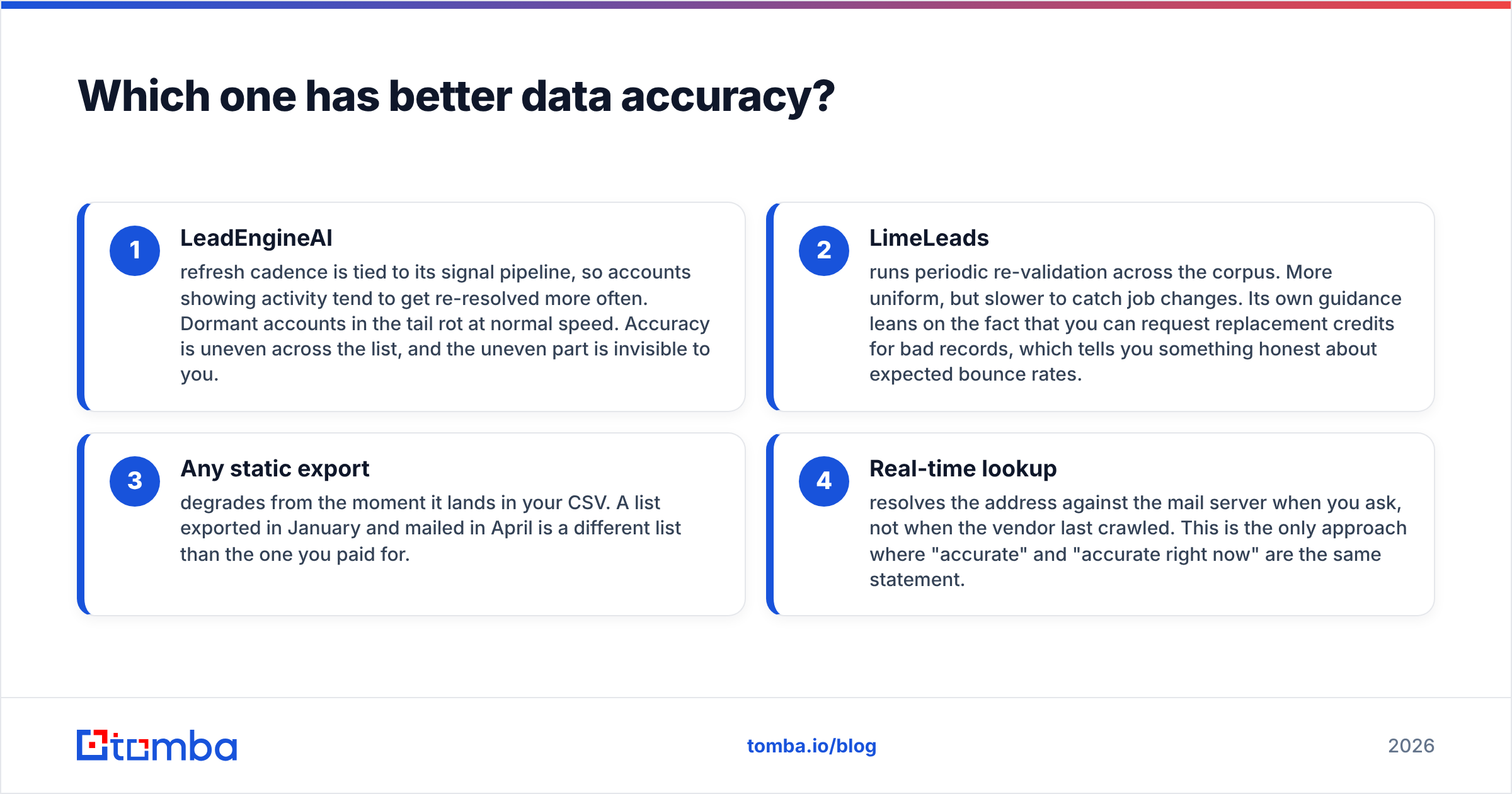
- LeadEngineAI — refresh cadence is tied to its signal pipeline, so accounts showing activity tend to get re-resolved more often. Dormant accounts in the tail rot at normal speed. Accuracy is uneven across the list, and the uneven part is invisible to you.
- LimeLeads — runs periodic re-validation across the corpus. More uniform, but slower to catch job changes. Its own guidance leans on the fact that you can request replacement credits for bad records, which tells you something honest about expected bounce rates.
- Any static export — degrades from the moment it lands in your CSV. A list exported in January and mailed in April is a different list than the one you paid for.
- Real-time lookup — resolves the address against the mail server when you ask, not when the vendor last crawled. This is the only approach where "accurate" and "accurate right now" are the same statement.

The practical takeaway: whichever of these two you pick, budget for a verification pass. Running a email verifier over an exported list before import typically strips 8-20% of records from a mid-tier database export. That is not a knock on either vendor — it is the physics of the category.
Suggested visual: screenshot of a verification run showing deliverable / risky / invalid breakdown on an imported CSV.
What does each one cost in practice?#
Pricing structures differ enough that a sticker-price comparison misleads.
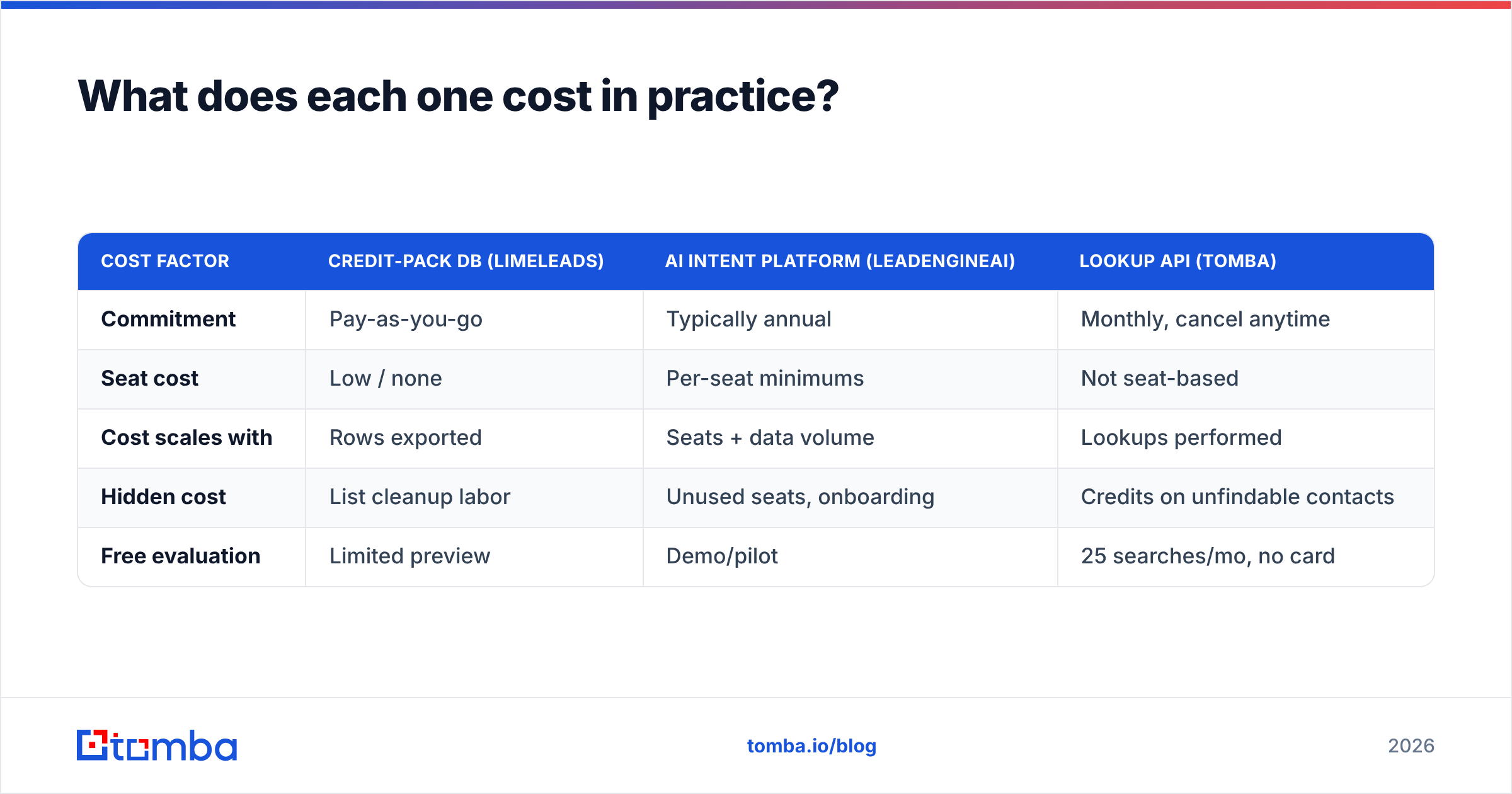
LimeLeads uses credit packs. You buy a block of export credits, you spend them, you buy more. The appeal is that unused credits don't evaporate on a monthly cycle and the entry cost is genuinely low. The cost you don't see on the pricing page is the SDR hours spent cleaning exports and the deliverability cost of whatever bounces slip through.
LeadEngineAI — like most AI-intent tools — trends toward annual contracts with seat minimums and a data-volume component. You're paying for the model and the signal pipeline, not per row. That math works when your ACV is high enough that better targeting moves revenue meaningfully. At a $4K ACV with a two-person SDR team, it usually doesn't.
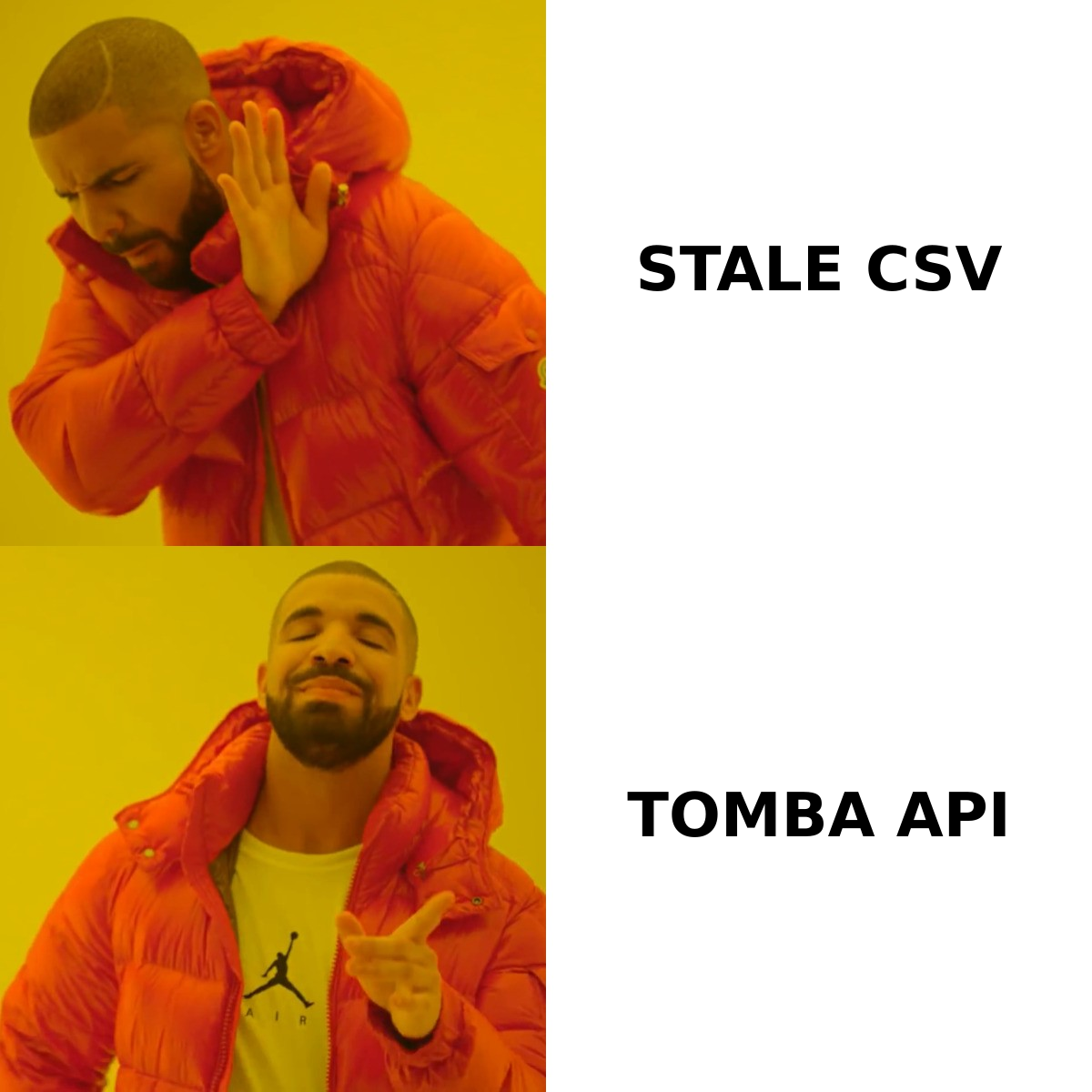
For reference on the third approach, Tomba pricing runs a free tier at 25 searches/month, Starter at $49/mo, Growth at $99/mo, and Pro at $249/mo, with Enterprise custom. That's a per-lookup model rather than per-seat, which matters if you have one ops person running lookups for a team of ten.
| Cost factor | Credit-pack DB (LimeLeads) | AI intent platform (LeadEngineAI) | Lookup API (Tomba) |
|---|---|---|---|
| Commitment | Pay-as-you-go | Typically annual | Monthly, cancel anytime |
| Seat cost | Low / none | Per-seat minimums | Not seat-based |
| Cost scales with | Rows exported | Seats + data volume | Lookups performed |
| Hidden cost | List cleanup labor | Unused seats, onboarding | Credits on unfindable contacts |
| Free evaluation | Limited preview | Demo/pilot | 25 searches/mo, no card |
A useful sanity check before you sign anything: take 50 companies you already know you want to sell to, and see which tool returns correct, contactable people for the most of them. Vendor-supplied sample lists are curated. Your own list is not.
Is an AI intent layer worth paying for?#
It depends entirely on whether account selection is genuinely your constraint.
Intent data earns its keep when your addressable market is large and undifferentiated — say, 40,000 companies fit your ICP on paper and you can only touch 800 a month. Prioritization is worth real money there. Forrester and Gartner have both published extensively on intent-driven prioritization lifting conversion in exactly that shape of market.
It stops earning its keep when:
- Your TAM is small. If there are 600 companies on earth who could buy your product, you don't need a model to rank them. You need correct contact data for all 600.
- Your signals are weak. Third-party intent is probabilistic and noisy. A spike in "CRM" topic reads at a company might be one intern doing research.
- You can't act fast. Intent decays in days. If your sequence takes three weeks to launch, the signal is gone before your first touch lands.
- Your reps don't change behavior. Scoring only pays off if the list actually reorders what reps do on Monday morning. Plenty of teams buy scores and then work the list alphabetically anyway.
If two or more of those apply, the money is better spent on data accuracy and sending infrastructure than on ranking.

How do you build a stack that actually works?#
The honest answer is that neither tool is a complete outbound data stack, and the teams getting good numbers in 2026 are layering.
A workable architecture, in order:
- Account discovery — a database (LimeLeads, BookYourData, or similar) or an intent platform (LeadEngineAI) to define the target set. Optimize here for coverage and filter quality, not for email accuracy.
- Contact resolution — take the account domains and resolve real people at real titles. A domain search returns the email pattern and named contacts per company, which is more durable than a frozen CSV column.
- Verification — SMTP-level checking before anything enters your sequencer. Catch-all domains need the catch-all verifier specifically, because a generic checker returns "unknown" and your team either guesses or discards good leads.
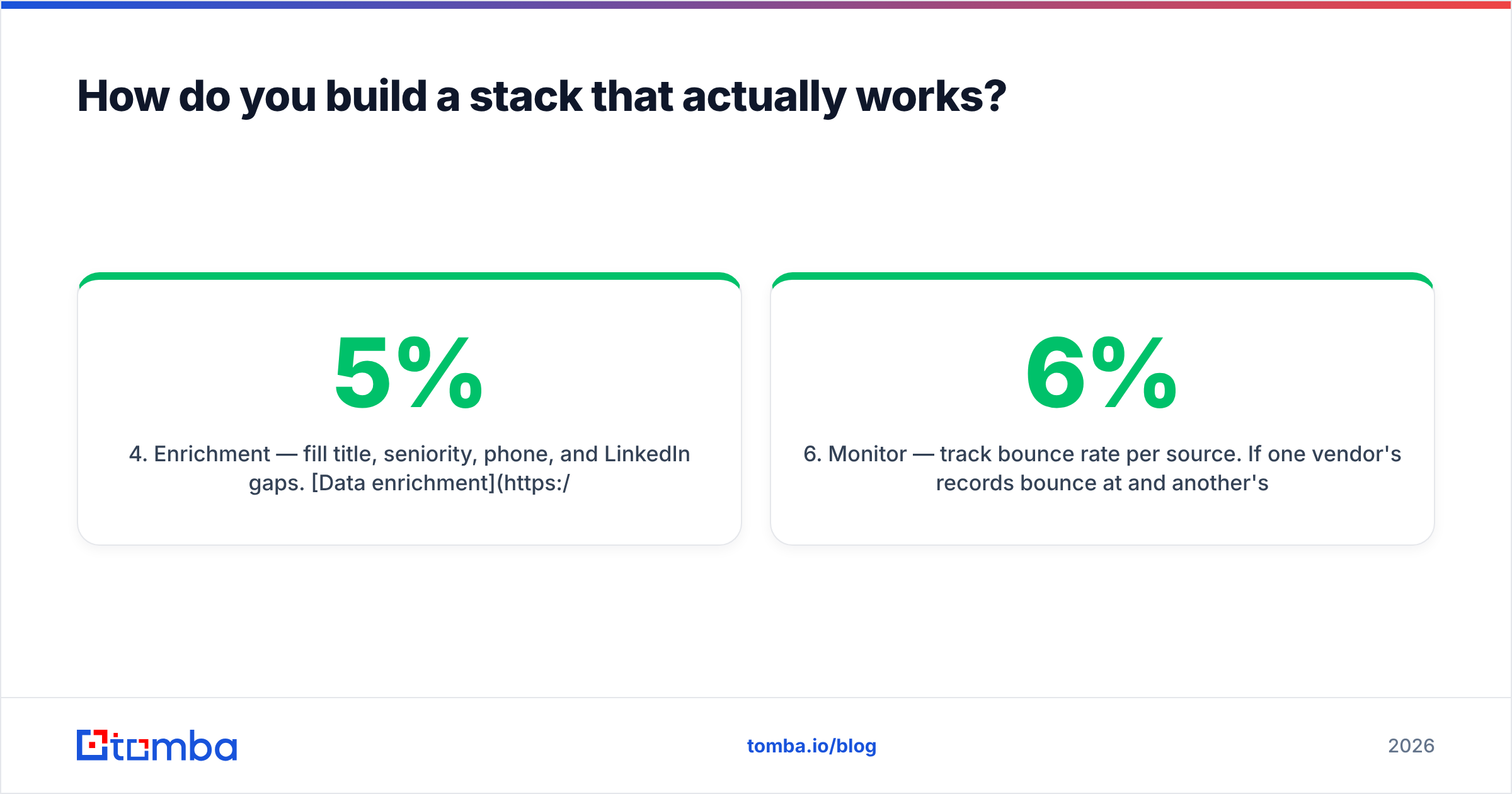
- Enrichment — fill title, seniority, phone, and LinkedIn gaps. Data enrichment at this stage is cheaper than paying a database vendor for fields you only need on 5% of records.
- Sync — push clean records into the CRM. Broken syncs re-introduce stale data, so treat the HubSpot or Salesforce connection as part of the data pipeline, not an afterthought.
- Monitor — track bounce rate per source. If one vendor's records bounce at 6% and another's at 1.5%, that's your renewal decision made for you.
The reason to separate discovery from resolution is that they decay at different rates. A company's industry, headcount band, and tech stack are stable for months. A person's email address is stable until they change jobs, which in B2B SaaS averages around 18 months and is trending shorter.
Suggested visual: side-by-side of a CRM record before and after enrichment, showing filled title/phone/LinkedIn fields.
What do real users say about each tool?#
Check G2 and Capterra before you commit, and read specifically for these three complaint patterns, which recur across the entire category:
- Export/credit disputes. How the vendor handles bad records. Generous replacement policies are a good sign; rigid ones on a decaying dataset are not.
- Coverage gaps by geography. Most B2B databases are strong in US mid-market and thin in EMEA SMB and APAC. If you sell into Germany or Japan, sample before you buy.
- Contract friction. Annual AI-platform contracts are much harder to exit than credit packs. Weigh that against the upside.
Reviews of LimeLeads tend to praise the price and the simplicity, and flag freshness. Reviews of AI-intent platforms generally praise the targeting and flag the cost-to-value ratio for smaller teams. Both criticisms are structural to the model, not fixable bugs.
Which should you choose?#
Short version:
- Choose LimeLeads if you want cheap, broad, self-serve list building, your ICP is easy to express as filters, and you already have a verification step in your workflow.
- Choose LeadEngineAI if you have a large addressable market, a real sales team that will act on prioritization, an ACV that justifies an annual contract, and the operational speed to work signals while they're warm.
- Choose neither, yet if your actual pain is bounce rates, catch-all domains, or finding the right person at companies you've already identified. That's a resolution and verification problem, and buying more rows makes it worse, not better.
Run the 50-company test. It takes an afternoon and it settles the argument better than any comparison post, including this one.
Ready to fix the accuracy layer?#
If you already know which companies you want and the problem is reaching the right people without torching your sender reputation, start with the Tomba Email Finder. Feed it a domain and a name, get a verified address back with a confidence score and the sources behind it — no annual contract, no seat minimums, and 25 free searches a month to test it against whatever list you're currently paying for. Layer it on top of LimeLeads, LeadEngineAI, or your existing CRM, and let each tool do the job it's actually good at.
Related guides#
Ready to find emails that actually work?
Join 150,000+ professionals who stopped guessing and started sending. Free credits on signup — no credit card required.
Get the Tomba newsletter
Practical outbound tactics and product updates — once every two weeks.
About the author