LeadEngine AI vs Mattermark: Which Lead Data Tool Wins?
One tool scores companies with AI, the other built its name on startup growth signals. Here is where LeadEngine AI and Mattermark actually differ in 2026 — and the contact-data gap both leave behind.
LeadEngine AI vs Mattermark is a fair fight, but not a like-for-like one. One tool ranks accounts with AI. The other tracks company growth and funding. This guide shows where each one wins. It also shows the contact gap both leave open.
TL;DR
- Mattermark is a company data product. It covers company profiles, funding, growth signals, and account lists. It was built for investors first and sales teams second.
- LeadEngine AI sits in the newer AI scoring group. You give it a target profile. It returns ranked accounts and a guess at buying intent. It is strong at sorting, thin on verified contact data.
- Neither one is a contact database. You still need a second layer to turn "this account matters" into "this is the buyer's inbox."
- Both vendors price by quote in 2026. That makes a side-by-side cost check harder than it should be. Plan for annual deals, not monthly credits.
- The practical stack: pick one signal tool, then add a dedicated email finder for the contact step. That beats paying a premium for a platform that half-covers both jobs.
What are LeadEngine AI and Mattermark?#
Two products. Two different jobs. One overlapping sales pitch.
Mattermark launched in 2012 as a startup tracking database. It scored company momentum: headcount growth, web traffic, funding rounds, and mindshare. Venture funds used it to spot rising companies early. Sales teams later used it to build account lists by stage, size, and growth rate. The product has changed owners more than once since 2017. Today it reads as a company and funding dataset with list tools on top.
LeadEngine AI belongs to a much younger group. AI lead scoring took off once language models made it cheap to read messy signals. Those signals include job posts, review sites, press mentions, and tech-stack changes. The pitch is simple. You describe your ideal customer in plain words. The system ranks your market. Your reps work the top of the list instead of an alphabetical CSV.
Here is the honest framing. Mattermark answers which companies exist, and how fast are they growing. LeadEngine AI answers which of these should I call this week. Both leave the third question open: who do I email, and will that address bounce.
LeadEngine AI vs Mattermark: how do they differ?#
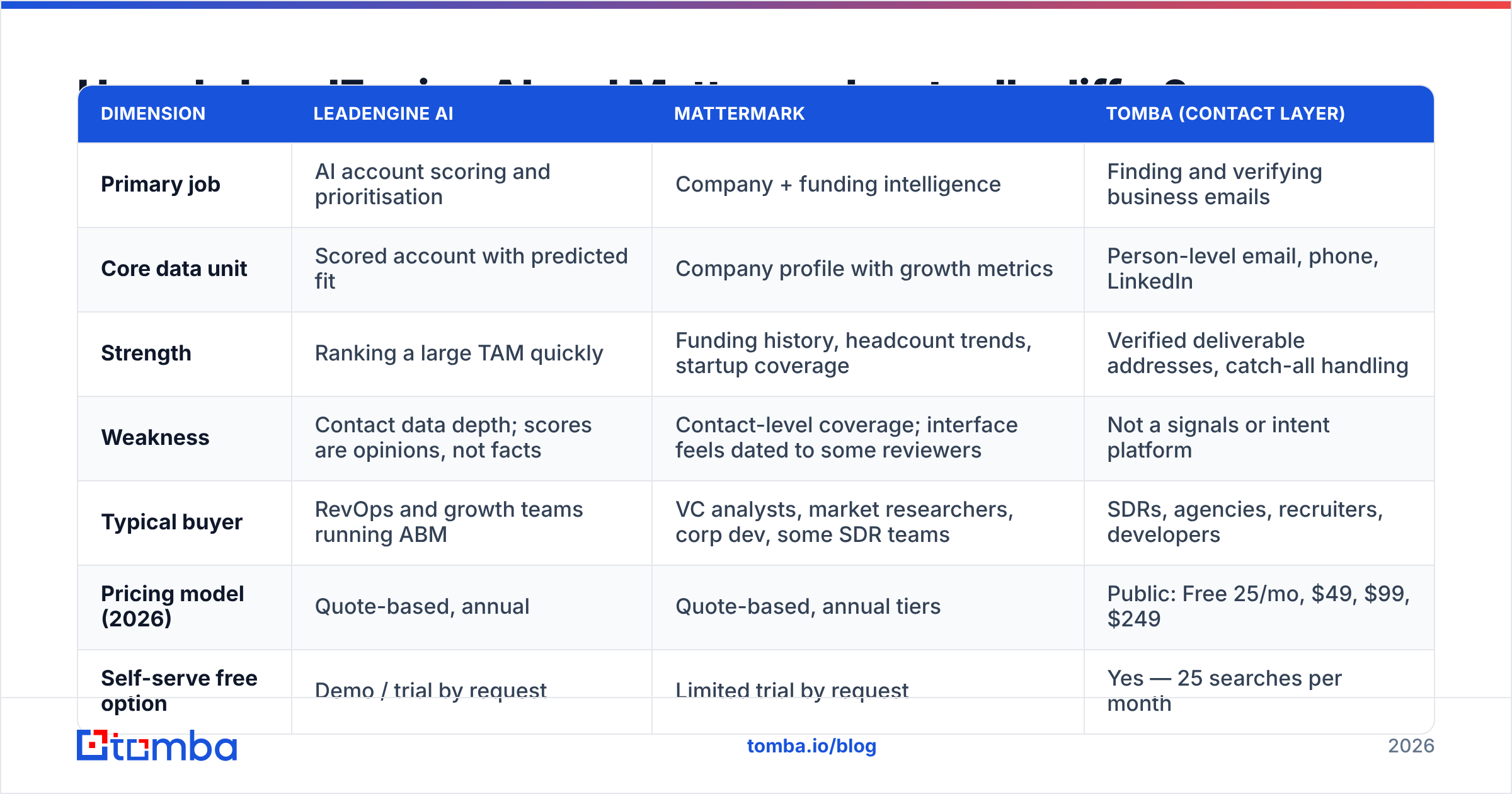
| Dimension | LeadEngine AI | Mattermark | Tomba (contact layer) |
|---|---|---|---|
| Primary job | AI account scoring and prioritisation | Company + funding intelligence | Finding and verifying business emails |
| Core data unit | Scored account with predicted fit | Company profile with growth metrics | Person-level email, phone, LinkedIn |
| Strength | Ranking a large TAM quickly | Funding history, headcount trends, startup coverage | Verified deliverable addresses, catch-all handling |
| Weakness | Contact data depth; scores are opinions, not facts | Contact-level coverage; interface feels dated to some reviewers | Not a signals or intent platform |
| Typical buyer | RevOps and growth teams running ABM | VC analysts, market researchers, corp dev, some SDR teams | SDRs, agencies, recruiters, developers |
| Pricing model (2026) | Quote-based, annual | Quote-based, annual tiers | Public: Free 25/mo, $49, $99, $249 |
| Self-serve free option | Demo / trial by request | Limited trial by request | Yes — 25 searches per month |
| API access | Yes, on higher tiers | Yes, historically gated to paid tiers | Yes on all paid plans |
Two things stand out. First, both tools hide price behind a form. That is a clear sign they sell to teams, not to single users. Second, neither one leads with person-level email checks. That is not the job either was built to do.
Which one has better data coverage?#
Coverage differs, so "better" depends on your target market.
Mattermark is strongest on venture-backed, fast-growing firms. Say your target is "Series A to C SaaS in North America." The data runs deep there: round sizes, investor names, and headcount curves. Say your target is "300-person machine shops in Ohio." Coverage thins out fast. That is a design choice, not a flaw. The product grew out of the startup world and still shows it.
AI scoring tools get coverage from sources they license or crawl. Then they add a model on top. The score is the product. The company data under it often comes from a third party. Ask any scoring vendor two questions before you sign. Where does the base company data come from? And what happens to a score when the record is 14 months old? A confident ranking built on a dead record is worse than no ranking. It still looks authoritative.
Contact accuracy is where both types get uncomfortable. Company data ages slowly. People data ages fast. Industry estimates put B2B contact decay near 2–3% a month. That adds up to about a quarter of your list going bad each year. A tool that refreshes funding rounds each quarter is not refreshing the VP of Marketing's inbox.
So most teams add a check step. Run your export through an email verifier before it hits the sequence. It is the cheapest insurance in the stack. It guards the sender reputation you spent months building. It also stops you from judging a campaign by its bounce rate.
What does each cost in 2026?#
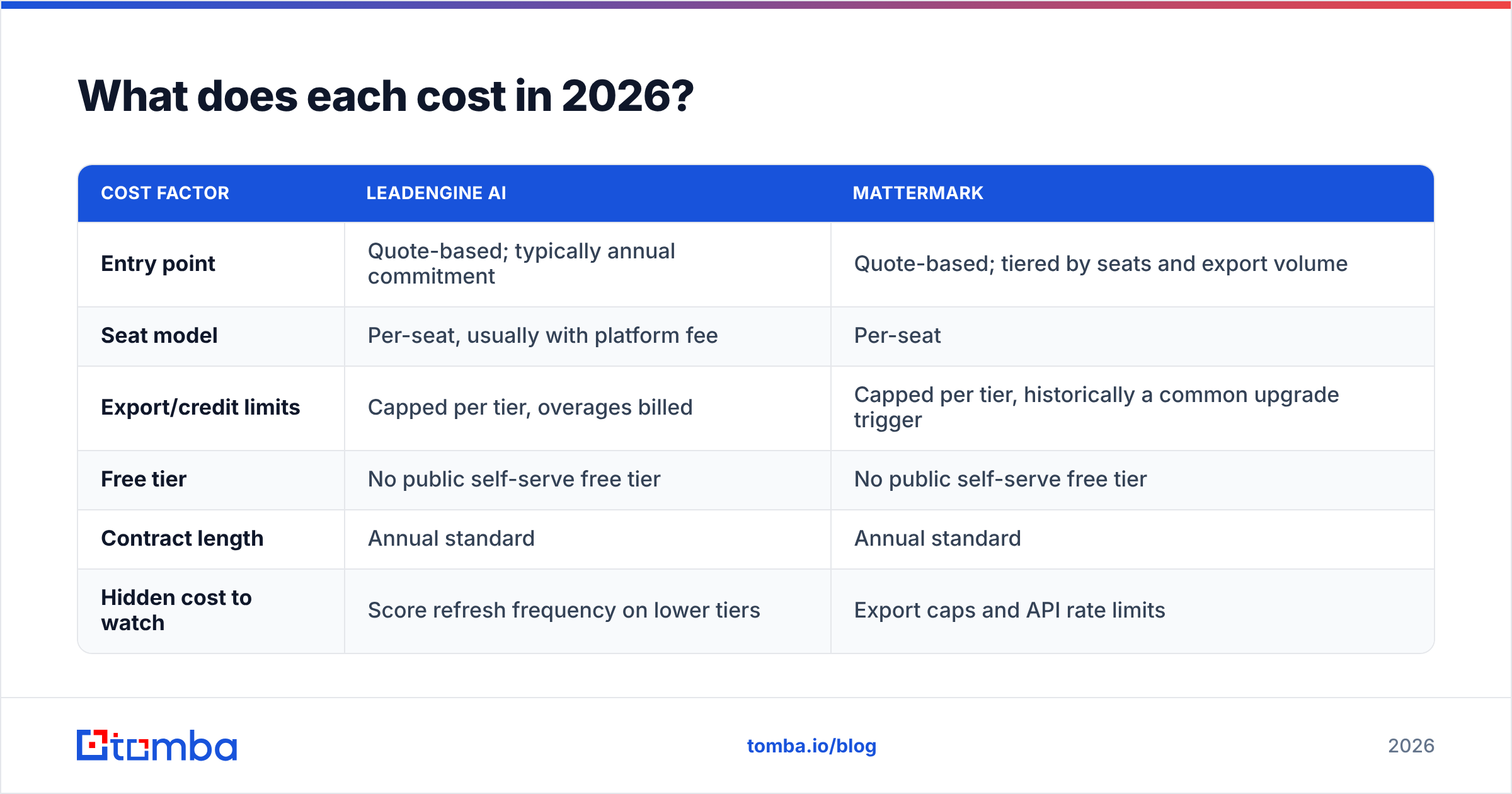
Both vendors quote rather than publish. Treat any number you read online, this page included, as a rough guide. Get it in writing.
| Cost factor | LeadEngine AI | Mattermark |
|---|---|---|
| Entry point | Quote-based; typically annual commitment | Quote-based; tiered by seats and export volume |
| Seat model | Per-seat, usually with platform fee | Per-seat |
| Export/credit limits | Capped per tier, overages billed | Capped per tier, historically a common upgrade trigger |
| Free tier | No public self-serve free tier | No public self-serve free tier |
| Contract length | Annual standard | Annual standard |
| Hidden cost to watch | Score refresh frequency on lower tiers | Export caps and API rate limits |
Now compare the contact layer, where prices are public and per unit. Tomba has a free tier at 25 searches a month. Paid plans run $49/mo Starter, $99/mo Growth, and $249/mo Pro, with custom Enterprise. You can read the full Tomba pricing page without a sales call. The point is not that one is cheap and one is dear. A signals platform does heavier work. The point is to know which line item does which job. Do not pay enterprise rates for what is really a lookup.
Try this budget check. Take your annual quote from either platform. Divide it by the number of prospects you actually contacted last year. Compare that to the per-contact cost of a finder plus a verifier. The ratio surprises most teams.
Is Mattermark still right for market research?#
Yes, for one kind of reader. No, for the general SDR team.
Mattermark earns its keep when your question is analytical. Maybe you want to know which fintech firms raised a Series B last quarter and doubled headcount. Maybe you need to map a market before a board meeting. Maybe you feed funding events into a scoring model you built yourself. That is the work the dataset was built for. The funding history in particular is hard to rebuild with scrapers.
It is the wrong main tool when your job is build list, find contacts, send, follow up. You get a solid account list. Then you hit a wall at the contact step. Reviews in G2's market intelligence category show the same split across the class. Analysts rate depth highly. SDRs rate the workflow lower.
Where does LeadEngine AI fit in an AI-first stack?#
At the top of the funnel, before your reps touch anything.
The best case for AI scoring is triage. Say your market is 40,000 companies and your team can work 400 a quarter. Then the ranking is the strategy. A model that reads hiring signals, tech changes, and content activity can beat a static filter on headcount and industry code.
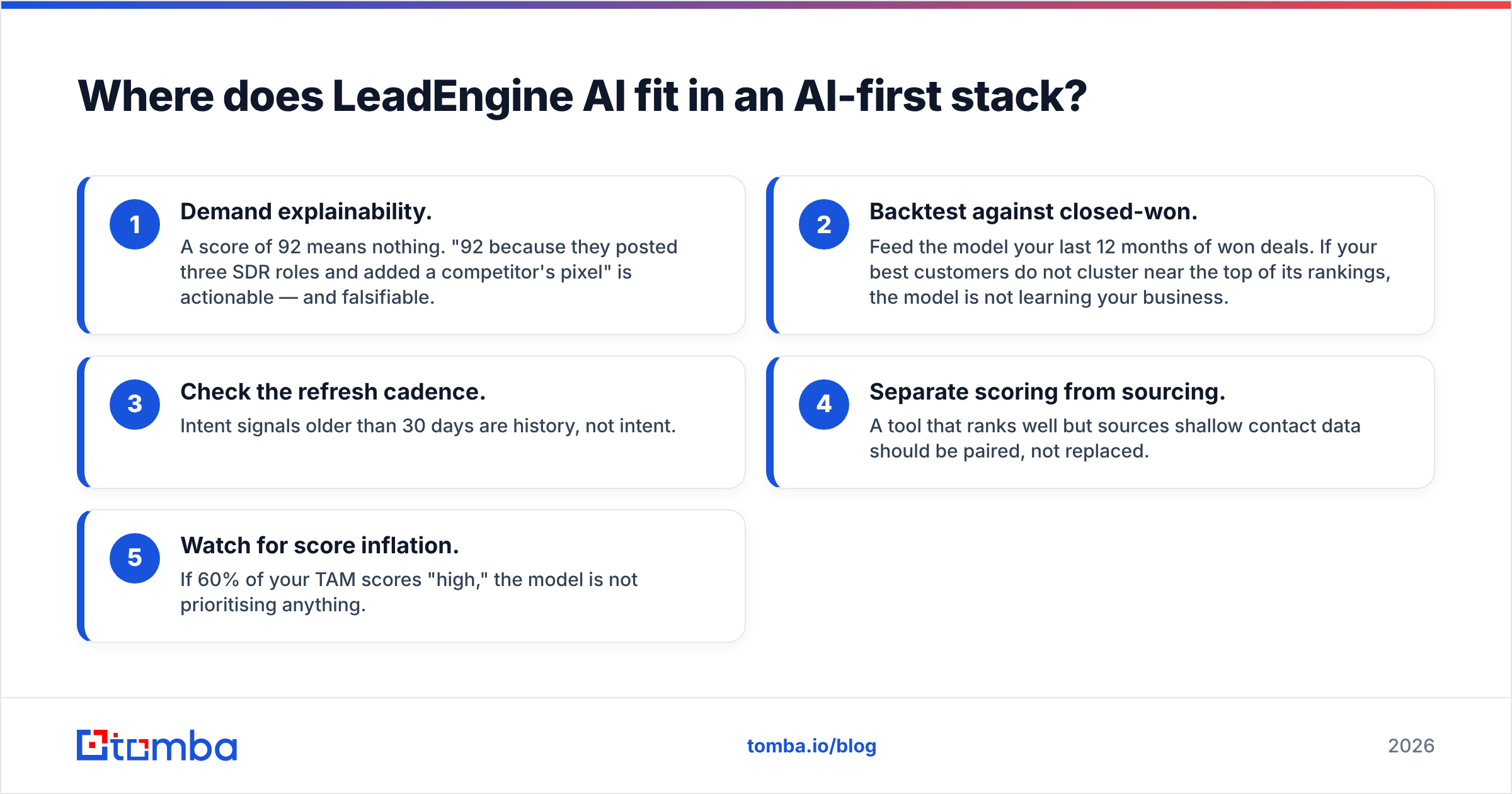
The worst case is treating the score as truth. Insist on five guardrails:
- Ask for explanations. A score of 92 means nothing. "92 because they posted three SDR roles and added a rival's pixel" is useful, and you can check it.
- Backtest against closed-won. Feed the model your last 12 months of won deals. If your best customers do not sit near the top, the model has not learned your business.
- Check the refresh rate. Intent signals older than 30 days are history, not intent.
- Keep scoring and sourcing apart. A tool that ranks well but sources thin contact data should be paired, not swapped in.
- Watch for score inflation. If 60% of your market scores "high," nothing is really being ranked.
Run those checks during the trial, not after you sign. A vendor who resists the backtest is telling you something.

Do either of them give you usable email addresses?#
Only in part. That gap decides most stacks.
Company data tells you an account is worth a try. AI scoring tells you it is worth a try now. Neither tells you that firstname.lastname@company.com is the right pattern for that domain. Neither tells you the mailbox still exists. Neither flags a catch-all domain that needs a different kind of check.
This is a separate technical problem. Finding a valid work email means three things. You resolve the company's naming pattern. You cross-check it against public sources. You run an SMTP check that respects the receiving server. Catch-all domains accept everything at the gate and bounce later. That breaks naive checks, which is why a catch-all verifier exists as its own product.
Most teams land on a clean four-layer setup:
- Signals layer — Mattermark or an AI scorer decides who and when.
- Contact layer — a finder turns names into verified, deliverable addresses.
- Enrichment layer — data enrichment fills in role, seniority, and company fields so your sequences can personalise at scale.
- Sequencing layer — your sending tool of record.
Folding the first two layers into one vendor is where budgets get burned. A tool that is great at market data is rarely great at mailbox checks. The reverse holds too. For a neutral primer, the lead generation overview is a fine place to start.
How should you choose between LeadEngine AI and Mattermark?#
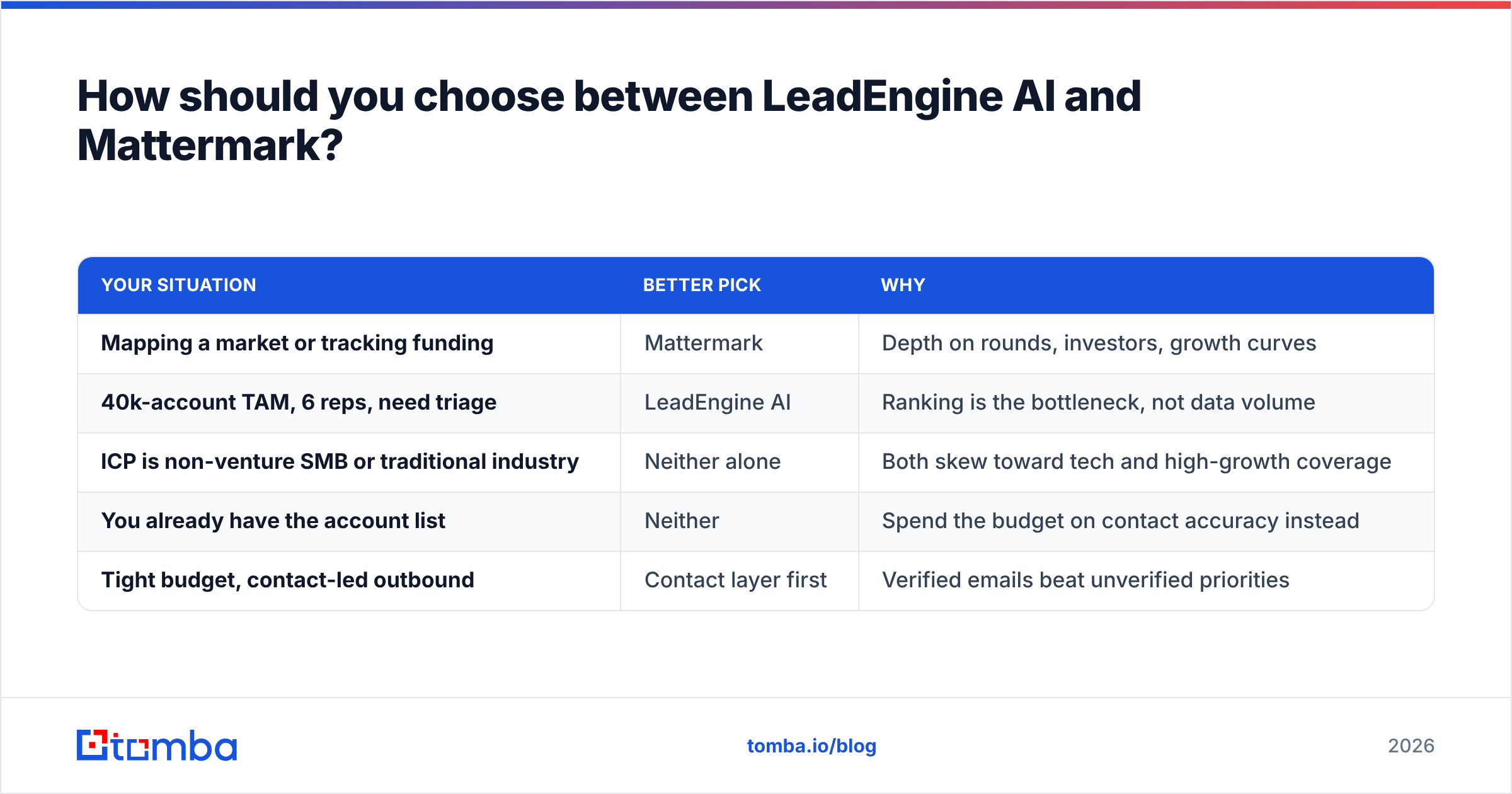
Decide by the question you are really asking.
| Your situation | Better pick | Why |
|---|---|---|
| Mapping a market or tracking funding | Mattermark | Depth on rounds, investors, growth curves |
| 40k-account TAM, 6 reps, need triage | LeadEngine AI | Ranking is the bottleneck, not data volume |
| ICP is non-venture SMB or traditional industry | Neither alone | Both skew toward tech and high-growth coverage |
| You already have the account list | Neither | Spend the budget on contact accuracy instead |
| Tight budget, contact-led outbound | Contact layer first | Verified emails beat unverified priorities |
Here is a practical order. First prove you can convert a list you already trust. Only then buy a tool that builds bigger lists. If your reply rate on 200 hand-picked, verified contacts is weak, a 40,000-row scored list will not fix it. It will just scale the weakness. If that reply rate is strong, buying prioritisation pays off.
One more tip on evaluation. Ask both vendors for a sample export of 100 records that match your target. Then verify the contact fields yourself with an outside tool. Vendors rarely refuse. The bounce rate on that sample is the most useful number you will get. It beats any feature table, this one included.
Ready to close the contact gap?#
The LeadEngine AI vs Mattermark call matters less than the contact layer you bolt on. Whichever signals tool you pick, the last mile is the same. You need a verified address for a named person at a named account. That is the job Tomba Email Finder does. Search by domain, name, or company. Get the address with a confidence score. Verify it before it reaches your sequence. Start free with 25 searches a month. Test it against whatever export your platform produces, then compare bounce rates. If the numbers hold, plans start at $49/mo. That is a rounding error next to an annual data contract, and the gap between a scored account and a booked meeting.
Related guides#
// get started
Find, verify and enrich your first contacts today
Start on the free plan with 25 searches a month, then scale when your team is ready.
Free plan · No credit card required · GDPR & CCPA
// about the author