LeadEngineAI vs Pitchbox: Which Outreach Platform Wins in 2026?
One tool was built for SEO link building, the other for AI-driven B2B lead gen. Here is where LeadEngineAI and Pitchbox actually differ on data, automation, pricing, and who should pick which.
LeadEngineAI vs Pitchbox is an odd match. One tool chases links. The other chases sales calls. Here is how they differ, and how to pick.
TL;DR
- Pitchbox is built for SEO link building and digital PR. It finds leads in search results and link data, not in a sales list.
- LeadEngineAI is an AI-first sales tool. You name your buyer. It builds the list and writes the email. It is new, so test it in a trial first.
- Both send email at scale. Almost all else differs: data, reports, price, and buyer.
- Neither one sells contact data. Both work better when you feed them clean, checked emails.
- Want links? Pick Pitchbox. Want booked calls? Pick LeadEngineAI.
What are LeadEngineAI and Pitchbox?#
Same look. Very different jobs.
Pitchbox launched around 2013. It was made for SEO teams, writers, and PR teams. The loop is simple. You run a search, pull a rival's links, or load a list. The crawler finds the site owner. You score each site on SEO stats. Then you send a set of emails with auto follow-ups. It plugs into Moz, Majestic, Ahrefs, and Semrush. So you can sort by Domain Rating or traffic before you send. See the plans on the official Pitchbox site. User reviews sit on G2.
LeadEngineAI is part of the new AI lead gen wave. You write who your buyer is in plain words. The tool builds a list, fills in the data, drafts the email, and sends it. Three jobs in one app. That space grew fast in 2024–2026. The tools change every quarter, and LeadEngineAI has few public reviews, so treat each claim as a thing to test. Run a 50-contact pilot and watch the bounce rate before you spend more.
Here is the honest frame. Pitchbox is an outreach CRM for earned press. LeadEngineAI is an outbound sales engine. The match only helps one buyer: a team that chases links and sales leads at once.

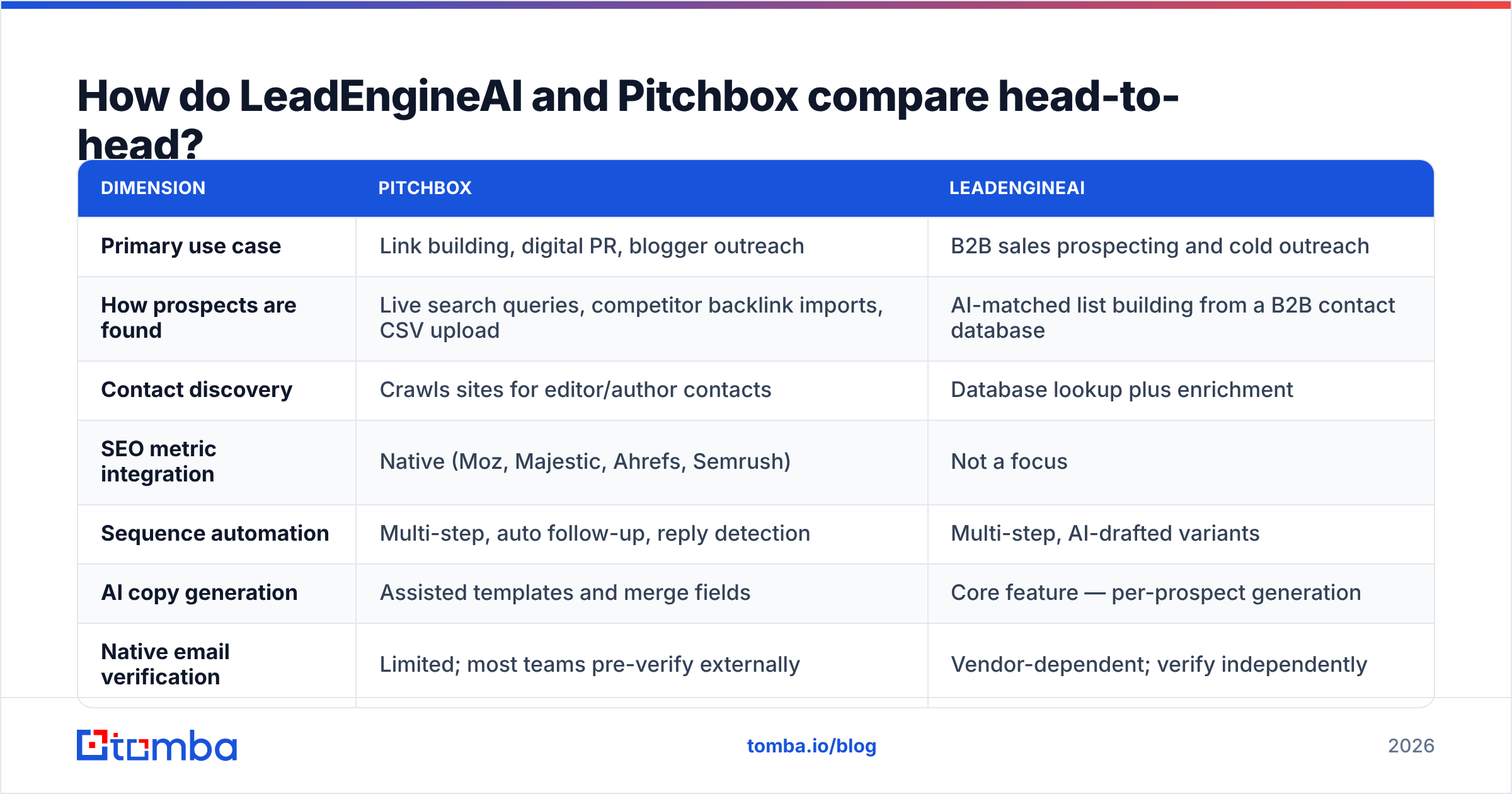
LeadEngineAI vs Pitchbox: the feature table#
Here is the side by side. If a vendor hides a number, the cell says so.
| Item | Pitchbox | LeadEngineAI |
|---|---|---|
| Main job | Link building, PR, blog outreach | B2B sales email |
| How leads are found | Live search, rival link data, CSV upload | AI-matched list from a B2B database |
| Contact look-up | Crawls sites for editor emails | Database plus data fill |
| SEO stats | Built in (Moz, Majestic, Ahrefs, Semrush) | Not a focus |
| Email sequence | Multi-step, auto follow-up, reply spotting | Multi-step, AI-drafted |
| AI copy | Templates and merge fields | Core feature, written per lead |
| Built-in email checks | Thin; most teams check first | Varies; check it yourself |
| Reports | White-label client reports, link tracking | Pipeline and reply stats |
| Typical buyer | SEO agency, in-house content team | Sales rep, founder |
| Age | 10+ years, many agency users | New, small public footprint |
| Pricing | Tiered plan, quote at scale | Public tiers, credit based |
Read it as a fit test, not a score. If three rows in the Pitchbox column sound like your week, skip the other column. That works both ways.
Which one finds better contact data?#
Neither one is a data firm, and that is the first thing to know before you buy. The LeadEngineAI vs Pitchbox split on contact data comes down to where each tool looks.
Pitchbox crawls the target site for contacts. It reads contact pages and author bios, which works well for a small blog editor who will never show up in a sales list. It works poorly for a VP at a 2,000-person firm, because her email is not on the site.
AI tools like LeadEngineAI flip that. They are strong on firm data: job title, head count, tech stack, funding. They are weak on small sites and solo writers. Their reach rests on the data firms behind them. Few vendors name those.
Both leave the same gap: stale emails at send time. A crawler found that address eight months ago. A list refresh can be just as old. So most teams check the list first. A good email verifier spots dead boxes, role emails, and spam traps. It does that before they hit your domain. A catch-all verifier deals with domains that say yes to every address, then bounce. Building a list by firm, not by person? Domain search returns the public emails and the name pattern in one call. Load those into the tool you choose.
Rule of thumb: keep bounces under 2%. Past 3%, inbox hosts mark your domain. No clever email fixes that.
How does the price compare?#
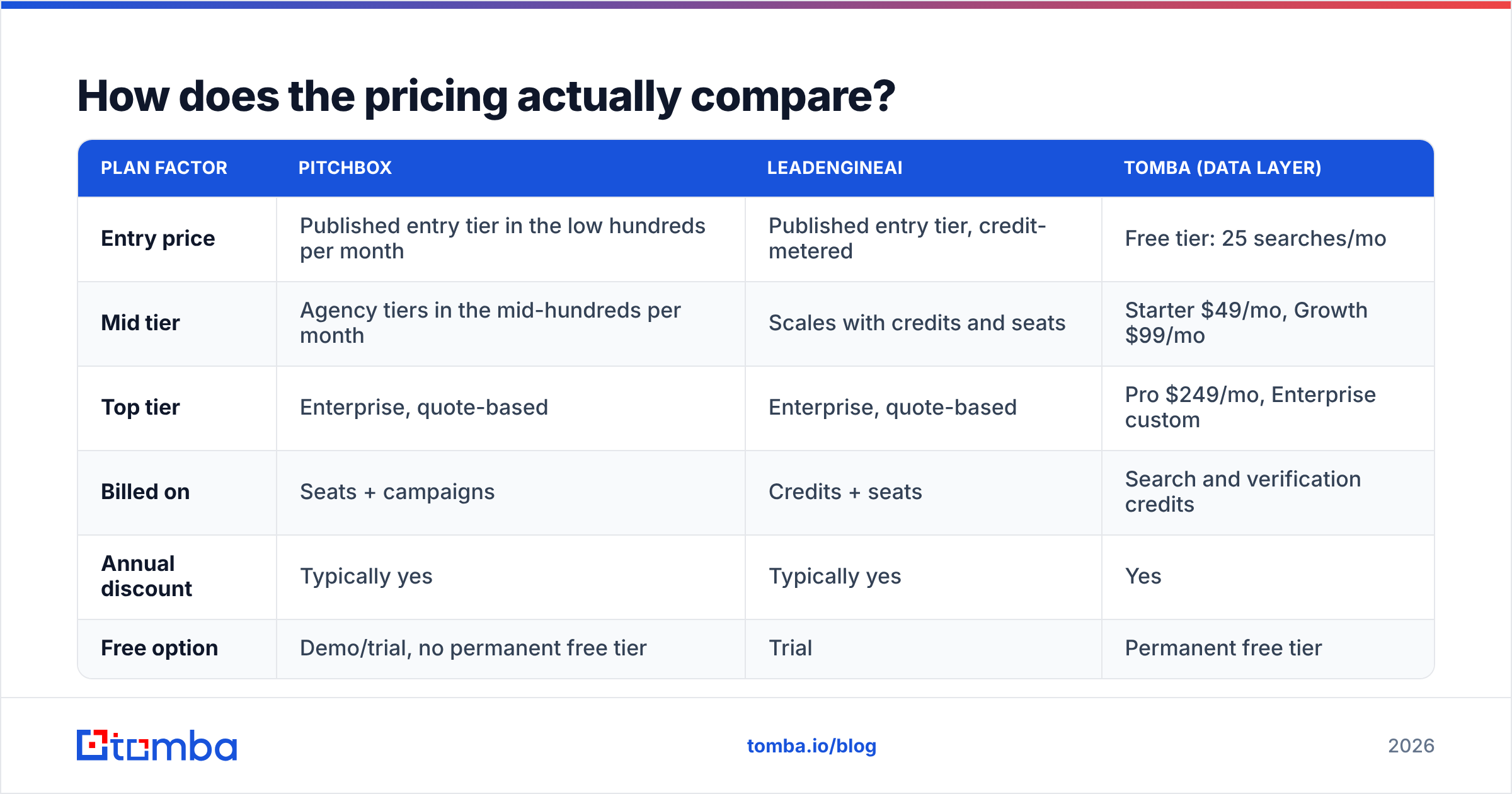
Price is where LeadEngineAI vs Pitchbox splits the most. Be wary of any post that quotes hard numbers, this one too. Both firms change plans. Pitchbox moves big accounts to a custom quote.
| Plan item | Pitchbox | LeadEngineAI | Tomba (data) |
|---|---|---|---|
| Entry price | Low hundreds per month | Public entry tier, credit based | Free: 25 searches/mo |
| Mid tier | Mid hundreds per month | Grows with credits and seats | Starter $49/mo, Growth $99/mo |
| Top tier | Quote only | Quote only | Pro $249/mo, custom above |
| Billed on | Seats plus campaigns | Credits plus seats | Search and check credits |
| Yearly discount | Yes, as a rule | Yes, as a rule | Yes |
| Free option | Demo or trial only | Trial | Free tier, always |
Three things matter more than the sticker price.
- Seat math. Pitchbox is priced for teams. The per-seat line is what makes agency bills grow. Two people on outreach means two seats.
- Credit burn. AI tools spend credits on tries, not just hits. Ask if a failed look-up is paid back. That answer can shift your true cost by 20–40%.
- The data line. Both tools assume you bring your own emails. Budget for that on its own. Tomba pricing starts free and moves to $49/mo at Starter. Next to the outreach bill, that is small.
Check each vendor's price page before you build a case. Prices here moved twice in 18 months.
What does each one feel like day to day?#
Demos hide this part. Here is the real shape.
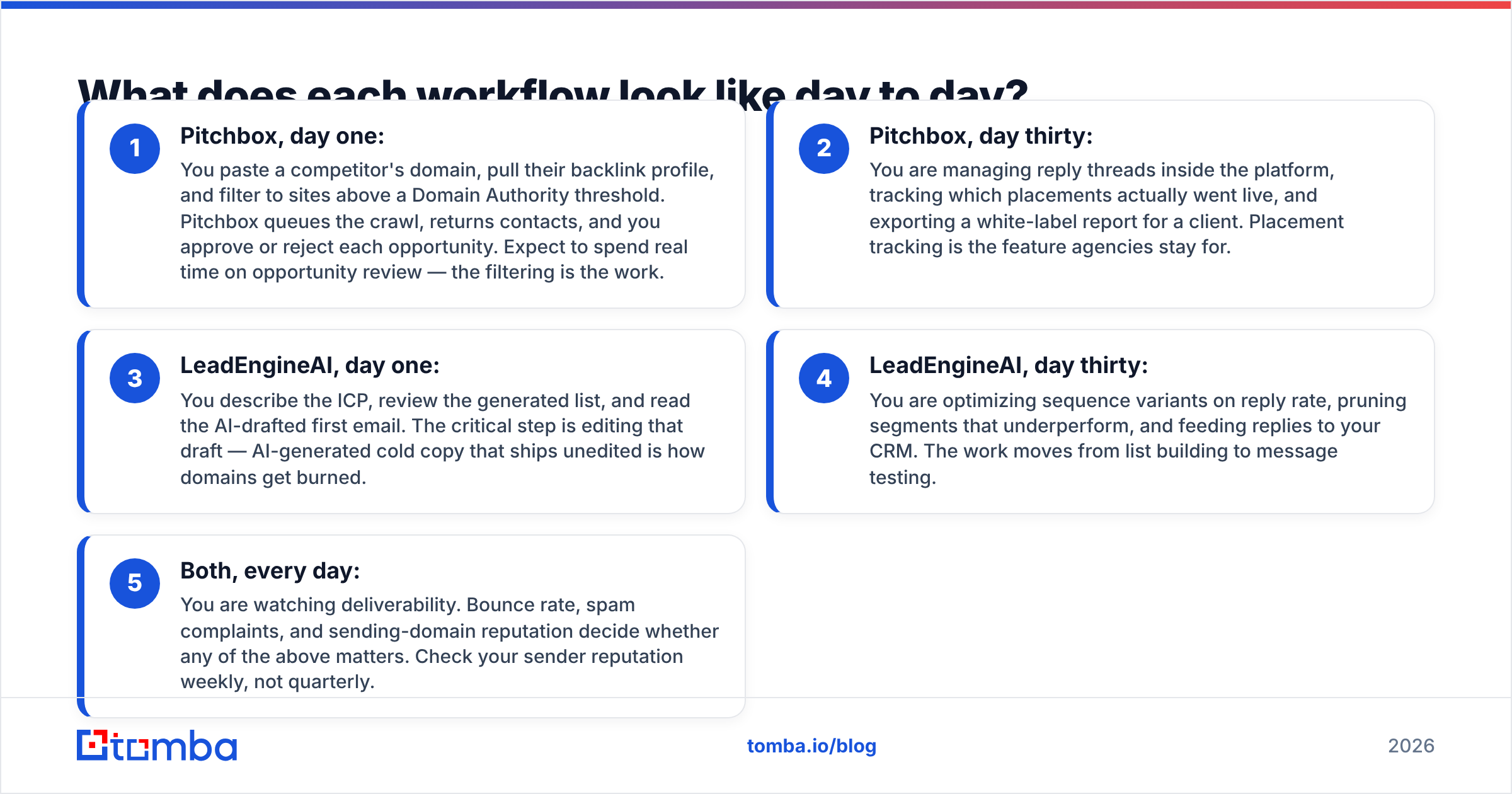
Pitchbox, in practice:
- Day one. You paste a rival domain and pull their links. You filter to sites above a set score. Pitchbox runs the crawl and hands back contacts. You say yes or no to each one. Plan for real time here. The filter work is the work.
- Day thirty. You handle reply threads in the app. You log which links went live. You send the client a white-label report. Link tracking is why agencies stay.
LeadEngineAI, in practice:
- Day one. You write the buyer profile. You scan the list. You read the draft email. Now edit that draft. AI cold copy that ships as-is is how domains get burned.
- Day thirty. You test email variants on reply rate. You cut weak groups. You push replies to your CRM. The work shifts from list building to message work.
Both tools share one daily job. Watch your inbox rate. Bounces, spam flags, and domain trust decide if any of this works. Check your sender reputation each week, not each quarter.
The pattern is clear. Pitchbox front-loads hand work and pays you back in link quality. LeadEngineAI front-loads the robot and pays you back in volume. Skip the edit step, though, and you mail junk to the wrong people.

Where does each tool fall short?#
No honest LeadEngineAI vs Pitchbox review skips the rough edges. Here are both sets.
Pitchbox weak spots:
- Steep learning curve. The app assumes you know link work. New users often need two weeks.
- Hard to justify for a solo user. It is built for agencies, and the price shows it.
- Wrong fit for B2B sales. You cannot sort by head count, funding, or tech stack.
- Contact quality swings by niche. A blog with a "write for us" page is easy. A big firm site is not.
LeadEngineAI weak spots:
- Short track record. Few outside reviews means few stress tests at scale.
- Thin AI copy. "I saw your firm works in [trade]" is not personal. Buyers spot it at once.
- Credit plans hide the true cost until month two.
- Black-box data. Under GDPR or CCPA you need proof of where each email came from. "The AI found it" is not proof. Ask for the data sources behind any list you buy. That goes for Tomba too.
Shared weak spot: both will mail a bad address without a blink. That is on you, not on them. It is also the top reason outreach stalls.
Is there a third option?#
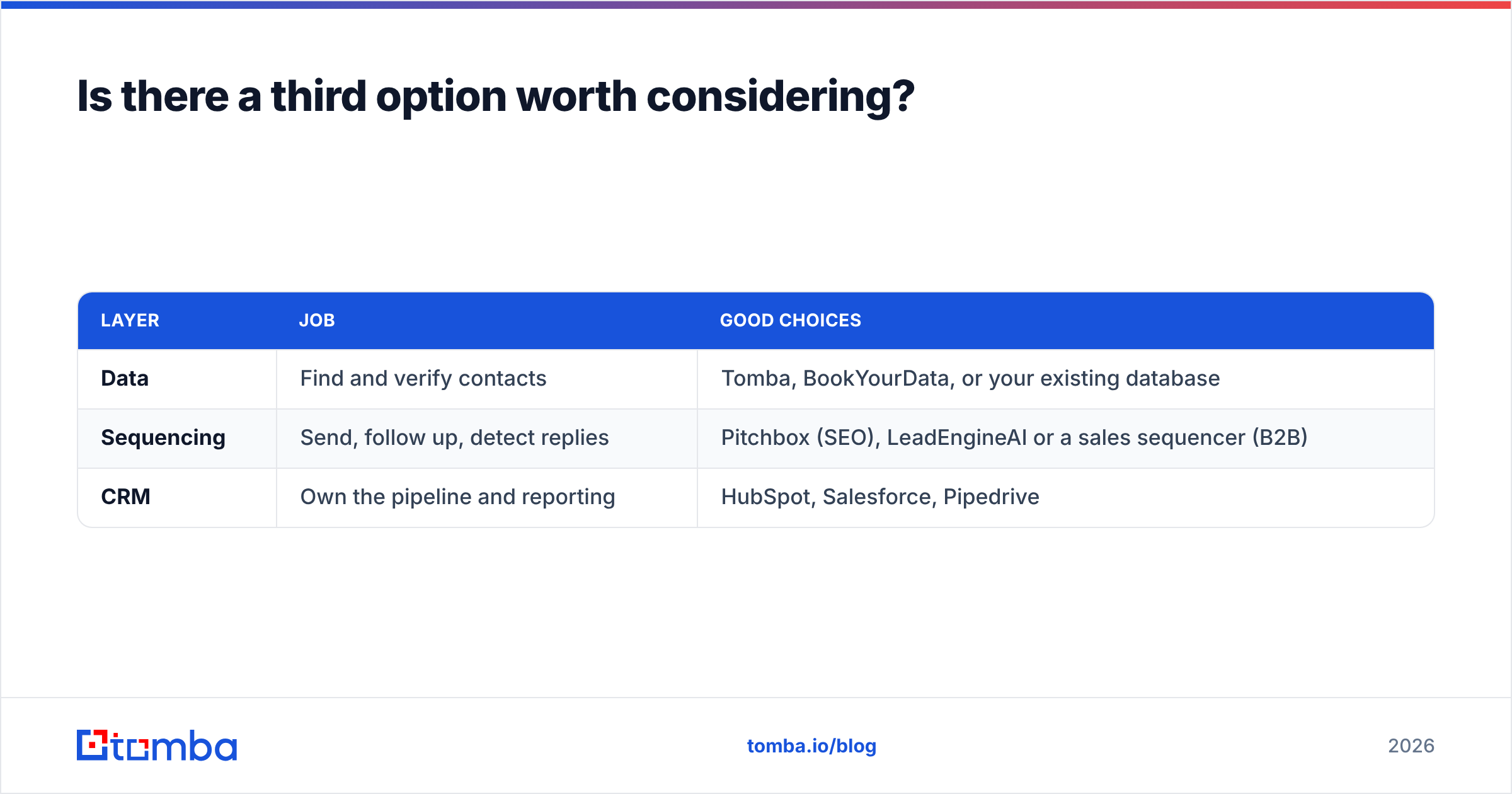
Yes. It is not one tool. It is a stack.
The best teams in 2026 do not buy one big app. They split the job in three.
| Layer | Job | Good picks |
|---|---|---|
| Data | Find and check emails | Tomba, BookYourData, your own list |
| Sending | Send, follow up, spot replies | Pitchbox for SEO, LeadEngineAI for sales |
| CRM | Own the pipeline and reports | HubSpot, Salesforce, Pipedrive |
The win is swap-ability. One day your sending tool will let you down. You swap that layer and keep your data. BookYourData fits if you want ready lists to filter and download. That is a different buy from a per-look-up API. Plenty of teams run both.
For the data layer, an API keeps things clean. The Tomba API runs finder, verifier, and data calls from what you already use. That means Make, Zapier, n8n, or your own script. It pushes clean rows into your sending tool. Want no code? The HubSpot integration and Google Sheets add-on cover the same ground. HubSpot's sales blog is a fair, neutral read on email hygiene.
Which should you choose in 2026?#
Choose Pitchbox if:
- Your goal is links, press, or brand mentions.
- You run outreach for clients and need white-label reports.
- You want SEO stats inside the search step.
- You have two or more people on outreach and time to learn.
Choose LeadEngineAI if:
- Your goal is booked calls.
- You want the list built for you, not by hand.
- You are fine with a new tool and will run a bounce test first.
- Your team is small, so drafted email saves real hours.
Choose neither, for now, if:
- Your bounce rate is past 3%. Fix the data first.
- You have not named your ideal buyer. No tool fixes that.
Here is the hard truth in the LeadEngineAI vs Pitchbox debate. The tool moves your response rate by a few points. Clean data and a good pitch move it ten times more. Spend your trial time there.
Start with the layer that moves the number#
Before you settle the LeadEngineAI vs Pitchbox question, fix the input. Run your list through a check and see how much of it lives. Most teams are shocked, and not in a good way.
Tomba Email Finder finds work emails by domain, name, or firm. It hands back a score and the sources for each hit. It plugs into the sending tool you pick. Start free with 25 searches a month. Test it on a list you trust. Move to Starter at $49/mo once it holds up on your own data. That is the right order. Check the input, then pick the engine.
Related guides#
// get started
Find, verify and enrich your first contacts today
Start on the free plan with 25 searches a month, then scale when your team is ready.
Free plan · No credit card required · GDPR & CCPA
Get the Tomba newsletter
Product and data updates
// about the author