LeadEngineAI vs PlusVibe (2026): Honest Feature Comparison
LeadEngineAI and PlusVibe both promise AI-powered outbound, but they solve different halves of the problem. Here's an honest breakdown of features, deliverability controls, pricing models, and the data gap neither one fully closes.
LeadEngineAI vs PlusVibe is the wrong fight for most teams. The two tools solve different halves of outbound. Here is what each one does well, and where both leave you exposed.
TL;DR
- They are not the same category. PlusVibe is a cold email sending engine. It handles inbox rotation, warmup, a unified inbox, and deliverability. LeadEngineAI sits upstream as an AI-SDR layer. It builds lists and drafts your outreach.
- Pick PlusVibe if your bottleneck is volume and inbox health. It runs many sequences across many mailboxes without throttling you.
- Pick LeadEngineAI if your bottleneck is "who do we email, and what do we say?" The AI does the sourcing and the first draft.
- Neither fixes your data. Both tools inherit the list you feed them. Bounce rates kill most campaigns, not missing features. A dedicated email verifier in front of either tool matters more than the tool you pick.
- Budget reality: entry tiers for both sit in the double-digit monthly range. The real cost is credits, mailbox seats, and add-ons. Model your all-in cost per booked meeting, not per feature.
What exactly are LeadEngineAI and PlusVibe?#
Think of outbound as a restaurant. One tool is the kitchen. It cooks and plates at volume without burning anything. The other is the sourcing manager. She decides what goes on the menu and buys the ingredients. A head-to-head comparison only works once you accept that they stand in different parts of the building.
PlusVibe (plusvibe.ai) is built around the sending problem. The core job is multi-mailbox campaign execution. You connect a pool of sending accounts, rotate volume across them, and warm them up. You then run multi-step sequences and handle replies in one inbox. It competes with Instantly, Smartlead, and Saleshandy. All of them sell the same promise: your mail lands in the inbox, at scale.
LeadEngineAI is pitched further upstream. The pitch is AI-assisted lead generation. You describe your ideal customer. The system builds a target list, enriches it, and writes personalized drafts. So it competes with AI-SDR tools and prospecting platforms, not with sending infrastructure.
The difference matters, because teams often buy the wrong one. Say your reply rate is 0.4% because you email the wrong 5,000 people. A better sending engine just delivers your bad message faster. Or say your open rate fell because 14 of your 20 mailboxes are burnt. No amount of AI copy will save you.
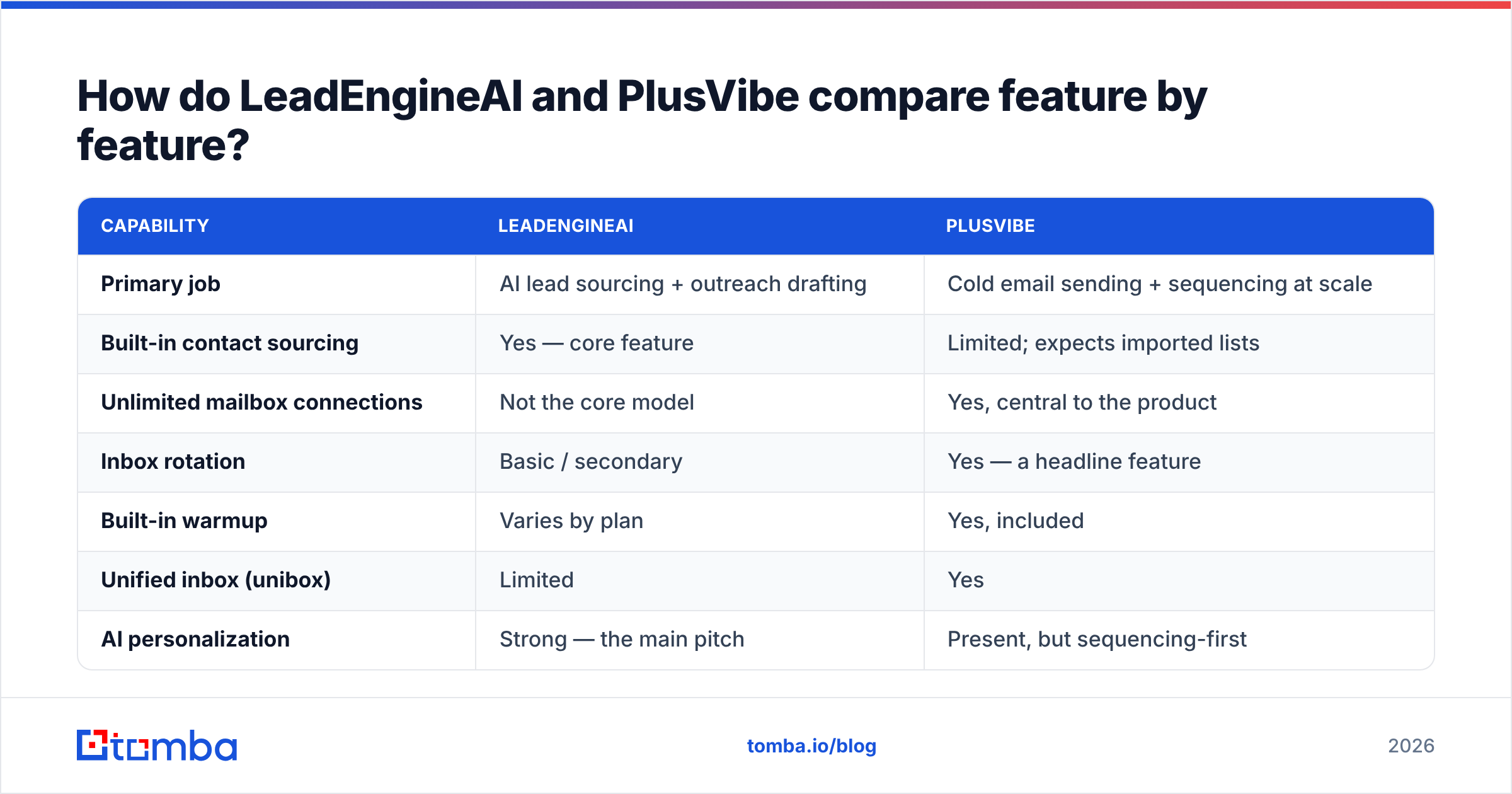
LeadEngineAI vs PlusVibe: how do they compare, feature by feature?#
Here is the honest side-by-side. Prices move fast in this category. Treat the tiers below as directional, and check each vendor's pricing page before you buy.
| Capability | LeadEngineAI | PlusVibe |
|---|---|---|
| Primary job | AI lead sourcing + outreach drafting | Cold email sending + sequencing at scale |
| Built-in contact sourcing | Yes — core feature | Limited; expects imported lists |
| Unlimited mailbox connections | Not the core model | Yes, central to the product |
| Inbox rotation | Basic / secondary | Yes — a headline feature |
| Built-in warmup | Varies by plan | Yes, included |
| Unified inbox (unibox) | Limited | Yes |
| AI personalization | Strong — the main pitch | Present, but sequencing-first |
| Email verification | Bundled, quality varies | Bundled/partner-based |
| LinkedIn / multichannel | Roadmap-dependent | Sequence-level support |
| Entry price (directional) | Low double-digit $/mo | Low double-digit $/mo |
| Best for | Teams without a list | Teams with a list and a volume ceiling |
Two things jump out. First, the overlap is thinner than the marketing pages suggest — about a third of the feature set. Second, the "bundled verification" row quietly decides whether your campaign works. It is also the row buyers skim past fastest.

Which platform gives you better deliverability control?#
PlusVibe, clearly — that is the category it was built for.
Deliverability in 2026 is not a soft metric. Google and Microsoft enforce hard limits on bulk senders. You need authenticated domains, one-click unsubscribe, and a spam-complaint rate under 0.3%. Google's bulk sender guidelines spell out the rules. Enforcement is automated. Cross the complaint line and your mail goes to spam, however good the copy is.
Where PlusVibe's model helps:
- Mailbox rotation caps per-inbox volume. Spread 1,000 daily sends across 25 mailboxes at 40 each. Every account stays inside a plausible human range. One mailbox blasting 1,000 is a guaranteed filter trip.
- Integrated warmup keeps reputation from decaying between campaigns. That matters most for domains you rotate in and out of use.
- Per-account health signals let you pull a burnt mailbox out of rotation. You catch it before it drags the whole pool down.
- Sequence-level throttling and sending windows reduce the burst patterns that spam filters fingerprint.
LeadEngineAI helps in a different way. It cuts the upstream cause of complaints. Better targeting means fewer irrelevant emails. Fewer irrelevant emails mean fewer spam reports. Your sender reputation stays intact. That is a real gain. You just cannot see it on a dashboard.
The blunt version of LeadEngineAI vs PlusVibe: PlusVibe protects you from technical failure. LeadEngineAI protects you from relevance failure. Both failures end the same way.
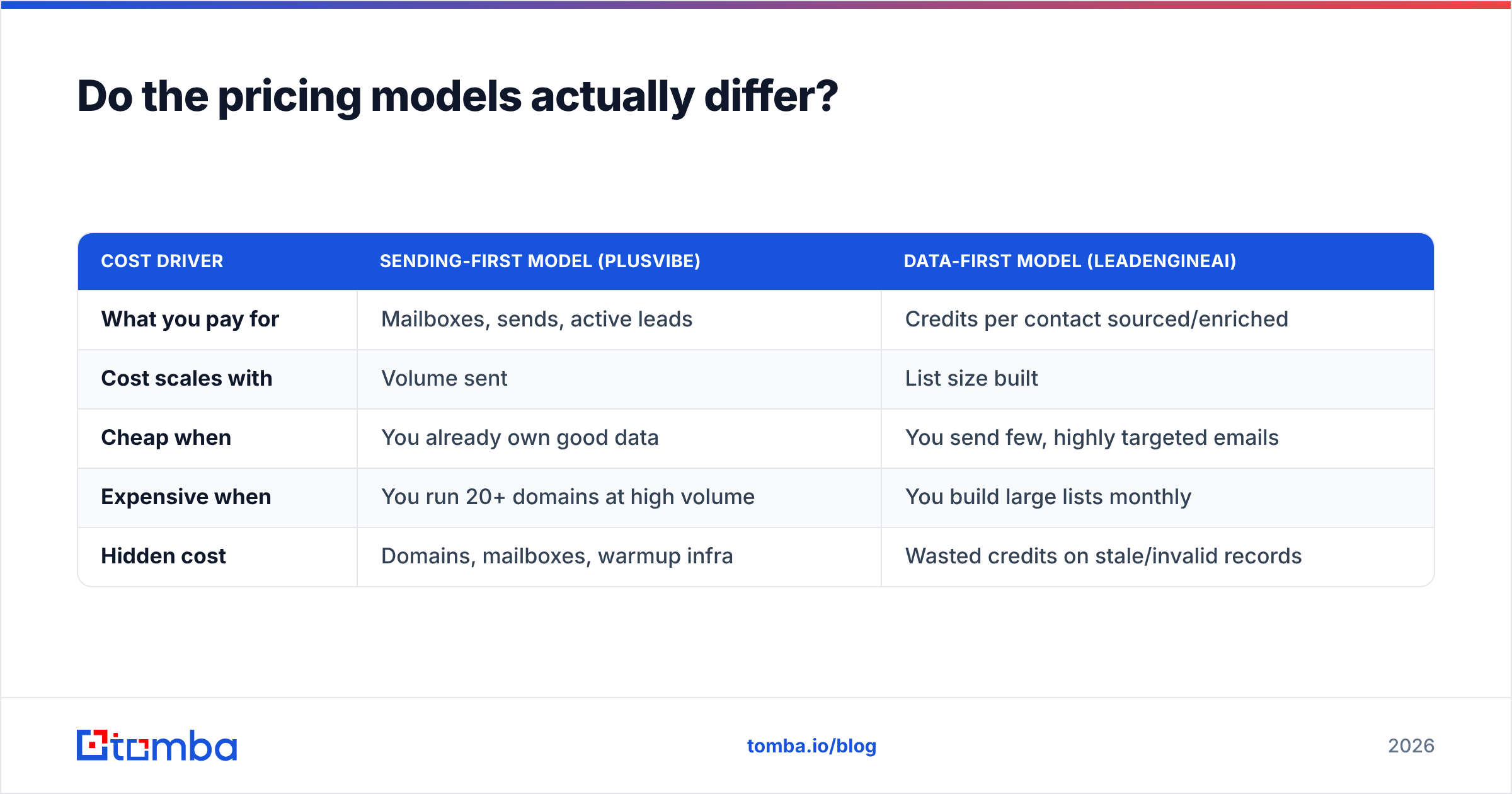
Do the pricing models actually differ?#
Yes, and the difference is structural rather than numerical.
PlusVibe-style sending platforms price on sending capacity and contact volume. You pay for active leads, monthly emails, and connected mailboxes. Adding a mailbox costs little or nothing on most plans. That is why agencies like this model.
LeadEngineAI-style platforms price on credits and enrichment. Every contact you source, enrich, or verify draws down a balance. Your cost scales with list size, not send volume. That is kind to tight, high-intent lists. It is brutal on big ones.
| Cost driver | Sending-first model (PlusVibe) | Data-first model (LeadEngineAI) |
|---|---|---|
| What you pay for | Mailboxes, sends, active leads | Credits per contact sourced/enriched |
| Cost scales with | Volume sent | List size built |
| Cheap when | You already own good data | You send few, highly targeted emails |
| Expensive when | You run 20+ domains at high volume | You build large lists monthly |
| Hidden cost | Domains, mailboxes, warmup infra | Wasted credits on stale/invalid records |
That last row is where budgets leak. A credit spent on a record that bounces burns money twice. You lose the credit, and you lose reputation. Teams find this out about six weeks in, usually the hard way.
Does either tool solve the contact data problem?#
Partially — and this is the honest weak spot in both products.
Every all-in-one outbound platform bundles some data. That dataset is rarely the vendor's core skill. It is licensed, aggregated, or scraped, and refresh rates vary a lot. B2B contact data decays about 25–30% a year as people change jobs. So a database refreshed once a quarter is not the same product as one refreshed daily.
What that means in practice:
- Bundled verification is usually syntax + MX, not SMTP-level. It catches
john@@acme.com. It missesjohn.smith@acme.comwhen John left in March. - Catch-all domains get silently marked "valid." About a fifth of B2B domains accept all mail at the gateway. Without a dedicated catch-all verifier, those records pass validation and bounce anyway.
- Coverage is uneven by geography and company size. Both platforms skew toward US mid-market. European SMB coverage thins out fast.
- Role-based addresses inflate list counts.
info@,sales@, andsupport@pad the numbers and depress reply rates. - You cannot audit the source. Neither platform shows where a record came from. That matters when you have to defend a GDPR request.
The fix is not to drop either platform. Stop treating bundled data as a finished product. Source or enrich with a specialist. Run a verification pass. Then load the clean list into whichever execution layer you chose. A bulk email finder step in front of your sequencer costs far less than replacing a burnt domain.
Which one should you actually buy?#
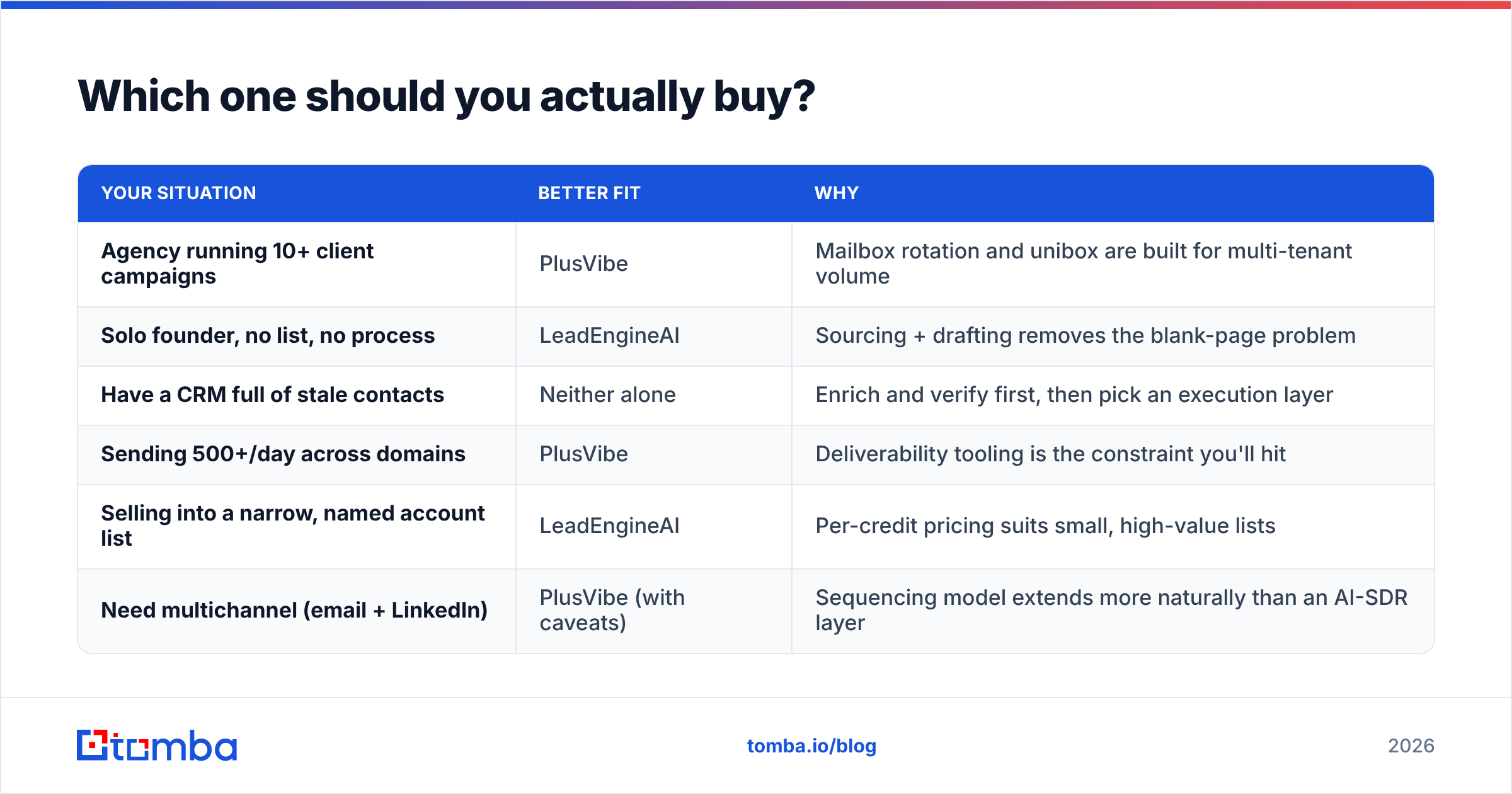
The LeadEngineAI vs PlusVibe choice comes down to your bottleneck, not your budget.
| Your situation | Better fit | Why |
|---|---|---|
| Agency running 10+ client campaigns | PlusVibe | Mailbox rotation and unibox are built for multi-tenant volume |
| Solo founder, no list, no process | LeadEngineAI | Sourcing + drafting removes the blank-page problem |
| Have a CRM full of stale contacts | Neither alone | Enrich and verify first, then pick an execution layer |
| Sending 500+/day across domains | PlusVibe | Deliverability tooling is the constraint you'll hit |
| Selling into a narrow, named account list | LeadEngineAI | Per-credit pricing suits small, high-value lists |
| Need multichannel (email + LinkedIn) | PlusVibe (with caveats) | Sequencing model extends more naturally than an AI-SDR layer |
Want a broader view before you commit? The G2 AI sales assistant category carries verified reviews across both segments. Filter those reviews by company size. A tool that delights a 200-person sales org often frustrates a three-person team, and the reverse is just as true.
What does a stack that actually works look like?#
The best-performing outbound teams do not buy one platform. They assemble three layers and keep each one replaceable:
- Data layer — source and verify contacts from a specialist provider. This is where accuracy is won or lost. It should never be an afterthought bundled into a sending tool.
- Execution layer — PlusVibe, or whichever sequencer fits your volume and mailbox count. Swappable. Commoditizing fast.
- Intelligence layer — LeadEngineAI-style AI for research, list building, and first-draft personalization at the top of the funnel.
Separation buys you one specific thing. When a vendor raises prices, drops quality, or gets acquired, you swap one layer. You do not rebuild the whole motion. Teams that bought a single all-in-one platform in 2023 are still stuck on it in 2026. They learned this the expensive way.
On the data layer, the checklist is short. Does the provider expose an email finder API so you can enrich in code instead of exporting CSVs? Does it verify at SMTP level, not just syntax level? Does it handle catch-all domains explicitly instead of guessing?
Is the pricing legible? For reference, Tomba's plans run a free tier at 25 searches a month, Starter at $49/mo, Growth at $99/mo, and Pro at $249/mo. Enterprise pricing is on request. You should be able to work out cost per verified contact in under a minute. If you can't, the pricing page is doing a job other than informing you.
Frequently asked questions#
Is LeadEngineAI a direct PlusVibe competitor? Not really. They overlap on AI personalization and basic sequencing. But PlusVibe's depth is in sending infrastructure, and LeadEngineAI's is in sourcing and drafting. Many teams end up using one of each.
Can I use both together? Yes, and it is a reasonable setup. Build and enrich lists in the AI layer. Verify externally. Then execute in the sending platform. The handoff is usually CSV or API, which is clunky but workable.
Which has better deliverability? PlusVibe, on technical controls. But deliverability is 60% list quality and 40% infrastructure. A clean, verified list on mediocre infrastructure beats a dirty list on excellent infrastructure every time.
Do I still need a separate email verifier? Almost always. Bundled verification in all-in-one platforms is usually shallow. If your bounce rate is above 3%, the bundled check is not doing its job. Your domain reputation is already paying for it.
Start with the data layer#
Before you commit to either platform, fix the input. Run your existing list through a real verification pass and see what survives. Most teams find that 15–30% of a six-month-old list is already dead. That single number reframes the whole tool decision.
Tomba's Email Finder finds and verifies professional email addresses by domain, name, or company. You get SMTP-level checks, explicit catch-all handling, and a free tier with 25 searches a month. Test coverage against your own target accounts before you spend anything. Then load a clean list into whichever execution layer you choose — LeadEngineAI, PlusVibe, or something else. You will have removed the single biggest cause of failed outbound campaigns. The tool comparison matters. The data matters more.
Related guides#
Ready to find emails that actually work?
Join 150,000+ professionals who stopped guessing and started sending. Free credits on signup — no credit card required.
Get the Tomba newsletter
Practical outbound tactics and product updates — once every two weeks.
About the author