LeadEngineAI vs Sales Automation Systems: 2026 Comparison
AI lead engines promise to replace your sequencer, your list builder, and half your SDR workflow. Here's where LeadEngineAI-style tools actually beat traditional sales automation systems, and where they quietly cost you more.
LeadEngineAI vs sales automation systems is a choice most teams get backwards. One tool picks who to contact, the other runs how and when you send. Here is how to tell which half is your real bottleneck.
TL;DR
- LeadEngineAI vs sales automation systems is not a fair fight. The two fix different halves of the same job.
- An AI lead engine picks who to contact. It writes the first draft too.
- A sales automation system controls how and when mail goes out. It also logs the work in your CRM.
- Is list building the bottleneck? Buy the AI engine. Is rep chaos the bottleneck? Buy the automation system.
- Most teams under 15 reps buy too much sending and too little data.
- Neither one fixes bad email addresses. Put an email verifier in front of both.
- Best 2026 setup: an AI engine to source, a light sequencer to send, and a data layer under both.
What is LeadEngineAI and what does an "AI lead engine" actually do?#
An AI lead engine folds four old jobs into one. You describe your ideal buyer in plain words, and the tool finds firms and people that match. It adds their contact details, then drafts the first email for each one.
Think of a grocery list and a meal-kit box. A sales automation system is the kitchen. It has burners, timers, and a clock for when dinner goes out. An AI lead engine is the box that shows up with the food picked, boxed, and matched to a recipe. The kitchen still helps. It just no longer picks the meal.
LeadEngineAI sits in a new group of "prompt in, pipeline out" tools. Most of them shipped after 2023. The market shifts every quarter, and most vendors hide their prices. So treat any number you read here as a starting point, and check the vendor's own page before you buy.
The shape of these tools is stable. You get plain-language targeting, auto research, written-for-you lines, and a thin send layer at the end. That last part matters more than the ads suggest. The send layer is thin on purpose.
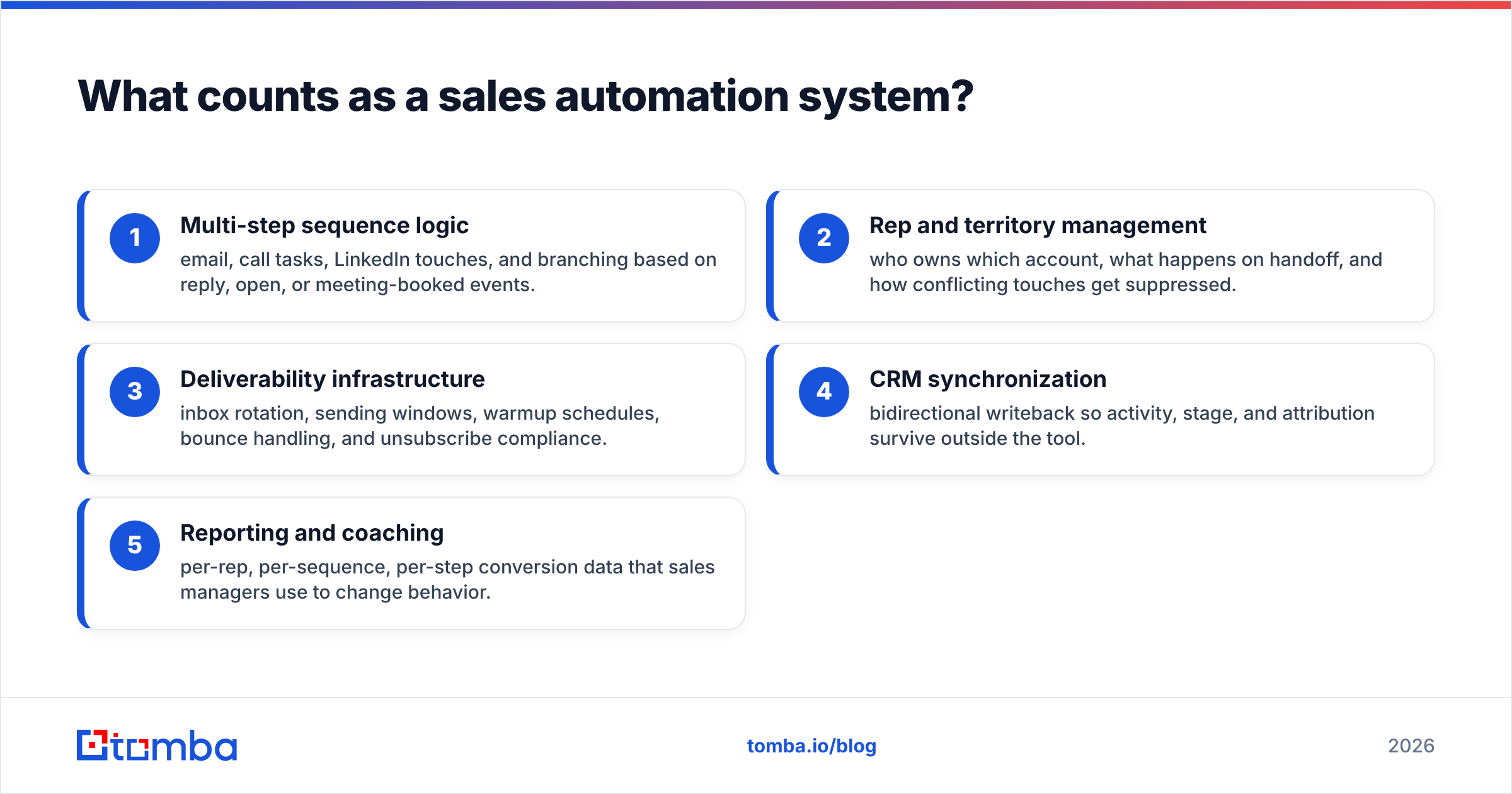
What counts as a sales automation system?#
A sales automation system is the old, proven side of this market. G2 tracks it as sales engagement software. Think Outreach, Salesloft, HubSpot Sales Hub, Reply.io, Saleshandy, and Instantly. Their shared job is timing and control:
- Multi-step sequences. Email, call tasks, and LinkedIn touches. Steps branch on replies, opens, and booked meetings.
- Rep and territory rules. Who owns which account. What happens on handoff. How double-touches get blocked.
- Send health tools. Inbox rotation, send windows, warmup, bounce handling, and opt-out rules.
- CRM sync. Two-way writeback, so the work and the credit show up where your board looks.
- Reports and coaching. Numbers per rep, per step, and per sequence that managers act on.
None of those five picks who goes in the campaign. That is the gap AI lead engines walked into.
LeadEngineAI vs sales automation systems: how do they actually differ?#
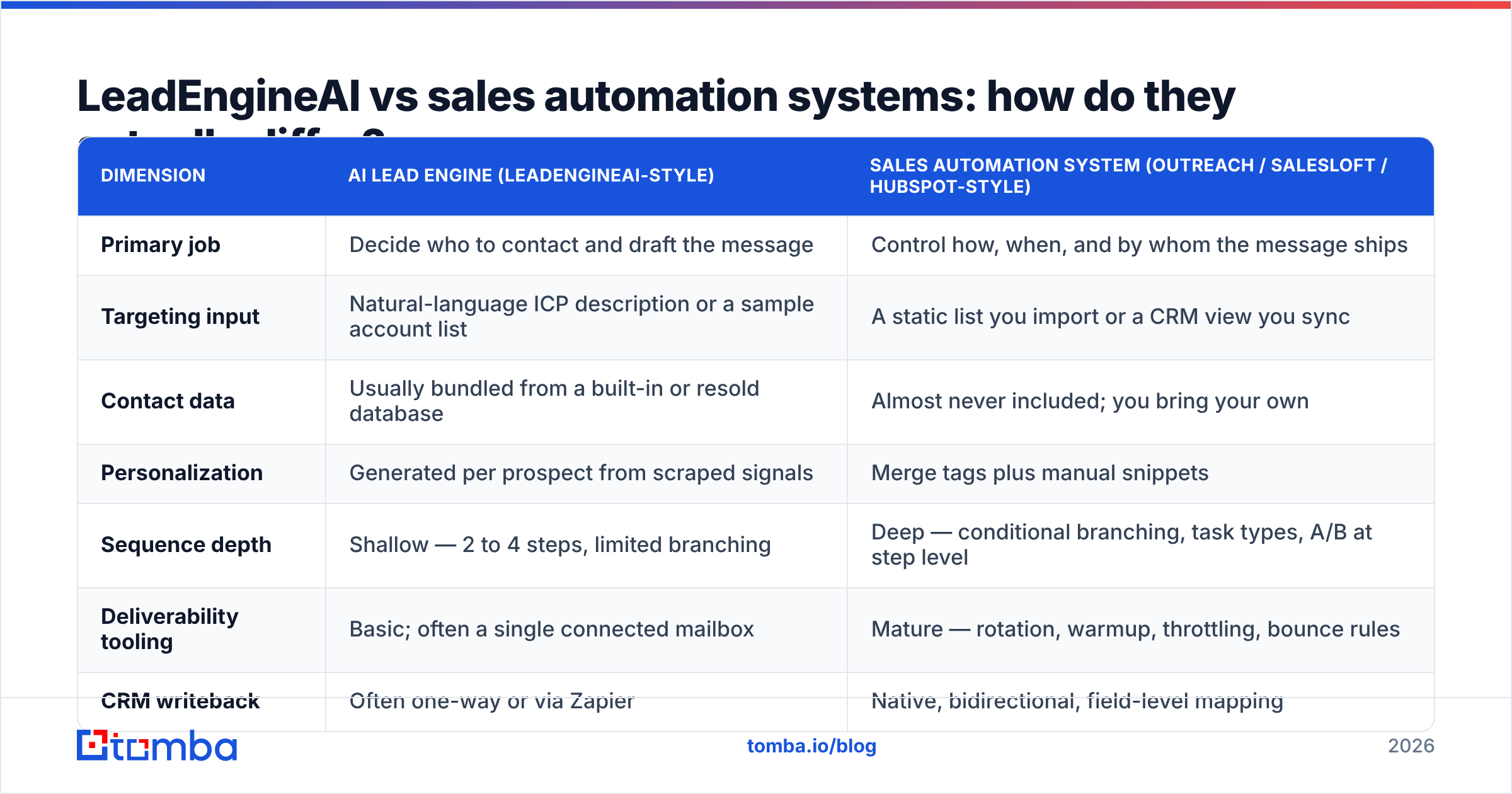
Here is LeadEngineAI vs sales automation systems, side by side.
| Dimension | AI lead engine (LeadEngineAI-style) | Sales automation system (Outreach / Salesloft / HubSpot-style) |
|---|---|---|
| Main job | Picks who to contact. Drafts the note. | Controls how and when mail ships. |
| Targeting | Plain-language buyer profile. Or a sample list. | A list you import. Or a CRM view. |
| Contact data | Bundled from a built-in or resold source. | Rarely included. You bring it. |
| Custom lines | Written per lead from scraped signals. | Merge tags and hand-written snippets. |
| Sequence depth | Thin. Two to four steps. | Deep. If-then branches and task types. |
| Send health | Basic. Often one mailbox. | Mature. Rotation, warmup, bounce rules. |
| CRM writeback | One-way. Or through Zapier. | Native and two-way, field by field. |
| Reports | Campaign level. | Rep, step, and cohort level. |
| Who buys it | Founder, solo AE, small GTM team. | Sales lead or RevOps at 10+ reps. |
| Ramp time | Hours. | Two to six weeks, with CRM mapping. |
| Pricing | Per workspace or per credit. | Per seat, often a yearly deal. |
Read the table as two columns, not a scoreboard. They only fight over one row: contact data. Even that fight is mostly for show. Both sides scrape or resell the same sources.
Which one actually finds better leads?#
Neither, and that is the part most LeadEngineAI vs sales automation systems posts skip.
The AI engine wins on speed of choice. Type "Series A fintechs in the EU that just hired a compliance lead." Get 300 matching contacts in four minutes. That is genuinely new. A sales automation system cannot do it at all; it waits for your CSV.
But speed is not accuracy. Those 300 emails come from a bundled list, built the way every other list was built: crawled pages, guessed patterns, and traded files. B2B contact data goes stale at 25–30% a year as people switch jobs. So a list you did not check this month is already part wrong.
Here is the honest setup: use the AI engine to pick who, then run the output through a data layer to learn how to reach them. A domain search confirms the live email pattern at the target firm, and a quick check drops the addresses that will bounce. Do that before the first send, and you guard the sender name your automation system spent weeks warming up.
Want the same check inside your own code? The Tomba API runs finder and verifier calls in one chain. The clean-up step then sits between the AI engine's export and the sequencer's import.
What does each one actually cost to run?#
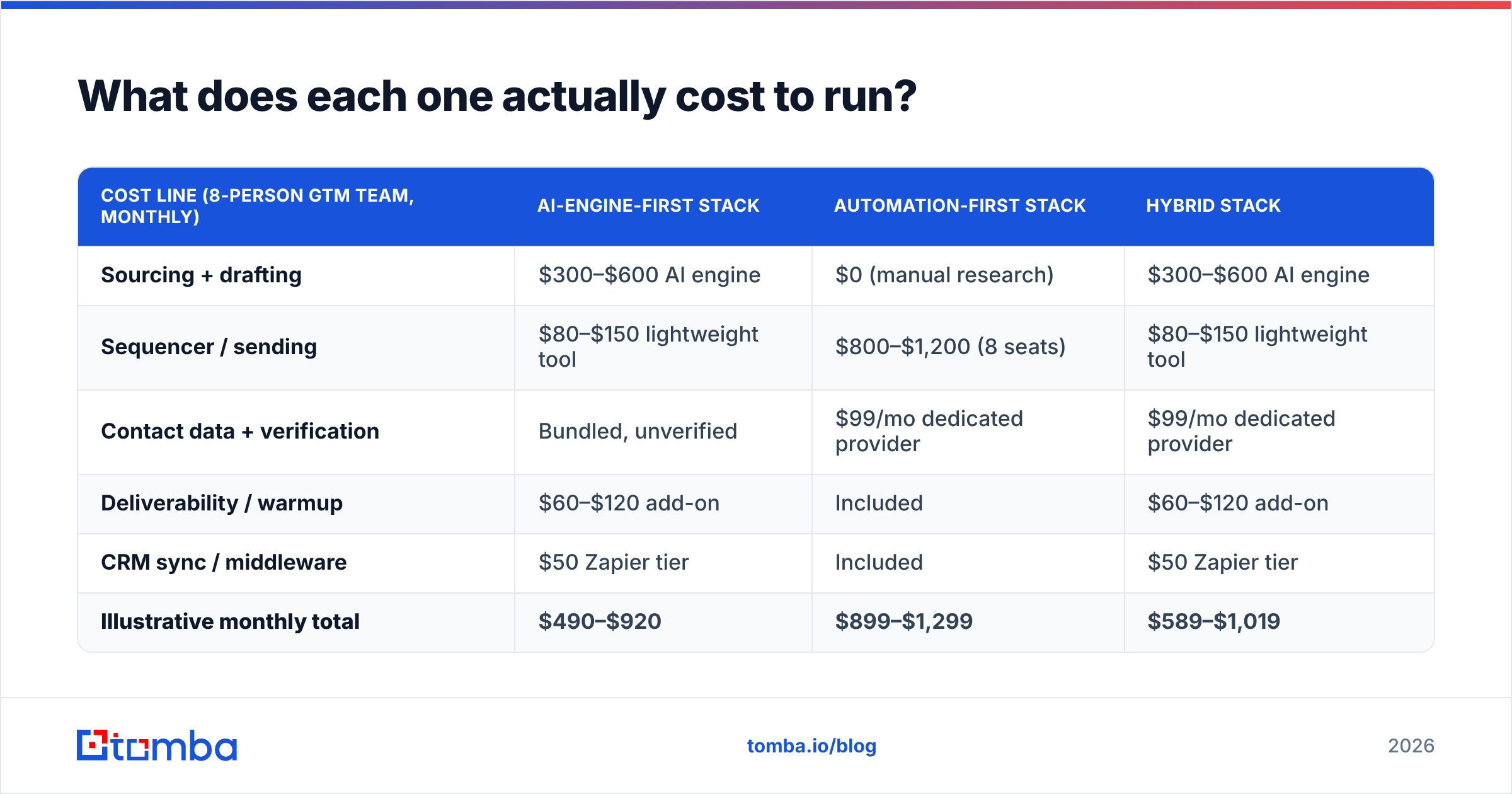
Here is the trap in LeadEngineAI vs sales automation systems pricing. AI engines look cheap because they bill per workspace. Automation tools look dear because they bill per seat. Price the whole stack and the gap shrinks or flips.
| Cost line (8-person GTM team, monthly) | AI-engine-first stack | Automation-first stack | Hybrid stack |
|---|---|---|---|
| Sourcing and drafting | AI engine, $300–$600. | None. Hand research. | AI engine, $300–$600. |
| Sequencer | Light tool, $80–$150. | Eight seats, $800–$1,200. | Light tool, $80–$150. |
| Data and checks | Bundled. Not checked. | Data plan, $99. | Data plan, $99. |
| Send health | Add-on, $60–$120. | Included. | Add-on, $60–$120. |
| CRM glue | Zapier tier, $50. | Included. | Zapier tier, $50. |
| Rough monthly total | $490–$920. | $899–$1,299. | $589–$1,019. |
Now add the line nobody quotes. An enterprise sales contract for 15 reps, with setup and a year lock-in, lands near $2,400 a month. That figure includes the data plan the platform leaves out. Teams sign it hoping for a pipeline machine. They bought a costly scheduler.
Tomba pricing marks the low end: a free tier with 25 searches a month, $49 for Starter, and $99 for Growth. That $99 row is what the table above assumes. Data is not the big cost. It is just the line teams cut first, and it moves reply rates the most.
When should you pick an AI lead engine like LeadEngineAI?#
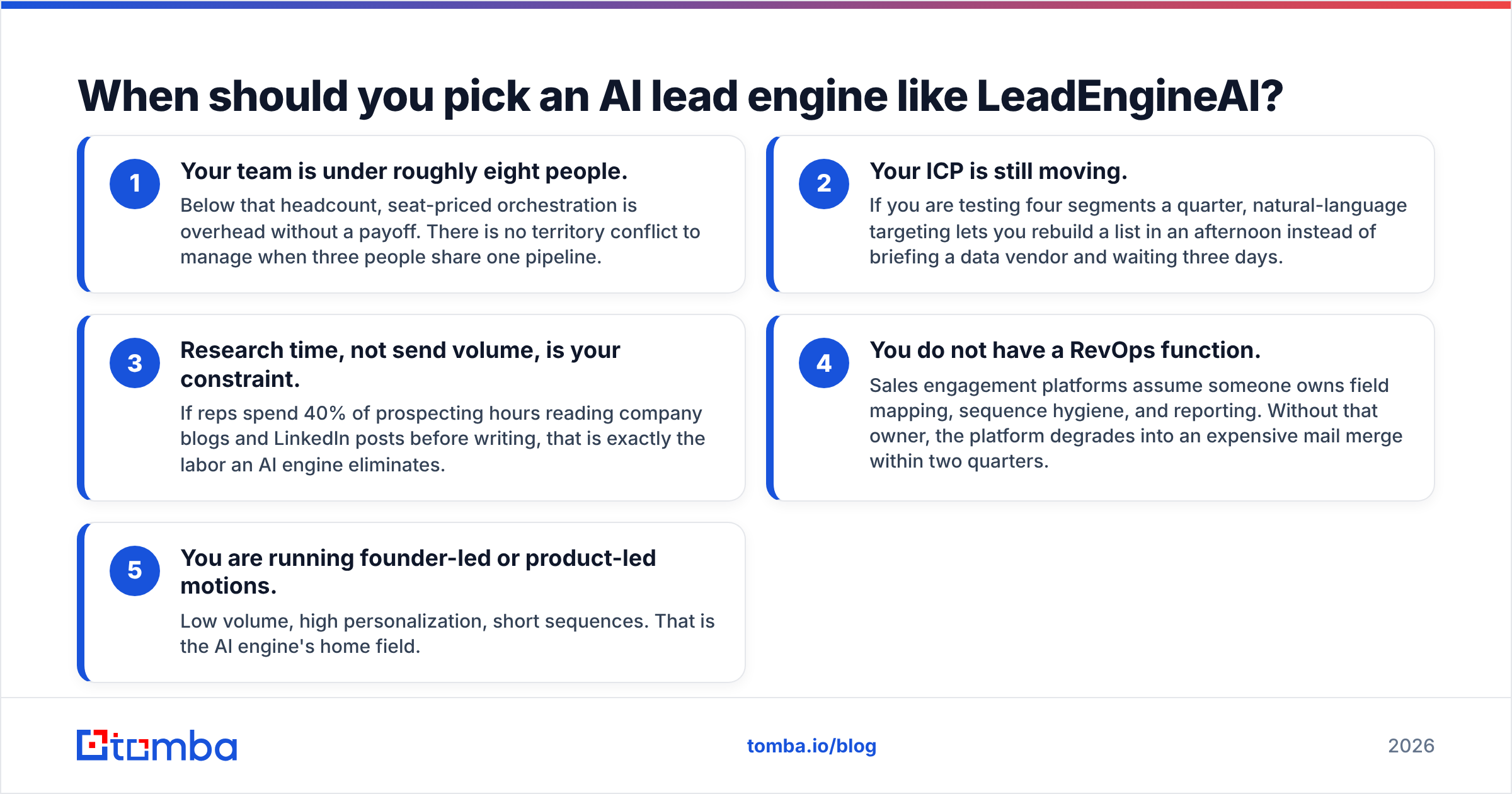
Pick the AI engine as your main tool when these hold:
- Your team is under eight people. Seat pricing is pure overhead at that size. Three people on one pipeline have no turf to fight over.
- Your buyer profile still moves. If you test four segments a quarter, plain-language targeting rebuilds a list in an hour. A data vendor takes three days.
- Research time is the constraint, not send volume. Reps who spend 40% of their hours reading blogs and LinkedIn posts are doing work the engine can do.
- You have no RevOps. Big platforms assume someone owns field mapping, clean sequences, and reports. With no owner, the platform rots into a costly mail merge.
- You run founder-led or product-led sales. Low volume, high touch, short sequences. That is the engine's home field.
Watch the failure mode. AI engines make volume cheap, and volume on unchecked data burns your domain fast. Cap daily sends, and check the list before you scale, not after.
When is a traditional sales automation system the better buy?#
Flip every point above. Buy the automation system first if you have ten or more reps, set territories, a CRM your board reports from, or rules that demand clean opt-out and consent records.
There is a coaching case too. HubSpot's sales tooling and its peers let a manager see that Rep A finishes 40% of step-three calls while Rep B finishes 90%. An AI lead engine has no view on rep habits. If your problem is patchy follow-through, better copy will not fix it.
Send health is also hard to build, and these tools have worked on it for a decade. Inbox rotation, per-domain limits, and bounce sorting are dull features that still decide whether your mail lands. Most AI engines treat this as a later problem. Do not accept a thin send layer above 2,000 emails a month.
Can you run both without duplicating spend?#
Yes, and most teams land there by year two. The clean split looks like this:
- AI lead engine owns the buyer profile, account discovery, research, and first-draft copy. It hands you a list, not a live campaign.
- Data layer owns checks and missing fields. Every contact gets its email confirmed before it touches a sequence. A bulk email finder keeps that from turning into hand work.
- Sales automation system owns sending, tasks, branches, opt-outs, and CRM writeback. It takes clean records only.
This beats either extreme because it splits the three failure modes. Bad targeting is an engine problem. Bounces are a data problem. Silence at step four is a sequence problem. When one tool owns all three, you cannot tell which one broke. The vendor dashboard will say all is well while your reply rate halves.
Want the back story on how this split formed? The primer on sales force automation covers which jobs were always meant to live in the CRM layer.
What should you actually buy in 2026?#
Here is the verdict on LeadEngineAI vs sales automation systems, stated plainly: buy the AI lead engine if you are small and your targeting is unsettled. Buy the sales automation system if you are large and your follow-through is patchy. Buy a data layer either way.
The two camps are merging: AI engines are adding branches, and automation tools are adding AI research agents. Neither is merging on data quality, because data quality is a running cost, not a feature you ship once. That is why the contact layer stays a separate line item.
Run a 30-day test before you sign a yearly deal. Take 200 accounts, split them, and track three numbers on their own: how many contacts were a true fit, the bounce rate on first send, and the reply rate on mail that landed. The first number grades the engine. The second grades your data. The third grades your sequence and copy. Most teams learn their sequence was never the problem.
Start with the layer you can test fastest. Run your current target list through the Tomba Email Finder and see how many contacts still work. The free tier covers 25 searches. Ten minutes is enough to learn whether LeadEngineAI vs sales automation systems is even your real question, or whether the data under both is.
Related guides#
// get started
Find, verify and enrich your first contacts today
Start on the free plan with 25 searches a month, then scale when your team is ready.
Free plan · No credit card required · GDPR & CCPA
// about the author