LeadEngineAI vs The Data City: Which B2B Data Tool Wins?
One platform classifies companies by what they actually do. The other tries to hand you ready-to-work leads. Here is where each one earns its budget, where both fall short, and how to fill the gap.
LeadEngineAI vs The Data City is not a fair fight, and it was never meant to be. One tool maps a market. The other hands you a list. Buy the wrong one and you pay for data you cannot use.
TL;DR
- The Data City is a company-intelligence platform built on real-time industrial classification. It tells you which companies exist in a market and what they actually do. It does not hand you a contact list.
- LeadEngineAI sits at the other end of the funnel. It bills itself as an AI-assisted lead generation engine that returns prospect lists and outreach-ready records.
- They are not substitutes. One is a market-mapping layer. The other is a list-building layer. Buying the wrong one for your use case is the most common mistake here.
- Both leave the same hole: verified, deliverable contact data. A company record without a working email address does not produce pipeline.
- Practical stack: use a classification tool to define the account universe, a lead engine to prioritise, and a dedicated email finder plus verification to make the list sendable.
What are LeadEngineAI and The Data City, exactly?#
Start with the honest framing. The labels these tools get shoved under — "B2B data", "lead gen" — hide the real difference.
The Data City is a UK-headquartered company data platform. Its core idea is simple: traditional SIC codes are too stale and too broad to describe a modern business. A company registered in 2009 under a generic "other business support activities" code might sell AI infrastructure today.
Its answer is real-time industrial classification. The platform reads company websites and public filings, then sorts companies into sectors based on what they say and do now. You can define a custom sector, pull every firm that matches, and add firmographics on top: headcount, turnover estimates, growth signals, registered details.
LeadEngineAI, by its own positioning, is a lead generation product. The promise of that category is simple. Describe your ideal customer, and the platform returns matching companies and people, usually with AI-assisted scoring and sometimes with drafted outreach copy.
One caveat matters. LeadEngineAI is a much smaller and younger vendor than The Data City, and its public documentation is thin. Treat every capability claim as something to test in a trial, not something to take at face value. Check current user reviews on a neutral marketplace like G2's lead intelligence category before you sign an annual contract.
That asymmetry matters for the rest of this comparison. The Data City has a documented, auditable method. LeadEngineAI has a broader promise with less public evidence behind it.
What does The Data City actually do well?#
Four things, and they are genuinely hard to copy:
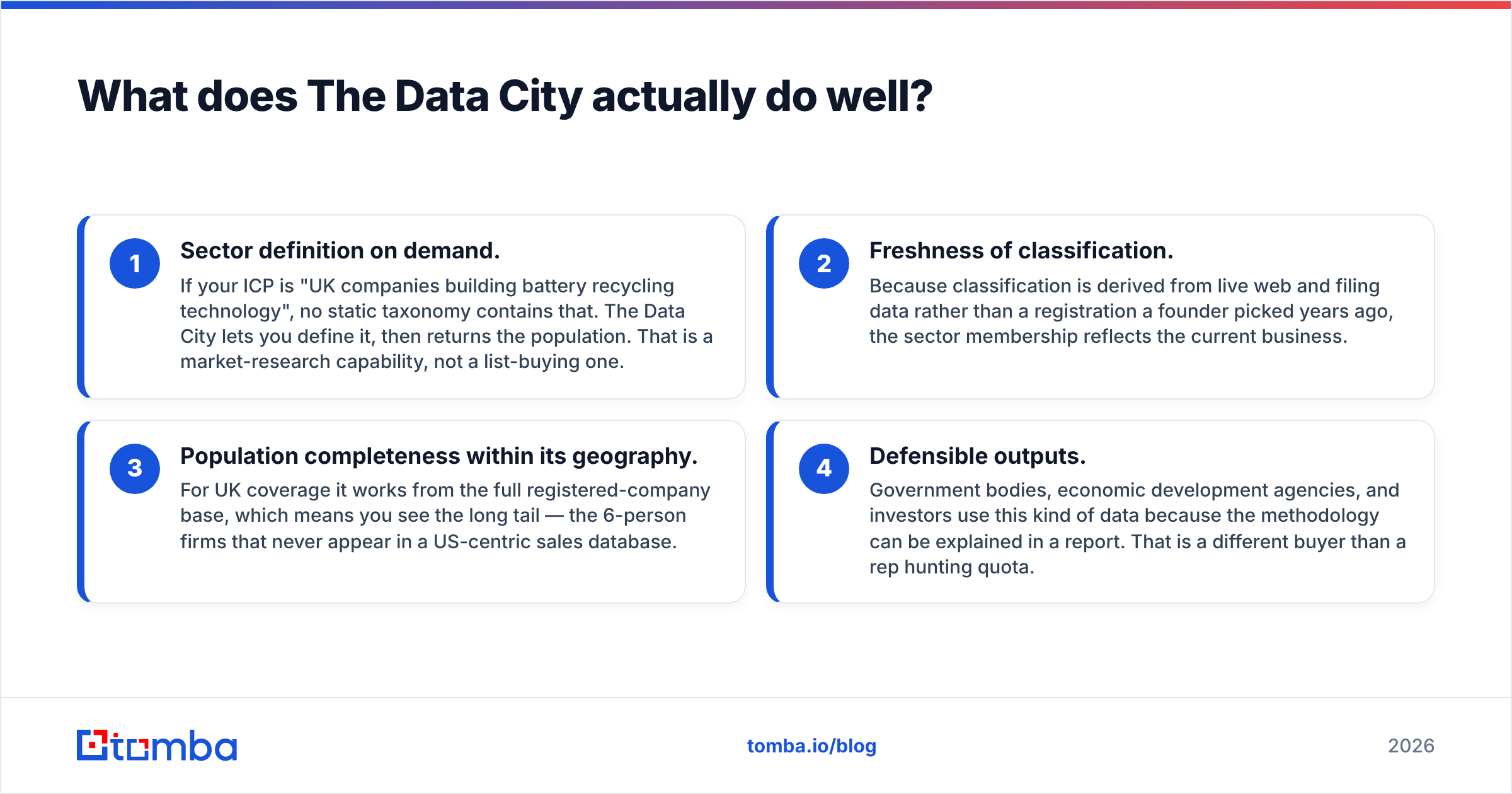
- Sector definition on demand. Say your ICP is "UK companies building battery recycling technology". No static taxonomy holds that. The Data City lets you define it, then returns the population. That is market research, not list buying.
- Freshness of classification. Sector membership comes from live web and filing data, not from a code a founder picked years ago. So it reflects the business as it is today.
- Population completeness within its geography. UK coverage works from the full registered-company base. You see the long tail — the 6-person firms that never show up in a US-centric sales database.
- Defensible outputs. Government bodies, economic development agencies, and investors use this kind of data because the method can be explained in a report. That is a different buyer than a rep hunting quota.
The limits are just as clear. Reach outside the UK is narrower than a global sales-intelligence vendor. And it is a company data product, not a contact data product. You get the organisation. You do not get a verified inbox for the Head of Operations.
What does LeadEngineAI actually do well?#
The pitch is speed and packaging. Instead of a research workflow, you get something that looks like a prospecting list on day one: companies, contacts, a relevance score, and in many tools of this class, a generated first-touch email.
For a small team with no data analyst, that packaging has real value. You trade method transparency for time-to-first-list. If your ICP is broad and conventional — "SaaS companies, 50 to 500 employees, US and UK, VP Sales or above" — a lead engine will get you something workable in an afternoon.
Four trade-offs to test in a trial:
- Where does the data come from? AI-branded lead tools are often a UI over licensed or scraped third-party data. Ask for the source. If nobody answers, assume resale.
- How are contacts verified, and when? An email guessed from a naming pattern is not a verified address. This is the single biggest driver of bounce rates.
- Is the AI scoring explainable? "Fit score: 87" with no reasoning is decoration.
- What happens at renewal? Small vendors change pricing and limits faster than established ones.
LeadEngineAI vs The Data City: how do they compare head-to-head?#
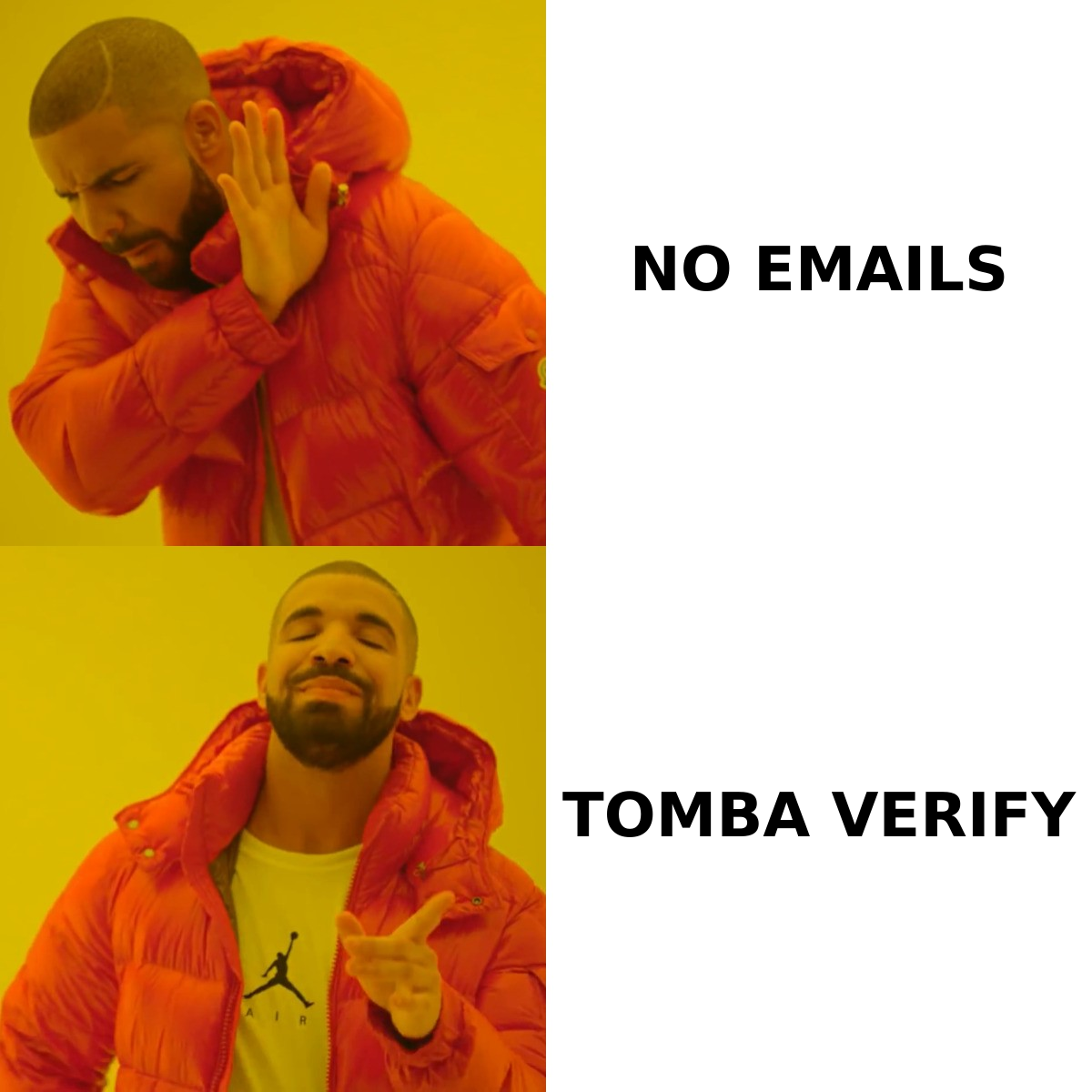
| Attribute | The Data City | LeadEngineAI | Tomba (contact layer) |
|---|---|---|---|
| Primary job | Define and size markets by real activity | Produce ready-to-work prospect lists | Find and verify business email addresses |
| Core unit of data | Company / sector | Company + contact + score | Email, phone, enriched person record |
| Classification method | Real-time industrial classification from web + filings | AI matching over licensed/aggregated data | Pattern discovery + source crawling, then SMTP verification |
| Geographic strength | UK-first, deepest on registered UK companies | Broad claims, verify in trial | Global domains, 100+ countries |
| Contact emails included | Not the product | Yes, verification quality varies | Yes, with confidence scoring |
| Email verification | No | Bundled, methodology usually undisclosed | Dedicated email verifier, catch-all handling |
| Transparency of method | Published and auditable | Limited public documentation | Documented data sources |
| API access | Yes | Check current plan | Yes, full email finder API |
| Entry price | Quote-based, enterprise-shaped | Quote or self-serve, verify current | Free tier (25 searches/mo), Starter $49/mo |
| Best buyer | Strategy, research, economic development, investors | SDR teams wanting fast lists | Any team that needs deliverable contact data |
Read that table as three columns doing three jobs, not three vendors fighting over one seat. The row that should decide your evaluation is "primary job".
Which one fits your GTM motion?#
The LeadEngineAI vs The Data City call gets easy once you name the question you are trying to answer:
- "How big is this market and who is in it?" — The Data City. This is a total-addressable-market and territory-design question. A lead engine gives you a sample, not a population, and you cannot defend a sample in a board deck.
- "I need 500 contacts to call this month." — LeadEngineAI or a similar list tool, with verification bolted on. Speed beats method here, as long as your bounce rate stays low.
- "Our ICP is a category that has no name yet." — The Data City. Custom sector definition is the problem it was built for. Emerging-tech, climate, and deep-tech ICPs are where it pulls away from generic databases.
- "We have the account list, we just cannot reach anyone." — Neither. You need a contact-discovery layer: domain search to map who works there, an email finder to resolve addresses, and verification before send.
- "We need to refresh 40,000 stale CRM records." — A dedicated enrichment API. Lead engines are built for net-new discovery, not for cleaning records you already own.
Why does neither tool solve the deliverability problem?#
Because company data and contact data decay at very different rates. Only one of them hurts your sender reputation when it goes stale.
Firmographic data ages slowly. Sector, headcount band, and registered address stay broadly stable across a year. Contact data does not. B2B email lists decay every year through job changes, restructures, and domain migrations. Every dead address you mail is a hard bounce, and enough bounces push the rest of your sends to spam. That is how a data-quality problem turns into an email deliverability problem.
The two platforms here behave differently but land in the same place. The Data City does not claim to solve contacts, because they sit outside its scope. LeadEngineAI, like most tools in its class, does claim to. The question is whether the verification behind that claim is real.
Three checks worth running on any trial export:
- Bounce a sample. Take 200 records, run them through an independent email verifier, and compare the verdicts. If more than 5 to 10 percent come back invalid or risky, the "verified" label is decorative.
- Check catch-all handling. Many B2B domains accept all mail at the server level. Naive verification then returns "valid" for addresses that do not exist. Ask how catch-all domains are scored.
- Check the timestamp. An address verified 14 months ago and cached since is an unverified address with good manners.

What do these tools actually cost?#
Pricing is the weakest part of any LeadEngineAI vs The Data City comparison, including this one. The Data City sells on a quote basis. Pricing scales by seats and data access, and it is shaped like an enterprise research subscription rather than a per-rep sales tool. LeadEngineAI's published pricing has moved, and small vendors change tiers often. Check the current page. The only figures worth quoting are the ones you can verify today.
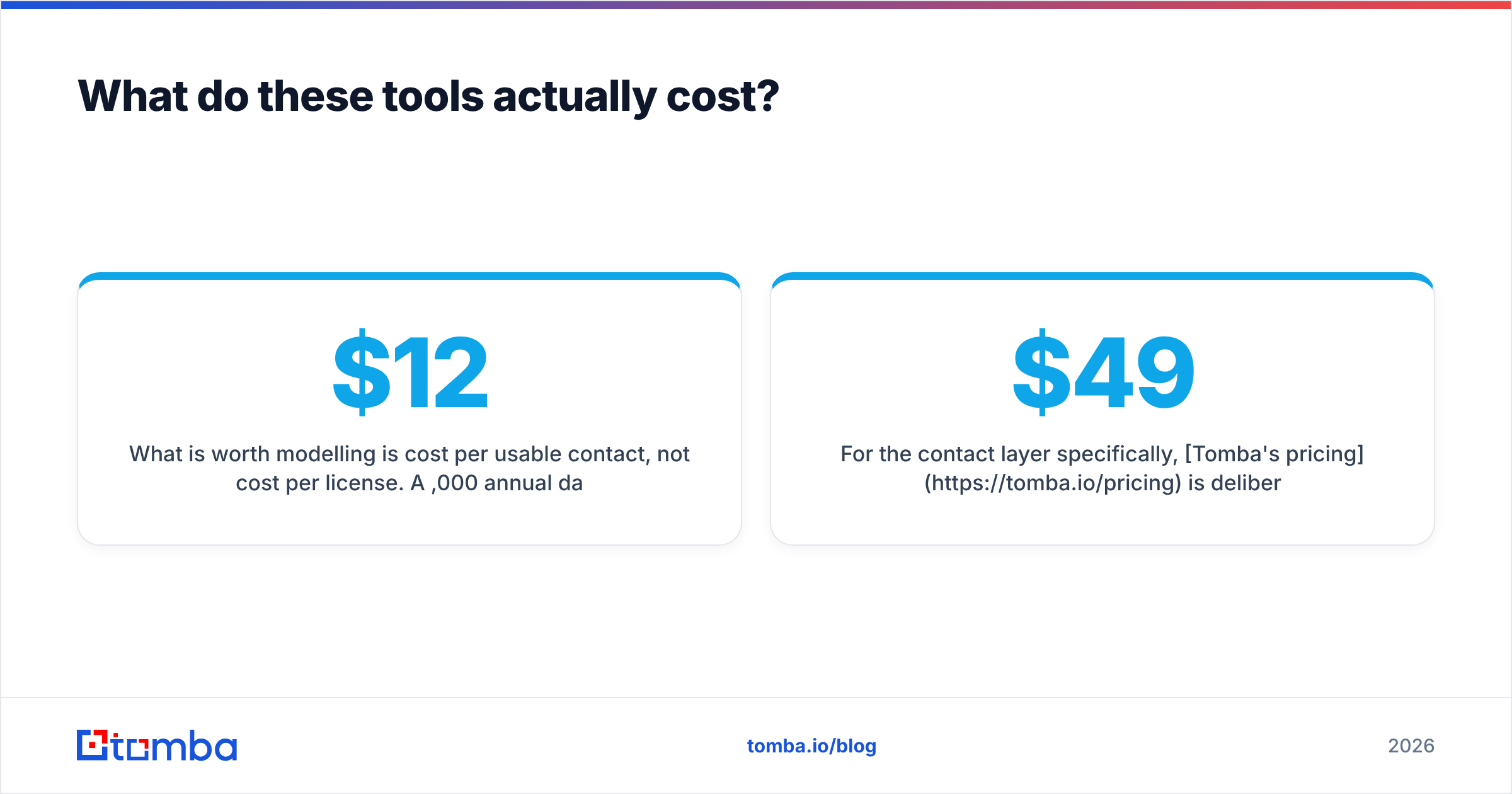
Model cost per usable contact, not cost per licence. A $12,000 annual data subscription that produces 4,000 accounts is excellent value for market mapping. As a source of email addresses it is terrible value, because it produces none. A $3,000 lead tool that returns 20,000 contacts at a 25 percent bounce rate delivered 15,000 usable records and a damaged sending domain.
For the contact layer, Tomba's pricing is deliberately simple: a free tier with 25 searches a month, Starter at $49/mo, Growth at $99/mo, Pro at $249/mo, and custom enterprise terms. It is not competing with either platform above, because it does a different job. The point is that it gives you a fixed, known number for the one input that decides whether the rest of the stack makes revenue.
How should you stack these tools together?#
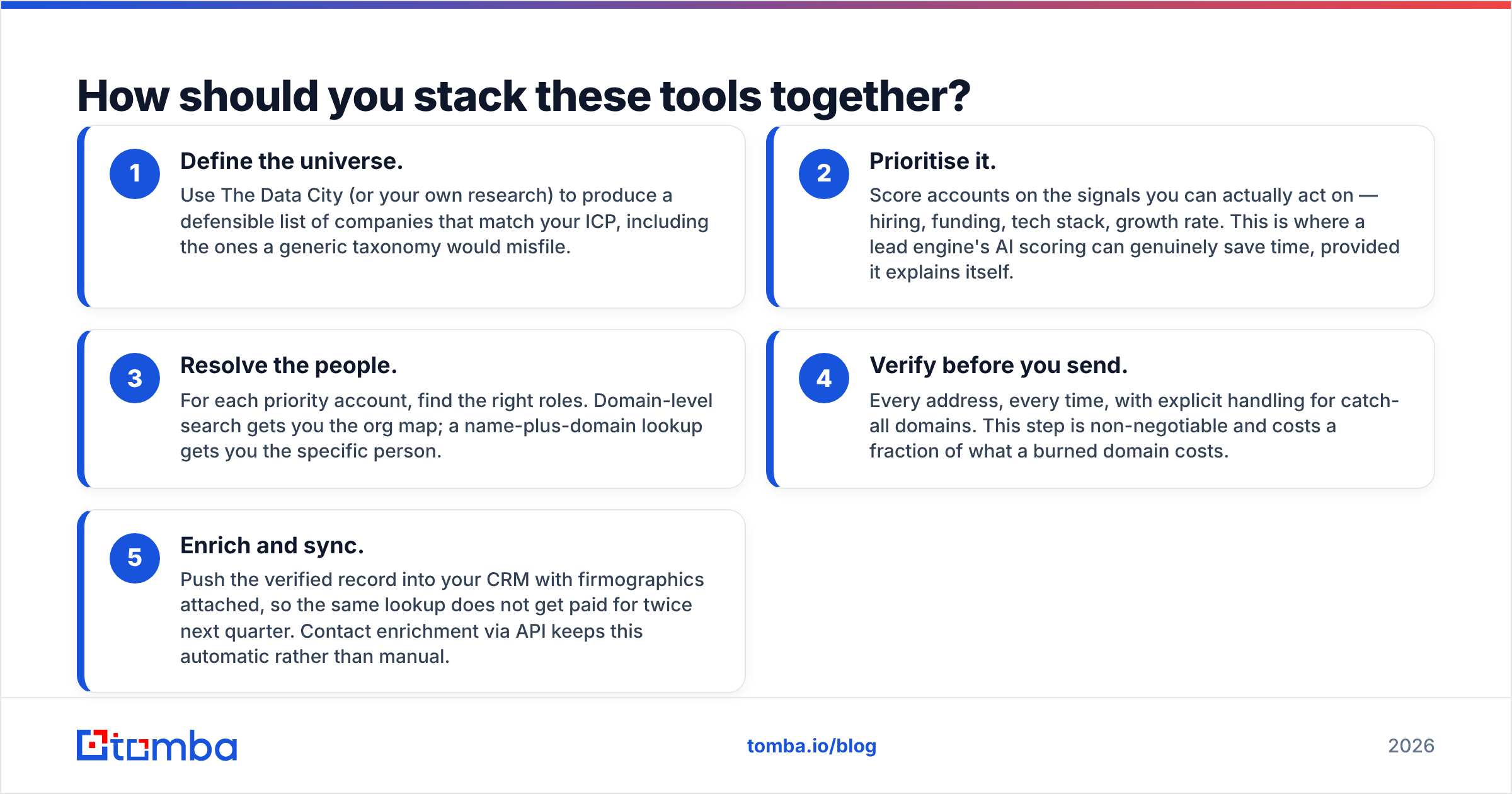
Teams that get this right treat it as a pipeline, not a purchase:
- Define the universe. Use The Data City (or your own research) to build a defensible list of companies that match your ICP, including the ones a generic taxonomy would misfile.
- Prioritise it. Score accounts on signals you can act on: hiring, funding, tech stack, growth rate. This is where a lead engine's scoring saves real time, provided it explains itself.
- Resolve the people. For each priority account, find the right roles. Domain-level search gets you the org map. A name-plus-domain lookup gets you the person.
- Verify before you send. Every address, every time, with explicit handling for catch-all domains. This step costs a fraction of what a burned domain costs.
- Enrich and sync. Push the verified record into your CRM with firmographics attached, so you do not pay for the same lookup next quarter. Contact enrichment via API keeps this automatic.
Steps 1 and 2 are where these two platforms compete. Steps 3 through 5 are where neither is the answer.
Is LeadEngineAI better than The Data City?#
No. And the reverse is also no. The honest answer to LeadEngineAI vs The Data City is that each one wins a different argument.
Are you a strategy, research, investment, or economic development team? Then The Data City is the stronger and better-evidenced product. You need to know who is in a market and defend the definition. The caveat is that its depth is UK-centric.
Are you a small sales team that needs a working list this week? Then a lead engine gets you moving faster. Budget for independent verification. Go in with realistic expectations about data provenance from a vendor with thin public documentation.
If your real bottleneck is that you already know who to contact and cannot reach them, neither purchase helps. Spend that budget on the contact layer instead.
Get the contact layer right#
Whichever side you land on, a list only becomes pipeline when the emails work. Tomba's Email Finder resolves professional addresses from a name and a domain. It scores every result with a confidence level and runs verification, including catch-all detection, before the address reaches your sequencer. Start on the free tier with 25 searches a month. Test it against a sample from whichever platform you are trialling, then compare the bounce rates yourself. That one test tells you more than any comparison table, including this one.
Related guides#
// get started
Find, verify and enrich your first contacts today
Start on the free plan with 25 searches a month, then scale when your team is ready.
Free plan · No credit card required · GDPR & CCPA
// about the author