LeadEngineAI vs Thomson Data: Which B2B Data Wins in 2026?
One sells AI-assembled prospect lists, the other sells curated industry databases. We break down accuracy, pricing models, refund terms, and who each vendor actually fits in 2026.
TL;DR
- LeadEngineAI builds lists with AI. You describe your buyer. It returns contacts, and it often bundles outreach tools on top.
- Thomson Data sells files. You pick a segment, such as health care or tech. You get a CSV or a CRM append.
- The core split in LeadEngineAI vs Thomson Data is not features. It is how fresh the data is.
- One builds records close to search time. The other sells from a stored file on a refresh cycle.
- Neither one posts clear self-serve prices. Both sell by quote. So cost per good contact is hard to judge up front.
- Buy a sample first. Run 100 rows through your own checker. That beats any promise in a sales deck.
- Need work emails one at a time? A per-search tool like Tomba (free tier, then $49/mo) often wins on cost.
What are LeadEngineAI and Thomson Data?#
They solve one problem: "get me people to sell to." But they start from opposite ends of the market. That is the heart of LeadEngineAI vs Thomson Data.
LeadEngineAI is part of the AI lead engine wave that began in 2023. The pitch is intent in, list out. You type a short note about your ideal buyer. The tool reads it, queries its sources, and hands back contacts. Most tools in this class also add sequences, AI first lines, and a shared inbox. The list never has to leave the app.
Thomson Data is the older model. It is a B2B list shop. It has sold industry files for well over a decade. Its strong suits are health care, tech install base, and global B2B. You tell a rep the segment. They scope the count. You buy the file. Their company site sorts the catalogue by industry, job role, and tech stack, not by a search box.
That gap in shape drives the rest. It sets the price, the freshness, and how much checking lands on you.
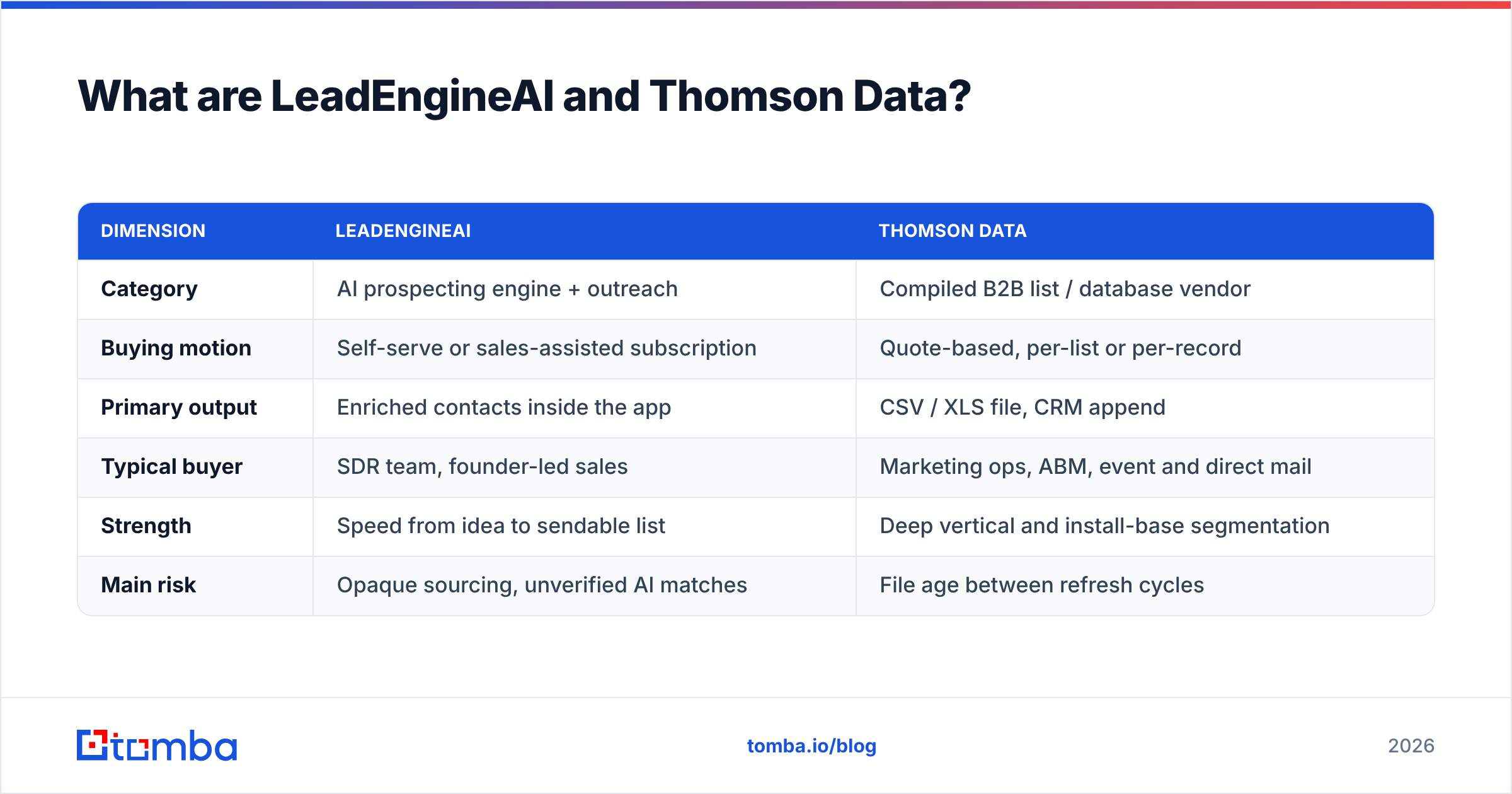
| Dimension | LeadEngineAI | Thomson Data |
|---|---|---|
| Category | AI prospecting engine + outreach | Compiled B2B list / database vendor |
| Buying motion | Self-serve or sales-assisted subscription | Quote-based, per-list or per-record |
| Primary output | Enriched contacts inside the app | CSV / XLS file, CRM append |
| Typical buyer | SDR team, founder-led sales | Marketing ops, ABM, event and direct mail |
| Strength | Speed from idea to sendable list | Deep vertical and install-base segments |
| Main risk | Opaque sourcing, unverified AI matches | File age between refresh cycles |
How does each vendor actually source its data?#
This one question sets your bounce rate. It is also the one both sides dodge.
AI lead engines rarely crawl the whole web. Most blend three inputs. First, a licensed base file. Second, a web enrichment layer. Third, a guess at the email format, plus a check on that guess. That third step is the magic and the risk. It can find a contact no static file holds. It can also return an address with no mailbox behind it.
Compiled vendors work the other way. Records come from directories, trade shows, sign-ups, filings, surveys, and data swaps. The file is built, deduped, then checked on a cycle. Buy in month one and the data is good. Buy in month eleven and you buy an old snapshot. In that window, about a fifth of contacts change jobs.
So in LeadEngineAI vs Thomson Data, ask both sides the same four questions before you pay:
- How often do you refresh? "All the time" is not an answer. Ask for the median age of a record in your segment.
- Is the check SMTP level or pattern level? Pattern-only checks inflate the claims by a lot.
- How do you count catch-all domains? Many vendors log them as valid. The server accepts all mail. That is a choice in the report, not a fact about the mailbox.
- What is the replacement policy? Credit for hard bounces above a set rate beats any raw accuracy claim.

LeadEngineAI vs Thomson Data: how do they compare head to head?#
Here is the side by side. I added a per-search email finder as a third view. Many teams weighing these two are really choosing between "buy a list" and "find contacts as I go."
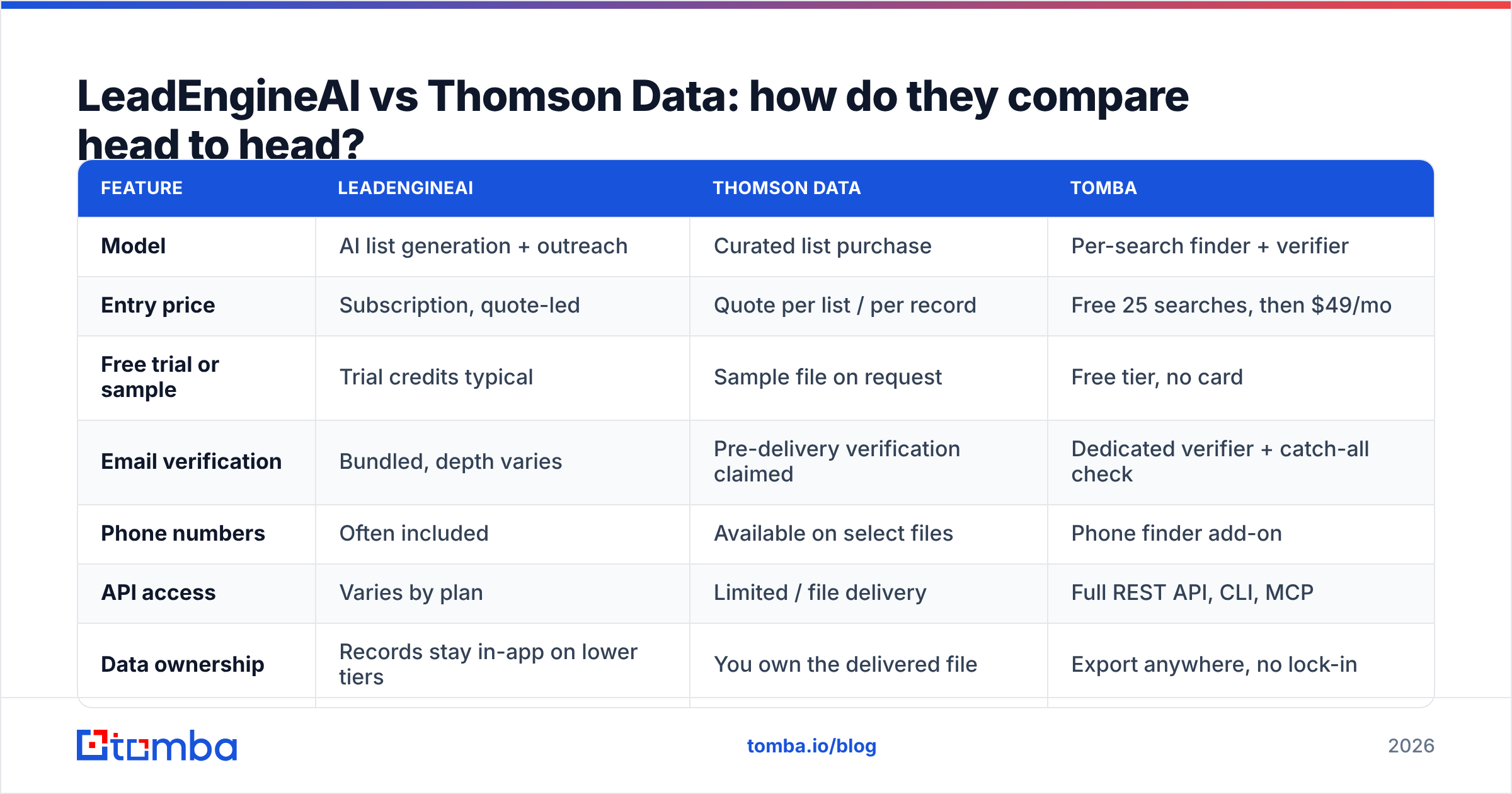
| Feature | LeadEngineAI | Thomson Data | Tomba |
|---|---|---|---|
| Model | AI list generation + outreach | Curated list purchase | Per-search finder + verifier |
| Entry price | Subscription, quote-led | Quote per list / per record | Free 25 searches, then $49/mo |
| Free trial or sample | Trial credits typical | Sample file on request | Free tier, no card |
| Email verification | Bundled, depth varies | Pre-delivery verification claimed | Dedicated verifier + catch-all check |
| Phone numbers | Often included | Available on select files | Phone finder add-on |
| API access | Varies by plan | Limited / file delivery | Full REST API, CLI, MCP |
| Data ownership | Records stay in-app on lower tiers | You own the delivered file | Export anywhere, no lock-in |
| Best for | Fast ICP-to-inbox motion | Vertical and install-base targeting | Precision, per-contact accuracy |
Two caveats on that table. First, both vendors set scope and price per deal. Read the price row as a sketch, not a rate card. Pull a fresh quote before you budget. Second, "email checks included" means a different thing at each vendor. That is the honest read on LeadEngineAI vs Thomson Data today.
Which one has better data accuracy?#
You cannot test either claim from outside. So test it yourself.
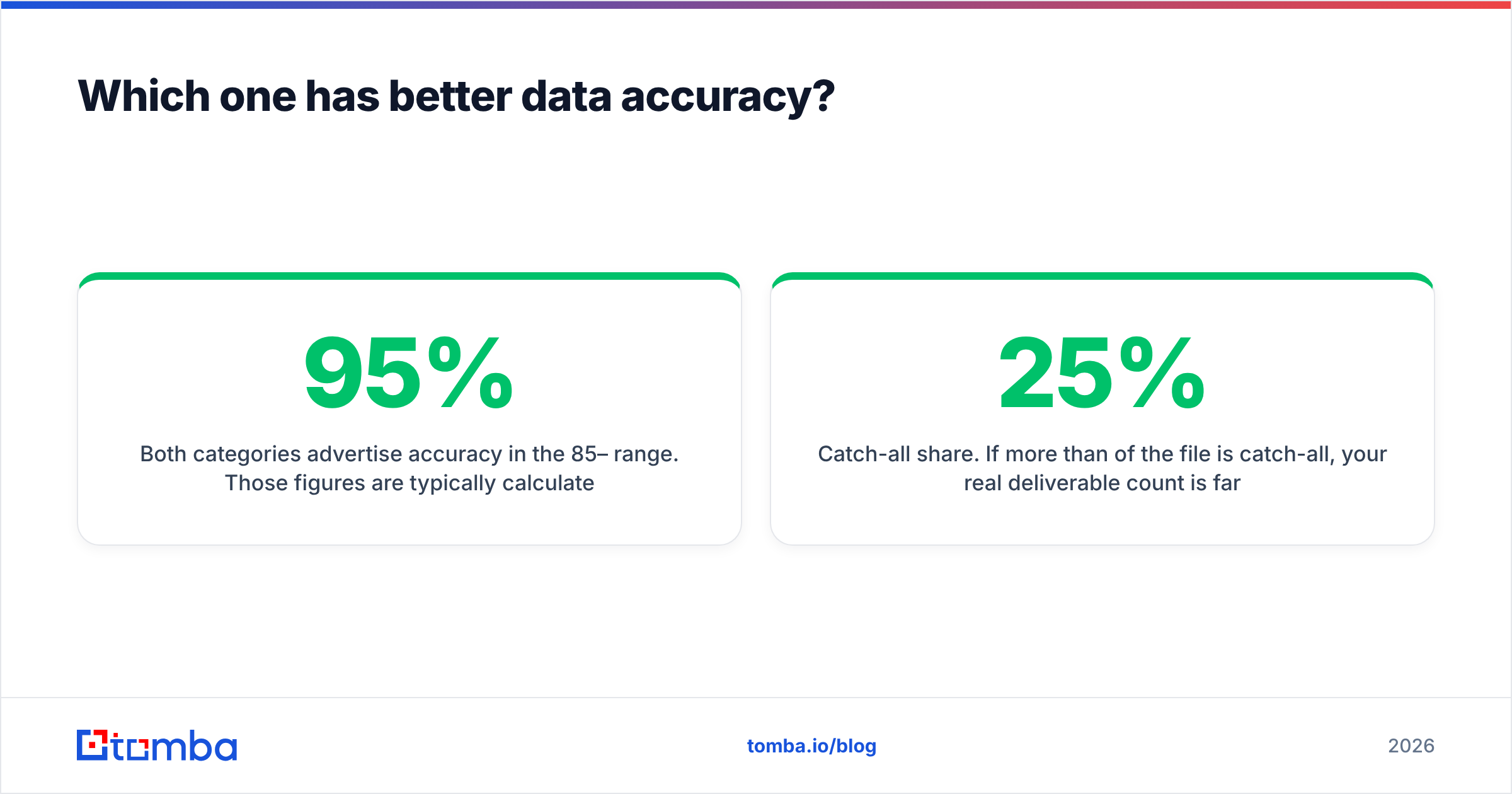
Both sides of LeadEngineAI vs Thomson Data quote accuracy in the 85–95% band. Those numbers cover one thing: did the address work at the moment of the check. They skip the useful part. Is this the right person, at the right firm, in the right role, today? A record can be 100% deliverable and still be dead weight. The contact may have left in March.
Run the same 100-row sample against both vendors:
- Bounce test. Push the sample through an outside email verifier, not the vendor's own. Log hard bounce, catch-all, and unknown apart.
- Role test. Spot-check 20 records on LinkedIn. How many still hold the title on the file?
- Coverage test. Take 20 firms you know well. See how many the vendor covers. Vertical vendors look great inside their niche and thin outside it.
Then price the waste in the file:
- Catch-all share. If over 25% of the file is catch-all, your real reach is far below the headline. A catch-all verifier sorts live catch-all mailboxes from the rest.
- Duplicate rate. Dedupe against your CRM before you count. Paying twice for contacts you own is the most common hidden cost.
In practice, AI engines cover small and mid-size firms well. They slip on senior titles. Compiled vendors go deep in one lane. An install-base file of Epic or SAP users is hard to rebuild. They slip on recency. Neither rule holds every time. That is why your own sample beats any review-site average.
Want outside signal first? The lead intelligence category on G2 is the least bad public source. Read the 3-star reviews, not the 5-star ones.
What does each one cost in practice?#
Cost per contact is the wrong number. Cost per usable contact decides your pipeline math.
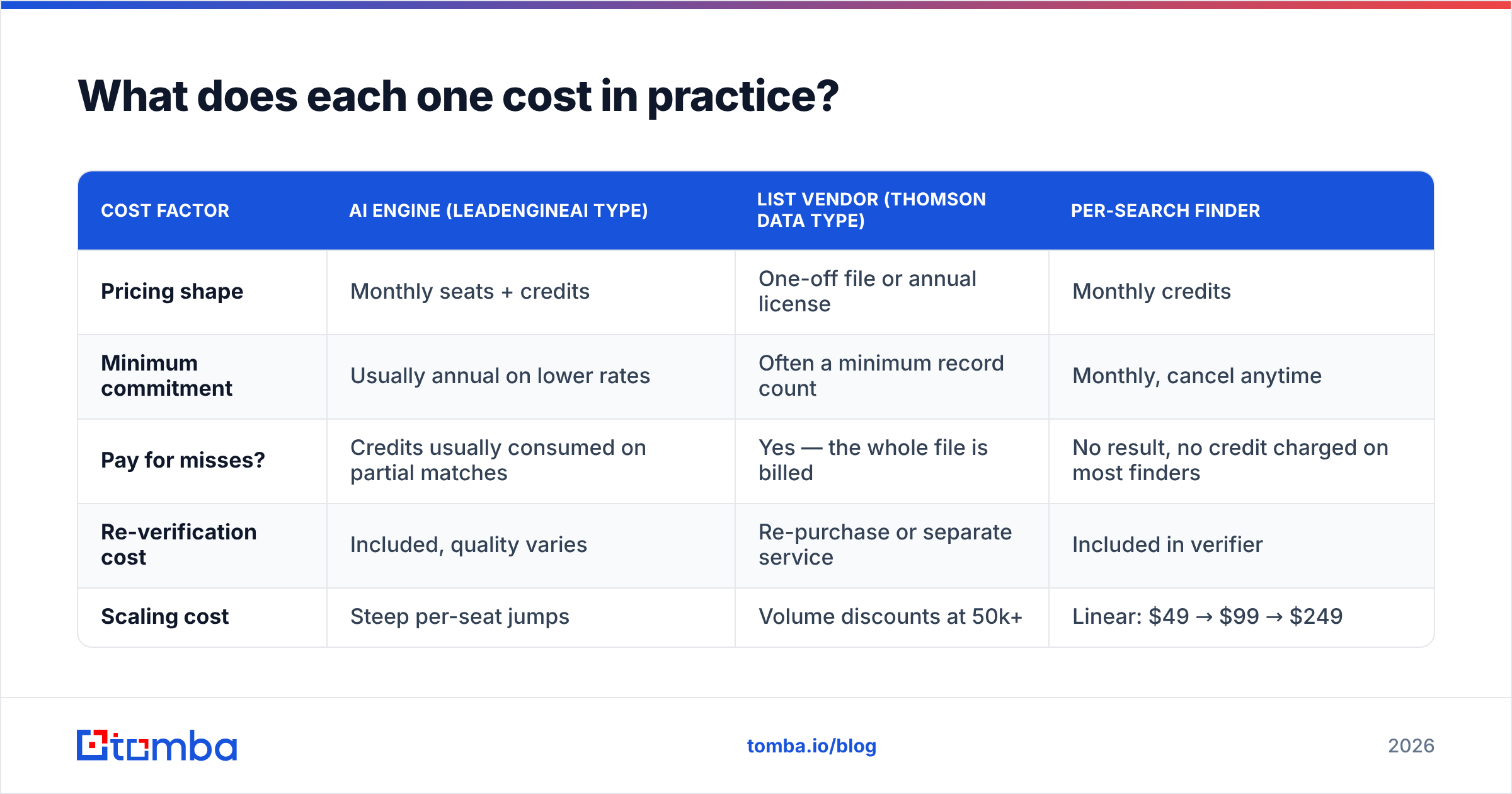
Work it out in three steps. Take the quote. Divide by the record count. Divide again by the share that passes your bounce, role, and dupe tests. A file at $0.10 per record with 55% good data costs $0.18 per usable record. A tool at $0.30 per lookup with 92% good data costs $0.33. It costs more per record. It burns far less sender trust.
| Cost factor | AI engine (LeadEngineAI type) | List vendor (Thomson Data type) | Per-search finder |
|---|---|---|---|
| Pricing shape | Monthly seats + credits | One-off file or annual license | Monthly credits |
| Minimum commitment | Usually annual on lower rates | Often a minimum record count | Monthly, cancel anytime |
| Pay for misses? | Credits usually spent on partial matches | Yes — the whole file is billed | No result, no credit on most finders |
| Re-verification cost | Included, quality varies | Re-purchase or separate service | Included in verifier |
| Scaling cost | Steep per-seat jumps | Volume discounts at 50k+ | Linear: $49 → $99 → $249 |
For scale, Tomba pricing is public: Free (25 searches/mo), Starter $49/mo, Growth $99/mo, Pro $249/mo, and Enterprise custom. No quote call. That matters in LeadEngineAI vs Thomson Data, since both ask for a chat before they name a price. A true cost comparison stays out of reach until you are already in a sales cycle.

Which should you choose for your use case?#
Match the tool to your motion, not to the feature list.
- Founder-led outbound, 200–800 contacts a month. Neither. You need aim, not volume. A domain search over your target accounts plus a check costs less than any file.
- SDR team running high volume. LeadEngineAI-style tools fit here, but only if the built-in sequencer replaces a tool you pay for now. Keep Instantly or Smartlead too, and you pay twice for the send layer.
- ABM into one vertical. Health care, install base, manufacturing: this is Thomson Data's home turf. Vertical vendors hold slices that broad AI tools cannot rebuild.
Three more shapes in the LeadEngineAI vs Thomson Data call:
- Direct mail, events, or multi-channel. List vendors again. Postal and firm fields run richer in a compiled file.
- Engineering-led pipeline. Neither side is API first. A finder with a documented email finder API slots in with far less friction than a CSV handoff.
- Mixed need, tight budget. Buy one small vertical file for the slice you cannot reach. Cover the rest with per-search lookups. Most teams land here after a year.
What are the credible alternatives to both?#
The two-vendor frame is too narrow. LeadEngineAI vs Thomson Data is one of four shapes on the market.
Checked database vendors. BookYourData fits this lane. It sells pay as you go and backs it with a bounce guarantee. That drops the subscription lock. It is a different risk profile, and worth a quote next to the other two.
Broad sales intelligence suites. Apollo, ZoomInfo, and peers bundle data, sequences, and intent. They cost more and lock in more. See our notes on picking an Apollo alternative if you have outgrown the bundle.
Per-search email finders. Best cost per usable record when your account list is set. You bring the target. The tool brings the verified contact.
Do it yourself. Scrape or license firm data, then resolve contacts through an API. Cheapest at scale. Most costly to maintain.
How do you run a fair bake-off in one week?#
Give both vendors the same brief. Score them on the same sheet. One week settles LeadEngineAI vs Thomson Data for your market.
- Day 1. Write one ICP: industry, headcount band, region, three target titles. Send it word for word to both.
- Day 2–3. Ask each for a 100-record sample. Turn down any sample cleaned unlike a real delivery.
- Day 4. Run both through the same outside checker and the same CRM dedupe. Log deliverable, catch-all, unknown, and dupe.
- Day 5. Spot-check 20 records per file for title accuracy on LinkedIn.
- Day 6. Send a 50-contact test from a warmed backup domain. Track bounce and reply by source.
- Day 7. Work out cost per usable contact and cost per reply. Pick on the second number.
Most teams are surprised by the result. The cheap file often loses once you price in the bounce damage. The pricey vertical file often wins one segment and loses the rest. Read that as a cue to buy narrow, not to standardise on one vendor.
The verdict: LeadEngineAI or Thomson Data?#
Here is the call on LeadEngineAI vs Thomson Data.
Choose LeadEngineAI if speed beats aim for you. It fits when you own no sequencer yet, and when your buyer profile is broad enough that reach beats depth.
Choose Thomson Data if you target one vertical or install base. It fits when you need postal and firm depth for multi-channel work, and you are fine doing the checks yourself.
Choose neither if your real problem is accuracy on accounts you already know. That is the common case. Buying a list is the wrong buy there. You pay for 90% of a file you will never touch.
If that sounds like you, start with the Tomba Email Finder. Give it a name and a company domain. You get a verified work email back, with the source score shown rather than hidden behind one headline number. The free tier covers 25 searches a month with no card. Starter is $49/mo. Every result runs the same checks, catch-all included. Test it against either sample file from the LeadEngineAI vs Thomson Data pair above. One week of side-by-side data beats any comparison post, this one included.
Related guides#
// get started
Find, verify and enrich your first contacts today
Start on the free plan with 25 searches a month, then scale when your team is ready.
Free plan · No credit card required · GDPR & CCPA
// about the author