LeadEngineAI vs Winmo: Which B2B Data Tool Wins in 2026?
One is an AI-first lead engine, the other is a 20-year media-sales database. We compare LeadEngineAI vs Winmo on data depth, contact accuracy, pricing transparency, and who each one actually fits.
Weighing LeadEngineAI vs Winmo? The short answer is that they solve different jobs. Winmo is built for media and ad sales teams. LeadEngineAI is built for general B2B prospecting with AI on top. This LeadEngineAI vs Winmo guide covers data depth, pricing, and who each tool actually fits.
TL;DR
- Winmo is a vertical database, not a general prospecting tool. It serves people who sell ads, sponsorship, and marketing services. Outside that lane, most of what you pay for sits unused.
- LeadEngineAI is an AI-first lead engine. It promises sourcing, scoring, and outreach in one dashboard. Public docs are thin. Test the claims in a live trial first.
- Neither one publishes a price. Both route you to a demo. Your cost depends on seat count, contract length, and how well you negotiate.
- Contact accuracy decides the winner. Rich company data does not help if the emails bounce. Budget for a separate verification step either way.
- Need correct emails at known companies? A finder-and-verifier stack costs a fraction of either platform.
LeadEngineAI vs Winmo: what is each tool?#
Both tools show up in the same "B2B lead data" searches. They were built for different jobs. Think of a specialist medical directory next to a general scheduling app. Both hold contacts. The value sits in different places.
Here is the honest breakdown:
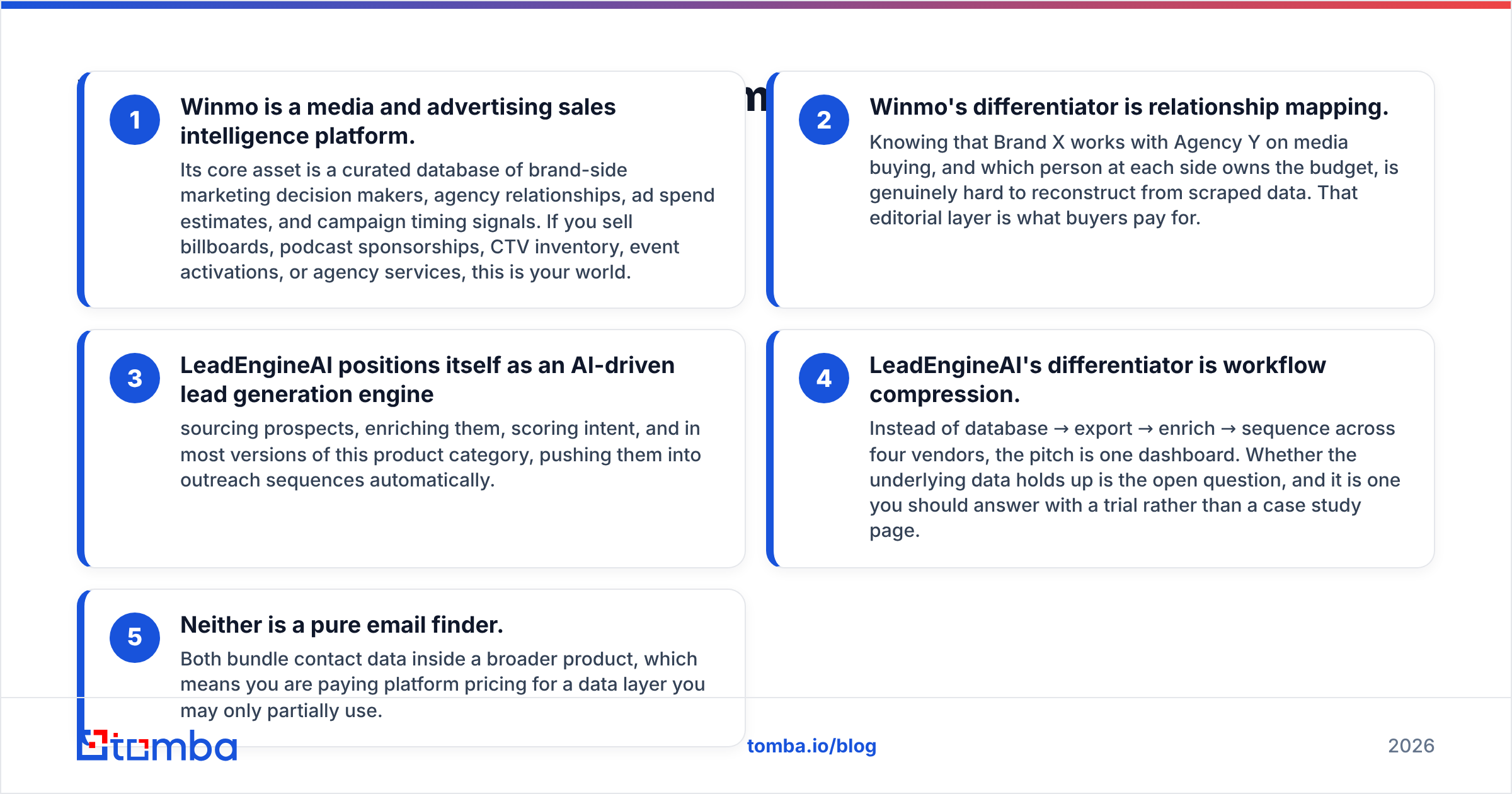
- Winmo is a media and ad sales intelligence platform. Its core asset is a curated database of brand-side marketing decision makers. It also tracks agency ties, ad spend estimates, and campaign timing. Sell billboards, podcast slots, CTV inventory, or agency services? This is your world.
- Winmo's edge is relationship mapping. It shows which agency a brand works with, and who owns the budget on each side. Scraped data rarely gets that right.
- LeadEngineAI is an AI-driven lead engine. It sources prospects, enriches them, and scores intent. Most tools in this category also push contacts into outreach sequences.
- LeadEngineAI's edge is speed. The old path runs database, export, enrich, then sequence across four vendors. The pitch here is one dashboard.
- Neither one is a pure email finder. Both bundle contact data inside a bigger product. You pay platform prices for a data layer you may barely use.
One caution before we go deeper. LeadEngineAI has little independent coverage. I could not verify its credit limits or tier pricing from public sources. Treat every number below as "confirm on the demo call," not gospel. Winmo documents its scope on winmo.com. Read user reviews on G2 before you commit.
LeadEngineAI vs Winmo: head-to-head comparison#
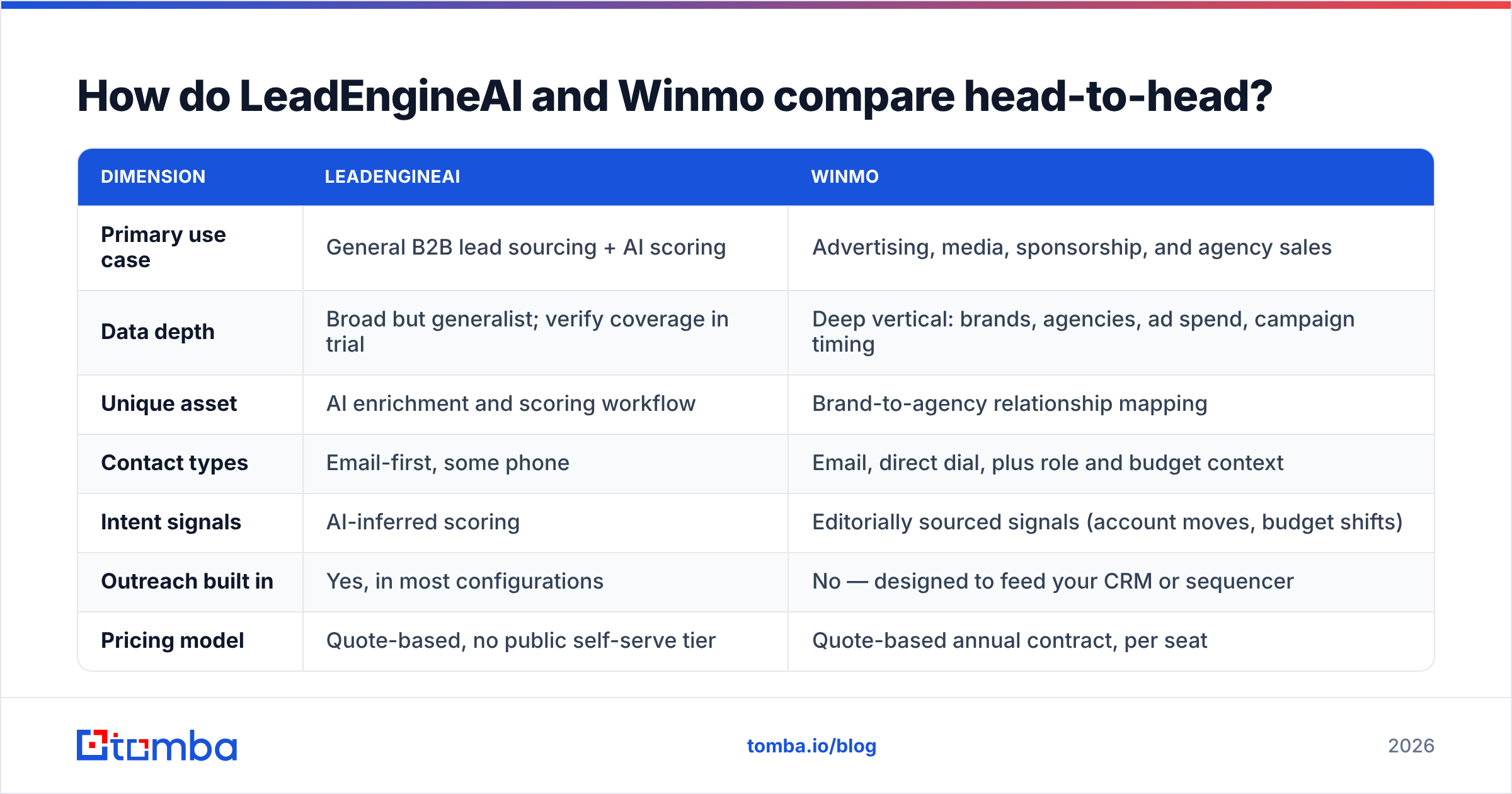
| Dimension | LeadEngineAI | Winmo |
|---|---|---|
| Primary use case | General B2B lead sourcing + AI scoring | Advertising, media, sponsorship, and agency sales |
| Data depth | Broad but generalist; verify coverage in trial | Deep vertical: brands, agencies, ad spend, campaign timing |
| Unique asset | AI enrichment and scoring workflow | Brand-to-agency relationship mapping |
| Contact types | Email-first, some phone | Email, direct dial, plus role and budget context |
| Intent signals | AI-inferred scoring | Editorially sourced signals (account moves, budget shifts) |
| Outreach built in | Yes, in most configurations | No — designed to feed your CRM or sequencer |
| Pricing model | Quote-based, no public self-serve tier | Quote-based annual contract, per seat |
| Free trial | Demo-gated; confirm availability | Demo-gated |
| Best for | Generalist SDR teams wanting one dashboard | Media sellers who need to know who owns the budget |
| Weakest for | Niche verticals needing editorial accuracy | Anyone selling outside marketing and advertising |
The table shows the split clearly. Winmo is narrow and deep. LeadEngineAI is wide and automated. In the LeadEngineAI vs Winmo choice, both are rarely right. Often neither one is.

Is Winmo worth it if you do not sell ads?#
Short answer: no.
Winmo pays off in one clear case. You sell to a brand's marketing team, or to the agency behind it. Your deal hinges on who owns the budget and when the campaign lands. A regional radio group. A sponsorship team at a sports property. A studio pitching brand content. An agency selling retainers. In those accounts, the relationship map can pay for itself in one closed deal.
Outside that pattern, you buy a premium vertical database to do generic work. Say your ICP is "SaaS firms with 50 to 500 staff." Or "manufacturing ops directors in the Midwest." Winmo's research depth will not help you. You pay for pages you never open. A general B2B database with good company filters covers that need for far less.
Contract shape is the second issue. Winmo sells annual, per-seat deals through a sales team. That is fine for five full-time media sellers. It hurts when you only wanted to test a channel for a quarter.
Is LeadEngineAI accurate enough for cold outreach?#
This question decides the tool. You have to answer it yourself.
AI-first platforms share a common flaw. The AI layer looks great. The data layer is often licensed or scraped from sources that feed a dozen rivals. A scoring model can be sharp while the emails are eighteen months old. Demos hide this, because demos use hand-picked accounts.
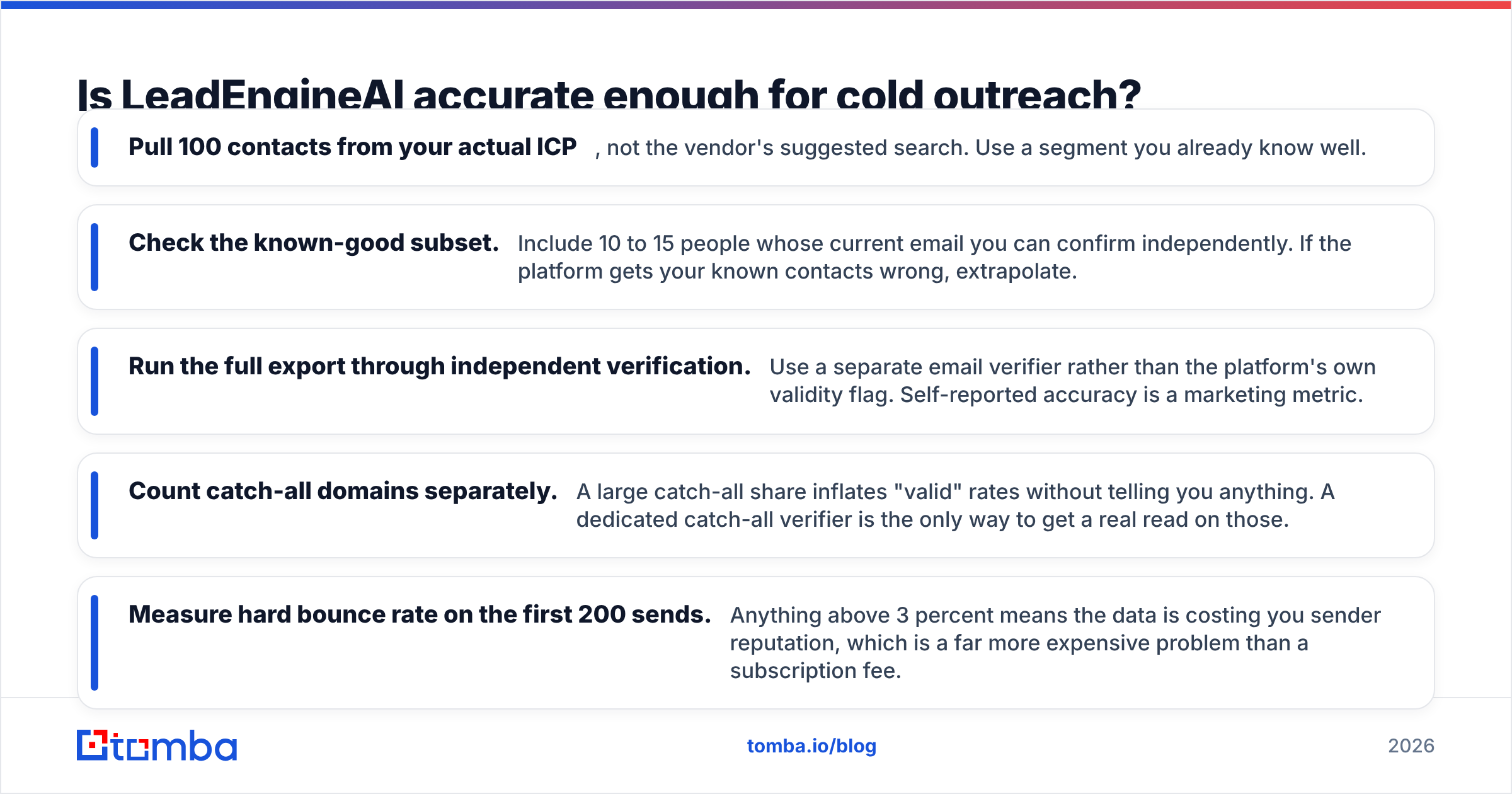
Run this test during any trial. It takes about twenty minutes:
- Pull 100 contacts from your real ICP. Skip the vendor's suggested search. Use a segment you know well.
- Include a known-good subset. Add 10 to 15 people whose current email you can confirm on your own. If the tool misses those, assume the rest are worse.
- Check the full export yourself. Use a separate email verifier, not the platform's own valid flag. Self-reported accuracy is a marketing number.
- Count catch-all domains on their own. A big catch-all share inflates "valid" rates. A catch-all verifier gives you a real read.
- Track hard bounces on the first 200 sends. Above 3 percent, the data is burning your sender reputation. That costs far more than a subscription.
Pass that test, and the AI layer is a real convenience. Fail it, and the AI layer is a nicer skin over a worse list.
LeadEngineAI vs Winmo pricing: what does each one cost?#
Neither vendor posts self-serve pricing. That is a data point on its own. Quote-based pricing moves with seat count, term length, and your negotiating position. It also means you cannot start on Monday.
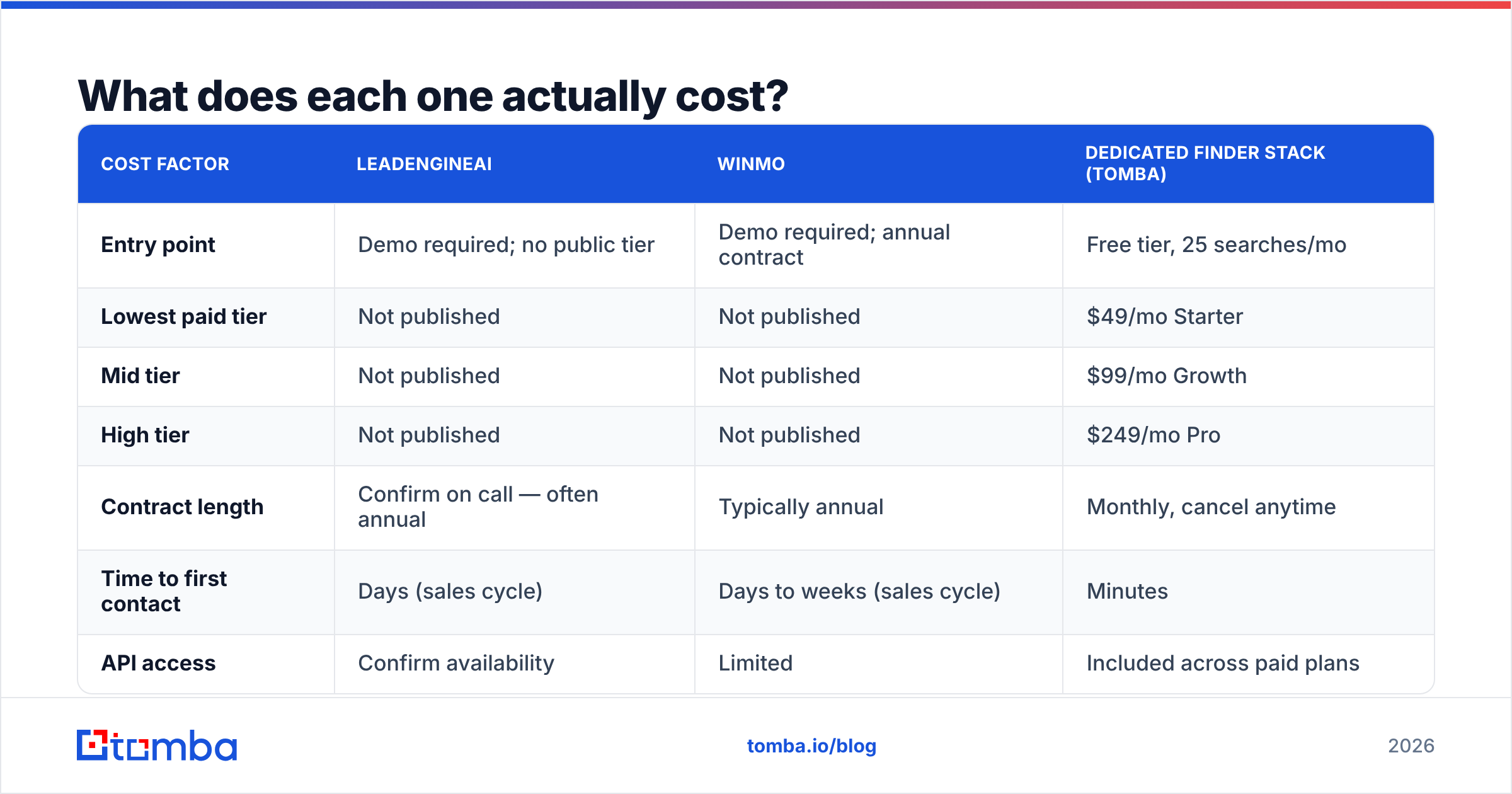
| Cost factor | LeadEngineAI | Winmo | Dedicated finder stack (Tomba) |
|---|---|---|---|
| Entry point | Demo required; no public tier | Demo required; annual contract | Free tier, 25 searches/mo |
| Lowest paid tier | Not published | Not published | $49/mo Starter |
| Mid tier | Not published | Not published | $99/mo Growth |
| High tier | Not published | Not published | $249/mo Pro |
| Contract length | Confirm on call — often annual | Typically annual | Monthly, cancel anytime |
| Time to first contact | Days (sales cycle) | Days to weeks (sales cycle) | Minutes |
| API access | Confirm availability | Limited | Included across paid plans |
The right-hand column is not a claim that Tomba does Winmo's job. It does not. Tomba has no ad-spend data and no agency map. The point is narrower. Say the job is "get correct, current emails for people at companies I already picked." Then platform pricing buys a lot of capability you never touch. Exact tiers sit on the Tomba pricing page, not behind a call.

LeadEngineAI vs Winmo: which one should you pick?#
Work back from what stalls your pipeline.
Pick Winmo if your reps pitch the wrong person. Or they pitch the right person three months too late. That is a timing and org-chart problem. Winmo's team builds for exactly that. One or two saved cycles per rep can cover the cost in high-ACV media sales.
Pick LeadEngineAI if tool sprawl is your bottleneck. You pay for a database, an enrichment vendor, and a sequencer. The handoffs between them eat a day a week. Merging them has real value. Check data quality first with the twenty-minute test above.
Pick neither if you already know your target accounts and just need contact data. This is the most common case, and the most over-solved. A domain search maps the contacts at a known company. Data enrichment fills in titles and profiles. Verify before you send. No procurement cycle needed.
Pick both if you sell into marketing teams and also need volume elsewhere. Use Winmo for the named-account motion. Use a cheap finder-and-verifier layer for the rest. Splitting by motion beats forcing one platform to cover both.
How do you protect deliverability with either list?#
This part is tool-agnostic. It matters more than the LeadEngineAI vs Winmo decision itself.
Every database decays. People change jobs. Companies rebrand domains. Role-based inboxes get shut off. Industry estimates put B2B contact decay near 20 to 30 percent a year. It hits the senior titles you most want to reach. HubSpot has written at length about the cost: bounces, spam complaints, and a sender score that takes months to rebuild.
Three habits protect you, whichever tool you buy:
- Verify at send time, not export time. A list checked in January and mailed in April is an unchecked list. Re-check anything older than 30 days.
- Keep catch-all domains separate. Do not mix them into your main send. Warm them up on their own, or move them to LinkedIn.
- Cap daily volume per mailbox. No data quality fixes a robotic sending pattern. Bounces and volume spikes compound fast.
Running bulk imports from either platform? Push them through a bulk verify step first. It is the cheapest insurance in the stack.
What is the verdict on LeadEngineAI vs Winmo?#
Winmo wins in its vertical. It is a poor buy outside it. LeadEngineAI wins on workflow, but carries data risk you must clear in a trial. Both hide pricing behind a sales process. That adds weeks to a decision that should take days.
For most teams weighing LeadEngineAI vs Winmo, the platform is not the constraint. Contact accuracy is. Fix that layer first, and fix it cheaply. Then you will see whether you need a vertical database or an AI engine on top of one.
Start with the data layer. The Tomba Email Finder returns verified work emails by name, domain, or company. Your first 25 searches each month are free. Starter runs $49/mo. API access comes with every paid plan. Run your target account list through it this week. You may find the pipeline problem was never a platform problem.
Related guides#
// get started
Find, verify and enrich your first contacts today
Start on the free plan with 25 searches a month, then scale when your team is ready.
Free plan · No credit card required · GDPR & CCPA
// about the author