11 Best Leadfeeder Alternatives in 2026 (Tested & Priced)
Leadfeeder (now Dealfront) still identifies companies, not people. Here are 11 alternatives compared on match rate, pricing, and what you actually get in your CRM.
TL;DR
- Leadfeeder is now part of Dealfront after the 2022 Echobot merger. The product still works, but pricing moved up-market and the free "Lite" plan is capped at 7 days of data and 100 companies.
- Visitor identification tools tell you which company visited. None of them reliably tell you which person visited — that gap is where most teams stall out.
- The best replacement depends on what's broken: cost (Lead Forensics is worse, Albacross is cheaper), EU coverage (Dealfront is strong, most US tools are not), or turning company names into contactable people (that is an enrichment job, not a visitor-ID job).
- Expect 25-45% company match rates on B2B traffic in 2026 — not the 60%+ some vendors quote. Mobile traffic, VPNs, and residential ISPs eat the rest.
- Practical stack for most teams: one visitor-ID tool for the signal, plus an email finder to convert the account into named contacts you can actually email.
Why are people looking for Leadfeeder alternatives in 2026?#
Leadfeeder did one thing well for a decade: reverse-resolve the IP addresses hitting your website into company names, then push those into your CRM. It was cheap, it worked, and it was the default answer for "who is on my site?"
Three things changed.
First, the Dealfront merger. Leadfeeder combined with German data provider Echobot in 2022 and rebranded under the Dealfront umbrella. The visitor-ID product survived, but it now sits inside a broader GTM suite with suite-level pricing. Teams who paid €99/mo for a narrow tool found themselves quoted for a platform.
Second, match rates fell industry-wide. More traffic comes from phones on cellular networks. More employees work from home on residential ISPs that resolve to Comcast, not to their employer. Corporate VPNs mask origin entirely. Every IP-based vendor is fighting the same decay — anyone claiming 70% match on cold B2B traffic is measuring something other than unique company sessions.
Third, and most importantly: a company name is not a lead. Knowing that "Siemens" visited your pricing page three times is a signal, not a contact. Someone still has to figure out who in Siemens cares, find their email, and write to them. Tools that stop at the company name hand you homework.
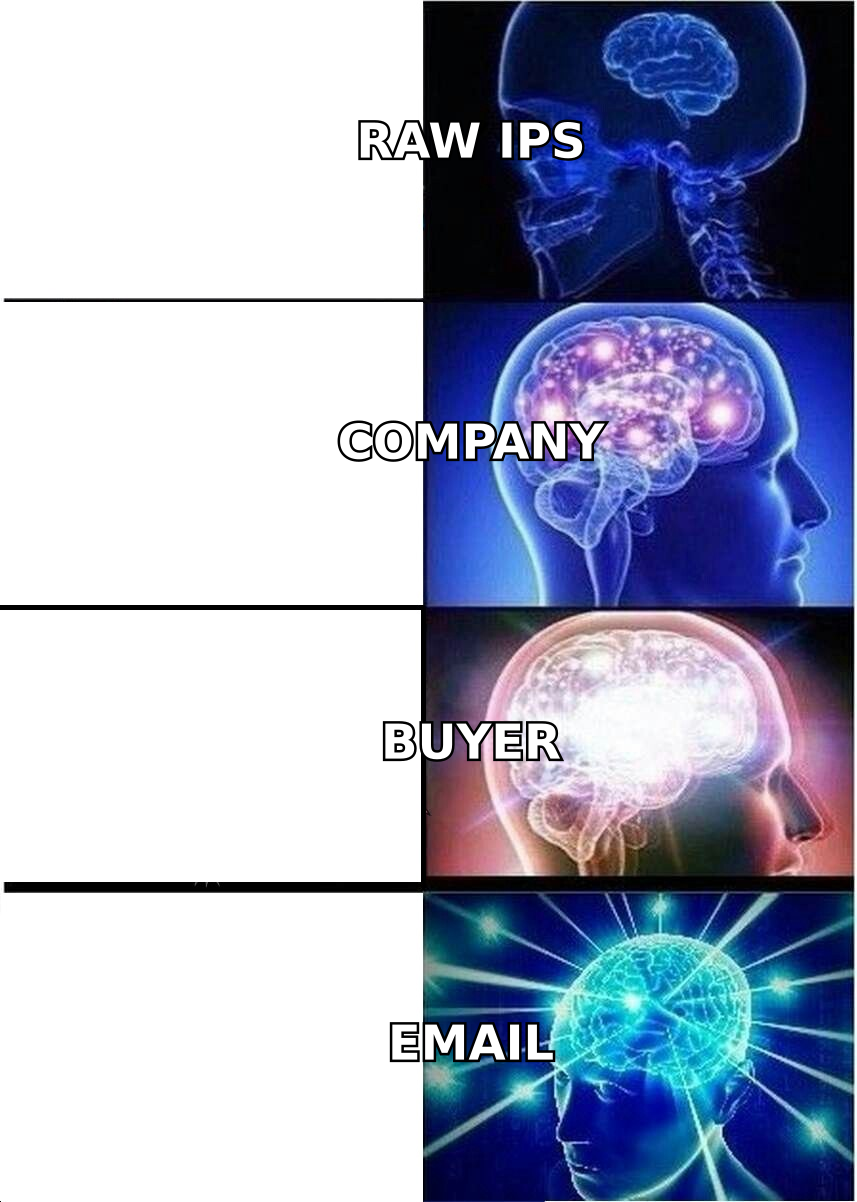
That third point reframes the whole category. When you evaluate Leadfeeder alternatives, you are really evaluating two separate jobs — detection and activation — and most vendors are only good at one.
What does Leadfeeder actually cost now?#
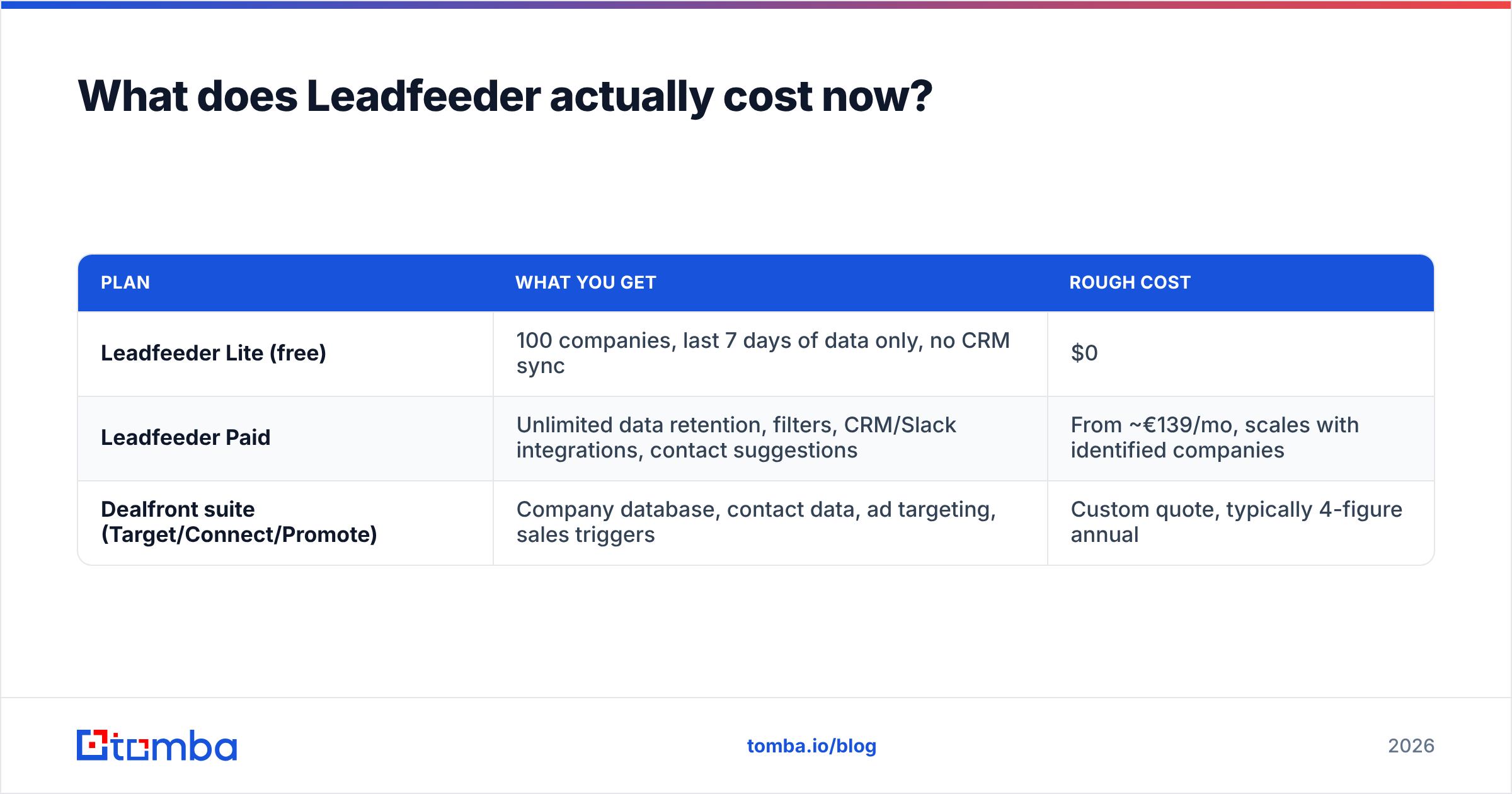
Dealfront publishes a free tier and a paid tier, with everything beyond that quoted by sales.
| Plan | What you get | Rough cost |
|---|---|---|
| Leadfeeder Lite (free) | 100 companies, last 7 days of data only, no CRM sync | $0 |
| Leadfeeder Paid | Unlimited data retention, filters, CRM/Slack integrations, contact suggestions | From ~€139/mo, scales with identified companies |
| Dealfront suite (Target/Connect/Promote) | Company database, contact data, ad targeting, sales triggers | Custom quote, typically 4-figure annual |
The gotcha is that paid pricing scales with the number of companies identified per month. A traffic spike from a good content quarter raises your bill. Budget on your best month, not your average.
What are the best Leadfeeder alternatives?#
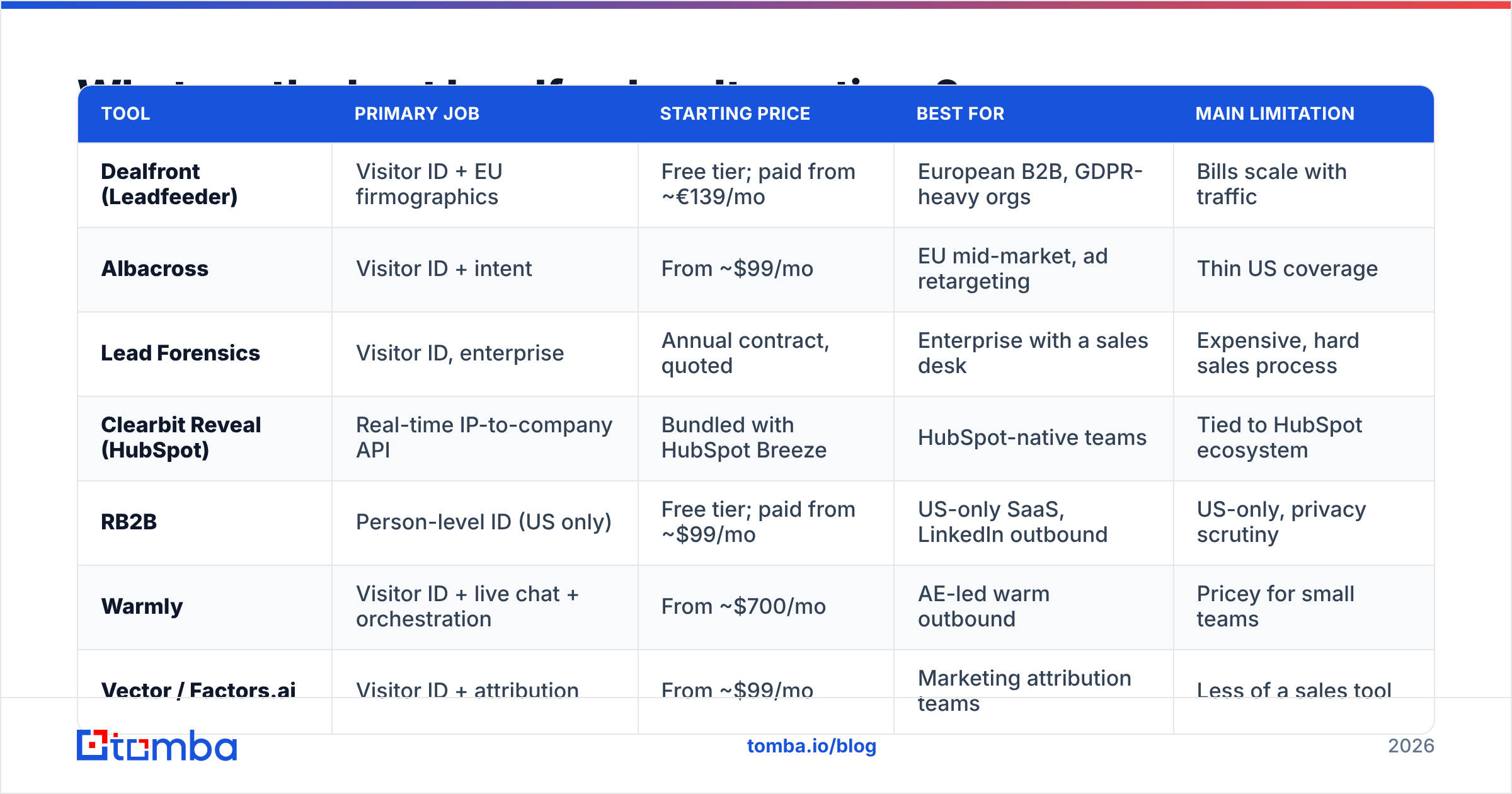
Here is the honest landscape, grouped by what each tool is actually for.
| Tool | Primary job | Starting price | Best for | Main limitation |
|---|---|---|---|---|
| Dealfront (Leadfeeder) | Visitor ID + EU firmographics | Free tier; paid from ~€139/mo | European B2B, GDPR-heavy orgs | Bills scale with traffic |
| Albacross | Visitor ID + intent | From ~$99/mo | EU mid-market, ad retargeting | Thin US coverage |
| Lead Forensics | Visitor ID, enterprise | Annual contract, quoted | Enterprise with a sales desk | Expensive, hard sales process |
| Clearbit Reveal (HubSpot) | Real-time IP-to-company API | Bundled with HubSpot Breeze | HubSpot-native teams | Tied to HubSpot ecosystem |
| RB2B | Person-level ID (US only) | Free tier; paid from ~$99/mo | US-only SaaS, LinkedIn outbound | US-only, privacy scrutiny |
| Warmly | Visitor ID + live chat + orchestration | From ~$700/mo | AE-led warm outbound | Pricey for small teams |
| Vector / Factors.ai | Visitor ID + attribution | From ~$99/mo | Marketing attribution teams | Less of a sales tool |
| Apollo.io | Contact database + sequences | Free tier; paid from $49/user/mo | All-in-one outbound | Data freshness varies |
| BookYourData | Verified B2B contact lists | Pay-as-you-go credits | Buying a clean, targeted list outright | List purchase, not live web signal |
| Tomba | Email finding + verification + enrichment | Free (25 searches); $49/mo Starter | Turning accounts into contactable people | Not a visitor-ID tool |
| Snitcher | Visitor ID + GA4 integration | From ~$49/mo | Analytics-first teams | Smaller data network |
Notice the split. Rows 1-7 detect. Rows 8-11 activate. A functioning pipeline needs both, and buying two focused tools usually beats buying one suite that does each job at 60%.
Which alternative fits which problem?#
1. You left because of price → Albacross or Snitcher#
Albacross is the closest like-for-like swap for European traffic. Similar IP resolution network, cleaner UI, and it bundles first-party intent data plus an ad-targeting layer. If your Leadfeeder bill crept past €300/mo, get a quote here first.
Snitcher is the budget option. Entry pricing is genuinely low, it pipes identified companies straight into GA4 as a custom dimension, and the CRM integrations cover the basics. The data network is smaller than Dealfront's, so expect a lower match rate — but you're paying a fraction of the price for it.
2. You need person-level identity → RB2B (with caveats)#
RB2B resolves a slice of US traffic to named individuals with LinkedIn profiles and work emails, pushed into Slack in near real time. When it hits, it's the single strongest signal in this category.
The caveats are real: US-only, coverage is a minority of sessions, and person-level web tracking sits in contested privacy territory. Check with legal before deploying it on EU or UK traffic — under GDPR, resolving an anonymous visitor to a named person without consent is a hard problem, not a paperwork problem.
3. You live in HubSpot → Clearbit Reveal#
HubSpot acquired Clearbit and folded Reveal into its data layer. If your CRM is HubSpot, this is the lowest-friction option: company data appears on records automatically, no separate tool to log into. HubSpot's own documentation covers the enrichment behavior per tier. The tradeoff is lock-in — you can't take it with you.
4. You want warm outbound orchestrated → Warmly#
Warmly stacks visitor ID with live chat, AI SDR prompts, and routing so an AE gets pinged while the prospect is still on the page. It is genuinely good at converting a session into a conversation. It is also the most expensive option on this list for what most teams will use. Worth it if you have AEs sitting ready; wasted if the alerts pile up unread.
5. You need people, not companies → enrichment, not visitor ID#
This is the category most buyers land in without realizing it. You already know which accounts are interested. What you lack is a name and a verified address to write to.
That is a data enrichment and email finder problem. Feed a company domain into a domain search, pull the people in the relevant department, verify the addresses, and you have an outbound list built from real intent instead of a static ICP filter.

How accurate are visitor identification tools really?#
Set expectations before you sign anything.
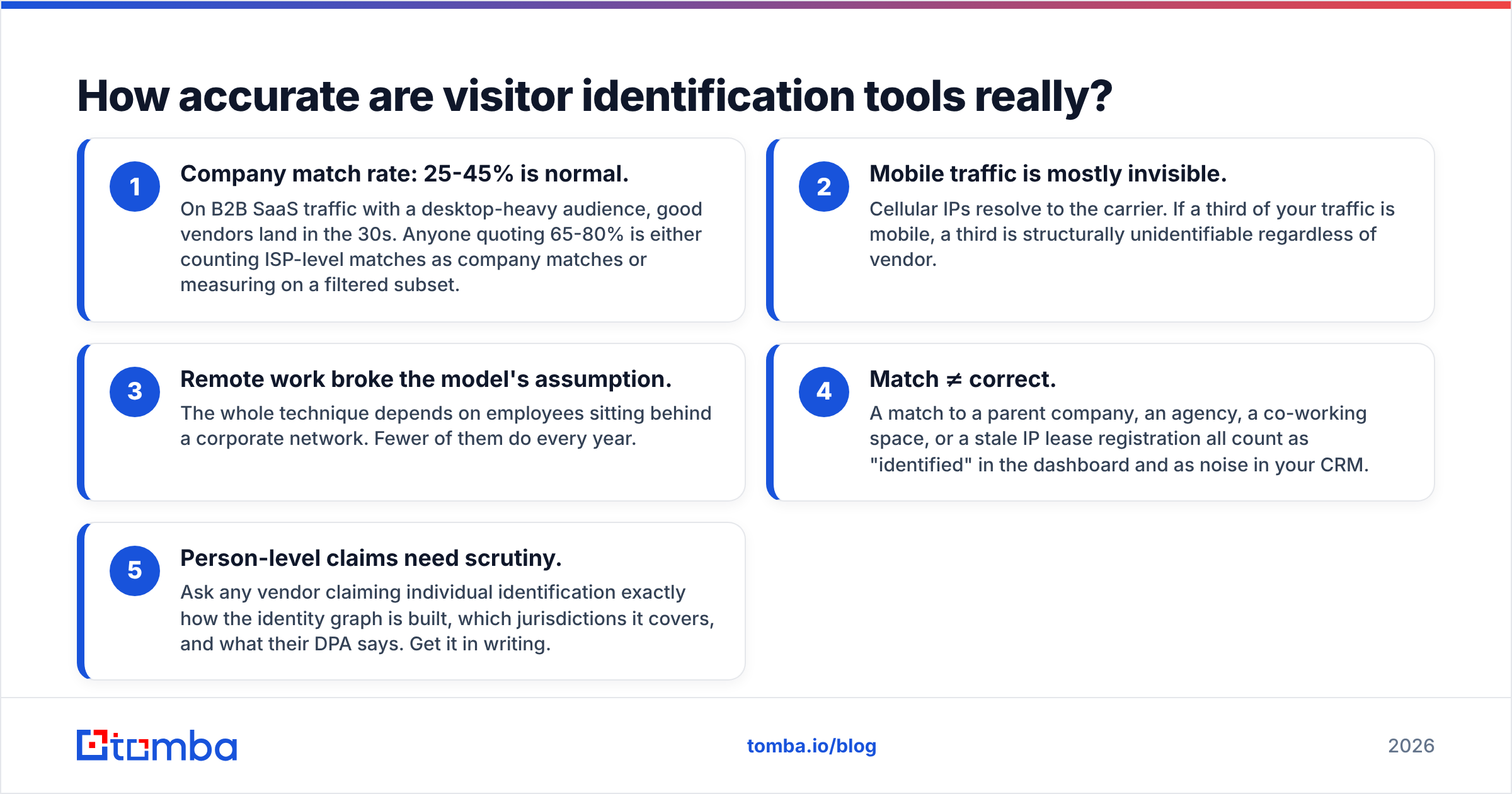
- Company match rate: 25-45% is normal. On B2B SaaS traffic with a desktop-heavy audience, good vendors land in the 30s. Anyone quoting 65-80% is either counting ISP-level matches as company matches or measuring on a filtered subset.
- Mobile traffic is mostly invisible. Cellular IPs resolve to the carrier. If a third of your traffic is mobile, a third is structurally unidentifiable regardless of vendor.
- Remote work broke the model's assumption. The whole technique depends on employees sitting behind a corporate network. Fewer of them do every year.
- Match ≠ correct. A match to a parent company, an agency, a co-working space, or a stale IP lease registration all count as "identified" in the dashboard and as noise in your CRM.
- Person-level claims need scrutiny. Ask any vendor claiming individual identification exactly how the identity graph is built, which jurisdictions it covers, and what their DPA says. Get it in writing.
A useful test during any trial: pick 20 identified companies, check them against your analytics referrer and page-path data, and see how many are plausibly real prospects rather than bots, agencies, or your own vendors. That number is your true match rate.
How do you turn identified accounts into actual pipeline?#
Detection is the cheap half. Here's the workflow that converts signal to replies.
Step 1 — Filter hard. Not every identified company is a prospect. Filter to ICP fit, minimum session depth (two pages or more), and high-intent pages: pricing, comparison, integrations, careers if you sell to fast-growing teams.
Step 2 — Pick the right people. For each surviving account, decide which two or three roles matter. A pricing-page visit at a 200-person company usually means a manager researching, not the CFO.
Step 3 — Find and verify the addresses. Run the domain through a bulk email finder to pull role-matched contacts, then push them through an email verifier before anything sends. Unverified lists are how good domains end up in spam folders — bounce rate is the fastest way to wreck sender reputation.
Step 4 — Reference the signal without being creepy. "I saw you on our pricing page Tuesday at 3:14pm" reads as surveillance. "Noticed some interest from your team in X — worth a quick note" reads as normal. The signal should shape your timing and your angle, not your opening line.
Step 5 — Route it through your CRM. Whatever tool you pick, the identified account should land in the same place your reps already work. Both HubSpot and Salesforce integrations exist across most vendors here; confirm the field mapping before you commit.
If you want to skip live detection entirely and just buy a targeted, verified list for a defined segment, BookYourData is a solid pay-as-you-go option — different motion, same destination, and useful when your traffic volume is too low for visitor ID to produce meaningful signal in the first place.
Is a visitor-ID tool even worth it for your team?#
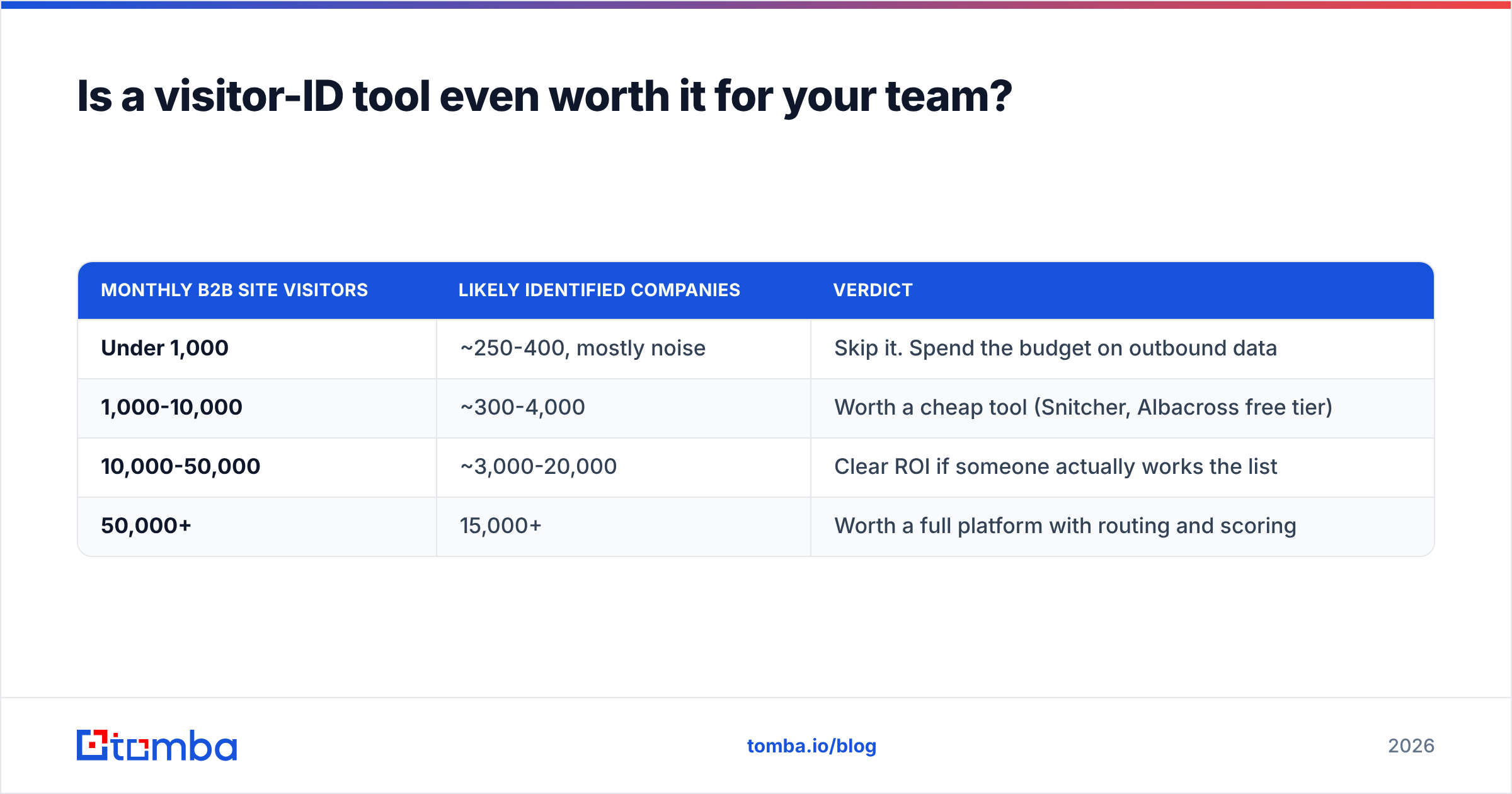
Honest answer: it depends almost entirely on traffic volume.
| Monthly B2B site visitors | Likely identified companies | Verdict |
|---|---|---|
| Under 1,000 | ~250-400, mostly noise | Skip it. Spend the budget on outbound data |
| 1,000-10,000 | ~300-4,000 | Worth a cheap tool (Snitcher, Albacross free tier) |
| 10,000-50,000 | ~3,000-20,000 | Clear ROI if someone actually works the list |
| 50,000+ | 15,000+ | Worth a full platform with routing and scoring |
The second column is the part vendors gloss over. A list nobody works is a subscription, not a strategy. Before renewing Leadfeeder or buying a replacement, check how many opportunities last quarter actually traced back to a visitor-ID alert. If the answer is zero, the tool isn't the problem — the follow-up process is.
What should you check before you switch?#
Run every shortlisted vendor through the same five questions:
- Data origin. Where does the IP-to-company mapping come from, and how often is it refreshed? Vendors with their own network beat vendors reselling one.
- Geographic fit. EU-heavy traffic favors Dealfront and Albacross. US-heavy favors Clearbit and RB2B. Test on your actual traffic, not a demo dataset.
- Contract shape. Monthly vs annual, and whether overages are billed or throttled. Lead Forensics in particular is known for annual commitments — read before signing.
- Real integration depth. "Has a HubSpot integration" can mean full bidirectional sync or a webhook that creates a note. Ask which.
- Exit cost. Can you export identified companies with their visit history, or does the data die with the subscription?
Reviews on G2 are useful for the contract-and-support half of this, less so for match-rate claims — those are self-reported by happy customers on favorable traffic.
The practical setup most teams land on#
After all the comparison, the stack that works for a typical 10-50 person B2B company is unglamorous:
- One affordable visitor-ID tool for the signal — Albacross or Snitcher unless you have a specific reason to pay more.
- A hard filter so only ICP-fit, multi-page, high-intent accounts reach a human.
- An email finder and verifier to convert those accounts into named, deliverable contacts.
- A CRM task, owned by a named person, with an SLA measured in hours.
Step 3 is where most of the value is created and where most teams underinvest. You can have perfect detection and still generate zero pipeline if nobody can find the buyer's email address.
Ready to turn identified accounts into people you can actually email? Tomba's Email Finder takes a company domain and returns role-matched, verified professional emails — with a free tier at 25 searches/month and paid plans starting at $49/mo. See the full Tomba pricing breakdown, or start with the free tier and run it against last month's visitor list to see how many real contacts were sitting behind those company names.
Related guides#
// get started
Find, verify and enrich your first contacts today
Start on the free plan with 25 searches a month, then scale when your team is ready.
Free plan · No credit card required · GDPR & CCPA
// about the author