Leadforce Pricing, Reviews, Pros and Cons: 2026 Breakdown
Leadforce sells on demos, not price cards. Here's what buyers actually report paying, where the contract gets expensive, and when a flat-rate data tool beats it.
TL;DR
- Leadforce does not publish a full self-serve price card. Almost every plan is quoted after a discovery call, which means your price depends on seat count, data volume, and how well you negotiate.
- Buyers typically report entry contracts in the low four figures annually, with mid-market deals landing in the $6,000–$15,000/year range once seats, intent data, and enrichment credits are stacked.
- The strongest reviews praise the intent signals and the done-for-you feel. The harshest ones hit annual lock-in, credit rollover rules, and data accuracy that varies sharply by region.
- If you need contact data more than you need a platform, a flat-rate tool like Tomba (free tier, then $49/mo) does the finding-and-verifying job at a fraction of the contract value.
- Run a 200-contact bounce test against any vendor before you sign anything longer than a month. It is the only number that settles the argument.
What is Leadforce, and who is it actually for?#
Leadforce sits in the "lead generation platform" bucket rather than the "point tool" bucket. The pitch is that it combines company and contact data, buying-intent signals, and some degree of campaign or routing automation into one subscription, so a small revenue team can skip stitching four tools together.
That positioning matters more than any feature list, because it explains the pricing model. Point tools — an email finder, a verifier, a dialer — compete on a public number you can compare in thirty seconds. Platforms compete on a business case delivered by a rep on a Zoom call. Leadforce is firmly in the second camp.
The buyers who get the most out of it look like this:
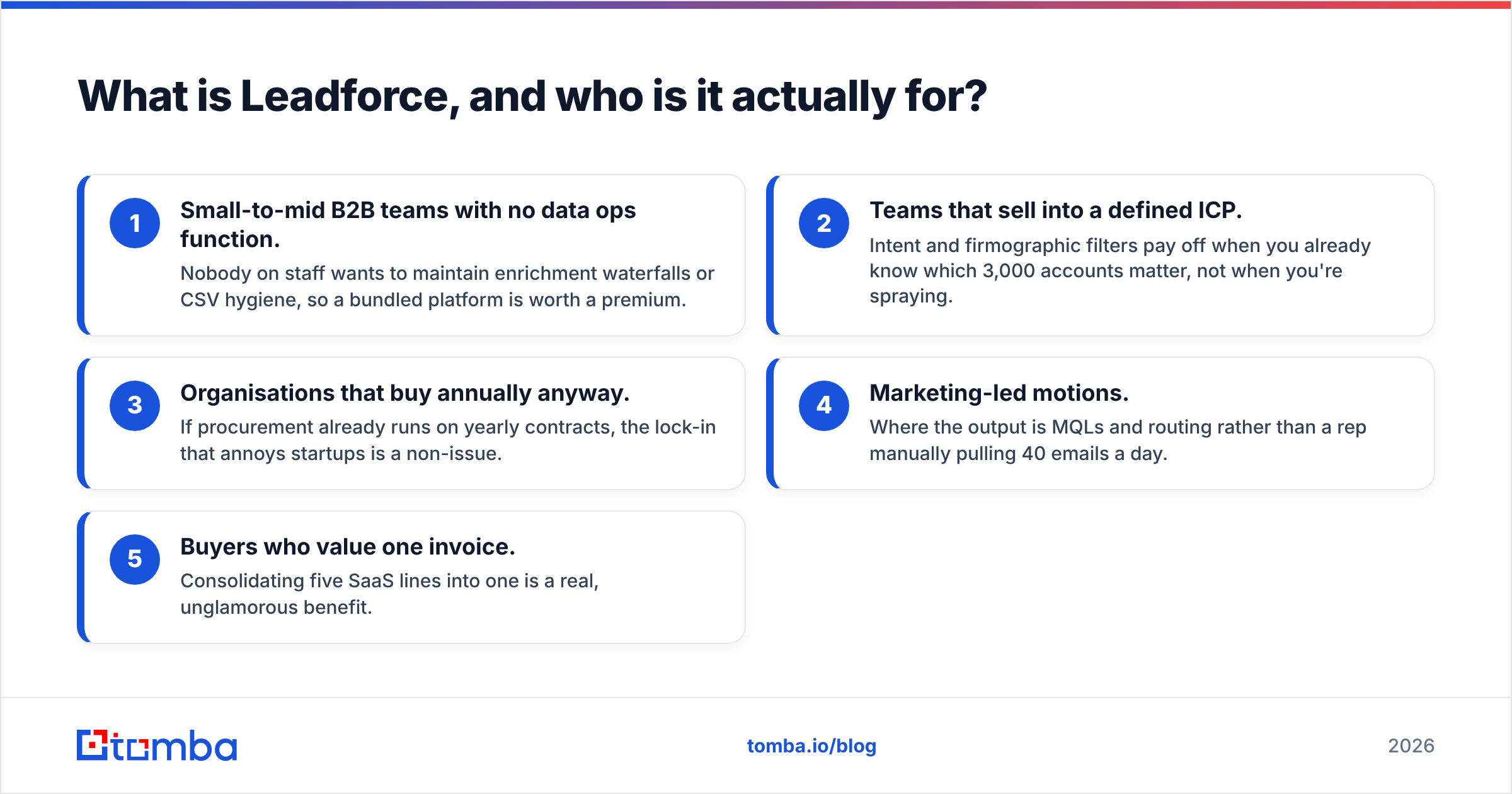
- Small-to-mid B2B teams with no data ops function. Nobody on staff wants to maintain enrichment waterfalls or CSV hygiene, so a bundled platform is worth a premium.
- Teams that sell into a defined ICP. Intent and firmographic filters pay off when you already know which 3,000 accounts matter, not when you're spraying.
- Organisations that buy annually anyway. If procurement already runs on yearly contracts, the lock-in that annoys startups is a non-issue.
- Marketing-led motions. Where the output is MQLs and routing rather than a rep manually pulling 40 emails a day.
- Buyers who value one invoice. Consolidating five SaaS lines into one is a real, unglamorous benefit.
If you are a two-person outbound team that needs 3,000 verified emails a month and nothing else, you are outside that list — and you will feel it on the invoice.
How does Leadforce pricing actually work in 2026?#
Short answer: it is quote-based, and the published figures you find online are directional at best.
Leadforce, like most platforms in this category, gates pricing behind a demo. That is a deliberate choice, not an oversight. Quote-based pricing lets a vendor charge a 20-seat enterprise five times what it charges a 4-seat agency for the same software, and it makes apples-to-apples comparison shopping deliberately hard. Review aggregators such as G2 and Capterra are usually the best public source for what buyers report paying, and even there the numbers scatter widely.
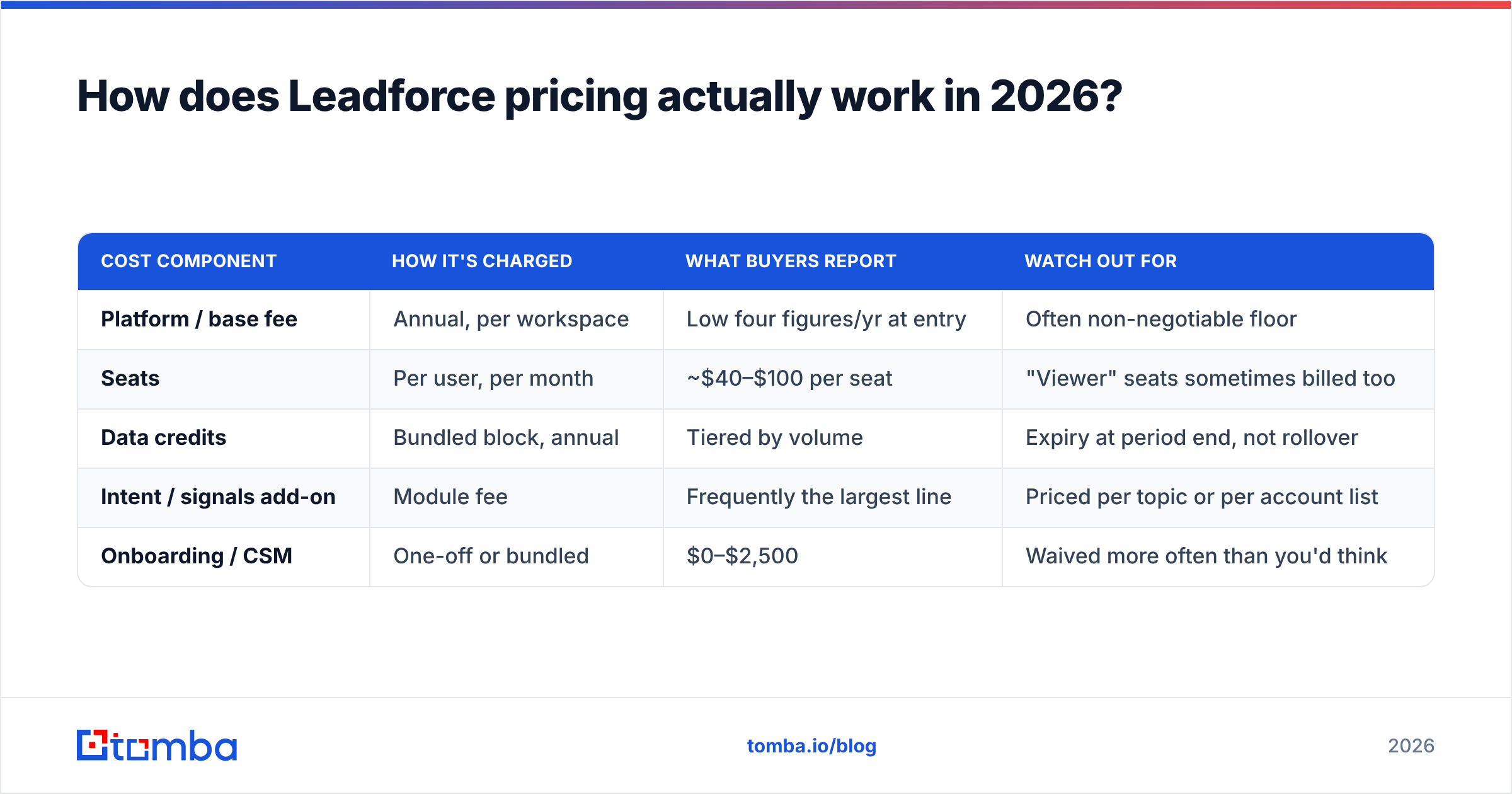
From what buyers report, the cost stack breaks into five parts:
| Cost component | How it's charged | What buyers report | Watch out for |
|---|---|---|---|
| Platform / base fee | Annual, per workspace | Low four figures/yr at entry | Often non-negotiable floor |
| Seats | Per user, per month | ~$40–$100 per seat | "Viewer" seats sometimes billed too |
| Data credits | Bundled block, annual | Tiered by volume | Expiry at period end, not rollover |
| Intent / signals add-on | Module fee | Frequently the largest line | Priced per topic or per account list |
| Onboarding / CSM | One-off or bundled | $0–$2,500 | Waived more often than you'd think |
Two structural details do more damage to budgets than the headline number:
Credits usually expire. If your annual block resets each period rather than rolling over, a slow Q3 is money burned. Ask explicitly, and ask for it in the order form, not the email thread.
Seat minimums move the real price. A platform quoted at "$X per user" with a five-seat minimum costs 5X even if three people log in. For a team of three, that is a 66% overpay on day one.

What do Leadforce reviews say about value for money?#
Review sentiment on quote-based platforms follows a reliable shape, and Leadforce fits it.
The positive reviews cluster around time saved. Teams that previously ran a list-building process across three tabs describe a real reduction in manual work, and the intent layer gets specific praise when the ICP is narrow. Reviewers who came from spreadsheets are the happiest cohort by a distance.
The critical reviews cluster around three things:
- Data accuracy varies by geography. North American coverage is consistently rated stronger than EMEA and APAC. If you sell into Germany, the Nordics, or Southeast Asia, treat any accuracy claim as unproven until you test it on your own list.
- Contract flexibility is limited. Mid-term downgrades are rare, and several reviewers mention auto-renewal clauses that needed a written cancellation window. Diary the notice date the day you sign.
- Support quality tracks contract size. Small accounts report slower response times than enterprise accounts on the same product. That is normal across the category; it is still worth knowing before you budget.
The fair summary: reviewers rarely say the product is bad. They say the price is hard to predict and hard to exit. That is a pricing complaint dressed as a product complaint, and it is exactly the thing a pricing review should surface.
What are the pros of Leadforce?#
- Consolidation. One contract instead of a data tool, an intent tool, and an enrichment tool. Fewer integrations to babysit, one renewal to manage.
- Intent signals included. Buying signals normally sit in a separate, expensive contract. Bundling them is genuine value if you'll actually action them.
- Guided onboarding. Quote-based vendors typically assign a human to your launch. For teams with no RevOps function, that shortens time-to-first-campaign meaningfully.
- Negotiable. The flip side of opaque pricing is that it bends. Multi-year commitments, end-of-quarter timing, and case-study participation all move the number.
- Enterprise hygiene. SSO, role permissions, and audit trails tend to come standard on platforms, which matters once procurement or security gets involved.
What are the cons of Leadforce?#
- No self-serve trial of the real thing. You cannot validate data quality on your own domain list before a sales conversation. That is the single biggest cost of quote-based pricing.
- Annual commitment as the default. Monthly billing, when offered, usually carries a 20–30% premium — so the "flexible" option is priced to push you into the annual one.
- Credit expiry. Unused data credits typically vanish at the period boundary.
- Cost per verified contact is opaque. Because credits are bundled, the actual unit economics only become visible after a quarter of usage — by which point you're locked in.
- Overlap with tools you already own. If you already run a CRM with enrichment and a sequencer, you may be paying twice for the same rows.
How does Leadforce pricing compare to the alternatives?#
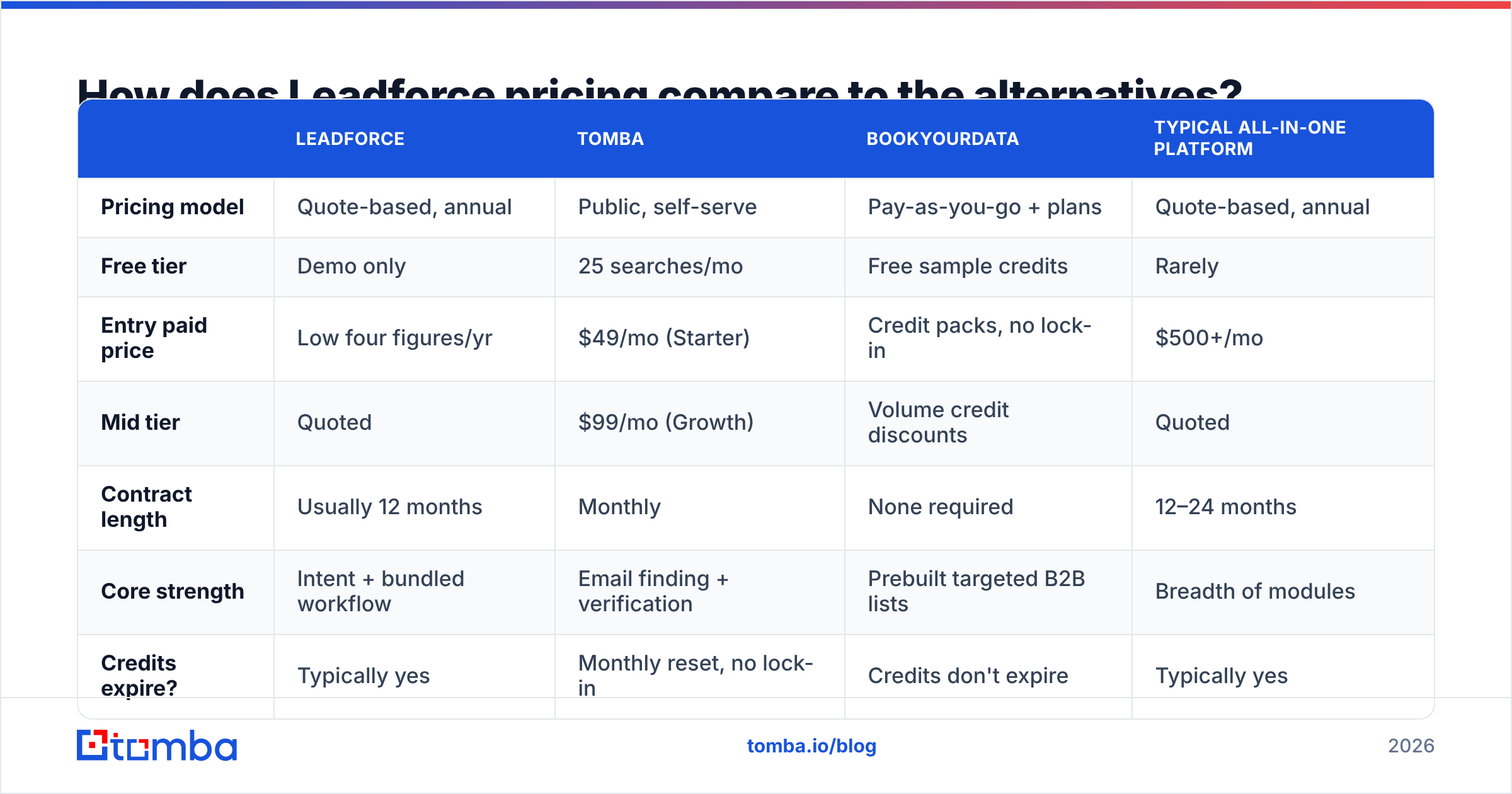
Here is the honest comparison. The point is not that one tool wins — it is that these products are priced for different jobs, and buying the wrong shape is what wastes money.
| Leadforce | Tomba | BookYourData | Typical all-in-one platform | |
|---|---|---|---|---|
| Pricing model | Quote-based, annual | Public, self-serve | Pay-as-you-go + plans | Quote-based, annual |
| Free tier | Demo only | 25 searches/mo | Free sample credits | Rarely |
| Entry paid price | Low four figures/yr | $49/mo (Starter) | Credit packs, no lock-in | $500+/mo |
| Mid tier | Quoted | $99/mo (Growth) | Volume credit discounts | Quoted |
| Contract length | Usually 12 months | Monthly | None required | 12–24 months |
| Core strength | Intent + bundled workflow | Email finding + verification | Prebuilt targeted B2B lists | Breadth of modules |
| Credits expire? | Typically yes | Monthly reset, no lock-in | Credits don't expire | Typically yes |
| API access | Add-on / higher tiers | Included, documented | Available | Higher tiers |
| Best for | Marketing-led ICP plays | Outbound teams needing accurate contacts | Buying a clean list fast | Large RevOps orgs |
Three takeaways from that table.
If your bottleneck is contact data, buy a data tool. Tomba's pricing is public precisely because it competes on a number: free for 25 searches a month, $49/mo Starter, $99/mo Growth, $249/mo Pro, custom above that. You can test it this afternoon without a calendar invite.
If your bottleneck is a list, buy a list. BookYourData is a strong option here — pay-as-you-go credits that don't expire, with prebuilt targeting. For a one-off campaign into a defined segment, that beats committing to twelve months of platform.
If your bottleneck is process, a platform can be worth it. Leadforce's value case is real when the alternative is three tools plus a contractor to glue them together. Just make sure the intent module is something you'll operationalise, not a line item you admire.
Is Leadforce worth it for your team?#
Work the decision from cost-per-usable-contact, not from the subscription price.
Take the annual quote, divide by the number of contacts you will actually reach in a year, then divide again by the share that turn out deliverable. A $9,000 contract producing 20,000 contacts at 80% deliverability costs $0.56 per usable contact. The same 20,000 contacts through a $99/mo plan costs about $0.06 — but that plan gives you no intent data, no routing, and no CSM. Whether the ten-times premium is justified depends entirely on whether you use the other nine-tenths of the platform.
A quick gut check:
- Count the tools it replaces. Fewer than two? The bundle math doesn't work.
- Count who logs in weekly. Fewer than the seat minimum? You're subsidising empty chairs.
- Check your target geography. Heavily non-US? Demand a regional accuracy test before signing.
- Check your volume curve. Spiky campaigns punish expiring credits; steady volume rewards them.
- Check your exit. If you can't downgrade mid-term, price the worst case, not the plan.
What should you test before you sign anything?#
Do this regardless of vendor. It takes an afternoon and it has saved buyers more money than any negotiation tactic.
- Run a 200-row bounce test. Take 200 real target accounts, pull contacts from each vendor, then push them through an independent email verifier and compare valid rates side by side. Vendor-reported accuracy is a marketing number; your bounce rate is a fact.
- Test your worst segment, not your best. Everyone looks good on US SaaS mid-market. Test the vertical where you struggle.
- Ask for the API docs before purchase. If the email finder API or equivalent is gated behind a higher tier, that changes your real price.
- Get credit rollover, cancellation notice, and seat minimums in writing. All three are negotiable. None of them are negotiable after signature.
- Ask what happens to your data on churn. Exportable? Retained? This is a GDPR question as much as a commercial one, and lead generation compliance obligations follow the data, not the vendor.
The verdict on Leadforce pricing#
Leadforce is a reasonable buy for a marketing-led team that genuinely needs intent signals bundled with contact data and has the budget shape to absorb an annual contract. It is a poor buy for an outbound team whose actual problem is "I need verified email addresses for these 2,000 companies and I need them today."
The pricing model is the deciding factor more than the product is. Quote-based annual contracts transfer risk to the buyer: you commit before you can measure. Public, monthly pricing transfers it back: you measure, then commit. Neither is wrong, but you should know which trade you're making.
If your problem really is contact data, start where the risk is lowest. Tomba's Email Finder gives you 25 searches free — no demo, no call, no contract — so you can benchmark deliverability on your own target list before you let any platform quote you a number. Run the 200-row test, keep the receipts, and walk into the Leadforce demo knowing exactly what their data has to beat.
Related guides#
// get started
Find, verify and enrich your first contacts today
Start on the free plan with 25 searches a month, then scale when your team is ready.
Free plan · No credit card required · GDPR & CCPA
// about the author