LeadFuze vs LimeLeads: Which B2B Lead Database Wins in 2026?
LeadFuze sells AI-assisted list building on a subscription; LimeLeads sells pay-per-record contacts with preview-before-you-buy. We compare pricing, data freshness, verification and export limits to show which one fits your outbound motion.
LeadFuze vs LimeLeads is a choice between two billing models. One charges you every month for automated list building. The other charges you only for the records you export.
TL;DR
- LeadFuze is a subscription list-builder. You describe your ideal customer, its "Fuzebot" builds matching contact lists on autopilot, and you pay monthly for a lead allowance. Unused leads mostly do not roll over.
- LimeLeads is a pay-as-you-go contact database. You filter, preview the records for free, and spend credits only when you export. It is cheaper to test, but thinner on automation.
- Pick LeadFuze if you send at volume every week and want a list that refills itself. Pick LimeLeads if your buying is bursty and you hate paying for quiet months.
- Neither tool is a verification engine. Both ship lists that need a second check before you load them into a sending tool. Budget for that separately.
- Is your real problem "I have companies, I need correct emails"? Then a domain-first finder like Tomba costs less than either one, and it plugs into your stack through an API.
What are LeadFuze and LimeLeads, exactly?#
Both sell the same raw material: B2B contact records. They package it in opposite ways.
LeadFuze (leadfuze.com) is a lead-generation SaaS built around search personas. You set filters — industry, headcount, role, technology used, ad spend, hiring signals — and save them as a persona. Fuzebot then adds new matching contacts to a list on a schedule. Records include a work email, sometimes a mobile number, a LinkedIn URL, and company details. It pushes to HubSpot, Salesforce, Pipedrive and the usual sequencers, or exports a CSV.
LimeLeads (limeleads.com) is a leaner search-and-export database. You filter on industry, location, title, revenue and headcount. Then you see a preview of the matching records, with names and companies visible and emails hidden, before you spend anything. Credits are used on export, and they do not expire the way a monthly allowance does.
The split in philosophy matters more than any single feature. LeadFuze charges you for access over time. LimeLeads charges you for records you take. That one difference decides which tool wastes your money.

LeadFuze vs LimeLeads: how do they compare head-to-head?#
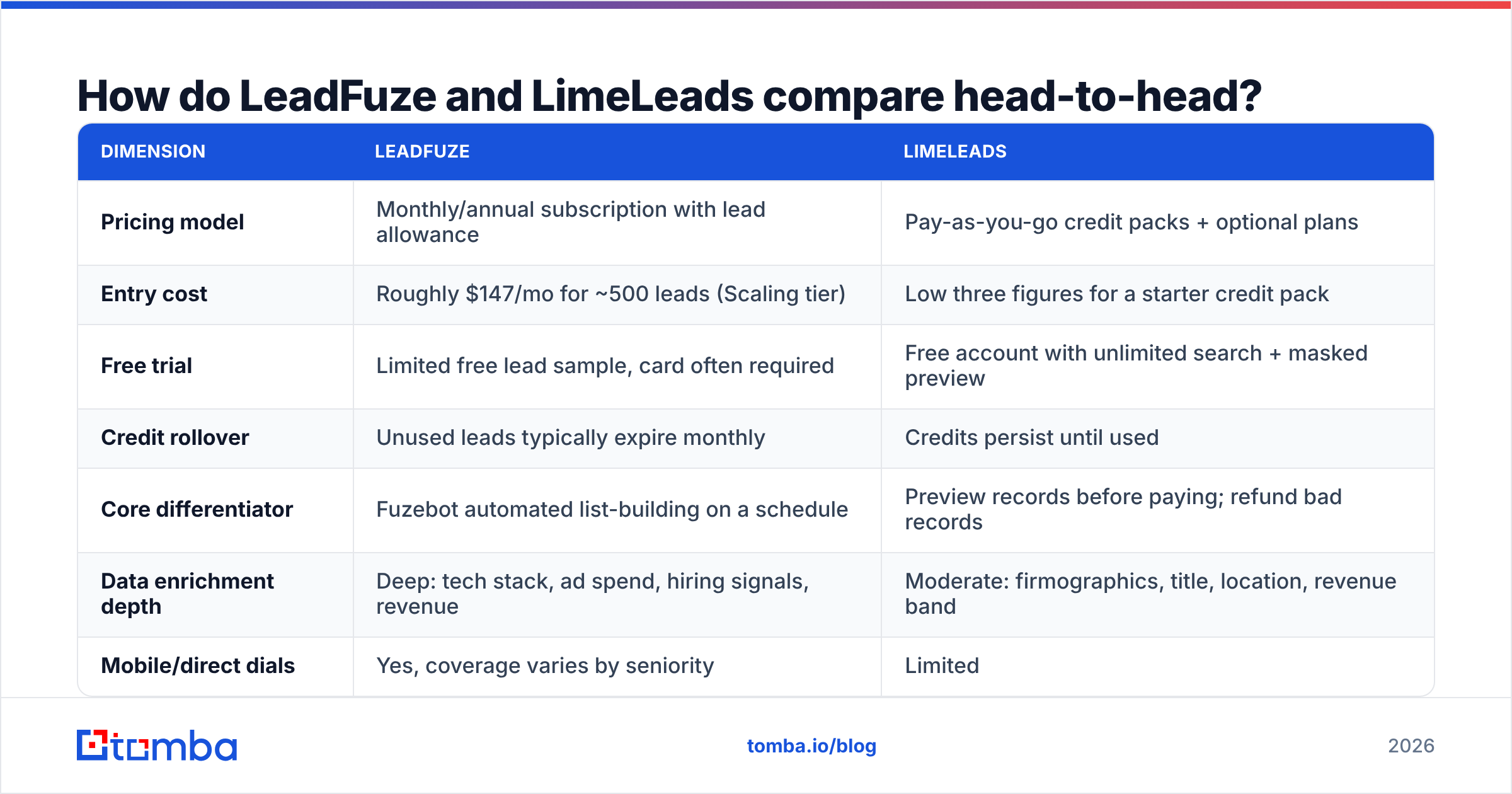
| Dimension | LeadFuze | LimeLeads |
|---|---|---|
| Pricing model | Monthly/annual subscription with lead allowance | Pay-as-you-go credit packs + optional plans |
| Entry cost | Roughly $147/mo for ~500 leads (Scaling tier) | Low three figures for a starter credit pack |
| Free trial | Limited free lead sample, card often required | Free account with unlimited search + masked preview |
| Credit rollover | Unused leads typically expire monthly | Credits persist until used |
| Core differentiator | Fuzebot automated list-building on a schedule | Preview records before paying; refund bad records |
| Data enrichment depth | Deep: tech stack, ad spend, hiring signals, revenue | Moderate: firmographics, title, location, revenue band |
| Mobile/direct dials | Yes, coverage varies by seniority | Limited |
| Native CRM push | HubSpot, Salesforce, Pipedrive, Zapier, sequencers | CSV export, Zapier, lighter native list |
| Email verification | Basic hygiene, no standalone verifier | Records checked at export, bad-record refund policy |
| Best for | Always-on outbound teams running weekly sequences | Bursty campaigns, agencies, one-off list pulls |
| Worst for | Seasonal senders paying for idle months | Teams wanting hands-off list automation |
The table hides one thing worth saying out loud. LimeLeads is much cheaper to start with. LeadFuze is much cheaper to scale with — if you actually use the allowance. An SDR team burning 1,500 contacts a month will pay less per lead with LeadFuze than with repeated LimeLeads credit packs. A founder pulling 300 contacts a quarter will find the opposite, badly.
Which one has better data quality?#
Neither vendor publishes an audited accuracy figure you should trust at face value. Be suspicious of any comparison post that quotes a precise percentage for both. What you can judge is how each one handles being wrong.
LimeLeads' preview-then-pay model helps here. You see the record set before you spend credits. That lets you check whether the filters returned the companies you expected — a check you cannot run on a blind CSV. LimeLeads also runs a bad-record refund process, which pushes some of the accuracy risk back to the vendor.
LeadFuze's edge is fresh signal rather than per-record guarantees. Fuzebot re-runs your persona all the time. So the contacts landing in your list this week are more likely to reflect this week's job changes and hiring. A static export pulled once and reused for six months cannot do that. Job-change decay is the quiet killer in B2B data. A large share of contacts change roles every year, so any list you bought in January is much worse by June.
Use this evaluation protocol, whichever you pick:
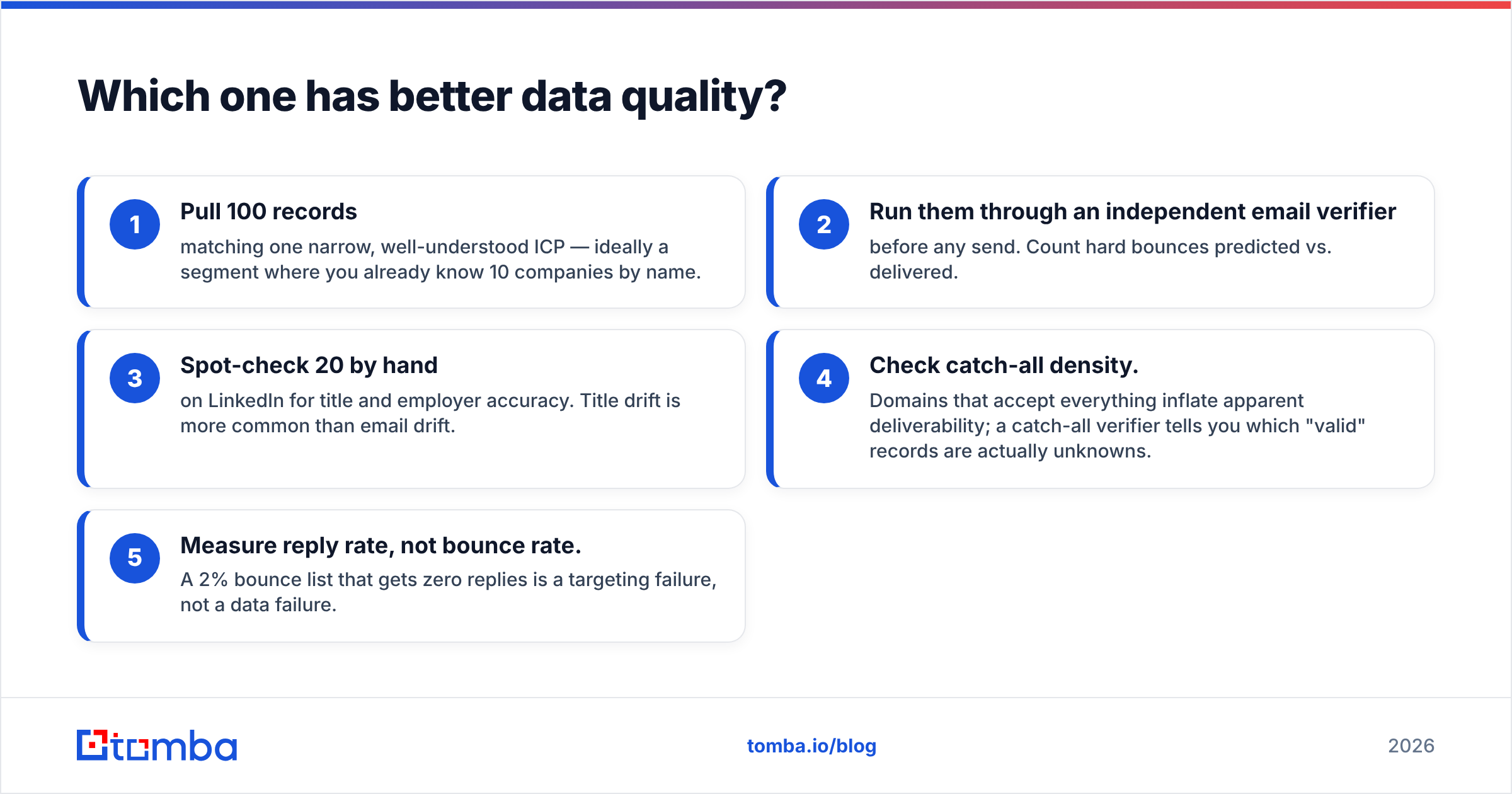
- Pull 100 records that match one narrow, well-understood ICP. Pick a segment where you already know 10 companies by name.
- Run them through an independent email verifier before any send. Compare predicted hard bounces with real ones.
- Spot-check 20 by hand on LinkedIn for title and employer. Title drift is more common than email drift.
- Check catch-all density. Domains that accept every address inflate apparent deliverability. A catch-all verifier tells you which "valid" records are really unknowns.
- Measure reply rate, not bounce rate. A 2% bounce list with zero replies is a targeting failure, not a data failure.
Run that test on both trials with the same ICP. You will get a defensible answer for your market in an afternoon. That beats any generic benchmark.
Is LeadFuze worth the subscription price?#
It depends almost entirely on how often you send.
LeadFuze's value is the automation loop. Set a persona once. Let Fuzebot top up the list, sync it to your CRM, and sequence. Does your team run outbound every week? Does someone spend 4-6 hours a week building lists by hand? Then the subscription buys back real payroll. The market-based search — finding companies by installed technology, hiring speed, or ad spend — is also a genuinely different filter set. Most cheap databases do not offer it.
Where it stops being worth it:
- Allowance expiry. Lead credits reset every month, which punishes stop-start prospecting. Two slow months wipe out a thousand leads you paid for.
- Per-seat friction. At some tiers, adding reps raises the cost faster than adding leads does.
- Overlap with tools you already own. If you already pay for Apollo, Clay, or a B2B database, you may be buying the same records twice. Check the overlap before you add a second subscription.
- Annual-contract pressure. The discounts are real. They also lock you in before you have tested the data on your own segment.
The honest framing: LeadFuze is priced as a workflow tool that happens to include data. If you only want the data, you are overpaying for Fuzebot.
Is LimeLeads better for small teams and agencies?#
For low or irregular volume, usually yes. There is one structural reason. Credits that never expire turn lead generation from a fixed cost into a variable cost, and variable costs are how small teams survive slow quarters.
The preview feature is the second reason. You can run unlimited searches on a free account and see result counts and company names before you pay. So you can check that a market exists before you spend anything. Most tools in this category work the other way: you pay first, then find out the segment holds only 40 real companies.
The trade-offs are real:
- No real automation. You search, you export, you upload. Nothing quietly refreshes your list the way Fuzebot does.
- Shallower intent and technology filters. You can slice by firmographics. You cannot easily slice by "companies that started running LinkedIn ads last month."
- Lighter integrations. CSV and Zapier cover most needs. A RevOps team that wants two-way CRM sync will feel the gap.
- Coverage skews. Like most mid-market databases, US coverage beats EMEA and APAC. Test your own geography.
Agencies often land on LimeLeads because client work is bursty by nature. You need 2,000 records for a new client this month and none next month. Paying a subscription across that pattern is a slow leak.
What about the option neither vendor mentions?#
There is a third path that both vendors skip: you may not need a list database at all.
A lot of B2B prospecting does not start with "give me contacts matching a filter." It starts with a list you already have. A conference roster. Companies scraped from a directory. A job-board pull. Your website visitors. A partner's customer list. In those cases you do not need a database subscription. You need a way to turn domains and names into verified addresses.
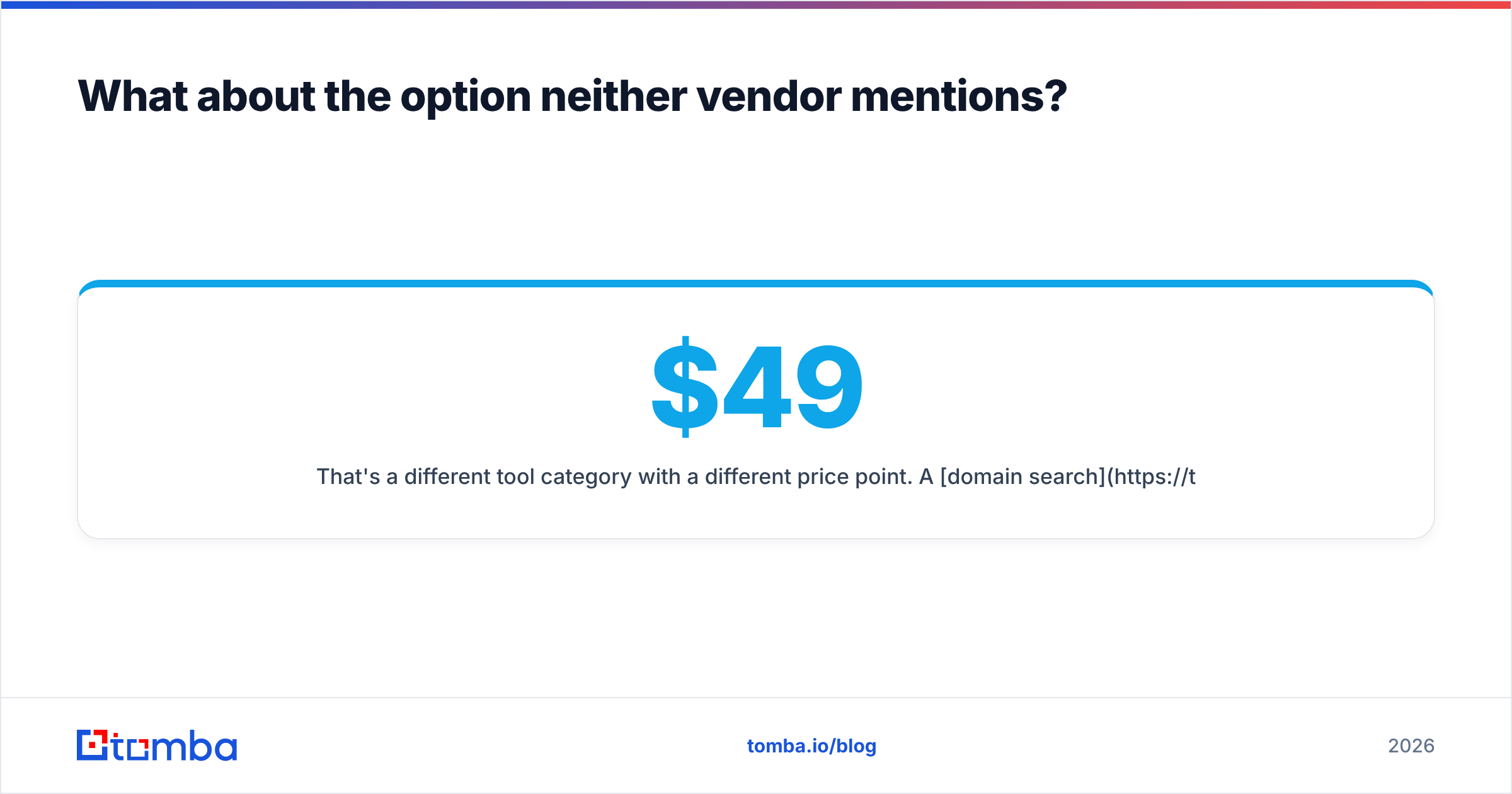
That is a different category at a different price. A domain search returns the known addresses and the email pattern for any company domain. An email finder takes a first name, last name and domain, and returns the exact address. Tomba's pricing starts free at 25 searches a month. Starter is $49/mo, Growth is $99/mo, and Pro is $249/mo — below LeadFuze's entry tier. It covers the "I have the company, I need the person" job directly.
The same logic applies to other tools in the space. BookYourData is a solid option if you want verified pay-per-lead lists with strong compliance documents, and it competes well with LimeLeads on the pay-as-you-go axis. The point is not that one vendor wins. It is that "list database" and "email finder" solve different problems. Buying the wrong category is the most expensive mistake in this whole decision.

How should you actually decide?#
Work through these in order. Stop at the first one that describes you.
- You already have target company domains. Skip both. Use a finder plus a verifier. It is the cheapest path by a wide margin.
- You prospect every week, at volume, with a dedicated SDR. LeadFuze. The automation pays for itself in hours saved, and you use up the allowance.
- You prospect in bursts — campaigns, client projects, seasonal pushes. LimeLeads. Credits that never expire match demand that comes and goes.
- You need technology or hiring-signal targeting. LeadFuze. LimeLeads does not compete on filter depth.
- You need to test a market before committing budget. Start with the LimeLeads free preview, then decide. It is the lowest-risk first step here.
- You need European or APAC coverage above all. Test both hard. Do not assume either one is enough. Regional coverage is where mid-market databases break down most often, and a regional specialist may beat both.
One note on process, whichever vendor you pick. Treat every export as raw input, not finished data. Dedupe it, because overlapping exports are common. Verify it. Then check email deliverability health on your sending domain before you push volume through it. The fastest way to destroy a warmed domain is to buy a list on Monday and blast it on Tuesday. Peer reviews on G2 are worth skimming for recent complaints about coverage in your segment. Patterns in the last six months of reviews tell you more than the star average.
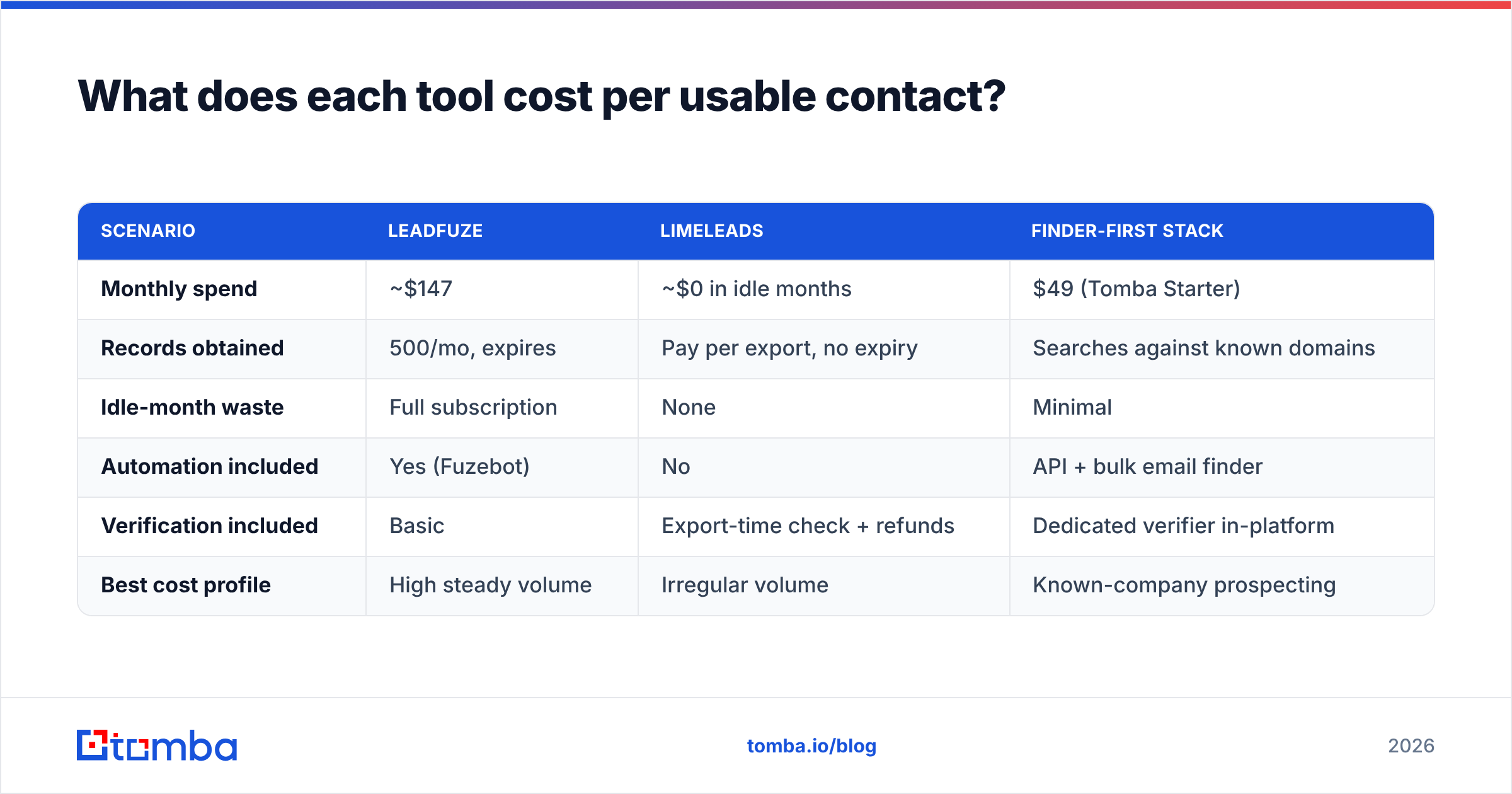
What does each tool cost per usable contact?#
Sticker price misleads, because neither vendor's raw export is 100% sendable. Here is the arithmetic that actually matters. Plug in your own verification pass rate.
| Scenario | LeadFuze | LimeLeads | Finder-first stack |
|---|---|---|---|
| Monthly spend | ~$147 | ~$0 in idle months | $49 (Tomba Starter) |
| Records obtained | 500/mo, expires | Pay per export, no expiry | Searches against known domains |
| Idle-month waste | Full subscription | None | Minimal |
| Automation included | Yes (Fuzebot) | No | API + bulk email finder |
| Verification included | Basic | Export-time check + refunds | Dedicated verifier in-platform |
| Best cost profile | High steady volume | Irregular volume | Known-company prospecting |
The column that wins for you depends on how steady your volume is, not how big it is. Teams keep overestimating how steadily they prospect. That is why subscription lead tools generate so much unused allowance.
Frequently asked questions#
Can I use LeadFuze and LimeLeads together? Yes, and some agencies do. They run LeadFuze for the always-on house list and LimeLeads for one-off client pulls. Dedupe across both before you send. Overlap in mid-market US data is large.
Do either of these replace an email verifier? No. Both apply some hygiene, but neither is a verification specialist. Run a dedicated verification pass on any list before a cold send. That matters most on catch-all domains, where "valid" really means "unknown."
Which has better GDPR and compliance documentation? Both publish compliance positions. Read them against your own counsel's requirements, not a blog's summary. If EU outreach is core to your motion, make documented lawful-basis handling a hard requirement, not a nice-to-have.
Is a database subscription necessary at all in 2026? Less and less, for teams whose targeting starts from named companies rather than open-ended filters. The database model earns its keep when you do not yet know who your accounts are.
So who wins, LeadFuze vs LimeLeads? Neither wins outright. LeadFuze wins on steady, high-volume outbound. LimeLeads wins on bursty buying and low-risk testing. If you already know your target companies, a finder-and-verifier stack beats both on cost.
Start with the addresses you actually need#
Most teams start prospecting from companies they have already named. If that is you, you do not need a list subscription to get moving. Point the Tomba Email Finder at a domain and a name, and get the verified work address back. You get 25 free searches a month to test it against your own ICP before you spend a cent. Pair it with the built-in verifier and run a 100-contact pilot this week. Let the results settle the LeadFuze vs LimeLeads question for you — not a vendor's pricing page.
Related guides#
Ready to find emails that actually work?
Join 150,000+ professionals who stopped guessing and started sending. Free credits on signup — no credit card required.
Get the Tomba newsletter
Practical outbound tactics and product updates — once every two weeks.
About the author