LeadFuze vs Ocean.io (2026): Which B2B Lead Tool Wins?
LeadFuze builds contact lists from filters. Ocean.io finds companies that look like your best customers. They solve different halves of the same problem — here is which one your team actually needs, and what it costs.
TL;DR
- LeadFuze is a contact-list builder. You set filters (role, industry, headcount, tech stack), it returns people with emails and phone numbers, and you export or push to your CRM.
- Ocean.io is a company-discovery engine. You feed it your best accounts, it returns lookalike companies scored against that pattern. Contact data is the second act, not the headline.
- They are not really substitutes. If you know exactly who you want, LeadFuze is faster. If you are still arguing about your ICP, Ocean.io earns its price.
- Both are expensive per verified contact. LeadFuze's entry tier is published in the $140–$150/mo range; Ocean.io is quote-only and typically lands in annual-contract territory.
- Most teams end up running a cheap verification and finder layer underneath either one, because neither vendor guarantees the email is still live on the day you send.
What is LeadFuze and who is it built for?#
LeadFuze is a B2B lead database with a search layer on top. You describe the person you want — "VP of Marketing, SaaS, 50–200 employees, US, using HubSpot" — and the platform assembles a list of matching people with work emails, phone numbers, company details and social profiles. Its "Fuzebot" feature keeps a list topped up automatically, adding new matches as they enter the database so you are not re-running the same search every Monday.
The product's centre of gravity is volume with filters. It is designed for an SDR team or an agency that already knows its target profile and needs 500 to 5,000 new names a month without manual research. The official LeadFuze site leans hard on that use case, and the G2 reviews echo it: praise for list speed and Fuzebot automation, complaints about credit burn and stale records in long-tail industries.
Where LeadFuze struggles is the upstream question. It will happily build you a list of 3,000 "VP of Marketing at SaaS companies." It will not tell you that the 40 deals you actually closed last year were all 80–300-person logistics companies with a recent Series B. That is the gap Ocean.io was built to fill.
What is Ocean.io and how does it work differently?#
Ocean.io is an account-intelligence platform. Its core mechanic is lookalike search: you upload a list of customers (or connect your CRM), and the engine analyses what those companies actually do — from website copy, product language, hiring signals and firmographics — then surfaces other companies that match that pattern. It is closer to a targeting tool than a contact tool.
The practical difference from keyword or SIC-code filtering is that Ocean.io reads the company's own description of itself. A filter for "manufacturing" returns a sprawl of unrelated businesses. A lookalike built on twelve customers who all sell precision components to automotive OEMs returns companies that describe themselves the same way, regardless of what industry code they filed under. Ocean.io's own documentation frames this as ICP discovery and TAM sizing, and that is honest positioning.
Contact data exists in Ocean.io, but it is thinner. You get decision-maker records attached to target accounts, not an unbounded people search. If your workflow is "give me 4,000 emails this week," you will find the contact layer limiting.

What are the core differences between LeadFuze and Ocean.io?#
Here is the split in plain terms:
- Starting point. LeadFuze starts with a person filter. Ocean.io starts with a company pattern. That single difference explains most of the others.
- Primary unit of data. LeadFuze optimises for contact records — email, phone, title. Ocean.io optimises for account records — firmographics, technographics, similarity score.
- Who buys it. LeadFuze is bought by SDR managers and agencies who are measured on activity volume. Ocean.io is bought by demand-gen and RevOps leads who are measured on pipeline quality and need to defend a target list.
- How you fail with it. With LeadFuze you fail by blasting a badly-targeted list and burning your domain. With Ocean.io you fail by building a beautiful account list and then having no reliable way to reach the people inside it.
- Contract shape. LeadFuze publishes monthly pricing with self-serve signup. Ocean.io routes you through a demo and an annual commitment.
- Enrichment depth. Ocean.io goes deeper on company signals; LeadFuze goes wider on people coverage.
How do LeadFuze and Ocean.io compare feature by feature?#

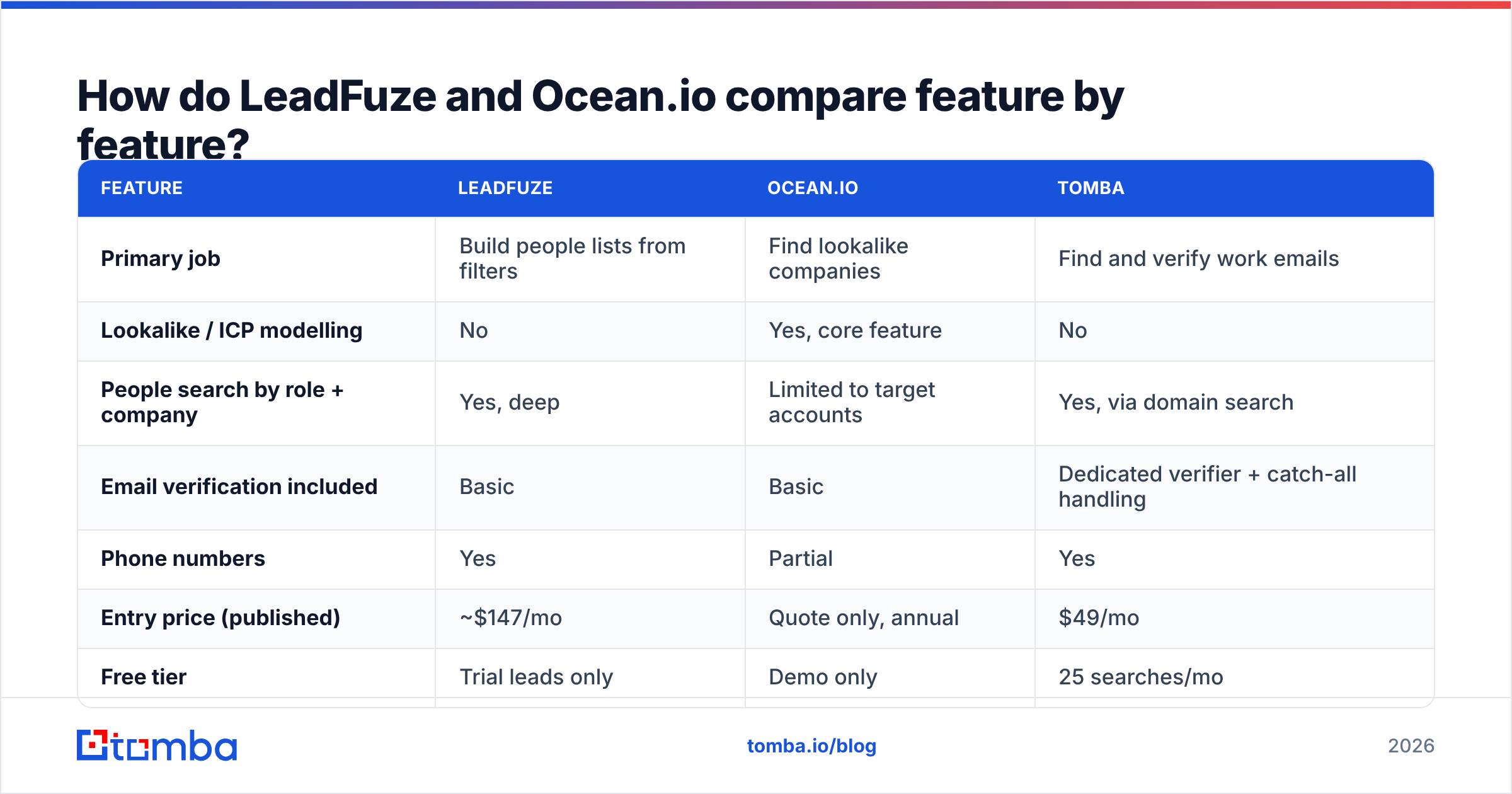
| Feature | LeadFuze | Ocean.io | Tomba |
|---|---|---|---|
| Primary job | Build people lists from filters | Find lookalike companies | Find and verify work emails |
| Lookalike / ICP modelling | No | Yes, core feature | No |
| People search by role + company | Yes, deep | Limited to target accounts | Yes, via domain search |
| Email verification included | Basic | Basic | Dedicated verifier + catch-all handling |
| Phone numbers | Yes | Partial | Yes |
| Entry price (published) | ~$147/mo | Quote only, annual | $49/mo |
| Free tier | Trial leads only | Demo only | 25 searches/mo |
| API access | Yes, higher tiers | Yes | Yes, all paid tiers |
| Self-serve signup | Yes | No | Yes |
| Best for | Volume outbound lists | ICP definition and TAM sizing | Accurate contact data at low cost |
Two things fall out of that table. First, LeadFuze and Ocean.io overlap far less than the "vs" framing suggests — they compete for the same budget line, not the same job. Second, neither is cheap if your only real need is "get me the right email address for this person at this company." That is a solved, commoditised problem, and paying a platform fee for it is how lead-gen budgets quietly balloon.
How accurate is the contact data in each tool?#

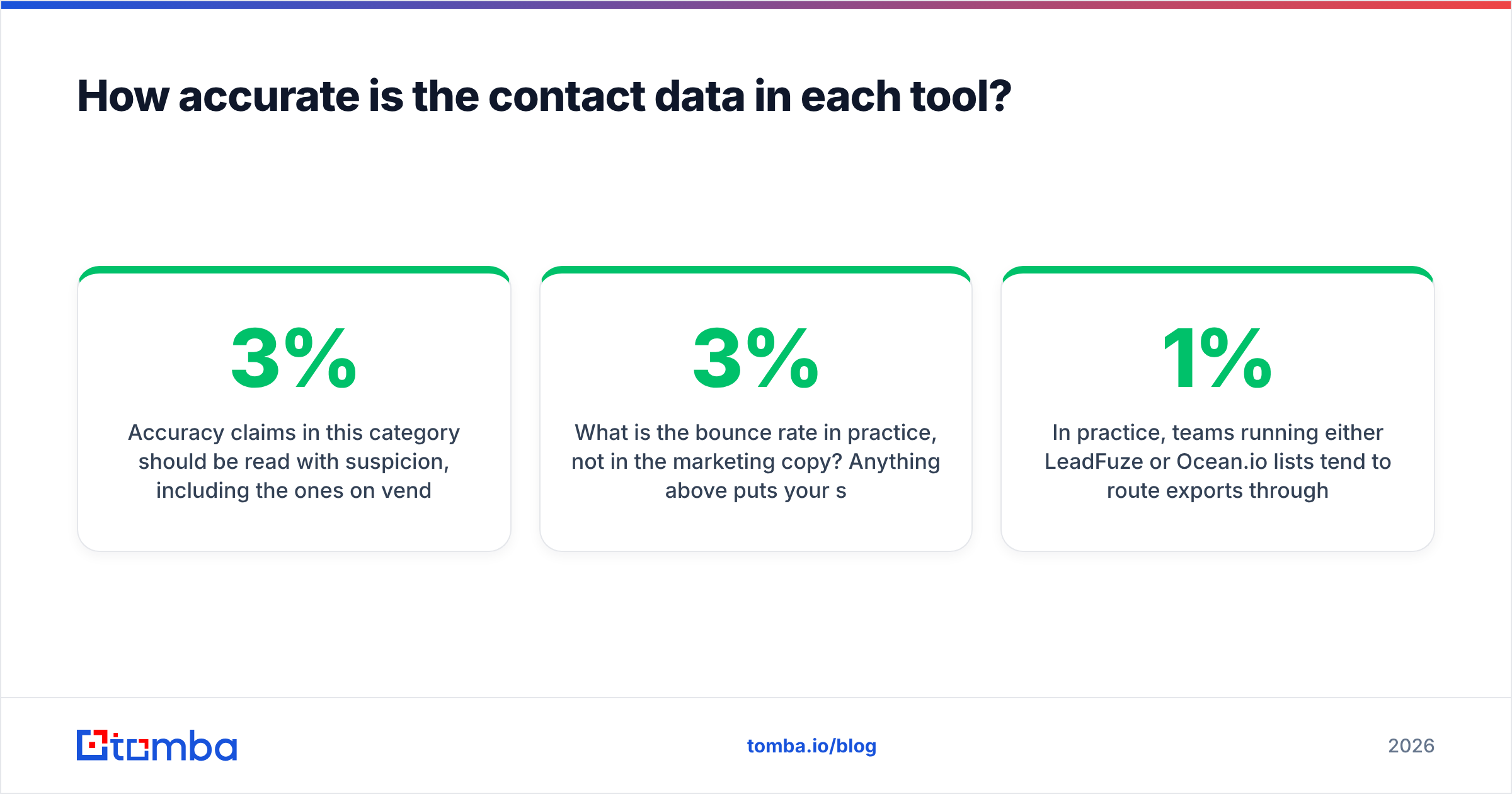
Accuracy claims in this category should be read with suspicion, including the ones on vendor homepages. Databases age at roughly 2–3% per month through job changes alone, so a record sourced nine months ago is a coin flip regardless of how it was validated at ingest.
What actually matters:
- Was the record verified at export time or at ingest time? Ingest-time verification is nearly meaningless by the time you send.
- How does the tool handle catch-all domains? A large share of mid-market B2B domains accept all mail, which makes standard SMTP checks return "valid" for addresses that do not exist. If a vendor reports high validity rates without explaining catch-all handling, the number is inflated. A dedicated catch-all verifier is the only honest answer here.
- What is the bounce rate in practice, not in the marketing copy? Anything above 3% puts your sender reputation at risk with Google and Microsoft's 2024-onward bulk sender rules.
In practice, teams running either LeadFuze or Ocean.io lists tend to route exports through a separate email verifier before the first send. It costs a fraction of a cent per record and it is the difference between a 1% bounce rate and a 7% one. Treat this as mandatory, not optional, whichever platform you pick.
What do LeadFuze and Ocean.io cost in 2026?#
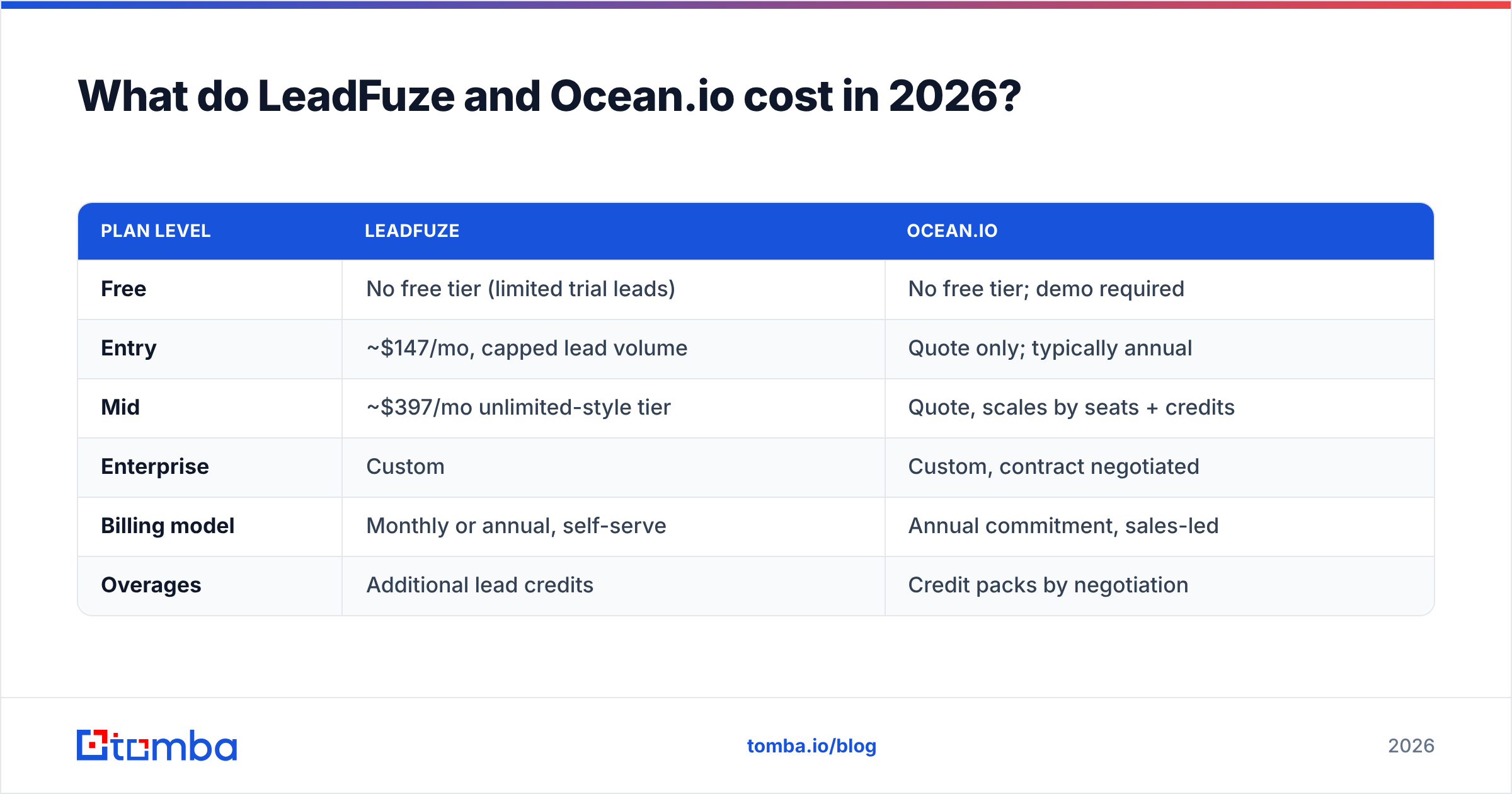
| Plan level | LeadFuze | Ocean.io |
|---|---|---|
| Free | No free tier (limited trial leads) | No free tier; demo required |
| Entry | ~$147/mo, capped lead volume | Quote only; typically annual |
| Mid | ~$397/mo unlimited-style tier | Quote, scales by seats + credits |
| Enterprise | Custom | Custom, contract negotiated |
| Billing model | Monthly or annual, self-serve | Annual commitment, sales-led |
| Overages | Additional lead credits | Credit packs by negotiation |
Pricing on both sides moves, and Ocean.io does not publish a full rate card, so confirm current numbers with each vendor before you budget. The structural point holds regardless of the exact figures: LeadFuze charges you for volume of contacts, Ocean.io charges you for quality of targeting, and both charge a platform fee on top.
Run the maths per usable contact rather than per month. A $147 plan that yields 500 leads, of which 340 are current and reachable, costs about $0.43 per usable contact. A $9,000 annual Ocean.io contract that produces a 600-account target list you actually work costs $15 per account — which is excellent if those accounts convert at 3x your baseline, and terrible if they do not.

Which one should you choose for your team?#
Pick based on which problem is currently costing you more money.
Choose LeadFuze if:
- Your ICP is settled and documented, and nobody on the team disputes it.
- You need consistent list volume every week and want Fuzebot to handle the refill.
- You are an agency running outbound for multiple clients with different filters.
- You want self-serve signup without a procurement cycle.
Choose Ocean.io if:
- Your win rate varies wildly by segment and you cannot explain why.
- You are sizing a TAM for a board deck or a new market entry.
- You run ABM and need a defensible target-account list, not a name dump.
- You have budget for an annual contract and a RevOps person to operationalise it.
Choose neither if: your actual bottleneck is finding and validating email addresses for accounts you have already identified. That is a much cheaper problem. A domain search against a list of target companies plus verification will cover it for a small fraction of either platform's cost, and you can run it from a spreadsheet.
Can you combine them, or is that overkill?#
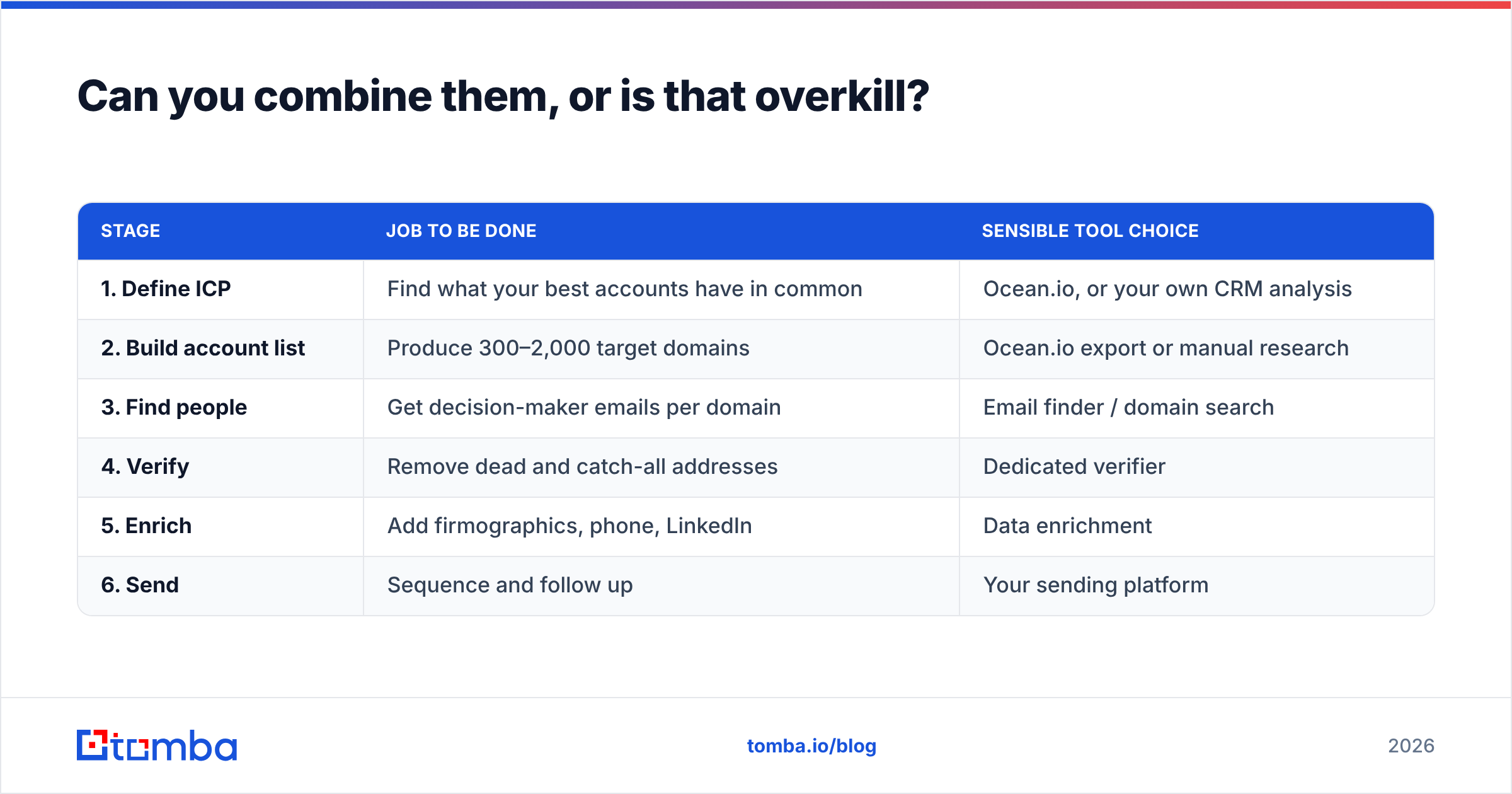
The combination that actually works is not LeadFuze plus Ocean.io. It is one targeting layer plus one contact layer, and the second layer should be the cheap one.
A realistic stack looks like this:
| Stage | Job to be done | Sensible tool choice |
|---|---|---|
| 1. Define ICP | Find what your best accounts have in common | Ocean.io, or your own CRM analysis |
| 2. Build account list | Produce 300–2,000 target domains | Ocean.io export or manual research |
| 3. Find people | Get decision-maker emails per domain | Email finder / domain search |
| 4. Verify | Remove dead and catch-all addresses | Dedicated verifier |
| 5. Enrich | Add firmographics, phone, LinkedIn | Data enrichment |
| 6. Send | Sequence and follow up | Your sending platform |
Buying LeadFuze and Ocean.io means paying two platform fees for steps that overlap at stage 2 and 3. Most teams that do this end up cancelling one within two quarters. If you want the targeting intelligence, buy Ocean.io and handle stages 3–5 with a per-credit tool. If you want volume, buy LeadFuze and skip the ICP platform until you have enough closed-won data to model against.
For step 3 and 4 specifically, running domains in batch through a bulk email finder is usually cheaper than the marginal credit cost inside either platform, and it gives you verification and enrichment in the same pass. Compare that against Tomba pricing — Free at 25 searches/mo, Starter at $49/mo, Growth at $99/mo, Pro at $249/mo — and the arithmetic on stage 3 is not close.
What do most buyers get wrong in this comparison?#
Three recurring mistakes:
Treating list size as the metric. A 5,000-name list with a 6% bounce rate and a 0.8% reply rate is worse than a 400-name list with a 1% bounce rate and a 6% reply rate — worse for pipeline and worse for your domain. Volume tools reward the wrong behaviour unless you cap send volume deliberately.
Buying ICP software before you have ICP data. Lookalike modelling needs a training set. If you have twelve customers and six of them came from a founder's network, the model will learn noise. Wait until you have 30–50 closed-won accounts with clean CRM data.
Assuming exported emails are send-ready. They are not, from any vendor. Job changes, domain migrations and catch-all configurations mean a meaningful slice of any export is dead on arrival. Verification is a separate step that costs pennies and prevents the single most expensive failure mode in outbound.
Verdict: LeadFuze vs Ocean.io#
If you forced a single answer: Ocean.io wins on targeting intelligence, LeadFuze wins on speed-to-list and price transparency, and neither wins on contact accuracy per dollar.
Ocean.io is the better purchase for a team that can act on better targeting — meaning you have the sales capacity to work a focused list well, and the analytical capacity to feed the model good data. LeadFuze is the better purchase for a team whose constraint is raw throughput and whose ICP is already proven.
If your honest answer is "we just need correct email addresses for people we can already name," you are looking at the wrong two products. Start with Tomba Email Finder: search by domain, name or company, verify in the same workflow, and pay per credit rather than per seat. The free tier gives you 25 searches a month to test coverage against your own target list before you spend anything — which is a far better evaluation method than reading anyone's comparison table, including this one.
Related guides#
// get started
Find, verify and enrich your first contacts today
Start on the free plan with 25 searches a month, then scale when your team is ready.
Free plan · No credit card required · GDPR & CCPA
// about the author